During the 1830s, the Afghan region became a theater of confrontation between rival empires, most notably the Russians and the British. Recent scholarship has detailed the events of this unfolding Great Game and those of the First Anglo-Afghan War (1839–42) (Dalrymple Reference Dalrymple2012; Hopkins Reference Hopkins2012). Far less attention has been paid to the reverberations of the Afghan War across British India. As they committed resources to Afghanistan in the months leading to the onset of this war, rumors of a Muslim uprising began to circulate within the ranks of the colonial administration and across well-established paths of commerce and migration. These rumors prompted a massive investigation by officials of the ruling East India Company. Curiously, the investigation was centered on that region of south-central India known as the Deccan. Why the Deccan and not cities of the north with heavy Muslim populations and in closer proximity to Afghanistan?
All paths of the investigation pointed to the Muslim princely state of Hyderabad. There, a man named Mubariz ud-Daula, the rebellious younger brother of the Nizam of Hyderabad, was believed to have collaborated with Russian and Persian armies to plan a rebellion that would drive the British out of India. Among his accomplices were rulers of two smaller and less-known Indo-Afghan regimes of the Deccan—Ghulam Rasul Khan, the Nawab (regional governor) of Kurnool, and Shah Abbas Ali Khan, the Jagirdar (holder of a jagir or land grant) of Udayagiri. During the course of its investigation, the Company had amassed convincing evidence of Mubariz's seditious designs. In June 1839, it imprisoned him at the Golconda Fort, where he spent the remainder of his life. The same did not hold, however, for Mubariz's alleged accomplices. Based on very thin evidence of their ties to Mubariz and his campaign, the Company imprisoned Rasul Khan and Ali Khan without trials and annexed their territories.
The focus of this article is on Kurnool and to a lesser degree Udayagiri.Footnote 1 How is it that events in the Afghan region could carry ripple effects that would impact these remote and obscure regimes of the Deccan, that too with scant evidence that their rulers had posed any real threat to the Company? The answer brings to mind Arjun Appadurai's (Reference Appadurai2006, 100) allusion to developments in the post 9-11 world, in which “faraway events” give rise to “proximate fears.” Appadurai describes a “cellular” international order in which migrants, connected world markets, and the Internet facilitate flows of resources and information across vast distances. Subverting the sovereignty of the nation-state, the cellular order gives rise to new degrees of anxiety and uncertainty, often expressed in localized fear of minorities.
Amid the buildup to the First Anglo-Afghan War, travelers circulating between India's Deccan, Central Asia, and Arabia evoked anxieties among East India Company officials of a coordinated attack. Some of these travelers came to the Deccan in search of employment or other assistance from the nawabs presiding over Muslim regimes. Others came to propagate Muslim reformist ideas. These migrants spread knowledge of happenings in other lands and often enmeshed their stories with the politics of local regimes. As “faraway threats” were thus translated into “proximate fears,” local stakeholders exploited these fears to advance their own agendas.
The cases of Kurnool and Udayagiri illustrate how discourses arising from a context of inter-empire rivalry could intersect with local politics far removed from the rivalry's epicenter (Alavi Reference Alavi2011, Reference Alavi2015). At Kurnool, local entrepreneurs attempted to oust Rasul Khan by drawing the Company's attention to the growing size of his military arsenal and by linking him to Mubariz ud-Daula's campaign. At Udayagiri, employees of the District Cutcherry (administrative office) similarly manufactured allegations of Ali Khan's collaboration in the alleged “conspiracy” (as it was called) as an arms provider. Local grievances, when joined to fears of a transnational alliance against British rule, sanctioned the Company's agenda to pacify and absorb these princely regimes.
It is tempting to suppose that during the Afghan War, Kurnool and Udayagiri, as regimes ruled by Indo-Afghan dynasties, were uniquely susceptible to colonial suspicions. This was not exactly the case. Through the eyes of colonial authorities, the primary agents who linked the affairs of Afghanistan to those of India's Deccan were those itinerant Muslim operatives whom they labeled—pejoratively and inaccurately—“Wahhabis.”
Strictly speaking, Wahhabis were followers of the Arabian Muslim reformer Ibn Abdul Wahhab (1703–92). They called for a return to a purer form of Islam grounded in the Qur'an and the Hadith. They also espoused jihad (struggle or holy war) against religious abuses and innovations and against regimes that impeded the practice of Islam. As numerous scholars have pointed out, the Muslim reformers who were most active in India during the 1830s were not the Arabia-based Wahhabis, but followers of the Indian reformer Sayyid Ahmad Barelvi (1786–1831), who called themselves the Tariqah-i-Muhammadiyah (Order of the Prophet Muhammad) (Ahmad Reference Ahmad1975; Hardy Reference Hardy1972; Metcalf Reference Metcalf1982; Pearson Reference Pearson2008). These reformers began their work among Afghan warriors near India's northwest frontier before extending their influence to other regions of India, including the Deccan. Colonial officials and Muslim opponents of the movement labeled Sayyid Ahmad's followers “Wahhabis.”
By the early 1830s, the Muhammadi movement did in fact make a convert of Hyderabad's Mubariz ud-Daula. After joining the movement in the early 1830s, Mubariz committed himself to distributing reformist literature, observing sharia law, and financially supporting Muhammadi missionary work. His ties to the reformers kept him informed about developments along the Afghan frontier. He and several reformist maulvis (teachers of Islamic law) also propagated jihadist ideas among the troops stationed at Secunderabad (the principal outpost of the Hyderabad army) in an attempt to incite them to rebellion. In response, authorities arrested Mubariz along with forty-six other men at Hyderabad whom they branded Wahhabis. Thereafter, the Company's investigation shifted to other nodes of the alleged conspiracy, including Kurnool and Udayagiri.
The Company framed its 1839 campaign in the Deccan in terms of a confrontation with Wahhabism, but clearly it could have found other excuses to absorb these smaller regimes. Since the turn of the nineteenth century, the Company had been committed to subduing princely states that had either threatened its sovereignty or presented potential sources of revenue from their lucrative lands. The conquests of Mysore (1799) and the Marathas (1818) were joined by the subordination of other princely states, including Hyderabad, by means of treaties of subsidiary alliance (Regani Reference Regani1986, 177–80).Footnote 2 Through a combination of alliance building and military operations against hostile warrior bands, the Company was determined to monopolize the use of force by eliminating threats posed by independent princely armies (Vartavarian Reference Vartavarian2014, Reference Vartavarian2016). It did not need the Wahhabi scare to legitimate its actions.
The Company's fixation on the transnational Wahhabi operative, however, performed a unique kind of work for a variety of actors. For the Company, it was a threat that not only “traveled” to various parts of peninsular India, but also could unite a wide range of personnel—within both Company and princely ruled territories—in a concerted endeavor to subdue “the enemy.” Fully aware of how responsive Company authorities had become to the Wahhabi threat, local actors found ways of exploiting the situation for their own ends. When rumors of a conspiracy reached the ears of local stakeholders in Kurnool and Udayagiri, they tried to bring down their nawabs by implicating them in Mubariz's grand scheme. Such rumors would have carried no purchase at all had it not been for the very real conflict unfolding in Afghanistan and the southward movements of Muslim reformers to places such as Hyderabad, Nellore, and Madras. As much as the fear of Wahhabi sedition had framed the Company's overarching investigation, far more profane and petty disputes at Kurnool and Udayagiri became the driving force behind events.
The Alleged Crimes of Ghulam Rasul Khan
The Company charged Rasul Khan with two distinct but related crimes: (1) communicating and collaborating with Mubariz ud-Daula, and (2) secretly amassing weapons and troops at his palace, in vast excess of what was permitted by treaty. The Company's investigation of Rasul Khan's alleged treason seems to have created a fertile climate for widespread criticism of his reign. Complaints from numerous factions within Kurnool would play an important role in legitimating the Company's actions against him.
At the forefront of those who brought charges against him were regional merchants and traders, who claimed that he had taken their merchandise on credit without ever paying them. A group of twenty-two cattle merchants, for instance, claimed that Rasul Khan had taken from them bullocks worth twelve thousand rupees. Instead of paying them, Rasul Khan placed them in confinement for bringing their grievance to the attention of the Company (Asiatic Journal and Monthly Register 1839b; IOR 1839g). In addition to his debts to merchants, Rasul Khan had to pay an expanding army consisting of Rohilla, Arab, and Pathan soldiers. Most of these soldiers had migrated from India's northwest frontier to Hyderabad to enter the Deccan's military labor market. Far from being motivated by any ethnic solidarity with the Nawab's family, these soldiers were chiefly interested in being paid for their services. The Nawab's failure to do so was a consistent source of grievance and provided grounds for mutiny or defection, as James Fraser, the British Resident at Hyderabad had often noted (NAI 1839f).
Another source of disaffection came from Brahmin residents of Kurnool. In a letter to the Governor of Madras, John Elphinstone, one group of Brahmins decried Rasul Khan's withdrawal of support for their inams, or tax-exempt land grants. Whereas Kurnool's previous Nawabs had contributed to the upkeep of inams and temples constructed on these lands, Rasul Khan had “sequestered all the inams belonging to the gods and Brahmins” (IOR 1839h, 1839s, n.d.a). A separate petition from another group of Brahmins charged Rasul Khan with “greatly oppressing” them by extracting revenue from their inam lands and using the money to purchase arms. They also accused Rasul Khan of the vilest forms of extortion. When Brahmins did not satisfy his demands for revenue, Rasul Khan, they claimed, seized their women and abused them (IOR 1839d, 1839e).
Authorities viewed it as no coincidence that this growing disaffection coincided with reports about Rasul Khan's “warlike preparations” and affiliation with Mubariz ud-Daula (IOR, n.d.a). At least for a time, officials responded to these allegations skeptically. They were inclined to believe that Rasul Khan's local enemies were manufacturing rumors that would prompt the Company to oust him from power.Footnote 3 Members of his own family who opposed his accession to the masnad (throne), a range of unpaid merchants or soldiers, or a number of disenfranchised Brahmins could have been responsible for spreading rumors that implicated Rasul Khan in Mubariz's conspiracy.
In the months following the June arrest of Mubariz ud-Daula, however, the posture of the Company shifted from measured skepticism to fervent conviction about Rasul Khan's involvement. Prior to Mubariz's arrest, the Company had detained a number of Muslims in Nellore and Hyderabad. In their oral testimonies, several of these detainees described their visits to Kurnool and Udayagiri. Two of them, Muhammad Abdullah and Shaikh Abdul Ruzzaq, were Arab travelers from Mecca. Muhammad Abdullah came to India in hopes of receiving financial support from prominent Indian nawabs to pay off his debts. Learning that the Nawab of Kurnool was a “very liberal man,” he visited Kurnool and later Udayagiri to solicit funds (IOR 1839c).
Shaikh Abdul Ruzzaq also visited Kurnool and Udayagiri. He did so carrying a letter, which officials claimed was from the Sharif of Mecca because it carried his seal. The letter did little more than introduce Abdul Ruzzaq as a person possessing a sound grasp of the Qur'an. It exhorted the recipient of the letter to care for him and his colleagues, invoking the charge of the Prophet Muhammad, “whoever [would] assist such brethren” will be blessed by God. In an alarmist manner, T. V. Stonhouse, Nellore's Principal Collector, declared the letter to be indicative of something far more insidious:
The solemn nature of this appeal is indicative of its dark designs to excite the religious passions of the Mussalmen in a common cause, and to effect this they have gone to the fountain head—the Sharif of Mecca, the first of their holy men at the Shrine of the Prophet. (IOR 1839f)
Stonhouse never questioned the letter's authenticity. He assumed that as an Arab migrant, Abdul Ruzzaq had no business passing through remote regions of the South, unless in fact he was doing so to spread disaffection toward the British. What made Abdul Ruzzaq's movements particularly alarming were the months he had spent in Hyderabad in the home of Hyder Sahib, an alleged Wahhabi, and the elaborate description of the conspiracy that Ruzzaq provided to officials. He also had spent considerable time (fourteen days) at Kurnool, before moving on to Udayagiri (IOR 1839b). Only after the imprisonment of Rasul Khan and Ali Khan, however, did officials learn that the seal on Abdul Ruzzaq's letter (purportedly from the Sharif of Mecca) was inauthentic and that the letter had been forged. By forging a letter from the Sharif of Mecca, Abdul Ruzzaq had merely sought to enhance his reputation and ability to solicit financial assistance from nawabs of the Deccan.
Such accounts of “suspicious foreigners” visiting Kurnool fanned concerns about Rasul Khan's participation in the conspiracy. In spite of the Company's rising determination to confront the Nawab, officials consistently lamented their reliance upon mere hearsay, and that too from persons with highly questionable motives. The colonial state was placing more and more emphasis on documentary evidence as the sine qua non of proof and legitimacy. According to Bhavani Raman (Reference Raman2012, 16–17, 137), the fixation on documentation created a parallel domain of mimicry and forgery, which was clearly evident in both Kurnool and Udayagiri. The Company was looking for documents in the form of letters, which had allegedly passed between Rasul Khan and Mubariz ud-Daula, letters that clearly disclosed his allegiance to Mubariz and his treasonous intentions (TNA 1839b).
In August 1839, James Fraser, newly appointed as British Resident at Hyderabad, was convinced he had found such a letter (Fisher Reference Fisher1991).Footnote 4 In fact, this would be the only letter the Government would locate that linked Rasul Khan to Mubariz ud-Daula and his campaign. Fraser told the story of an elderly woman who traveled from Kurnool to Mustaidpura, a suburb of Hyderabad, carrying a letter from Rasul Khan to Mubariz ud-Daula. The woman arrived from Kurnool “having the appearance of a religious beggar” and wearing a ta'wiz (amulet) around her left arm. Because the ta'wiz bore the name of God, it could not, in her mind, be defiled. Weakened by her extreme illness, she asked in a low, broken voice to be attended to by a pirzada, or a local Sufi cleric. Making “a faint sign with her head to her left arm,” she asked the cleric to remove the ta'wiz and cast it into a well. After her death, however, the cleric took the ta'wiz to the home of three cousins (who were brothers) of the Nawab of Kurnool who lived nearby. These brothers, according to Fraser, had fled from Kurnool to escape Rasul Khan's tyranny and had since lived as pensioners of the Hyderabad minister, Chandulal, who was known for his loyalty to the Company (NAI 1839g). When word of this letter reached Fraser through another cleric named Mahdi Ali, Fraser summoned the brothers to the Residency.
According to Fraser, the elderly woman was a “procuress in the nabob's pay, and … had in former occasions come to Hyderabad for the purpose of purchasing women for his zenana” (NAI 1839g). The letter was from Rasul Khan to Mubariz ud-Daula, essentially declaring his own readiness for war. The translation was riddled with ambiguous transliterations of Persian phrases, rendered by Fraser's translator:
Your supplicant is prepared with arms and materials for war and is ready. His troops and treasure will be collected in a short time, because many of their [*probably the Company's] villages are rich [or thriving, abundant] … and very near my frontier. Having understood [or satisfied yourself “kusuwwur formooda”] that most of the dependents [*meaning probably the sepoys] of the infidels have adopted the established religion of the ruler of the Faithful (Raes ul Muissulmeen) it will be highly proper for you at all events to come out before the appointed time. Do not delay, for the enem[ies] are waiting. As a measure of precaution the inferior old woman, who is perfectly trustworthy, has been dispatched with this note.… (NAI 1839g)
What can we glean from Fraser's account of the letter, beyond perhaps his penchant for exotic anecdotes? The intercepted letter from Rasul Khan provided the Company with only a small piece of evidence concerning his allegedly seditious plans. And yet, the Company relied heavily upon this small scrap of paper.
It was only after Mubariz ud-Daula's arrest in June 1839 that Fraser, with the cooperation of the Nizam and his minister Chandulal, assembled a Commission of Enquiry to investigate the nature and extent of the Hyderabad-based conspiracy. The Commission was convened in June 1839 and concluded in March the following year (roughly five months after the Company's siege of Kurnool). Fraser was determined to comprise the Commission of both British and Muslim members. For him, the Commission involved more than a criminal investigation. It was also a public relations project that drew sharp distinctions between Indian Muslims and “Wahhabis,” and by extension those who were and were not loyal to the British (Regani Reference Regani1986, 253–62).
As the only piece of written evidence linking Rasul Khan to Mubariz, the Commission investigated each and every aspect of Fraser's account of the letter. After having interviewed numerous witnesses and consulted experts who examined the seal of the letter, the Commission concluded that the letter was a forgery and that the brothers had most likely invented the story of the woman and the amulet. The Commission somehow managed to acquire the original seal from a seal maker in Kurnool. They hired an expert to examine its authenticity. Having scrutinized the impressions that the seal made on the paper, the expert concluded that the seal was inauthentic. From this, the Commission concluded that the letter had been forged.
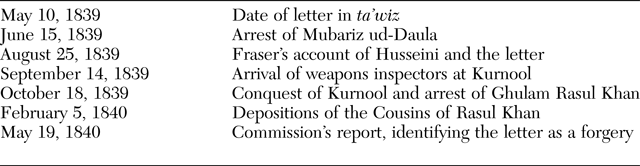
The dating of the letter itself, Fraser's account of it, Mubariz's arrest, the conquest of Kurnool, and the final report of the Commission concerning the letter's contents are shown in table 1. What this timeline reveals is that the Company had ultimately attacked the Kurnool Fort under false information, that is, long before Fraser's account of the letter could be subject to any scrutiny. Only after Rasul Khan's imprisonment did the Commission of Enquiry conclude that the letter was forged and the entire account was a fabrication (TNA 1839a).Footnote 5
Timeline of the case against Ghulam Rasul Khan.

On account of these findings, the Commission drew this carefully worded conclusion:
… that the Nawab of Kurnool possessed arms and ammunitions. There is no doubt that the witnesses had given statements of cooperation between the Nawab of Kurnool and Mubariz ud-Daula, but all of them are without written proofs. (Hyderabad State Committee 1992, 152)
The Commission concluded that Mubariz ud-Daula was in communication with other seditious princes and zamindars (landlords), but now was far more cautious in grouping Rasul Khan with this cohort. Strikingly absent from their analysis was any discussion of Rasul Khan's Wahhabi sympathies. They devoted far more attention to his arms accumulation.
In their final report, two members of the Commission, Captains George Hutton and Duncan Malcolm, made explicit what others had only intimated. They claimed that a conspiracy against Rasul Khan, not any involvement of his in the Wahhabi conspiracy, is what explains the content of the letter. The report implicated the brothers who appeared before Fraser along with the cleric, Mahdi Ali, in a scheme conducted with “skill and cunning” to bring false charges against Rasul Khan (IOR 1840b).
Somehow, these conclusions of Hutton and Malcolm did not alter the standard, official pronouncements that worked their way into Government gazetteers, manuals, and other publications. The official position downplayed Rasul Khan's Wahhabi ties (for which there was no evidence), but interpreted his accumulation of weapons as indicating his rebellious intentions and legitimating the Company's military intervention (Chetty Reference Chetty1886, 38–41; Hunter Reference Hunter1908, 39).
At least one publication, however, presented an alternative interpretation of what Rasul Khan was intending through his amassing of weapons:
Subsequent events tended to show that there was no real intention on the part of the Nawab to place himself in a warlike opposition to the British Government. He was a man of violent and ill-regulated passions and had conceived a fancy for making military display, a fancy, which was encouraged by his minister, Namdar Khan, who obtained from his own relatives very profitable contracts to supply gunpowder, lead, and other stores.… The Nawab's family and adherents and the townspeople were all together at feud with their ruler as to his proceedings and it is quite absurd to suppose that any military operations were contemplated. (Walker and Walker Reference Walker and Walker1855, 71)
When coupled with Hutton's conclusions, this report reveals that there was no consensus among Company officials concerning Rasul Khan's capacity or motives for rebellion. Public knowledge of the events associated with the conquest of Kurnool similarly lacked consensus. A closer examination of the events concerning Rasul Khan's arms buildup reveals the cloud of misunderstanding and apprehension that marked the Company's proceedings.
The Company's 1839 campaign against Kurnool signaled its shift to a far more grave assessment of the threat posed by Rasul Khan. Fears of a Wahhabi conspiracy when coupled with rumors of his “warlike” preparations demanded decisive action. The Company responded with a massive military operation, which it timed to coincide with the arrival on September 14 of two weapons inspectors, Thomas Law Blane and Lieutenant Colonel Scudamore Steele. The Company sent these men—who formed part of an official “Kurnool Commission”—several weeks ahead of the army to examine the size and strength of Rasul Khan's arsenal. If the inspectors were to experience Rasul Khan or his guards as noncompliant in their search of his fort complex, the arrival of the Company army would convey a clear ultimatum to the Nawab, namely to comply with the inspections or face imprisonment and the forfeiture of his regime (IOR, n.d.c).
Early on, the inspectors appear to have reported that a military advance on Kurnool would be unnecessary on account of the Nawab's cooperation (IOR 1839k, 31). The Nawab had requested his brother, Khadir Khan, and his diwan (prime minister), Namdar Khan, to guide the inspectors to various places within the fort where he stored his weapons. The inspectors claimed to have been received with “great civility” by these men. They noted the storage of cannon, guns, and other war materials kept in the fort, and checked their quantities against inventories provided in earlier inspections (IOR 1839j).
The initial experience of compliance, however, would soon take a turn for the worse. The inspectors developed suspicions that these escorts had shown them only a small portion of Rasul Khan's arsenal. They insisted that Rasul Khan allow them to search the fort “wherever they pleased.” As they proceeded to do so, they discovered massive quantities of gunpowder, mortar, pistols, and other materials, hidden in the fort's zenana quarters (which housed the Nawab's harem). This alarmed the inspectors enough to insist—now with the backing of the Company army—that Rasul Khan surrender his fort (IOR, n.d.d). The Nawab and his family vacated the fort without resistance and relocated to a dargah (shrine) a mile away, in the village of Zorapur.
Records of the events that followed reveal important details about the Company's evolving narrative concerning Rasul Khan and his Rohilla guards. Most notably, the focus shifted from his Wahhabi ties (vis-à-vis his correspondence with Mubariz and hosting of “suspicious foreigners”) to his warlike accumulation of arms for the purposes of launching his own rebellion, and finally to details about his personality. Various accounts of the confrontation portray Rasul Khan as someone ruled by an erratic temperament and uncontrolled passions. His idiosyncrasies, not his ideology or any rational self-interest, are what guided his behavior. Rasul Khan's Arab and Rohilla personal guards emerge as mercenaries who were fundamentally guided by financial considerations, not by any ethnic bond to their fellow Pathan Nawab. This profile of the Nawab and his guards diminishes any sense that he had joined out of conviction the Wahhabi conspiracy or was ideologically opposed to British rule. Ultimately, it was this profile of an indulgent, irrational prince—not that of a “Wahhabi”—that most decisively informed the Company's attack on the fort and annexation of Kurnool.
J. T. Pears, the Commanding Engineer of the Company's Kurnool expedition, provides in his 1839 journal a revealing first-hand account of the Company army's confrontation with Rasul Khan. His entries describe a six-week military operation involving as many as six thousand soldiers (NAI 1839e).Footnote 6 Their mission, in his view, was to dislodge a troublesome Afghan prince, whose regime lay curiously situated in the middle of India, surrounded by Hindus and propped up by foreign mercenaries. Pears described Rasul Khan as a “vagabond” who was “intriguing” foreigners in the Afghan region. The nabob, Pears recorded, “has been filling his place with arms and fighting men, Arabs, Afghans, and even Turks! And now we are going to smash him” (IOR 1839k, 5).
Clearly, intelligence concerning Rasul Khan's involvement in a transnational confederacy profoundly shaped Pears's sense of mission. This intelligence helps explain the amount of force the Company deemed necessary to confront the supposedly volatile prince. The Company army treated reports of Rasul Khan's military accumulation seriously enough to enter Kurnool with an overwhelming display of force, detailed by Pears in the same swashbuckling tone (IOR 1839k, 18).Footnote 7
Pears also described Rasul Khan as a prince who had used his high degree of autonomy from British oversight to mismanage his regime and indulge his own obsessions. This observation of his concurred with those of the weapons inspectors who portrayed Rasul Khan as a prince who was fundamentally guided by passions for women, cock fighting, and weapons.
With the assistance of the army, the inspectors scoured the fort for hidden arms. As they began to unearth masses of military stores, they also discovered on the premises “some thousand fighting cocks,” some of the finest, in fact, that Pears had ever seen. The escorts, Namdar Khan and Khadir Khan, had initially steered Blane and Steele away from the zenana to ensure the privacy of the women. Later, the inspectors observed several Company soldiers knocking a hole through a wall of the zenana. Unexpectedly, they encountered several frightened elderly women, who, according to Pears, “declared the world was turned upside down when men dared to break into a zenana full of ladies” (IOR 1839k, 35). Colonel Steele comforted the women by assuring them that “the British officers were all the ladies could wish, gentle and polite,” after which, he reported, the women retired to their quarters.
Upon completing their inspection, the inspectors concluded that Rasul Khan had converted the gardens, the zenana's quarters, and the precincts of his fort into “one vast arsenal” (NAI 1839c). They urged the Government to consider “strong measures” that could involve “the entire and absolute resumption of the jagir of Kurnool” by the Company (NAI 1839a, 1839b). An official account of the weapons found in Rasul Khan's fort was supplied by Edward Armstrong, who headed the Madras 34th Light Infantry. He described a wide variety of weapons and other war materials found in the Fort:
The gardens of his palace and zenana are covered with foundries for casting guns, shot and shells, and pieces of ordnance are to be found in every stage of preparation. Two of the mortars, beautiful brass pieces, are probably the largest in the world.… The various buildings in the palace and zenana are turned into vast magazines of every imaginable weapon, from guns of the heaviest caliber to double-barreled pocket pistols. In one shed, which had the entrance bricked up to appear a dead wall, we found forty-five brass guns, from two to six pounders, mounted on new carriages, while in the same place there were seventy or eighty new carriages for guns that were buried near the shed.… Ranges of godowns of great extent are filled with powder, sulfur, saltpeter, and other materials. (Fraser Reference Fraser1885, 57; IOR 1839a)
Much of what Pears and his fellow soldiers had found lay buried beneath sheds and other structures of the fort (IOR 1839k, 35–36). This he claimed is why the inspectors had initially missed them. The secrecy and deception employed by the Nawab and his escorts further legitimated the Company's massive intervention.
The Kurnool Commission eventually reported to the Government that the weapons, though sizeable in quantity, were far from being ready for war. More importantly, the report suggested that Rasul Khan's expenditure on arms left him little reserves from which to pay his soldiers. The Nawab had increased the number of Arab and Rohilla troops in his army, but had decreased their pay by nearly two-thirds. “It may therefore we think be safely pronounced,” the report concluded, “that the Nawab's troops were never in a less efficient state than they have been for the last few years” (IOR 1839m). This description is a far cry from what was contained in the forged letter, which described Rasul Khan's readiness for war upon receiving Mubariz ud-Daula's command.
This report reinforced the sense that the Nawab, in spite of this impressive accumulation, posed no real threat to the Company. Pears too had noted that in light of the poor state of his gunpowder and other materials, “one shot would blow them all into the river” (IOR 1839k, 37). Ultimately, the Commissioners were less concerned about the actual capacity of Rasul Khan's arsenal than they were about its deliberate concealment from the inspectors.
On October 14, a full month after the arrival of the weapons inspectors, Rasul Khan provided the Company with a lengthy, written explanation of the state of his arsenal. The most striking feature of his letter was its sense of history. The Nawab began by lauding the Company for its honesty and commitment to honoring its agreements. He drew attention to the fact that his fort, land, and properties were grants from the Company. Having turned over his fort, children, and zenana to the care of the Company, he trusted that the Company would eventually restore them. As for the weapons he accumulated in his fort, the Nawab explained that he had done so not out of any ill intention, but purely out of his “fondness for military display”:
The preparation of these military things was at first made from my fondness for military display and out of my sincerity and fidelity, under the impression that all of my property is the Honorable Company's. I call God to witness that I considered that … these things were necessary to my reputation as a soldier. Notwithstanding this, if I had received a single letter from Mr. Robertson [the District Collector at Bellary] directing me not to make such preparation, I would never have done it. Upon this point there is no written agreement between us. And certainly upon a point of such consequence there should have been some written voucher. (NAI 1839h)
To this, Rasul Khan added that he was far too weak to take on the might of the Company's army. If powers far greater than him, such as the Nizam of Hyderabad, remained loyal to the Company, why should anyone suppose that he, as the head of a much smaller state, would be so bold as to launch a rebellion? “There is nothing in religion or in this world,” he wrote, “so desirable as honor and respect” (NAI 1839h, 73). Rasul Khan concluded by explaining that the possession of troops was a longstanding tradition in his family. Rohillas, Pathans, and Arabs had long been in the service of the Kurnool Nawabs. Their service to Rasul Khan did not signify rebellion, but adherence to family tradition (NAI 1839h, 74).
As Rasul Khan proceeded in this line of defense, it is not easy to determine from his tone whether he was being naïve or clever. As if unaware of the gravity of the charges being leveled against him, Rasul Khan boldly declared his intention to proceed to Mecca “with some companions, relations and women.” For these he requested that the Company issue passports (NAI 1839h, 70). The Commissioners, of course, rebuffed this request, regarding it as a diversion from their immediate demand for full compliance.
Rasul Khan's diwan (prime minister), Namdar Khan, would later attempt to make a case for the Nawab's insanity. Not only did he use this insanity plea to explain Rasul Khan's reckless accumulation of arms, but he also used it to explain his ambitions to wage war against the army of Egypt's Muhammed Ali Pasha during his planned pilgrimage to Mecca (NAI 1839d). Throughout his entire narrative, Namdar Khan insisted in the most earnest manner that Rasul Khan held no ill feelings toward the Company and maintained no contact whatsoever with Mubariz ud-Daula. He urged the Commissioners to recognize the antiquity of Rasul Khan's family. It was “the last of the high Pathan houses in southern India.” He pleaded that the Company exert its influence so that “so old and noble a family might not be deprived of their inheritance through the fault or misfortune of one member of it” (NAI 1839d).
The Commissioners dismissed the claims of Rasul Khan and his minister as disingenuous and misleading. If his stores were due to his “fondness for display,” why did he conceal them in the zenana? Moreover, even if the maintenance of a military was central to the traditions of Pathan ruling families, the Nawab had taken this tradition to an unacceptable extreme: “You have collected cannon and stores upon a scale greatly beyond the wants of your jagir and with an extravagant waste of your revenues” (NAI 1839c). In light of the Nawab's efforts to conceal his arsenal from the Company, the Commissioners declared that they would resume “on behalf of the British Government the territory of Kurnool, and to require [Rasul Khan] to deliver [himself] up” (NAI 1839c).
For the Nawab to “deliver himself up” to the Company was no simple affair. The Rohilla and Arab troops who had guarded him at the Zorapur dargah refused to allow him to do so. The Nawab himself had noted their loyalty to him. They would do whatever he would do, including accompanying him to Mecca (IOR 1839l). As much as the Nawab wished to present his guards as being motivated by a sense of loyalty, the events that unfolded indicate that their chief concern was financial. They wanted to be paid for their services—either by the Company or the Nawab himself—before turning him over. This demand for payment (whether by the Nawab or by the Company), not any defiance of Company rule per se, is what led to the eruption of violence. After a series of exchanges facilitated by the Commission's munshi (Persian translator), it was Shah Wali Khan, the Nawab's chief Rohilla guard, who refused to turn the Nawab over to the Company because of his disbelief that he and his men would ultimately be paid their arrears.
From the fighting that ensued, two European officers and ten privates were killed, along with eleven sepoys. Many more were reported as wounded or missing. The Nawab's troops suffered greater casualties. After the fighting had ceased, the Company arrested the unharmed Nawab along with ninety-eight of his soldiers, many of whom were wounded (Spectator 1840, 57).
The Company made Ghulam Rasul Khan a state prisoner at the Fort in Trichinopoly (then known as Trichy, now as Tiruchirappalli). From prison, Rasul Khan continued to press the case for his own innocence. He described how he had every intention of disclosing the full extent of his arsenal to the inspectors, but that his minister, Namdar Khan, had deceived him by not showing the inspectors everything (IOR 1839q). Rasul Khan made no mention of the contracts that Namdar Khan had allegedly secured for himself with dealers of weapons and munitions, a report that circulated long after the fact without substantiation.
In July 1840, an Arab prisoner murdered Rasul Khan as he was leaving a chapel service within the prison complex. According to Arthur Hathaway, the Magistrate of Trichinopoly, the Arab murdered him in retaliation for Rasul Khan having taken his wife and placed her in his harem (IOR 1840a). Other reports, however, explain the murder in terms of his alleged conversion to Christianity in prison (Museum of Foreign Literature 1841). Clearly, official reports concerning his death are as conflicted as those concerning his involvement in the conspiracy.
A Diamond in the Trough
In Udayagiri, a region located in Nellore District (150 miles to the southeast of Kurnool), another Indo-Afghan ruler, Abbas Ali Khan, suffered a similar fate. For several generations, Ali Khan's family had been the hereditary holders of the jagir (land grant) of Udayagiri. Disputes between the Company and the family over the payment of the sizeable tribute owed to Company resulted in the Company's decision to reduce the jagir to a life grant. Because of this, Ali Khan would be unable to pass on his jagir to his progeny. His accusers speculated that the aged and infirm Ali Khan had joined Mubariz's campaign in order to secure title to his jagir on a more lasting basis under a new, Muslim regime.
The Company accused Ali Khan of hosting “suspicious foreigners” at his palace (for example, Muhammad Abdullah and Shaikh Abdul Ruzzaq) and communicating by letter with prime suspects in the alleged Wahhabi conspiracy. More importantly, they accused him of using his sizeable Hill Fort to manufacture the weapons that were ultimately sold to Rasul Khan. Unlike the inspectors at the Kurnool Fort, who discovered massive numbers of weapons, inspectors at Udayagiri were unable to locate any of the powder, balls, saltpeter, lead, brimstone, or other war materials Ali Khan had allegedly kept at his fort. Nellore's Principal Collector, T. V. Stonhouse, claimed that prior to the arrival of inspectors, Ali Khan had ordered his men to destroy these materials by dumping them in streams and wells and burying them in troughs.
The accusations brought against Abbas Ali Khan were framed in terms of his involvement (as a weapons dealer and manufacturer) in a transnational conspiracy. A rather unique account of his role is found in the testimony of another detainee, Rahamatullah, the Jagirdar of Annamasamudram (Bayly Reference Bayly1989, 179–81).Footnote 8 What sets his testimony apart from that of others is its emphasis on South India and his implication of the Hyderabad royalty in the scheme. He described, for instance, the involvement of the Nizam of Hyderabad, Nasir ud-Daula, and his minister, Chandulal, men considered to be stalwart allies of the Company. In Rahamatullah's rendition of events to come, Mubariz ud-Daula would come to Kurnool. The exiled Barakzai Afghan leader, Dost Muhammad Khan, and the Rajah of Satara (a small princely regime in the Maratha country) would send forces to join Mubariz ud-Daula and the Nawab of Kurnool. The Nizam Nasir ud-Daula and his minister, Chandulal, would then secretly dispatch ten thousand horses belonging to influential landholders of Hyderabad (IOR 1839p). Udayagiri's Abbas Ali Khan would resupply troops with munitions and grain in their campaign to ultimately seize control of Madras. For this unlikely scenario to be true, it would have had to escape the detection of a range of authorities that held a very high stake in being aware of such involvement. Hence, the testimony is best seen as a mapping of the conspiratorial narrations that circulated through the Deccan during this period and not as factual.
Beneath the broad strokes of such narrations were interpersonal conflicts within the Nellore Cutcherry (administrative office) from which the most damning of allegations against Ali Khan arose. The key player behind these events was the cotwal (head of police), Aminuddin Khan. As the son of the head Qazi (Islamic judge or notary) of Nellore, Aminuddin would have been well informed about the spread of Wahhabism in the District and its divisive impact among Muslims. Throughout the investigation, Stonhouse lauded Aminuddin's exemplary loyalty and skill at ferreting information from detainees. “I think few persons,” he wrote, “could have managed so skillfully as [Aminuddin Khan] has done and to whom the entire credit is due, as it is in respect to most of the information, which has been elicited from those who have been arrested” (IOR 1839n).
For a time, Aminuddin appeared to be using his identity as a Muslim to help the Company incriminate those whom it branded “Wahhabis.” By pretending to be someone who was dissatisfied with his employment with the Company, he was able win the trust of Muslim detainees and elicit valuable information about their plans. On at least two occasions, alleged conspirators are reported to have attempted to bribe him into joining their ranks (IOR, n.d.e). Considerable evidence suggests that Aminuddin's claims about declining bribes were part of his clever scheme of earning Stonhouse's favor. By crafting such narratives, he was able to sell himself to Stonhouse as a loyal Muslim who could be entrusted with power and access to information.
Aminuddin used his position of influence to manufacture the charges that Stonhouse brought against Abbas Ali Khan. One account of his maneuvering is found in a pamphlet published by the family of Ali Khan long after his death. The aim of the pamphlet was to set the historical record straight concerning the demise of their “esteemed ancestor” (A Brief Sketch 1898, 2). Because of its explicit bias, this source must no doubt be handled critically. The pamphlet, however, provides information about Aminuddin and other personalities within the Nellore Cutcherry, which are absent in official accounts of Nellore's administrative history. When examined alongside other archival materials, a convincing case emerges that the Government had falsely accused Ali Khan of treason.
According to this family account, a reputed jeweler named Muhammed Khan Kabuli and his son had come to Udayagiri from a foreign land (presumably Kabul) and enjoyed Abbas Ali Khan's patronage for a time. The son, aged twenty, had developed a reputation as a womanizer and went so far as to pursue relations with a slave woman who resided within Abbas Ali Khan's palace complex. For this, Abbas Ali Khan's sons seized the boy and “soundly thrashed him” (A Brief Sketch 1898, 10). This event set off a series of false allegations. Muhammed Khan Kabuli reported to Stonhouse that Abbas Ali Khan's sons had stolen from his son a diamond of great value. When Stonhouse sent his assistant, Mr. Jellicoe, and another attendant, V. Venakatarao, to conduct a thorough search of his palace for the diamond, it incensed Abbas Ali Khan, particularly because Stonhouse was lending so much credibility to Kabuli, a man of far “inferior rank” (18). In a letter to Stonhouse, Ali Khan decried the dishonor to which the inspectors had subjected him.
Stonhouse responded by emphasizing that all were equal in the eyes of the law and that in order to clear his name, Ali Khan like any other good subject should allow his palace to be searched (Stonhouse to Ali Khan 1836, in A Brief Sketch 1898, 11). Stonhouse's patronizing homily on the rule of law stands in stark contrast to his own complicity in the corruption that would later cloud his investigation. Moreover, it set in motion a series of events that ultimately placed Ali Khan in prison without a trial.
Since Jellicoe was ignorant of Indian languages, Stonhouse assigned none other than Aminuddin Khan to mediate this unresolved matter concerning the diamond. According to the family account, Aminuddin used this role as an opportunity to extort money from Ali Khan. When Ali Khan refused to pay him, Aminuddin told Jellico that Ali Khan was planning to murder him, a threat that prompted Stonhouse to press charges against Ali Khan in Nellore's Sessions Court and imprison a number of his officers. A sympathetic judge, however, acquitted Ali Khan of all charges and reprimanded Stonhouse for making frivolous allegations (A Brief Sketch 1898, 13). Embarrassed by the ordeal, Stonhouse grew more hostile toward Ali Khan, as did his officer, Aminuddin.
Aminuddin proceeded to invent the story of Abbas Ali Khan's arms manufacturing, his collaboration with Mubariz ud-Daula and Ghulam Rasul Khan, and his intention to murder all Europeans at Nellore. He also forged letters in Persian, which disclosed Ali Khan's treasonous designs. In one such letter, Ali Khan threatened to enlist the support of “Arabs from Northern Hindustan, Mecca, and Iran” should the Collector take any action against him (17). Upon being presented to Stonhouse as “having been secured from secret emissaries,” Stonhouse became more and more convinced of Abbas Ali Khan's guilt (15). He sent inspectors to the Udayagiri Hill Fort, who conducted their inspections with Abbas Ali Khan's full compliance.
The family account of Ali Khan's demise sheds light on two developments at Udayagiri, which can be corroborated with other evidence. The first is Aminuddin's reputation as a corrupt subordinate and a schemer. He earned this reputation not only by implicating Ali Khan in the conspiracy, but also by identifying Nellore's Huzur Sheristadar (Chief Revenue Secretary), Ramanja Rao, as an active accomplice in Ali Khan's treason. In the lengthy trial the Company afforded to Ramanja Rao (which is documented separately from the family account), Ramanja Rao was able to expose Aminuddin for his habit of making false claims about others. Citing an 1836 lawsuit in which Aminuddin was shown to have forged a document, Ramanja Rao described Aminuddin's history of committing perjury while under oath (IOR, n.d.b). Moreover, Ramanja Rao decried the special favor that Stonhouse had extended to Aminuddin. “No one,” he noted, “is allowed to go to the cutcherry where the gentlemen sit nor are there any people belonging to me who wait at the cutcherry.” Stonhouse, however, routinely gave Aminuddin special access to his quarters to speak with him privately (809).
Ramanja Rao also informed Stonhouse of Aminuddin's role in forging incriminating letters about Ali Khan, which placed the Jagirdar in the midst of the Wahhabi conspiracy. For this, Stonhouse did not charge Aminuddin with perjury. He simply “degraded him to an insignificant clerkship,” where he “[sank] into obscurity” (A Brief Sketch 1898, 21). Repeatedly, Ali Khan wrote to Stonhouse to address the charges being brought against him, but to no avail (IOR 1839r).Footnote 9
What becomes increasingly evident in the affairs at Udayagiri is the willingness of Stonhouse and Cassamajor (Nellore's Special Commissioner) to proceed against Ali Khan even after learning about the storm of misinformation created by Aminuddin. Given the premium these officials had placed upon written correspondence, one might imagine the discovery of forged letters to have tempered their zeal, but this was not the case. Proving forgery, after all, was no easy matter. In May 1839, Stonhouse had intercepted nineteen letters passing from Bellary to Udayagiri. Buried among them he found two Persian letters with “suspicious content” (IOR 1839o). In each of them, the writer declares the Government to have “discovered their secrets” and that the man responsible for this is none other than Aminuddin Khan. Here again, Aminuddin emerges as one who had resisted the bribes and cunning of conspirators and divulged their plans to the Company.
The other letter was attributed to Abbas Ali Khan and follows a similar structure to the first. It identifies Aminuddin as having resisted Ali Khan's overtures to join the conspirators. It also presents Ramanja Rao as having supplied Ali Khan with adequate cover for his role:
Our intentions have been made public by some foolish people and have been got hold of by our enemies. They were communicated to the Collector by one [Aminuddin], an apostate from his religion.… All the artifices I have used to make him join me have proved fruitless. He has not been caught in my snare. His name therefore will now be rooted out of the earth. But I am exceedingly sorry for the letter having been intercepted and that the secret matters have been disclosed. (IOR, n.d.f)Footnote 10
In his communication with authorities at Madras, Stonhouse acknowledged the possibility that the above letters could have been forgeries—a suggestion that Madras authorities had made initially. At the same time, he was baffled by the very idea of someone directing these letters to him (IOR 1839i). This moment of critical reflection upon his “evidence” proved to be a fleeting one. He and Cassamajor proceeded with the investigation with unaltered zeal, an investigation that ultimately cost the aged and infirm Ali Khan his jagir. The Company imprisoned Ali Khan at Chingleput, where he spent his remaining months.
Conclusion
This article has demonstrated how, in the context of the First Anglo-Afghan War, significant local factors were at work in contributing to the demise of two Indo-Afghan rulers of the Deccan. For a time, the Company scrutinized Kurnool and Udayagiri because of its suspicions—at times bordering on paranoia—concerning Ali Khan's and Rasul Khan's involvement in a transnational conspiracy. In the absence of any evidence linking Rasul Khan to Mubariz ud-Daula or Wahhabism, it became more and more difficult for the Company to view his massive supply of weapons as serving a wider conspiracy. Allegations about his Wahhabi connections gradually gave way to an emphasis on his own plans for a revolt and on his personal obsession with arms, fowl, and women.
Udayagiri's Abbas Ali Khan was the victim of more spurious charges. Years after his tragic demise, a Madras administrator, Patrick Boyle Smollett, cited Udayagiri as an instance of the Company's corrupt methods of confiscating the lands of zamindars (hereditary landholders). Smollett, the former Collector of Vizagapatnam (in 1842, and again in 1846–50), was one among several administrators who used first-hand experience to publicly expose abuses of power by the Company (Lewin Reference Lewin1856).Footnote 11 Smollett's discussion of Udayagiri highlights the Company's pecuniary interest in acquiring the jagir and its failure to grant the aged and infirm Ali Khan a trial after his arrest. The events, Smollet (Reference Smollett1858, 76–77) observed, transpired “at a time when perfect panic reigned in Madras of Russian intrigue.” All inhabitants of the district, he concluded, believed the charges brought against Ali Khan to be false, being based on letters that were shown to be forgeries.
Smollett's words present the Company as the chief agent behind Ali Khan's demise. As important as it is to consider all of the Company's motives, Smollett's observations do not explain how politics within the Nellore Cutcherry had worked hand in hand with the agendas of officials such as Stonhouse, not to mention colonial fears of the dreaded Wahhabi. The story that emerges from these case studies is indeed one of corruption, but not of local agents eating away at institutions of a more rational imperial bureaucracy (Frykenberg Reference Frykenberg1965; Raman Reference Raman2012, 24–26). Rather, they reveal a symbiotic relationship between colonial officers and subjects, with local actors feeding officials precisely what they wanted to hear to enable those officials to execute what they had intended from the outset. The details of these case studies debunk any attempt to construe events in terms of a Manichean confrontation between the British Empire and the wrong kind of Islam. Instead, they illustrate how local disputes having nothing to do with “religion” had attached themselves to conspiratorial rumors, which during a period of imperial rivalry had assumed a life of their own.
Acknowledgments
I am grateful to the anonymous reviewers of this journal for their helpful comments.