


Introduction
Surface albedo measurement of snow and ice is necessary for climate-modeling studies and analyses of glacier mass-balance change. Satellite remote sensing can provide a means for global observation of surface albedo (reflectance) of snow and ice (e.g. Reference Hall, Chang and SiddalingaiahHall and others, 1988; Reference WintherWinther, 1993), and thus is useful to global studies of glaciers, sea ice and seasonal snow cover. Albedo of snow and ice, particularly in the visible region, is largely affected by impurities such as soot, volcanic ash and desert sand (e.g. Reference Warren and WiscombeWarren and Wiscombe, 1980; Reference WarrenWarren, 1982). Thus, optical characteristics of the impurities are important for interpreting glacier surface reflectance derived by remote-sensing technology (Reference WintherWinther, 1992).
Biogenic impurities, including snow algae, bacteria and their products, have been shown to affect the surface albedo of snow and ice (Reference GajdaGajda, 1958; Reference Kohshima, Seko and YoshimuraKohshima and others, 1993; Reference Takeuchi, Kohshima and SekoTakeuchi and others, 2001). The biogenic material on glaciers is well known as cryoconite and has been reported from glaciers in many parts of the world (e.g. Reference GajdaGajda, 1958; Reference Wharton, Kay, Simmons and ParkerWharton and others, 1985; Reference Takeuchi, Kohshima, Yoshimura, Seko and FujitaTakeuchi and others, 2000). Cryoconite consists of algae, bacteria, organic matter and mineral particles, and usually collects at the bottom of cryoconite holes on ablation surfaces of the glaciers. On Himalayan glaciers, the cryoconite lies not only in cryoconite holes, but also on whole glacier surfaces in the ablation area, and substantially reduces albedo of the glacier surface (Reference Kohshima, Seko and YoshimuraKohshima and others, 1993).
The cryoconite usually has dark coloration (high light absorbency), which efficiently reduces the surface albedo of snow and ice. The high light absorbency of cryoconite is due to humic substances, which are dark-coloredbiogenic organic matter (Reference Takeuchi, Kohshima, Goto-Azuma and KoernerTakeuchi and others, 2001). Humic substances are thought to be highly polymerized compounds of residues remaining after bacterial decomposition of organic matter (Reference KononovaKononova, 1966; Reference KumadaKumada, 1987). Dark coloration of humic substances is due to a large amount of conjugated molecular bonds forming part of the compounds (e.g. benzene ring, polyethylene chain), which can effectively absorb a wide range of visible-light wavelengths (Reference KumadaKumada, 1965).Therefore, the formation of the humic substances in the cryoconite may significantly affect optical characteristics of the cryoconite.
This paper aims to investigate the optical characteristics of cryoconite collected from nine glaciers in the Himalaya, Tibet and the Arctic. The spectral reflectance of the cryoconites in the visible region was measured in a laboratory. The organic-matter and humic-substance contents in the cryoconites were also analyzed. The relationship between the optical characteristics and the property of organic matter in the cryoconite is discussed.
Material And Methods
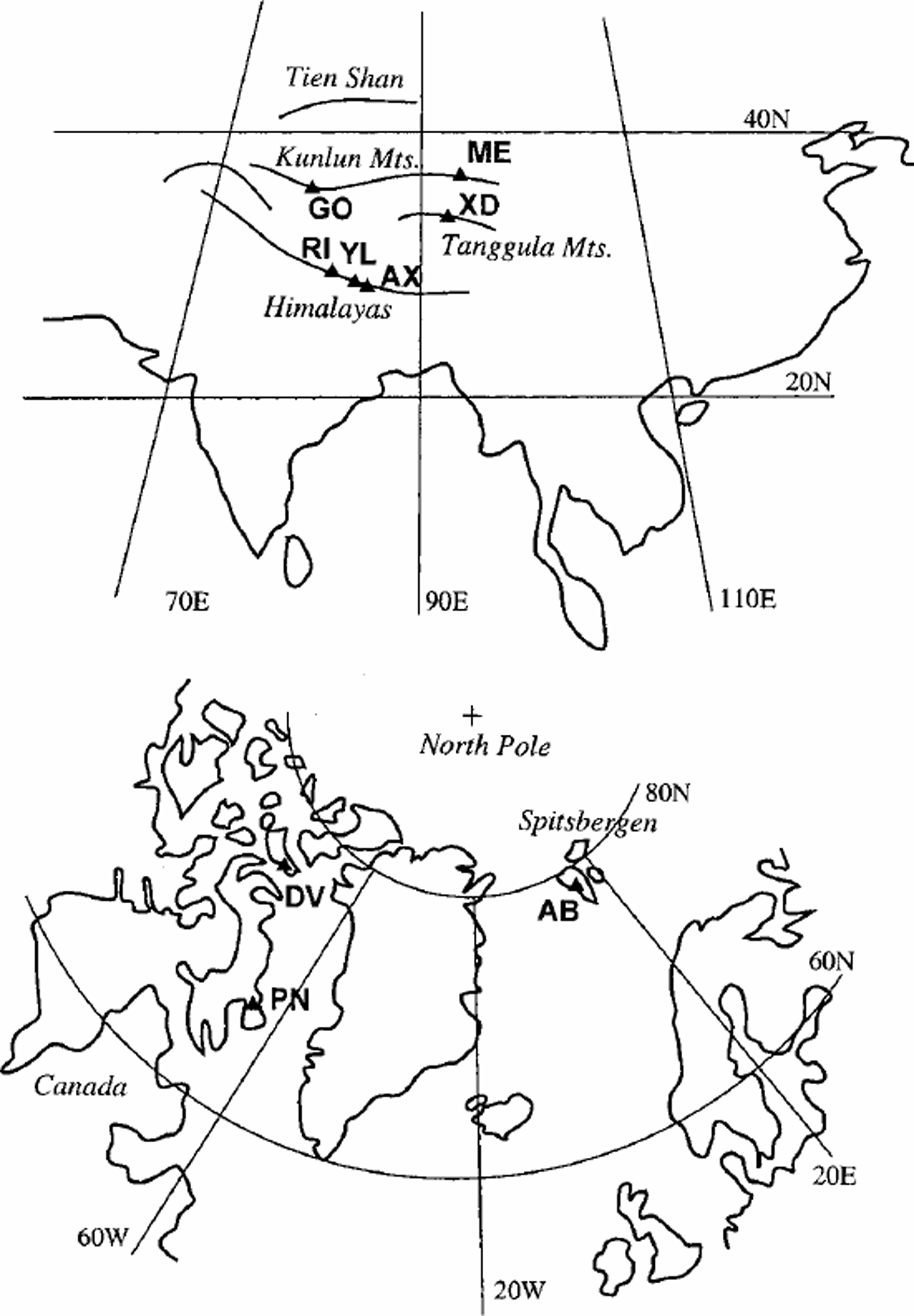
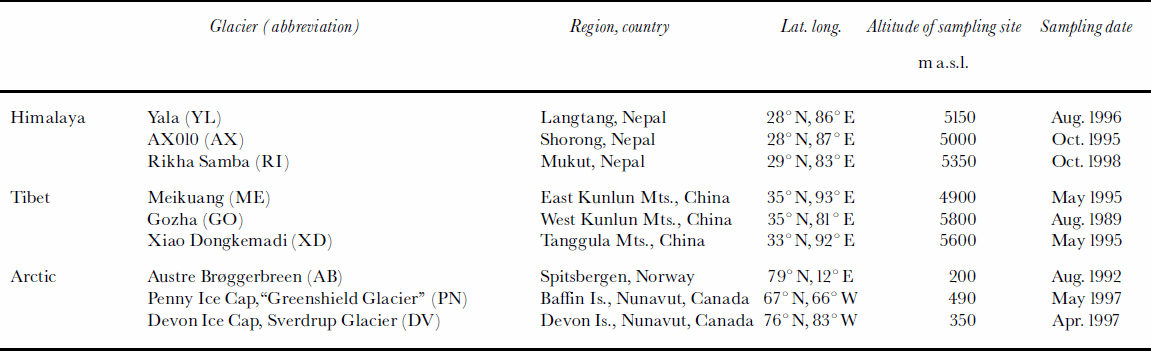
Cryoconites collected from three glaciers in the Himalaya, three in Tibet and three in the Arctic were analyzed (Fig. 1; Table 1). The cryoconite was collected from bare ice surface or the bottom of cryoconite holes in the ablation area of glaciers. Five to ten samples of cryoconite (each approximately 10–50mL in volume) were collected on each glacier. The collected samples were kept with glacial meltwater in 100 mL clean polyethylene bottles and preserved in a 3% formalin solution to fix biological activity.
Location of glaciers where cryoconite samples were collected. Abbreviations are explained in Table 1.
The glaciers and sampling sites of the cryoconites
The composition of the cryoconite was observed with an
optical and fluorescent microscope (Optiphoto2, Nicon, Japan). The amount of organic matter in the cryoconite was measured by the following method. After the samples were dried (65°C, 24 hours) and weighed, they were combusted for 1hour at 1000°C in an electric furnace. Percentage of weight reduction by this procedure was measured. Carbon and nitrogen contents in the cryoconites were measured with a nitrogen–carbon (NC) analyzer (Sumigraph-80, Simitomo Simazu Co., Japan).
To analyze optical characteristics of the cryoconite, the spectral light reflectance was measured. The samples were ground up into fine particles with a pestle and a mortar and collected on Millipore filters (HAWP047XX, pore size: 0.45μm) by filtering the sample waters. The amount of material collected on a filter was approximately 10 mgcm–2 in dry weight, which was enough to completely cover the filter surface with the cryoconite. After the filter was dried, the reflected irradiance of the cryoconite on the filter was measured by a spectrometer (FieldSpec FR, Analytical Spectral Devices Inc., U.S.A.) with a light source of integrating sphere (USS-1200V, Labsphere Co.,U. S.A.) at 1nm intervals, in wavelengths from 400 to 950 nm. The spectral reflectance was calculated from the reflected irradiance of the sample and that of a standard white reference plate. The spectral reflectance of mineral particles contained in the cryoconite is measured in the same way. The mineral particles were obtained from the cryoconite by removing the organic components with heated hydrogen peroxide (6 hours).
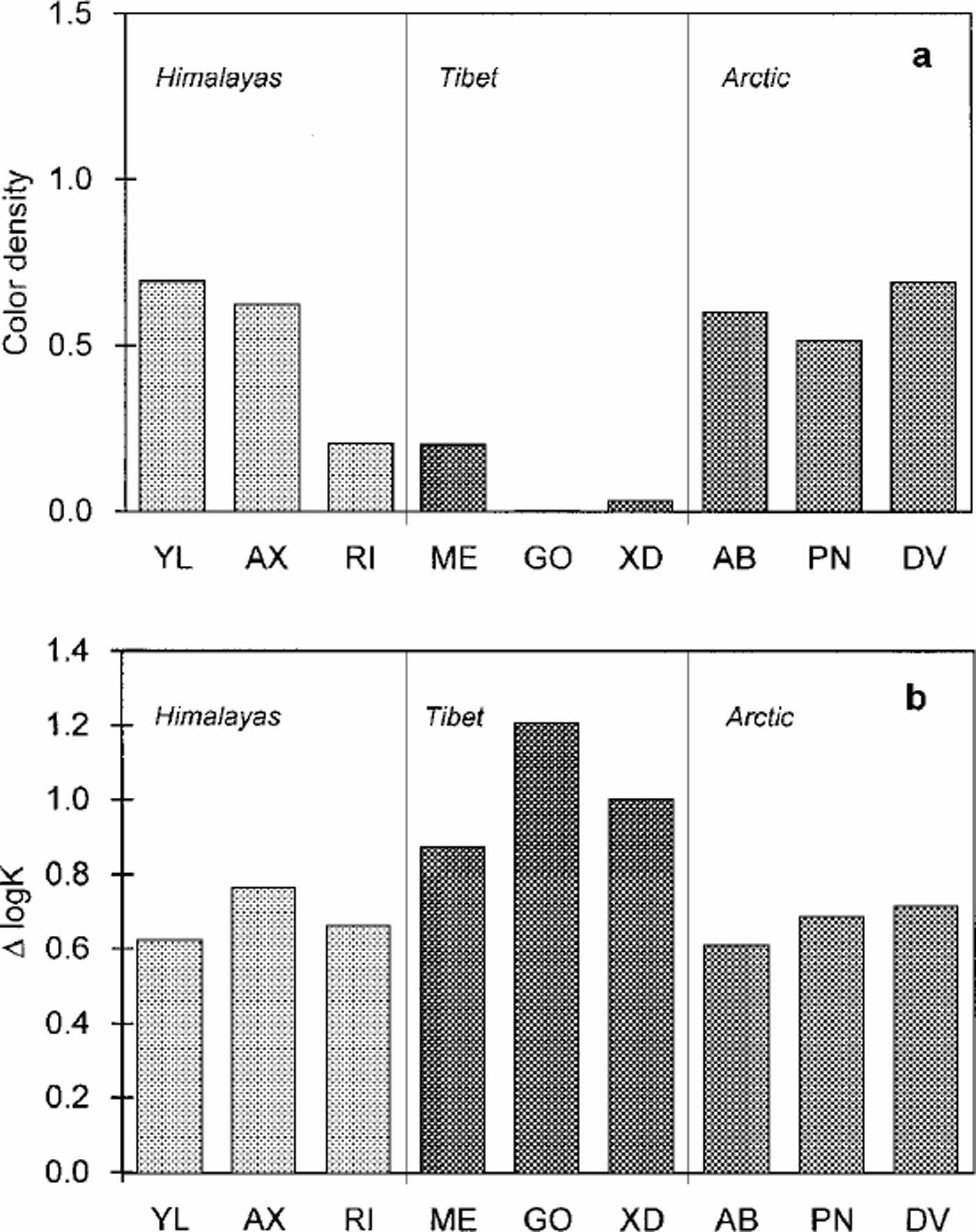
The humic substances in the cryoconite were analyzed in the following simplified manner on the basis of the Nagoya method (Reference KumadaKumada, 1987): An equivalent amount of cryoconite to 100 mg carbon was put in a test-tube with 5 mL of 1% NaOH solution (carbon/NaOH=1:20) and was kept at 30°C for 1hour. The humic substances can be extracted to the solution in this procedure. Then, light absorption of the solution was measured at 400,600 and 610 nm with a spectral photometer (UV-1100,HITACHI, Japan). Color density and ΔlogK were obtained from the light absorption at 610 nm and log(absorption at 400 nm) –log(absorption at 600 nm), respectively. Color density indicates the amount of dark-colored humic substances (humic acids), and ΔlogK indicates humification (the extent of polymerization of humic substances).
Results
General description and components of the cryoconites
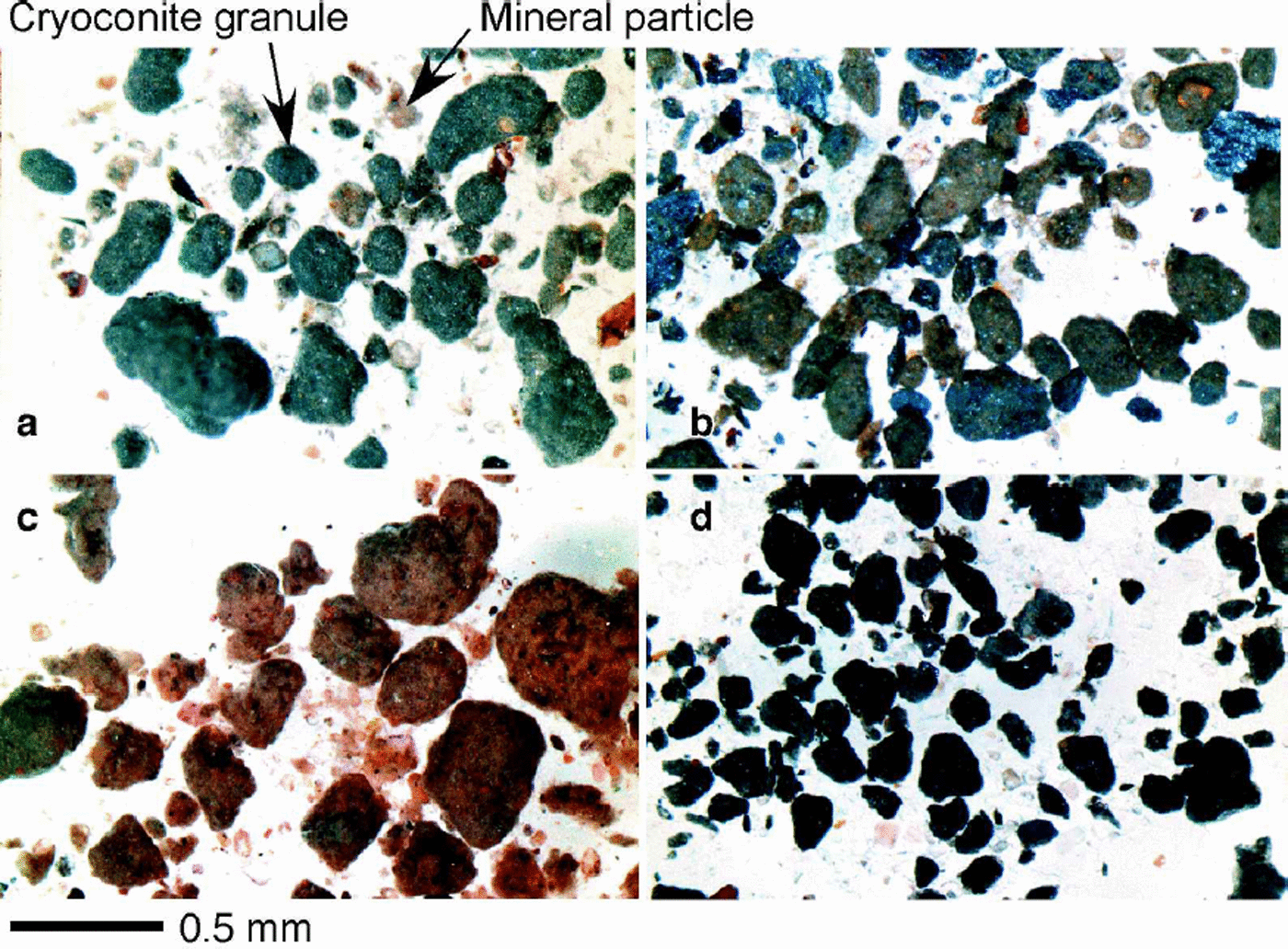
The cryoconites fromall of the nine glaciers mainly consisted of mineral particles and spherical granules (cryoconite granules; Fig. 2). The mineral particles are transparent, brown or black. The mean diameter of the mineral particles in the glaciers is 110–280μm (Table 2). The snow algae in the cryoconite of all glaciers were observed with a microscope. The algae included unicellular green algae, and coccoid and filamentous cyanobacteria. The cryoconites of one glacier are almost the same components.
Cryoconites on the glaciers. The pictures were taken in a laboratory. Cryoconite consisted of mineral particles and cryoconite granules. (a) Yala Glacier, Himalaya; (b) Rikha Samba Glacier, Himalaya; (c) Xiao Dongkemadi glacier, Tibet; (d) Penny Ice Cap, Canadian Arctic.
The characteristics of the cryoconites of the nine glaciers (SD, standard deviation)
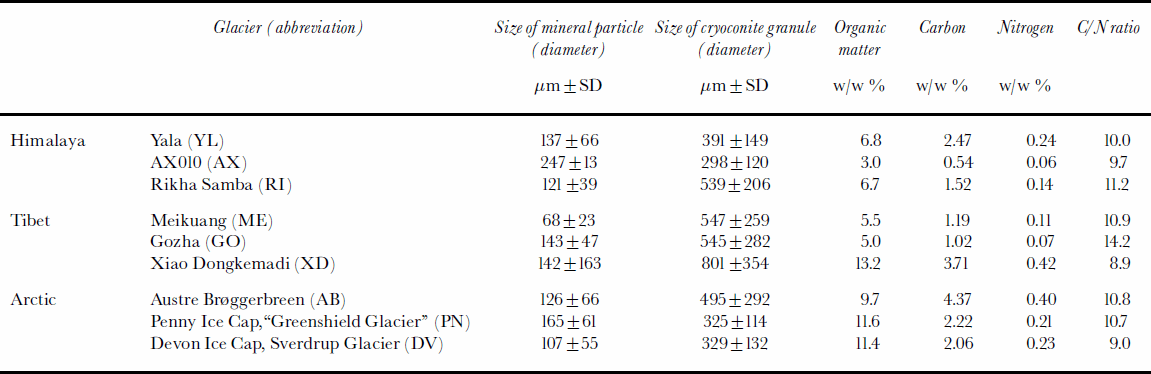
The cryoconite granule was the main component of cryoconites in all of the glaciers. The diameter of the granules was 0.2–3.0mm. Themean size of the cryoconite granules for each glacier is shown in Table 2. Microscopy of the granules disassembled by ultrasonication revealed that they were aggregations of filamentous cyanobacteria, bacteria, amorphous black matter and mineral particles. Observation with a fluorescent microscope revealed that the surfaces of the granules were densely covered with filamentous cyanobacteria, suggesting that the granules were formed by biological activity. The detailed structure of the cryoconite granule of Yala Glacier has been described by Reference Takeuchi, Kohshima and SekoTakeuchi and others (2001). The structures of the cryoconite granules of all other glaciers were similar to those of Yala Glacier.
Table 2 shows carbon, nitrogen and total organic matter content (percentage by weight) in the cryoconites. The carbon and nitrogen contents in cryoconite were 0.54–4.37% and 0.11–0.42%, respectively. The C/N ratio was 9.0–14.2, which is close to the C/Nratio of general microbes (10; Reference Begon, Harper and TownsendBegon and others, 1990). The total organic matter content of the cryoconite was 3.0–13.2%.
Spectral reflectance of the cryoconites
The spectral reflectance of the cryoconites collected from the nine glaciers in the visible range (400–950nm) differed between the glaciers (Fig. 3a). The six cryoconites from the Himalaya and the Arctic had similar spectral reflectance: the reflectances were low and almost constant in the wavelengths (mean: 0.128–0.179), indicating blackish coloration. The three cryoconites from the Tibetan glaciers had a significantly higher reflectance (mean: 0.305–0.376). The spectra of the three Tibetan cryoconites showed remarkably high reflectance in the range longer than 500 nm, indicating pale brown coloration. These spectra were consistent with visible coloration of cryoconite. The cryoconite of the Himalayan and arctic glaciers appeared blackish, while the cryoconite of the Tibetan glacier appeared pale brown (see Fig. 2). The lower reflectance in the range 400–450nm shown in all spectra is due to low intensity of the light source in this range.
The spectral light reflectances of the cryoconites of the nine glaciers (a), and of the mineral particles contained in the cryoconites (b).

The spectra of mineral particles of all glaciers showed a similar curve: the reflectance increased with wavelength from 400 to 600 nm and kept almost constant until 950 nm (Fig.3b). This curve indicates a brown coloration. However, the mean reflectance of the spectrum differed between the glaciers, ranging from 0.190 to 0.392. The spectra of the Penny (PN) and Devon (DV) Ice Caps were higher, and the spectra of AX010 (AX) and Rikha Samba (RI) glaciers lower than the other spectra, probably due to different proportions of mineral components.
Figure 4 shows a comparison of mean spectral reflectance between cryoconite and mineral particles of each glacier. While the mean reflectance of mineral particles varied among the glaciers, the reflectances of six cryoconites from Himalayan and arctic glaciers were close to each other (0.123–0.171), as were the three cryoconites from Tibetan glaciers (0.287–0.352). In Himalayan and arctic glaciers, the mean reflectance of cryoconite was significantly lower than that of mineral particles. The difference of the reflectance between cryoconite and mineral particles ranged from 0.052 to 0.269. This indicates that the reflectance of the cryoconite was reduced by organic matter contained in it. In contrast, the difference of the reflectance between cryoconite and mineral particles was small in Tibetan glaciers. This indicates that the effect of organic matter on the reflectance of cryoconite is small.
Comparison of mean reflectance of the cryoconite and mineral particles for the nine glaciers.

Extraction of humic substances
Figure 5 shows the results of extraction of humic substances from the cryoconites. The color density was relatively high in two Himalayan (Yala and AX010) and three arctic glaciers (0.52–0.70), while the values were relatively low in one Himalayan (Rikha Samba) and three Tibetan glaciers (Fig. 5a). This indicates that the cryoconite of the two Himalayan and three arctic glaciers contains larger amounts of dark- colored humic substances relative to the one Himalayan and three Tibetan glaciers. The values of ΔlogK were relatively high in Tibetan glaciers, indicating that the humic substances in the cryoconites are less humificated (Fig. 5a). In contrast, ΔlogK was lower in Himalayan and arctic glaciers, indicating that the cryoconites contain well-humificated humic substances.
The results of humic-substances extraction from the cryoconites in the nine glaciers: (a) color density; (b) ΔlogK. Color density and Δlog K were obtained from the light absorption of extracted solution at 610 nm and log(absorption at 400 nm) –log(absorption at 600 nm), respectively. Color density indicates the amount of dark-colored humic substances (humic acids), and ΔlogK indicates humification (the extent of polymerization of humic substances).
Discussion
The different optical characteristics of cryoconite among the glaciers show that the effect of the cryoconite on surface albedo of the glaciers differs from glacier to glacier. The cryoconites of the six glaciers in the Himalaya and the Arctic had lower reflectance (black coloration), while those of the three glaciers in Tibet had higher reflectance (pale brown). The higher reflectance of cryoconites from the Tibetan glaciers indicates that the visible light absorbency of the cryoconite is lower relative to the Himalayan or arctic glaciers. Therefore, the effect of cryoconite on surface albedo is likely smaller in the Tibetan glaciers relative to the Himalayan or arctic glaciers, in terms of light absorbency of the cryoconite.
The spectral reflectance of the cryoconite depends on its components: organic matter and mineral particles. Although the spectral reflectances of the cryoconites of the Himalayan and arctic glaciers were close to each other, the spectral reflectance of the mineral particles differed among the glaciers. Furthermore, the reflectance of the mineral particles was significantly higher than that of the cryoconite of the Himalayan and the arctic glaciers. This suggests that the reflectance of the cryoconite is largely affected by the organic matter contained in it. The lower reflectance of Himalayan and arctic cryoconite is due to low-reflectance (dark-colored) organic matter contained in it. In contrast, the higher reflectance of cryoconite in the Tibetan glaciers is due to high reflectance of both organic matter and mineral particles. Therefore, the difference of the cryoconite reflectance between the Tibetan and the Himalayan and arctic glaciers is not due to mineral particles, but to organic matter contained in the cryoconite.
The reflectance of the cryoconite was not correlated with amounts of carbon, nitrogen or total organic matter. The correlation coefficients of the reflectance are –0.104 with carbon, –0.047 with nitrogen and –0.087 with total carbon content, which are lower than the level of significance (0.666, probability = 0.05). This indicates that the reflectance of cryoconite is related, not to quantity, but to quality of the organicmatter.
There is a significant correlation between the reflectance of cryoconite and humic substances. The correlation coefficients of the reflectance are –0.718 with color density and 0.775 with ΔlogK, values which are higher than the level of significance. This suggests that the light absorbency of the cryoconites is due to the amount of humic substances in the cryoconite. The result of humic-substances extraction indicated that the cryoconite on Tibetan glaciers contained significantly smaller amounts (low color density) and less humification (high ΔlogK) of the humic substances than the cryoconite on the Himalayan and arctic glaciers. Therefore, the amount of humic substances is likely responsible for the difference of reflectance between the Tibetan and the Himalayan and arctic glaciers studied.
The humic substances are considered to be formed on the glacier and/or transported from ground soil out of the glaciers. Most of the humic substances in the cryoconite are likely formed on the glaciers. According to the report on Yala Glacier (Reference Wake, Mayewski and SpencerTakeuchi and others, 2001), the airborne material on the glacier contains only 1.8% of organic matter, which is much less than that of cryoconite (6.8%). This suggests that most of the organic matter in cryoconite is produced by photosynthesis of snow algae on the surface of the glacier. In the cryoconites of all the glaciers, a large amount of snow algae was observed. Furthermore, the organic components observed with a microscope were mainly cryoconite granules, which are aggregations of snow algae and bacteria formed on the glaciers. Therefore, the amount of organic matter transported from out of the glacier is rather small, and most of the humic substances in the cryoconite are likely derived from the residue of bacterial decomposition of these snow algal products. The difference of humic substances between the Tibetan and the Himalayan and arctic glaciers is probably due to different formation processes of the humic substances on the glaciers.
The origin of humic substances on the glaciers is questionable. According to Reference KumadaKumada (1987), the formation of humic substances in soil mainly depends on the temperature and moisture of the soil. However, there is no difference of temperature and moisture conditions among the glaciers, because temperature and moisture are uniformly 0°C and 100% (humidity), respectively, in glacial meltwater, where the cryoconite exists. The formation of humic substances is also affected by characteristics of original organic matter, microbial activity and chemical condition (Reference KumadaKumada, 1987). Since the bacterial decomposition activity is related to the formation of humic substances, the small amount of humic substances on the Tibetan glaciers may be due to low bacterial activity. Differences of snow chemistry between Himalayan and Tibetan glaciers have been reported (Reference Wake, Mayewski and SpencerWake and others, 1990). The chemical condition of snowand ice may also affect the formation of humic substances.
Quantitative effects of the humic substances on surface albedo of the glaciers are not evaluated in this paper. There have been some in situ data of surface spectral albedo on a Tibetan glacier (Xiao Dongkemadi glacier; Reference Seko, Jianchen, Fujita, Ageta, Ohata and TandongSeko and others, 1994) and a Himalayan glacier (Yala Glacier; Reference Takeuchi, Kohshima and SekoTakeuchi and others, 2001). According to the reports, decrease of the albedo at shorter than 600 nm wavelength is observed on the Tibetan glacier, while albedo is constant in the whole visible region on the Himalayan glacier. These in situ spectra are consistent with the spectral reflectance of cryoconite on each glacier. This suggests that the light reflectance of cryoconite derived by humic substances affects the surface albedo of the glaciers. If the cryoconite lies only at cryoconite holes on the glacier surface, the effect of optical characteristics of cryoconite on the whole surface albedo is rather small, because the total area of cryoconite holes is usually very small on the whole glacier surface (e.g.<7%; Reference Takeuchi, Kohshima, Goto-Azuma and KoernerTakeuchi and others, 2001). However, on glaciers where the whole surface is covered with cryoconite, as on the Himalayan glaciers, the optical characteristics of cryoconite would be significant in the surface albedo of the glacier.
On the basis of the optical characteristics of cryoconite revealed in this paper, remote sensing would be able to provide information on this biogenic material on glaciers globally. This study showed a local trend of optical characteristics of cryoconite (high reflectance in Tibet and low in the Himalaya and the Arctic), based on nine selected glaciers. In order to discuss the connection of cryoconite with type and size of glaciers, location of sampling site and/or climatic conditions, cryoconite data on more glaciers are necessary. Remote sensing would be useful for investigating the distribution, quantity and optical characteristics of cryoconite on large areas of glaciers. Although there have been many studies of satellite-derived surface reflectance of glaciers using multispectral bands in the visible region, they have focused mainly on the snow and ice characteristics of the glacier surface, rather than on cryoconite. The satellite-derived surface reflectance about glaciers would include information about cryoconite on the glaciers, and also may be useful for quantifying biological activity and its effect on surface albedo on glaciers.
Conclusions
The optical characteristics of the cryoconite collected from nine glaciers were investigated. The light reflectance of cryoconite differed among the glaciers: it is higher in three glaciers in Tibet compared to three Himalayan glaciers and three arctic glaciers in Canada and Svalbard. Analysis of the cryoconite revealed that the difference of light reflectance was due neither to mineral particles nor to the amount of organic matter, but instead to the amount of dark-colored humic substances. Although the origin of humic substances on the glaciers remains a mystery, our results show that the formation of the humic substances in the cryoconite possibly affects the surface albedo of glaciers, especially where the whole surface is covered with cryoconite, as on the Himalayan glaciers. On the basis of the optical characteristics of cryoconite revealed in this paper, remote sensing is a method that would provide information about this biogenic material on glaciers globally.
Acknowledgements
I would like to thank S. Kohshima for cryoconite samples (Spitsbergen and Chonce ice cap, China) and for helpful discussion of the manuscript, Y. Yoshimura for cryoconite samples (Meikuang and Xiao Dongkemadi glaciers), T. Aoki for spectral reflectance measurements, and M.Watanabe and N. Iwasaki for nitrogen–carbon analysis. I also thank J.C. Kohler and an anonymous reviewer for comments on the manuscript. Fieldwork on Himalayan glaciers is supported by Grants-in-Aid for scientific research (Nos. 10041105, 11640422) from the Ministry of Education, Science, Sports and Culture, Japanese Government. The fieldwork in the Canadian Arctic was partly supported by a grant for Promotion of Surveys and Research in Earth Science, and Technologies and Ocean Development of the Science and Technology Agency of Japan.



