Implications
Meat derived from pasture-based production systems embodies extrinsic features that consumer value. However, volatile indoles responsible for off-flavours accumulate more in the meat of lambs on pasture than on grain, especially when lambs graze alfalfa. We tested if barley supplementation could reduce this defect and investigated its effect on the reliability of pasture-feeding authentication methods. We show that this farming practice, beyond its cost, is not effective for reducing meat volatile indoles content. Although the biomarkers used correctly discriminated lambs that grazed alfalfa from stall-fed (SF) lambs, they cannot be used for discriminating supplemented from non-supplemented grazing lambs.
Introduction
Lamb meat derived from low-input farming systems embodies numerous extrinsic features that consumers value. These features often revolve around acceptance of the production system rather than intrinsic properties of the product (Sheath et al., Reference Sheath, Coulon and Young2001). However, several studies have shown that the volatile indoles responsible for off-flavour in meat accumulate more in the fat of lambs raised on pasture than on grain (Young et al., Reference Young, Berdagué, Viallon, Rousset-Akrim and Theriez1997 and Reference Young, Lane, Priolo and Fraser2003), due to the higher ratio of protein to readily-digestible carbohydrate typically found in pasture diets which favours deamination of protein amino acids by rumen microbes (Sheath et al., Reference Sheath, Coulon and Young2001). Ruminal synthesis of these faecal-smelling compounds from the amino acid tryptophan may be even greater when animals graze legume-based pastures, such as white clover or alfalfa, due to their high degradable protein content (Schreurs et al., Reference Schreurs, Marotti, Tavendale, Lane, Barry, Lopez-Villalobos and McNabb2007a; Devincenzi et al., Reference Devincenzi, Prunier, Meteau, Nabinger and Prache2014). Because the concentration of volatile indoles is enhanced when animals are pasture-fed (P), these compounds have been suggested as potential biomarkers of pasture-feeding. However, the literature has focused on the statistical significance of the difference in fat volatile indoles concentration between P and SF animals (Vasta and Priolo, Reference Vasta and Priolo2006) rather than on their discriminatory ability. The fat from P lambs is yellower than the fat from SF lambs due to a higher carotenoid content (Priolo et al., Reference Priolo, Micol, Agabriel, Prache and Dransfield2002; Prache et al., Reference Prache, Priolo and Grolier2003; Dian et al., Reference Dian, Chauveau-Duriot, Prado and Prache2007; Oliveira et al., Reference Oliveira, Carvalho and Prache2012). These pigments have been shown to be reliable biomarkers for authenticating carcasses from animals fed green-forage diets (Prache and Theriez, Reference Prache and Theriez1999; Huang et al., Reference Huang, Andueza, de Oliveira, Zawadzki and Prache2015; Prache et al., Reference Prache, Huang and Andueza2018). Priolo et al. (Reference Priolo, Micol, Agabriel, Prache and Dransfield2002) also observed that the meat from P lambs was darker than meat from SF lambs and that subcutaneous dorsal fat was firmer in P than SF lambs, which was attributed to a lower polyunsaturated fatty acids:saturated fatty acids ratio due to a higher ruminal retention time and therefore higher ruminal biohydrogenation.
A great deal is therefore known about contrasting feeding regimes (P v. SF), but little work has been done on the effects of grain supplementation at pasture, which is common practice in grassland-based sheep farming systems. This farming practice may mitigate the excess of degradable protein over energy and decrease pasture herbage intake level. In this study, we tested the hypothesis that supplementary feeding of barley to lambs that are concurrently grazing alfalfa would influence sensory quality traits by (i) decreasing fat volatile indoles concentration, (ii) decreasing fat yellowness and the intensity of light absorption by carotenoid pigments in the fat, (iii) increasing meat lightness and (iv) lowering subcutaneous fat firmness. We also investigated potential implications for pasture-feeding authentication.
Material and methods
The study was conducted at the Herbipôle Experimental Unit situated at Saint-Genès-Champanelle (850 m a.s.l) and run by the Auvergne-Rhône-Alpes INRA Centre in France.
Experimental design, animals and diets
We compared three feeding regimes: alfalfa (Medicago sativa) grazing (AG), alfalfa grazing + supplementation with barley (AGS) and stall-feeding with concentrate and hay (SF). Each experimental regimen comprised 12 male Romane lambs used from weaning to slaughter. In the SF group, lambs were given concentrate at a level that was adjusted weekly to achieve a similar average growth paths as that of AG lambs, and hay was given ad libitum.
We used 36 lambs from seven rams and 30 dams. The lambs were born between 3 and 9 April. From birth until 15 May, the animals were managed uniformly and housed in a sheepfold with their dams. Ewes had access to concentrate and hay and lambs had access to a commercial concentrate in an area where the ewes were not allowed. On 16 May, lambs and their dams were assigned to the treatment groups on the basis of litter birth weight, litter live weight (LW) on 03 May and sire; then, AG and AGS lambs were turned out to a pasture composed mainly of graminae without any supplementation; whereas, SF lambs remained in stalls. The lambs were weaned on 06 June. From 13 June, AG and AGS lambs were progressively allowed more time on alfalfa pasture over 5 days, and grazed alfalfa exclusively from 18 June onwards. Concomitantly, SF lambs stayed in stalls and received a commercial concentrate and hay. Mean lamb birth weight was 4.4 kg (SD 0.99) and average daily gain (ADG) between birth and weaning was 281 g/day (SD 51.3). At weaning, lambs weighed 21.5 kg (SD 3.42) and were 61 days old (SD 1.6) on average.
We used five alfalfa plots, of around 0.48 ha each, which were grazed rotationally. Grazing management ensured sufficient availability of green leaves. Each plot was divided into two sub-plots, and the AG and AGS groups were switched between the two sub-plots three times per week (on Monday, Wednesday and Friday) to avoid confounding effects of sward characteristics. The plots were mechanically topped and the trimmings removed after each grazing period to ensure good-quality regrowth.
Mean voluntary intake level of P lambs was assumed to be 78.125 g dry matter (DM)/LW0.75, where LW is the average live weight of the group (Hassoun and Bocquier, Reference Hassoun and Bocquier2007). Level of barley supplementation to AGS lambs was calculated from weekly weighings, at 29 g/kg LW0.75. Barley was distributed every day at 0900 h in collective feeding racks, the length of the racks being sufficient to ensure that all AGS lambs had the same access to barley. Pasture-fed lambs were treated with anthelmintic at weaning. Then, a faecal sample was collected every 14 days from the rectum of each lamb to measure faecal egg counts (FEC) according to Raynaud (Reference Raynaud1970). A targeted anthelmintic drench was performed for those lambs whose FEC was above 550 eggs/g faeces.
Stall-fed with concentrate and hay lambs received a commercial concentrate (0.93 Unités Fourragères Viande, 17% CP) containing barley, wheat, rapeseed meal, sunflower meal, sugar beet pulp, small cereal seeds, sugar cane molasses, calcium carbonate and salt, along with grass hay. All groups of lambs had ad libitum access to water and salt blocks.
Slaughter procedures
The lambs were slaughtered at the experimental slaughterhouse according to EU welfare guidelines. There were five slaughter sessions, on 3 and 28 August, 4, 7 and 11 September. Lambs were slaughtered at a mean age of 147 (SD 10.2) days after an average experimental period of 74 (range 45 to 84) days. The lambs had access to food and water until about 30 min before slaughter and were transported by truck to the slaughterhouse located ~500 m from the experimental site. The lambs were electrically stunned and slaughtered by throat cutting. The carcasses were placed in a refrigerated room at 4°C until 24 h after slaughter and were kept in the dark.
Measurements
Animal body weight
Lambs were weighed at birth, then on 3 May, at weaning, once weekly in the morning before barley distribution, and finally at slaughter.
Feed offered and refusals
The feed offered to SF lambs were measured daily. Feed tubs of both AGS and SF lambs were emptied every day, and any refusals were weighed, recorded and discarded. Once a week, samples of feed offered and refused (when present) were collected, oven-dried at 60°C for 72 h, then weighed for DM estimation. Feed intake was calculated for each lamb group as the difference between DM offered and DM refusals.
Carcass characteristics
Carcass conformation and fatness (visual evaluation using the 1 to 15 point scale described by Fisher et al., (Reference Fisher, Enser, Richardson, Wood, Nute, Kurt, Sinclair and Wilkinson2000)), carcass and perirenal fat weight, subcutaneous fat thickness over the last thoracic rib, pH of longissimus thoracis et lumborum (LTL) muscle (pHu) and subcutaneous dorsal fat firmness (finger-test on a scale from 3 (oily) to 15 (very hard)) were measured 24 h after slaughter.
Instrumental colour and reflectance spectrum of perirenal and subcutaneous caudal fat and longissimus thoracic et lumborum muscle
The reflectance spectrum (RS) and colour coordinates of perirenal fat and subcutaneous caudal fat from the tail root and LTL muscle were measured at wavelengths between 400 and 700 nm using a MINOLTA CM-700d spectrophotometer (illuminant: D65, observer angle: 10°; Minolta France S.A., Carrières-sur-Seine, France). Colour coordinates were expressed as lightness (L*), redness (a*), yellowness (b*), chroma (C*) and hue angle (hue). The instrument was fitted with protective glass to shield the eye of the apparatus from the sample. This apparatus measures the proportion of light reflected every 10 nm. For fat samples, the measurements were made at 24-h postmortem; for perirenal fat, a plane surface was cut with a knife to allow the fat to adhere perfectly to the eye of the apparatus. For LTL muscle samples, a 1-cm thick sample was taken at 24-h postmortem from the right side of the carcass between the 12th and 13th rib and then stored on a tray covered by an oxygen-permeable film kept in the dark. Reflectance spectrum and colour coordinates were measured 4 days after slaughter. For each tissue and each measurement time, five measurements were done at five randomly selected locations.
Perirenal and subcutaneous dorsal fat skatole and indole concentrations
Fat samples were taken for all lambs at 24-h postmortem. The subcutaneous dorsal fat was taken from the posterior end of the loin. Fat samples were wrapped in aluminium foil, vacuum-packed in sealable polyamide bags, snap-frozen and stored at −20°C until analysis. Fat skatole and indole concentrations were measured by HPLC according to the method described by Batorek et al. (Reference Batorek, Škrlep, Prunier, Louveau, Noblet, Bonneau and Čandek-Potokar2012) (Supplementary Material S1). Concentrations were expressed in µg/g of lipid fraction from adipose tissue. Limit of detection was 0.03 µg/g liquid fat.
Lamb chop sensory evaluation
The saddles (muscle, fat and bones) were removed from the posterior end of the loin from the right side of the carcass, cut into nine chops and stored in a tray covered by oxygen-permeable film kept in the dark for 3 days at +4°C. They were then individually wrapped and vacuum-packed in sealable polyamide bags, snap-frozen and stored at −20°C until sensory evaluation.
Lamb chop sensory evaluation was performed by 12 trained panellists at the INRA Magneraud Experimental Unit, according to the rules set out in standards NF ISO 8586-1 and ISO 8586-2. The panellists were 11 women and 1 men, of an average age of 57 years. Before evaluation of the experimental chops, two preliminary sessions were held, using (i) two small bottles, one containing water and the other containing a solution of 3-methylindole (skatole, 0.2 μg/l) (Sigma-Aldrich, Darmstadt, Germany), and (ii) additional chops from one lamb with a high perirenal fat skatole concentration and one lamb with a low perirenal fat skatole concentration, for the panellists to experience perceptions linked to skatole.
Lamb chop sensory evaluation was performed on eight chops per experimental lamb in 12 panel sessions. At each panel session, each panellist evaluated one lamb from each treatment group, with lambs from each group presented in random order. Samples were prepared as described by Devincenzi et al. (Reference Devincenzi, Prunier, Meteau, Nabinger and Prache2014). The panellists used a 10-cm unstructured line scale (from 0 to 10) to evaluate the intensity of tenderness, juiciness, abnormal odour of the lean part, intensity of abnormal odour, animal odour, six flavour attributes (typical lamb, rancid, liver, milky, fatty, animal) of the fat part, and intensity of the odour-liking of the fat part, the flavour liking of the fat part and overall liking of the chop. Assessments were scanned and scored as the distance in cm from the left end of the line using FIZZ® software. Panellists were asked to drink water and eat toast and a piece of apple between assessments to ensure that each sample was assessed with a cleansed palate.
Data analysis
The fat RS data were used at wavelengths between 450 and 510 nm, that is, the range in which carotenoid pigments absorb light (Prache and Theriez, Reference Prache and Theriez1999). The fat RS data were translated (TRS) to give a reflectance value at 510 nm of 0. On the TRS, the integral value (I450-510) was calculated as follows:
 $$\eqalignno{ I450{\minus}510 & {\equals}\left[ {\left( {{{{\rm TRS}450} \over 2}} \right){\plus}{\rm TRS}460{\plus}{\rm TRS}470{\plus}{\rm TRS}480 } \right \cr & \quad {\plus}{\rm TRS}490{\plus}{\rm TRS}500{\plus}\left \left ( {{{{\rm TRS}510} \over 2}} \right)} \right]{\rm }{\times}10$$
where TRS i is the reflectance value of the translated RS at i nm. This integral value is considered an indicator of carotenoid content in the fat (Prache et al., Reference Prache, Priolo and Grolier2003). The integral value was averaged over the five measurements. As the mean integral values were all negative, hereafter we use the absolute value of the mean integral (AVMI).
The colour difference between two treatment groups (ΔE ab*) was calculated as ΔE ab*=((ΔL*)2+(Δa*)2+(Δb*)2)0.5, where the Δ quantities in the right-hand part of the formula represent the differences between the corresponding coordinates of the two treatments groups (Brainard, Reference Brainard2003).
The data for animal performance, carcass characteristics, fat and LTL muscle colour, AVMI, and skatole and indole concentrations were analysed by ANOVA using a mixed model (SAS 9.4, 2013; Supplementary Material S2) with feeding treatment as fixed factor and slaughter session as random factor. The data for lamb chop sensory evaluation were analysed by ANOVA using a mixed model, with feeding treatment and panel session as fixed factors and panellist as random factor (Supplementary Material S2). Data variance for perirenal fat AVMI was stabilized using the natural logarithmic transformation. Data variance for skatole concentration in both fat tissues and for indole concentration in subcutaneous dorsal fat were stabilized using the log+10 transformation. Pairwise comparisons were performed using a Tukey test.
We compared the frequency distribution of the perirenal and subcutaneous dorsal fat skatole concentrations using a χ 2 test, as previous studies suggested that there may be a threshold for fat skatole concentration (0.16 to 0.24 µg/g of liquid fat) above which the corresponding ‘animal’ odour and flavour reach a plateau (Devincenzi et al., Reference Devincenzi, Prunier, Meteau, Nabinger and Prache2014 in lamb meat; Bonneau and Chevillon, Reference Bonneau and Chevillon2012 in pork meat).
For P lambs, we compared the frequency distribution of the number of anthelmintic drenches per lamb (0 or at least 1) using a χ 2 test (Supplementary Material S2). The experimental unit was the individual animal.
Results
Feed intake
Mean barley intake was 30.35 kg DM/lamb. Mean daily barley intake was 410 g DM/lamb (range: 298 to 511 g DM/lamb). Barley represented on average 37.86% of the diet of AGS lambs, assuming a mean voluntary intake of 78.125 g DM/LW0.75. For SF lambs, mean concentrate and hay intakes were 100.35 kg DM/lamb and 21.84 kg DM/lamb, respectively. Mean daily concentrate and hay intakes were 1.209 kg DM/lamb (range: 0.548 to 1.830 kg DM/lamb) and 263 g DM/lamb (range: 60 to 480 g DM/lamb), respectively.
Number of anthelmintic drenches
Number of anthelmintic drenches ranged from 0 to 2 and averaged 0.41/lamb in AG and 0.92/lamb in AGS. Frequency distribution in the two classes (0 drench or at least 1 drench) did not differ between AG and AGS lambs (P>0.05).
Animal performance and carcass characteristics
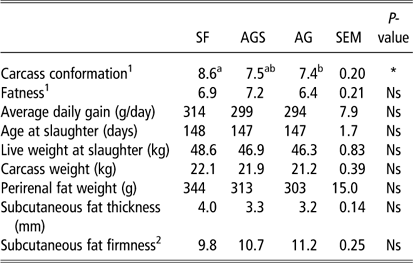
Animal performance and carcass characteristics did not differ between feeding regimes, except for carcass conformation (Table 1). Stall-fed with concentrate and hay lambs presented a higher carcass conformation score than AG lambs; whereas, AGS lambs were intermediate and not significantly different from SF and AG lambs. Subcutaneous fat firmness tended to differ between treatments (P=0.092), being in the order AG lambs>AGS lambs>SF lambs. Average daily gain during the experiment, age at slaughter, carcass weight averaged 302 g/day, 147 days and 21.8 kg. Fatness score, perirenal fat weight and subcutaneous fat thickness averaged 6.9, 320 g and 3.5 mm
Lamb performance and carcass characteristics at slaughter according to the feeding treatment

SF=stall feeding; AG=alfalfa (Medicago sativa) grazing; AGS=alfalfa (Medicago sativa) grazing+supplementation with barley.
a,bValues within a row with different superscripts differ significantly at P<0.05.
1 Measured using a visual evaluation (1 to 15 scale).
2 Measured using a scale from 3 (oily) to 15 (very hard).
*P<0.05, Ns: P>0.05.
Fat skatole and indole concentration
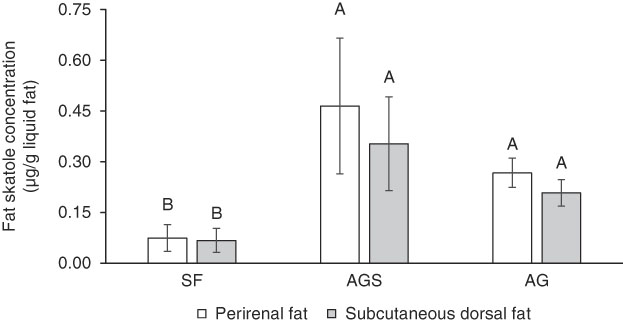
Skatole was detected in the perirenal fat of all AG and AGS lambs and three SF lambs and the subcutaneous dorsal fat of all AG and AGS lambs and of two SF lambs.
There was a treatment effect on skatole concentration for both perirenal and dorsal fat (P<0.0001 for both fat tissues). Skatole concentration in both fat deposits was lower in SF lambs (perirenal: 0.07 µg/g (0.03 to 0.51 µg/g), dorsal: 0.07 µg/g (0.03 to 0.45 µg/g)) than in AG (perirenal: 0.27 µg/g (0.09 to 0.56 µg/g), dorsal: 0.21 µg/g (0.07 to 0.51 µg/g)) and AGS lambs (perirenal: 0.46 µg/g (0.10 to 2.62 µg/g), dorsal: 0.35 µg/g (0.08 to 1.83 µg/g)) (P<0.0001 for both comparisons), but was not significantly different between AG and AGS lambs (Figure 1). Note that one SF lamb (perirenal: 0.51 µg/g, dorsal: 0.45 µg/g) and one AGS lamb (perirenal: 2.62 µg/g, dorsal: 1.83 µg/g) were considered outliers for fat skatole concentrations.
Mean skatole concentration in lamb perirenal and subcutaneous dorsal fat according to the treatment: stall-feeding (SF), alfalfa grazing (AG) and alfalfa grazing + supplementation with barley (AGS). Bars represent standard error of the mean (SEM/√n), where n is number of lambs in each group. Means with different superscripts are significantly different (A, B: P<0.0001).

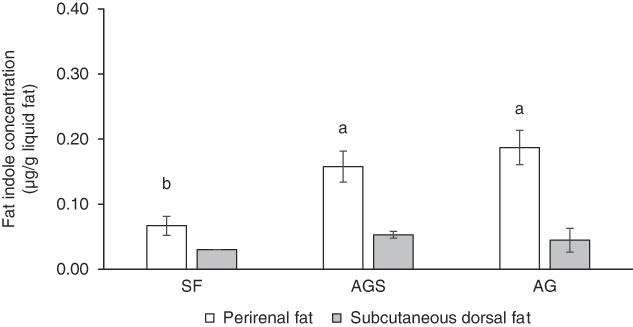
Indole was detected in all perirenal fat samples except for one SF lamb. In dorsal fat, indole was detected in only six AG lambs and four AGS lambs. There was a treatment effect on indole concentration in perirenal fat (P=0.002) but not in dorsal fat (P=0.115). Mean perirenal fat indole concentration was 0.07 µg/g (0.03 to 0.18 µg/g), 0.19 µg/g (0.06 to 0.28 µg/g) and 0.16 µg/g (0.04 to 0.37 µg/g) in SF, AG and AGS lambs, respectively. Indole concentration in perirenal fat was lower in SF lambs than in AG (P<0.001) and AGS (P=0.007) lambs, but was not significantly different between AG and AGS lambs. Mean dorsal fat indole concentration was 0.03 µg/g (all samples under the limit of detection), 0.04 µg/g (0.03 to 0.09 µg/g) and 0.06 µg/g (0.03 to 0.25 µg/g) in SF, AG and AGS lambs, respectively (Figure 2).
Mean perirenal and subcutaneous fat indole concentration in lambs according to the treatment: stall-feeding (SF), alfalfa grazing (AG) and alfalfa grazing + supplementation with barley (AGS). Bars represent standard error of the mean (SEM/√n), where n is number of lambs in each group. For perirenal fat, means with different superscripts are significantly different (A, B: P<0.01).

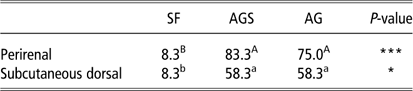
There was a treatment effect on distribution of lambs within the two classes of fat skatole content (<0.16 µg/g of liquid fat v. ⩾0.16 µg/g of liquid fat) for both perirenal (P<0.001) and dorsal (P<0.02) fat. This distribution was significantly different between SF and P (AG and AGS) lambs but was not significantly different between AG and AGS lambs for both tissues (Table 2).
Proportion (%) of lambs whose fat skatole concentration is above the target value of 0.16 µg/g liquid fat in each feeding treatment

SF=stall feeding; AG=alfalfa (Medicago sativa) grazing; AGS=alfalfa (Medicago sativa) grazing+supplementation with barley.
A,BValues within a row with different superscripts differ significantly at P<0.001.
a,bValues within a row with different superscripts differ significantly at P<0.02.
*P<0.02, ***P<0.001.
Colour and reflectance spectrum of perirenal and subcutaneous caudal fat
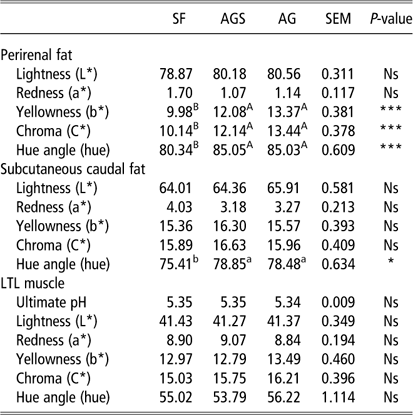
There was a treatment effect on perirenal fat b*, C* and hue (P<0.001 for all variables) (Table 3), all of which were lower in SF lambs than in P (AG and AGS) lambs (P<0.001) but not significantly different between AG and AGS lambs. Perirenal fat L* and a* were not significantly affected by treatment, although there was a tendency for higher L* and lower a* in P (AG and AGS) lambs than in SF lambs (P=0.064 and P=0.054, respectively). The perirenal fat ΔE ab* values were 3.16, 2.30 and 1.35 for the comparison between the different treatment groups (SF and AG lambs, SF and AGS lambs, AG and AGS lambs, respectively). There was no treatment effect on the colour coordinates of subcutaneous caudal fat, except for hue (P=0.047) which was higher for P (AG and AGS) lambs than for SF lambs.
Lamb perirenal and subcutaneous caudal fat colour, longissimus thoracis et lumborum (LTL) muscle ultimate pH and colour at 4 days postmortem according to the feeding treatment

SF=stall feeding; AG=alfalfa (Medicago sativa) grazing; AGS=alfalfa (Medicago sativa) grazing + supplementation with barley.
A,BValues within a row with different superscripts differ significantly at P<0.001.
a,bValues within a row with different superscripts differ significantly at P<0.05.
*P<0.05, ***P<0.001, Ns: P>0.05.
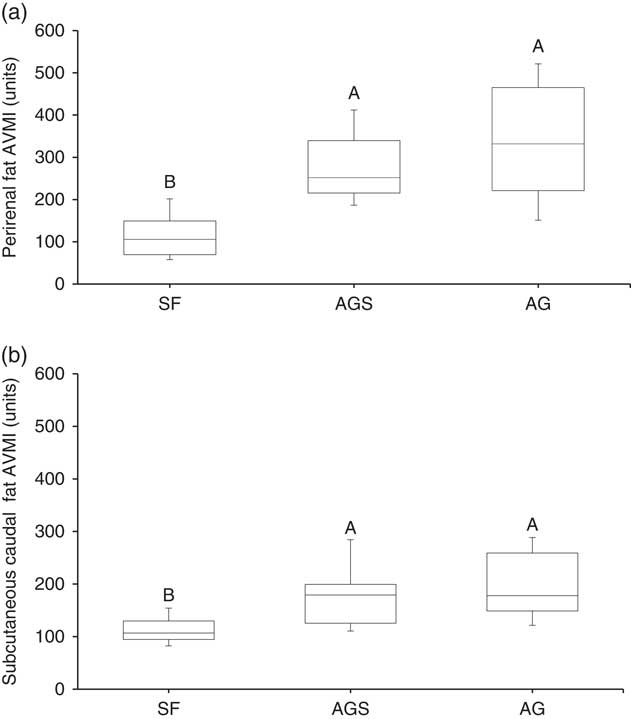
There was a treatment effect on the AVMI of both perirenal fat (AVMIPF) and subcutaneous caudal fat (AVMISC) (P<0.001 for both). AVMIPF and AVMISC were lower in SF lambs than in P (AG and AGS) lambs (P<0.0001 and P<0.001, respectively), but were not significantly different between AG and AGS lambs (Figure 3). AVMIPF averaged 113 units in SF lambs (range: 58 to 201 units), 345 units in AG lambs (range: 151 to 521 units) and 277 units in AGS lambs (range: 186 to 412 units). AVMISC averaged 112 units in SF lambs (range: 82 to 154 units), 199 units in AG lambs (range: 122 to 288 units) and 178 units in AGS lambs (range: 110 to 284 units).
Boxplots of the absolute value of the mean integral (AVMI) of the translated spectrum of lamb fat between 450 and 510 nm (considered as an indicator of fat carotenoid content) for (a) perirenal fat (b) subcutaneous caudal fat, according to the treatment (stall-feeding (SF), alfalfa grazing (AG) and alfalfa grazing + supplementation with barley (AGS)). The box represents the middle 50% of the data (between the 25th and 75th percentiles), the upper and lower whiskers represent the extreme values and the line in the box indicates the median value. A, B: means with different letters differ significantly at P<0.0001.

Instrumental quality parameters of longissimus thoracis et lumborum muscle
Longissimus thoracis et lumborum muscle pHu did not differ significantly between treatment groups, averaging 5.35 (Table 3). There was no treatment effect on LTL muscle colour coordinates. Lightness, a*, b*, C* and hue averaged 41.36, 8.94, 13.09, 15.66 and 55.01, respectively.
Lamb chop sensory evaluation
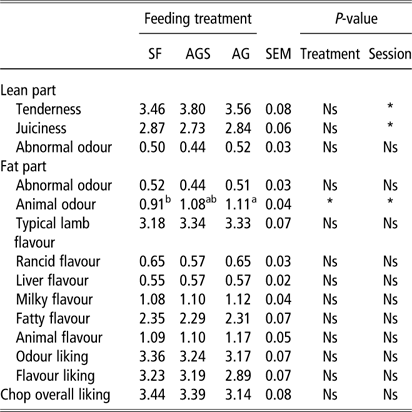
There was a treatment effect on the intensity of animal odour in the fat part of the chops (P<0.05) (Table 4). Intensity of animal odour was higher in AG lambs than in SF lambs (P<0.05), with AGS lambs being intermediate and not significantly different from the other two groups. There were no significant differences between treatment groups in any of the other criteria evaluated, but intensity of flavour liking of the fat part of the chops tended to follow a gradient (P=0.071) in the order SF lambs>AGS lambs>AG lambs.
Effect of feeding treatment and sensory panel session on evaluation of lamb chops (0 to 10 scale of increasing intensity)

SF=stall feeding; AG=alfalfa (Medicago sativa) grazing; AGS=alfalfa (Medicago sativa) grazing+supplementation with barley.
a,bValues within a row with different superscripts differ significantly at P<0.05.
*P<0.05, Ns: P>0.05.
Discussion
We aimed at investigating the effects of barley supplementation to lambs grazing alfalfa on meat sensory quality traits and concentration of biomarkers of pasture-feeding in animal tissues.
We succeeded in ensuring a similar average growth pattern, age at slaughter, carcass weight and degree of fattening for SF and AG lambs, thus avoiding these variables being confounding factors. Stall-fed with concentrate and hay lambs presented a higher conformation score than AG lambs, but the difference was low.
Although barley represented more than a third of the diet of AGS lambs, it did not offer any advantage in terms of animal ADG. Likewise, carcass weight and degree of fattening were not significantly different between AG and AGS lambs. Substitution of pasture herbage by grain in grazing ruminants is a well-documented phenomenon, and sheep grazing high-quality pastures offered at a high herbage allowance are known to show high substitution rates (Prache et al., Reference Prache, Béchet and Thériez1990; Molle et al., Reference Molle, Decandia, Cabiddu, Landau and Cannas2008). Despite this high level of substitution, barley supplementation did not offer any advantage in terms of parasitism level, probably because the pastures were relatively contamination-free.
Feeding treatment tended to affect fat dorsal firmness along a gradient in the order AG lambs>AGS lambs>SF lambs, that is, a consistent trend of decreasing fat firmness with increasing dietary proportion of grain, in line with our hypothesis. The amplitude of the difference in fat firmness between AG and SF lambs is similar to that obtained between P and SF lambs by Priolo et al. (Reference Priolo, Micol, Agabriel, Prache and Dransfield2002), where the difference was significant, probably because Priolo et al. (Reference Priolo, Micol, Agabriel, Prache and Dransfield2002) used a higher number of animals. Regarding the pairwise comparison between AG and AGS lambs, given the observed mean difference and sample variance, it would be necessary to increase the sample size up to 34 lambs to reach a probability of finding a significant reduction of fat firmness in AGS lambs.
Some confusion exists in the literature regarding the effect of pasture-feeding (v. stall feeding) on lamb meat colour, with some authors reporting a decrease (Priolo et al., Reference Priolo, Micol and Agabriel2001 and Reference Priolo, Micol, Agabriel, Prache and Dransfield2002) and others no change (Santé-Lhoutellier et al., Reference Santé-Lhoutellier, Engel and Gatellier2008) in LTL muscle L*. In this study, there was no treatment effect on LTL muscle colour coordinates.
Fat skatole concentrations were high in lambs that grazed alfalfa. It was above the target of 0.1 μg/g, which is considered high in lamb (Schreurs et al., Reference Schreurs, McNabb, Tavendale, Lane, Barry, Cummings, Fraser, Lopez-Villalobos and Ramirez-Restrepo2007b) in most of the AG lambs (22 lambs out of all 24 grazing lambs for perirenal fat, and 18 out of all 24 grazing lambs for dorsal fat), which confirms the risks of off-odours and off-flavours associated with alfalfa grazing. Conversely, fat skatole concentrations were below this target in both perirenal and dorsal fat in most of the SF lambs (11 out of 12). This outcome supports the results obtained previously (Vasta and Priolo, Reference Vasta and Priolo2006). Moreover, our results show that most of the AG and AGS lambs (eight out of 12 in each group) presented a perirenal fat skatole concentration above the target value of 0.16 µg/g of liquid fat identified by Devincenzi et al. (Reference Devincenzi, Prunier, Meteau, Nabinger and Prache2014) as being a threshold above which the corresponding ‘animal’ odour and flavour reach a plateau. These results are in line with the sensory evaluation, where (i) the intensity of animal odour in the fat part was higher for lambs having grazed alfalfa than for SF lambs and (ii) the intensity of the flavour liking of the fat part tended to be affected by treatment, following a gradient in the order SF>AGS>AG.
Despite the large inter-individual variability in fat skatole concentration in lambs pasture-fed alfalfa, this compound was fairly reliable at distinguishing lambs pasture-fed alfalfa (AG and AGS lambs) from lambs stall-fed indoors. Actually, the skatole concentration in both fat tissues was lower for all SF lambs than for all lambs having grazed alfalfa, except for one outlier SF lamb for which skatole concentration in perirenal and dorsal fat was 0.51 and 0.45 µg/g liquid fat, respectively. We cannot explain why this SF lamb presented such outlying values, but note that this lamb was not considered an outlier in the chop sensory evaluation.
We found that barley supplementation at pasture did not lead to a reduction in fat volatile indole concentrations nor ‘animal odour’ intensity of the fat part of the chops. Even though the substitution of alfalfa herbage by barley was high, as shown by the ADG data, the use of barley supplementation failed to effectively reduce fat volatile indole concentrations and excessive odour/flavour in lambs grazing alfalfa. The dietary supply of barley and/or duration of supplementation may not have been sufficient to affect the fat volatile indoles concentrations. However, the combination of additional costs and the fact that lambs were supplemented from weaning until slaughter makes it difficult to envisage greater dietary barley supply and/or longer duration of supplementation. Note that the outlier AGS lamb presenting very high skatole concentrations in both perirenal and dorsal fat was also considered an outlier for the intensity of abnormal odour in the fat part of the chops.
The treatment effect on fat colour coordinates was due to carotenoid pigments, confirming previous studies (Prache and Theriez, Reference Prache and Theriez1999; Prache et al., Reference Prache, Priolo and Grolier2003 and Reference Prache, Huang and Andueza2018). However, these differences, although significant, were of low biological amplitude, as ΔE ab* values were lower than the threshold of 5.9 suggested by Schwarz et al. (Reference Schwarz, Cowan and Beatty1987) as enabling visual appraisals on fat to find significant differences. Barley supplementation at pasture did not significantly change the colour of the fat, in line with Ripoll et al. (Reference Ripoll, Albertí and Joy2012).
Fat AVMI was higher in P (AG and AGS) lambs than in SF lambs, confirming that visible reflectance measurements of fat in the region of light absorption by carotenoid pigments are of interest for authenticating pasture-feeding in sheep. However, the outcome of this study shows that although the substitution of alfalfa herbage by barley was high, the distribution of AVMI values for lambs grazing alfalfa completely (AVMIPF) or broadly (AVMISC) overlapped that of AG lambs, making it impossible to discriminate between AG and AGS lambs.
Conclusion
This study confirms that AG lambs accumulate high levels of volatile indoles in their fat. It further demonstrates that the use of barley supplementation – at 38% of total diet intake here – to feed lambs that are concurrently grazing alfalfa did not offer any advantage in terms of animal performance and was not effective in reducing fat volatile indoles concentration or intensity of animal odour in the fat part of the chops. Meat and fat colour in lambs grazing alfalfa were not influenced by barley supplementation, but subcutaneous dorsal fat firmness tended to be lower in barley-supplemented lambs.
This study also confirms that both perirenal fat volatile indoles concentration and intensity of light absorption in the 450 to 510 nm area of the RS of perirenal fat are of interest for discriminating lambs grazing alfalfa from lambs stall-fed indoors. However, the distribution of both variables in supplemented lambs completely overlapped that of non-supplemented lambs, making it impossible to discriminate the two, as all lambs grazing alfalfa would get classified into the same group regardless of whether or not they were barley-supplemented.
Acknowledgements
The authors thank L. Lavelle, A. Cercy, C. Coustet, S. Faure, C. Labonne and the staff of Herbipôle Experimental Unit for their collaboration. The authors thank Wesley Gros for analysing the fat volatile indoles content. This study was funded by the Special Assignment Account ‘Agricultural and Rural Development’ (CASDAR) of the French Ministry of Agriculture, Agrifood and Forestry, under project CASDAR IP 5560 – ECOLAGNO.
Declaration of interest
None.
Ethics statement
This study received ethical approval from Ethical Review Committee of the French Ministry of Higher Education, Research and Innovation (ethic committee approval n9689-2017042411419479V2).
Software and data repository resources
None.
Supplementary material
To view supplementary material for this article, please visit https://doi.org/10.1017/S1751731118001477