Early in 1719 plans were advanced for establishing a company by the name of the Royal Academy of Music for the purpose of performing ‘Operas on the English Theatre, in greater perfection than they have hitherto been represented, either in this or any other Country’.Footnote 1 In May George I ordered the organizers to ‘prepare a Bill for Our Royal Signature’ to incorporate the Academy by letters patents, and he granted the company £1,000 a year for seven years. The official royal charter establishing the Academy for twenty-one years is dated 27 July 1719. In addition to the Governor of the company (always to be the Lord Chamberlain), the original fourteen directors of the company can be identified from the minutes of the first meetings in November and December. By the time the Academy produced its first opera, Giovanni Porta's Numitore (2 April 1720), the composition of the board of directors had shifted (as indicated in the printed libretto), and seven were new.Footnote 2 One of these was John Percival, later 1st Earl of Egmont.Footnote 3
Royal Academy of Music directors in 1719 and 1720: surviving oath records

Percival left a voluminous correspondence. Two separate collections are preserved in the British Library: general correspondence in nine volumes (1697–1731) and estate correspondence in thirty-nine volumes (1699–1748), which latter set of volumes is organized from 1717 into annual registers.Footnote 4 Musicologists seem not to have examined the estate correspondence in much detail, but it has interest for them, not least because Percival generally includes at the end of each volume a summary of the year's events. In 1720, his appointment as a director of the Royal Academy of Music is given significant attention. The general entry for February reads in part: ‘This month I was acquainted . . . that the Society erected for the promoting Christian knowledge had elected me a Member thereof. I was likewise this month chose a director of the Royall Accademy of Music.’ The entry for 24 April 1720 then includes the following: ‘I qualified my Self for Directorship of the Royall Accademy of Musick, by takeing the Oathes this day at Guildhall before the Ld Mayor & Sr Wm Thomson Recorder, & then delivred into Court my Certificate of having taken the Sacrament at St James Church Westminster.’Footnote 5
Percival's statement provides the first known evidence that directors of the Royal Academy of Music needed to swear ‘oaths’ in order to be eligible to serve.Footnote 6 It also raises the question (unanswered here) of the prevalence of this practice in relation to other theatrical companies in London. In this essay I will examine the regulations concerning required oaths during the reign of George I, trace the surviving documents and their preservation, and detail the surviving record of oath-taking by the early directors of the Royal Academy of Music (for full texts, see the Appendix below). At the end of the essay, I will speculate very briefly on how the requirement that the directors swear the oaths might change our perception of the operas produced by the Academy during its years of operation.
The process of taking the oaths was somewhat complicated. Three obligatory oaths were required – of allegiance (to the king), supremacy (of the king over all other rulers, especially the pope) and abjuration (of the Stuart claim to the throne) – in addition to a declaration that there was no transubstantiation in the sacrament of the Lord's Supper. Before taking the oaths, a person needed first to acquire a Certificate of Conformity to the sacrament of the Church of England, which was submitted to the court when the oaths were sworn. The order of events in Percival's description is a little confusing, as he mentions delivering his certificate into court after mentioning his taking of the oaths, but the dates on the documents themselves confirm the standard, and required, practice of handing in the certificate at the time the oaths were sworn.
Various oaths of allegiance had been required for different sections of the population from the sixteenth century. As stated in the fine introduction to the extensive collection of oath rolls preserved in Devon: ‘Beginning with the Act of Supremacy of 1534 and the Elizabethan Oath of Supremacy of 1559, oaths of religious and political loyalty are a regular feature of the history of post-Reformation and revolutionary England.’Footnote 7 The continued requirement and expansion of the oaths under George I were established by statute in the first year of his reign (I Geo. 1 s[tatute] 2. c[hapter] 13).Footnote 8 The statute begins by providing a history of the oaths back to the reign of ‘his late majesty King William’, citing the relevant statutes at each previous stage. It continues by addressing the current political situation: following the death of Queen Anne in 1714, the Protestant succession had brought the Hanoverian George I to the throne, but the Catholic son of James II claimed the succession by blood and had been declared James III of Great Britain by Louis XIV of France. It was because of the seriousness of James's claim to the throne (and his Roman Catholicism) at the time of George I's accession that Parliament required all who held any official governmental office, civil or military, or received ‘any pay, salary, fee or wages, by reason of any patent or grant from his Majesty’ to swear the loyalty oaths of allegiance, supremacy and abjuration, obtain a sacrament certificate and subscribe the declaration against transubstantiation. The statute (greatly abridged) reads in part:Footnote 9
[W]hereas the said pretended prince of Wales hath assumed the stile and title of James the third, King of England, Scotland and Ireland . . ., and whereas the said pretended prince of Wales, since the demise of the late Queen, in prejudice of your Majesty's most lawful and rightful title to the crown . . ., and whereas also several wicked and evil-minded persons have, even since your Majesty's happy accession to the throne, in riotous, seditious, and treasonable manner, taken upon them to give to the said pretended prince of Wales the aforesaid name and title . . ., we your Majesty's most dutiful and loyal subjects, the lords spiritual and temporal and commons, in this present parliament assembled, do [188] / humbly beseech your most excellent Majesty, that it may be enacted . . ., That all and every person and persons, as well peers as commoners, that shall bear any office or offices, civil or military, or shall receive any pay, salary, fee or wages, by reason of any patent or grant from his Majesty, or shall have command or place of trust from or under his Majesty, or from any of his Majesty's predecessors, or by his, her, or their authority, or by authority derived from him, her, or them, within Great Britain, or in his Majesty's navy, or in the several islands of Jersey and Guernsey, or shall be of the houshold, or in the service or imployment of his Majesty, or of his royal highness George prince of Wales, or her royal highness the princess of Wales, or their issue, and all ecclesiastical persons, heads or governors, of what denomination soever, and all other members of colleges and halls in any university, that are or shall be of the foundation, or that do or shall enjoy any exhibition, (being of the age of eighteen years) and all persons teaching or reading to pupils in any university, or elsewhere, and all schoolmasters and ushers, and all preachers and teachers of separate congregations, all constables, and every person that shall act as a serjeant at law, counselor at law, barrister, advocate, attorney, solicitor, writer in Scotland, proctor, clerk, or notary, by practicing in any manner as such in any court whatsoever, who shall inhabit, reside, or be within the cities of London or Westminster, or within thirty miles distant from the same, on the first day of Michaelmas term next, at any time during the said term, shall personally appear before the end of the said term in his Majesty's court of chancery, king’s-bench, common pleas or Exchequer, and there, in publick and open court, between the hours of nine of the clock and twelve in the forenoon, take the oaths herein mentioned . . . [189] / unto which oaths so taken, every such person so taking the same, shall subscribe his name, or if he cannot write, shall make his mark . . . and all and every the said respective persons and officers, not having taken the said oaths, and subscribed the same, as aforesaid, shall on or before the twenty-third day of January next, at the general or quarter-sessions for that county, riding, liberty, city, borough, town corporate or place . . . take the said oaths in open court . . . and subscribe his name . . . [190]
In 1722, following the discovery of the Atterbury Plot, which had as its goal the capture of the Hanoverian royal family and restoration of the Stuart succession with James III, new and stricter statutes were enacted demanding that all Catholics who refused to take the oaths register their names and properties (I Geo. 9 c. 24 (1722)):
Whereas since his Majesty's happy accession to the crown of these realms, divers rebellions insurrections and traitorous conspiracies have been entred into and carried on, for the destruction of his Majesty's most sacred person and government, the overturning our religious and civil rights, and for placing a popish pretender on the throne: and whereas the papists and other persons, refusing to take the oaths appointed by law to be taken to his Majesty, have enjoyed, and do still enjoy the protection and benefit of the government, as well as the rest of his Majesty's subjects, yet have been notoriously concerned in contriving, stirring up and supporting the said rebellions, insurrections and conspiracies, by which it most manifestly appears, that they take themselves to be obliged, by the principles they profess, to be enemies to his Majesty and the present happy establishment; and forasmuch as it is highly reasonable, that the government should be thoroughly acquainted with, and apprized of the number, names and real estates of such disaffected persons as aforesaid, in order more effectually to prevent, disappoint or punish the like traitorous attempts for the future, in such manner as by the wisdom of parliament shall hereafter be thought proper; be it therefore enacted . . .
[that] all persons, being papists, in that part of Great Britain called Scotland, and all persons in Great Britain, refusing or neglecting to take the oaths appointed for the security of his Majesty's person and government, by several acts herein mentioned, to register their names and real estates.Footnote 10
This stopgap measure was quickly superseded by a more expansive act (I Geo. 9 c. 4 (1723)) requiring all persons eighteen or older who had not yet sworn the oaths to do so or to register their names and properties ‘in such and the same manner and form as papists were obliged and directed to register their names and real estates’ (I Geo. 9 c. 24 (1722)).Footnote 11
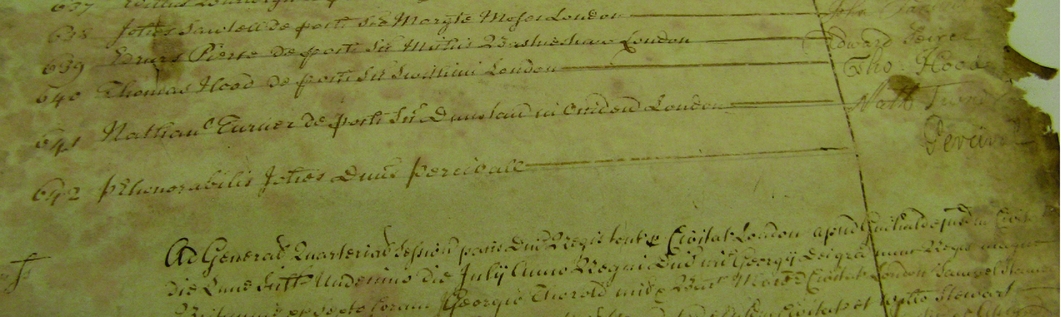
The original statute of 1714 demanded that every person ‘that shall bear any office or offices . . . by reason of any patent or grant from his Majesty’ take the oaths. That is, the establishment of the Academy in 1719 by letters patent with a yearly bounty from the king required that the directors take the oaths. The statute specifically compelled office holders under the crown at the time of its enactment to take their oaths at one of the central courts of law: Chancery, King's Bench, Common Pleas or Exchequer. These court records survive somewhat spottily at The National Archives (TNA). For those who, at the time of the statute, were not office holders under the crown, and for all after the first year of George I's reign, the statute allowed for oaths to be sworn at the county, city or borough courts during Quarter Sessions. The records for Middlesex and Westminster survive at the London Metropolitan Archives (LMA). Percival took his oaths before the Lord Mayor in the City of London, whose records (formerly in the Corporation of London Record Office) are now in the LMA as well. These records verify Percival's statements, and the survival of complete records for his entire process ensures that the procedure can be clarified. First, the oath-taker needed to obtain a Certificate of Conformity attesting to his having taken the sacrament in the Church of England, and this had to be presented to the magistrate in order for the oaths to be taken. Percival's certificate, acquired at the church of St James Westminster, is dated 13 March 1719/[1720] (LMA: CLA/047/LR/02/03/033). Percival took the oaths and made the declaration against transubstantiation on 25 April 1720 (LMA: CLA/047/LR/02/01/004/007). In the oath roll, the entry for Percival reads in full: ‘642 P[er] honorabilis Joh[ann]es D[omi]nus Percivall——–Percival’ (The Honourable John Lord Percival——–Percival). After the oaths were sworn, the number 642 was added to the top of the certificate, which served as an index to the record in the oath rolls (Figure 1).
Oath-roll record for John Percival. London Metropolitan Archives: CLA/047/LR/02/01/004/007. Used by permission
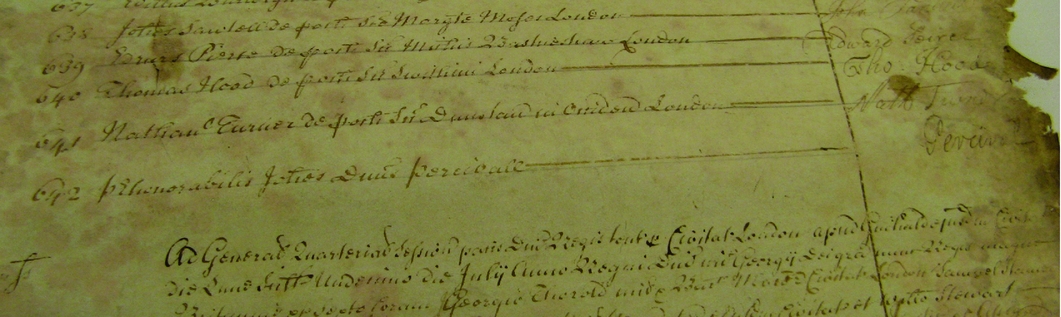
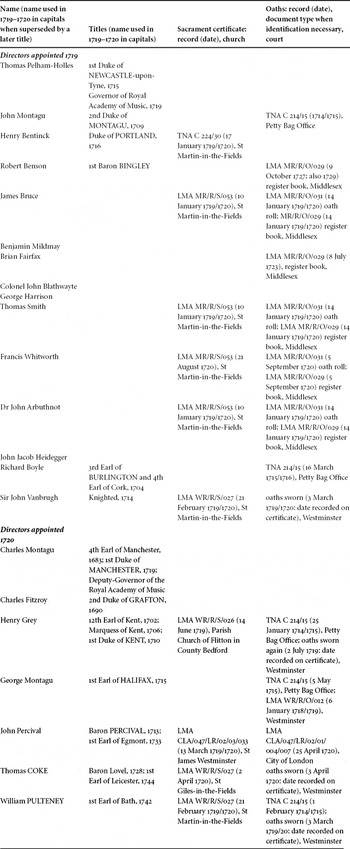
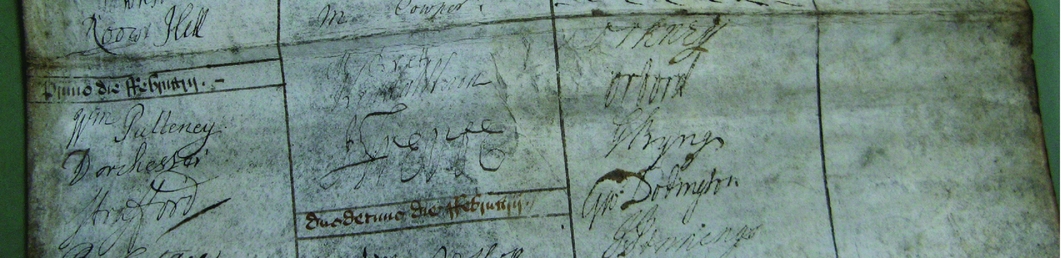
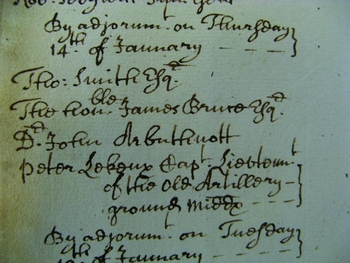
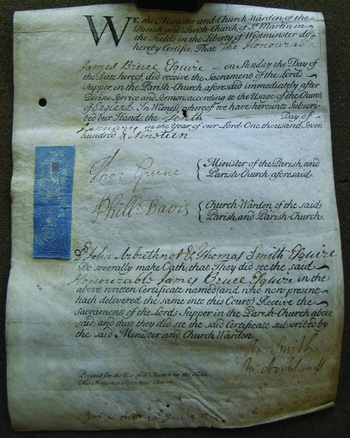
Following the discovery of specific documents relating to Percival's oaths, I undertook a further exploration of the records at The National Archive and the London Metropolitan Archive for the other directors from 1719 and 1720 (see Table 1). These records illustrate that the directors who in 1715 were Lords, Members of Parliament (MPs) or otherwise closely connected to the court did, as required in the original statute in the reign of George I, take the oaths in the central courts as soon as the requirement was made law; examples from the Petty Bag Office in the court of Chancery from 1714–1715 include Halifax, Kent and Pulteney (TNA C214/15).Footnote 12 In Figure 2 William Pulteney is the first signatory in the left-hand column on 1 February 1715 (‘primo die Februarij’). Most of the directors, especially those without court positions, took their oaths in the county courts of Middlesex and Westminster. Thomas Coke, for example, who became a director at the same time as Percival in spring 1720, took his oaths in Westminster. His sacrament certificate from St Giles-in-the-Fields (dated 3 April 1720) records that he took his oaths on 22 April (LMA: WR/R/S/027). In a register book of oaths taken at the General Quarter Sessions in Middlesex on 14 January 1719/1720, I found three of the directors appointed in autumn 1719 – Thomas Smith, James Bruce and John Arbuthnot – listed in a row, which suggested the three of them making something of a convivial gathering out of the obligation (LMA: MR/R/O/029) (Figure 3). In fact, the sacrament certificates illustrate that they also went together on 10 January 1719/1720 to St Martin-in-the-Fields, as each certificate is witnessed by the other two directors (LMA: MR/R/S/053) (Figure 4). (Note that at Westminster and Middlesex, as opposed to the City, the date of the oath is written on the bottom of the certificates rather than having an identifying number at the top, and the single punch hole on the upper left suggests the certificates were at one point kept on spindles to keep them in date order.) Four days later, as recorded in the register book, the three were again together to swear and sign the oath rolls (LMA: MR/R/O/031).
Signature of William Pulteney on oath roll of George I. The National Archives: C214/15. Used by permission
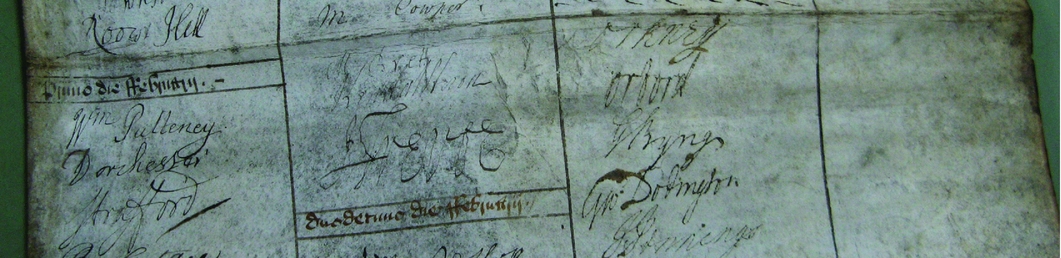
Smith, Bruce, and Arbuthnot in register book of oaths taken at Middlesex. London Metropolitan Archives: RM/R/O/029. Used by permission

Certificate of James Bruce witnessed by Arbuthnot and Smith. London Metropolitan Archives: MR/R/S/053. Used by permission

The frequent repetition of names within the registers illustrates that it was not always sufficient to take the oaths once and be done with them. The original statute [I Geo. 1 s. 2. c. 13] required the oaths be repeated each and every time the individual took on ‘some new office or imployment’. The full statement from that statute reads:
And be it further enacted by the authority aforesaid, That all and every person and persons that shall be admitted, entred, placed or taken, into any office or offices civil or military, or shall receive any pay, salary, fee or wages, by reason of any patent or grant from his Majesty [and here the very long list of all who must take the oaths, already given above, is repeated] . . ., who shall, at any time after the tenth day of August one thousand seven hundred and fifteen, be admitted into, or enter upon any of the before-mentioned preferments . . ., as aforesaid, shall within three months after he or they shall be admitted into or enter upon any such preferment, benefice, office or place, or come into such capacity, or taken upon him or them such practice, imployment or business, as aforesaid, take and subscribe the same oaths . . . [191].
This requirement meant that directors of the new Royal Academy of Music who had previously sworn the oaths would have needed to do so again given their new office ‘by reason of any patent or grant from his Majesty’. Henry Bentinck, Duke of Portland, was appointed a director of the Royal Academy of Music in autumn 1719, and his sacrament certificate dated 17 January 1719/1720 survives in the Chancery records (TNA C224/30). I have found no record of Portland's signature on the oath rolls that survive at The National Archives – and, unfortunately, none of the sacrament certificates that I have seen from the central courts includes the specific date the oaths were sworn – but the survival in Chancery of a sacrament certificate, which document was only handed in to court when the oaths were sworn, means that some time after receiving the certificate he swore the oaths in Chancery. Portland already would have taken the oaths some time after the accession of George I in 1714 (in accordance with I Geo. 1 s. 2. c. 13); he would, for example, have been required to take them when he was appointed Lord of the Bedchamber in 1717. Although I have not located these earlier documents, the certificate from 1720 can be comfortably associated with Portland's retaking the oaths specifically on account of his new appointment as director of the Royal Academy.
Other instances of repeated oaths at a time likely to be associated with the Academy do survive. For example, three of the early directors who attained important government positions in 1714 appear, as one would expect, on the oath rolls in the Petty Bag records of the Court of Chancery early in 1715 (TNA C 214/15): Henry Grey, first Duke of Kent and Lord of the Bedchamber at Windsor in January 1715; William Pulteney, MP for Hendon, and later Earl of Bath, in February 1715; and George Montagu, MP for Northampton in May 1715 (the month in which he succeeded to the title Baron Halifax and later created first Earl of Halifax). All reappear later in the Westminster Quarter Sessions.
Kent obtained a sacrament certificate at the parish church of Flitton in Bedford on 14 June 1719 and then retook the oaths at the Westminster Quarter Sessions on 2 July, as evidenced by the date on the certificate in the Westminster records. Pulteney obtained a sacrament certificate on 21 February 1719/1720 and retook the oaths on 3 March, on both occasions apparently in company with John Vanbrugh, another director (LMA: WR/R/S/027, certificates). Not only did they obtain their certificates on the same day in the same church with a shared witness, but they also took their oaths at the Westminster Quarter Sessions on the same day (as indicated on the certificates). Although Halifax retook the oaths at Westminster Quarter Sessions on 6 January 1717/1718 at the same time as (or with) Thomas Brereton, playwright, whose English translation in 1715 of Racine's Esther strongly influenced the libretto of Handel's Esther of 1718 (LMA: WR/R/O/012), the date is too early for the oaths to relate to his appointment as director of the Royal Academy of Music in 1720. Rather, Halifax's oath-taking in January 1718 most probably relates to his appointment as Privy Counsellor on 27 November 1717, and he must have taken them yet again for the Royal Academy, although I have not found the record, in 1720.
The most extreme instance of repeated oath-taking relates to a well-known figure outside the circle of the Royal Academy of Music: Sir Hans Sloane, physician and collector. The Register of Middlesex oath rolls (MR/R/O/029) lists Sloane in every year except four between 1719 and 1733, and in one year, twice. Some of these occasions, but probably not all, relate to Sloane's appointments to positions in royal societies, which, like appointment to the Royal Academy of Music, would have required the oaths. For example, in 1719 Sloane was named President of the Royal College of Physicians, and in 1727, President of the Royal Society, but such appointments are unlikely to account for all the occasions on which Sloane swore the oaths.Footnote 13 I would suggest that at least some of Sloane's repeated oaths, and perhaps a number of those by Academy directors as well, relate to a specific stipulation in the original statute that the oaths be retaken after any departure from Great Britain, including travel to the continent: ‘That nothing in this act contained shall extend to any person now beyond the seas, who by virtue of this act ought to take the said oaths, so as such person do, within [193] / three months after his return to Great Britain, take the said oaths, and subscribe thereunto according to the appointment of this act [194].’
Travelling abroad was relatively commonplace among the class of society represented by the directors at the opera (which could explain how often oaths were sometimes repeated). However, the continent was not just a repository of interesting cultural artefacts for acquisition or viewing, but also, in many respects, enemy territory. James III, the Pretender, held court in Italy; his supporters (Jacobites) were centred in France; Great Britain and the Austrian Netherlands were engaged in active hostilities over the competition to the English East India Company from the Ostend East India Company (which company had strong Jacobite associations);Footnote 14 and Catholic Spain not only supported the Stuart restoration and upheld the rights of the Ostend Company against British interests, but also competed with Britain for dominion of the seas. Since any trip to the continent might have held a Jacobite purpose, the requirement to swear one's allegiance on returning was understandable. It would not, however, have provided any security against perjured oaths, of which there must have been many. Not only would secret Jacobite supporters and informants have necessarily perjured themselves to maintain their role in the opposition, but others, who may have cared less about the succession, probably took the oaths simply to acquire the benefits that accrued to doing so.Footnote 15 An anonymous poem in the manuscripts of the Duke of Beaufort at Badminton describes this state of affairs in delightful doggerel:
For some of the directors in 1719 and 1720, I did not find any entries at all in the manuscripts I examined (as shown in Table 1), while for others the records were too late for the oaths to have been related to their appointment at the Royal Academy of Music. There are at least three reasons that could explain the apparent lack of a relevant record: the loss of the document (especially if the oath was sworn in one of the central courts, for which the survival of the oath rolls and sacrament certificates is erratic), an oversight on my part or the possibility that these directors took their oaths neither at a central court in London nor at Middlesex, Westminster or the city (which are the only records I have examined). It was possible to obtain sacrament certificates outside of London, and oaths could be sworn at any of the county, city or borough courts.Footnote 17 Kent, as mentioned above, received his sacrament certificate from the parish church of Flitton in Bedfordshire, then submitted it to the court of Westminster when he took the oaths.
Francis Whitworth, a director from autumn 1719, only appears in the register book from Middlesex as having taken his oaths on 5 September 1720; his signature on the oath roll for this date also survives. He had obtained his sacrament certificate at St Martin-in-the-Fields on 21 August 1720 (MR/R/S/053). Autumn 1720 seems late for these records to pertain to a position begun a full year before. Although the delay could represent a late fulfilment of the requirement, it could also relate to a different, newly acquired position or to a recent trip ‘beyond the seas’. The earliest oath record I have found for Brian Fairfax appears in the Middlesex Register dated 8 July 1723 (LMA: MR/R/O/029). This is certainly too late to be related to his appointment as a director in autumn 1719 and is probably connected instead to his appointment in 1723 as Commissioner of Customs. The earliest indication I have found of Robert Benson, Baron Bingley, swearing the oaths also comes from the Middlesex register book in which he is recorded as having sworn the oaths on 9 October 1727 (for a reason I have been unable to discern). Perhaps Bingley took his oaths in 1719 or 1720 nearer Bramham Park, his home in Yorkshire.
My exploration of the surviving documents pertaining to oath-taking during the reign of George I has been too preliminary for me to make any firm conclusions, but it has led to the following thoughts. The records themselves are intrinsically interesting, providing signatures, as well as connections between individuals that might not have been expected. If (and I emphasize this word) repeated oaths indicate a return within the prior three months from a trip outside Britain, they also could in some cases provide biographical information of significant interest. Finally, the requirement that the directors of the Royal Academy of Music take the oaths, which is not surprising in retrospect, raises some issues for the directors themselves. Burlington, for one, has been considered a secret Jacobite. If he was, the record of his oath-taking provides fresh evidence of the equivocation necessary to maintain such a position. The requirement of taking the oaths also suggests why some ardent supporters of Italian opera one might have expected to become directors did not: that is, those who were non-jurors on principle would have been unwilling to perjure themselves to serve.Footnote 18 George Granville, Lord Lansdowne, who was among the original subscribers listed in the charter of the Royal Academy of Music, is one possibility; Lansdowne's nephew Bernard Granville may be another. Charles Jennens is perhaps the clearest example.
The requirement that the opera directors take the oaths also sheds a somewhat different light on the question of whether Handel's operas contain political allusions. On the one hand, the common themes of monarchy and succession provide (and provided) easy fodder for such interpretations. As John Loftis has stated, settings in ‘remote times and places’ avoided the necessity of ‘literal social comment’, but allowed tragedy (and I would add heroic opera) to be in ‘closer touch with the currents of political thought’.Footnote 19 In contrast, Robert Hume has warned that ‘the oft-cited hypothesis that opera protagonists must be identified with the reigning monarch is not borne out by scrutiny of the texts’.Footnote 20 These two views are not, however, incompatible. In his fine book Fiction as History: Nero to Julian, the classicist Glen Bowersock demonstrates, in the chapter ‘Truth in Lying’, how the ‘overt creation of fiction’ provides a way of ‘rewriting or even inventing the past, and for us . . . poses major questions of historical interpretation’.Footnote 21 Similarly, the librettos of Handel's operas create a fiction in which the present and recent past can be located without the danger of detailed personification or allegory. Handel's Floridante (1721), which has served as a key work in the ongoing debate about topical politics in opera in Handel's London, offers an example.Footnote 22
The plot of Floridante, which is set in Persia, focuses on three main characters: a usurping tyrant as the reigning monarch, a princess of the true royal blood who has been raised as his daughter, and a valiant foreign prince engaged to the princess. In the end, the tyrant is overthrown, and when the princess ascends to the throne as queen, she raises her valiant prince to the kingship. This story has any number of political resonances for Britain. Most obviously, the royal princess could represent Queen Mary, daughter of James II, and the valiant prince, King William (formerly prince of Orange in the Netherlands). That the tyrant turns out not to be the princess's actual father suggests the nicety of a lineal separation between the Catholic James and his Protestant daughters that, of course, did not exist in fact. Given this reading, the opera could be understood to support the Hanoverian succession by precedent. More dangerously, the foreign prince could represent the son of James II, known as the Pretender to the Hanoverians but as the ‘king across the water’ to supporters of a Stuart restoration. The usurper would then suggest the reigning German monarch George I.
This Jacobite reading has support in a letter of 19 December 1721 written by Dr William Stratford to Edward Harley, both of whom had Jacobite leanings, which describes ‘unseasonable clapping’ in the audience at the moment when the usurper is put in chains.Footnote 23 The incident was disturbing enough that the secretary to the French embassy in London described the same disruption in a letter of 26 January 1722, stating explicitly that George I was present.Footnote 24 These letters would seem to demonstrate that at least some of the audience saw political meaning in the story of Floridante. In The Politics of Opera in Handel's Britain, however, Thomas McGeary rejects this conclusion. Following up on Hume's argument, stated above, McGeary has taken the more exclusionary view that ‘careful consideration of the full array of evidence reveals the [opera] companies operated above the fray of partisan politics’,Footnote 25 and he specifically rejects a Jacobite reading of Floridante on two grounds: first, because the fiction does not match the facts (‘the Pretender was in Italy, did not return victorious to Britain, and was not imprisoned by George, who was not a general who murdered his own king to gain the throne’), and second, because ‘the restoration of the rightful heir is such a common conclusion of opera librettos that there is no reason Floridante or any other opera [by Handel] should be taken as referring specifically to the restoration of the British Crown to a rightful British heir’.Footnote 26 However, the very commonness of the theme of rightful restorations in operas of the 1710s and 1720s (and not before or after) is an argument in favour of taking the theme seriously. And, second, applying Bowersock's theory to these operas, it is precisely the lack of factual truth (‘the overt creation of fiction’) that allows for the presence of political resonance.
The requirement that the directors of the Royal Academy of Music needed to qualify themselves for the position by taking the oaths (Percival's wording) alters our understanding of the role of politics in opera. For supporters of the Hanoverian succession, like Percival, the prerequisite would have posed no issue. For non-jurors who stood on principle, like Jennens, it would have presented an insurmountable obstacle, no matter how ardent their love of opera. For Jacobites who wished to use opera as a political tool, perhaps like Burlington, the requirement was a hurdle easily overcome with justifiable perjury. For example, William, Lord North and Grey, penned a short treatise explaining how it was morally possible for a sworn Jacobite to take the oaths to George I in order to sit in Parliament. (The treatise, entitled ‘Considerations on the Nature of Oaths at Present’, was seized by the government in 1722.) He argued that since ‘the Monarchy is Hereditary, not Elective, and that either of both Houses of Parliament have no coercive Power over the King, why then to transfer Allegiance whilst the Rightful Monarch is in Being is unlawful; an Oath to that Purpose is consequently Invalid, has no manner of Force whatsoever against our natural Duty’.Footnote 27 That is, for one who had previously sworn fealty to James II (and his heirs), taking the required oaths for George I would not absolve the prior obligation and, therefore, breaking these later oaths would not be perjury.
Since the oaths were required for any position of responsibility and needed to be re-sworn for any new position or after a return from abroad, they affected how people could live their lives (especially in London). It is hard to imagine anyone in the 1710s and 1720s, no matter on which side of the question, forgetting the apparent fragility of the Hanoverian succession (however stable it may seem to us in retrospect). By weaving the oaths back into the life choices of the British population, the role of politics in the daily lives of the upper classes who attended the opera resumes its proper place and provides a background for the letters written about the ‘unseasonable clapping’ at Floridante. That is, from the requirement that those elected to become directors of the Royal Academy of Music qualify themselves by taking the oaths to the audience interpretations of the librettos (even when these are not specifically allegorical), the productions of the Royal Academy of Music were, like the culture of the time, permeated with politics through and through.
APPENDIX
Texts of the oaths and declaration against transubstantiation (LMA: CLA/047/LR/02/01/005/005)
I A.B. do Sincerely Promise and Swear, That I will be Faithful, and bear true Allegiance to his Majesty King GEORGE.
So help me God.
I A.B. do Swear, That I do from my Heart Abhor, Detest, and Abjure as Impious and Heretical, that Damnable Doctrine and Position, That Princes Excommunicated or Deprived by the Pope, or any Authority of the See of Rome, may be Deposed or Murthered by their Subjects, or any other whatsoever. And I do Declare, That no Foreign Prince, Person, Prelate, State or Potentate, hath or ought to have any Jurisdiction, Power, Superiority, Pre-eminence, or Authority, Ecclesiastical or Spiritual, within this Realm.
So help me God.
I A.B. do truly and Sincerely Acknowledge, Profess, Testify, and Declare in my Conscience, before GOD and the World, That our Sovereign Lord King GEORGE is Lawful and Rightful King of this REALM, and all other His Majesty's Dominions and Countries thereunto belonging: And I do Solemnly and Sincerely Declare, That I do believe in my Conscience, that the Person pretended to be Prince of WALES during the Life of the late King James, and Since his Decease pretending to be, and taking upon himself the Stile and Title of King of England, by the Name of James the Third; or of Scotland, by the Name of James the Eighth, or the Stile and Title of King of Great Britain, hath not any Right or Title whatsoever to the Crown of this Realm, or any other the Dominions thereto belonging. And I do Renounce, Refuse, and Abjure any Allegiance or Obedience to him. And I do Swear, That I will bear Faith and True Allegiance to his Majesty King GEORGE, and Him will defend to the utmost of my Power, against all Traiterous Conspiracies and Attempts whatsoever, which Shall be made against His Person, Crown or Dignity. And I will do my utmost Endeavour to disclose and make known to His Majesty, and His Successors, all Treasons and Traiterous Conspiracies which I Shall know to be against him, or any of Them. And I do faithfully promise, to the utmost of my Power, to Support, maintain and defend the Succession of the Crown against him the Said James, and all other Persons whatsoever; which Succession, by an Act, Intituled, An Act for the further Limitation of the Crown, and better securing the Rights and Liberties of the Subject, is, and stands limited to the Princess Sophia, Electoress and Dutchess Dowager of Hanover, and the Heirs of Her Body being Protestants. And all these Things I do plainly and Sincerely Acknowledge and Swear, according to these express Words by me Spoken, and according to the plain and common Sense and Understanding of the Same Words, without any Equivocation, mental Evasion, or Secret Reservation whatsoever. And I do make this Recognition, Acknowledgment, Abjuration, Renunciation and Promise, heartily, willingly, and truly, upon the true Faith of a Christian.
So help me God.
I A. B. do declare that I do believe that there is not any Transubstantiation in the Sacrament of the Lord's Supper or in the Elements of Bread and Wine at or after the consecration thereof by any person whatsoever.