INTRODUCTION
Exploding wires or electrical explosion of wires (EEW) is performed by rapidly heating the wires to vaporization temperature with a high density (104–106 A/mm2) current pulse flowing through the wires (Chace & Howard, Reference Chace and Howard1959). EEW has found many applications among which are the opening switches (Chuvatin et al., Reference Chuvatin, Kokshenev, Aranchuk, Huet, Kurmaev and Fursov2006), named fuses, in the circuits for inductive energy storage (Schoenbach et al., Reference Schoenbach, Kristiansen and Schaefer1984; Kolacek et al., Reference Kolacek, Schmidt, Prukner, Frolov and Straus2008; Orlov et al., Reference Orlov, Gus'kov, Pikuz, Rozanov, Shelkovenko, Zmitrenko and Hammer2007; Sasaki et al., Reference Sasaki, Yano, Nakajima, Kawamura and Horioka2006), the discharge loads of X-pinch (Liu et al., Reference Liu, Zou, Wang, Zeng and He2008a, Reference Liu, Zou, Wang, He and Zeng2008b; Li et al., Reference Li, Yuan, Zhang, Shu and Zhang2008), or Z-pinches, namely wire array Z-pinches (Sanfod et al., Reference Sanford, Allshouse, Marder, Nash, Mock, Spielman, Seamen, McGurn, Jobe, Gilliland, Vargas, Struve, Stygar, Douglas and Matzen1996), and the production of nano-powders (Kotov, Reference Kotov2003). Moreover, a large body of thermodynamic data in the liquid state, and evaluations of the critical point resulted from traditional thermophysical measurements, were obtained with “exploding wire” experiments (Lomonosov, Reference Lomonosov2007). Knowing the electrical behavior of the exploding wires is important for the aforementioned applications. For fuses in which the wires are embedded in the dielectrics with low compressibility to prevent the expansion of the evaporated metallic vapor, the opening mechanism is the creation of a highly resistive channel of dense metallic vapor, leading to the current to transfer to a lower impedance load. Thus, one way to characterize the fuses is to use their time-increasing resistance R(t). The faster the R(t) increases, the better is the fuse. For wire array Z-pinches in which the wire arrays are embedded in vacuum, the parameters such as the current waveform, the energy deposited resistively in the wire before plasma formation, and the peak voltage have much influence on the initial explosion dynamics of wires (Hammer & Sinars, Reference Hammer and Sinars2001; Politov et al., Reference Politov, Potapov and Antonova2000). This initial wire dynamics may affect the development of the instabilities, the formation of precursor plasmas on the axis, and other aspects of the later time behavior of the wire array implosions. For the production of nano-powders where the wires are embedded in gases at a pressure from 0.1–1 atm, the vapor produced by EEW is cooled by collisions with the gas molecules, forming nano-powders from the condensed vapor. The particle size depends on overheating of the wires, i.e., the ratio of the deposited energy before explosion to the specific energy of sublimation. The overheating results from a high rate of energy deposition and an expansion lag of the heated wires. In this article, a circuit model of EEW for the nano-powder production was established in which the time-varying resistance R(t) of the wire was considered as a function of specific action (Tucker & Toth, Reference Tucker and Toth1975). The nonlinear differential equation describing the circuit was numerically solved and the electrical behavior, such as current and voltage as well as the deposited energy of exploding wires made from different materials under different experimental conditions, was obtained. Although numerous papers concerned with EEW for nano-powder production could be found, only a few of them are focused on the electrical behavior of EEW by circuit simulation that would be helpful to the investigation of nano-powder production by EEW.
EQUIVALENT CIRCUIT AND MODEL OF WIRE RESISTANCE
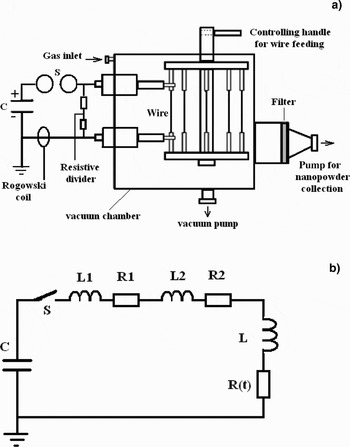
Figure 1 shows our experimental setup of EEW as well as its equivalent circuit for nano-powder production. Eight pieces of metal wire are installed on a wire holder made from two insulating discs inside the vacuum chamber. A controlling handle for the wire holder comes out through the top plate of the vacuum chamber. By rotating the handle in the horizontal plane, each wire could be moved, in turn, to the right position to connect two electrodes inside the chamber. In this way, eight wires could be exploded one by one without opening the chamber.
Experimental setup for nano-powder production by exploding wires. (a) Schematic diagram. (b) Equivalent circuit.

In Figure 1b, C is the energy storage capacitance of 2 µF; s is a gas spark gap switch; L 1 and R 1 are the equivalent inductance and resistance of the external circuit outside the vacuum chamber, respectively; L 2 and R 2 are those inside the chamber. L and R(t) are the equivalent inductance and time-varying resistance of the wire, respectively. Since the resistive divider was installed outside the vacuum chamber, the voltage across the wire could not be directly measured. In order to compare the wire voltage obtained from simulation with the experimentally measured ones, we need to know not only the values of the total inductance and the total resistance of the external circuit, i.e., L 1 + L 2 and R 1 + R 2, but also the values of L 2 and R 2. By replacing the resistive divider with a thick aluminum rod and then making short-circuit discharge, L 1 and R 1 were calculated from the waveform of the measured discharge current to be 1.96 µH and 65 mΩ, respectively. By replacing the wire inside the chamber by the aluminum rod and using the same method, L 1 + L 2 and R 1 + R 2 can also be calculated. Since L 1 and R 1 are known, L 2 and R 2 could be determined to be 0.52 µH and 5.4 mΩ, respectively. The wire inductance L was calculated using the following empirical formula (Chen et al., Reference Chen, Liu, Luo and Zhang1992),
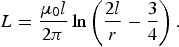
where μ0 is the magnetic susceptibility of the vacuum; l and r are the wire length and radius, respectively.
The only unknown parameter in the equivalent circuit is the time-varying resistance R(t). It has been demonstrated that R(t) can be expressed as a unique function of either energy, W = ∫i 2 · R(t) · dt, or specific action, g = ∫j 2 · dt (Tucker, Reference Tucker1961), where i and j are current and current density, respectively. Energy, although perhaps physically more meaningful, contains the resistance implicitly; on the other hand, the specific action involves only current and time.
A simplification of the quasi-static theoretical model for R(t) developed by Tucker and Toth (Reference Tucker and Toth1975) was used. R(t) was described in terms of two basic processes, the heating process in a given phase and the phase change process. Based on conservation of energy, the formulas of the resistivity were derived for these two processes.
For the heating process in a given phase the resistivity of the wire can be expressed by

where ρi is the initial resistivity at t = 0, the time when heating starts; g max and ρmax are the values of g and ρ at the end points of the heating phase, i.e., the points of the onset of melting or vaporization.
In the case of phase change processes in which the wire is a two-phase material of solid and liquid or liquid and vapor, energy conservation, i.e., i 2R × dt = −H × dM, yields
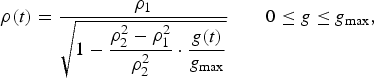
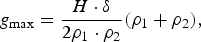
where H is the latent heat of fusion or vaporization; M is the mass of phase 1; ρ1 and ρ2 are the resistivity of phase 1 and phase 2 at melting temperature or vaporization temperature, respectively; g max corresponds to the point when the material of phase 1 is completely transformed into that of phase 2, δ is the mass density of phase 1.
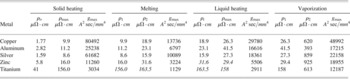
The parameters, such as ρi, ρmax, ρ1, ρ2, and g max in Eqs (2) and (3) were given by Tucker and Toth (Reference Tucker and Toth1975) and are listed in Table 1 for some materials used in our circuit simulation. As well-known, the region of vaporization is characterized by a very rapid increase of resistance associated with a decrease in wire cross-section. If the voltage across the wire is sufficiently high, the resistance rise will be terminated by an arc breakdown through the wire vapor, resulting in a resistance maximum designated the “burst.” Hence, EEW in our simulation was ended by a vapor breakdown, forming plasma with a resistivity of empirical values.
Parameters used in simulation for some metals

RESULTS AND DISCUSSIONS
With the model of the wire resistance described above, the nonlinear circuit shown in Figure 1b was numerically solved using a circuit analysis code called Simplorer from ANSOFT. In order to check the validity of the circuit simulation, the simulation results of exploding copper, titanium and zinc wires are compared with our experimental results for these materials.
Exploding Copper Wires
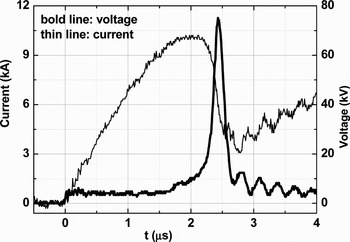
The copper wires used in our experiment are 196 µm in diameter and 85 mm in length, which yields an equivalent inductance of 0.11 µH calculated using Eq. (1). Figure 2 presents the waveforms of the discharge current and voltage measured in the experiment in which the energy storage capacitor was charged to a voltage of 20 kV. It shows a typical picture of exploding wire. The voltage begins to rise strongly when the current reaches its maximum of about 10 kA and then falls down, which means that the vaporization of the wire begins, leading to a rapid increase of the wire resistance. After the current falls down to a value of 3 kA, it rises up again, which represents an arc breakdown through the wire vapor, a shunting of the current by this low resistance arc.
Waveforms of discharge current and voltage measured in the experiment.

It should be noted that the experimentally measured voltage shown in Figure 2 is not the voltage of the wire resistance but rather the voltage across L 2 and R 2 in addition to the wire voltage. The voltage of the wire resistance is important for us to make an estimation of the energy deposition in the wire before the explosion. It was calculated by

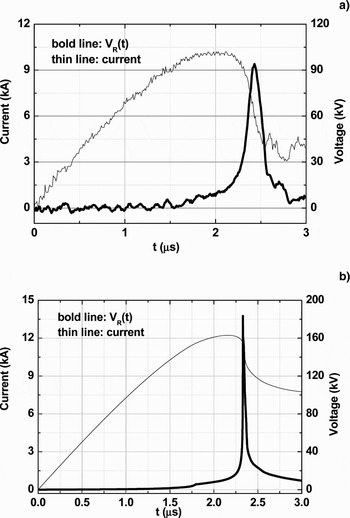
Since V m(t) and i(t) are the measured voltage and current, we called V R(t) obtained using Eq. (5), the experimentally obtained V R(t). The experimentally obtained V R(t) together with the measured current are compared to those obtained from the circuit simulation, as shown in Figure 3.
Comparison of the current and the voltage of the wire resistance. (a) Experimental results. (b) Simulation results.

It is obvious that the waveforms of the current in the experiment and the simulation are quite similar in shape, but a little bit different in amplitude, about 10 kA occurred in the experiment in contrast to 12 kA in the simulation. The reason for this difference may be that the inductance of the circuit used in the simulation was experimentally determined a little bit lower than the real one. As we know, the current in EEW is mainly dependent on the inductance rather than on the resistance of the circuit before the vaporization of the wire. Concerning the voltage, the waveform in the experiment is wider in the pulse width and much lower in the amplitude than in the simulation, about 95 kV in contrast to 180 kV. Except that the higher current the simulation would cause a higher voltage in the simulation. The main reason for this big difference in the voltage pulse obtained in the experiment and the simulation, may be caused by the fact that the time response of the resistive divider, we used to measure the voltage in the experiment is not fast enough for the measurement of a narrow pulse of about 50 ns in full width at half magnitude (FWHM) as shown in Figure 3b. Indeed, the voltage pulse of EEW in experiments should be such a narrow pulse (Tucker, Reference Tucker1961). It is well known that a voltage divider of lower time response will change a narrow pulse to a wider in pulse width and smaller in amplitude output one. We had calibrated the resistive divider with a quasi-square wave of about 7 ns in rise time, to our surprise; the output pulse from the divider became 20 ns in rise time, 13 ns longer than the real one. Furthermore, it should be indicated that the results from the circuit simulation were based on a computation with 0.1 ns time step that means with quite a high time resolution. If the time step of the computation was changed to 10 ns to reproduce, to some extent, the effect of the slow time-response divider, the amplitude of the voltage in the simulation was decreased from 180 kV to 140 kV. Based on these analyses, we believe that the waveform of the measured voltage was much distorted by the divider and the voltage obtained from the simulation may be more believable.
The wire resistance and the energy deposition in the wire could be readily obtained by the calculation using V R(t) and i(t). It was found that the wire resistance behaves almost in the same way as V R(t) does, i.e., a narrow pulse with its maximum of about 16Ω, appearing at the time when V R(t) is maximum, which means that the current is mainly determined by the rapidly increasing wire resistance after the vaporization of the wire, begins. The energy deposition in the wire can be calculated by
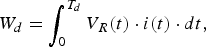
where T d is the time at which the energy deposition stops usually by an arc breakdown through the wire vapor.
For an exploding wire, the wire may be under heated, i.e., the arc breakdown through wire vapor occurs before the wire is fully vaporized, or overheated, i.e., one has a high rate of the energy deposition in contrast to the expansion lag. W d is an important parameter for the application of EEW in the production of nano-powders since the particle size usually decreases with the increase of the overheating of the wires, i.e., the ratio of W d to the specific energy of sublimation. Unfortunately, T d is a parameter difficult to be predetermined due to the complicated process of the arc breakdown through the wire vapor. In the model, it was assumed that the arc breakdown happens as soon as the deposited energy reaches W vapor, a value just enough to vaporize the whole wire, 135 J for one copper wire we used. As a result, W d unfavorably becomes a constant for a definite wire and no overheating or under heating could be predicted from this model. Even so, the rate of the energy deposition obtained from the circuit simulation based on this model could be helpful to choose the right experimental conditions to increase the possibility of overheating.
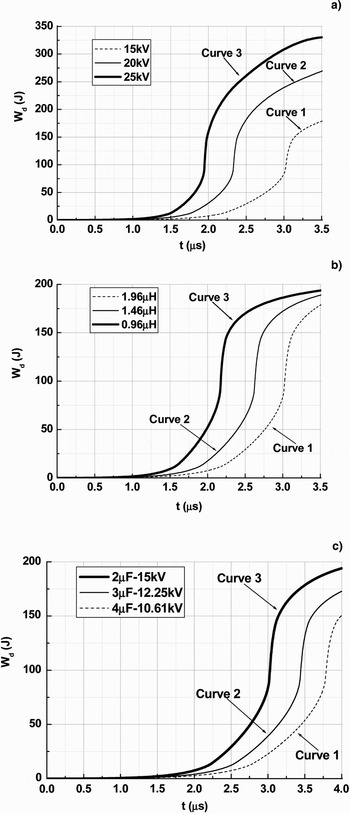
It is expected that a high rate of energy deposition can be realized with a high rate of current rise. There are several ways to increase the rise rate of the current, including raising up the charging voltage of the energy storage capacitor, reducing the capacitance of the energy storage capacitor while keeping the stored energy unchanged, lowering the inductance of the external circuit outside the vacuum chamber. Figure 4 shows the corresponding results of the simulations.
Rate of the energy deposition as function of the circuit parameters. (a) L 1 = 1.96 µH, c = 2 µF. (b) U charge = 15 kV, c = 2 µF. (c) L 1 = 1.96 µH, W storage = 225 J.

From Figure 4 it can be seen that during the first microsecond, the deposited energy is very small due to the small wire resistance, no matter which circuit parameters were chosen in the simulations. Hence, we defined the averaged rate of energy deposition as
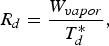
where T d* is the time interval from t = 1 µs to the time instant corresponding to W vapor, the effective time of the energy deposition.
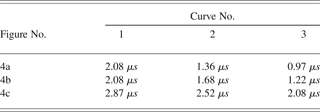
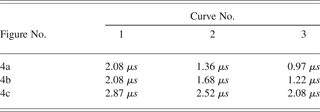
Since R d is inversely proportional to T d*, we need only to pay attention to T d* that was listed in Table 2. Figure 4a yields a group of shortest T d*, but it was obtained at the cost of consuming much more energy in one discharge. While consuming a lower energy compared to Figure 4a, Figure 4b yields a group of a little bit longer T d*. It seems that lowering L 1, the equivalent inductance of the external circuit outside the vacuum chamber, is a good choice. However, when you put this method into practice you would find that the equivalent inductance of a circuit working at a high voltage could be limitedly reduced. For Figure 4c, the shortest T d* of 2.08 µs was obtained by reducing the capacitance of the energy storage capacitor while keeping the stored energy unchanged at 225 J. It is probably the most practicable method for reducing T d*.
The effective time of the energy deposition T d* as a function of the circuit parameters
Exploding Titanium Wires
While the above model of wire resistance works well in the circuit simulation for the metals of high conductivity and low sublimation heat, such as copper, aluminum, gold, and silver, it introduces a big error into the calculated voltage of the exploding wires made from titanium and zinc. The reason for this may be that the resistivities of titanium and zinc anomalously change with the joule heating. As we know, the resistivity of many metals may be expressed by a linearly increasing function of temperature, i.e.

where T is the temperature; ρi and T i are the initial resistivity and temperature, respectively; k is the linear factor depending on the metal material.
The model of wire resistivity we used for the heating process, Eq. (2), was derived based on energy conversation and Eq. (8). However, as was shown in italics in Table 1, the resistivity of titanium and zinc are decreased rather than being increased during the process of liquid heating, which means that their resistivity may not be expressed by Eq. (8). It should be noted that some other metals such as palladium, vanadium, and scandium, also show a decreasing resistivity during the process of liquid heating.
Although the resistivity of titanium and zinc may not be expressed by the explicit functions of specific action g, i.e., Eqs (2) and (3), the relationship between ρ and g can be read out, point by point, from the experimentally obtained curves provided by Tucker (1975). With this method, which we called resistivity acquisition method (RAM), the nonlinear circuit shown in Figure 1b may also be numerically calculated.
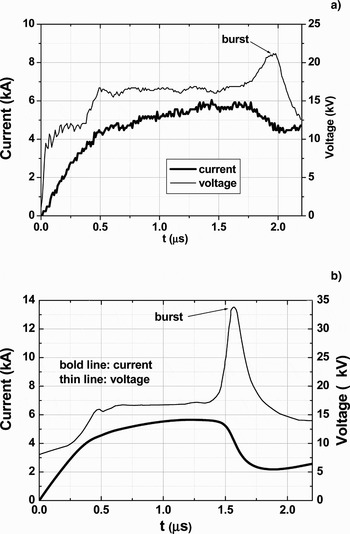
Figure 5 shows the comparison of the results of exploding titanium wires obtained by the experiment and by the simulation with RAM. The titanium wires used in our experiment are 234 µm in diameter and 85 mm in length. By making the circuit outside the vacuum chamber more compact, L 1 was reduced from 1.96 µH to 0.94 µH. The energy storage capacitor of 2 µF was charged to a voltage of 20 kV.
Comparison of the results of exploding titanium wires. (a) Experimental results. (b) Simulation results.

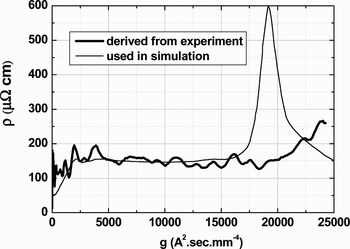
It can be seen that the experimentally measured current and voltage agree well with those obtained in the simulation until t = 1.45 µs, which means one has more or less the same deposited energy or specific action in the wire in both cases before t = 1.45 µs. After that time, the wire in the simulation first begins to burst, a voltage peak occurs, and the experimental results become quite different from the simulation ones. While the burst happens at the time t ≈ 1.57 µs and with the amplitude of 34 kV in the simulation, it appears at the time t ≈ 1.98 µs and with the amplitude of 21 kV in the experiment. Even with more or less the same specific action before the burst, the wire bursts behave differently in the experiment and the simulation. It was suggested by this phenomenon and confirmed by Figure 6 that during the burst, the dependence of the wire resistivity on the specific action g, i.e., ρ = f(g), which we used in the simulation is different from the experimental one derived from Figure 5a. It is this difference that results in the differences between Figures 5a and 5b.
Dependence of the wire resistivity on the specific action.

CONCLUSIONS
The electrical behavior of exploding wires of high conductivity and low sublimation heat, such as copper, aluminum, gold, and silver, can be well simulated based on the resistivity model developed by Tucker in which the resisitivity is expressed by the explicit functions of specific action, i.e., ρ = f(g). For metals such as titanium and zinc with anomalously changing resistivity, i.e., decreasing rather than increasing one at liquid heating, the circuit simulation of the exploding wires can be performed using the implicit relationship between ρ and g that is read out point by point from the experimentally measured curve. Using the circuit simulation the rate of the energy deposition in the exploding wires before the explosion can be obtained, which is helpful to choose the right experimental conditions for possible overheat that is desirable for getting smaller nano-powders produced by exploding wires.
ACKNOWLEDGEMENT
This research was supported by National Natural Science Foundation of China under contracts 50677034.