Historically, auxin-type herbicides, such as dicamba, have been a concern to herbicide applicators because of frequent injury to adjacent broadleaf crops as a result of off-target movement (Auch and Arnold Reference Auch and Arnold1978; Weidenhamer et al. Reference Weidenhamer, Triplett and Sobotka1989). Off-target movement of herbicides, otherwise referred to as drift, occurs as a result of either physical spray drift or vapor drift. The latter is primarily a function of volatilization that takes place after spray particles reach their intended site and can be influenced by various abiotic factors such as temperature and relative humidity (Egan and Mortenson Reference Egan and Mortenson2012; Mueller et al. Reference Mueller, Wright and Remund2013). As such, increased temperature and low humidity tend to intensify the risk for volatility to occur by increasing the amount of atmospheric space for evaporation to take place (Mueller et al. Reference Mueller, Wright and Remund2013). Additionally, the vapor pressure of herbicidal compounds can also greatly influence the occurrence of vapor drift. As a general rule, the higher the vapor pressure of a specific herbicide, the greater the risk it has to volatilize.
In contrast to vapor drift, physical particle drift is not greatly influenced by the chemical characteristics of the herbicide and, in contrast, it occurs at the time of application instead of afterwards. Factors that impact the application itself, primarily wind speed, play a major role in the likelihood of physical drift occurrence (Maybank et al. Reference Maybank, Yoshida and Grover1978). Yarpuz-Bozdogan (Reference Yarpuz-Bozdogan2011) reported that improper application speed, boom height, and nozzle selection can also contribute to the occurrence of physical drift. For many commercial applicators, time is always a concern. However, if applicators are able to take the necessary precautions, physical drift can be combated in several ways. First and foremost, wind speeds should not be in excess of the label restrictions, nozzle sizes should produce the largest possible droplet size without the threat of jeopardizing herbicide efficacy, and lower pressure combined with high spray volumes should be used whenever possible (Maybank et al. Reference Maybank, Yoshida and Grover1978; Wolf et al. Reference Wolf, Grover, Wallace, Shewchuk and Maybank1992; Womac et al. Reference Womac, Goodwin and Hart1997).
Dicamba drift is a major concern within the agricultural community (Riar et al. Reference Riar, Norsworthy, Steckel, Stephenson, Eubank and Scott2013). Dicamba is a synthetic auxin herbicide in the benzoic acid family, which is currently sold under numerous trade names. Dicamba is marketed as the dicamba acid, dimethylamine salt of dicamba, diglycolamine salt of dicamba, sodium salt of dicamba, and most recently the N, N-bis-(aminopropyl) methylamine salt of dicamba. Currently, dicamba-containing products are registered for use in corn, grain sorghum, various small grains, and pasture. The herbicide can also be applied in cotton and soybean as dicamba-resistant technologies are now offered commercially (XtendTM, trademark of Monsanto, St. Louis, MO).
Previous research has demonstrated numerous consequences of dicamba drift onto non-dicamba-resistant soybean, such as reduced growth, fewer seeds per pod, lower seed quality, maturity delays, and pod malformation (Anderson et al. Reference Andersen, Clay, Wrage and Matthees2004; Auch and Arnold Reference Auch and Arnold1978; Griffin et al. Reference Griffin, Bauerle, Stephenson, Miller and Boudreaux2013; Kelley et al. Reference Kelley, Wax, Hager and Riechers2005; Wax et al. Reference Wax, Knuth and Slife1969; Weidenhamer et al. Reference Weidenhamer, Triplett and Sobotka1989). Symptomology can be slight, such as chlorosis of the terminal buds, cupping or crinkling of canopy leaves, and leaf or stem epinasty. Higher rates can result in stem cracking, terminal death, or plant death (Griffin et al. Reference Griffin, Bauerle, Stephenson, Miller and Boudreaux2013; Solomon and Bradley Reference Solomon and Bradley2014; Thompson and Egli Reference Thompson and Egli1973). Soybean sensitivity is such that visible dicamba symptoms can often be seen even when quantitative instrumentation cannot detect the presence of molecules in plant tissue, suggesting that soybean is perhaps a better indicator of dicamba than analytical technology (Andersen et al. Reference Andersen, Clay, Wrage and Matthees2004; Lorah and Hemphill Reference Lorah and Hemphill1974; Marquardt and Luce Reference Maraquardt and Luce1961; Yip Reference Yip1962).
The continued evolution of herbicide-resistant weeds is arguably the top concern in the weed science community today. In rice (Oryza sativa L.), new weed-control technologies are needed as a result of the stress that barnyardgrass [Echinochloa crus-galli (L.) P. Beauv.] and other weeds continue to place on current production systems. In light of this concern, many chemical companies have revamped their herbicide discovery programs. Florpyrauxifen-benzyl (Dow AgroSciences LLC, Indianapolis, IN) is an herbicide currently under development in rice that which will represent the second herbicide in a new structural class of synthetic auxins, the arylpicolinates. This herbicide provides an alternative site of action in rice and displays broad-spectrum, POST control of broadleaf, grass, and sedge species at low use rates (Miller and Norsworthy Reference Miller and Norsworthy2015). While the potential benefits that florpyrauxifen-benzyl can bring to the rice weed-control market are clear, auxin-type herbicides, such as dicamba, have historically been a concern to soybean growers in terms of drift. In Arkansas and other midsouthern U.S. rice-producing states, soybean is frequently grown as a rotational crop with rice, and it is common for soybean fields to be located adjacent to rice fields, thereby having potential for off-target movement of rice herbicides onto soybean.
The purpose of this research was to evaluate the potential for florpyrauxifen-benzyl to injure neighboring crops as a result of off-target movement relative to dicamba. Because of its auxin-like nature, florpyrauxifen-benzyl applied at low rates will likely cause significant injury to soybean and result in injury and yield loss similar to that seen with dicamba. The objectives were 1) to evaluate the sensitivity of corn, cotton, grain sorghum, soybean, and common sunflower to florpyrauxifen-benzyl and 2) to evaluate and compare soybean injury and yield loss following applications of florpyrauxifen-benzyl or dicamba across various concentrations.
Materials and Methods
Sensitivity of Field Crops to Florpyrauxifen-benzyl
A greenhouse experiment was conducted during the spring of 2014 and repeated in the fall of the same year at the University of Arkansas−Altheimer laboratory located in Fayetteville, AR. The experiment was arranged as a completely randomized design with a two-factor factorial treatment structure and four replications. The first factor consisted of florpyrauxifen-benzyl rate: 0× (none), (1/10)× (3 g ai ha−1), (1/100)× (0.3 g ai ha−1), or (1/500)× (0.06 g ai ha−1) of the purposed 1× rate (30 g ai ha−1) of the herbicide. The second factor consisted of crop: soybean, cotton, common sunflower, grain sorghum, and corn. The cultivars included ‘Asgrow AG4730’ (soybean), ‘Stoneville ST 4946 GLB2’ (cotton), ‘Hunters’ (common sunflower), ‘DeKalb DKS53-67’ (grain sorghum), and ‘DeKalb DK46-36 RIB’ (corn). Seeds from each crop were sown in individual pots (6 cm in diameter) containing potting mix in a greenhouse with 32/22 C day/night temperatures. The plants were later thinned to one plant per pot. At the time of application, crops were at an early vegetative growth stage and heights averaged 13, 12, 15, 20, and 21 cm for soybean (V3), cotton (four leaf), common sunflower (three leaf), grain sorghum (V2), and corn (V2), respectively. Solutions were prepared using serial dilutions to achieve accurate concentrations, and 2.5% (v/v) methylated seed oil concentrate (MSO concentrate with LECI-TECH, Loveland Products, Loveland, CO) was added. Applications were applied inside of a stationary spray chamber with a two-nozzle boom track sprayer fitted with flat-fan 800067 nozzles (TeeJet Technologies, Springfield, IL) calibrated to deliver 187 L ha−1 at 276 kPa.
Visual estimates of injury were recorded 14 and 28 days after treatment (DAT) on a scale ranging from 0% to 100%, were 0% represented no injury and 100% represented complete plant death. Plant heights were also collected for each crop (treated and nontreated) 14 and 28 DAT. In addition, aboveground biomass was collected, dried, and weighed 28 DAT. For each crop, plant heights and dry biomass weights were then converted to a percent dry weight reduction relative to the nontreated control.
Data were subjected to ANOVA using the MIXED procedure in JMP Pro 12 (JMP Pro 12, SAS Institute Inc. Cary, NC 27513) and factors were analyzed as fixed effects. Where the ANOVA indicated significance, means were separated using Fisher’s protected LSD (α=0.05).
Comparison of Florpyrauxifen-benzyl and Dicamba on Soybean
A field experiment was conducted in 2014 and 2015 at the University of Arkansas Agricultural Research and Extension Center in Fayetteville, AR. The soil texture in the experimental area included a mix of Captina silt loam (fine-silty, siliceous, active, mesic Typic Fragiudults) and a Leaf silt loam (fine, mixed, active, thermic Typic Albaqults). In both years, fields were prepared through disking and cultivating prior to planting. Each experimental plot contained four rows spaced 91 cm apart, resulting in an overall plot size of 3.6 m wide by 7.62 m long. In both years, a glyphosate-resistant soybean (Asgrow®, trademark of Monsanto, St. Louis, MO) cultivar was planted; AG4730 was planted on May 22, 2014, and AG4933 was planted on May 1, 2015. Soybean was planted at a 2-cm depth at 296,000 seed ha−1 using a tractor-mounted John Deere 7200 MaxEmerge planter (John Deere Seeding Group, Moline, IL). Plots were irrigated four to six times using an overhead lateral irrigation system, and standard soybean production practices typical for the region were used. All herbicide treatments were applied to the two center rows with a CO2-pressurized backpack sprayer fitted with 110015 AIXR nozzles (Teejet Technologies, Springfield, IL) calibrated to deliver 143 L ha−1 at 4.8 km hr−1. The experiment was arranged as a randomized complete block design with a three-factor factorial treatment structure and four replications. The first factor consisted of soybean growth stage where either florpyrauxifen-benzyl or dicamba were applied at the V3 or R1 growth stage. The second factor consisted of the herbicide treatment where either florpyrauxifen-benzyl or dicamba (Clarity®, trademark of BASF, Research Triangle Park, NC) was applied. The third factor consisted of the concentration of florpyrauxifen-benzyl or dicamba used, where either 0, 1/20, 1/40, 1/80, 1/160, 1/320, or 1/640 of the 1× rate of dicamba (1× rate=560 g ae ha−1) or florpyrauxifen-benzyl (1× rate=30 g ai ha−1) was applied at the appropriate growth stage.
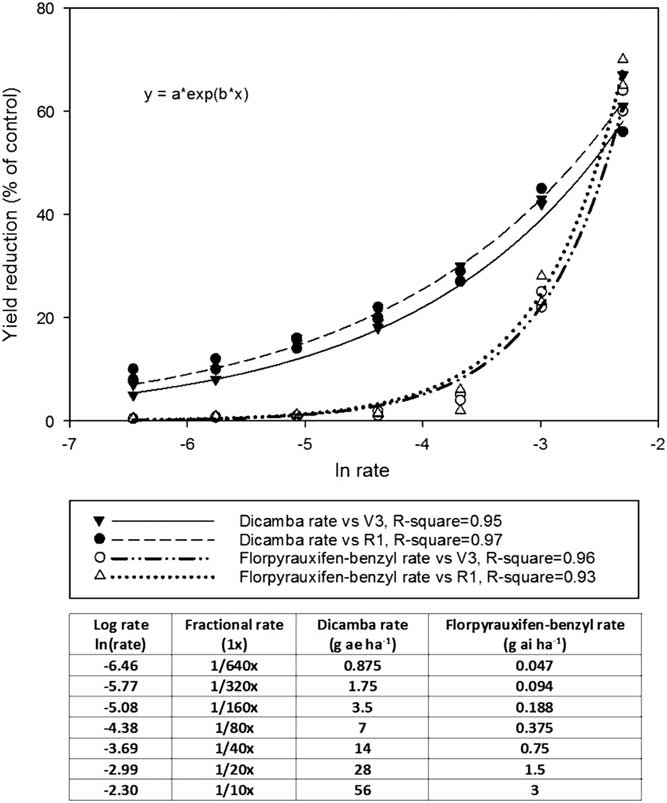
Estimates of visible soybean injury were recorded throughout the year on a scale of 0% to 100%, where 0% represented no injury and 100% represented complete crop death. In addition, soybean plant heights were collected throughout the season by measuring the distance from the ground to the tip of the most fully expanded leaf for five plants within each plot. Yield was determined at maturity by harvesting the two center rows from each plot with a small-plot combine and correcting to 13% moisture. All data were presented as a percentage of the nontreated check for the parameters measured. Data were first tested for normality to comply with the assumptions of homogeneous variance. Herbicide drift rate was transformed using the natural log of the fractional rate of the herbicide used. All data were regressed with a nonlinear regression model using JMP Pro 12 (JMP Pro 12, SAS Institute Inc. Cary, NC 27513), and graphs were constructed using Sigmaplot version 13 (Systat Software Inc., San Jose, CA). A two-parameter exponential growth model was selected and fit for all parameters based on minimum Akaike information criterion (AIC)/Bayesian information criterion (BIC) comparisons and then used for the nonlinear regression, which is indicated below:
 $$Y{\equals}a{^\asterisk}exp\left( {b{^\asterisk}X} \right),$$
where Y is the response (i.e., soybean injury 28 DAT), a is the asymptote, and b is the growth rate. For each treatment, data from 2014 and 2015 were pooled and then fit to the exponential growth model, which resulted in better predictions of soybean response to dicamba and florpyrauxifen-benzyl at V3 and R1 growth stages.
Results and Discussion
Sensitivity of Field Crops to Florpyrauxifen-benzyl
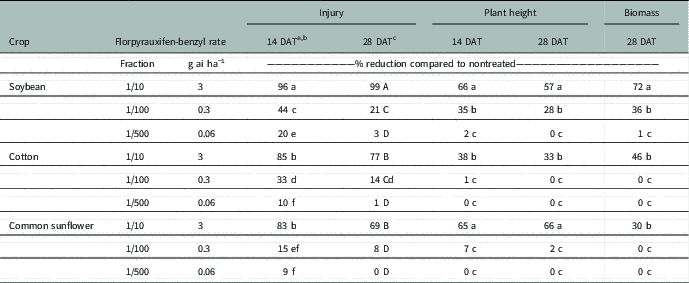
The ANOVA indicated a significant two-way interaction (P ≤ 0.05) between crop and herbicide drift rate for visible injury, plant height, and aboveground biomass (Table 1). Corn and grain sorghum were not affected (0% visible injury) by any of the drift rates used in the experiment, and no differences were observed for plant height or biomass compared to the nontreated control. Visible injury 14 DAT was the greatest with soybean (96%) when exposed to the highest rate of (1/10)× (3 g ai ha−1) of florpyrauxifen-benzyl and was significantly higher than all other crops and rates evaluated. At 14 DAT, soybean injury was 44% and 20% from the (1/100)× and (1/500)× rates, respectively. With crops soybean, cotton, and common sunflower, where visible injury was observed, symptomology was typically expressed as severe leaf and stem epinasty and stunting, followed by chlorosis and necrosis of leaves and stems from the highest rate [(1/10)×]. Symptomology of the same crops to lower rates such as (1/100)× or (1/500)× were expressed as minor stunting and leaf and stem epinasty. While the greatest injury 14 DAT was to soybean, cotton and common sunflower were also injured 85% and 83%, respectively, by the (1/10)× rate. However, these crops had less injury when a (1/100)× or (1/500)× rate was applied (injury ranging from 9% to 33%). By 28 DAT, visible injury remained the highest with soybean (99% injury) from the (1/10)× rate of florpyrauxifen-benzyl while only 21% and 3% injury was observed from the (1/100)× and (1/500)× rates, respectively. This result indicates that, while soybean can be significantly injured from high simulated drift rates [(1/10)×], the injury appears to dissipate quickly as dose decreases [(1/100)× or (1/500)×]. Cotton and common sunflower did recover slightly by 28 DAT, but still sustained 77% and 69% injury respectively from the (1/10)× rate of florpyrauxifen-benzyl. However, by 28 DAT injury only ranged from 0% to 14% when either of the crops were subjected to a (1/100)× or (1/500)× rate.
Effect of florpyrauxifen-benzyl drift rate on corn, sorghum, soybean, cotton, and common sunflower injury and plant height and aboveground biomass reduction, averaged over experimental runs.

a Means within columns followed by different letters are significantly different using Fisher’s protected LSD (α=0.05).
b Abbreviation: DAT, days after treatment.
c Height and biomass of nontreated 28 DAT: corn, 21 cm, 88 g; sorghum, 20 cm, 76 g; soybean 13 cm, 42 g; cotton, 12 cm, 40 g; common sunflower, 15 cm, 49 g
As a result of stunting caused by florpyrauxifen-benzyl, significant differences in plant height and aboveground biomass were observed in soybean, cotton, and common sunflower. At 14 and 28 DAT, each of the three affected crops had height reduction relative to a nontreated control when treated with a (1/10)× rate of florpyrauxifen-benzyl. However, only soybean expressed height reduction from the (1/100)× rate when compared to its nontreated control. Similarly, aboveground biomass for the three crops was less than that of the respective nontreated control when treated with a (1/10)× rate. Only soybean had a reduction in biomass caused by the (1/100)× rate.
Based on these results, several inferences regarding the sensitivity of crops to low rates of florpyrauxifen-benzyl can be made. First, corn and grain sorghum are likely to be tolerant to high drift rates of florpyrauxifen-benzyl. Second, soybean, cotton, and common sunflower had some sensitivity to low rates of the herbicide, which in turn caused noticeable injury, as well as a decrease in plant height and biomass accumulation. Finally, while negative effects were observed for soybean, cotton, and common sunflower, those effects primarily resulted from exposure to the highest rate tested [(1/10)×]. Only soybean expressed negative effects from the lower rate of (1/100)×. Therefore, these data lead to the suggestion that soybean will likely express some sensitivity to off-target movement of florpyrauxifen-benzyl in the field if the herbicide is applied to rice in the direct vicinity of soybean with the wind blowing toward the sensitive crop.
Comparison of Florpyrauxifen-benzyl and Dicamba on Soybean
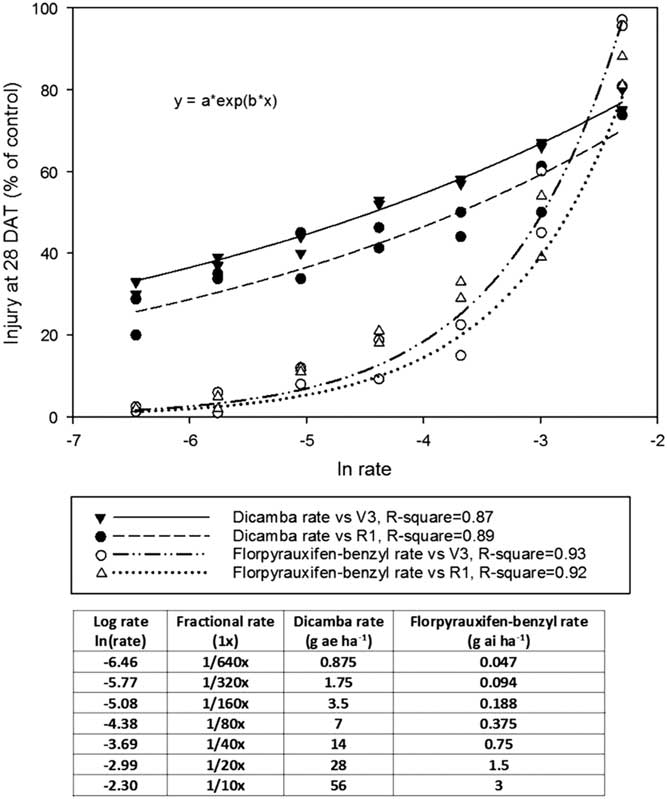
At 28 DAT, soybean injury from florpyrauxifen-benzyl and dicamba increased exponentially as rate increased from (1/640)× to (1/10)×, regardless of growth stage (Figure 1). In addition, soybean injury was greater when exposure occurred at V3 than when exposure occurred at R1 for both herbicides. At V3, florpyrauxifen-benzyl at (1/10)× (3 g ai ha−1) caused 96% to 97% injury, whereas the same rate applied at R1 resulted in 79% to 85% injury. A similar trend was observed for dicamba. The increased sensitivity of soybean to either of these auxin herbicides at an early growth stage (V3) is likely attributed to increased absorption at this younger, more rapid vegetative growth stage compared to the same plant at a more mature growth stage and a greater concentration of herbicide per gram of biomass relative to later exposure (R1) (Devine Reference Devine1989; Wanamarta and Penner Reference Wanamarta and Penner1989).
Soybean injury 28 days after treatment (DAT) as affected by rate of dicamba or florpyrauxifen-benzyl applied at V3 or R1 growth stages at Fayetteville in 2014 and 2015. Abbreviations: V3, vegetative third trifoliate; R1, reproductive first bloom; a, asymptote of the curve; b, growth point of the curve. The equation of the two-parameter exponential model is Y=a*exp(b*X), where Y is the response, a is the asymptote, and b is the growth rate: Dicamba rate in V3, y=129.10exp(0.2515x) Dicamba rate in R1, y=128.14exp(0.2219x) Florpyrauxifen-benzyl rate in V3, y=910.13exp(0.9746x) Florpyrauxifen-benzyl rate in R1, y=912.02exp(0.9817x)

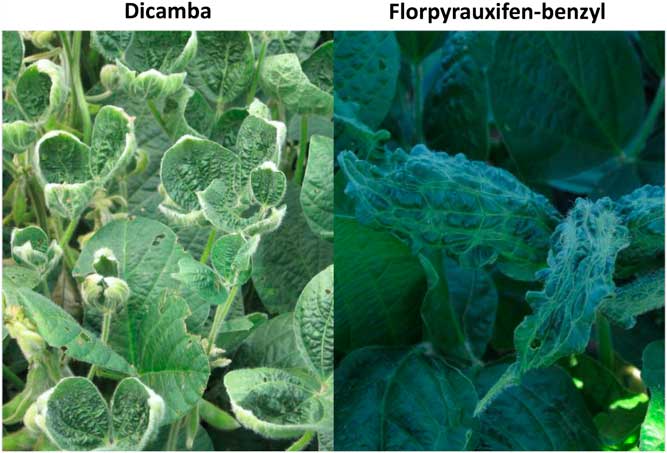
High rates [(1/10)× or (1/20)×] of florpyrauxifen-benzyl caused significant soybean injury 28 DAT (Figure 1). However, as the rate decreased from (1/10)× (3 g ai ha−1) towards (1/640)× (0.047 g ai ha−1), soybean injury resulting from florpyrauxifen-benzyl declined rapidly. The same, however, was not observed with dicamba, which caused ≥20% injury even at the lowest rate [(1/640)×], a higher than was seen with florpyrauxifen-benzyl (0%). Previous research has also reported significant soybean injury from low rates of dicamba (Griffin et al. Reference Griffin, Bauerle, Stephenson, Miller and Boudreaux2013; Norsworthy et al. Reference Norsworthy, Barber, Scott, Bond, Steckel and Reyoolds2015; Solomon and Bradley Reference Solomon and Bradley2014). Hence, these findings indicate that while florpyrauxifen-benzyl [(1/10)×] will cause significant soybean injury at a high drift rate, that injury will dissipate quickly as the rate decreases. It would then be practical to suggest that soybean immediately next to a florpyrauxifen-benzyl drift might incur substantial injury, but that injury would likely diminish rather quickly with concentration across the field. While both herbicides are auxinic, it is important to note that the symptomology caused by the herbicides is quite different in soybean (Figure 2). Dicamba primarily displays symptomology such as cupping of leaves, stunting, and pod malformation (Anderson et al. Reference Andersen, Clay, Wrage and Matthees2004; Griffin et al. Reference Griffin, Bauerle, Stephenson, Miller and Boudreaux2013; Weidenhamer et al. Reference Weidenhamer, Triplett and Sobotka1989). In contrast, soybean displays blistering, leaf and stem epinasty, and reduced growth from exposure to low rates of florpyrauxifen-benzyl (personal visual observation).
Soybean symptomology 28 days after treatment, as affected by (1/160)× rate of dicamba or florpyrauxifen-benzyl.

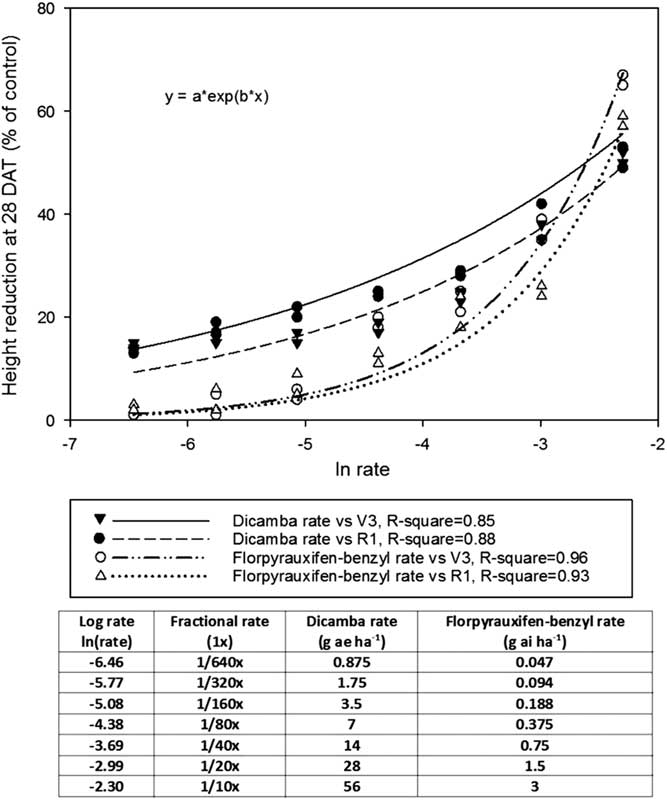
As mentioned previously, reduced growth was observed in soybean exposed to low rates of either of these auxin herbicides. Soybean that received no herbicide treatment was 41 and 73 cm tall 28 DAT for V3 and R1, respectively (data not shown). At 28 DAT, soybean height reduction from florpyrauxifen-benzyl and dicamba increased exponentially as rate increased from (1/640)× to (1/10)×, regardless of growth stage (Figure 3). At the highest drift rate of dicamba (56 g ae ha−1) and florpyrauxifen-benzyl (3 g ai ha−1), a height reduction of 45% to 50% and 55% to 65% was observed across V3 and R1 for each herbicide, respectively. Similar to injury, as the rate of florpyrauxifen-benzyl decreased, height reductions dissipated more rapidly than was seen with dicamba. Dicamba caused ≥16% reduction at the lowest rate [(1/640)×] compared to 0% with florpyrauxifen-benzyl. Griffin et al. (Reference Griffin, Bauerle, Stephenson, Miller and Boudreaux2013) also reported reduced growth when soybean was subjected to low rates of dicamba at the V3 and R1 growth stages.
Soybean height reduction 28 days after treatment (DAT) as affected by rate of dicamba or florpyrauxifen-benzyl applied at V3 or R1 growth stages at Fayetteville in 2014 and 2015. Abbreviations: V3, vegetative third trifoliate; R1, reproductive first bloom; a, asymptote of the curve; b, growth point of the curve. The equation of the two-parameter exponential model is Y=a*exp(b*X), where Y is the response, a is the asymptote, and b is the growth rate: Dicamba rate in V3, y=126.14exp(0.2725x) Dicamba rate in R1, y=127.08exp(0.2627x) Florpyrauxifen-benzyl rate in V3, y=908.21exp(0.9814x) Florpyrauxifen-benzyl rate in R1, y=910.14exp(0.9823x) Nontreated soybean was 41 and 73 cm 28 days after treatment for V3 and R1 growth stages, respectively.

Soybean that received no herbicide treatment produced seed yields of 2,690 and 2,620 kg ha−1 in 2014 and 2015, respectively (data not shown). Similar to injury and height reduction, soybean yield reduction from florpyrauxifen-benzyl and dicamba increased exponentially as rate increased from (1/640)× to (1/10)×, regardless of growth stage (Figure 4). Previous research has documented numerous negative consequences of dicamba drift onto soybean, such as fewer seeds per pod, lower seed quality, pod malformation, and reduced yield (Anderson et al. Reference Andersen, Clay, Wrage and Matthees2004; Auch and Arnold Reference Auch and Arnold1978; Griffin et al. Reference Griffin, Bauerle, Stephenson, Miller and Boudreaux2013; Kelley et al. Reference Kelley, Wax, Hager and Riechers2005; Norsworthy et al. Reference Norsworthy, Barber, Scott, Bond, Steckel and Reyoolds2015; Wax et al. Reference Wax, Knuth and Slife1969; Weidenhamer et al. Reference Weidenhamer, Triplett and Sobotka1989). Similar results were observed herein where dicamba caused 10% to 62% yield loss across all rates and growth stages. Unlike dicamba, florpyrauxifen-benzyl caused 5% to 71% yield reduction from (1/40)× to (1/10)× (0.75 to 3 g ae ha−1) of the herbicide, and all other rates resulted in a yield similar to that of the nontreated control, across both growth stages. Therefore, the initial hypothesis is not accepted because low rates of florpyrauxifen-benzyl on soybean will result in less injury and yield loss than low rates of dicamba will.
Soybean yield reduction as affected by rate of dicamba or florpyrauxifen-benzyl applied at V3 or R1 growth stages at Fayetteville in 2014 and 2015. Abbreviations: V3, vegetative third trifoliate; R1, reproductive first bloom; a, asymptote of the curve; b, growth point of the curve. The two-parameter exponential model Y=a*exp(b*X), where Y is the response, a is the asymptote, and b is the growth rate: Dicamba rate in V3, y=125.26exp(0.2589x) Dicamba rate in R1, y=126.64exp(0.2439x) Florpyrauxifen-benzyl rate in V3, y=907.47exp(0.9814x) Florpyrauxifen-benzyl rate in R1, y=908.83exp(0.9874x) Nontreated soybean yielded 2,788 kg ha−1.

Conclusions and Practical Implications
Results from these experiments show that soybean is more sensitive to florpyrauxifen-benzyl than corn, cotton, grain sorghum, and common sunflower are. Rates ranging from (1/10)× to (1/40)× of this new auxin herbicide can cause significant visible injury, height reductions, and yield reductions in soybean. Florpyrauxifen-benzyl may be as damaging or more damaging to soybean than dicamba is at these rates. However, lower rates of (1/160)× to (1/640)× florpyrauxifen-benzyl result in little to no injury or height or yield reduction and are far less damaging to soybean than dicamba is. Therefore, if off-target injury to soybean from florpyrauxifen-benzyl occurs during either of the growth stages examined herein, the chances for recovery and no yield loss will increase as drift concentration decreases.
In Arkansas, soybean is typically planted from May 1 to July 15 (dependent on various factors), while rice is planted from March 15 to May 31. Therefore, with the anticipated preflood application timing of florpyrauxifen-benzyl (H. Miller, personal communication), the potential to injure soybean is greatest during vegetative development. Results in this experiment found slightly less injury and height and yield reductions at R1 compared to V3 for either of the herbicides. However, further research is needed to determine the response of soybean to florpyrauxifen-benzyl under different reproductive growth stages and maturity groups. Dicamba is known to have its greatest impact on yield during the early reproductive stages, and damage to progeny caused by dicamba drift the following year is greatest at the R5 growth stage (Barber et al. Reference Barber, Norsworthy and McCown2014; Griffin et al. Reference Griffin, Bauerle, Stephenson, Miller and Boudreaux2013).
The results of this and other weed control research suggest that the positive attributes of this new herbicide will outweigh the slight risks for off-target movement onto soybean (Miller and Norsworthy Reference Miller and Norsworthy2015). However, growers and applicators should use extreme caution when applying florpyrauxifen-benzyl to a rice field that is adjacent to a soybean field. In addition, newly commercialized soybean cultivars expressing resistance to dicamba or 2,4-D will not protect against off-target movement of florpyrauxifen-benzyl because of its unique binding site (Epp et al. Reference Epp, Alexander, Balko, Buysse, Brewster, Bryan, Daeuble, Fields, Gast, Green, Irvine, Lo, Lowe, Renga, Richburg, Ruiz, Satchivi, Schmitzer, Siddall, Webster, Weimer, Whiteker and Yerkes2016).
Acknowledgements
Funding for this research was provided by the Arkansas Rice Promotion Board and Dow AgroSciences.