Introduction
The historiography of eighteenth-century India has been polarised. Historians have spoken of either general decline or degeneration in the aftermath of the decay of the Mughal Empire, or at the other end of the spectrum, focused on the realignments and reorientation occurring in large parts of the erstwhile Mughal Empire. Focusing on the newly emergent regional polities of the eighteenth century the revisionist writings, especially of those who have worked on North India, have striven to locate elements of political and economic animation. Historians have also delineated the economy of Mughal Bengal in detail.Footnote 1 However, the Nizamat era has been less explored. Older historiography has tended to regard individual character of the Nazims as determining the Nizamat's fortunes. They perceived Bengal declining in the post-Plassey phase, a waning of the fortunes which although intensified by the Company, was but a ‘natural sequel’ to the Maratha depredations.Footnote 2 The image portrayed in some writings of the ruling Nizamat élite as making and unmaking marketplaces, their almost whimsical propensity (note the tale of the magic drum being used in this context to illustrate the feature) ‘to intercede in all affairs of exchange, and visibly affect the ebb and flow of traders, wayfarers, pilgrims and goods’ also has its limitations.Footnote 3 Kumkum Chatterjee sees an intermeshing of the different rungs of the polity in Bihar with that of the merchants.Footnote 4 The evidence here would corroborate her work, but it also differs in attributing too close an interconnection with the political sphere. Even as the political fortunes of the ruling authorities varied, trade and commerce continued with vigour. The export trade, whether the Dutch (as in Om Prakash's writing),Footnote 5 or the Asian merchants (as in Sushil Chaudhury's work),Footnote 6 has been seen to buttress a prosperous Nizamat, but the Nazims themselves are depicted, if at all, as rather passive onlookers. Other formulations exist too, where the confrontation in Plassey or Palashi is seen as a ‘contest between two modes of production’ with Siraj-ud-Daula representing ‘decaying and degenerate feudalism’.Footnote 7
Eighteenth-century Bengal witnessed commercial prosperity and the state played a facilitating role in the smooth functioning of the economy. Muzaffar Alam and Sanjay Subrahmanyam in recent years,Footnote 8 as well as older historiography have briefly alluded to the Nizamat's direct involvement in trade. Rather than considering relations with European companies alone or concentrating on the new revenue policies and consolidation of zamindaris,Footnote 9 this essay attempts to portray the state's involvement with the larger economy. The conditions necessary for the functioning of marketing networks—protection of property and enforcement of contract—were maintained. It was a mutually beneficial system with both the state and the commercial sector symbiotically tied together.Footnote 10 The state in eighteenth-century Bengal appears to have had positive functions of recognising property rights and ensuring compliance, without actually initiating the formation of markets or laying down the rules of possession and exchange. Since peasants and other segments of society had recourse to alternative sources of protection and justice, the rulers and landed proprietors had to bargain for revenue, offering property rights and other services in return.Footnote 11 As it appears from the evidence here, the system of establishment of markets and ensuring the safety of routes were well thought out rational decisions, where the State had a say. However, this is not to suggest that it took all the decisions regarding its functioning. In the following pages, therefore, we will see the ways in which the indigenous regime of the Nizamat, even in difficult times, tried to intervene, or attempt to regulate various facets of the economy, be it the infrastructure of roads, or markets, or trading activities. The state systems in the eighteenth century were also major consumers of luxuries and other goods, which imparted a positive economic effect to the regional economy. The Nazims in their capital Murshidabad were not the only powerful ruling authority in the region. Numerous landed proprietors in the districts, constituting the second level of the state system, had an equally important role to play in the political and agrarian organisation as well as the commercial and economic well-being of the region. The ruling authority resolved conflicts, streamlined its revenue mechanisms, and yet, it was dependent on the landed proprietors, bankers and merchants. This was not a parasitic system. Although endemic violence marked this century, it was also characterised by a great degree of political, economic and cultural adjustments, flexibility and pragmatism. State systems in the ‘pre-colonial’ era were an intrinsic component of the economic terrain of the region, either through their direct involvement or indirectly through the facilitating policies that they pursued.
The Pre-Nizamat Era
. . . it is the ancient custom of Mogul Empire, as none could intrude or interfere on the business of each other, neither could obstruct merchants business with any means, whatsoever; such were the practice always exercised in this Empire for the encouragement of Trade in General and for augmenting Peoples livelyhood, Governments Revenues and duties in particular.Footnote 12
The Mughal Empire witnessed and even in some areas promoted specialisation in agriculture, the development of a rooted landed class and a flourishing commercial culture. The so-called successor states or more appropriately regional states continued this process of agrarian and commercial growth. The great trade routes and the circulation of commodities, merchant groups specialising in different goods and services, tied the constituents of the Empire together. Individual Mughal emperors experimented with novel kinds of bazars.Footnote 13 The long-term processes of urbanisation and expansion of trade continued. A common thread running throughout the medieval period appears to be the State's concern with land revenue but also markets, price regulation and related economic matters. Contemporary ideologues of the Turkish Sultans, for instance, while reflecting on the prevailing political trends among the ruling élite and other norms have not ignored the close relationship that existed between state policies and the health of the economy. They realised the significance of the standardisation of currencies and weights, and the importance of safe trade routes for transport of goods.Footnote 14 Scholars have even attributed positive consequences to the price and wage controls these monarchs introduced. One of Barani's observations was that the state should crush monopolists who dictated market prices through their control of transport systems and credit.Footnote 15 Studies of Mughal Imperial monetary policies highlight a sophisticated system in operation.Footnote 16
The measures that the rulers of Mughal, Ottoman and Safavid dynasties initiated to stimulate trade were modification of traditional economic policies that were the norms in the early modern Islamic world. Contemporary works directed monarchs to create an infrastructure of roads, bridges and caravanserais, and to protect travellers and merchants.Footnote 17 In part, strategic compulsions inspired these policies, but they always took into account the likely impetus to trade. As a result, customs revenues probably rose substantially. The ruling authorities levied duties throughout the Empire in various categories of markets and along the routes.
The medieval and early modern world was not opposed to the making of wealth or commerce as the old models of an either extractive military fiscal state or an ascetic warrior society with restrictive spending would suggest. Contemporary commentators remarked that people should seek abundance of wealth and ‘convenience of resources’. With wealth, one could achieve any level of ‘ascendancy’ in the world. A needy person, deprived of such pleasure in this world, would also be denied high rank in the next. The author of the Mau'izah-i-Jahangiri goes on to say that money was a ‘resource for boldness, a furbisher of opinion, and an ornamentation of and prop for power. A person without money was without friends’. No task initiated by an ‘empty handed person’ reached completion. ‘No desire that germinates in his heart is destined for fruition’. Apparent destitution and privation are the root causes of all sorts of disasters and all condemn a needy soul.Footnote 18Topos of the prosperity of the raiyat (subjects, peasants) is common to medieval akhlaq literature (Mirror of the Princes).Footnote 19
The Political Setting of Eighteenth-Century Bengal
Despite its fabled wealth, the region of Bengal in the eyes of the Mughal mansabdars (holders of an office who had to provide military service and/or civil duties in lieu of an allowance) was an unhealthy terrain, a different and strange world. During greater part of Aurangzeb's reign, Nazims and Diwans had come for brief periods and left soon after for none could hope to and desire to have anything beyond a 3-year assignment.Footnote 20 As a frontier province, Bengal had not been fully assimilated into the Mughal pattern of administration and bureaucracy, which the Mughals had imposed in Northern India. However, the increasing political disturbances in the North made a placement in Bengal, with its high revenue tributes to Delhi, seemingly attractive. Murshid Quli Khan, the last Diwan of Aurangzeb in Bengal, became the Nazim of the region soon after the Emperor's death, having combined the two offices in his person. He shifted the Nizamat from Dhaka to Murshidabad.Footnote 21 In the new dispensation, Murshid Quli Khan curtailed the powers of major mansabdars and enhanced the role of certain zamindars by endorsing the accretion of large expanses of territory. It was under him that the Subah (province) grew, in contrast to the earlier expansion and contraction according to the whim of the provincial government. During his nawabship, the Subahdar (provincial governor) drew the strings of Bengal's government permanently into his hands.Footnote 22 The revenue rates were increased under the successive Nazims. John McLane'sFootnote 23 computations show that Murshid Quli, Shuja-ud-Din and Alivardi Khan added roughly 40 percent to the pre-1722 jama (estimate) of 131.15 lakhs, underlying the need for resources for a newly emergent Nizamat, reeling as it was under the Maratha incursions and the Afghan rebellions in the 1740s. However, it is difficult to say the extent of their success in realising the actual amount given the distances, the range of intermediaries at each level of the revenue collecting chain and local level collusion. Direct challenge to the Nazim's authority would have of course invited immediate retaliation, but everyday small transgressions of rules were hard to punish.Footnote 24 The State itself, situated in a region with a high degree of agrarian commercialisation and extensive trade connections, did not let economic opportunities pass as is manifested in several cases mentioned in the Persian sources.
Crisis and Mobility
Wars and rebellions induced dislocations appear to be quite significant in the process of state formation and brought in a measure of dynamism. Texts like the Maharashtra Purana,Footnote 25 also demonstrated the political uncertainties of the period. The theme of this work revolves around Shahu Raja's complaints about non-receipt of chauth (revenue or tribute) from Bengal and the former's devastating inroads into the region. The Nizamat held on to the tribute from Bengal. The Mughal emperor was yet to confirm the Nazim's accession to the throne by issuing a sanad (official order) to that effect. The early years too witnessed considerable chaos with several political plots (1726, 1740, 1756), a series of devastating assaults by the Maratha Bargis between 1740 and 1750,Footnote 26 and an Afghan rebellion. In addition, the Nazims of Murshidabad had to maintain ties with Delhi and vigilance against the European Companies in the region. Yet, the politico-military engagements did not appear to have curtailed the expenditure of the State as evidenced from both their court and personal consumption. The architectural remains, which for instance dot Murshidabad, also indicate lavish spending. Though the immediate impact was devastating, the regional economy seemed to have recovered rapidly.
The rulers proved themselves through a display of military prowess, and it was a case of ‘the survival of the fittest’. The other important elements of the Calkins triad—the nobility, rich bankers and landed proprietorsFootnote 27—continued to negotiate with whoever was in power. As the number of military campaigns (chronicled in the Persian sources in great detail) often against recalcitrant zamindars, or competing factions vying for the throne,Footnote 28 show, the one which could most efficiently harness the resources, succeeded. Thus, reshuffling occurred in a system where generally one's birth or close association to the ruling family determined the right to the masnad or seat of power.
Upward mobility was very much possible, and so was accumulation of wealth. It was not too rare for even a ‘shopkeeper’ to become a diwan as for example Ratanchand who oversaw the management of the household, and even occupy the office of the Vazir (prime-minister), as Abdullah Khan did.Footnote 29 The faujdar (executive head of the sarkar or subdivision of a province) of Bhagalpur, being only in office for 14 years, could amass a fortune of 60 lakhs of rupees, 70 elephants, besides ‘a quantity of gems, precious stuffs, and gold’ and furniture.Footnote 30 Political, economic and religious élite were apparently fluid and consequently the social redistribution of wealth assured a constant renewal of demand.
The Ruling Authorities and Economic Infrastructure
Alivardi's assertion that the ‘merchants are the kingdom's benefactors, their imports and exports are an advantage to all men’,Footnote 31 guided the Nazims. The Nizamat, even in the early years of the eighteenth century, implicitly recognised the importance of mercantile activity and a vibrant system of markets to the regional economy, both rural and urban.
Even in the pre Nizamat days, Muhammad Azam Shah during his governorship of Bengal supposedly laid down a brick road in Dhaka,Footnote 32 to make travelling easier especially during the rains. During the monsoons, mud covered the thoroughfares in Dhaka, making movement for men as well as horses and elephants very difficult. The governor ordered a road to be laid which enabled free passage. Moreover, according to the author of the tract Nau-Bahar-i-Murshid Quli Khani, the Bengalis who had never seen a brick paved road before, wondered at the sight and rejoiced. ‘This practice continues . . . and many well-to-do men have laid down brick covered roads’.Footnote 33 The author might have exaggerated somewhat, for Portuguese contemporaries observed brick streets and lanes full of people, and markets well stocked with all kinds of commodities, at an even earlier date, and compared them to the new streets of Lisbon. The streets were well mapped out and arranged.Footnote 34 Shuja Khan (Shuja-ud-Din), when he was the governor of Orissa, had several stone bridges built over the rivers on the way to Murshidabad.Footnote 35
Inland water transport was organised on an efficient basis. The office of ‘Meer Behry’ (Mir-Bahari, or Admiralty; also port dues, a tax levied on the building of boats) oversaw the activities connected with this vital sector even during the times of the Mughals. Abul Fazl noted that boats were available everywhere; but in Bengal, Kashmir and Thatta, they were the main means of communication and transport upon which all commerce moved.Footnote 36 The naval department in Bengal was quite formidable with over 3,000 war vessels, later reduced to 768. The zamindars supplied a large number too. The governor of Bengal always maintained, according to another report, 8,000 horses and 1 lakh of foot soldiers, 100 elephants and 500 war boats.Footnote 37
Numerous sarais (inns) were built for accommodating travellers on the roadsides. Contemporary travellers observed that under former rulers they were the objects of much attention but in later periods they were reportedly in a state of ruin.Footnote 38 Sultan Shuja had a bridge constructed in Rajmahal that had three pointed arches, and in the middle two cupolas on each side of the battlements. He also had a magnificent caravanserai made there.Footnote 39 At an earlier period, Shaista Khan underwrote mosques, madrasas (educational institutions), rest houses, bridges and roads. Although a large numbers of sarais might have been lacking in Bengal, other forms of accommodation were readily available.Footnote 40
As other sources of income became less lucrative or less reliable, the gentry increasingly turned to trade and foundation of markets especially in the later half of eighteenth century in order to boost their revenuesFootnote 41; in addition, faced with the aggressive Company incursions in terms of buying up claims, there was a need for the Nazims to make a manifest show of their wealth and influence. Various members of ruling families even involved themselves in manufacturing and retailing liquor. Mubarak-ud-Daula and his family in particular dealt widely in toddy and ‘spirituous’ liquors.Footnote 42
Trade and the State
Ruling powers, trade and commerce were not antagonistically opposed. Prince Azim-us-Shan,Footnote 43 for instance, practised Sauda-i-Khas, that is goods that arrived on board the mercantile ships at the port of Chatgaon, were bought on behalf of the Prince. Afterwards these were resold to the merchants and were called Sauda-i-Am.Footnote 44 The King's money was coined first and followed by the merchants ‘who paid custom’ and then the rest gave in their silver for minting.Footnote 45 Merchants enjoyed a high status and even ‘nobility and the gentry of the Saiyad and Mughal tribes’ comprised some rich merchants.Footnote 46
Murshid Quli Khan had himself founded the Katra for the reception of pious and learned persons. He invited them from all parts of the subcontinent and afar.Footnote 47 He constructed the chauk (market square) of Dhaka.Footnote 48 He tried to keep the prices of food-grains cheap and did not allow rich people to hoard up stocks. Every week, he had the ‘price current reports’ of food-grains prepared and compared them with the prices paid by the poor people. Ghulam Hussain writes, if the latter were cheated he had the dealers and weighmen punished. His officials did not permit captains of ships to export food-grains beyond what were needed for actual consumption by those on board the ships. At the period of disembarkation of ships, the faujdar of the port of Hughli deputed to the harbour a preventive officer for inspection and attachment of the food-grains.Footnote 49 The Persian chronicle goes on to extol his virtues in bringing the faujdari of Hughli within his jurisdiction,
and placed the centre of the financial resources of the country of Bengal upon the customs duties levied from traders, he maintained peaceful and liberal relations with the merchants of England, China, Persia and Turan, and beyond the legitimate imports he did not levy one dam oppressively or against the established usage.Footnote 50
During Shaista Khan's tenure, the cheapness of food-grain enabled people to buy a seer of rice for a damri (dam, 1/40th of a rupee).Footnote 51 Due to mainly Munshi Jasunat (perhaps Jaswant) Rai's efforts, Sarfaraz Khan's deputy at Dhaka, the price was brought down to the level once current during Shaista Khan's reign.Footnote 52 Shuja-ud-Din also fixed levies on warehouses and factories, remitting it to the Imperial Treasury in Delhi through the banking agency of Jagat Seth Fatehchand.Footnote 53
The early modern indigenous states also tapped pilgrim traffic to the major centres. The pilgrim tax in Jagannath temple itself amounted to a huge sum annually.Footnote 54 All the ruling regimes exploited the potential revenue generating ventures.Footnote 55 Eighteenth century saw a considerable influx of silver into the region, brought by both the European companies, as well as by traders from Central Asia.Footnote 56 The state provided the important function of striking of coins in its mints, a privilege that was increasingly slipping into the hands of powerful bankers.
A Facilitating State?
The eighteenth-century state system was neither parasitic nor a proto bourgeois government in the sense that all social forms were mediated by the market. We might call it a facilitating state. A welter of rules and regulations, which laid out when and where one could be held, hedged around the foundation of markets and their functioning. The smooth running of the network was ensured by the ruling regimes through their systems of courts, law and administrative machinery. The judicial system was elaborate, both in the capital as well as in the interiors.Footnote 57 Arbitrators, chosen from among themselves, adjudicated disputes involving merchants.Footnote 58 Records suggest that the state system played a crucial facilitating role in the economy of the region. Neither could the markets be set up without the State's sanad, nor operate without the State's co-operation.Footnote 59 The ruling élite played a full role in the chartering of markets. Documentary evidence also demonstrate landed rulers and their officials acted as participating investors, subordinate to market principles, as well as fiscal beneficiaries and guarantors.Footnote 60
People perceived the State—whether the local functionaries of the Nizamat, or the Company—as a body of mediators. Its authority to grant the right to found markets was accepted with the expectation that in the case of contests and infringements of rights, the governing body would intercede and dispense justice and compensation.Footnote 61 The ruling powers had to devise methods to not only grant rights but also ensure that these were respected after the grant was made. Instances both in the Company records and in the indigenous accounts show that traders and merchants called upon the political authority to settle disputes. The incident of Rudraraya, the Maharaja of Khadi and Judi is a case in point. The latter became embroiled with a trader over the price of shoes and matters came to a boil. He beat up the shopkeeper and threw him out of his shop. The other shoe merchants thus ‘hastened to inform the governor of the Maharaja's misconduct’. However, the latter ‘out of fear’ sent a minister of his to the governor with a letter promising to pay a fine of a 100,000 silver pieces. The prince bought all the shoes for a sum of 10,000 pieces, distributed them among the people. Similarly, it is recorded in 1682 that the merchants of Dhaka protested against the impositions of the diwan.Footnote 62 Such instances can be found in other contemporaneous regional states too.Footnote 63
Contrast this with Banarasidas' account of the incident when the governor of Jaunpur imprisoned all the jewellers of the city and the harsh treatment meted out to them. Once freed, they all fled the city in droves. They only returned when the governor was recalled to Agra.Footnote 64 Political events seemed to have had a much more direct effect on the fate of traders in North India. No such panic reactions in Bengal are recorded in the sources that, for instance, followed Akbar's death elsewhere.Footnote 65 However, once the succession took place, things moved back to normalcy very quickly as Muzaffar Alam and Sanjay Subrahmanyam note, indicating resilience of political institutions even during periods of ‘crisis’.Footnote 66 Merchants banded together in a concerted way in the face of arbitrary actions of rulers, including the Company State. Indian merchants were reputed for their commercial acumen and even the diaspora of traders abroad in a city such as Isfahan were known for their wealth and hard work and were well trusted.Footnote 67
The ruling authority's role in controlling the major routes is well documented. For instance, Murshid Quli Khan established the thanas (police stations) of Katwah and Murshidganj on the highway leading to Burdwan. The Nazim appointed his special envoy Muhammad Jan to guard and control this important artery.Footnote 68 This emphasis on law and order did not flow out of merely altruistic considerations.Footnote 69 Secure roads and rivers had a positive effect on the smooth flow of trade, revenue, commodities for the ruling authorities, both commercial and military news, movement of pilgrims and other travellers, providing further inducement for the growth of the economy. While delegating power to local landed proprietors, the sanads specifically highlighted their responsibilities concerning maintenance of law and order and safety of pathways.Footnote 70 Many contemporary travellers also commented on the relative safety of travelling on roads.Footnote 71 Individual Nazims, such as Shuja-ud-Din, had expeditions carried out for suppressing the banjara tribe for instance. He also subdued the Rajas of Bitiah, Bhawarah, Chakwar, Bhojpur, Tikari, Cooch Bihar, Dinajpur and Birbhum.Footnote 72
When huge amounts of remittances were involved, Murshid Quli Khan himself with his retinue used to accompany the treasure to the suburbs of the capital. As the wagons made their way into another Subah, the Subahdar had them escorted to his fort and it was reloaded on carts and guarded with attendants supplied by him. The process was repeated until the treasure finally reached the Emperor in Delhi.Footnote 73
The Nizamat too was aware of the importance of intelligence gathering and interception and fixed chaukis (police posts) on all the roads especially during battles.Footnote 74 The Mughal outposts and forts were in the frontiers of the province or in disturbed areas, as also the ones established by the Nizamat. Company officials noted similar arrangements. When the Arakanese made inroads into the district of Jahangirnagar and adjacent places, the Nazim erected forts and thanas in different parts for the security and protection of the country. He had ‘prepared instruments of war for the purpose of punishing and expelling this seditious tribe’. These incursions were successfully repulsed. The arms were then transferred from the forts and thanas and deposited in Lal Bag and were since then at the disposal of the Nizamat Adalat (law court) and the Nizamat Amla (administrative officials).Footnote 75 The sources often mentioned the Nizamat daks (posts) on the road to Dhaka.Footnote 76 The Mughal faujdaris and thanas were generally posted in the frontier or disturbed areasFootnote 77 unlike the Company's dispersed ones. Contemporaries noted that there was ‘no post of horses in India; but there is a post of men on foot, established all over Hindostan at every cosse’.Footnote 78 Bodies of spies were an intrinsic part of the indigenous state system.Footnote 79 Prisons were very much a part of the State's arsenal for ‘disciplining’ the contumaciousFootnote 80 and the ‘law’ breakers.
Court Culture
Involvement in the economy need not mean a direct investment in the infrastructure of roads and markets alone. The ruling authorities, through their massive spending on ‘luxuries’ and even daily necessities had a crucial role to play in the economic well being of the region.Footnote 81 ‘Luxuries’ would consist of anything that gave social or bodily satisfaction, and are normally linked with corporeal and sensory pleasures.Footnote 82 Luxury had to be widely coveted, but acquired by few.Footnote 83 Material culture consisted of physical objects that the élite consumed in their every day lives. Not only did an extensive service industry located in the capitals and other centres benefit, but also the advantages spread out into the hinterlands and rural producing areas. Elaborate court culture, conspicuous consumption, pageants and festivals had significant economic repercussions. The wealth of the élite also percolated down through philanthropic activity. This is not to conjure up the notion of jajmani system,Footnote 84 but to draw attention to the many welfare activities that governing bodies and individuals undertook. Charity could be a prescriptive norm, but more than that, it appears to be almost like a contractual obligation, competitive in nature, where taxes and revenues were paid by different strata of society in the expectation of benefits and state action in return. Included in this moral economy was the expectation that the rich would help the poor and the needy during natural calamities or personal misfortunes.Footnote 85
The court in Bengal, as elsewhere in the early modern period, in a widely accepted definition, was an arena of interface between the Nazims and other sections of society, a ‘cultural trend-setter’, centre of patronage, focus of politics and the household of the ruler.Footnote 86 Court culture included habits of consumption, religious beliefs, devotional practices, modes of dress and other markers of status and function and the patronage of arts.Footnote 87 Increasing financial liquidity fuelled increased demands of luxury goods and their consumption. Though Philip Calkins and others have noted the presence of rather scaled down buildings and pomp among Mughal Bengali élite,Footnote 88 there were no signs that the Nizamat court was ‘foundering as a vehicle of noble lifestyles, high-status cultural patronage, and political power brokering’Footnote 89 in the eighteenth century. Indeed, this was true in the other regional states as well. The last quarter of the century saw the development of a distinct culture in Awadh under Asaf-ud-Daula and his successors.Footnote 90 Similarly, Bengali court society also blossomed. The history of eighteenth-century Bengal consists of a complex interweaving and interaction of cultural forms and values. The mainly Bengali landed élite, the Mughal centre with its distinct and magnificent court culture and its universal acceptance as a Sovereign, the English officials, neighbouring state of Awadh, as well as the opulent Hyderabad court, might have impinged on the imagination of the Bengal Nizamat even as its political fortunes waned. In the case of Bengal, court culture had a deep historical precedence even as it was open to outside influence. The courts of the Bengal Sultans were no less glittering, with elaborate rituals, norms and grandeur as contemporary accounts testify.Footnote 91
The process of ‘invention of tradition’Footnote 92 can be clearly seen, for instance, in the darbar (court) rituals of the Mughals. Ceremonies, complex Indo-Persian etiquette and ritualsFootnote 93 patterned authority and subordination.Footnote 94 As Norbert Elias writes, etiquette and ceremony were means to exercise power.Footnote 95 What was true for the Mughals with their rigid codes of behaviour cannot perhaps be applied to the Nazims completely, as they had greater accessibility. They seemed to have elements of at least two of the three types of courts observed in Europe—the ceremonial and the sociable with the latter predominating.Footnote 96 The decision to cultivate the relaxed and more inclusive atmosphere in Murshidabad might have been deliberate. Shuja-ud-Din had demolished the buildings that Murshid Quli Khan had erected and built new palaces, arsenal, gateway, revenue court, a public audience hall, private office, a boudoir, reception hall, court of chancery, gardens, a mosque and court of justice. Contemporary observers noted the luxurious style of his living.Footnote 97 Even in the midst of much political flux, with Alivardi Khan at the helm, affairs of the state were conducted with regularity. In winters, he used to go hunting in RajmahalFootnote 98 and he spent the rest of the year in his capital. The days of the week were devoted to a particular business. Describing the daily schedule of this Nazim, Tabatabai noted that he gave audience twice and a patient hearing to all comers in his assembly hall.Footnote 99 The day was so scheduled that the Nazim could spend time with selected important functionaries, as well as other subjects and his personal entourage. This in itself of course was not something novel.Footnote 100 Perhaps rulers were assumed the ones who governed the flow of time and submission to the rules of a mechanical device would be incompatible with regal majesty. Hence, the ruling authorities' apparent lack of interest in buying watches as a contemporary noted.Footnote 101 Although they were curious about them and received many as gifts, they appeared to put more reliance on specialised timekeepers. William Bruton had observed similar arrangements for timekeeping by measuring water.Footnote 102 However, Mubarak-ud-Daula after his accession bought clocks and ‘curious pieces of mechanism’ and other jewellery made in England.Footnote 103 The palace itself perhaps was a clock, its ciphered sounds following the course of the sun. The Nazim in the heart of the palace, and the province, kept his ears attuned to every changing resonance.Footnote 104
The Court and Conspicuous Consumption
A steady stream of people as well as commodities, whether poets and musicians, or goods such as silk, tobacco, coffee,Footnote 105 spices, dyestuffs and textiles across Central Asia tied Mughal India to the Ottoman Empire through the larger part of seventeenth and eighteenth century. ‘From Mughal Delhi to Ottoman Sarajevo, poetry connected another world of cultural goods’.Footnote 106 Besides the remittances in the form of money, a very diverse array of goods and animals such as elephants, horses, buffaloes, domesticated deer, game, wolf-leather shields, mats mounted in gold, mosquito curtains, ivory, musk, musical instruments, European manufactures, ‘presents received from Christians’, special cotton fabrics, etc., too were sent from Bengal to Delhi.Footnote 107 The Nazim's household retained the services of a wide range of professional groups such as storytellers, painters, coffee makers, ice makers, hakims (physicians) (as in Bubboo Begum's household)Footnote 108 and artificial flower makers, timekeepers, surgeons, various employees looking after the aviary and menagerie (as under Mubarak-ud-Daula).Footnote 109 The latter had been part of Indian and European aristocratic and courtly life for centuries. It was probably a way to demonstrate one's dominion over the earth by display of gifts and acquisitions from the wild.Footnote 110 Precious objects came from far-flung regions too. ‘Djica’—a gold ornament studded with jewels, surmounted by an aigrette which was either the tail of a ‘bird of paradise’ or of a sheaf of glass threads that came from Venice—from England and simulated ‘all the hues of the most brilliant rainbow’.Footnote 111 Like a mirror, jewellery too reflected societal progress, acting as a refined example of the artistic style of the period; as a means of expression for sophisticated tastes, the styles dominant often show parallel tendencies with the architecture and paintingsFootnote 112 of its time. European elements were gradually creeping into all these media, much before the nineteenth-century explosion of western styles in Calcutta.Footnote 113 Political authorities clearly valued objects or animals, which were not only expensive but also exotic and rare. Their possession acted as a marker of high status. The acquisition of exotic commodities might also have been an avenue whereby the outside world entered their courts and palaces. Tied to the daily routines of administration and ceremonial performance, the Nazims visualised other regions and countries through these material, artistic and scientific products. In a culture of mobility, it was a means to travel without physical movement. This might explain why themes such as travel scenes and depiction of distinct shrines with their followers came to be included in the repertoire of the atelier, besides the usual portraits of Nazims and noblemenFootnote 114 and ragamala Footnote 115 paintings. By viewing these visual representations, they broke away from their claustrophobic life forever surrounded by people, kinsmen, attendants and foes. This élite, with its obsession with food, dress and rare goods gave early modern Bengal its characteristic extravagant flavour. Despite all the expenditure, this was not a hedonist society prone to excesses. The link from a reform of manners or temperance to sustainable economic growth is only inferred, but presumably those who can refrain from uninhibited expenditure will also be better able to defer consumption gratification in order to invest for the future.
Under the Company dispensation, the number of people employed by the Nizamat clearly decreased, as also the net amount of money at the disposal of the Nazim and his household (from an annual household expenditure of Rs. 26,84,559.10, the expenses were curtailed to Rs. 15,45,689.8). This would have depressed the conditions of a sizeable number of professionals dependent on them. Yet a fair number did continue in the household as the detailed Nizamat accounts show. In addition to the karkhanas (workshops) mentioned in the lists, there were other expenses that were not mentioned such as small gifts to servants, amount expended in charity, zanana (female quarters) expenses and the expenditure on entertainment (‘amusements of every kind’) that were paid from part of the treasury referred to as the ‘bhela’, and the details of which could not ‘with any degree of delicacy towards the Nabob be laid before a public body’.Footnote 116
Alivardi Khan was fond of food and the hour following the morning audience was spent in conversing with a select few and sometimes he himself oversaw the preparation of some dish, or appointed others, especially those who might have come from Persia or any other land renowned for its cuisine.Footnote 117 Later he sent the trays or tables of the delicacies to those he chose to distinguish, ‘always adding some things from those dishes which had been dressed under his direction’.Footnote 118 Thus, the inclusion or exclusion out of regal favour could be expressed in very subtle ways. The offering and acceptance of pan had similar functions in indigenous society.Footnote 119 Food became a luxury when it offered a ‘refinement’ of staple items, which were not available to all and besides being procured with difficulty, was also hard to prepare.Footnote 120 Court rituals and food seemed to buttress one another, each a vital part of the performance of state, as also sacrifices at family feasts, rites of life and celebrations of good fortune. Descriptions of food and elaborate meals were relatively absent in the early medieval periodFootnote 121 but by at least the eighteenth century, these were hardly rare.Footnote 122 Mubarak-ud-Daula also employed a large number of cooks in the bawarchi khana (kitchen) and even after reductions, the sum expended amounted to Rs. 60,000 annually.Footnote 123
Dress, in similar fashion, served as an essential means of identification and consequently played a central role in the cultural construction of nobility as well as masculinity. It appears that there was an increasing dichotomy between male and female dress, as well as worlds.Footnote 124 Beyond superficial concerns with personal appearance, the history of dress points to deep pre-occupations surrounding the social order, religious identity and moral decency. Respectable clothes for men required a great quantity of cloth as it did for women. Royal families, richer people used finer textiles, often embellished with precious stones or elaborate work. Women's clothing was however, more regulated. The importance of clothes emphasises the links with rank and possibly signified the public role of the queen or princess as a ‘social mannequin’, a term Rachel Gibbons uses for Isabeau of Bavaria.Footnote 125 The unique political role of the women of ruling families, such as the Mughals, also led to additional expenditure in public buildings, entertainment and gifts. Quite apart from the rare and expensive jewels and lavishly set apartments, an army of retainers provided sumptuous foods and an ever-changing wardrobe of exquisite clothes. These expenses were necessary to ensure a convincing display of wealth, beauty and economic confidence in order to inspire or reassure those around them, and the populace at large, that the fate of the Mughals and the Empire was secure, despite political events and all other indications to the contrary. Similarly in Bengal, the expenditure in constrained times (the Nizamat household spent Rs. 60,000 on the purchase of cloth in Murshidabad in 1773) must have been rationalised on the grounds of wider functions and appearances that clothes helped to maintain. The Bengal Nazims did not seem to have any colour preferences, as the Mughals appeared to have had,Footnote 126 but seemed to have imposed some sumptuary laws concerning clothing.Footnote 127 They could themselves gift clothes of different colours.Footnote 128
Akin to the Mughals, the Nizamat was very conscious of its prestige. The Nazims maintained norms of behaviour and hierarchy. Apparently, a host of regulations restricting expenditures, celebrations and the public display of some symbols was in operation for other segments of the society.Footnote 129 This manifested itself even in the mode of transport. Thus, the ruling authorities did not allow anyone under a rank of 7,000 mansab to put fringes on their palanquins and no one under the 4,000 mansab could use lace or embroidery.Footnote 130 Who used which mode of transport was also an indicator of social status as during Murshid Quli Khan's time. He prohibited all zamindars and Hindus from riding in palanquins and allowed the use of only straight bamboo for their chowpalehs.Footnote 131 This differential status continued well through the century. A court deposition in 1780 described a respected Hindu sarraf (money changer, banker) of Ganda Banian caste, transacting the ‘business of many gentlemen’ who lived in a large brick house with brick enclosures but kept no palkis (palanquins). His business adversary, a well-respected Muslim, lived in a large ‘upper roomed’ house, and it was noted that he rode in a palanquin.Footnote 132 Laws attempting to regulate clothing, et al. might be taken as evidence to suggest that other sections of society had enough wealth to emulate the highest echelons of power, and hence the need to restrict possibilities of luxuries becoming widely available and diluting hierarchies.
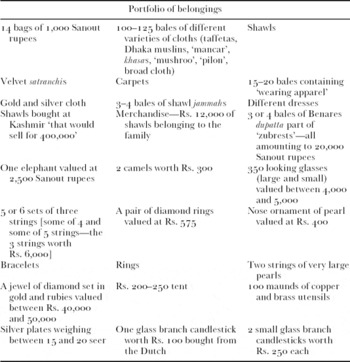
The resplendent courts and conspicuous consumption were not features of just the immediate family members of the Nazim. High value commodities continued to fascinate and beguile all that could afford these. The tussle over the property of a noble in Patna, Shah Baz Khan, for instance brings to our notice a very wide range of commodities, including European goods as can be seen in Table 1.
Shah Baz Khan's Property

Source: OIOC, Bengal Law Council, P/166/82, 13 April 1779, pp. 276–318, 391–397.
Besides the wide range of goods, 300–400 maunds of rice were bought just for the funeral ceremony. There were large buildings on each side of Shah Baz Khan's house. The men received company in the outer apartment, women in the inner ones where the noble man also used to receive people.Footnote 133 Such instances of wealth and consumption are not rare.Footnote 134
Scholars have argued that such expenditure arose from a stratified and competitive nature of society.Footnote 135 Possession of wealth was not enough; others had to know one had it. Hence, ostentatious purchase and display were essential. They used large portions of their riches for the construction of big houses, filled with beautiful artefacts that testified to their high social status. However, the highest echelons had not only to disburse the most on show but also had to ‘frame their display within a lifestyle that emphasises expenditure on leisure—indicating both that they possess money and that they do not need to work for it’.Footnote 136 At the same time poorer consumers used their minimal spending power on such things as chinaware and toys; goods that were certainly not intended to be investments, and had to be frequently replaced.Footnote 137 The view that luxury corrupted or wasted resources was dangerous.Footnote 138 Emulation stimulated people to work harder, and even the sections lower down in the social order could benefit from the ‘trickle down’ effect with employment generated by such flamboyant displays.Footnote 139 By the early half of the nineteenth century, the European society in Calcutta, described as ‘numerous, their habits convivial and hospitable, their mode of living luxurious and their appearance splendid in the extreme’Footnote 140 had taken over as the new big consumers. The English parts of the city had magnificent buildings, gardens, and the entrance by a ‘handsome flight of steps, with a portico or colonnade, which gives them a noble appearance’.Footnote 141 Contemporary Europeans estimated that prices in India were twice as high as in England, and they observed that ‘where the climate is so oppressive, what are luxuries indeed at home are here necessary to health and existence. . .’,Footnote 142 which rendered it necessary to live beyond ones means.
Other Arenas of Consumption and Display
Although by the later half of the eighteenth century the Bengal Nazims were politically impotent, there was a last blaze, before the flame spluttered out completely in the nineteenth century. Power and wealth radiating out from the declining court of the late eighteenth century was not sufficient in the new Company dispensation. Newer arenas had to be used to gain legitimacy. Huge amounts were spent on construction of mosques and imambaras (building commemorating the martyrs of Karbala) and on other public occasions, the lavish disbursements injecting money into the local economy. These provided employment to large numbers of the city population—craftsmen, labourers, artists and others. The later Nazims grasped the utility of both public display and ritual symbolism.Footnote 143 They used displays of fireworks,Footnote 144 and opulent imageries of processions.Footnote 145 The presentation in triumphal pageants and other public entertainment of Bengal served as tangible expressions of power. Processions on temple panels of course testify that these were not novel features. Beyond simply constituting the expression of sovereignty, military ritual and its dissemination constituted an essential component of the accumulation and reiteration of imperial power. The use of highly theatrical spectacles laden with symbolism to reinforce political influence offered unparalleled possibilities for making the people believe that the Nazim's power and its military foundations had not disappeared in the new political setting. Marriage pageantsFootnote 146 had similar functions—to bedazzle onlookers. Ceremonies of this type offered opportunities not only to the erstwhile rulers to enhance status but also to individuals for raising their political and social stature. Thus, illusion of power could be a more effective weapon than any visible forms of control or wealth. Of course, this is not a characteristic feature of this society alone. The kind of power relationship (where forcible and fraudulent exploitation were taken as enduring features of markets, courts and households) that for instance David Curley sees as the dominant feature of this society,Footnote 147 cannot adequately explain the complex web of interaction taking place, despite the waning fortunes of the Nazims.
The patronage extended to the imambara too had similar connotations. Siraj-ud-Daula had constructed it and it was noted that, ‘its praise is beyond description; its equal is not to be found in the whole of Hindustan’.Footnote 148 As a contemporary painting shows,Footnote 149 the image of the brightly lit imambara, with its lucent medusa-shaped chandeliers during Muharram, with Babar Ali smoking a hookah—was also a potent symbol. Under the aegis of the Nazims, religious festivals and commemorations such as Muharram were becoming an occasion to accentuate local values and authority. Munni Begum's chauk mosque, built in 1767 no doubt had political and economic meanings. Although the Company was on the ascendant, the Nizamat could still try to assert itself by its very public show in the form of a massive and splendid religious structure. It was also a symbol of its continued financial viability. Even earlier during Murshid Quli Khan's tenure, zealous religiosity was very much in display in both his personal habits and more public manifestations. He offered daily prayers, fasted, recited and transcribed the Qur'an, copies of which he sent with offerings and gifts to major pilgrim centres including Mecca and Medina. He also endowed or employed people to recite the holy verses and provided them with food. Similarly, the Sufi sheikhs (saint), the ulama (religious scholars) and other holy men were fed from his kitchen.Footnote 150 The construction of Katra mosque combined some Mughal idioms of architecture with earlier ornamental styles and was very likely a reflection of the independent,Footnote 151 regional, yet not completely distancing political aspirations of the Nizamat. On the other hand, it imparted religious importance to the newly established political capital. The Nazims, as in Awadh and Benares, were deploying religious symbols and arenas for furthering their political agenda in the eighteenth century.
The Network of Patronage
The Nazims and other important functionaries redistributed their wealth through alms to the needy and poor and alleviated their suffering in other forms as well.Footnote 152 Philanthropic activities were widely undertaken. Numerous instances are cited in the Persian works such as Siyar-ul-Muta'akhkhirin, which demonstrate how significant such acts were deemed in the contemporary world, and the lustre it added to the personal worth of an individual, specifically one who enjoyed some high post. Although the eighteenth-century ruling group was far from a meritocracy, such acts of benevolence could earn the individual the right and provided justification for occupying an elevated rank. The noble families, richer landed proprietors and merchants employed these strategies combined with altruistic motives.Footnote 153 Even earlier gifts of food, or clothes worth lakhs of rupees, or money was distributed on certain occasions, like death anniversaries.Footnote 154Nawab Hashmat Jang of Dhaka, for instance, spent Rs. 1,518.10 for providing medicines for poor patients.Footnote 155
What is more important in the eyes of the rulers was the bestowal of offices and other honours to members of the nobility or military commanders or scholars, the formation of vertical linkages of allegiance which were crucial for the Nazims. Wealthier segments of society extended patronage to physicians, scholars and artists, incorporating intellectual and artistic excellence into the state.Footnote 156 For instance, Alivardi Khan bestowed Haji Ali Khan, ‘Plato of his time’, who was ‘endowed with a breath as healing as that of the Messiah’,Footnote 157 with a khilat (robe given to honour a dependent) of the first rank, a ‘serpich’ and a ‘djica’ (kinds of jewels), a huge elephant with a howdah or seat and Rs. 5,000. The Nazim even went to the extent of rising and standing when the latter came to visit.Footnote 158
Painters were already flocking to Bengal in the early years of the eighteenth century. Robert Skelton notes that court painters from Delhi came to Murshidabad in the wake of dwindling Mughal support. Murshidabad became the centre of a new style of regional painting, which under Alivardi Khan achieved its definitive position.Footnote 159 However, since Bengal is taken to have ‘declined’ in the eighteenth century, even in Milo Beach's authoritative survey on Indian painting,Footnote 160 this distinctive school fails to find a mention. Similarly, other historians note that, ‘beyond the Teliagarhi narrows, Bengal moved into a provincial isolation from the artistic and religious life of Mughal India’.Footnote 161 Other crafts such as metalwork, jewellery, ivory carving, textile weaving and embroidery developed under the various Nazims.Footnote 162
Relations with the East India Companies
The fortunes of the European companies and the indigenous state's prosperity were interdependent. This however, did not remove cases of conflict.Footnote 163 The faujdar of Hughli, on the pretext of collecting the custom duties of the Imperial Customs House, requisitioned troops from the Emperor and ‘commenced hostilities’ with the English, Dutch and French and levied nazars (presents) and taxes. Finally, the Chief of the English Factory in Calcutta, borrowed ‘the nazarana money from the Calcutta bankers and remitted it to Shiraj-ud-daulah’.Footnote 164 From the English Company's perspective, the State placed too many restraints on their trade in the shape of extortion, arbitrary actions and demands in the early years of the eighteenth century. To the Nazims, the extraction of presents was a badge of legitimacy and not simply a form of arbitrary taxation.Footnote 165
However, it has to be borne in mind that contemporary Persian sources do paint a contrary picture. For preparing armies for waging wars, ruling powers raised money from the bankers and the ‘principal men of the city . . . proportionable (proportional) to their circumstances’. In return, they gave signed bonds pledging repayment once the enemies were subdued.Footnote 166 The army was dependent for provisions on the grain merchants that followed it.Footnote 167 The chronicle does not mention arbitrary extortion. The ruler's role in maintaining fairness in transactions and peace was by no means unequivocal. He was bound to respect and enforce rights of merchants to travel freely, with exceptions during periods of war or rebellion. In such circumstances, looting of convoys carrying tribute of Bengal to Allahabad for instance was apparently fair game.Footnote 168 Merchants and rich bankers, including the Armenians, played a central role in the organisation and protection of mercantile interests. These political as well as community links, along with the intimate knowledge acquired of markets in these regions enabled them to survive as merchants and traders well into the eighteenth century. It might have also influenced the rulers' perceptions about different religions and thus lead to greater tolerance of diverse spiritual or religious traditions. Alivardi Khan's daily ritual and perhaps of all the Nazims included hearing the chiefs of officers, the ‘general intelligencer’ and the Jagat Seth, among others, and the reading of ‘news of every part of Hindia’, or matters relating to revenue in the second audience of the day.Footnote 169
Officials often had to be placated with presents, ‘for want of which they are very often troublesome’. They could be rare, relatively novel and expensive and could range anything from broad cloth, penknives, cutlery, enamelled ware, liquor, wax candles, gold watch, pictures, chinaware to Persian horses and even a ‘Japan Doll’ in return for Diwan's dastak for free tradeFootnote 170 or in one case a fine ‘imbost [perhaps embossed] cloth tent’.Footnote 171
The Chief of the factories or others could prevail upon officers of the court to procure an audience through small inducements. Sometimes this proved to be difficult.Footnote 172 For example, in 1724 a letter from Kasimbazar informed the Council that their repeated endeavours to get permission for their Chief to visit the Nawab to present their papers (which they received from the ‘Vizier’ and others of the ‘Nobility at Court’) had been in vain. Though the Nawab did not directly deny them admission, ‘he wearyed them with so many Delays’Footnote 173 that they turned to the officials. There are instances too when the vakil (agent) employed by the Company took advantage of such situations.Footnote 174 Factories could sustain losses due to the ‘impositions’ of zamindars or other political troubles that made the roads impassable and prevented the sale of their woollen manufactures on which a considerable profit was expected to arise. This caused a great ‘decay of trade’, that is in the Company's trade.Footnote 175
Strained relations were recorded right from the very beginning of the eighteenth century over the question of the copy of the farman (imperial order) for free tradeFootnote 176 and the inability of the English Company to get a dastak (pass) without showing the original hasb-ul-hukm (according to orders, as commanded). English private tradeFootnote 177 was relatively limited in the early years of the eighteenth century. When the question of increasing the presents given to the Nazim and his officers arose, there was trepidation among the East India Company officials. Neither the Company's commerce nor the private trade could bear the ‘charges [of the] Durbar’, which could amount to an extravagant sum. In 1757, the Company complained of ill treatment of ‘their people, peons and others’. The Raja of Bishnupur, for example, paid no regard to the Nazim's orders but insisted on collecting the usual duties from the English ‘as they paid before’.Footnote 178 Company officials in their private capacity carried on trade in prohibited commodities such as betel nut sometimes.Footnote 179 The indigenous government clearly excluded all Europeans from private inland trade in commodities such as salt, betel nut and tobacco.Footnote 180 After Plassey, the English gumashtas (agent or representative) in different parts had begun to insist upon this trade as a farman privilege, along with foreign trade and refused to pay any customs. In response, the Government demanded duties and stopped the passage of the goods. Thus, both the Nazim and the Company received many complaints.Footnote 181 Abuse of dastaks was another sore point between them. As early as 1705 the practice was becoming frequent.Footnote 182 The English East India Company's business was stopped in Dhaka in September 1737. One of the reasons cited by the Nazim was that they owed Rs. 6,000 for the dastaks because they had not paid the previous 3 years (the annual sum of Rs. 2,000) ‘for the clearance of our boats, Goods etc’. The demand was brushed aside by the Company as they had the ‘King's Royal Phirmaun for trading custom free’.Footnote 183 Verelst observed,
I have been surprised to meet with several English flags, flying in places, which I have passed, and on the river I do not believe that I passed a boat without one. But whatever title they have assumed (for I could only trust to the information of my eyes, without stopping to ask questions) I am sure their frequency can bode no good to the nabob's revenues, the quiet of the country, or honour of our nation, but evidently tends to lessen each of them.Footnote 184
Mir Jafar protested several times, but Mir Kasim was prepared to go further and take action that turned into full-scale war and ultimately defeat.Footnote 185
The Nizamat and the East India Company were not the only players on the scene. Other European companies were present and indigenous merchants too were powerful interest groups in all the major states, which had emerged from the decline of the central authority in Delhi. By the mid-eighteenth century, bankers, merchants, moneylenders, were playing a crucial role not only in the economy, but also in the political order.Footnote 186 Besides the Nizamat with its seat in Murshidabad, the landed élite were the most conspicuous and direct manifestation of the state in the locality. Their interface with the economy paralleled that of the regional ruling authorities, as the following section will show.
Landed Proprietors and Economic Infrastructure
Landed proprietors constituted the second level of power in the region and the most proximate and visible source of authority for the general populace. From their rajbari (residence/court) and kachari (office), landed proprietors held sway over their estates, combining in themselves a very wide range of functions. Various scholars have studied them at length,Footnote 187 and here we will only briefly consider their role in the commercial economy of the eighteenth century.
Zamindars and taluqdars did not remain insulated from this increasingly vibrant commercial economy. Apart from their pivotal position in agricultural production and in revenue collection,Footnote 188 they also had a part to play in the realms of commerce and industry. They built roads, bridges, inns, bazars, ghats (landing places), shrines and palaces.Footnote 189 Their patronage of craftsmen and artisans evidently led to improvements in the quality of products and increase in their production. Fine quality goods were directly manufactured, for instance, under the aegis of the Nadia Raj. Similarly, the zamindars encouraged developments and improvements in pottery, silk and gold ornaments.Footnote 190
Local landed proprietors often donated huge sums for the construction of roads. Maharaja Sukhomoy Roy,Footnote 191 for example, contributed a sum of Rs. 150,000 for constructing a road from Calcutta to the temple of Jagannath in Puri in late eighteenth century. It was noted that a road running in that direction was ‘an object highly desirable’ both because of the religious importance of the temple as well for the ‘general convenience’ of the people. However, the Company state was more influenced by its military importance, for it afforded a
free communication between the provinces immediately dependent on the Presidency of Fort William and the territories subject to the Government of Fort St. George.Footnote 192
These acts of dan (charity) by the local élite did not cease even with the establishment of the new regime. An arzi (petition) written in 1793 requested that the Company allow petitioner Manohar Das, a well-known Benares and Patna banker, to clean the tank near Chowringhee in Calcutta at his expense. It had dried up due to the heat and the people were ‘greatly distressed’ due to water shortage.Footnote 193 Although the old élite were on the decline, new people were coming into wealth and prominence, as this example of a newly rich family's munificence demonstrates. The long cumulative advantage of a favourable balance of payments in trade had enriched the region and wealth was distributed geographically and socially, it could increase over a period of time—all imparting vigour to the economy.
Landed proprietors supplied labourers in large numbers to work on construction sites or made available requisite numbers for the carriage of goods. It required organisational abilities to mobilise the labour necessary for reclaiming land. In this context, headmen also had an important role to play. They negotiated with rulers to get tax concessions or exemptions, security of titles to land and other benefits.Footnote 194
Rural élite established markets, with the prior permission of the government, but their actual functioning was vested with the founder. There was a proliferation of zamindari outposts to collect tolls and disputes over the charges grew frequent.Footnote 195 According to K.K. Datta and P.J. Marshall, big amounts were exacted from the English Company at these chaukis.Footnote 196 The petition of the beoparies (merchants) of Nawab Ganj, for instance, noted the proliferation of ghats and duties and forcible seizure of boats.Footnote 197
The various functionaries in the countryside could and did interfere in the economy. Company documents mention the ‘strange and violent proceedings’ of different shiqdars (officer-in-charge of an area of land described as a shiq), zamindars and chowkidars (literally guards) in the districts of Dhaka in stopping the English trade, plundering their gumashtas and servants in 1763.Footnote 198 These instances, however, were localised and, overall, landed proprietors did not hinder the smooth movement of goods along the numerous pathways of trade. Though John McLane,Footnote 199 and others, have indicated that coercion was intrinsic to the functioning of landed élite, the fear of trade bypassing their areas and consequently loss of both taxes and other material benefits acted as a check on oppression. The Company documents do note that there were exactions of nobles in the early years of the century and Persian sources mention Murshid Quli Khan's notorious baikunth and later, political assassinations, imprisonment and rebellions. McLane's analysis of Mughal Bengal using Foucault is no doubt interesting but perhaps veers too far towards the notion of an over-exploitative and coercive state system.Footnote 200
The zamindars of the coastal regions also played an important part in salt production as supervisors. After collecting the salt, the controlling zamindars were authorised by the Company to sell it to the merchants, who in turn distributed it to the different markets.Footnote 201 Landed proprietors appointed thanadars.Footnote 202Zamindars and taluqdars in Nadia at least owned ferry ghats.Footnote 203 The landed proprietors normally let out the ferries to individual farmers.Footnote 204
The mir-bahri was an important source of revenue. As the zamindars kept a registry of the boats, manjhis, or boatmen belonging to each district, the river toll was useful in the detection of dacoits. Thus, the landed proprietors exercised a good amount of autonomy and authority in the economic sphere.
The Landed Proprietors and Consumption
The courts of the landed élite deployed symbols and acted as a microcosm of the Mughal and Nazim's court.Footnote 205 There are instances of material goods making their way from the Nazim's palace to the landed élite's estates directly. Shuja-ud-Din reportedly raised a sizeable amount by
selling off at fancy prices to zamindars the jaded horses, cattle, and other live-stock, as well as damaged carpets and curtains belonging to the private estate of Nawab Jafar Khan, he sent another forty laks of rupees, besides elephants, to Emperor Muhammad Shah.Footnote 206
Although not on the scale of Tokugawa Japan's alternate attendance system (sankin kotai),Footnote 207 and enforced residence in the capital, the puniya ceremony represents a considerable intervention on the part of the Nazims. The landed élite travelling to and fro from his or her place of residence in the district capital to Dhaka or Murshidabad might have had not only a positive effect on road infrastructure but also helped in the dissemination of Nizamat culture and spending patterns. The puniya ceremony was held at the beginning of each Bengali year. Revenue accounts with the different landed proprietors were adjusted and leases confirmed or revoked. The zamindars either came to Murshidabad themselves or their vakils negotiated and settled the amount on their behalf for the following year, as well as settled previous dues. A similar conglomeration occurred in each zamindari where taluqdars, revenue farmers and other officials attended.Footnote 208 It was an occasion where the opulence of both the Nazim and the zamindar was displayed at its glittering best and these ceremonies were replicated by the subordinates in their respective bases, having further ‘civilising’Footnote 209 effects in the surrounding areas. The wealthier élite cultivated the various arts and patronised singers, poets,Footnote 210 dancersFootnote 211 and court jesters such as Gopal Bhadh, who no doubt enacted with his verbal pyrotechnics, iconoclasm and satire, a role that Tenali Rama played in the South Indian court—‘an ironic advocate of movement and transformation within the royal world’.Footnote 212 Of course, the reverse flow of taste and habits also occurred with local cuisine and more importantly things such as textiles and mayurpankhi boats entering the Nazim's kitchens, wardrobes, chambers (as furnishings) and outhouses. Some of the bigger landed proprietors spent sizeable amounts of money on maintaining their domestic establishment including expenditure on food, clothing and furniture.Footnote 213
Some among the upper echelons of the landed élite and merchants were also acquiring European clothing habits and a variety of objects like optical glasses, books and watches as amply evidenced from our records.Footnote 214 They were not necessarily simply status markers but might have been acquired because they afforded aesthetic pleasure, comfort or protection. The evidence at hand cannot be used to map out the extent of the popularity among the relatively well off segments of society. However, it is certain that not only some Europeans such as Polier or KirkpatrickFootnote 215 displayed a taste for things Indian; there was also a fascination among some of their Indian counterparts for western objects.Footnote 216 Indeed, temples sometimes delineated Europeans on the terracotta panels.Footnote 217 There is evidence to suggest a wider diffusion of objects such as prints among the richer people of society.Footnote 218 The purpose is not to overestimate and extend a new set of myths about the encounter itself or about its effects on local society. Admittedly, the tryst was characterised by greater participation and absorption than hitherto noted, and epithets such as ‘clash of cultures’ or ‘clash of modes of production’ do little justice to this period. This conspicuous consumption extended not merely to goods, furnitureFootnote 219 and architectureFootnote 220 but seemed to have found expression also in passion, pleasure and gratification of desire—even sexual ones, which was quite central to this society if the evidence from contemporary literature is taken into account.Footnote 221 Erotic themes too made their way into the poetic works as the Vidya Sundar,Footnote 222 prompting earlier historical writings to characterise it as of ‘vitiated taste’, being a product of a ‘debased political atmosphere’.Footnote 223 Contrast this with the earlier ballads where the emphasis was often on love and the tribulations of the lovers, but did not dwell on the sensual dimensions of romance.Footnote 224
The celebration of festivals, ceremonies and pilgrimages were occasions when the landed proprietors could display their wealth and benevolence. This appears to have been intrinsic to the process of local state formation and renewal. Some new pujas were introduced. It is possible that Durga puja, for instance, gained such widespread currency, especially in the nineteenth century, among the zamindars not only because the goddess symbolised power and martial qualities, but because it drew on a much familiar trope of a transitory deity sojourning with her devotees on a short annual leave away from her austere husband's domain. Life cycle rituals also held great significance and were occasions for lavish displays of wealth and its redistribution. Raghuram, grandfather of the famed Krishnachandra of Nadia, invited rulers, princes, Brahmans, from Anga, Vanga, Kalinga, Kashi and Kanchi on the occasion of his son's naming ceremony and erected an enormous camp,
which was constructed of cloth and the like, resplendent with ranges of various palaces, adorned with rows of white, blue, yellow and other flags and surrounded by a fence likewise of cloth and such materials. There he deposited stores of daintiest provisions, and appointed a number of ministers to care for the entertainment of the assembled princes and Brahmans. And also for those of various castes, who had come without being invited to witness the feast, were provided stores of various and abundant provisions; there were many streams of curdled and fresh milk, clarified butter, honey and the like, and innumerable heaps of beans, peas, bilobes and similar fruits; and the piles of rice and such things, how could they be counted?Footnote 225
After the performance of the rituals and the feast (‘at whose noise and splendor the earth was so astonished, that she did not know what to make of it’) the invited guests left ‘satisfied with presents and honors, rejoiced the child with prayers for his happiness’.Footnote 226 As it has been argued by scholars for South India, for political powers in Bengal too, annadana formed the ‘essential claim to fame’.Footnote 227
Food, from its preparation to its consumption, was also enveloped in layers of rituals and normative procedures. Meat eating and hunting was more of an aristocratic privilege in Middle Ages Europe, while in Bengal meat eating was not widespread, but the consumption of fish was more prevalent.Footnote 228Kichri was the ‘usual’ food of the poorest ‘in rice countries’. It consisted of pulse and rice boiled together.Footnote 229 Besides these, people used curds, fruits such as mangoes, oranges, pineapples, coconuts, palm-fruits, jackfruits and plantains, as well as mustard oil, sweetmeats, red chilly and salt in their diet.Footnote 230 It appears that the calorific value of the food available even for the poorer people was quite adequate, unlike the situation in the mid-nineteenth century.Footnote 231
Conclusion
The Nizamat appears in the scattered historical records to have been an efficient entity, well suited to adjust to local realities and contingencies. Although dependent upon landed proprietors and rich bankers,Footnote 232 and the large number of middle-level, literate gentry families, it had the power to intervene in local society. From their seat in Murshidabad, the Nazims maintained a close watch over the situation in the different parts of the region and at the Mughal court in Delhi and handled any potential trouble with firmness. They were particularly vigilant about the management of the financial resources available to them. The Nizamat appears to have co-opted diverse groups, using local institutions, traditions, people and resources much more effectively than it is commonly assumed. They took effective measures to foster trade, industry and agricultural pursuits. Their enterprise lured merchants to Bengal not only from different parts of India and Asia but also from Europe.Footnote 233
The state whether in the form of the Mughal Empire, the Nizamat or the local landed proprietors, appeared to have actively participated in, and tried to control at certain times, the operations of commerce. The extent of this control varied from one ruler to another as well as from one area to another. These different strata of political authority were in constant negotiation with local power holders. Though the rulers' interest in trade and commodities was clear, the involvement was not intrusive. In the later part of the eighteenth century, with dwindling political power, the Nazims' participation as market owners increased—the resourceful ways of power reminding us of The Leopard's dictum, ‘If we want things to stay as they are, things will have to change’.Footnote 234 The cities and towns often provided the physical setting where the Nazims and other aristocrats displayed their wealth and benefited from the proximity to the bigger bazars. They often founded these centres, or extended existing ones, and by their continued residence there, attracted a host of service gentry and professional groups. Commodities flowed in to meet the demands of those engaged in the construction and those who lived in these sites. The Nizamat had a close union of interests with the merchants, as well as the landed proprietors of the region in keeping these sites of exchange and supply lines of commodities open. The traders functioned in the context of economic risk and at times political adversity. Merchants also mobilised financial, political and cultural resources to negotiate and transact their way out of perils as various scholars have stated.Footnote 235
The Mughal State, at least in its core areas of influence might have been equally intrusive, and ‘strong’.Footnote 236 The situation in outlying areas, as in the region of Bengal, was another matter. The scope of intervention appears to be substantially different not only in scale and in magnitude, but even in its nature. The Nizamat had certainly learnt to manoeuvre the complex web of alliances and loyalties, which had come to characterise the political firmament of the century. They realised the importance of commerce as we saw in preceding pages. There was awareness that even the great territorial kingdoms living on the revenues generated from a productive agriculture needed the intermediary of merchants and bankers for converting it into liquid incomes.Footnote 237 They were dependent on markets and trade and the service industry for their own direct consumption needs. The evidence cannot support the notion long in vogue that medieval and early modern rulers lived off the land and land revenue was their primary, if not sole area of interest.Footnote 238 The ruling authorities displayed considerable business acumen and interest in maintaining a dynamic system of economic infrastructure through both direct investment, institutional support and being major consumers. Although trade in luxuries in itself might not considerably boost the economy,Footnote 239 it does provide a fillip to the further development and refinement of artisan products and wealth percolates into the countryside through a chain of intermediate consumers.
Simultaneous to the dissemination of the market and commercial mentality, there was an undeniable importance put on cultural values, especially on patronage, honour, community or kin networks and an ostentatious court culture. Religion, culture and economics intertwined in myriad ways. Trading activity was not, as recent studies would like us to believe, ‘normatively subordinate to the spheres of warfare, rule and aristocratic culture’.Footnote 240 Aristocratic culture and political power facilitated commercial activity. A powerful combination of élite interests had developed in Bengal concerning trade. The increasing influence of commerce facilitated social mobility. By the beginning of the eighteenth century, if not earlier, the attitudes toward commerce had changed. The indigenous state and merchants reached an accommodation and social hierarchy and élite status not only survived but also was reconstructed and strengthened in the Nizamat period, what C.A. Bayly terms for North India ‘commercialisation of kingship’.Footnote 241 The later Nazims related to the commercial economy more directly and thus individual members of this section of society could attempt to survive through the late eighteenth century and strengthen their positions even in the context of waning political fortunes.Footnote 242 The prosperous economy was both the crucial underpinning of the political regime, as well as the beneficiary from its policies and expenditures.
Acknowlegements
This essay is a part of my larger work on eighteenth century Bengal. I am indebted to Professor C.A. Bayly under whose supervision I wrote my Ph.D. thesis, ‘Markets, Transport and the State in the Bengal Economy, c. 1750–1800’, University of Cambridge, 2004. The Association of Commonwealth Universities is gratefully acknowledged for providing funding for my research. Professor Rajat Datta and Dr Yogesh Sharma are thanked for their encouragement and interest in my work. Grateful thanks also to Dr Raziuddin Aquil for his comments on an earlier draft. The usual disclaimers apply.