INTRODUCTION
Alternative pig management systems such as outdoor and organic systems have expanded in many European countries during the last 10–15 years. This development has been driven largely by increasing consumer demand for products perceived as healthy and produced in husbandry systems with good animal welfare (Thamsborg, Roepstorff and Larsen, 1999). These alternative management systems entail a risk of increased infection levels with helminths and especially the whipworm Trichuris suis, as the highly resistant eggs can remain infective under outdoor conditions for many years (Burden, Hammet and Brookes, 1987). Furthermore, in Denmark anti-parasitic drugs approved for food-producing animals are only available on prescription due to the increasing development of chemotherapeutic resistance and a growing concern for chemical residues in food for human consumption. Consequently, there has been a surge of interest in developing potential alternative ways to treat or prevent gastrointestinal helminths.
The symptoms of clinical T. suis infections in growing pigs are typically anorexia and bloody diarrhoea with resulting production losses (Stewart and Hale, 1988) and in severe cases death (Jensen and Svensmark, 1996). Due to the longevity of the eggs, it may be difficult to control T. suis in outdoor systems by means of pasture management, and biological control of parasitic nematodes using predacious micro-fungi is presently restricted to nematode species with larval stages in faeces (Thamsborg et al. 1999). However, host nutritional factors are important for the establishment and development of gastrointestinal parasites, and may be included in an alternative control strategy. In ruminants, dietary supplementation with protein or the grazing of bioactive plants is being investigated as sustainable alternatives to chemotherapy (Coop and Kyriazakis, 2001). In pigs, several studies conducted over the past decade on experimentally infected pigs (Petkevičius et al. 1999, 2001, 2003) have shown that diets containing carbohydrates with contrasting fermentability and physico-chemical properties can have a significant effect on the establishment, intestinal distribution and fecundity of the pig nodular worm Oesophagostomum dentatum. Carbohydrates that are only fermented to a small extent in the gastrointestinal tract (e.g. oat hull) generated advantageous conditions for the establishment of infection, whereas carbohydrates that are easily fermented in the large intestine such as inulin and sugar beet fibre reduced the establishment of the parasite. If similar effects of diet carbohydrates can be found on Trichuris this may have more practical implications for organic pigs, in which T. suis is a more serious problem compared to Oesophagostomum spp. (Carstensen, Vaarst and Roepstorff, 2002), and perhaps for humans, where T. trichiura is very common worldwide (Crompton, 1999) and notoriously difficult to treat with anthelmintics (Stephenson, Holland and Cooper, 2000). However, T. suis is connected to the mucosa with its anterior end, and may therefore be better protected against luminal changes due to fermentation.
The purpose of the present investigations was to study the effect of diets with different composition of carbohydrates on the establishment of T. suis in pigs. The hypothesis was that a diet supplemented with easily fermentable carbohydrates would reduce the establishment and a diet supplemented with non-fermentable carbohydrates would favour the establishment of T. suis infections. This paper reports the results of 2 experiments and is to our knowledge the first paper describing the use of dietary carbohydrates as a means of control against T. suis infections. In Exp. 1, uninoculated groups of pigs on different diets were included to study the effect of infection on the chemical composition and digestibility of the diets. In Exp. 2, experimentally infected groups of pigs on different diets were included to observe the effect of diet on T. suis infections for an extended period of time.
MATERIALS AND METHODS
Experimental design
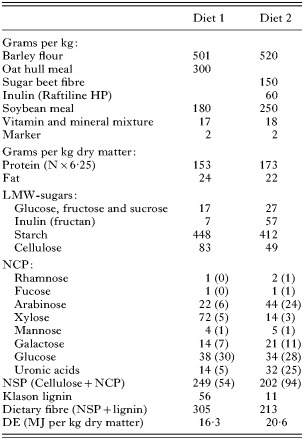
Ten week old helminth-naïve Danish Landrace/Yorkshire/Duroc cross-bred pigs were purchased from a specific pathogen-free herd. The pigs were fed the two experimental diets shown in Table 1. Both diets were based on barley flour and added either insoluble fibre from oat hull meal (Diet 1) or inulin (Raftiline®) and sugar beet fibre (Diet 2) to obtain different degree of fermentation in the large intestine, and both diets were supplemented with soybean meal, vitamins and minerals to balance the concentrations of essential nutrients. The content of digestible energy (DE) was 16·3 MJ per kg dry matter (Diet 1) and 20·6 MJ per kg dry matter (Diet 2) and the calculated amount of digestible protein per DE was 7·3 g/MJ (Diet 1) and 6·9 g/MJ (Diet 2). The pigs were fed the same amount of DE per day divided into 2 daily meals according to weight development. The average intake of dry matter per day during the entire study period was 2·75 kg for Diet 1 and 2·24 kg for Diet 2, the amount of DE per day was 44·8 MJ and 46·1 MJ and the amount of digestible protein per day was 327 g and 316 g for Diet 1 and 2, respectively. The pigs were kept in pens without bedding and had free access to water. Prior to infection faecal samples were taken to make sure that the pigs were helminth-free, and the pigs were allowed to adapt to the experimental diets for 3 weeks. The pigs were weighed every second week and faecal samples were collected rectally for T. suis egg counts twice a week from 5 weeks post infection (p.i.) until the end of the experiments. Two weeks before slaughter, the insoluble marker chromium oxide (Cr2O3) was added to the diets at a level of 2 g per kg feed. On 3 consecutive days before slaughter faecal samples were collected rectally and pooled for chemical analyses. All the pigs were slaughtered around 3 h after the morning feed by intravenous injection of pentobarbitone. At necropsy the gastro-intestinal tract was quickly removed and separated from the mesenteries. The large intestine was divided into the caecum (Ce) and 5 sections of the colon and rectum: Co1 (0–20%), Co2 (20–40%), Co3 (40–60%), Co4 (60–80%), and Co5 (80–100%). pH was immediately measured in the contents of each section before emptying. Ten percent of the contents of each colon section were pooled and subsamples for short-chain fatty acids (SCFA) measurements and chemical analyses were taken from the contents of the caecum and the colon pool. Depending on the volume of the remaining contents either 100% or subsamples of 20% were used from each section for isolation of T. suis.
Table 1. Diet ingredients and chemical composition of the experimental diets (LMW sugars, low molecular weight sugars; NCP, non-cellulosic polysaccharides; NSP, non-starch polysaccharides; DE, digestible energy. Values in parentheses are soluble NCP.)

Experiment 1
Thirty-two pigs (16 castrates and 16 females) were allocated into 4 groups according to weight and sex by stratified random sampling and each group was housed in 2 pens (4 in each pen). The mean body weight of the pigs at the start of the experiment was 22 kg, ranging from 18 to 25 kg. Two groups were fed Diet 1 and 2 groups were fed Diet 2. Pigs from one group on Diet 1 and one group on Diet 2 were inoculated with 2000 infective T. suis eggs each by stomach tube, while the remaining two groups were uninfected control groups. All the pigs were slaughtered 8 weeks p.i. and blood samples were collected from vena jugularis externa of each pig at necropsy.
Experiment 2
Twenty-four pigs (12 castrates and 12 females) were used. The pigs were allocated into 2 groups by stratified random sampling according to weight and sex and each group was placed in 2 pens (6 in each pen). The average body weight of the pigs at the start of the experiment was 23 kg, ranging from 20 to 25 kg. One group was fed Diet 1 and the other group was fed Diet 2 (Table 1). Pigs in both groups were inoculated with 2000 infective T. suis eggs each by stomach tube. Six pigs from each group were slaughtered 8 weeks p.i. and the remaining 6 pigs were slaughtered 12 weeks p.i.
Parasite isolate
Infective T. suis eggs were originally isolated in 1993 from the soil from a small organic farm and have been passaged in helminth-naive pigs several times. After each passage the eggs have been isolated from faeces and embryonated in vermiculite according to the method described by Burden and Hammet (1976) and stored in water at 10 °C until use.
Parasitological techniques
Faecal egg counts were determined using a concentration McMaster method (Roepstorff and Nansen, 1998), with saturated NaCl+500 g glucose/l (specific gravity: 1·27 g/ml) and having a lower detection limit of 20 eggs g−1 of faeces (epg). Sera from the blood samples in Exp. 1 were tested for antibodies against adult T. suis excretory/secretory antigen using an enzyme-linked immunosorbent assay (ELISA) according to Hill, Romanowski and Urban (1997). For recovery of T. suis the mucosa of the large intestinal sections were rinsed several times and examined for the presence of worms. The intestinal contents and washings were then washed through a 212 μm sieve. The retained samples were fixed in iodine for later examination of T. suis. The sex of T. suis was determined and the lengths of worms (10 males and 10 females) recovered from Co1 were measured. If less than 10 worms of each sex were recovered the length of all the worms were measured. A stereo-microscope connected to a digital image analysis system (Olympus DP-soft) was used to measure worm lengths. Only few pigs fed Diet 2 from Exp. 1 harboured worms at slaughter. Most of these worms could not be measured because of apparently poor preservation, wherefore the worm lengths of this experiment are not recorded.
Chemical analysis
Chemical analysis of diets, intestinal contents and faeces was only made on samples from Exp. 1. All analyses were performed in duplicate. Cr2O3 and SCFA analyses were performed on wet materials; all other analyses were performed on freeze-dried materials. The dry matter (DM) content was determined by drying to constant weight at 105 °C. Ash was analysed according to the method described by the Association of Official Analytical Chemists, AOAC (1990), protein (N×6·25) was determined by the Kjeldahl method using a Kjeltec autosampler system 1035 (Foss Tecator, Höganäs, Sweden), fat (hydrochloric acid-fat) was extracted with diethyl ether after acid-hydrolysis and analysed as described by Stoldt (1952) and chromic oxide was determined using the method of Schürch, Lloyd and Crampton (1950). DE was estimated in vitro on the basis of the total tract digestibility of organic matter as described by Boisen and Fernández (1997). Starch was analysed by an enzymatic colorimetric method (Bach Knudsen, 1997), non-starch polysaccharides (NSP) and Klason lignin were analysed by an enzymatic-chemical method (Bach Knudsen, 1997), and LMW sugars were analysed by the method described by Bach Knudsen and Hessov (1995). SCFA were determined by the method described by Jensen, Cox and Jensen (1995).
Calculations and statistical analysis
Digestibilities of starch, inulin and NSP were calculated relative to the insoluble marker (Cr2O3) content as:

where X is the nutrient in question. X(d) is the concentration of specific nutrients in the diet and X(i/ce/co/fe) are the concentrations of specific nutrients in samples from ileum (i), caecum (ce), colon (co), or faeces (fe), respectively.
Model checking by residual analysis was carried out in all analyses. A summary measure was used to analyse the repeated faecal egg excretion (epg) by estimating the area under the curve of individual pigs from 5 weeks p.i. until slaughter. Groups were then compared using the Kruskal-Wallis test. Data on body weight gains and pH were analysed by repeated measurements with time and intestinal section as fixed effects, respectively. Worm counts, epg per female T. suis at slaughter (fecundity), and worm lengths were analysed by the Kruskal-Wallis test. The chemical composition and SCFA concentrations of the digesta materials were analysed by analysis of variance to determine the effect of diet, infection and any interaction between them. The digestibilities were analysed by analysis of variance to determine the effect of diet, infection and large intestinal section and any interaction between them. As no effect of infection was found on the chemical composition and digestibility, these data are presented as the mean of the infected and the control group of each diet. Data on chemical composition of digesta materials and total SCFA were log10 transformed and values expressed as percentage were arcsine transformed before analysis. All statistical analyses were done using the SAS® Release 8.2 software package with a significance level of 0.05.
RESULTS
Animal performance
One castrate from Exp. 1 died of unknown reasons 3 days before the experimental inoculation and was not replaced. The daily feed allowances were completely consumed by the pigs and no effect of diet or infection on body weight gains over time was found in any of the experiments. In Exp. 1 the average weight (S.D.) at 0, 4, and 8 weeks p.i. reached 34·5 kg (4·3), 55·0 kg (7·4) and 78·9 kg (9·1), respectively, and in Exp. 2 the average weight (S.D.) at 0, 4, 8 and 12 weeks p.i reached 34·5 kg (2·4), 53·2 kg (4·9), 78·4 kg (6·8) and 111·0 kg (8·6), respectively. Throughout both experiments a difference was observed in the faecal consistency between the two diet groups. Faeces from pigs fed Diet 2 had a sticky and wet consistency; whereas the faeces from pigs fed Diet 1 was dry and very bulky.

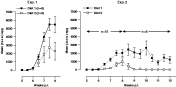
Fig. 1. Mean Trichuris suis eggs per gram faeces (epg) from groups of pigs inoculated with 2000 infective eggs and fed Diet 1 or Diet 2 in 2 experiments (Exp. 1 and Exp. 2).
Parasitology
Faecal egg excretion started 6 weeks p.i. in most of the infected pigs on Diet 1 and a few pigs on Diet 2. The mean faecal egg counts are presented in Fig. 1. The egg excretion course was identical in the two experiments with a rapid increase in the Diet 1 pigs compared to a more moderate increase in the Diet 2 pigs until 7–8 weeks after inoculation. Subsequently, a decline in excretion followed in pigs fed Diet 2 (Exp. 2), whereas the excretion from pigs fed Diet 1 dropped only slightly. Thus, very few eggs were found in pigs on Diet 2 after 9 weeks, whereas the Diet 1 pigs continued to excrete eggs at levels between 1000 and 2500 epg until the end of the experiment. Statistical analysis showed that the epg of Diet 2 was significantly lower in pigs slaughtered 8 weeks p.i. (P=0·0015) and 12 weeks p.i. (P=0·0104), respectively, compared to Diet 1.
The egg counts were generally higher in Exp. 1 in comparison to Exp. 2, but in spite of this observation there was no difference in the epg between the two diet groups of Exp. 1. Four pigs from the Diet 2 group in Exp. 1 did not excrete any T. suis eggs throughout the study and no worms were found at slaughter. The ELISA results, however, showed that all 4 pigs were seropositive at the day of slaughter.
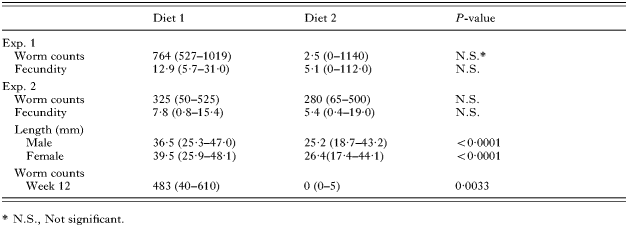
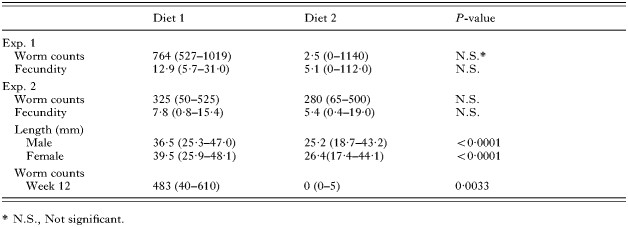
The median numbers of T. suis recovered are shown in Table 2. No differences were found between the two diet groups in the worm counts and fecundity 8 weeks p.i. in either of the experiments. In Exp. 2, however, the worm burden 12 weeks p.i. was significantly lower in Diet 2 pigs, corresponding to a 99% reduction, compared to Diet 1 pigs. Only very few male worms were recovered from 2 pigs on Diet 2 at week 12, whereas the number of worms recovered from pigs on Diet 1 at week 12 were higher than week 8 (Table 2). The distribution of worms along the large intestine was similar for both diet groups in both experiments. Analyses of length measured on worms recovered 8 weeks p.i. showed that both male and female worms were significantly shorter from pigs on Diet 2 compared to worms from pigs on Diet 1 (Table 2).
Table 2. Numbers of worms from the large intestine of pigs inoculated with 2000 infective Trichuris suis eggs each, epg per female T. suis (fecundity), and length of male and female T. suis (Values are the median (min-max) from pigs fed 2 different diets in Exp. 1 and Exp. 2. If not stated results are from week 8.)
Composition of digesta materials and digestibility of carbohydrates
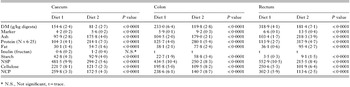
The composition of the contents from caecum, colon and rectum are shown in Table 3. The effect of diet was significant for all components except the fructans, which were only present at trace levels in the colon and rectum. The bulky material from Diet 1 contained higher concentrations of DM, NSP, cellulose and NCP, while the concentration of protein and fat were higher in Diet 2.
Table 3. Composition (g/kg dry matter) of digesta materials from the caecum, colon and rectum of pigs fed Diet 1 and Diet 2 (Values are mean (S.E.M.). (DM, dry matter; NSP, non-starch polysaccharides; NCP, non-cellulosic polysaccharides). Values are the mean of infected and non-infected pigs of each diet in Exp. 1.)

Starch and inulin were completely digested in pigs on both diets, whereas only 29 and 87% of the NSP were digested in pigs on Diet 1 and Diet 2, respectively. Most of the starch was digested up to the end of the small intestine (ileum), while most of the inulin was digested before the end of the caecum. Depending on the diet, however, the digestibility of carbohydrates in the intestinal compartments and faeces was different. The statistical analysis of the digestibility in the ileum, caecum, colon and faeces, respectively, showed a significant effect of diet (P<0·001) and site of digestion (P<0·0001) for all three types of carbohydrates. Thus, starch was digested to a lower degree and inulin to a higher degree at the different sampling points in pigs fed Diet 2 compared to pigs fed Diet 1. The digestibility of NSP in the Diet 2 fed pigs was significantly higher at all sampling points and in faeces compared to the Diet 1 fed pigs, which reflects the higher contents of soluble NSP in Diet 2.
pH and SCFA
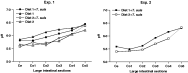
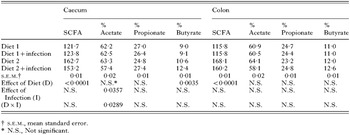
The pH in the large intestine of pigs on Diet 2 was lower in both experiments with a significant effect of section (P<0·0001) (Fig. 2). A significant effect of diet was, however, only found in Exp. 1 (P<0·001), whereas no effect of infection was found. The high acidic concentration in the Diet 2 pigs was also evident from the concentration of total SCFA, which was significantly higher in the caecum and colon of pigs fed Diet 2 compared to pigs fed Diet 1 (Table 4). The concentration of lactic acid was generally low in all the pigs and no differences between the groups were found (results not shown). The molar proportions of acetate and propionate were not affected by diet in the caecum or colon. Pigs fed Diet 2 had higher proportions of butyrate in caecum and colon compared to pigs fed Diet 1, but the effect of diet was only significant in the caecum (Table 4).

Fig. 2. Mean pH in the contents of the large intestinal sections of pigs fed Diet 1 or Diet 2 in 2 experiments (Exp. 1 and Exp. 2) measured at slaughter 8 weeks p.i. In Exp. 1, two groups were non-infected controls and 2 groups were inoculated with 2000 infective T. suis eggs. In Exp. 2, two groups were inoculated with 2000 infective T. suis eggs. Sections of the large intestine: Ce, caecum; Co1, colon 0–20%; Co2, colon 20–40%; Co3, colon 40–60%; Co4, colon 60–80%; Co5, colon and rectum 80–100%.
Table 4. Mean concentration of total short chain fatty acids (SCFA) (mmol/kg digesta) and mean molar percentage of the main SCFA acetate, propionate and butyrate of digesta materials from caecum and colon of Trichuris suis-infected and non-infected pigs fed Diet 1 and Diet 2 (Total SCFA are the sum of acetate, propionate, butyrate, valerate, iso-butyrate and iso-valerate. Values are from Exp. 1.)

DISCUSSION
The present experiments have shown that strategic use of carbohydrates with specific properties can significantly influence infections with T. suis in pigs. The diet including fermentable carbohydrates, in this case inulin and sugar beet fibre, had a negative effect on faecal egg excretion, worm burden and size of adult T. suis. These findings correspond to the results of previous studies (Petkevičius et al. 2001, 2003) investigating the influence of similar diets on infections with the pig nodular worm O. dentatum. Furthermore, in a study of 25 commercial breeder-finisher units, Pearce (1999) reported that dietary fibre intake appears to be the most important factor controlling T. suis infection in growing pigs.
The egg counts and worm burdens of pigs in Exp. 1 were, in general, higher than in Exp. 2, despite the fact that the same T. suis egg batch was used for both experiments. The results of the two experiments 8 weeks p.i., nevertheless, complement each other well, both showing lower faecal egg counts from pigs fed fermentable carbohydrates and no differences between the diet groups in worm counts and fecundity. In Exp. 2, however, a highly significant effect of the diet was seen on the worm length 8 weeks p.i., faecal egg counts and worm burdens at slaughter 12 weeks p.i., with an almost 100% reduction in egg excretion and number of worms from pigs fed fermentable carbohydrates when compared to pigs fed non-fermentable carbohydrates. This suggests that well-established patent worms are more susceptible to environmental changes caused by fementable carbohydrates than newly established worms.
The effect of the diet with inulin and sugar beet fibre on O. dentatum was apparent 3 weeks p.i. (Petkevičius et al. 2001). These authors found that the differences in worm burdens were similar both 3 and 12 weeks p.i., suggesting that the fermentable carbohydrates exerted their negative influence on pre-patent nodular worms. Trichuris suis and O. dentatum are different species with partly overlapping locations in the large intestine, T. suis being located a little anterior to O. dentatum (Christensen et al. 1995; Pedersen and Saeed, 2000). Both species have histotrophic larval stages, but O. dentatum leaves its nodule as a L4-larva after approximately 10 days (Christensen et al. 1995), whereas T. suis remains connected to the mucosa by the embedded anterior end most of its entire life (Beer, 1973). It is therefore likely that T. suis is somewhat better protected against physico-chemical changes in the large intestine. The carbohydrate source and time of intervention are unquestionably very important. Petkevičius et al. (2003) showed that the inclusion of inulin to pig diets had a significantly better anti-worm effect on already established experimental O. dentatum infections compared to that of sugar beet fibre or a combination of inulin and sugar beet fibre. In the present experiments only the prophylactic effect of the diets were investigated, but the use of specific carbohydrates in diets for treatment of already established T. suis infections should also be considered.
Inulin and sugar beet fibre are dietary fibre that pass the upper gastrointestinal tract of humans and monogastric animals largely without being hydrolysed or absorbed and are subsequently fermented through microbial activity in the large intestine (Bach Knudsen and Hessov, 1995; Gibson et al. 1995). The major metabolic end-products of bacterial degradation are SCFA, which are rapidly absorbed and metabolized in the body (Cummings et al. 1997).
In the present study the total concentration of SCFA was significantly higher and the pH values lower in the large intestine of pigs fed fermentable carbohydrates. Short chain fatty acids can inhibit the growth of many pathogens, the majority of which prefer neutral or slightly alkaline environment for growth (Gibson and Wang, 1994), and low pH has been shown to have a negative effect on the growth of bacterial pathogens like Escherichia coli and Clostridium perfringens (Wang and Gibson, 1993). A direct effect of SCFA on O. dentatum infections has actually been demonstrated by infusion of SCFA and lactic acid into the caecum of cannulated pigs, which resulted in a marked reduction in faecal egg counts and worm burdens and an almost complete ‘de-worming’ of pigs within a few days (Petkevičius et al. 2004). Mansfield and Urban (1996) suggested that resident bacteria are required to induce pathology in T. suis-infected pigs. The absence of specific bacteria as a result of changes in the microbial composition due to fermentation could have an impact on the survival of T. suis.
Alterations in the epithelial lining could severely affect T. suis, as its anterior end is embedded in the mucosa, and dietary components have been shown to influence the mucosal architecture in the gastrointestinal tract of pigs (Brunsgaard, 1998). Colonic epithelium depends, to a large extent, on the availability of SCFA. The major energy substrate for colonocytes is butyrate (Roediger, 1980), which stimulates mucosal growth by increasing the proliferation of colonocytes and enhancing defence functions of the large intestine (Wächtershäuser and Stein, 2000). Inulin promotes the production of SCFA and particularly butyrate (Kelly-Quagliana, Nelson and Buddington, 2003) and some immune modulating effects of inulin have been reported by several authors e.g. Schley and Field (2002). Supplementation of diets with inulin may strengthen mucosal defence mechanisms against pathogenic invasion, which could play a role in the de-worming effect of the diet. Development of acquired immunity to T. suis infections has been suggested to reduce the prevalence with age (Powers, 1959), and in controlled studies, repeated experimental exposure to small infective doses of T. suis prevented establishment of challenge infections (Pedersen and Saeed, 2001). Possible interactions of diet and immunity in T. suis- infected pigs should therefore be considered.
In intensive production systems T. suis occurs only sporadically (Nansen and Roepstorff, 1999), but prevalence rates are higher in pigs with access to outdoor facilities (Biehl, 1984; Carstensen et al. 2002). Concurrent with the change of pig management systems to outdoor production, the risk of T. suis infections is increased due to the resistance and longevity of infective eggs. Increasing frequency of chemotherapeutic resistance and growing concern for chemical residues in meat products confirm the importance of developing alternative ways to control parasitic infections. The present study demonstrated that supplementation of specific carbohydrates in pig diets for parasitic control may be applicable in farm management without compromising growth rate. In addition, the markedly reduced T. suis egg output from pigs fed fermentable carbohydrates has essential epidemiological importance because of the subsequent reduction in environmental contamination. Further research in carbohydrate sources and concentrations is, however, required to optimize the antagonistic effect on T. suis.
In conclusion, we have demonstrated that diets with easily fermentable carbohydrates such as a combination of inulin and sugar beet fibre can reduce the faecal egg counts and worm burdens of T. suis in pigs. This may have great implications for future parasite control in conventional as well as alternative pig production systems and perhaps for controlling T. trichiura in developing countries.
The experiments were approved by the Danish Animal Ethical Committee (Experimental animal permission licence: 2000/561-321). The study was supported by the Danish National Research Foundation. The authors greatly appreciate the skilled assistance provided by Winnie Østergaard Thomsen, Lisbeth Märcher, Marie Lilleris Nielsen, Kathrine Hansen Høirup, Niels Peter Hansen, Jeff Craven and Christina Vinther.