INTRODUCTION
Social outcome following traumatic brain injury (TBI) has implications in terms of both an economic cost to society, and the social and psychological costs to the individual and their family (Benedictus, Spikman, & van der Naalt, Reference Benedictus, Spikman and van der Naalt2010; Kosty, Stein, & Sherman, Reference Kosty, Stein and Sherman2013). Important for social outcome is post-injury social behavior, how one behaves toward other people (Struchen, Pappadis, Sander, Burrows, & Myszka, Reference Struchen, Pappadis, Sander, Burrows and Myszka2011). Changes in social behavior, such as a lack of concern for others and poor social judgement, are fairly common and potentially debilitating consequences of TBI (Williams & Wood, Reference Williams and Wood2010; Wood & Yurdakul, Reference Wood and Yurdakul1997). As a result, survivors of TBI may struggle to establish and maintain close personal relationships, friendships, or relationships with work colleagues, which can contribute to failure to re-integrate back into the workplace (Ownsworth & McKenna, Reference Ownsworth and McKenna2004; Williams & Wood, Reference Williams and Wood2013).
For relatives and caregivers of patients with TBI, changes in social behavior can contribute to caregiver burden (Katsifaraki & Wood, Reference Katsifaraki and Wood2014). In fact, emotional and social behavioral changes typically present a greater burden for patients and their families than physical or cognitive deficits, even many years after injury (Brooks, Campsie, Symington, Beattie, & McKinlay, Reference Brooks, Campsie, Symington, Beattie and McKinlay1986; Koskinen, Reference Koskinen1998).
The adverse consequences of changes in social behavior have been well described, but relatively little is known about the neuropsychological impairments that may underlie and predict these changes. Further insight into this issue could have important practical implications for improving assessment and prediction of behavioral changes following brain injury. Furthermore, identifying underlying neuropsychological deficits that predict adverse behavioral and social outcomes would help in the selection of relevant targets for intervention.
Models of psychosocial outcome following TBI include neuropsychological deficits as factors directly contributing to post-injury behavior (Kendall & Terry, Reference Kendall and Terry1996; Prigatano, Reference Prigatano1992). Outcome research tended to focus on cognitive functions such as memory, processing speed, or attention, as possible predictors of outcome. Although impairments in these functions are common following TBI, their contribution to predicting social outcome and behavior has been limited (Onsworth & McKenna, Reference Ownsworth and McKenna2004; Wood & Rutterford, Reference Wood and Rutterford2006). Moreover, adequate cognitive performance is no guarantee for successful return to social functioning and productivity (Wood, Reference Wood2001).
Potentially more relevant for social outcome is social cognition, which refers to abilities implicated in recognizing and responding to social information. Models of social cognition have proposed several functions and processes that would underlie adequate social functioning. Corrigan (Reference Corrigan1997) proposed: (1) the perception of social cues, (2) retrieval of social knowledge and understanding other people’s intentions, and (3) the selection of an appropriate response. Similar models of have been proposed by Ochsner (Reference Ochsner2008) and Adolphs (Reference Adolphs2009), which include stages for recognition and interpretation of social cues, and adjusting behavior in response to the context. Impairments in any one of these functions could result in maladaptive social behavior.
The models by Corrigan (Reference Corrigan1997) and Ochsner (Reference Ochsner2008) were originally proposed for social behavior in schizophrenia, but may also be applied to TBI. Deficits in each of the domains have been observed following TBI (McDonald, Reference McDonald2013). Impaired recognition of emotional expressions following TBI has been reported by various studies (e.g., Babbage et al., Reference Babbage, Yim, Zupan, Neumann, Tomita and Willer2011; Croker & McDonald, Reference Croker and McDonald2005; Ietswaart, Milders, Crawford, Currie, & Scott, Reference Ietswaart, Milders, Crawford, Currie and Scott2008; Spikman, Timmerman, Milders, Veenstra, & van der Naalt, Reference Spikman, Timmerman, Milders, Veenstra and van der Naalt2012; Williams & Wood, Reference Williams and Wood2010). Understanding other people’s intentions and beliefs, also referred to as theory of mind (ToM), can also be impaired following TBI (Bibby & McDonald, Reference Bibby and McDonald2005; Bivona et al., Reference Bivona, Riccio, Ciurli, Carlesimo, Delle Donne, Pizzonia, Caltagirone and Costa2014; Geraci, Surian, Ferraro, Cantagallo, Reference Geraci, Surian, Ferraro and Cantagallo2010; Havet-Thomassin, Allain, Etcharry-Bouyx, & Le Gall, 2006; McLellan & Mckinlay, Reference McLellan and Mckinlay2013; Milders, Ietswaart, Crawford, & Currie, Reference Milders, Ietswaart, Crawford and Currie2008, 2012; Muller et al., Reference Muller, Simion, Reviriego, Galera, Mazaux, Barat and Joseph2010; Spikman et al., Reference Spikman, Timmerman, Milders, Veenstra and van der Naalt2012).
Selecting appropriate social behavior in response to the context would rely on adequate executive functioning (Shany-Ur & Rankin, 2011), in particular, flexibility to adjust behavior in accordance with the situation and inhibition to suppress initial, and possibly inappropriate, responses. Impairments in flexibility and impulsivity are frequently reported following TBI (e.g., Tate, Reference Tate1999; Osborne-Crowley, McDonald, & Rushby, Reference Osborne-Crowley, McDonald and Rushby2016; Spikman et al., Reference Spikman, Timmerman, Milders, Veenstra and van der Naalt2012; Struchen et al., Reference Struchen, Clark, Sander, Mills, Evans and Kurtz2008).
While there is ample evidence for impairments in functions that would be prerequisites for adequate social behavior, there have been few attempts to investigate the association between behavior following TBI and these functions. Studies that did explore potential relationships, reported associations between emotion recognition and behavior and social integration post-injury. Persons with TBI who performed more poorly on emotion recognition tasks showed more inappropriate behavior and poorer social communication skills post-injury, according to a significant other (Milders et al., Reference Milders, Ietswaart, Crawford and Currie2008; Spikman et al., Reference Spikman, Milders, Visser-Keizer, Westerhof-Evers, Herben-Dekker and van der Naalt2013), and showed less successful social integration (Knox & Douglas, Reference Knox and Douglas2009; Struchen et al., Reference Struchen, Clark, Sander, Mills, Evans and Kurtz2008).
However, the association reported by Milders et al. (Reference Milders, Ietswaart, Crawford and Currie2008) was restricted to a single aspect of behavior (communication), while Milders, Fuchs, and Crawford (Reference Milders, Fuchs and Crawford2003) and Osborne-Crowley and McDonald (Reference Osborne-Crowley and McDonald2016) found no associations between emotion perception and social functioning following TBI. Other reports suggested associations between understanding intentions and behavior following brain injury (Gregory et al., Reference Gregory, Lough, Stone, Erzinclioglu, Martin, Baron-Cohen and Hodges2002; Milders et al., Reference Milders, Fuchs and Crawford2003; Ubukata et al., Reference Ubukata, Tanemure, Yoshizumi, Sugihara, Murai and Ueda2014). Performance on inhibition or flexibility tasks could also be associated with poorer social functioning. Osborne-Crowley, McDonald, and Rushby (Reference Osborne-Crowley, McDonald and Rushby2016) and Rolls, Hornak, Wade, and McGrath (Reference Rolls, Hornak, Wade and McGrath1994) found that patients with TBI who were less able to adjust their responses, following changes in reward contingencies, showed more inappropriate social behavior. Struchen et al. (Reference Struchen, Clark, Sander, Mills, Evans and Kurtz2008) reported that patients with TBI who demonstrated poorer inhibition ability on the Stroop task, engaged less in social activities. Similarly, Villki et al. (Reference Vilkki, Ahola, Holst, Ohman, Servo and Heiskanen1994) found poorer performance on tasks assessing flexibility and inhibition (including on the Stroop task) in those TBI patients who reported fewer social activities. However, other studies found no association between executive function and social outcome following TBI (Reid-Arndt, Nehl, & Hinkebein, Reference Reid-Arndt, Nehl and Hinkebein2007).
Although the above studies were promising, the correlations tended to be modest, which could suggest that the contribution of social cognition and response selection to social functioning may be weaker than the models would propose. However, alternative reasons for weak associations should be considered. First, patients were typically not selected for behavioral problems post-injury, thereby reducing the chances of finding changes in behavior and associations with test performance. Second, some studies assessed patients one year or less after injury (Milders et al., Reference Milders, Ietswaart, Crawford and Currie2008; Struchen et al., Reference Struchen, Pappadis, Sander, Burrows and Myszka2011), which may be too early for behavioral difficulties to become apparent. A further reason for the weak associations could be the tasks used. Overall, the measures used were sensitive to the effects of brain injury, but the tasks might be less sensitive to functions relevant to social behavior and outcome. Despite the face validity of many tests of social cognition, their ecological validity is largely unknown (Henry, Cowan, Leeb, & Sachdev, Reference Henry, Cowan, Leeb and Sachdev2015).
The current study attempted to address some of these potential limitations by (1) recruiting adult patients with TBI who had been referred to a neuropsychologist because of post-injury adaptation problems, (2) having no upper limit on the time since injury, and (3) including tests of social cognition that might be more relevant to social functioning, but had not been used before in patients with TBI. The current study explored the association between emotional and social behavior and emotion recognition, understanding intentions, and response selection. The main hypotheses were that (1) the participants with TBI would perform more poorly than matched controls on tasks of social cognition and response selection, and (2) performance on these tests would be associated with social behavior and outcome post-injury, with worse test performance being associated with worse outcome.
METHOD
Participants
The participants were 40 persons with TBI (28 males, 12 females) and 32 healthy participants (25 males, 7 females). The groups were matched for distribution of males and females (χ2=1.54; p>.2), age (TBI M 40.1 years, SD 13.2, range 19–60; healthy comparison M 35.2 years, SD 13.4, range 19–61, t(70)=1.56; p>.1), and education (TBI M 13.9 years of full time education, SD 3.09, range 11–25; comparison M 13.4, SD 1.91, range 11–19, t(62)=0.73; p>.4) The participants with TBI had suffered a single incident TBI and had been selected from a database of patients previously seen for assessment at the Department of Neuropsychology of Aberdeen Royal Infirmary, NHS Grampian (United Kingdom). Inclusion criteria were: (1) age between 18 and 70 years, (2) a documented history of TBI, and (3) social integration difficulties (reported by the clinician or the individual’s family). Exclusion criteria were: (1) neurodegenerative disorder (e.g., dementia), major psychiatric history (e.g., psychosis), or alcohol/drug dependencies; (2) no capacity to give informed consent; (3) premorbid learning disability; (4) significant visual perceptual or language comprehension impairment.
Injury severity was determined based on the length of post-traumatic amnesia (PTA) and Glasgow Coma Scale (GCS) score, depending on what was available for individual patients. For 10 patients, no PTA or GCS information was available because they had been admitted to a different hospital. For the remaining 30 patients, mean PTA length was 26.3 days (SD 16.5) and mean GCS score was 6.6 (SD 3.9). Based on a conventional severity classification (Hannay, Howieson, Loring, Fischer, & Lezak, Reference Hannay, Howieson, Loring, Fischer and Lezak2004) of mild (GCS 13–15 or PTA<1 hr), moderate (GCS 9–12 or PTA 1–24 hr), and severe (GCS<9 or PTA>24 hr) injury, 4 patients were classed as mild, 3 as moderate and 23 as severe TBI. Mean time since injury was 5.5 years (SD 5.1; range, 8 months–21 years).
The healthy participants were recruited from the general population. The same exclusion criteria as for the patients, plus previous brain injury, applied. For every participant, a relative, partner, or close friend of the participant who had the opportunity to observe everyday behavior was approached to provide proxy ratings of the person’s current behavior. Informants of the patients knew the person before the injury and also provided ratings of behavior pre-injury. All participants gave informed consent to take part in the study, which had been approved by the North of Scotland Research Ethics Committee.
Materials
Screening measures
To exclude language and perception impairments in the participants, two screening measures were included; the Complex Ideation subtest from the Boston Diagnostic Aphasia Examination (Goodglass & Kaplan, Reference Goodglass and Kaplan1983) and the Benton Facial Recognition Test (short form; Benton, Sivan, Hamsher, Varney, & Spreen, Reference Benton, Sivan, Hamsher, Varney and Spreen1994).
General cognitive functioning
Two cognitive measures that had previously been linked to behavioral changes following TBI (Struchen et al., Reference Struchen, Clark, Sander, Mills, Evans and Kurtz2008) were included: the Trail Making Test Part A (Reitan, Reference Reitan1958) as a test of processing speed, and the Digit Span Forwards and Backwards (Wechsler, Wycherley, Benjamin, Crawford, & Mockler, Reference Wechsler, Wycherley, Benjamin, Crawford and Mockler1998) as a test of working memory.
At least two measures were used to assess the three functions proposed by the models of social behavior.
Emotion recognition
Recognizing dynamic facial expressions
This task consisted of 20 soundless clips of dynamic facial expressions from the Cambridge Mindreading Face-Voice Battery (Golan, Baron-Cohen, & Hill, Reference Golan, Baron-Cohen and Hill2006). Each clip showed a face changing from neutral to an emotion in 3 to 5 s, followed by four emotion labels. Participants selected the label that best described the emotion. One point was awarded for each correct response (maximum score=20). The faces expressed social emotions (e.g., empathic, resentful, uneasy), which are arguably more subtle than basic emotions and more relevant to social conduct. All 20 clips showed different emotions. The clips had been selected from 50 clips based on recognition performance of 40 healthy participants (mean age, 26.20 years; SD 9.32; range, 19–54 years), none of whom took part in the current study. The 20 clips with the highest recognition scores (M 90% correct recognition; SD 0.06; range, 83–100%) were selected.
Morphed facial expressions
This task presented 30 computer-interpolated (“morphed”) images based on facial expressions from the Ekman and Friesen set (Calder et al., Reference Calder, Young, Rowland, Perrett, Hodges and Etcoff1996). To create the morphed images, facial expressions had been ordered in the sequence happiness-surprise-fear-sadness-disgust-anger. Each expression was blended with the subsequent expression in the sequence in the mixes 90/10% (e.g., 90% happy/10% surprise or 90% surprise/10% fear), 70/30%, 50/50%, 30/70%, or 10/90%, resulting in five morphed expressions per emotion. The pictures were presented one at a time accompanied by labels of the six emotions. Participants selected the label that best described the expression shown. One point was awarded for each correct answer (maximum scores=30). For images containing 50% of each emotion (e.g., happy and surprise) either emotion label (e.g., happy or surprise) was correct.
Understanding intentions (verbal tasks)
Faux Pas Test (Stone, Baron-Cohen, & Knight, Reference Stone, Baron-Cohen and Knight1998)
This test consists of 20 vignettes: 10 of which describe a social faux pas (i.e., a violation of social norms) and 10 that contain no faux pas. The printed story was placed in front of the participant and read aloud by the experimenter. Stories with and without faux pas were presented in random order. Participants answered questions while keeping the printed story in front of them and received one point for each correct response. Following stories that contained a faux pas, five questions were asked: two assessed participants’ detection of the social faux pas (detection score; maximum score=20), and three questions evaluated understanding of the intentions and beliefs of the characters in the story (clarification score, maximum score=30). The maximum total Faux Pas score was 50. Following stories without a faux pas, one question assessed detection of the absence of a faux pas (control detection score, maximum score=10).
The Hinting Task
The Hinting Task (Corcoran, Mercer, & Frith, Reference Corcoran, Mercer and Frith1995) aimed to assess understanding of people’s intentions from indirect messages. The task consists of 10 vignettes of a protagonist expressing an indirect message to another person. Participants were asked to describe the meaning behind the indirect messages. Two points were awarded for a correct answer in response to the first question. One point was awarded if the initial answer was incorrect, but the participant gave a correct answer after the examiner had provided an additional prompt (maximum score=20). Channon, Pellijeff, and Rule (Reference Channon, Pellijeff and Rule2005) previously reported impaired performance on this task in patients with TBI. McDonald, Fisher, and Flanagan (Reference McDonald, Fisher and Flanagan2015) found no impairment in participants with TBI on an audiovisual version of the task.
Understanding intentions (visual tasks)
The ToM Cartoons Test
The ToM Cartoons Test (Vollm et al., Reference Vollm, Taylor, Richandson, Corcoran, Stirling, McKie and Elliot2006) is a nonverbal task in which participants were required to infer the intentions of a cartoon character. Participants were presented with a cartoon strip showing a sequence of three pictures and selected the most likely ending from a choice of two pictures. One point was awarded for each correct response on 40 items. This test has previously been used in patients with schizophrenia (Vollm et al., Reference Vollm, Taylor, Richandson, Corcoran, Stirling, McKie and Elliot2006).
The Cartoon Predictions Test
The Cartoon Predictions Test (O’Sullivan & Guilford, Reference O’Sullivan and Guilford1976) provided a nonverbal measure of social understanding. Participants made inferences regarding the feelings and intentions of characters in a cartoon picture that is accompanied by a written prompt. Participants predicted what is likely to happen next by selecting the most socially appropriate cartoon picture from a choice of three. There were 10 test items, and 1 point was awarded for each correct answer. Eslinger, Moore, Anderson, & Grossman (Reference Eslinger, Moore, Anderson and Grossman2011) found that patients with frontal dementia were impaired on this task. Mah, Arnold, & Grafman (Reference Mah, Arnold and Grafman2005) reported impaired performance in patients with frontal damage and an association with socio-emotional behavior.
Cognitive flexibility
The Golden version of the Stroop test (Golden, Reference Golden1978)
The Stroop test is a commonly used measure of cognitive flexibility that has been validated in a TBI population (Ben-David, Nguyen, & van Lieshout, Reference Ben-David, Nguyen and van Lieshout2011). Previous studies showed associations between Stroop performance and social functioning (Struchen et al., Reference Struchen, Clark, Sander, Mills, Evans and Kurtz2008; Villki et al., Reference Vilkki, Ahola, Holst, Ohman, Servo and Heiskanen1994). The test consists of: (1) reading out as many color words, written in black ink, as possible in 45 s (W); (2) naming the color of as many color patches as possible within 45 s (C); (3) naming the ink color of as many color words as possible within 45 s (CW). A ratio score was calculated by dividing the number of correct responses on task CW by the number of correct responses on task C (CW/C). Ratio scores between 0 and 1, mean that the participant produced fewer words in CW than in C.
The emotional GO/NoGO task
The emotional GO/NoGO task was based on a task by Wessa et al. (Reference Wessa, Houenou, Paillere-Martinot, Berthoz, Artiges, Lebooyer and Marinot2007) and required inhibition of the dominant (i.e., most frequent) response as well as emotion recognition. Photographs from Ekman and Friesen’s (Reference Ekman and Friesen1976) set displaying fearful or happy expression appeared for 500 ms on a computer screen. Participants responded as quickly as possible to the “Go” stimulus (a happy face) by pressing the spacebar and withheld responding when the “No-Go” stimulus (a fearful face) appeared. Sixty photographs, 42 happy and 18 fearful, were presented in random order in a single block. One point was given for each correct response and one error point for each false alarm (pressing a key on NoGo trial). A non-emotional control condition consisted of 60 neutral faces (42 male and 18 female). The “Go” stimulus was a male face, the “No-Go” stimulus was a female face. The order of the emotion and the non-emotion block was counterbalanced across participants.
Socio-emotional behavior questionnaires
The Dysexecutive Questionnaire – Proxy version
The Dysexecutive Questionnaire – Proxy version (DEX: Wilson, Alderman, Burgess, Emslie, & Evans, Reference Wilson, Alderman, Burgess, Emslie and Evans1996) consists of 20 items asking about an individual’s everyday behavior in areas of executive functioning and social functioning based on a 5-point scale. Higher scores indicate greater difficulties. The proxy version was completed by a family member, partner, or close friend of the participant. This measure has been used widely in TBI samples and found to be sensitive to executive dysfunction and frontal lobe injury (Bennett, Ong, & Ponsford, Reference Bennett, Ong and Ponsford2005). The DEX has good validity and reliability (Chaytor & Schmitter-Edgecombe, 2007), including within the TBI population (Norris & Tate, Reference Norris and Tate2000; Wilson et al., Reference Wilson, Alderman, Burgess, Emslie and Evans1996).
The Community Integration Questionnaire
The Community Integration Questionnaire (Willer, Ottenbacher, & Coad, Reference Willer, Ottenbacher and Coad1994) is a 15-item self-report questionnaire of integration into society. Higher scores represent better integration. Subscores were formed concerning integration within specific domains: (1) activities primarily related to the home (home integration), (2) activities related to socialization (social integration), and (3) education, vocation, or other productive activities outside the home (productivity). This measure has been used widely in TBI populations and has shown to have good validity and reliability (Salter et al., Reference Salter, Foley, Jutai, Bayley and Teasell2008; Dijkers, Reference Dijkers1997). Both participant groups completed the CIQ.
The Neuropsychological Behavior and Affect Profile
The Neuropsychological Behavior and Affect Profile (NBAP; Nelson, Drebing, Satz, & Uchiyama, Reference Nelson, Drebing, Satz and Uchiyama1998) measures cognitive, emotional, and behavioral difficulties after brain injury. Each of the 106 items is rated in relation to premorbid and post injury/current behavior as either “agree,” meaning typically or often, or “disagree,” meaning seldom or hardly at all. “Agree” is scored as 1 and “disagree” as 0. Item scores are allocated to one of five subscales (Indifference, Inappropriateness, Pragnosia, Depression, Mania) and are summed into a Total NBAP score. Higher scores reflect more emotional or behavioral problems. This measure has shown to have good internal reliability (Cannon, Reference Cannon2000), criterion validity, and construct validity in a TBI group (Mathias & Coats, Reference Mathias and Coats1999). Self and proxy ratings within the TBI group concerned both before and after injury (current behavior). Self and proxy ratings within the comparison group concerned current behavior only.
The Hospital Anxiety and Depression Scale
The Hospital Anxiety and Depression Scale (HADS; Zigmond & Snaith, Reference Zigmond and Snaith1983) was used as a self-report measure of anxiety and depression. The 14 items on the HADS were rated on a 4-point scale: 7 items producing a subscore for anxiety and 7 items a depression subscore. Higher scores indicate more emotional distress. Internal reliability, retest reliability, and validity of the HADS have been evaluated as satisfactory to good (Herrmann, Reference Herrmann1997).
Procedure
Participants were tested individually either at their home, the Psychology Department at the University of Aberdeen, or in a clinic room at Aberdeen Royal Infirmary. The battery of measures took approximately 2 hrs to complete. All participantscompleted the battery in one session. The administration order of tasks varied from participant to participant to reduce order-effects. The self-rated questionnaires were completed by participants during the test session. The proxy questionnaires were sent out along with participants’ appointment letters before the test session. Questionnaires completed by informants were returned to the examiner when the participant attended their scheduled appointment.
RESULTS
Screening Tests
No participant scored out-with the normal range of functioning on the screening tests, and no participant was excluded.
General Cognitive Measures
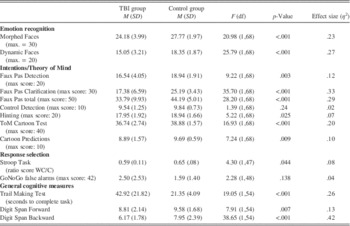
On the Trail Making Test: Part A (processing speed), and the Digit Span forward and backward tasks, the TBI group performed significantly poorer than controls (see Table 1).
Task performance in TBI and healthy comparison groups.

Note. Comparisons based on univariate analyses of variance.
Emotion Recognition
Comparing performance on the two emotion recognition tasks between the two groups showed significantly poorer performance in the TBI group on both tasks (see Table 1).
Understanding Intentions / Theory of Mind
Scores on the Hinting Task, ToM Cartoons, and Cartoon Prediction were all significantly poorer in the TBI group than in the comparison group (see Table 1). The subscores of the Faux Pas Test were the Faux Pas detection score (correctly detecting the presence of a faux pas), the Faux Pas clarification score (correctly explaining the reason for the faux pas), the sum of these two subscores, Faux Pas total score, and the Control score (correctly detecting the absence of a faux pas). The TBI group scored significantly poorer than the comparison group on the Faux Pas detection, clarification, and total scores, but not on the control score (see Table 1).
Cognitive Flexibility
The Stroop ratio was significantly lower in the TBI group than control group, meaning a larger difference between the C and the C/W condition in this group. The two groups did not differ in the number of errors on the Emotional Go/NoGo Task (see Table 1). Only half of the participants had completed the non-emotional Go/NoGo task and, therefore, this task was not analyzed further.
Ratings of Behavior
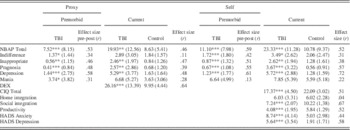
Ratings of current behavior for participants with TBI and comparison participants were compared using non-parametric Mann-Whitney tests. Proxy DEX scores concerning current behavior were significantly higher in the TBI group than the comparison group (see Table 2), suggesting more behavioral problems in TBI group. The CIQ total score, social integration, and productivity subscores were lower in the TBI group, indicating poorer functioning. However, CIQ Home Integration was comparable in the two groups (see Table 2). On the HADS, the depression and anxiety ratings were significantly higher in the TBI group than in the comparison group (see Table 2), indicating more symptoms.
Mean (SDs) ratings on the NBAP, DEX, CIQ, and HADS relating to premorbid or current/post-injury behavior for the TBI and the control group, as obtained from a relative or significant other (proxy) or from the participants themselves (self)

*p<.05.
** p<.01.
*** p<.001.
Comparing NBAP proxy ratings of current behavior showed significantly higher scores, indicating more problems, in the TBI group than in the comparison group for the NBAP total score and all the subscale scores, except indifference and mania (see Table 2). Comparing the NBAP self-ratings showed very similar results; higher total and subscale scores in the TBI group, except mania (see Table 2). Note that the pre-injury ratings in the PTA group were comparable to ratings of current behavior in the comparison group (see Table 2), suggesting an absence of serious behavioral difficulties before injury.
Proxy ratings of behavior before and after injury in the TBI group were compared with Wilcoxon signed ranks tests showing significant increments across all NBAP scales, suggesting more problems after injury. Similar results were found with pre and post-injury self-ratings in the patient group; only mania did not change (see Table 2). Self and proxy ratings of pre-injury and post-injury behavior correlated significantly (NBAP total pre-injury: r=.56, p=.002; NBAP total post-injury/current: r=.65, p<.001).
Associations Between Test Performance and Post-TBI Behavior
Associations between ratings of post-injury behavior (NBAP proxy and DEX), community integration (CIQ) and test performance in the TBI group were analyzed using only those tasks and those ratings of behavior on which the TBI group scored significantly poorer than the comparison group. To reduce the number of correlations, two composite scores were formed by summing Z-scores on the tests assessing emotion recognition and intention understanding. Summing the emotion recognition tasks was justified as the two tasks were correlated in the TBI group (r=.48; p=.002). An intention composite score was formed from the Faux Pas Test (total score), the Hinting Task, the ToM Cartoons Test and the Cartoon Predictions test. Summing was justified because these tests correlated significantly within the TBI group (r≥.52, p ≤.001). The Z-scores that made up the composite scores were formed by calculating Z-scores for each participant based on the means and standard deviations of the comparison group. Of the response selection tasks, only the Stroop ratio was impaired in the TBI group and included in the correlations with ratings of behavior.
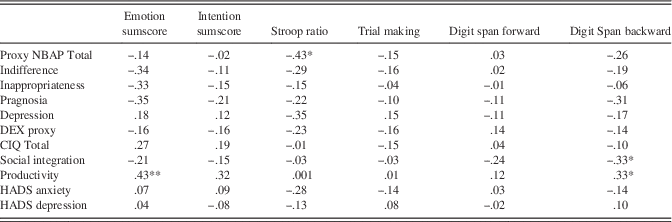
The emotion recognition composite score correlated significantly with CIQ Productivity (r=.43; p=.007), meaning that TBI participants with better emotion recognition reported more independent activities outside the home. The emotion recognition composite score did not correlate with any of the other post-injury behavior ratings. The intention understanding composite score was not associated with any rating of post-injury behavior (see Table 3). The Stroop ratio correlated significantly with NBAP total proxy scores of current behavior (r=−.43; p=.025). Ratings representing more behavioral problems were associated with lower Stroop ratios, indicating poorer inhibition.
Correlations between ratings of post-injury behavior and community integration in the TBI group and performance on combined emotion recognition and intention understanding tests, Stroop test, and other cognitive tests

Note. These correlations did not control for injury severity, time since injury, or education.
*p<.05.
** p<.01.
Cognitive measures assessing processing speed (Trail Making Test: Part A) and attention/working memory (Digit Span) were not associated with ratings of post-injury behavior, except for (1) significant correlations between Digit Span Backward and CIQ Productivity (r=.33; p<.05), where higher span backward was associated with more independent activities outside the home, and (2) a correlation between Digit Span Backward and CIQ Social Integration (r=−.33; p<.05), with a higher span backward score associated with poorer social integration, although the latter result was largely due to a single patient with relatively extreme scores on the two measures.
To examine whether the significant correlations could be explained by injury severity (using the severity categories mild, moderate, severe based on Hannay et al., 2004), time since injury, or education (recognizing that education, as indicator general cognitive ability, may influence both task performance and post-injury functioning), partial correlations were carried out. The correlation between emotion recognition and CIQ Productivity remained significant after controlling for injury severity and time since injury (r=.37, p<.05, and r=.38, p<.05, respectively), but was no longer significant when controlling for years of education (p>.5).
The association between Stroop ratio and NBAP total scores remained significant when controlling for time since injury (r=.44; p<.05), but was no longer significant when controlling for injury severity or education (p>.09). The correlation between Digit Span Backward and CIQ Productivity remained significant when controlling for injury severity and time since injury (r ≥.38, p<.05), but was no longer significant (p=.09) when controlling for years of education. The correlation between Digit Span Backward and CIQ Social Integration became non-significant (p>.06) when controlling for injury severity and time since injury, but remained significant when controlling for years of education (r=−.49; p<.01).
The small number of significant correlations between task performance and post-injury behavior might have resulted from insensitive ratings. The NBAP is subdivided into scores referring to particular behaviors, but the DEX and CIQ scores contain items that are not relevant for social behavior. Therefore, scores on the DEX and CIQ were recalculated to contain only items that refer to social behavior. For the DEX, proxy scores on five questions (questions 1, 9, 11, 13, 20) were summed into a new “social” DEX score. Four questions of the CIQ (questions 5, 9, 10, 11) were summed into a “social” CIQ score. Associations within the patient group between task performance and ratings based on these new scores revealed a significant correlation between the emotion sum score and “social” DEX (r=−.43; p<.05); with patients with poorer emotion recognition performance displaying poorer social behavior according to a significant other. This correlation remained significant after controlling for time since injury and education (r>=−.45; p<.05), but became a trend when controlling for injury severity (p=.06). No other tasks correlated with the new DEX and CIQ scores (p>.1).
The correlations reported above contained participants with severe and less severe TBI. Behavioral changes are more common following more severe TBI, which could mean that the weak associations were due to the mix of mild and severe TBI in the sample. Therefore, the associations between test performance and ratings were repeated including only participants with severe TBI (n=23). Within this severe subsample the intention sum score correlated with CIQ Productivity (r=.48; p<.05), which remained significant when controlling for time since injury (p<.05), but not when controlling for education (p=.38). Repeating the correlations between task performance and the new “social” DEX and CIQ ratings scores in this severe subsample revealed no significant correlations (p>.15).
DISCUSSION
The aim of this study was to examine the relationship between functions proposed as important for adequate social functioning (Corrigan, Reference Corrigan1997; Ochsner, Reference Ochsner2008) and social behavior and community functioning following TBI. The functions considered were emotion recognition, understanding intentions, and response selection. Participants with TBI performed significantly poorer than matched controls on virtually all the tests used to assess these functions. Self and proxy ratings revealed poorer community integration, more problems in social and emotional behavior in the TBI group compared to before the injury and compared to the healthy comparison group.
Emotion recognition correlated with CIQ productivity and a subset of DEX proxy ratings referring specifically to social behavior. Better emotion recognition was associated with better community outcome and social functioning. Response selection (operationalized as inhibition of the dominant response on the Stroop test) correlated with post-injury behavior measured with NBAP proxy ratings; participants with TBI who had better inhibitory control had fewer behavioral problems. Within the participants with severe TBI, a significant positive correlation was found between understanding intentions and involvement in work or education (CIQ productivity).
The only general cognitive measure associated with post-injury behavior was Digit Span Backward, as measure of working memory. Better working memory performance was associated with better community functioning in work or education, but poorer social integration. However, the latter result was largely due to the sores of a single patient with relatively extreme scores on the two tasks. Wood and Rutterford (Reference Wood and Rutterford2006) had previously reported working memory as the only cognitive function commonly assessed in standard batteries to predict psychosocial outcome following TBI.
The results showed associations between all three functions proposed as important for adequate social functioning and ratings of post-injury behavior and community integration. However, most associations were partly driven by other factors (i.e., injury severity, time since injury, or education), suggesting that their contribution to predicting post-injury outcome was not unique. Of the three functions considered, only emotion recognition was associated with both post-injury behavior, and community integration and the association between emotion recognition and post-injury social functioning could not be fully explained by injury severity, time since injury, or education. These findings are in line with previous studies that reported associations between emotion recognition and aspects of post-TBI behavior (Knox & Douglas, Reference Knox and Douglas2009; Milders et al., Reference Milders, Ietswaart, Crawford and Currie2008; Spikman et al., Reference Spikman, Milders, Visser-Keizer, Westerhof-Evers, Herben-Dekker and van der Naalt2013; Struchen et al., Reference Struchen, Clark, Sander, Mills, Evans and Kurtz2008). This was true even though these studies used different emotion recognition tasks, suggesting that the association did not depend on the particular tasks used.
Intention understanding and response selection were less strongly associated with post-injury behavior and outcome than emotion recognition. Reasons could be insensitivity of the instruments used (measuring irrelevant functions) or because the proposed relationship between these functions and adequate social behavior is weaker or more indirect than the models assumed. The current results do not allow a clear distinction between these two options, which was partly due to limitations of the instruments used to assess intention recognition, response selection and behavior. Several of the intention recognition tasks used in this study had rarely been used before in TBI samples, including the Cartoon Predictions test, ToM Cartoons Test, and the Hinting Task. The TBI group in this study was impaired on each of these tasks and performance correlated with tasks that have previously been used in TBI patients (i.e., the Faux Pas test). These findings suggest adequate construct validity, but otherwise little is known about the psychometric properties of these tasks of intention recognition in TBI samples.
The inhibition tasks used in this study (Stroop and GoNogo) may not have captured adequately the ability to select behavior in accordance with the context, hence the modest association with ratings of behavior. There are currently few tests to assess social response selection. A promising new task could be the social reversal learning test described by Osborne-Crowley et al. (Reference Osborne-Crowley, McDonald and Rushby2016). During this test, participants need to adjust their responses following changes in the social context, which is closer to real social situations than the response inhibition in the Stroop and GoNoGo tests. Reversal learning performance was associated with behavioral problems following TBI (Osborne-Crowley et al., Reference Osborne-Crowley, McDonald and Rushby2016).
A limitation of the assessment of behavior in this study was that assessment was based on self-ratings and proxy-ratings from a relative or other person close to the patient, but not on observations of an independent third person. Independent clinician ratings may be more accurate than self or relative’s ratings (Norris & Tate, Reference Norris and Tate2000). Biases in the ratings of behavior and outcome could have contributed to the limited associations with performance on intention recognition and response selection tasks.
The study had several other limitations. Few additional factors that could have modulated the associations were taken into account. For example, community integration may not only be influenced by severity of the impairments, but also by the amount of effort and tolerance of relatives and colleagues. Emotion recognition was restricted to emotions expressed in the face only. Emotions can be expressed in additional channels (e.g., voice, body posture). Furthermore, the current study did not examine performance on individual emotion categories (e.g., anger or positive emotions) or the association with behavior. The TBI sample was modest in size, which could have affected the power to detect associations. The modest size of the sample also prevented the use of advanced statistical techniques to enter multiple predictors simultaneously. However, several of the correlations between task performance and ratings were so low that a larger sample would have made little difference in terms of statistical significance.
In sum, the serious impact of socio-emotional behavior difficulties following TBI on quality of life (Dahlberg et al., Reference Dahlberg, Hawley, Morey, Newman, Cusick and Harrison-Felix2006), relationships (Parente, DeCesare, & Parente, Reference Parente, DeCesare and Parente1990), vocational outcome (Lezak & O’Brien, Reference Lezak and O’Brien1988), and social integration (Oddy, Coughlan, Tyerman, & Jenkins, Reference Oddy, Coughlan, Tyerman and Jenkins1985) has been well described. A greater understanding of cognitive deficits underlying these difficulties could help to identify individuals at risk of developing problems or to initiate interventions to address relevant deficiencies. The current study confirmed earlier studies in finding an association emotion recognition and current behavior in a TBI sample, providing partial evidence for the models proposing requirements for adequate social functioning (Adolphs, Reference Adolphs2009; Corrigan, Reference Corrigan1997; Ochsner, 2008).
Future studies may investigate further the contribution of social knowledge and response selection in predicting social behavior after TBI and may consider the contribution of other possible functions, including self-monitoring, recognition of social cues and specific emotion categories, self-control, empathy, or initiation of action (Hanks, Temkin, Machamer, & Dikmen, Reference Hanks, Temkin, Machamer and Dikmen1999; Kelley et al., Reference Kelley, Sullivan, Loughlin, Hutson, Dahdah, Long and Poole2014; McDonald, Reference McDonald2013; Wood & Williams, Reference Wood and Williams2008). In terms of implications for clinical practice and rehabilitation, the current results suggest that of the three functional domains included, emotion recognition may have most merit as a potential target because it had relatively stronger links with social outcome and community integration. Recent studies have shown that training can improve recognition of expressed emotion in patients with TBI (Neumann, Babbage, Zupan, & Willer, Reference Neumann, Babbage, Zupan and Willer2014; Bornhofen & McDonald, Reference Bornhofen and McDonald2008), although improvements in emotion recognition were not necessarily associated with improvements in social behavior, thus illustrating the complexity of the link between emotion recognition and social behavior.
ACKNOWLEDGMENTS
We thank Bogumila Radlak and Emily Boyd for their help with data collection and processing. None of the authors has any conflicts of interests to disclose.