INTRODUCTION
The understanding of the distribution of organisms in their habitat is a relevant issue in ecology. Macrobenthos in marine sediments is a key component of soft-bottom food webs including crustaceans and fish, and plays an important role in system dynamic processes such as nutrient cycling, dispersion and burial. The distribution and abundance of the macrobenthos communities are controlled by a series of environmental factors such as habitat characteristics (Peeters et al., Reference Peeters, Gylstra and Vos2004), sediment quality (Chapman et al., Reference Chapman, Anderson, Carr, Engle, Green, Hameedi, Harmon, Haverland, Hyland, Ingersoll, Long, Rodgers, Salazar, Sibley and Windom1997), grain-size composition (Mannino & Montagna, Reference Mannino and Montagna1997) and some ecological interaction factors such as competition and predation (Wilson, Reference Wilson1990). In studies conducted in the northern seas, many authors have shown that macrobenthic community distribution is correlated with the type of sediments (Sanders, Reference Sanders1958; Hensley, Reference Hensley1996; Warwick & Davies, Reference Warwick and Davies1997), while others suggested that it is controlled by physical factors at the sediment–water interface (Snelgrove & Butman, Reference Snelgrove and Butman1994) or by seasonal events (Holme & Wilson, Reference Holme and Wilson1985).
There have been only few studies dealing with soft-bottom macrozoobenthic communities in the South Atlantic Ocean, mainly focusing on the negative impact of coastal sewage discharge (Elías, Reference Elías1992; López Gappa et al., Reference López Gappa, Tablado and Magaldi1993; Elías et al., Reference Elías, Rivero and Vallarino2003). In this regard, Elías et al. (Reference Elías, Bremec and Vallarino2001) reported that organic enrichment decreased the relative abundance of macroinfauna in the shallowest subtidal zone and areas around the outfall.
The aim of this study is to determine the assemblage structure of macrozoobenthos communities off Mar del Plata (south-western Atlantic), to characterize them in terms of abundance and habitat, and to evaluate sediment characteristics influencing their structure. In order to assess the role of external factors in community structure, the community structure was related to sediment characteristics like the grain-size composition. On the basis that the studied area is subject to intensive fishing pressure and is heavily influenced by fishery activities such as dredging and oil pollution, this work aimed to provide data for further evaluation of changes in the macrobenthos community structure as a consequence of trawling.
MATERIALS AND METHODS
Study area
The study was conducted over the inner shelf next to the open coast off the port of Mar del Plata City (38°00′S 57°31′W), near the Corrientes Cape. The area, with a biomass ranging from 192 to 638 g 100 m−2, is a prawn-shrimp fishing ground for Artemesia longinaris Bate, 1888 and Pleoticus muelleri (Bate, 1888) (Scelzo et al., Reference Scelzo, Martinez Arca and Lucero2002). The sampling was made at 15–18 m depth, over an area of approximately 0.12 km2 (Figure 1). During the year, salinity varies between 33.5 and 33.8 psu and temperature between 8 and 21°C (Guerrero & Piola, Reference Guerrero, Piola and Boschi1997).
Map of Mar del Plata City showing the location of the sampling area.

Sampling of sediment and benthos
Samples for biological and sediment analyses were collected from June 2003 to January 2004. Fifty-five sampling stations were selected within the studied area. At each station, samples were taken with a Van Veen bottom grab with a sampling surface of 0.026 m2.
On board, the sediment was stored in plastic bags and preserved in a 5% formalin–seawater solution. In the laboratory, grab samples were passed through a series of stacked sieves (smallest sieve: 500 µm mesh size). The residues retained in the sieves were stained with rose Bengal to distinguish macrofauna, which was separated and preserved in 70% ethanol. Benthic fauna was recognized using a stereomicroscope and invertebrates were identified to the lowest taxonomic level possible.
Sediment samples were analysed for grain-size distribution. The coarser samples were dry-sieved through a nested series of sieves and the material retained was weighed. The rest of the samples were analysed using a diffraction particle size distribution analyser (CILAS 1180 Liquid). Six particle size-classes were used: silt (<62 µm); very fine sand (62–120 µm); fine sand (120–250 µm); medium sand (250–500 µm); coarse sand (500–1000 µm) and very coarse sand (>1000 µm). Granulometric fractions were determined according to Perillo et al. (Reference Perillo, Gómez, Aliotta and Galíndez1985).
Statistical analyses
The PRIMER (Plymouth Routines in Multivariate Ecological Research) software package (Clarke & Warwick, Reference Clarke and Warwick1994) was used for data analysis. Different assemblages were described based on the community structure. Hierarchical clustering with group-average linking was applied to abiotic and biotic data. The Bray–Curtis similarity index was used for species abundance and Euclidean distance for sediment characteristics. An a priori ANOSIM test was performed to examine if significant differences exist between months. These analyses were followed by a non-metric multidimensional scaling (MDS). The organisms which most contributed to the differences observed among groups were determined by the SIMPER (similarity percentages) procedure. The Shannon–Wiener diversity index (H) was calculated as: H = –∑ pi × (logepi), where pi is the proportion of abundance ith species from total benthos abundance (A). Differences among groups were tested with analysis of variance (ANOVA) followed by the Tukey test. Normality was tested with the Kolmogorov–Smirnov test and homoscedasticity with the Levene test. Comparisons were considered significantly different at a level of P < 0.05. The two similarity matrices were compared with the Spearman's rank-correlation coefficient (ρ) using the RELATE routine; values close to zero indicate lack of relationship. The BIO-ENV procedure was used to match biotic patterns with environmental variables, in this case particle size composition.
RESULTS
Characteristics of macrobenthic assemblages
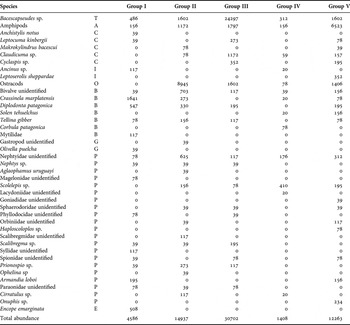
Forty-one species/taxa comprising 1745 individuals were collected from the 55 sampling stations. The number of species (S) in a single sample varied between 3 and 11 species/taxa. Amphipods and polychaetes were the most common taxa, both were found in 81% of the samples, followed by tanaidaceans (71%), bivalves (54%), cumaceans (47%) and ostracods (44%). Other taxa (i.e. isopods, gastropods and echinoderms) occurred in less than 12% of the samples. Total abundance in each sample varied between 156 and 6758 ind. m2. Tanaidaceans, followed by bivalves and amphipods, were the most abundant taxa (Table 1). An a priori ANOSIM test revealed that the community composition was not significantly different between months (r = 0.0292, P < 0.1).
List of species within each group and their total abundance (individuals m−2).

T, tanaidaceans; A, amphipods; C, cumaceans; I, isopoda; B, bivalve; G, gastropoda; tanaidaceans; A, amphipods; C, cumaceans; I, isopoda; B, bivalve; G, gastropoda; P, polychaete; E, echinoderm; P, polychaete; E, echinoderm.
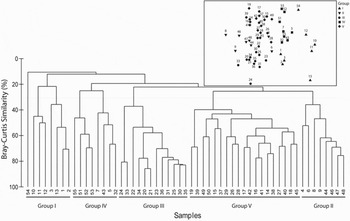
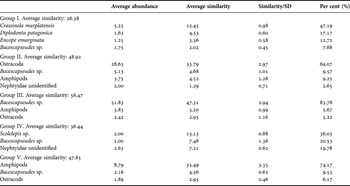
Five well-differentiated groups were identified by the cluster analysis (Figure 2). The SIMPER revealed differences in macrobenthos composition and abundance among sampling sites (Table 2). Group I was dominated by bivalves (with Crassinella marplatensis Castellanos, 1970 being the most abundant, followed by Diplodonta patagonica d'Orbigny, 1842), the echinoderm Encope emarginata (Leske, 1778), the tanaidacean Bacescapseudes sp. Guto, 1981 and polychaetes (particularly Armandia loboi Elías & Bremec, 2003). Group II was characterized by the presence of ostracods, Bacescapseudes sp., amphipods and polychaetes (mainly unidentified individuals belonging to the family Nephtyidae and, to a lesser extent, to the family Spionidae). Group III was characterized by Bacescapseudes sp.; this group showed the highest abundance values. Group IV was characterized by polychaetes, particularly Scolelepis sp. Blainville, 1828 and individuals of the family Nephtyidae and Bacescapseudes sp.; this group had low abundance. Finally, group V was dominated by amphipods and Bacescapseudes sp. The MDS analysis discriminated the same five groups obtained by the cluster analysis (Figure 2).
Bray–Curtis similarity index for macrobenthic abundance, and the corresponding two-dimensional MDS (multi-dimensional scaling) ordination (stress = 0.21).

SIMPER analysis of macrobenthic community.

Analysis of variance showed that there were significant differences in diversity (P < 0.05) (Figure 3). The post-hoc Tukey's test showed difference between group III and the other groups and the same result was obtained for group IV.
Mean±standard deviation of Shannon–Wiener diversity index.

Characteristics of sediments
An a priori ANOSIM test revealed that the sediment compositions were not significantly different between months (r = 0.0883, P < 0.1). The results of the cluster analysis and MDS ordination based on the percentage particle-size distribution at each of the stations sampled are shown in Figure 4. In these analyses, five groups were identified featuring the following assemblages: group A, medium sand (250–500 µm); group B, medium to very fine sand (62–500 µm); group C, fine to very fine sand (62–250 µm); group D, silt (<62 µm); and group E, fine sand (120–250 µm).
Euclidean distance for sediment composition, and the corresponding two-dimensional MDS (multi-dimensional scaling) ordination for sediment composition (stress = 0.13).

Relationship between particle size and macrofauna composition
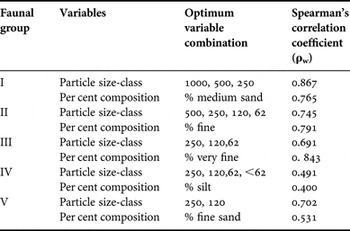
The correlation coefficient between sediment composition and the structure of the benthic community was high (ρ = 0.497; P < 0.01), thus suggesting that the occurrence of some species was related to particular sediment types. The relationship between macrofauna composition and sediment composition is summarized in Table 3 by representing the combination of environmental variables which yield the best matches of macrofauna and sediment similarity matrices, as measured by weighted Spearman rank-correlation. The correlations between individual faunal groups and particle size composition were high.
Combination of environmental variables giving the largest weighted Spearman rank-correlation between macrobenthic faunal groups and sediment composition (particle size-classes and per cent composition).

In group I macrobenthic community is associated with medium sand sediments. The group II community is associated mainly with medium to very fine sand. The group III community is characterized by fine to very fine sand; it showed the highest abundance and lowest Shannon–Wiener diversity index. The group IV community is associated with silt and fine sands and showed the lowest values of abundance and number of species and the highest value of diversity index. The group V community is characterized by fine sand.
DISCUSSION
The objective of this study has been to establish a relationship between macrobenthic community composition and grain-size composition in sandy bottoms off Mar del Plata City. The close relationship between macrobenthic communities and sediment composition has been shown in numerous studies (e.g. Sanders, Reference Sanders1958; Wilson, Reference Wilson1990; Nanami et al., Reference Nanami, Saito, Akita, Motomatsu and Kuwahara2005), although other studies suggest little correspondence between sediment composition and benthic communities (Seiderer & Newell, Reference Seiderer and Newell1999; Newell et al., Reference Newell, Seiderer and Robinson2001). In some South American systems, the granulometric type proved to be the main abiotic variable determining the spatial distribution of polychaete assemblages (Elías & Bremec, Reference Elías and Bremec1994; Capitoli et al., Reference Capitoli, Bremec, Elías and Giberto2004; Bremec & Giberto, Reference Bremec and Giberto2006).
The present study reveals that the study area was not homogeneous in terms of macrobenthic community composition and grain-size composition, and that they were related to each other. Despite the fact that similarity was lower for benthic communities than for sediments, they fell into the same well-defined groups. Comparison of the similarity matrices for benthic communities and sediments yields a value of 0.5 for the Spearman's rank-correlation (RELATE routine). The correlation between individual faunal groups and particle-size composition yields values of >0.4 for the weighted Spearman's rank-correlation (BIO-ENV routine). Those values suggest that different environmental conditions, in this case distinct grain-size composition, may contribute in controlling macrobenthic communities.
Five macrobenthic assemblages, separable largely on the basis of sediment characteristics, were recognized within the studied area. The bivalves Crassinella marplatensis and Diplodonta patagonica were the dominant species in group I, featuring sandy sediment. This result is consistent with the distribution pattern of benthic organisms proposed by Sanders (Reference Sanders1958), with filter-feeders dominating in coarse sediments. In contrast, mud substrates were dominated by deposit-feeders, represented in group IV by the polychaete Scolelepis sp., which fed on deposited particles (Pardo & Amaral, Reference Pardo and Amaral2004). This spatial separation of suspension-feeders and deposit-feeders may result from different causes. Rhoads & Young (Reference Rhoads and Young1970) reported a tendency for suspension feeders to dominate in sandy substrates. According to Nanami et al. (Reference Nanami, Saito, Akita, Motomatsu and Kuwahara2005), the high current activity in this type of sediment avoids accumulation of detritus on the bottom, thereby providing suspension-feeders with more potential food in comparison to weaker currents. In the case of deposit-feeders, Sanders (Reference Sanders1958) stated that the large surface area of silty bottoms contributes to the binding of organic matter to bottom sediments, leading to an increased availability of nutrients. On the other hand, larvae of suspension- and sediment-feeders may tend to settle on different substrate types. This behaviour was proposed by Rhoads & Young (Reference Rhoads and Young1970), who found that suspension-feeders are unable to successfully colonize silt bottoms which had been intensively reworked by deposit-feeders. Further studies are needed to determine the influence of granulometry on macrobenthic larvae.
The results presented above reveal differences in the structure of macrobenthic assemblages in relation to sediment characteristics at a micro-environmental scale and this agrees with studies in the subtidal area of Argentinean waters where several authors have shown spatial heterogeneity of bottoms in relatively larger scales than those we studied (Olivier et al., Reference Olivier, Bastida and Torti1968; Bremec & Roux, Reference Bremec and Roux1997). This pattern is consistent with models for patchy communities where habitat partitioning accounts for the patchy distribution of populations. This information improves the understanding of ecosystems in areas subjected to fishing disturbance as is the case for Mar del Plata. On the other hand, since changes in macroinvertebrate community structure are considered sensitive tools for detecting alterations in aquatic ecosystems (Pinel-Alloul et al., Reference Pinel-Alloul, Méthot, Lapierre and Willsie1996), in this study, we provided important data to assess the effects of the trawl on macrobenthic communities.
ACKNOWLEDGEMENTS
We are grateful to Daniel Roccatagliata and Paulo Lana for their assistance in species identification, to Alejandro Meyer for field assistance and to Silvia Marcomini for helping with the grain-size analysis. This study was partially supported by UBACyT X-316 and by Agencia de Promoción Científica, PICT 10975 and PICT 14419.