


%20--%3e%3c!DOCTYPE%20svg%20PUBLIC%20'-//W3C//DTD%20SVG%201.0//EN'%20'http://www.w3.org/TR/2001/REC-SVG-20010904/DTD/svg10.dtd'%3e%3csvg%20version='1.0'%20id='Layer_1'%20xmlns='http://www.w3.org/2000/svg'%20xmlns:xlink='http://www.w3.org/1999/xlink'%20x='0px'%20y='0px'%20width='64px'%20height='64px'%20viewBox='5.5%20-3.5%2064%2064'%20enable-background='new%205.5%20-3.5%2064%2064'%20xml:space='preserve'%3e%3cg%3e%3ccircle%20fill='%23FFFFFF'%20fill-opacity='0'%20cx='37.785'%20cy='28.501'%20r='28.836'/%3e%3cpath%20fill='%23595959'%20d='M37.441-3.5c8.951,0,16.572,3.125,22.857,9.372c3.008,3.009,5.295,6.448,6.857,10.314%20c1.561,3.867,2.344,7.971,2.344,12.314c0,4.381-0.773,8.486-2.314,12.313c-1.543,3.828-3.82,7.21-6.828,10.143%20c-3.123,3.085-6.666,5.448-10.629,7.086c-3.961,1.638-8.057,2.457-12.285,2.457s-8.276-0.808-12.143-2.429%20c-3.866-1.618-7.333-3.961-10.4-7.027c-3.067-3.066-5.4-6.524-7-10.372S5.5,32.767,5.5,28.5c0-4.229,0.809-8.295,2.428-12.2%20c1.619-3.905,3.972-7.4,7.057-10.486C21.08-0.394,28.565-3.5,37.441-3.5z%20M37.557,2.272c-7.314,0-13.467,2.553-18.458,7.657%20c-2.515,2.553-4.448,5.419-5.8,8.6c-1.354,3.181-2.029,6.505-2.029,9.972c0,3.429,0.675,6.734,2.029,9.913%20c1.353,3.183,3.285,6.021,5.8,8.516c2.514,2.496,5.351,4.399,8.515,5.715c3.161,1.314,6.476,1.971,9.943,1.971%20c3.428,0,6.75-0.665,9.973-1.999c3.219-1.335,6.121-3.257,8.713-5.771c4.99-4.876,7.484-10.99,7.484-18.344%20c0-3.543-0.648-6.895-1.943-10.057c-1.293-3.162-3.18-5.98-5.654-8.458C50.984,4.844,44.795,2.272,37.557,2.272z%20M37.156,23.187%20l-4.287,2.229c-0.458-0.951-1.019-1.619-1.685-2c-0.667-0.38-1.286-0.571-1.858-0.571c-2.856,0-4.286,1.885-4.286,5.657%20c0,1.714,0.362,3.084,1.085,4.113c0.724,1.029,1.791,1.544,3.201,1.544c1.867,0,3.181-0.915,3.944-2.743l3.942,2%20c-0.838,1.563-2,2.791-3.486,3.686c-1.484,0.896-3.123,1.343-4.914,1.343c-2.857,0-5.163-0.875-6.915-2.629%20c-1.752-1.752-2.628-4.19-2.628-7.313c0-3.048,0.886-5.466,2.657-7.257c1.771-1.79,4.009-2.686,6.715-2.686%20C32.604,18.558,35.441,20.101,37.156,23.187z%20M55.613,23.187l-4.229,2.229c-0.457-0.951-1.02-1.619-1.686-2%20c-0.668-0.38-1.307-0.571-1.914-0.571c-2.857,0-4.287,1.885-4.287,5.657c0,1.714,0.363,3.084,1.086,4.113%20c0.723,1.029,1.789,1.544,3.201,1.544c1.865,0,3.18-0.915,3.941-2.743l4,2c-0.875,1.563-2.057,2.791-3.541,3.686%20c-1.486,0.896-3.105,1.343-4.857,1.343c-2.896,0-5.209-0.875-6.941-2.629c-1.736-1.752-2.602-4.19-2.602-7.313%20c0-3.048,0.885-5.466,2.658-7.257c1.77-1.79,4.008-2.686,6.713-2.686C51.117,18.558,53.938,20.101,55.613,23.187z'/%3e%3c/g%3e%3c/svg%3e)
%20--%3e%3c!DOCTYPE%20svg%20PUBLIC%20'-//W3C//DTD%20SVG%201.0//EN'%20'http://www.w3.org/TR/2001/REC-SVG-20010904/DTD/svg10.dtd'%3e%3csvg%20version='1.0'%20id='Layer_1'%20xmlns='http://www.w3.org/2000/svg'%20xmlns:xlink='http://www.w3.org/1999/xlink'%20x='0px'%20y='0px'%20width='64px'%20height='64px'%20viewBox='5.5%20-3.5%2064%2064'%20enable-background='new%205.5%20-3.5%2064%2064'%20xml:space='preserve'%3e%3cg%3e%3ccircle%20fill='%23FFFFFF'%20fill-opacity='0'%20cx='37.637'%20cy='28.806'%20r='28.276'/%3e%3cg%3e%3cpath%20fill='%23595959'%20d='M37.443-3.5c8.988,0,16.57,3.085,22.742,9.257C66.393,11.967,69.5,19.548,69.5,28.5c0,8.991-3.049,16.476-9.145,22.456%20C53.879,57.319,46.242,60.5,37.443,60.5c-8.649,0-16.153-3.144-22.514-9.43C8.644,44.784,5.5,37.262,5.5,28.5%20c0-8.761,3.144-16.342,9.429-22.742C21.101-0.415,28.604-3.5,37.443-3.5z%20M37.557,2.272c-7.276,0-13.428,2.553-18.457,7.657%20c-5.22,5.334-7.829,11.525-7.829,18.572c0,7.086,2.59,13.22,7.77,18.398c5.181,5.182,11.352,7.771,18.514,7.771%20c7.123,0,13.334-2.607,18.629-7.828c5.029-4.838,7.543-10.952,7.543-18.343c0-7.276-2.553-13.465-7.656-18.571%20C50.967,4.824,44.795,2.272,37.557,2.272z%20M46.129,20.557v13.085h-3.656v15.542h-9.944V33.643h-3.656V20.557%20c0-0.572,0.2-1.057,0.599-1.457c0.401-0.399,0.887-0.6,1.457-0.6h13.144c0.533,0,1.01,0.2,1.428,0.6%20C45.918,19.5,46.129,19.986,46.129,20.557z%20M33.042,12.329c0-3.008,1.485-4.514,4.458-4.514s4.457,1.504,4.457,4.514%20c0,2.971-1.486,4.457-4.457,4.457S33.042,15.3,33.042,12.329z'/%3e%3c/g%3e%3c/g%3e%3c/svg%3e)
Introduction
Health technology assessment (HTA) is a “multidisciplinary process that uses explicit methods to determine the value of a health technology at different points in its lifecycle. The purpose is to inform decision-making in order to promote an equitable, efficient, and high-quality health system” (Reference O’Rourke, Oortwijn and Schuller1). Often, HTA takes a long-term perspective that assesses, using evidence of clinical and cost-effectiveness, the future impact in terms of health outcomes and costs of introducing a new technology in the healthcare system (Reference Drummond, Schwartz and Jönsson2).
Surrogate endpoints are biomarkers or other intermediate outcomes that are correlated with or are expected to reliably predict a clinical benefit or harm (Reference Ciani, Manyara and Davies3). This type of endpoint is of relevance to many HTA agencies because of their increasing use in regulation (4–6) which can result in a lack of data on long-term effectiveness when a new health technology enters the market (Reference Bujkiewicz, Achana, Papanikos, Riley and Abrams7).
Some HTA agencies have published methodological guidance on the acceptability of using surrogate endpoints to inform decision making (4,Reference Grigore, Ciani and Dams8). However, the level of detail varies widely, and there is limited guidance on validation and considerations for economic modeling (4;Reference Grigore, Ciani and Dams8;Reference Radu, Kumar and Cubi-Molla9). Furthermore, despite the extensive published general methodological guidance on conceptualization of economic models and evidence synthesis, there remains a lack of clarity on how to address surrogate endpoints specifically when conceptualizing an economic model to inform HTA (4;Reference Bujkiewicz, Achana, Papanikos, Riley and Abrams7;Reference Caro, Briggs, Siebert and Kuntz10;Reference Roberts, Russell and Paltiel11).
In this context, a group of HTA agencies collaborated to produce recommendations about using surrogate endpoints in health economic models to inform HTA decision making. The project activity was led and coordinated by the National Institute for Health and Care Excellence (NICE) who formed a working group that included the following organizations:
-
• Australian Government Department of Health and Aged Care
-
• Canada’s Drug Agency (CDA-AMC)
-
• the Institute for Clinical and Economic Review (ICER), USA
-
• the National Health Care Institute (ZIN), Netherlands
-
• Colombian Institute for Technology Assessment in Health (IETS)
-
• Rubix Health, USA
Working group members led on different tasks, and the results from each task were then used to determine best practices in model conceptualization for cost-effectiveness analysis involving surrogate endpoints. The final set of recommendations is designed to be used alongside existing economic modeling guidance and includes considerations around definition, justification, adoption, statistical validation, incorporation, reporting, and approaches to quantify and present uncertainty, when using a surrogate endpoint (4).
This paper describes one of the activities that informed the final recommendations. The objective of this study was to identify how HTA agencies have considered and dealt with the uncertainties around surrogate endpoints in their technology evaluations, with a focus on economic evaluation.
Methods
Data were collected for this study using focus groups, as this allowed for interaction between participants and open discussions (Reference Pope and Mays12). Three focus groups were conducted globally. The focus group for participants in the Americas was led by DO and MR, the European focus group was led by ZG, and MC and PA led the focus group in the Asia-Pacific region. NICE staff (LF, FS, SC) attended and supported each group.
HTA agencies were identified that were known to use, develop, or perform health economic evaluations as part of HTA. This included established HTA agencies and newly established HTA agencies with global geographic representation. The agencies then identified members of staff who had a technical or operational role and were involved in the evaluation of technologies. They also needed to be able to provide information on their experience of their agency on the use of surrogate endpoints for decision making.
Participants were invited through existing contacts of the working group. Contacts were approached via email and asked to forward to relevant staff. All participants were sent an information sheet and asked to complete a consent form before joining the focus groups.
A document outlining the aims of the focus group and four case studies involving the use of surrogate endpoints was sent to each participant prior to the meeting to help facilitate the discussions. This included anticipated questions to allow participants time to consider their response and research previous actions within their agency. The case studies included metabolic-associated steatohepatitis (MASH), obesity, Duchenne muscular dystrophy (DMD), and multiple myeloma. These topics were selected by the working group to reflect a range of surrogate endpoints and topics that participants may have experience of or an interest in.
-
• Obesity was chosen as a topic that has well-established surrogate endpoints with validated correlation to patient-centric outcomes that are likely to have been seen by all participants.
-
• Minimal residual disease (MRD) in multiple myeloma was selected as a less well-established surrogate endpoint that fewer participants will have experience of but is likely to be seen in HTA in coming years.
-
• DMD was chosen as a rare disease that utilizes surrogate endpoints due to its small patient populations making lengthy clinical studies challenging.
-
• MASH was selected as a topic that is likely to be seen in coming years where surrogate endpoints are required to extrapolate over long periods of time.
The focus groups were divided into three parts: (1) open discussion asking participants to reflect on how their HTA agency handles surrogate endpoints and the issues they have encountered, (2) discussion of specific case studies, and (3) recommendations or advice they would give to health technology developers. Discussions were conducted online via Microsoft Teams, video recorded, and transcribed using Microsoft Teams and then checked and edited by a member of the team. Focus groups lasted approximately 2 hours.
Ethics approval was obtained from Newcastle University (reference number: NICE 42449/2023).
Outline of analysis
Transcriptions were imported into Lumivero (2023) NVivo (Version 14) www.lumivero.com (Reference Lumivero13). A framework analysis approach was adopted for this study (Reference Gale, Heath, Cameron, Rashid and Redwood14). After familiarization with the data, an initial thematic framework was developed based on the research aims and discussions with the working group. This consisted of four key points in the data (themes):
-
1. Guidance on the use of surrogate endpoints in economic modeling for HTA
-
2. Issues when using surrogate endpoints in economic modeling for HTA
-
3. Consequences of using surrogate endpoints in economic modeling in HTA decision making
-
4. Suggested recommendations for using surrogate endpoints in economic modeling for HTA
Two people (LF and FS) then read one of the focus group transcripts independently, line by line assigning a code from the initial framework and noting any additional themes with no obvious place in the framework. The framework was then updated. LF applied it to the two remaining focus groups. All the data, from each focus group, relating to each code in the framework were collated into a framework matrix.
The results were interpreted in the context of the research aims and written into a draft report. The draft report was circulated to focus group participants and two further HTA staff who had consented to be part of the focus groups but were unable to attend on the day. They were given the opportunity to provide feedback and where appropriate this was incorporated into the analysis.
Once the feedback process was complete, a final framework was developed and used to structure the findings reported below. The four final themes were
-
1. Experience of surrogate endpoints in economic modeling for HTA
-
2. Challenges of using surrogate endpoints in economic modeling for HTA
-
3. Guidance on the use of surrogate endpoints in economic modeling in HTA decision making
-
4. Recommendations for future use of surrogate endpoints in economic modeling for HTA
Results
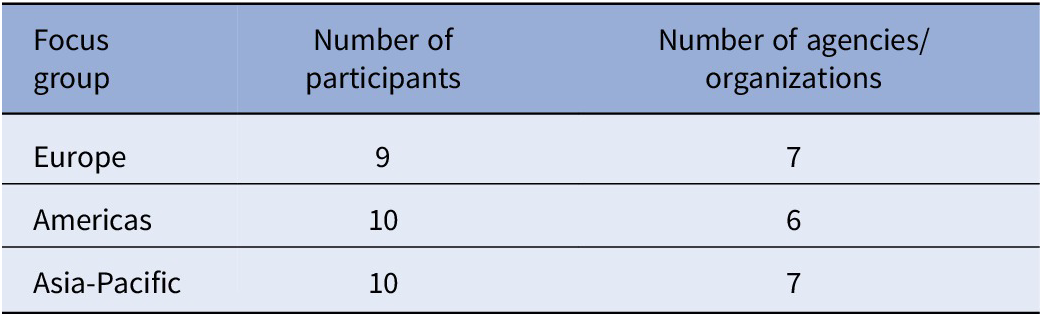
A total of 29 participants took part in the study between May and June 2024, as summarised in Table 1. There were 20 HTA agencies or associated organizations representing countries from Europe, the Americas, and Asia-Pacific regions.
Summary of the number of participants and agencies and associated organizations represented in the three focus groups

Table 1. Long description
The table consists of three columns and four rows including the header.
Column headers from left to right are: Focus group, Number of participants, and Number of agencies forward slash organizations.
Row 1: Europe focus group has 9 participants and 7 agencies forward slash organizations.
Row 2: Americas focus group has 10 participants and 6 agencies forward slash organizations.
Row 3: Asia-Pacific focus group has 10 participants and 7 agencies forward slash organizations.
Experience of using surrogate endpoints in economic modeling for HTA
Defining surrogate endpoints
Participants suggested that there was a lack of clarity about the definition of a surrogate endpoint. Some participants viewed biomarkers and intermediate outcomes differently and, in some cases, did not consider them always to be a surrogate endpoint. For example, progression-free survival (PFS) is an intermediate outcome with a well-accepted link to survival in certain cancers; some participants did not initially talk about PFS as a surrogate endpoint.
Frequency of encountering surrogate endpoints in evaluations
Across the discussions, regardless of their definition of a surrogate endpoint, participants agreed that their use in HTA submissions was increasing, with upward of 50 percent of assessments using a surrogate endpoint. This was thought to be a consequence of expedited regulatory approvals and trials targeting patients with earlier stage disease and commonly seen in more innovative technologies or rare diseases, such as DMD.
It makes sense that we’re seeing more submissions that are using either what we call a true surrogate or the intermediate surrogates. Because in oncology anyway, you’ve got all the treatments moving earlier and earlier. So adjuvant neoadjuvant space, you’re not going to have overall survival benefit demonstrated in the trial.
European focus group participant
Handling the increase in use of surrogate endpoints to inform decision making
Participants recognized that many HTA agencies have limited guidance on how to handle surrogate endpoints in their methods manuals. In response to the increase in use of surrogate endpoints, some participants described additional internal documents that are used to inform their evaluations. Where internal guidance is available, it was said to be centered around providing justifications for the inclusion of the surrogate endpoint in the economic model and exploring different scenarios to better understand the uncertainty due to the surrogate endpoint. There was consensus among participants that it would be useful to have more detailed guidance for the evaluation of clinical effectiveness based on surrogate endpoints and for its translation to the assessment of cost-effectiveness.
Awareness of surrogate endpoints in the pipeline through early engagement with industry
Participants from HTA agencies that have early scientific advice services for technology developers highlighted the value of knowing about potential new surrogate endpoints in the pipeline through the advice requests. This gave them experience and knowledge of a surrogate endpoint before seeing it in a submission. For example, seeing how surrogate endpoints such as MRD are being used in the evaluation of multiple myeloma treatments.
We do have a scientific advice programme where we support a sponsor in their very, very early stages of planning a trial. And it’s sometimes in that space we see what might happen in the pipeline five or six years down the line and in that space, we have seen sponsors who are at least planning for the primary or sometimes a composite a co-primary clinical endpoint to be […] NASH CRN scoring system.
Americas focus group participant
Challenges of using surrogate endpoints in economic modeling for HTA
Challenges when evaluating economic models that use surrogate endpoints
Participants reported that in their experience, economic models are designed around the surrogate endpoint, rather than the disease pathway, which makes model outputs difficult to validate and apply to other contexts. It was also highlighted that in some instances, the surrogate endpoint is embedded within the model structure in ways that can add complexity to their evaluation and make it challenging to separate the impact of the assumptions made about the relationship between the surrogate endpoint and the final outcome. An example of this is when a surrogate endpoint informs multiple transition probabilities that affect different outcomes, like the model used in ICER’s evaluation of resmetirom and obeticholic acid for NASH/MASH (15).
Like the NASH model, […] It’s […] an indirect route through multiple transition probabilities that follow that surrogate relationship.
Americas focus group participant
Participants highlighted that in HTA, intermediate endpoints that include a measure of function or symptoms and used as a substitute for a target outcome are considered as surrogate endpoints. This can include outcomes such as quality of life outcomes or adverse events. For example, in an evaluation of liraglutide for managing weight and obesity carried out by NICE in the UK, the final endpoint, cardiovascular benefit of liraglutide in the economic model was based on risk reduction based on surrogate endpoints hemoglobin A1c and blood pressure. Participants stressed that it is important that these outcomes are also validated if they are to be used in the economic modeling. As can occur in trials without surrogate endpoints, participants also identified that in some cases there was disconnect between how the surrogate endpoint was measured in the clinical trial and what was being modeled making it challenging to interpret and incorporate the evidence into the modeling.
Challenges when assessing the uncertainty arising due to the use of surrogate endpoints
Due to the opportunity cost of decision making based on surrogate endpoints and the potential losses if an incorrect decision is made, uncertainty needs to be mitigated. Some of the HTA agencies use temporary reimbursement decisions or managed access when the evidence to support the use of a surrogate endpoint is lacking. For example, an HTA agency might give a temporary reimbursement or time limited recommendation along with the condition that further evidence is provided in three years’ time. This flexibility alleviates some of the issues that arise when evaluations are a “single decision at a single time point” (European focus group participant). Other participants cited using scenario analyses to explore the uncertainty in their economic models such as considering the best and worst values for the surrogate endpoint, removing the surrogate endpoint entirely from the model, and even using value of information analysis to identify and prioritize further research in areas where the further reduction in uncertainty associated with the use of the surrogate endpoint is worth the extra resources required to collect the data (Reference Fenwick, Steuten and Knies16).
Challenges when validating a surrogate endpoint
The study participants suggested that it was key to understand what evidence and previous decisions had been made in the same technology, for the same disease or using the same surrogate endpoint. This was especially true for those HTA agencies where a decision to recommend a technology cannot be reversed and so sets a precedent for future decision making. However, many participants felt that the requirements of some validation processes are complex, time consuming and costly for technology developers and the HTA agencies evaluating the evidence.
The process involved in trying to validate a surrogate is complex and time consuming and it’s almost like a submission in itself just to do that.
Asia-Pacific focus group participant
It was also felt that it is important to consider the validity of a surrogate endpoint in the context of how and why it is collected. Often HTA agencies receive evidence on the validity of a surrogate endpoint after it has been evaluated by a regulator. This means it is collected and presented to meet the regulator’s needs, and the HTA agency is unlikely to be able to contradict any conclusions drawn about a surrogate endpoint’s validity. The HTA agency will still need to see and understand this evidence for their own decision making, but this can be challenging in the face of a lack of transparent evidence of validity. For example, the FDA surrogate endpoint table does not provide the validated evidence used in their decision making process (17).
Alignment in expectations between regulators, HTA agencies, and technology developers
There can be a lack of alignment in expectations between regulators, HTA agencies, and technology developers regarding the level of information required for decision making, especially relating to the surrogate endpoint. The evidence presented to regulators may not be sufficient to accurately represent a technology’s use in clinical practice if it is recommended by an HTA agency. For example, an HTA agency is often required to extrapolate the benefits and costs of a technology over a lifetime for use in an economic model.
The differing expectations are exacerbated by the lack of guidance on how to transparently report the evidence relating to surrogate endpoints. This makes it difficult to conduct thorough evaluations for a health technology and make robust recommendations. It was also identified as a stumbling block for many of the participants as it made it difficult to properly understand the evidence around the relationship between the surrogate endpoint and the final outcome.
It’s almost like getting information like with little teaspoons.
Americas focus group participant
Guidance on the use of surrogate endpoints in economic modeling in HTA decision making
Approach to providing additional guidance to technology developers around use of surrogate endpoints to inform decision making
Participants highlighted the following aspects that should be considered when developing additional guidance around surrogate endpoints:
-
• Variation in capacity and resource of different HTA agencies: if technology developers are requested to provide extensive volumes of additional information, less-resourced HTA agencies may struggle to assess this information within strict timeframes.
-
• Flexibility of guidance to be applicable in different situations where surrogate endpoints may arise: if guidance is too stringent, it may not accommodate situations where specific evidence is lacking, so it is important to present a tiered approach based on aspects like availability of evidence. For example, in NICE methods guidance the EQ-5D is set out as the preferred measure of quality of life in adults. However, multiple options are provided that would be acceptable where this evidence is not available from a clinical trial, for example, using data from the literature or mapping from other quality of life measures (18).
-
• Consistency within an organization: there is a need to have an approach that can be consistently applied to all submissions within an HTA agency.
There’s a consistency aspect if you have that flexibility to do something different every time, then what you get is an inconsistent approach every single time so that is not helpful to us and it’s really not helpful to those who submit their evidence to us.
Americas focus group participant
-
• Consistency between organizations: greater consistency between HTA agencies would support them to be able to use each other’s technical work and analysis. However, participants receiving HTA submissions on a delayed timeline relative to other jurisdictions did identify instances where mature data were available, but technology developers had submitted earlier data based on earlier submissions to HTA agencies in other jurisdictions. Guidance needs to consider launch patterns and changes to data availability over time.
Importance of the context and relevance of a surrogate endpoint to patients
The participants suggested that the use of surrogate endpoints in rare and ultra-rare disease, such as DMD, can be challenging, and additional guidance would be helpful. The use of surrogate endpoints in this setting is increasingly common due to the novelty of treatments in this area; however, evidence to support a surrogate endpoint can be minimal due to the small population or the immature data collection in this setting and due to the absence of other treatments.
The intermediate outcomes, we haven’t really assessed those outcomes before and until they’ve been assessed and […] had that clinical involvement, we don’t know whether or not they’re […] a surrogate for what we should be looking for.
European focus group participant
In this situation, participants suggested that it is important to keep the focus on what matters to patients and to consider the broader context to the decision making. For example, is there an unmet need in this population, is this a rare disease with few treatment options, is this a life-threatening condition, is it a refractory population and resistant to previous treatments? One participant noted that their agency has developed a multi-criteria decision analysis (MCDA) framework that help them to consider criteria including effectiveness and severity of disease, especially in relation to rare diseases. Participants also mentioned discussions with patients and clinical experts. Another participant suggested they consider relevant regulator decisions that involved the surrogate endpoint.
Guidance on how to validate a surrogate endpoint for use in an economic model
Participants were keen to have more guidance on how surrogate endpoints should be validated, including appropriate methods and how this should be presented. They wanted to see a set of standards that outlined how the relationship between the surrogate and final outcome should be calculated at an individual and a trial level.
The use of real-world evidence (RWE) and later data cuts from clinical trials were suggested by participants as a potential way to collect more information to validate a surrogate endpoint. For example, a temporary or conditional recommendation could be made on the basis that further evidence is collected to support the surrogate relationship.
If we have to be making a decision early that there is the opportunity in the future to be re looking at those, but based on real world evidence, based on observational data. And we should be putting in the infrastructure to look at that.
European focus group participant
Although available evidence may be helpful in certain situations, there were concerns that in many situations data may be collected in a way that is not useful for developing the model and for the assessments of clinical effectiveness, especially if different in nature (heterogeneous populations and comparators) to the clinical trial evidence that may also be employed to develop the model.
For some HTA agencies, a literature review of clinical studies, quality of life studies, previous HTA reports, and economic models in the disease area is required to inform the evidence synthesis and economic model, but this was not the case for all. The suggestion was that guidance could outline how a literature review of evidence should be carried out and presented as part of the submission to support the use of a surrogate endpoint. This should include the clinical evidence underlying and justifying the use of a surrogate endpoint. On the limited occasions when there is a systematic review of evidence of a surrogate endpoint, participants said they still rely on discussions with clinical and public experts to interpret this evidence and provide their views on the surrogate endpoint.
Some participants were keen to stress that past economic modeling approaches and HTA decisions should not dictate future decisions but should help to inform them and so the evidence presented should be interpreted with this in mind and decisions reflect more up-to-date knowledge.
Really you should build on what’s been done before. Not, carry on doing it.
European focus group participant
Guidance to facilitate transparent reporting of evidence (setting expectations with technology developers)
The participants wanted to see recommendations that would facilitate better reporting of evidence from technology developers that would help them to understand the surrogate relationships, how the economic models had been built and help them to explore the uncertainties themselves. There was also a suggestion that transparent reporting is required from HTA agencies and modelers on how they are using the evidence from a surrogate endpoint, how it has been validated, and how this might affect the results. This could also include the procedure of modeling, the assumptions, the sensitivity analyses performed, their limitations, and their strengths. It was felt that guidance would help to align the expectations of both HTA agencies and technology developers during the submission and assessment process.
I would want to see a transparent model that would allow me to make changes to the model and to test various scenarios.
Asia-Pacific focus group participant
Database of surrogates
Multiple participants suggested that a “living library” of surrogate endpoints and their available evidence that is shared across HTA agencies could be useful alongside a guidance document. However, it was noted by other participants that this could be challenging due to the different contexts that surrogate endpoints can be applied even for the same active ingredient or indication.
I know it’s very ideal, a living library of […] model relationships between surrogates and final outcomes would be lovely.
Asia-Pacific focus group participant
Suggested recommendations for future use of surrogate endpoints in economic modeling for HTA
Participants discussed recommendations that would support their work using surrogate endpoints in economic modeling for HTA. The suggested recommendations from the focus group participants are summarized in Table 2. These suggested points were considered in the development of the final recommendations, alongside the outputs from the wider project activities (4).
Focus group recommendations for future use of surrogate endpoints in economic modeling for HTA used to inform the findings of the wider project (4)

Table 2. Long description
The table is organized into four main thematic rows.
1. Recommendations for developing guidance on surrogate endpoints: Details specify that guidance should be flexible and versatile, using tiered approaches or algorithms. It must reflect global H T A agency structures and resources, account for varying technology launch patterns and data availability, and address challenges in rare disease evidence.
2. Recommendations for developing an economic model using a surrogate endpoint: This section is divided into three sub-points:
• i. Model conceptualization, design, and structure: Models should be disease-area focused rather than surrogate-focused, remain flexible to avoid outdated precedents, justify surrogate use with clinical data, accommodate future data updates, and allow for the removal of surrogate effects to explore impact.
• ii. Validation of the surrogate endpoint: Requires clinical expertise, comprehensive evidence reviews of the relationship between final outcomes and surrogates, and the potential use of real-world evidence.
• iii. Assessing uncertainty: Recommends testing assumptions via scenario analyses and using advanced techniques like value of information analysis.
3. Recommendations for reporting an economic model using a surrogate endpoint: Emphasizes transparent reporting to support the understanding of evidence and uncertainties.
4. Recommendations for further work: Suggests creating a database of surrogate endpoints and supporting evidence, potentially building on the Food and Drug Administration Table of Surrogate Endpoints, to assist H T A agencies and reduce validation workloads.
Discussion
Surrogate endpoints are increasingly used for regulatory purposes and with this there has been an increase in their use in HTA submissions (Reference Ciani, Manyara and Davies3). Surrogate endpoints have been identified as a challenge in the HTA of complex health technologies where data can be absent or unavailable for clinical outcomes (Reference Hogervorst, Vreman, Mantel-Teeuwisse and Goettsch19;Reference Jönsson, Hampson and Michaels20). Additionally, for cell and gene therapies, 70 percent of HTA reports included the use of a surrogate endpoint (Reference Pochopień, Tingting, Samuel, Emilie and Toumi21), but validation is challenging (Reference Aballéa, Katia and Rimma22–Reference Coyle, Durand-Zaleski and Farrington25). This study used focus groups with participants from HTA agencies and their related organizations to explore how HTA agencies consider surrogate endpoints in their evaluations and their needs for further guidance. Recommendations are summarized that aim to promote consistency within and between HTA agencies and clarify expectations between technology developers and HTA agencies.
The focus groups confirmed anticipated challenges and experiences of HTA agencies and their associated organizations such as the increased use of surrogate endpoints and the lack of clear guidance on validation. The focus groups also highlighted the tensions between the complexity and evidence requirements of current methods for validating surrogate endpoints with the resources available in many HTA agencies. The recommendations for better reporting of health technology evaluations using surrogates align with recent work encouraging and supporting the better reporting of the use of surrogates in trial protocols (Reference Manyara, Davies and Stewart26) and trial reports (Reference Manyara, Davies and Stewart27). Recognizing that the use of surrogate endpoints in economic modeling is related with their use in clinical effectiveness, the wider project activity included an update of a review published in 2020 (Reference Grigore, Ciani and Dams8). This means that final project recommendations build on existing guidance from HTA agencies and with methodological guidance published by the coordination group for the EU HTA regulation (28).
The topic of the use of surrogate endpoints in HTA is not a new one. The Horizon Europe COMED (Pushing the Boundaries of Cost and Outcome Analysis of Medical Technologies) project completed quantitative and qualitative work on this topic (Reference Ciani, Grigore and Taylor29). However, as far as we are aware, this is the first qualitative study focusing on the perspective of staff at HTA agencies and their associated organizations on the use of surrogate endpoints in economic evaluation in HTA and their suggestions for recommendations.
There are a number of limitations with this study. The study does not capture the perspectives of all HTA agencies, but it captures a breadth of HTA agencies of different maturity and resourcing levels in different areas of the world. Four specific case studies were used to center the discussions; the majority of the discussions were focused on general experiences and challenges relating to the use of surrogates in economic modeling in HTA. It is not felt that the choice of case studies influenced the results obtained, and the findings are generalizable to all health technology evaluations. The focus groups each had a different facilitator, which could have led to variation in content and delivery of the questions and discussion. However, NICE staff attended all the focus groups, and the use of different facilitators may also have enriched the breadth of opinion.
Conclusions
Decision making using surrogate endpoints is a frequent and challenging problem faced by HTA agencies. These results provide the first-hand experiences and reflect the needs of HTA agencies globally. Participants suggested that future guidance and recommendations on the use of surrogates in economic modeling for HTA should be flexible, adaptable, and consistent. Guidance should outline how to report methods and results transparently, include how to validate surrogacy relationship including methods, presentation, and minimum standards and consider patient needs and acknowledge scenarios where standards of evidence may be more challenging (e.g., rare diseases). The findings from these focus groups have been used with other project outputs to develop a set of recommendations to be used alongside existing economic modeling guidance and include considerations around definition, justification, adoption, statistical validation, incorporation, reporting, and approaches to quantify and present uncertainty, when using a surrogate endpoint (4).
Acknowledgments
We would like to thank all the focus group participants who gave up time from their busy schedules to take part in the study. Their insights were invaluable and greatly appreciated. The focus group discussions were anonymized to allow for candid discussions; however, some participants have confirmed that they or their organizations could be named, and these are Örjan Åkerborg, Josh J Carlson, Dawn Lee, and Malaysian Health Technology Assessment Section (MaHTAS) in the Ministry of Health Malaysia.
We would also like to thank the task leads and working group members who supported this collaborative work, full details available online at https://a.storyblok.com/f/243782/x/81f421da48/surrogate-endpoints-report.docx last accessed 10.03.2026.
Author contribution
Laura Flight designed the qualitative study, transcribed and analyzed data, and drafted the manuscript.
Fatima Salih provided input on the design of the qualitative study, transcribed and analyzed data, and drafted the manuscript.
Shane Collins coordinated the collaborative project on surrogate outcomes and NICE led tasks, and provided input on the design of the qualitative study.
Zoe Garrett managed the collaborative project on surrogate outcomes, provided input on the design of the qualitative study, chaired one of the focus groups, and drafted the manuscript.
Phyo Aung contributed to the conceptualization and design of the study and chaired one of the focus groups.
Michael Coory contributed to the conceptualization and design of the study and chaired one of the focus groups.
Marina Richardson contributed to the conceptualization and design of the study and co-chaired one of the focus groups.
Daniel Ollendorf contributed to the conceptualization and design of the study and co-chaired one of the focus groups.
Funding statement
This research received no specific grant from any funding agency, commercial or not-for-profit sectors.
Competing interests
Laura Flight is an employee of the National Institute for Health and Care Excellence (NICE).
Fatima Salih is an employee of the National Institute for Health and Care Excellence (NICE).
Shane Collins is an employee of the National Institute for Health and Care Excellence (NICE).
Zoe Garrett is an employee of the National Institute for Health and Care Excellence (NICE).
Phyo Aung has no conflicts of interest.
Michael Coory has no conflicts of interest.
Marina Richardson is an employee of the Institute for Clinical and Economic Review (ICER) and is a Deputy Editor with the International Journal of Technology Assessment in Health Care (IJTAHC).
Daniel Ollendorf is an employee of the Institute for Clinical and Economic Review (ICER).
All authors approved the final manuscript.


 Open access

