Following recent work in computational modeling (e.g., Baxter, Blythe, Croft, & McKane, Reference Baxter, Blythe, Croft and McKane2006, Reference Baxter, Blythe, Croft and McKane2009; Fagyal, Swarup, Escobar, Gasser, & Lakkaraju, Reference Fagyal, Swarup, Escobar, Gasser and Lakkaraju2010), we develop an agent-based model (ABM) of vowel chain shifts across large, multiagent communities in order to reassess the notions of transmission, diffusion, and incrementation in Labov (Reference Labov2007). In ABM, simple interactions between individual “agents” can lead to the emergence of complex patterns (Beckner, Blythe, Bybee, Christiansen, Croft, Ellis, Holland, Ke, Larsen-Freeman, & Schoenemann, Reference Beckner, Blythe, Bybee, Christiansen, Croft, Ellis, Holland, Ke, Larsen-Freeman and Schoenemann2009; Blythe & Croft, Reference Blythe and Croft2009; Epstein & Axtell, Reference Epstein and Axtell1996; Fagyal et al., Reference Fagyal, Swarup, Escobar, Gasser and Lakkaraju2010; Harrison, Dras, & Kapicioglu, Reference Harrison, Dras, Kapicioglu and Hirotani2002; Steels & McIntyre, Reference Steels and McIntyre1999; inter alia). In such models, individual agents interact with each other in a virtual world with simple initial parameters, such as a world where agents are required to move randomly around a “hometown” location, interact with other agents, and then return to the hometown after a certain amount of time. The behavioral patterns that emerge from face-to-face interactions among agents can be used to make predictions about real-world situations.
For this reason, ABM is being used across the social sciences, biology, economics, public policy, and many other fields of study (Heath, Hill, & Ciarallo, Reference Heath, Hill and Ciarallo2009). Medical researchers, for example, use ABM to determine which treatments may be most effective in the real world (Folcik, Broderick, Mohan, Block, Ekbote, Doolittle, Khoury, Davis, & Marsh, Reference Folcik, Broderick, Mohan, Block, Ekbote, Doolittle, Khoury, Davis and Marsh2011; Wang, Zhang, Sagotsky, & Deisboeck, Reference Wang, Zhang, Sagotsky and Deisboeck2007). Within linguistics, ABM research has informed historical linguistics, language contact, and language evolution (e.g., Abrams & Strogatz, Reference Abrams and Strogatz2003; Harrison et al., Reference Harrison, Dras, Kapicioglu and Hirotani2002; Kirby, Reference Kirby1999; Minett & Wang, Reference Minett and Wang2008; Niyogi & Berwick, Reference Niyogi and Berwick2009; Oudeyer & Kaplan, Reference Oudeyer and Kaplan2007; Satterfield, Reference Satterfield2001; Schulze, Stauffer, & Wichmann, Reference Schulze, Stauffer and Wichmann2008). The growing influence of exemplar models of language (Bybee, Reference Bybee1994, Reference Bybee2001; Pierrehumbert, Reference Pierrehumbert, Bybee and Hopper2001, inter alia) and related conceptualizations of language as a complex adaptive system (e.g., Beckner et al., Reference Beckner, Blythe, Bybee, Christiansen, Croft, Ellis, Holland, Ke, Larsen-Freeman and Schoenemann2009; Blythe & Croft, Reference Blythe and Croft2009, Reference Blythe and Croft2012; Bybee & Beckner, Reference Bybee, Beckner, Heine and Narrog2010; Kretzschmar, Reference Kretzschmar2009; Nowak, Komarova, & Niyogi, Reference Nowak, Komarova and Niyogi2002) all fit naturally with the goals and methods of ABM.
In many ways, ABM is an ideal tool because it can probe the individual effects of face-to-face interactions while also showing how those interactions lead to large-scale sociolinguistic patterns. Through ABM, it becomes possible to clearly see how large-scale patterns, such as dialect diffusion and speech communities, emerge from thousands of small-scale, individual interactions between speakers. Bloomfield (Reference Bloomfield1933) highlighted the importance of individual interactions in his “principle of density,” which predicts that speakers will become more like those around them, all things being equal: “Every speaker is constantly adapting his speech habits to those of his interlocutors” (Reference Bloomfield1933:476, quoted in Labov, Reference Labov2001:19; cf. Trudgill, Reference Trudgill2004, Reference Trudgill2008, Reference Trudgill2010:187–190). With the rise of computational methods, it is now possible to use agent-based approaches to model something similar to Bloomfield's original idea (cf. Fagyal et al., Reference Fagyal, Swarup, Escobar, Gasser and Lakkaraju2010:2063).
Goals of the present study
This study creates an agent-based model of chicago and st. louis.Footnote 1 We trigger a vowel chain shift in chicago in order to investigate Labov's (Reference Labov2007) three processes of transmission, diffusion, and incrementation in the context of a minimal set of modeling assumptions. On that basis, we can then suggest that a similar set of minimal assumptions may underlie those three processes in the real world as well. To our knowledge, this is the first time that an agent-based model has been used to simulate a vowel chain shift in a large multiagent world.
Transmission
Labov defined transmission as the “unbroken sequence of native-language acquisition by children” (Reference Labov2007:346). Transmission occurs from parent to child, and it faithfully reproduces structural patterns. For example, Labov (Reference Labov2007) noted that the U.S. Northern Cities Shift (NCS) is being faithfully transmitted across generations in the U.S. Great Lakes region.
Diffusion
By contrast, diffusion occurs when adult speakers come into contact with other adult speakers. Diffusion does not faithfully reproduce structural patterns. Labov stated that the process of diffusion has a “very different character” than transmission does (Reference Labov2007:347), and the difference between transmission and diffusion is attributed to the weaker language-learning abilities of adults in comparison to children. Diffusion produces only an incomplete transfer of linguistic features because “adult learning . . . loses much of the fine structure of the linguistic system” (Labov, Reference Labov2007:380).Footnote 2 For example, NCS parents in cities such as Chicago transmit their vowel systems to their children, but the NCS vowels are diffused to St. Louis through adult-adult contact. As a result, adults in St. Louis show evidence of the influence of NCS vowels, but they do not have the full structure and systematicity of the NCS. St. Louis speakers only acquire certain variants, not a faithful reproduction of the system itself (Labov, Reference Labov2007:379). Labov also discussed the New York City short-a pattern as another example of these principles of transmission and diffusion. In our study, we chose to model the NCS because the notion of a chain shift can be more effectively modeled as a system in our computational world of agents.
Using evidence from the NCS and from the New York short-a pattern, Labov concluded that there is a “clear dichotomy between transmission and diffusion” (Reference Labov2007:347). He determined that transmission and diffusion represent “two different kinds of language learning” (Reference Labov2007:349), those of adults and children. This is an elegant and insightful analysis of the data, but we wonder about the role of density of interactions among speakers in the different cities. For example, it is certainly the case that most St. Louis speakers typically have less contact with Chicago speakers than they do with other St. Louis speakers. Could the incompleteness and “irregularity” (Labov, Reference Labov2007:378) of St. Louis adults' acquisition of NCS be largely due to the limited number of interactions they have with NCS speakers—rather than primarily due to inherent language-learning differences between adults and children? There may well be inherent differences between child language-learning abilities and adult language-learning abilities, but our model suggests that the L1 dialect acquisition observations in Labov (Reference Labov2007) may be modeled economically as a matter of simple density of interactions.
Incrementation
In incrementation, children advance a sound change beyond the level of the previous generation. That is, “successive cohorts and generations of children advance the change beyond the level of their caretakers and role models, in the same direction over many generations” (Labov, Reference Labov2007:346). In our model, incrementation naturally emerges for a very simple reason: Children begin with a “blank slate,” that is, with no exemplars. Starting with a blank slate, they acquire exemplars according to the current state of the vowels. At any given point in time, adults are more influenced by earlier states of the vowel system simply because adults' exemplar sets include more of the older, conservative variants that they acquired during earlier times, as suggested in Pierrehumbert (Reference Pierrehumbert, Bybee and Hopper2001:149). It is understandable, then, that children are more likely to advance changes beyond the level of their parents' generation. In this way, our model naturally generates incrementation without additional theoretical cost.
Hypothesis
Our agent-based model tests the following hypothesis:
Simple density of interactions among agents, combined with simple exemplar-based learning, can economically model three dialect phenomena observed in the real world: (1) transmission, (2) diffusion, and (3) incrementation (Labov, Reference Labov2007).
If this hypothesis is found to be true in our model world, it will provide additional support for Labov's (Reference Labov2007) observations in the real world. But it will also suggest a more parsimonious explanation for those real-world observations. In particular, Labov's perspective requires the assumption that there is a dichotomy between transmission and diffusion: “two different kinds of language learning” (Reference Labov2007:349). We designed our computer model to test whether Labov's (Reference Labov2007) Inland North/St. Louis observations may actually be more simply described as a matter of density. Unlike Labov's approach, in our model, children and adults all have the same, simple, exemplar-based learning mechanism. Therefore, our model can determine whether the phenomena of transmission, diffusion, and incrementation emerge in a unified, economical way through simple density of interactions as agents move around in different cities in the model world. If these phenomena emerge in our computer model, then we will be able to suggest that such underlying principles may operate in the real world as well. After all, computer models of weather, medicine, economics, climate change, epidemiology, and many other fields have been used to make meaningful statements about the real world, serving as “an existence proof to show that a set of properties that the system is thought to have can interact in a particular way to produce a given type of result” (Wedel, Reference Wedel2007:152).
NCS AND THE ST. LOUIS CORRIDOR
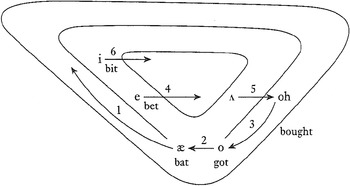
NCS involves vast populations across the Great Lakes region of the United States, and it has been a topic of extensive fieldwork and theoretical analysis (Eckert, Reference Eckert1988, Reference Eckert1999; Gordon, Reference Gordon2001, cited in Labov, Reference Labov2007; Labov, Ash, & Boberg, Reference Labov, Ash and Boberg2006; Labov, Yaeger, & Steiner, Reference Labov, Yaeger and Steiner1972). The shift is typically envisioned in terms of stages, and one characterization of the stages is shown as an example (Labov, Reference Labov2007:372, Reference Labov2010:112; see also Eckert, Reference Eckert1988, Reference Eckert1999; Gordon, Reference Gordon2001; McCarthy, Reference McCarthy2010).Footnote 3
Stage 1 (trigger): Tensing and raising of /æ/ in words like bat.
Stage 2: Fronting of /ɑ/ in words like cot, and lowering of /ɛ/ in words like bet.
Stage 3: Lowering and fronting of /ɔ/ in words like caught.
Stage 4: Backing of /ɛ/ in words like bet toward /ʌ/ in but.
Stage 5: Backing of /ʌ/ in words like but.
Stage 6: Lowering and backing of /ɪ/ in words like bit.
NCS is illustrated in Figure 1 (Labov, Reference Labov2010:112).
NCS as shown in Labov (Reference Labov2010:112). Reprinted, with permission, from Wiley-Blackwell.

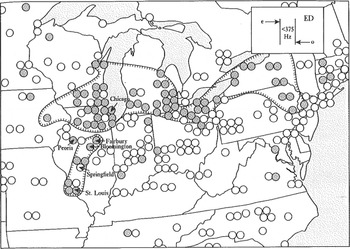
Labov used five vowel measures to compare speakers' different degrees of participation in NCS (Reference Labov2007:379, citing Labov et al., Reference Labov, Ash and Boberg2006). Figure 2 illustrates one of those measures with respect to St. Louis. Diffusion of NCS is evident in the speech of residents in the St. Louis corridor (i.e., St. Louis and locations along Interstate 55 approaching St. Louis). Labov observed that the St. Louis corridor speakers have received some influence from NCS vowels, but only one of the nine speakers in the St. Louis corridor has all five criteria of NCS (Reference Labov2007:377). Because the NCS vowels are a system, the spread or lack of spread of this system to other speakers can be described in terms of transmission and diffusion. Labov found that “the St. Louis corridor produces a more irregular result, indicating that individual sound changes are diffusing individually, rather than as a system” (Reference Labov2007:383), and proposed “that this is the result of the difference between the learning abilities of children and adults” (Reference Labov2007:344).
NCS and the St. Louis corridor in terms of the “ED criterion” (Labov, Reference Labov2010:337). Dark symbols indicate that F2 of the bet vowel minus F2 of the hot vowel is less than 375 Hz. Reprinted, with permission, from Wiley-Blackwell.

METHODS
A minimalist perspective
Agent-based worlds can be built using a wide range of different modeling approaches, from simple abstract worlds to highly complex simulations involving rich details of human social life and complex interpersonal behavior and motivations (cf. Epstein & Axtell, Reference Epstein and Axtell1996). In the present study, we take a minimalist approach to uncover underlying principles. Using an Occam's razor perspective, we focus on the minimal assumptions needed to generate the observed real-world patterns of transmission, diffusion, and incrementation. In this sense, we follow Labov's suggestion that “it is good practice to consider first the simpler and more mechanical view” (Reference Labov2001:506; cf. Trudgill, Reference Trudgill2004, Reference Trudgill2008:251, Reference Trudgill2010:187–190). If simple “mechanical” interactions between agents in a model world can successfully produce the effects observed in the real world, then this potentially suggests that both the model world and the real world have similar underlying principles in this respect (see Wang et al., Reference Wang, Zhang, Sagotsky and Deisboeck2007, on models of cancer treatments, and Warner, Reference Warner2011, on models of Earth's atmosphere and weather).
Therefore, simplification is one of the strengths of computational modeling in a sociolinguistic context. Real-world human communities have complex sociocultural histories and other innumerable idiosyncratic factors that are difficult to account for. But, as many researchers have found, modeling is a way to put the spotlight on the few key parameters that appear to underlie major behavioral patterns (Wedel, Reference Wedel2007:152). Moreover, unlike the real world, researchers can easily rerun their models multiple times, testing different possible conditions across many generations and configurations (e.g., Cangelosi & Parisi, Reference Cangelosi, Parisi, Moore and Stenning2001, Reference Cangelosi and Parisi2002; Holland, Reference Holland1995, Reference Holland1998).
Of course, various additional social factors may be relevant for certain research questions, such as social networks (Baxter et al., Reference Baxter, Blythe, Croft and McKane2009; Blythe & Croft, Reference Blythe and Croft2009) and the role of prestige in the spreading of dialect features (Fagyal et al., Reference Fagyal, Swarup, Escobar, Gasser and Lakkaraju2010). For our study, however, we have a different goal: to uncover the minimal assumptions needed to generate dialect transmission, diffusion, and incrementation. Can simple “mindless” interactions among agents generate these basic phenomena as they are found in the real world?
chicago and st. louis
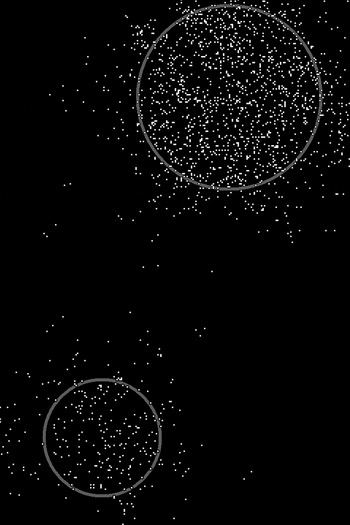
The computer program was developed by the second author using Java with Swarm,Footnote 4 which is a publicly available software package for ABM. Our model world was designed to have two distinct “cities” of agents: chicago and st. louis. The number of agents in each of these cities is based on a ratio of approximately 1500 humans to 1 agent (calculated from U.S. Census populations counts as of 2009Footnote 5). In our world, chicago has a population of about 1900 agents, and st. louis has a population of about 250 agents (the exact number of agents varies depending on birth and death at a given moment). Figure 3 shows a screenshot of chicago and st. louis agents interacting.Footnote 6 The large circle represents the area of influence of chicago, and the smaller circle represents the area of influence of st. louis.
A screenshot of the agents in action: The upper circle is the chicago area of influence. The lower circle is the st. louis area of influence.

These two area-of-influence radii are used to keep agents near their respective home cities. They represent abstract areas of city influence, not literal city limits. As with other issues in the model, there are many possible ways to parameterize such features. For example, a model could attempt to match agents' range of movement with the travel distance in a car during a certain length of time or walking distances or locations of shopping malls or clustering of neighborhoods, and so on. But there are no principled reasons why any one of these types of physicality would produce categorically different fundamental effects for the phenomena studied here. For the goals of our minimalist model, we have simply chosen one reasonable way to model the cities. Our model is intentionally abstract so that it can be generalizable to a wider variety of situations where transmission, diffusion, and incrementation may be expected to occur. In this respect, we follow the overall philosophy of abstract modeling in Fagyal et al. (Reference Fagyal, Swarup, Escobar, Gasser and Lakkaraju2010), Blythe and Croft (Reference Blythe and Croft2012), and others.
The distance between the cities was designed to create a realistic amount of interactions. If the cities are placed too close together, agents constantly interact and the notion of two separate cities is lost. On the other hand, if the cities are too far apart, little or no interaction occurs. We chose a balanced placement that produced a reasonably lifelike pattern of interaction. We give the agents a “homing instinct” that causes them to occasionally return to the area of influence of their respective home cities. Without such a homing parameter, the agents simply become more diffused throughout the world, and the cities completely dissolve. Because we are modeling effects in human society, we selected these parameters as a straightforward way to get the necessary effect. Agents are free to move around in the world, yet they are given a general tendency to remain rooted in one city. As a result, the likelihood of an agent interacting with an agent from the same city is an emergent effect of simple density. There are more chicago agents in and around the chicago area of influence than in and around the st. louis area of influence. An agent currently located in the chicago area of influence is therefore more likely to encounter a chicago agent than a st. louis agent, and the opposite is true for an agent in the st. louis area.
Time in the model is measured in terms of abstract “time-periods.” During each time-period, each agent moves 1000 times. A “move” consists of a random choice between nine different options. For a given move, the agent may move one grid unit in any of the eight compass directions or remain stationary. As a result of the homing parameter, every agent returns to the home city at randomly selected intervals of one to four time-periods. The random range of one to four time-periods prevents an unnatural situation where all agents would always return to their cities at exactly the same time.
To generate “traffic flow” between the cities in our model, we designed a travel parameter that causes agents to occasionally travel to the other city. This is the model equivalent of the general, long-term effects of Interstate 55 in real-world Illinois (Figure 2) and other similar travel routes between cities elsewhere in other situations. With or without this traffic flow parameter, our chicago and st. louis agents can interact with each other to some extent. However, the traffic flow parameter helps to reflect Interstate 55's role of promoting contact between these two cities in the real world. In our model, approximately 45 agents in each of the two cities are traveling at any given time. These agents are randomly selected to travel to the opposite city, spend a random number of time-periods in the other city, and then return home. All agents, including those randomly selected to travel, follow all of the regular movement rules described, except that traveling agents are required to move in the direction of the opposite city.
As with the other parameters discussed, the exact number of agents traveling is not crucial to the results. Naturally, if most or all of the agents were constantly traveling between cities, the notion of cohesive cities would be lost. We simply designed the model to include a handful of traveling agents as a way of promoting natural contact between cities. Future models could develop a precise estimate of personal interaction between Chicago and St. Louis in the real world, but our hypothesis does not require this level of rich detail. In fact, for our purposes, we would not want the model to crucially depend on such a level of precision in parameters. If the model were to strictly depend on any precise amount of traveling time or a precise city size, then the results would not be generalizable to wider circumstances. We are aiming for a model that can be generalizable across a variety of similar situations in the real world, just as the principles of transmission and diffusion in Labov (Reference Labov2007) are intended to be generalizable beyond the specific cases in that study.
The vowel system
In our model, vowel patterns emerge through language use as agents encounter each other in face-to-face interactions. In this way, we follow the growing number of usage-based and exemplar-based perspectives on the emergent nature of language (e.g., Bybee, Reference Bybee1994, Reference Bybee2001, Reference Bybee2010; Bybee & Beckner, Reference Bybee, Beckner, Heine and Narrog2010; Bybee & Hopper, Reference Bybee and Hopper2001; Johnson, Reference Johnson, Johnson and Mullennix1997, Reference Johnson2006; Pierrehumbert, Reference Pierrehumbert, Bybee and Hopper2001, Reference Pierrehumbert, Bod, Hay and Jannedy2003; Wedel, Reference Wedel2006; inter alia [cited in Mendoza-Denton, Reference Mendoza-Denton2008:213]). Prior work (e.g., De Boer, Reference De Boer2000, Reference De Boer2001) has shown that vowel spaces of different types can be computationally modeled as emergent systems, that is, as complex adaptive systems (e.g., Beckner et al., Reference Beckner, Blythe, Bybee, Christiansen, Croft, Ellis, Holland, Ke, Larsen-Freeman and Schoenemann2009; inter alia). De Boer (Reference De Boer2000) used an algorithm of “language games” where two computer agents communicate with different vowel values (cf. Steels, Reference Steels, Hurford, Studdert-Kennedy and Knight1998; Wittgenstein, Reference Wittgenstein1967, quoted in De Boer, Reference De Boer2000:449; De Boer & Zuidema, Reference De Boer and Zuidema2010). The result is a humanlike vowel space. As for vowel chain shifts, Ettlinger (Reference Ettlinger2007) developed an agent-based model of a two-vowel system where vowels affect each other as two agents interact. Likewise, as we will discuss in detail, our agents interact by exchanging vowel “frequencies,” thus developing vowel exemplars in their memories. In the present study, we place such an emergent vowel system into a world where thousands of agents interact with each other throughout a geographic space divided into two major population centers (chicago and st. louis). We use a three-vowel system in order to see both the initial stage of a chain shift (raised Vowel A affects Vowel B), as well as more advanced stages (raised Vowel A affects Vowel B which then affects Vowel C). In these respects, we follow the basic notions of vowel dispersion in Schwartz, Boe, Vallee, and Abry (Reference Schwartz, Boe, Vallee and Abry1997), De Boer (Reference De Boer2000, Reference De Boer2001; inter alia), Johnson (Reference Johnson, Johnson and Mullennix1997, Reference Johnson2000), and Ettlinger's (Reference Ettlinger2007) agent-based approach to vowel chain shifts (cf. Lakkaraju, Swarup, & Gasser, Reference Lakkaraju, Swarup and Gasser2009), but we develop those notions to fit into a large multiagent world with a multivowel chain shift.
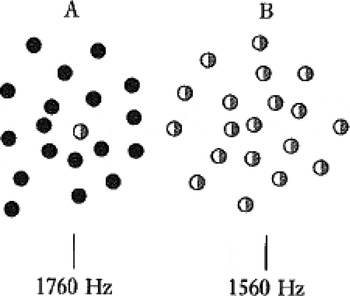
Our vowel system is modeled with an abstract set of vowel “frequencies,” such as Vowel A = 5.0 units and Vowel B = 15.0 units and so on. When any two agents are adjacent to each other at a given moment, they each “speak” each one of their vowels. Specifically, when an agent's intended movement in any of the eight compass directions would put it on a grid point occupied by another agent, the two agents are required to speak to each other. After the interaction is over, they may store each other's vowel values as exemplars, and draw upon those exemplars in subsequent interactions. Each agent therefore builds up a set of exemplars for each vowel, that is, a “bag of balls” (Blythe & Croft, Reference Blythe and Croft2009:53) that the agent can draw from each time it speaks a vowel to another agent. Following Labov (Reference Labov1994:586–587, Reference Labov2010:142–144), we assume that speakers have a “cloud” or set of vowel experiences that affect their production and perception of vowels. Figure 4 illustrates a speaker's sets for two vowels, Vowel A and Vowel B. As particular tokens of these vowels encroach on another vowel's set, shifts can occur. In Figure 4, a token of Vowel B is produced within the range of the set for Vowel A. Such instances can gradually change the speaker's vowel production.
“Clouds” of two different vowels (Labov, Reference Labov2010:143). Reprinted, with permission, from Wiley-Blackwell.

Our model uses the same overall perspective, although we simplify to one dimension of vowel space, as does Ettlinger's model (Reference Ettlinger2007). Two-dimensional vowel spaces are not needed to accomplish the purposes of our study, so we choose the simplest possible parameters. Future studies may choose to add more realism by using a two-dimensional vowel space, but this will raise additional issues, including the relative importance of F1 and F2 dimensions in different vowels. As discussed earlier, for this study we use a “minimalist” approach of finding the minimal parameters necessary to produce the effects being tested.
For our model, each agent has an exemplar set for each of the three vowels: Vowel A, Vowel B, and Vowel C. When two agents interact, each agent speaks the three vowels, such as “10.0, 15.2, 19.5,” respectively. The specific values are randomly selected from a normal distribution around the average of the current exemplar set for the given vowel for that agent. Each agent then “listens” to the vowels produced by the other agent. Example (1) illustrates the process.
(1) Vowel token accepted as an exemplar:
Suppose that Agent 1 and Agent 2 come into contact in the grid, and Agent 1 speaks “11.5” as a token of Vowel A. Suppose Agent 2's exemplar set for Vowel A currently contains {9, 9, 10, 10.5, 11}. Because the 11.5 token spoken by Agent 1 is close to the range of Agent 2's exemplar set for Vowel A, Agent 2 is likely to add it to the exemplar set. Agent 2's exemplar set for Vowel A then becomes {9, 9, 10, 10.5, 11, 11.5}. As a result, in future interactions, Agent 2 is now likely to produce a slightly higher Vowel A on average, as future pronunciations are drawn from the normal distribution around that agent's exemplar set for Vowel A.
If the given vowel value is close to the agent's own exemplar set for that vowel, there is a likelihood that the agent will add that value into its exemplar set. Otherwise, the vowel will not be added to the exemplar set. This is an emergent likelihood that changes according to the exemplar sets: An agent will perceive a token of Vowel A to actually be Vowel A if the token is close enough to the agent's own Vowel A exemplar such that it is distinguished from its exemplar sets for Vowels B and C. This follows Labov's statement that “outliers falling within the main distribution of a neighboring phoneme will not be recognized as consistently as other productions, and so will have less effect on the language learner's calculation of the mean” (Reference Labov2010:142). Specifically, whenever one of our agents “hears” a vowel pronunciation from another agent it encounters, it compares this value to its own exemplar sets for the three vowels. If the pronunciation lies halfway between the values of the expected vowel and the nearest other vowel, the likelihood that the agent will accept it as a token of the given vowel is 50 percent. In other cases, this emergent likelihood would then be higher or lower depending on the other vowels at that moment. As our agents interact, the occasional cases where a token is not accepted therefore correspond to the occasional “natural misunderstandings” studied in Labov (Reference Labov1994:586–587, Reference Labov2010:21–47).
Finally, note that the agents are exchanging abstract vowels rather than words, much like the abstract vowel systems in De Boer (Reference De Boer2000, Reference De Boer2001) and De Boer and Zuidema (Reference De Boer and Zuidema2010). In this way, our model focuses on the specific sound changes being studied: the chain shift of Vowels A, B, and C. Future studies could consider modeling the use of full words or phrases, as well as issues of lexical frequency.
Recency and memory decay
We recognize that actual human processing of exemplars is likely influenced to some extent by recency and memory decay (Bybee & Beckner, Reference Bybee, Beckner, Heine and Narrog2010:833; Pierrehumbert, Reference Pierrehumbert, Bybee and Hopper2001). Therefore, we include some memory decay in the model by setting a maximum number of exemplars: Each agent's memory has a maximum of 140 exemplars. After that maximum is reached in a given agent's exemplar set, the oldest exemplar in the set is deleted whenever a new exemplar is added. We note, however, that such parameters are not crucial to the model. For example, if we prioritize recent exemplars to a very high degree so that agents' pronunciations only change very slowly, then this would reduce the pace of vowel changes in the model as a whole. On the other hand, we find that our particular model also works just as well when we completely omit the memory decay parameter. Therefore, our particular choice of 140 for the maximum number of exemplars is simply based on a balance between those two extremes. As explained in our discussion of other parameters, our model is purposely designed in a way that is not dependent on the exact parameterization of such details; instead, the model is intended to be generalizable across a variety of situations.
Triggering a chain shift
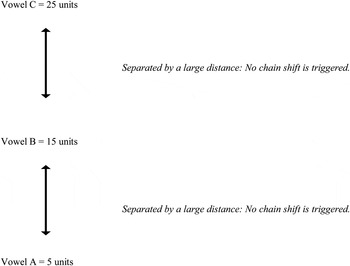
The very first (and only the very first) generation of agents is initialized with 50 exemplars for each vowel for each agent. Subsequent generations of agents are born into the world with a blank slate of zero exemplars. The values we select at the time of initialization determine whether a chain shift will be triggered in the world. We can “trigger” a chain shift by initializing two vowels close together for that first generation of agents. For example, when the vowels are initialized at a distance of 10 units, no chain shift effects are observed (Figure 5). This is the setting given to the initial set of st. louis agents when the world is initialized. Note that the vowel space is a circular “loop” such that 30.0 is the same as 0.0.
Vowel space with intervals of 10 units.

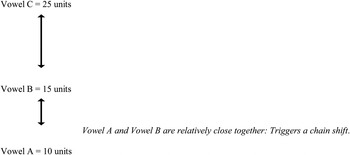
We find that chain shifts in this model are triggered when two vowels are initialized close together (Figure 6). This is the setting given to the initial generation of chicago adults during the initialization of the world.
Chain shift triggered due to the close proximity of Vowel A and Vowel B.

When the world is initialized with the values in Figure 6, Vowel B begins to raise because it is too close to Vowel A. Then Vowel C also begins to raise as Vowel B becomes too close to Vowel C. For the chain shift to progress in the direction initiated in Figure 6 (rather than slide back to the Figure 5 configuration), the model must be parameterized in a way that prevents Vowel A from lowering. This process is explained in the trigger vowel section.
The condition of the stable state in our model
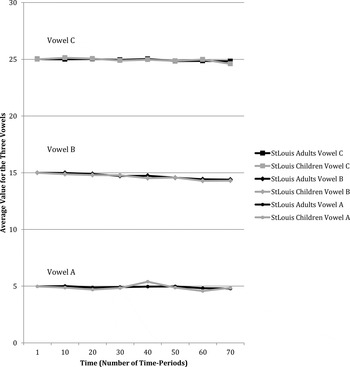
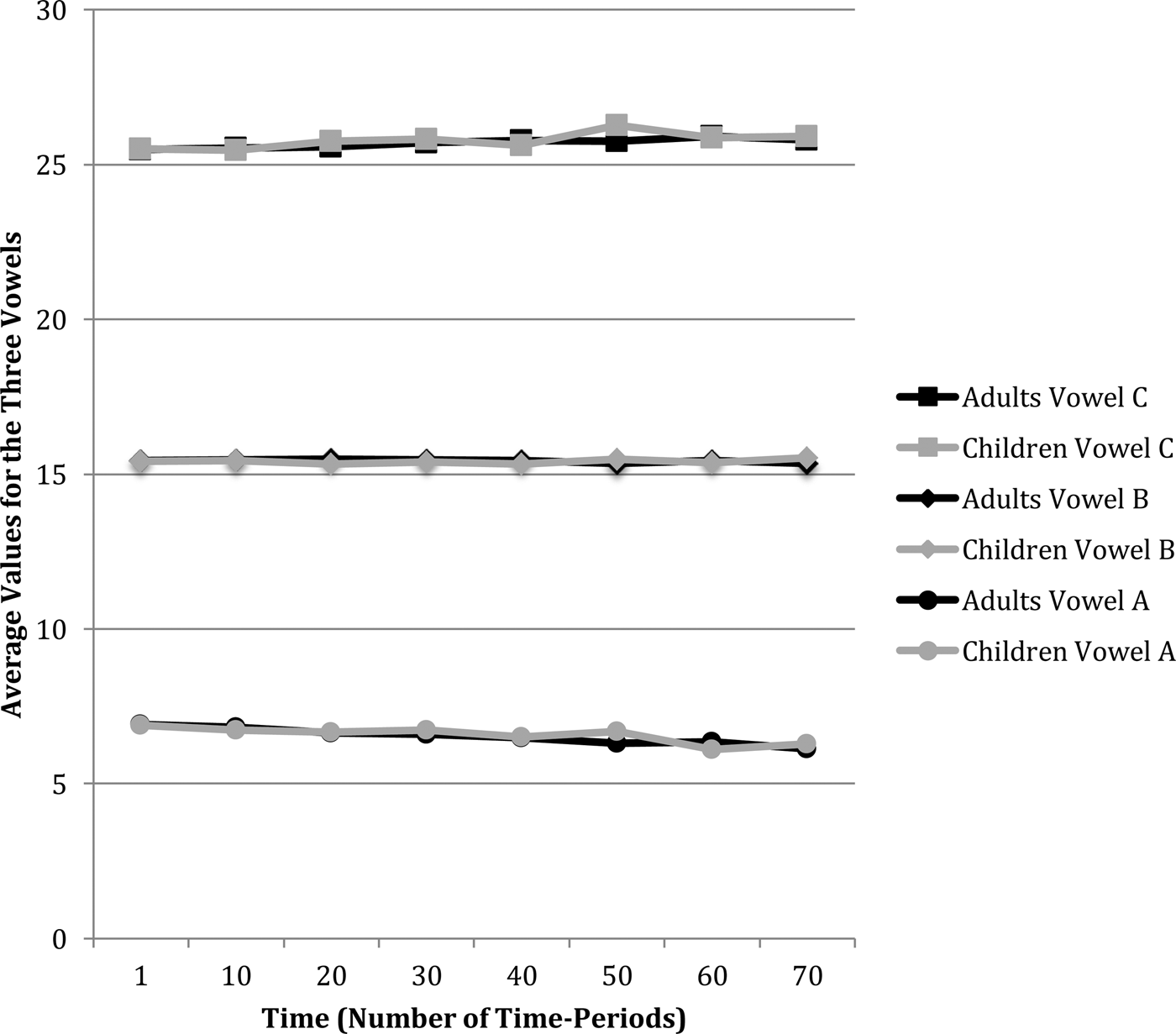
When all three vowels are separated by 10 units (Figure 5), the vowels maintain a stable distance of approximately 10 units throughout the run. There are no chain shift effects, and the vowels do not raise. By definition, the vowels in our one-dimensional minimalist model will be stable whenever the distance between vowels is equal to the total space divided by the number of vowels, that is, a distance of 10 units between each of the three vowels in our one-dimensional vowel space of 30 units. In our model, the vowel system lowers slightly under those conditions; the three vowels hover around their original value or drift downward slightly, while maintaining the stable distance between them. With the model parameterized in this way, we ensure that any patterns of raising that emerge in the other condition (Figure 6) can be attributed to the chain shift effects being explored in the study, not to other model effects. Figure 7 gives an example of a world with only st. louis (i.e., no chicago in the world). This run was initialized with evenly spaced vowels: Vowel A = 5.0 units, Vowel B = 15.0 units, Vowel C = 25.0 units. Over time, the vowels remain evenly spaced at about 10 units. Each vowel stays close to its initialized value or drifts downward slightly; no consistent pattern of raising emerges in these conditions.
Average values of Vowels A, B, and C when only the st. louis part of the model is running (i.e., no influence from chicago). The plot shows the average vowel values at the end of the given time-period, for example, average vowel values at the end of 1 time-period, 10 time-periods, and so on.

A chain shift
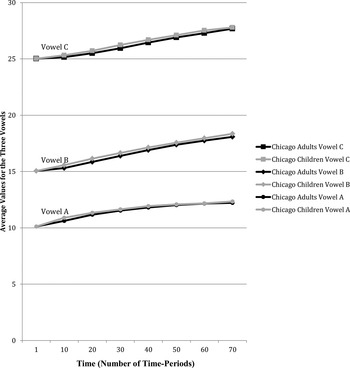
Labov noted that a chain shift is a “complex system” and “the structural complexity involved here has to do with the intricate interrelations of vowels as they evolve” (Reference Labov2007:371–2). Likewise, our model views a chain shift as a complex system involving interrelations between vowels. Figure 8 shows a chain shift triggered in chicago. In this case, Vowel A was initialized at a value of 10.0 units, Vowel B at 15.0 units, and Vowel C at 25.0 units. With this initialization, Vowel A triggers a chain shift because it “crowds” Vowel B. The three vowels are no longer evenly separated by 10 units as they were in the stable state described in the previous section. As a result, Vowel B gradually raises to keep enough distance from Vowel A. Then Vowel C raises to keep enough distance from Vowel B. Note in the figure that the children are consistently more advanced in the chain shift than the adults are. This is a case of incrementation, which is discussed in the results.
chicago: With initialized values of Vowel A = 10.0, Vowel B = 15.0, and Vowel C = 25.0, the result is a chain shift with a clearly raising trajectory. The plot shows average vowel values at the end of the given time-period, for example, average vowel values at the end of 1 time-period, 10 time-periods, and so on.

The trigger vowel
The chain shift in Figure 8 will only occur if the trigger vowel (Vowel A) maintains its raised position (greater than or equal to 10.0 units). If Vowel A is allowed to go lower, then the chain shift will not occur. In complex adaptive systems theory, an unstable system always moves toward the nearest (i.e., least costly) state of equilibrium (Solé, Reference Solé2011:25–36). In other words, all things being equal, an unstable system will shift toward the nearest attractor site (nearest state of equilibrium), not toward a more distant one. With respect to vowels, if a vowel raises and begins to crowd another vowel, then, all things being equal, the system will simply stabilize by reverting the original raised vowel back down to its stable position. There would be no need for a (costly) multistage chain shift to emerge. Rather, the system will just return to the closest state where the vowels are symmetrically arranged once again. Under these conditions, the only way to produce a multistage chain shift in a system with multiple vowels is to require the system to continue moving in a given direction, not backward. This necessitates a “trigger” vowel that stays above a certain “threshold” level. Therefore, because we need to generate a chain shift to test our hypothesis, we initialize the first generation of agents with a trigger vowel, Vowel A; Vowel A crowds Vowel B for the population of agents where we want the chain shift to be triggered (chicago).
The behavior of our trigger vowel, Vowel A, is defined precisely according to complex systems theory. The threshold for Vowel A is the exact midpoint between two attractor sites of equilibrium (Solé, Reference Solé2011:39). In our three-vowel system of 30 units, vowels are in equilibrium when separated by 10 units (e.g., Vowel A = 5.0 units, Vowel B = 15.0 units, Vowel C = 25.0 units). Half of the distance between any two of these vowels at equilibrium is 5 units. We therefore set Vowel A's threshold value at a height of 10.0 units, which is 5 units away from Vowel B's location (at 15.0 units). Vowel A moves freely like other vowels in all other respects, but if it reaches the threshold height (10.0 units), it cannot go back down. Only Vowel A needs such a threshold; Vowels B and C are completely free to move at all times. This is consistent with the real world where a chain shift needs only one trigger vowel.
Specifically, when Vowel A raises to a level of 10.0 units and beyond, it has crossed the exact halfway point between its equilibrium position (5.0 units) and Vowel B (15.0 units). As expected by the conditions described, Vowel A's raised position has the emergent effect of crowding Vowel B, causing Vowel B to raise. Vowel B then causes Vowel C to raise as well, and a multistage chain shift has been generated. By contrast, if Vowel A were allowed to move freely up or down like Vowels B and C, then a chain shift cannot emerge. Instead, the vowel system self-organizes by reverting to the less costly, original symmetrical form: Under pressure from Vowel B, Vowel A moves downward until there is adequate space again, which is consistent with prior analyses of vowel dispersion (Liljencrants & Lindblom, Reference Liljencrants and Lindblom1972; Lindblom, Reference Lindblom, Ohala and Jaeger1986; Maddieson, Reference Maddieson1984; Schwartz, Boe, & Abry, Reference Schwartz, Boe, Abry, Sole, Beddor and Ohala2007; Schwartz et al., Reference Schwartz, Boe, Vallee and Abry1997), as well as computational models of emergent vowels (Berrah & Laboissiere, Reference Berrah and Laboissiere1997; De Boer, Reference De Boer2000, Reference De Boer2001).
It is important to note that all agents in our model (whether in chicago or st. louis) are subject to exactly the same trigger vowel rules. For any agent anywhere in the world, Vowel A has a threshold of 10.0 units. Therefore, the only vowel difference between our chicago and st. louis is the initial vowel values of very first generation of initialized agents. All vowel rules operate in the same way in both cities. In the initial generation, chicago agents are initialized with Vowel A of 10.0 units, whereas the initial st. louis agents are given an initial Vowel A of 5.0 units. From that point on, everything is emergent. Every agent in the world, regardless of age or city, is subject to the same rules: same learning mechanism, same vowel threshold rules, and so on. With these initial settings in the first generation of our chicago agents, the chicago vowel system develops a multistage chain shift, and then the patterns that Labov (Reference Labov2007) described as transmission, diffusion, and incrementation naturally emerge as our chicago agents interact with our st. louis agents.
According to the basic principles of complex systems (Solé, Reference Solé2011:25–36), a trigger vowel having properties like those of Vowel A is the minimal scenario needed to initiate an emergent multistage shift in an otherwise stable system, and it recalls Labov's notion of the “unidirectional character of linguistic change” (Reference Labov2010:195). For this reason, we note that our threshold rule for Vowel A does not add theoretical cost to the model: Any multivowel chain shift in the real or virtual world must necessarily have at least one element with this property or something comparable. The trigger vowel must somehow “stay” in its shifted position long enough to initiate the next stage of the shift.
The origins of such trigger vowel behavior—the very origins of chain shifting—go beyond the scope of our study of abstract vowels. In this study, we are not examining the origins of chain shifts but rather the diffusion and transmission of chain shifts, in the same way that Labov (Reference Labov2007) began his study with the observation that the NCS exists. Questions of the (phonetic and social) origin of chain shifts are better addressed in another context, such as Labov's examinations of duration and other features of low vowels, off-glides, and other specific phonetic and phonological properties and social factors (Reference Labov2010:145–154; cf. Labov, Reference Labov1994, Reference Labov2001; Labov et al., Reference Labov, Yaeger and Steiner1972). Such analyses of the detailed acoustic phonetic features of each vowel in the real-world NCS would go beyond the goals of our minimalist, abstract model.
Even so, we conclude this section by briefly noting that prior research on real-world chain shifts suggests principles that support our overall approach. In real-world chain shifts, researchers have noted a distinction between the behavior of peripheral and nonperipheral vowels. Our abstract model does not depend on a specific theoretical notion of peripherality, but we mention it here because it is one type of “threshold” that may be observed in the real world. In particular, Labov (Reference Labov2010:146) suggested that peripheral vowels rise (i.e., they move upward along the peripheral track) and nonperipheral vowels fall. In Labov's (Reference Labov2010:148) approach, low vowels do not have the property of peripherality, but they may rise to a certain point (a threshold) where they acquire peripherality. Once they are [+peripheral], they continue rising much like other [+peripheral] vowels. In such real-world studies, a vowel that is [+peripheral] tends to rise in chain shifts. Our model functions in a similar way. Although the feature peripherality has no physical meaning in our one-dimensional model, we have a low vowel that has similar threshold behavior. When Vowel A reaches a threshold of 10.0 units, it is not allowed to fall back. Functionally speaking, this threshold for Vowel A recalls Labov's (Reference Labov2010) real-world notion of [+peripheral] and low vowels, and it is also compatible with earlier chain-shift rules in Labov et al. (Reference Labov, Yaeger and Steiner1972) and Labov (Reference Labov1994). As with the other parameters discussed, we prefer to keep the model general enough so that it is not dependent on any one particular instantiation of the acoustic phonetic vowel properties in chain shifts. Nonetheless, we note that Labov's (Reference Labov2010) real-world analyses of low vowels are consistent with our complex-systems approach to the trigger vowel.
Push chains and pull chains
Although we use the metaphor of crowding between vowels, in our model there is no principled difference between a push chain and a pull (drag) chain. We are using a circular, one-dimensional vowel space. A value of 0.0 units in this space “loops over” to the highest value in the space (30.0 units). For this reason, the vowel chain shifts described here can be equally interpreted in terms of push or pull, and so the model can be generalized to represent either kind of chain shift.
Birth and death
Because our research question includes generational effects (transmission and incrementation), we designed the computer program to periodically cause “child” agents to be “born” into the world. The rate of childbirth is balanced with the rate of death so that the world population is stable. Agents are defined in terms of two “sexes.” When two opposite-sex adult agents come into contact in the world, the computer calculates a probability that those two agents will produce a child, which is based on the two agents' age differences and the current population growth rate in the world. At birth, the child agent is placed on a grid point in the immediate vicinity of one of the parents (“primary caregiver”). The two parent agents will then remain close to each other in the grid. This is obviously an oversimplification of human relationships, but it is sufficient for the purposes of the model.
To model the influence of child rearing in early language development, each child agent is required to stay within a few grid points of its primary caregiver parent during the child agent's first 6 time-periods of life. In future work, it might be valuable to explore more nuanced parameters of child dialect acquisition, in other words, parent influence versus peer influence (Kerswill & Williams, Reference Kerswill and Williams2000:68; Labov, Reference Labov1972/1991:304; Stanford, Reference Stanford2008). For the purposes of the present study, we use the simplest parent-child relationship that reasonably reflects the real world: Parent and child stay nearby each other until the child reaches adulthood (at the age of 6 time-periods). An even simpler approach would allow children to wander freely around the world immediately after birth, just like adults. This alternate approach would not produce noticeably different results in the present study (because newborn agents are naturally surrounded by many speakers of their dialect), but it would diverge rather drastically from the patterns of socialization and child rearing seen in the real world.
To maintain a stable overall population count in the world, we designed the model so that agents “die” at the age of 25 time-periods. At the end of each time-period, all agents who have reached the age of 25 time-periods are permanently removed from the world.
Child dialect acquisition
The world is initialized by randomly placing agents throughout chicago and st. louis. Each of these initial agents is given a random starting age within the adult age range. Each initial agent is given 50 exemplars for each of the three vowels, using the initial vowel setting for their respective cities (see Figures 5 and 6). But once the world is initialized with these starting values for this very first set of agents, the subsequent processes of dialect variation, change, and acquisition are all completely emergent, including child dialect acquisition. Whenever a new agent is “born” into the world, it arrives with a blank slate of vowel values, that is, with zero exemplars. In other words, children acquire their vowel systems through interactions with other agents in the world. This approach to dialect acquisition follows the exemplar models of language previously discussed (Bybee, Reference Bybee1994; Wedel, Reference Wedel2006; inter alia) and related understanding of L1 acquisition (e.g., Clark, Reference Clark2009; Flege, Reference Flege and Birdsong1999; Lust & Foley, Reference Lust and Foley2004; Niyogi & Berwick, Reference Niyogi and Berwick2009; Nowak et al., Reference Nowak, Komarova and Niyogi2002; Tomasello, Reference Tomasello2003, Reference Tomasello and Bavin2009; inter alia).
The issue of whether there is a categorical difference between child and adult language learning is not being examined in this study. Instead, our study uses a model world to see whether the NCS patterns of Labov (Reference Labov2007) are crucially dependent on a categorical difference between child and adult language-learning abilities. Can comparable patterns (transmission, diffusion, incrementation) be generated in the absence of any categorical differences between child and adult language-learning abilities? To answer this question, our model uses a single learning mechanism for all agents, regardless of age. If our model produces patterns comparable to the NCS patterns of Labov (Reference Labov2007)—yet achieves this result in the absence of any categorical differences in child/adult learning—then the result will suggest that child-adult differences in language learning may not be the underlying sources of those NCS patterns in the real world. Of course, it may well be true that there is an innate, categorical difference in learning abilities between human adults and children, and this difference may be very important in other respects (such as L2). But this issue is not relevant to our particular research question about the NCS dialect patterns in Labov (Reference Labov2007). We recognize that the role of innateness in child language learning is a highly complex and controversial question (e.g., Bavin, Reference Bavin2009; Birdsong, Reference Birdsong1999; Flege, Reference Flege and Birdsong1999, Reference Flege, Piske and Young-Scholten2009; Lust & Foley, Reference Lust and Foley2004; Sanz, Reference Sanz2005; Tomasello, Reference Tomasello2003). Considering the work of Pierrehumbert (Reference Pierrehumbert, Bybee and Hopper2001), Bybee and Beckner (Reference Bybee, Beckner, Heine and Narrog2010), and Bybee (Reference Bybee2010), we find it intriguing to consider the possibility that adult/child language-learning differences might be largely a matter of exemplars, rather than an innate physiological matter of age. But our results are not dependent on adopting either theoretical viewpoint on this issue. Instead, our model uses the uncontroversial notion that young children have less experience with the world than adults do; our newborn “infant” agents begin with zero exemplars.
Age cohorts
In order to have an analysis that is comparable to real-world studies where researchers take a sample from different age groups at a particular moment in time, our analysis focuses on two contrastive age groups. Both of these age cohorts have an age range of 6 time-periods. The younger group (henceforth children) is defined as those agents who are aged 0–5 time-periods at the time of the sample. The older group (henceforth adults) consists of “middle-aged” adults who are aged 13–18 time-periods. Because the lifespan is 25 time-periods in the model, an agent's full adulthood is the age range of 6 to 25 time-periods. The middle 6 time-periods of adulthood (middle age) is therefore the age range of 13 to 18 time-periods. Future research could examine more age ranges or narrower/broader age ranges, but the two age ranges we have selected are sufficient to test our hypothesis.
RESULTS
The model correctly generated phenomena that are comparable to the notions of transmission, diffusion, and incrementation as described by Labov (Reference Labov2007) for real-world Chicago and St. Louis. In our model, child agents acquired shifted vowels from native chicago adults (transmission) and began advancing them farther than the adults (incrementation). The nonshifted st. louis adults in contact with chicago adults only learned an unsystematic, incomplete set of “phonetic variants” (diffusion). The st. louis agents' vowels were influenced by the chicago vowel values, but they were not incorporating the full, systematic chain shift. These outcomes therefore support our hypothesis. The detailed results follow.
First, Table 1 lists the starting values for the vowels in our two different cities. The initial agents in chicago started with 50 exemplars of each vowel, and their Vowel A exemplars were initialized at 10.0 units, a value which triggers a chain shift (recall Figure 8). The initial agents in st. louis also started with 50 exemplars of each vowel, initialized at evenly spaced at distances of 10 units around the 30-unit vowel space. All subsequent agents born into the world arrived with zero exemplars and acquired their vowel spaces entirely from interactions with other agents that they encountered in the world.
Initialization of the model

Because real-world sociolinguistic fieldwork often focuses on a particular “slice” of time (e.g., a group of speakers all measured during the same fieldwork period), we select a particular point in time for detailed analysis. We chose to conduct our statistical analysis at a point in time where there had been enough time for vowels to raise significantly, specifically 50 time-periods. Other similar points of time have similar outcomes, as Figure 8 shows. As with any model world, the passage of time in our model is only abstractly related to the passage of time in human interactions. In a more detailed simulation, we could add complex behavioral patterns that correspond to detailed daily human behavior or social milestones in a human lifespan. For the present study, however, we use the minimal parameters necessary for our research questions.
Results for transmission and incrementation
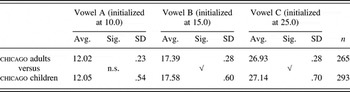
Table 2 shows the average vowel values for Chicago agents at 50 time-periods. In the table, “chicago adults” are agents who were aged 13–18 time-periods at the moment of sampling, and who were born in chicago. “chicago children” are those agents who were aged 0–5 time-periods at the moment of sampling, and who were born in chicago.
Comparing average vowel values for chicago adults and chicago children at 50 time-periods

Note: “Avg” indicates the average vowel value for that group of speakers after 50 time-periods. In the “Sig.” column, a check mark √ indicates a significant difference for the given pair (p ≤ .05, t-test); whereas “n.s.” indicates it is not significant. The “SD” column provides standard deviations. The sample sizes are listed in the “n” column.
We will first discuss the raising of Vowels B and C in chicago. In chicago, for both adults and children, Vowels B and C raised significantly above their initialized values of 15.0 and 25.0, respectively (p < .0001). Vowel A was crowding Vowel B, thus causing it to move. Then B crowded C, causing it to move. The children necessarily acquired this chain shift from older agents, so transmission has occurred. Children start with zero exemplars, and so these vowel values were transmitted to them from older agents. This transmission from older agents to children included the full, systematic chain shift.
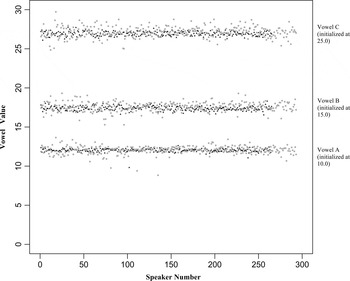
Moreover, the chicago children's Vowels B and C were statistically significantly higher than the chicago adults' Vowels B and C (Table 2). This is evidence of incrementation. For both Vowels B and C, the children had advanced the vowel raising significantly beyond the adults' level.
As for the trigger vowel, Table 2 shows that Vowel A raised slightly above its initialization value of 10.0 units: Vowel A raised to 12.02 units for adults and to 12.05 units for children. Because Vowel A is initialized at the threshold level (10.0 units) in chicago, it will always stay above the 10.0 level for those chicago agents and it tends to have a slight upward tendency over time. At our measuring point of 50 time-periods, we observe that the children's average Vowel A was slightly higher than adults' average was, although there was no significant difference between adults and children. Recall Figure 8 where the children's Vowel A tended to be slightly more advanced than adults' Vowel A, but the difference gets smaller over time. In the real world, this would correspond to coexisting generations eventually achieving approximately the same level of raising for the first stage of the shift (trigger), while the younger generation is considerably more advanced in the later stages of the shift (incrementation), such as Vowels B and C.
Figure 9 provides a graphical illustration of the data presented in Table 2, plotting the average vowel values for every individual chicago agent as sampled after 50 time-periods. Each black triangle represents the average value for a particular chicago adult agent. Each gray dot represents the average vowel value for a chicago child. For Vowels B and C, the children tend to be more advanced (higher) than the adults are. “Speaker Number” is a simple identification number for each agent.Footnote 7 As in many fieldwork studies, our model results show a range of variation among children and adults when viewed as individuals, but the group difference between children and adults was statistically significant (p < .0001) for these vowels. The children were significantly higher than the adults were (see Table 2 for averages). Moreover, in addition to this sample at 50 time-periods, recall that the children were consistently more advanced than the adults were for these vowels across all of the time-periods in Figure 8.
Average vowel values for each of the individual chicago adult agents (black triangles) and the chicago child agents (gray dots) after 50 time-periods.

Results for diffusion
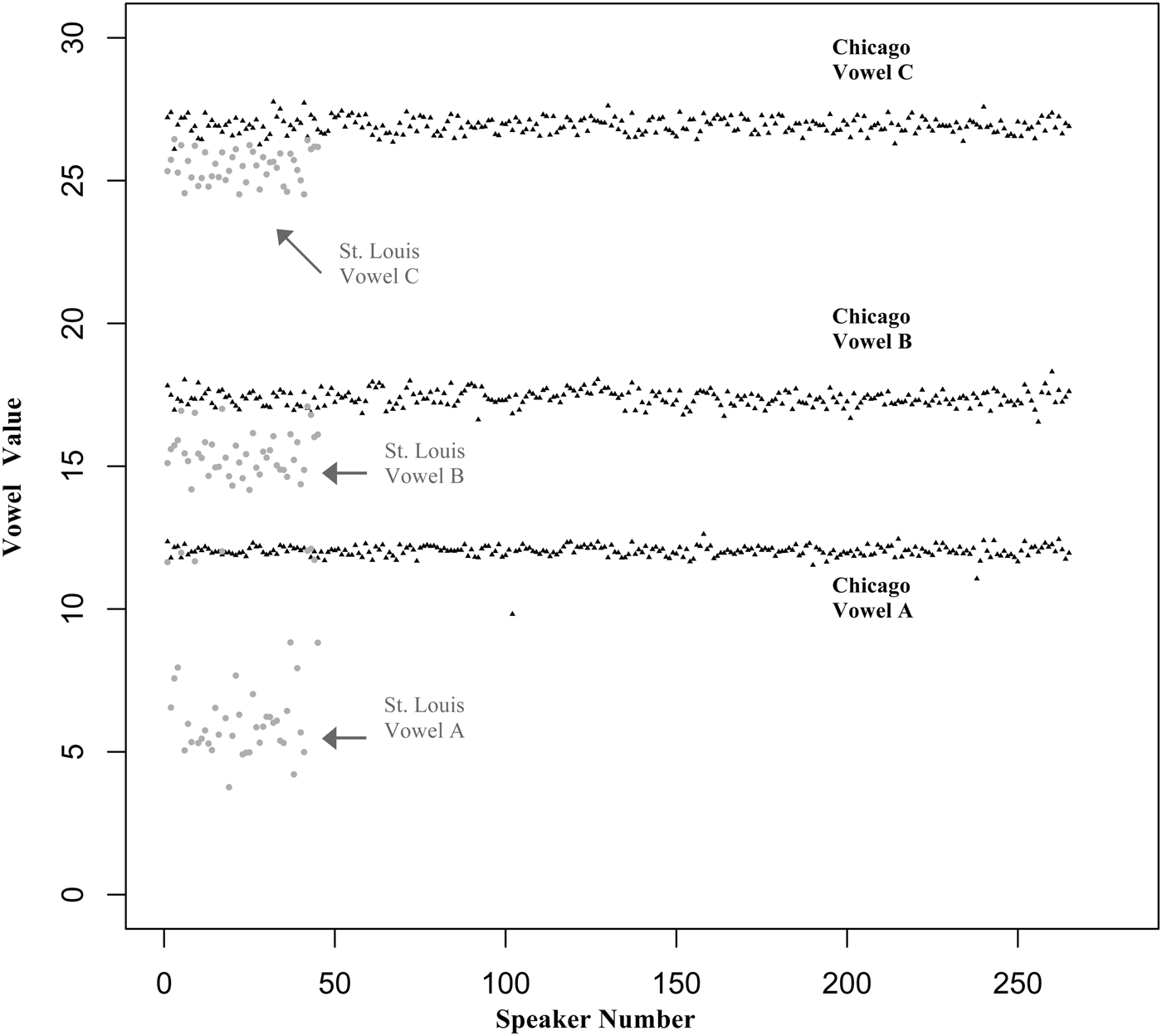
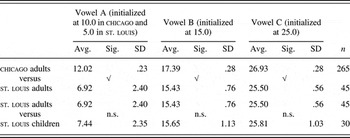
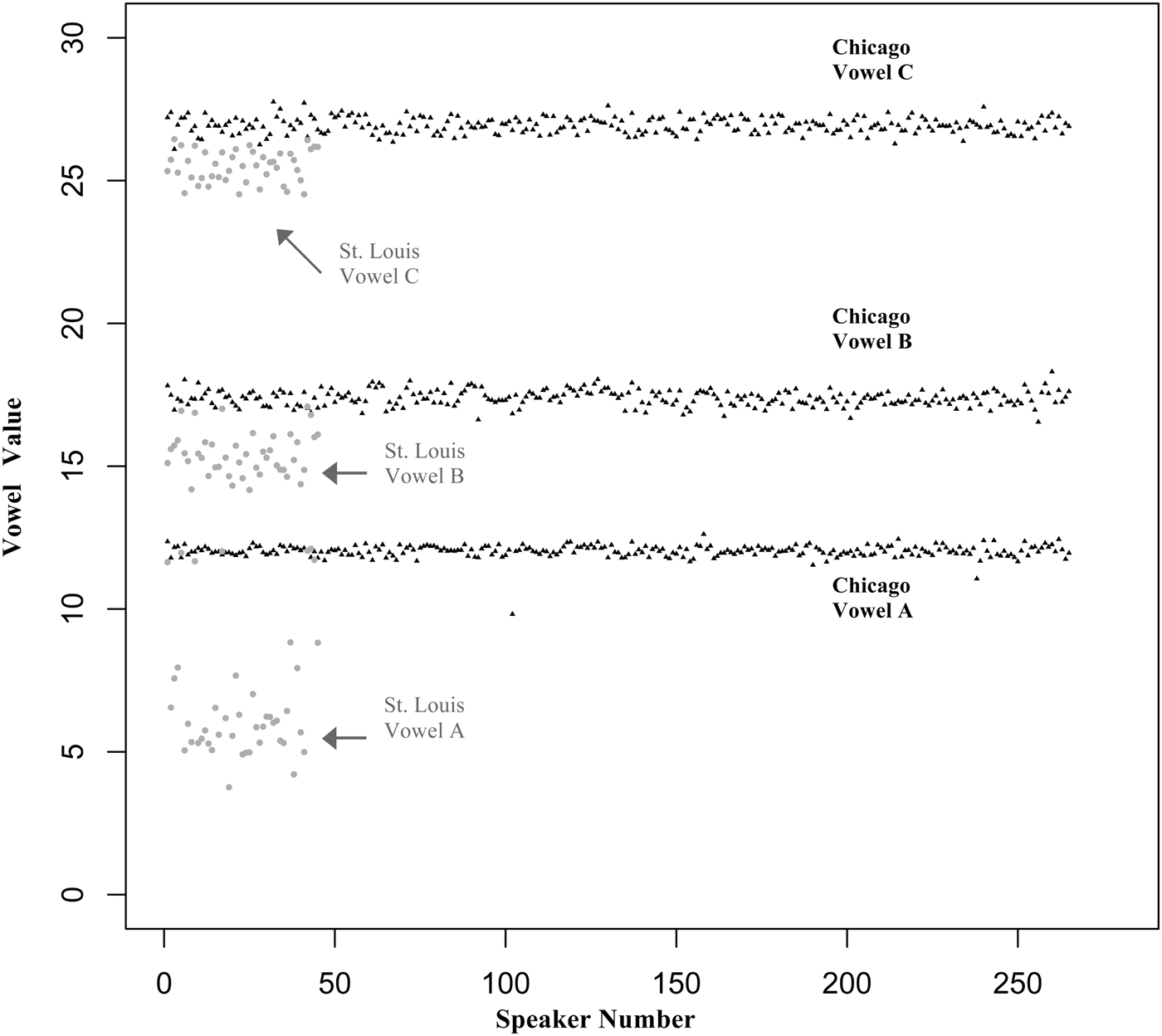
We now consider the results in the st. louis part of the world. Table 3 compares the vowels of the chicago adults versus the st. louis agents after 50 time-periods running in the model together. As before, our analysis focuses on children (ages 0–5 time-periods) and middle-aged adults (ages 13–18 time-periods). Our model world's st. louis population is smaller than that of chicago, so there are fewer st. louis adults than chicago adults in this sample taken at 50 time-periods: 45 st. louis adults compared to 265 chicago adults. Figure 10 provides a graphical counterpart for the numerical results in Table 3. In Figure 10, dark triangles represent the average vowel values for individual chicago agents, and gray dots represent the average vowel values for individual st. louis agents.
chicago adults (black triangles) plotted with st. louis adults (gray circles) after 50 time-periods.
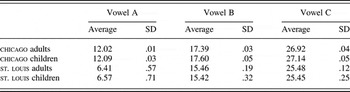
Results after 50 time-periods for each vowel in each group

Note: See Table 2 for abbreviations.
In Table 3 and Figure 10, first note that the chicago adults raised Vowel B significantly higher than its initial value of 15.0, and they also raised Vowel C above its initial value of 25.0. A chain shift is in progress in chicago as a result of the raised trigger Vowel A. But now consider the st. louis adults in the figure. For most st. louis agents, the results show incomplete, unsystematic acquisition of the chicago vowels. The majority of the st. louis agents lagged significantly behind the chicago agents; all three st. louis vowels were lower than the chicago vowels (p < .0001). At the same time, for all three vowels, the st. louis agents' vowel values after 50 time-periods were slightly, yet statistically significantly, higher than their respective initial values (see averages in Table 3), thus showing some influence from chicago. The fact that this raising effect is due to the influence of chicago can be seen through a comparison with our st. louis-only model presented earlier. Recall that our st. louis-only model (Figure 7) started with the same initial values for st. louis as those in Figure 10 and Table 3 (Vowel A = 5.0, Vowel B = 15.0, Vowel C = 25.0). But the st. louis-only model in Figure 7 showed no such raising pattern. The st. louis-only run occurred in the absence of chicago influence. Therefore, the st. louis raising in Figure 10 and Table 3 must be due to the influence of chicago.
In Figure 10, note that a small minority of st. louis agents have raised their Vowel A beyond the 10.0 threshold (see the handful of gray dots located around 12 units), thus initiating the full three-vowel chain shift for those particular agents. This interesting case exactly matches our model's prediction that adult acquisition can occur when there is enough density of interactions, as we will explain.
Therefore, we find that the st. louis agents' Vowels B and C were influenced by the chicago vowels to some extent, but they lag quite far behind in most cases. Crucially, Vowels B and C were not involved in a chain shift for most st. louis speakers, but they were for chicago speakers. Most st. louis adults acquired some “phonetic variants” of the chicago vowels but not the systematic, structural effect of the chain shift. In Labov's (Reference Labov2007) terms, this is a case of diffusion, rather than full acquisition or reproduction of the systematic chain shift. Specifically, Labov wrote that the real-world St. Louis vowel patterns “are not a structural consequence of the general raising of short-a, but rather the borrowing of individual elements of the NCS” (Reference Labov2007:378). Likewise, in our model, the st. louis agents had not acquired the “structural consequence” of the chain shift. We show this by running another st. louis-only test. This time we initialize it with the st. louis values in Table 3: Vowel A = 6.92, Vowel B = 15.43, Vowel C = 25.50. In other words, we initialize this run using the st. louis values after 50 time-periods in the regular two-city model. If, during the regular two-city model run, the st. louis agents in Table 3 and Figure 10 had acquired the vowel structure necessary for a chain shift, then that chain shift should be able to continue to advance itself despite the absence of further influence from chicago. But in this st. louis-only test, we find that the st. louis vowels actually move toward a symmetrical vowel space, not a chain shift. The results are plotted in Figure 11. In particular, Vowel A was pushed down toward a fully symmetrical spacing (10 units between each of the three vowels), whereas Vowels B and C hovered around their initialized values. It is clear that no raising chain shift has been initiated with these initial values in the st. louis-only run (compare with the sharply raising chicago chain shift in Figure 8). Instead, the st. louis-only results in Figure 11 show a system that is returning to a fully symmetrical vowel space by pushing Vowel A back down.
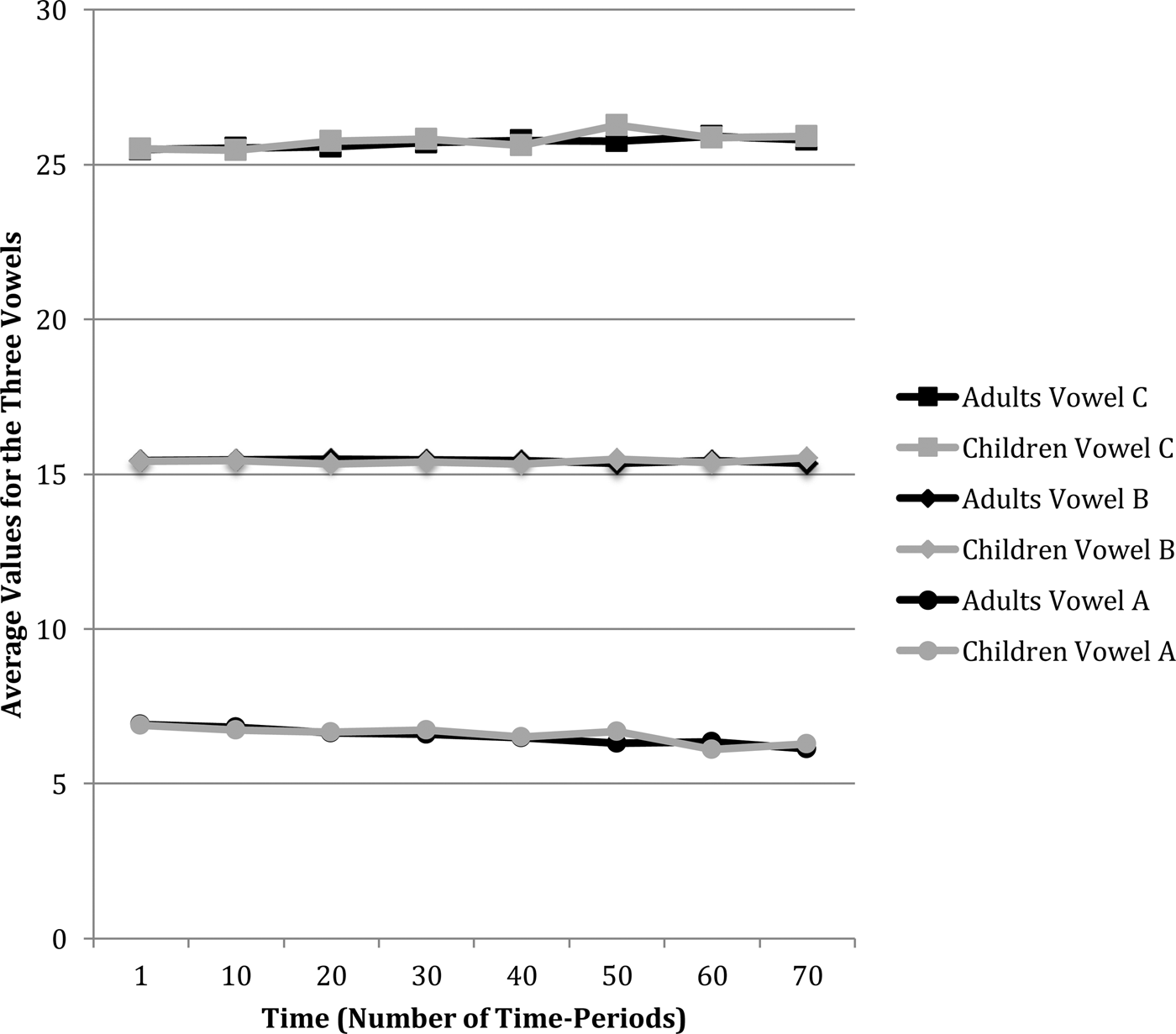
Returning to our discussion of the regular two-city model, we conclude that our st. louis adults acquired some phonetic variants (slightly raised vowels) from chicago, but the great majority of the st. louis adults did not acquire the chain shift itself. Most of our st. louis agents only acquired an “irregular” version of the chicago vowels (Labov, Reference Labov2007:378–379). As Labov observed in the real world, contact from Chicago to St. Louis results in phonetic influence on the St. Louis vowels, but not acquisition of the systematicity of a chain shift. Labov explained that these St. Louis effects are “not the same linguistic phenomenon as in the Inland North itself; there is reason to believe that the systematic chain-shift mechanism, triggered by the general raising of short-a, is not driving the shift in the St. Louis corridor” (Reference Labov2007:376). Although some of the real-world St. Louis speakers show the influence of the NCS in certain features, Labov found that only one of the nine speakers showed full acquisition of the chain shift (Reference Labov2007:379). Moreover, those nine speakers did not show advanced shifts among the individual components of the NCS. Only one of the NCS stages was “vigorously represented” among those nine speakers (Labov, Reference Labov2007:379), namely the movement of short /e/. Likewise, in our model, only a minority of st. louis speakers show full acquisition of the systematicity of a chain shift. For most st. louis agents in our model, there was no “vigorous” movement among the individual components of the chain shift nor an acquisition of systematicity (chain shift).
Finally, in our model, there was no significant difference between the st. louis children and adults for these vowels (Table 3). This is further evidence that the chain shift had not taken hold among the majority of our st. louis agents. If a chain shift were in progress, we would expect that the st. louis children would be raising their vowels significantly faster than the adults in their community (incrementation), as observed in our chicago results for Vowels B and C. Labov stated, “to the extent that the NCS is the result of the incrementation of sound changes by successive generations of children, we should see a clear relationship between age and the advancement of the shift” (Reference Labov2007:378). In Labov's (Reference Labov2007:378) analysis of the real-world data, age was a significant factor in Chicago but not in St. Louis, thus suggesting that younger generations were incrementing the NCS in Chicago but not in St. Louis. In our model, we find a similar pattern: Our chicago child agents were significantly more advanced in the chain shift than were our chicago adult agents. But for our st. louis agents, there was no significant difference between children and adults, and we find similar results each time the model is run. In this way, our results parallel Labov's (Reference Labov2007) real-world analysis.
Adult acquisition of the chain shift
Recall that in Figure 10 a few of the st. louis adults raised Vowel A enough to reach the threshold (10.0 units). At around 12.0 units in Figure 10, observe the handful of gray dots that are located among the larger number of chicago dark triangles. Likewise, for Vowels B and C, there are a handful of st. louis gray dots that are very close to the high level reached by the majority of the chicago dark triangles (approximately 17 units and 27 units for Vowels B and C, respectively). This minority of st. louis agents is participating in the full vowel shift: Vowels A, B, and C are raised, much like the chicago agents. Such results are expected because our model is based on density, rather than on a dichotomy of adult versus child learning abilities (transmission versus diffusion). In our model, adults can acquire the full shift—in rare cases where they happen to receive enough intensive interactions with chicago agents. Moreover, our model helps to explain the one adult in Labov's real-world St. Louis results who had acquired the full NCS. One of the nine real-world St. Louis corridor adults (Marvin H.) actually did have a fully developed NCS vowel system (Labov, Reference Labov2007:378–379, Table 2), much like the handful of st. louis adult agents in our model who acquired the chain shift.
The handful of raised st. louis data points in Figure 10 represent agents who, due to the travel parameter, came into relatively closer contact with chicago agents. This handful of st. louis agents exemplifies how a high density of interactions influences a speaker's vowel space. Because these particular st. louis agents came into closer contact with chicago agents, they acquired the systematicity of the chain shift, unlike our other st. louis agents. In other words, these agents are the exception that proves the rule. The majority of the st. louis agents did not acquire the chain shift; they only acquired some minor “phonetic” influences from chicago. However, a few st. louis adults happened to come into close contact with chicago agents as a result of the travel parameter. As a result, they acquired considerably more of the chicago vowel pattern, including the systematicity of the shift. In the real world, such results would correspond to adults who happened to have a relatively higher level of personal contact with Chicago people, perhaps relocating to Chicago for some years or encountering other unusual levels of contact through long-term business or personal relationships. Yet in the theoretical model described in Labov (Reference Labov2007), adult speakers are restricted to an incomplete, unsystematic learning level (diffusion); only children are expected to be able to acquire the full systematicity of the NCS (transmission). By contrast, in a simple density approach like the one proposed here, we would expect that a handful of adult speakers might acquire the full shift, owing to higher levels of personal contact in rare cases. In this way, our model naturally explains both the real-world and virtual-world results for these minority cases of adult St. Louis speakers who acquire the full shift, as well as the majority of speakers who do not.
Running the model multiple times
Finally, to ensure that the results we have presented are not artifacts of any particular run, we ran the model three more times. The outcome was very similar each time, thus confirming the results of the individual run examined in detail. Table 4 shows the averages for each vowel over the four runs, and the Appendix lists the results of each of these runs individually.
Values after 50 time-periods averaged over four different runs

Summary of results
Using a set of simple assumptions, our agent-based model has generated results that are consistent with the notions of transmission, diffusion, and incrementation in Labov (Reference Labov2007). The chain shift was passed down faithfully (transmission) from chicago adults to chicago children due to their close proximity within the dense chicago population. As for diffusion, we found that the majority of the st. louis agents received only an incomplete and unsystematic version of the vowel pattern, because st. louis agents had less contact with distant chicago. A handful of st. louis adults acquired the shift due to greater interactions with chicago agents, and this result provides a natural explanation for the one speaker among Labov's (Reference Labov2007) nine St. Louis corridor speakers who had acquired the NCS. Our st. louis results therefore match the Chicago/St. Louis NCS patterns that are described in terms of transmission and diffusion in Labov (Reference Labov2007). But our model produces these results without requiring a dichotomy in child/adult language-learning abilities. In our model, adults and children have the same learning mechanism, and yet the results match the patterns in the real-world observations of NCS in Chicago and St. Louis. This suggests that the underlying cause of transmission and diffusion in the real world may be explained more parsimoniously in terms of simple density of interactions.
As for incrementation, the children in our model advanced the shift beyond the level of the adult generation for a simple reason. Children are born with zero exemplars, so they always have fewer of the older conservative exemplars than their parents have. The parents and other older generations always have more of the older exemplars than the children do, so the adults are more resistant to change than the children are. It is likely that this straightforward explanation for incrementation can be extended to the real world as well.
CONCLUSIONS
This paper has used agent-based modeling to explore Labov's (Reference Labov2007) notions of transmission, diffusion, and incrementation. We hypothesized that these real-world processes could be modeled with two basic assumptions: simple density of interactions among agents and a simple exemplar-based approach to learning. The results confirmed the hypothesis. Using an exemplar-based approach, we triggered a vowel chain shift in a virtual chicago.chicago children accurately acquired the chicago adults' vowel system (transmission), and they advanced the chain shift significantly farther than the adults (incrementation). Most st. louis agents achieved only an incomplete, nonsystematic version of the chicago vowels (diffusion), rather than the full chain shift.
Therefore, our model supports Labov's (Reference Labov2007) real-world observations, but we reach this result using a more economical set of assumptions. Labov's approach requires the assumption that transmission and diffusion are two categorically different processes that depend on inherent differences in the language-learning ability of adults and children. In this view, there is a dichotomy between transmission and diffusion: “structural patterns are not as likely to be diffused because adults do not learn and reproduce linguistic forms, rules, and constraints with the accuracy and speed that children display” (Labov, Reference Labov2007:349). By contrast, the results of our model suggest that transmission and diffusion effects may be explained parsimoniously in terms of simple density of interactions of agents and exemplar-based learning. Of course, the differential learning abilities of adults and children are important issues to examine in various other aspects of L1 and L2. Such issues go beyond the scope of the present paper. Instead, what our study suggests is that real-world patterns of L1 vowel chain shifts, that is, the patterns of transmission and diffusion described in Labov (Reference Labov2007) with respect to the NCS in the Inland North and the St. Louis corridor, can be generated and explained without any added assumptions about differential language-learning abilities.
Moreover, in our model, incrementation can be naturally explained without any additional assumptions. Children simply have fewer exemplars than adults do (children start with zero exemplars). Therefore, when children acquire a chain shift, they are more likely to advance the vowels farther than the adults do simply because the adults have more prior exemplars to resist additional shifting. In the real world, of course, various additional factors of social identity, individuals' choices, and many other factors may have a role in increasing or decreasing the amount of incrementation. However, our model shows that the basic process of incrementation does not require such factors.
The simplicity and explanatory coverage of this model suggest that similar principles may underlie real-world processes as well. Just as computer models of weather or epidemiology can point to underlying principles at work in the real world, our model suggests underlying reasons for the NCS patterns in Labov (Reference Labov2007). The limited social parameters in our model are all basic necessities of any model of a human society in geographic space and time (birth, death, movement parameters, etc.). The details of these parameters may be configured differently in various models of human society, but the basic necessary functions are the same (cf. Epstein & Axtell, Reference Epstein and Axtell1996). Likewise, our vowel systems emerge from the minimal parameters necessary for a chain shift in an exemplar-based approach.
In conclusion, for the three topics that we have examined in this study (transmission, diffusion, and incrementation), we find that agent-based modeling provides valuable explanatory power. Large-scale sociolinguistic patterns can emerge naturally from small-scale, face-to-face interactions as agents come into contact with other nearby agents. In this respect, our agent-based model may evoke an emergent perspective on language and society (e.g., Berger & Luckmann, Reference Berger and Luckmann1967 [1966]; Bucholtz, Reference Bucholtz1999:209; Coupland, Reference Coupland, Eckert and Rickford2001:198–199; Eckert, Reference Eckert2005:16; Gergen, Reference Gergen1994; Giddens, Reference Giddens1979; Johnstone, Reference Johnstone and Fought2004; Ricoeur, Reference Ricoeur, Reagan and Stewart1978:114–116). At the same time, our results also clearly support Labov's (Reference Labov2012) emphasis on the speech community and other large-scale, generalizable sociolinguistic patterns (e.g., Labov, Reference Labov1972/1991, Reference Labov2001, Reference Labov2010). Although we have reached a different conclusion about the underlying source of the NCS patterns in Labov (Reference Labov2007), our model fully supports his notion of the importance of large-scale sociolinguistic patterns in human society. In our model, stable speech communities emerge as systems of shared norms among agents interacting in space and time. For artificial agents as well as real humans, the simple, localized encounters of daily life have far-reaching effects.
APPENDIX
Average vowel frequencies over four runs (measured after 50 time-periods in each case):