Introduction
Parkinson's disease (PD) is a chronic progressive neurodegenerative disorder (Jankovic, Reference Jankovic2008). The clinical features of PD can be mainly divided into motor symptoms and non-motor symptoms. The motor symptoms include tremor, rigidity, slowness of movement, and posture to reduce abnormal gait, which have been given aggressive attention (Chaudhuri et al., Reference Chaudhuri, Healy and Schapira2006). Recently, growing attention has been drawn to the non-motor symptoms of PD, including neuropsychiatric symptoms, sleep disorders, autonomic dysfunction, et al. However, pain in PD has not been adequately studied. Non-motor symptoms will seriously affect the quality of life of patients with PD, especially pain (Lee et al., Reference Lee, Walker, Hildreth and Prentice2006).
Pain is a frequent but under-recognized symptom of PD. To date, there has been no consistent definition and valid treatment for pain in PD. This condition is also poorly understood and ignored in clinic. Thus, one recent study has reported a wide variation of 30% to 85% in pain occurring in PD patients (Ashkan et al., Reference Ashkan, Samuel, Reddy and Chaudhuri2013). According to Christopher's review, pain in PD was very complex and could be divided into the following five categories: musculoskeletal pain, radicular or neuropathic pain, dystonia-related pain, akathitic discomfort, and primary, central Parkinsonian pain (Hess and Ford, Reference Hess and Ford2013). Our study is aimed to investigate the prevalence, clinical characteristics, and risk factors of pain in PD patients of eastern China, and in addition to explore the association of pain with development of PD.
Patients and Methods
Patients
The approach of this study was approved by Ethics Committee of Nanjing Brain Hospital affiliated to Nanjing Medical University. In Total, 200 PD patients were consecutively selected from the PD specialist outpatient department of Nanjing Brain Hospital between December 2012 and June 2013. All the patients were from eastern China and were diagnosed with PD using the Queen Square Brain Bank Criteria. Following categories of patients were excluded: (1) Patients with Mini-Mental State Examination (MMSE) score of less than 23 (Folstein et al., Reference Folstein, Folstein and McHugh1975); (2) patients who have undergone deep brain stimulation surgery; (3) serious or life-threatening diseases were combined for exclusion; (4) other causes of pain (clear trauma, cancer, inflammation, and other medical history); and (5) physical examination of patient could not be independently completed in cooperation.
A total of 200 healthy elderly adults were recruited and enrolled as controls from our health medical screening clinic between December 2012 and December 2013 in this study. Eligibility criteria included the following: age being over 45 years; being free from chronic medical problems that would limit participation in pain evaluation; having a physician's clearance to participate; and having no cognitive impairments (MMSE score ≥ 27) and depressive symptoms (Hamilton Depression Scale (HAMD)). Unified Parkinson's Disease Rating Scale III (UPDRS III) was not performed in this group. The informed consent was signed by all the participants of this study.
Methods
Information on general characteristics and medical history of the recruited participants was collected. The motor symptoms of PD patients were assessed using the Hoehn–Yahr Scale (H-Y) and UPDRS (Fahn and Elton, Reference Fahn, Elton, Fahn, Marsden, Calne and Lieberman1987). MMSE was used to assess participants’ cognitive functions. Pain assessment was completed according to the questionnaire of Brief Pain Inventory (BPI; Klepstad et al., Reference Klepstad, Loge, Borchgrevink, Mendoza, Cleeland and Kaasa2002), a 10-point pain scale as an optional reaction degree. The pain severity index in PD patients was evaluated by the sum of pain severity indexes of questions 3 (BPI = 5, worst level), 4 (BPI = 4, least level), 5 (BPI = 5, average level), and 6 (BPI = 6, present level). On the basis of pain evaluation, participants were divided into pain group and no pain group. Pain was not complained by healthy elderly adults according the BPI scores. But in order to further understand their potential physical pain states, SF-36 Bodily Pain Scale (the MOS item short from health survey) was adopted on them.
Their physical pain was assessed by the SF-36 Bodily Pain Scale, as compared with the results of healthy controls (Loge and Kaasa, Reference Loge and Kaasa1998; Li et al., Reference Li, Wang and Shen2003). According to the standard procedures of the SF-36 Bodily Pain Scale, two physical pain indexes (questions 7 and 8) were calculated, and the score was arranged from 0 to 100 (0 is the most painful, and 100 is without pain) (Ware et al., Reference Ware, Kosinski, Dewey and Gandek2000). The neuropathic pain was identified by the Leeds Assessment of Neuropathic Symptoms and Signs (LANSS). If the LANSS score was more than 12, neuropathic pain was defined as playing a key role in PD patients. Depressive symptoms of the patients were assessed on HAMD, and the anxiety symptoms were assessed on the Hamilton Anxiety Scale (HAMA).
After the authors got information on patients having neuropathic pain, they categorized neuropathic pain according to the semi-standardized pain questionnaire as follows: (1) whether patients have experienced pain (yes or no); (2) ask patients the characteristics of pain (burning sensation, tingling pain, dull pain, referred pain, or radiating pain); (3) onset forms (insidious or acute onset); (4) locations and fluctuations; and (5) aggravating or mitigating factors of pain. Based on the questionnaire and clinical examination, pain was divided into the following five types: (1) skeletal pain (dull or soreness pain, located only in joints, and occurring after physical activity or rest); (2) nerve root neuralgia (numbness, limited to the skin or along special nerves distribution); (3) dystonia pain (related with visible dystonia, often located in the toe and the lower limb in the morning, or occurring in the upper limb at the peak of pain); (4) central pain (annoying, abiding, indescribable, difficult in locating accurate location, and with no limitation to the skin or along the nerve distribution); (5) akathisia (inner restlessness, eager to move, occurring during off periods, or drug-related).Frequencies, durations, and progression of each type of pain were studied to analyze association between pain and the motor symptoms. Finally, the patients were asked to judge whether dihydroxyphenylalanine (dopa) could have an impact on their pain, and whether the pain was directly related with PD. If the patient could not answer the last question, a detailed history of patient's pain was collected to determine whether the pain was related with PD. If this process still did not give a definite result, the pain was identified to be irrelevant with PD in this study.
Statistical analysis
Descriptive statistics were performed on the data of BPI, SF-36 bodily pain index, and clinical examination. Linear regression and the implementation of phased approach were used to analyze the SF-36 bodily pain indicators of potential risk factors. The first group included suspected risk factors (HAMD, onset age), the second group included statistical factors (gender, age), and the third group included pain characteristics (pain category). Differences with p-values less than 0.05 were considered to be statistically significant. SPSS18 software was used for data processing.
Results
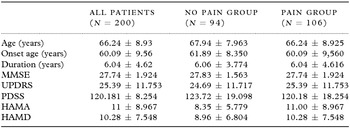
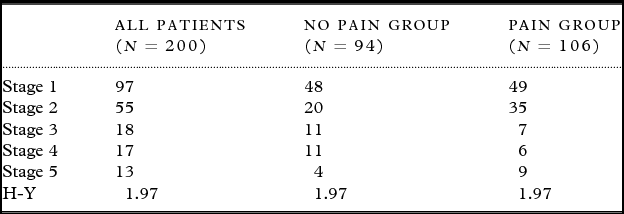
In total, 200 PD patients were enrolled in our study. The average age was 66.24 ± 8.93 years (35–85 years), and the mean onset age was 60.09 ± 9.56 years. The average duration of PD was 6.04 ± 4.62 years. Of these, 102 patients (51%) were males, aged 49.5 ± 6 years, and 98 patients (49%) were females, aged 69.5 ± 62 years. There were 106 patients in the pain group, including 56 males and 50 females. There were 94 patients in the no pain group, including 46 males and 48 females. The general information about all the patients is listed in Tables 1 and 2.
General information of PD patients

Hoehn–Yahr (H-Y) scale of PD patients

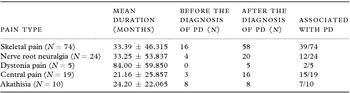
There were 21 PD patients with various pain types before the definitive diagnosis of PD, thus it was suspected that pain might be the first symptom of PD. Pain type and time of occurrence are shown in Table 3. In our survey of 106 PD patients with pain, 81 patients (76.4%) had only one type of pain, 23 patients (21.7%) had two pain types, and two patients (1.9%) had three kinds of pain. But 67 patients (63.2%) did not receive any treatment for pain. About 12.3% of the patients (13 of 106) took painkillers; 18.9% patients (20 of 106) received treatment for pain relief; and 5.7% (6 patients of 106) received accurate pain medication and physiotherapy. Thirteen patients (12.3%) had neuropathic pain with LANSS ≥ 12, 74 (69.8%) had skeletal pain; five (4.7%) had dystonia pain; 19 (17.9%) had central pain; ten (9.4%) had akathisia; 24 (22.6%) had neurological root pain or neuralgia, and one patient (0.9%) had tongue pain.
Duration and occurring time of all types of pain in PD

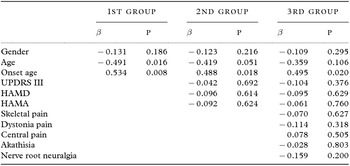
Linear regression analysis was done between the SF-36 bodily pain index and their relevant factors (Table 4). The first group included gender, age, and onset age; the second group added HAMD, HAMA, and UPDRS III in addition to the factors of the first group; and the third group comprised five pain types. Our present results showed that the SF-36 bodily pain index was only associated with the onset age of PD. The onset age in the pain group was lower than the control group, suggesting younger PD patients with higher SF-36 bodily pain index. In addition, pain may be associated with depression, although there were no statistical differences.
Relevant factors of SF-36 pain index in PD patients

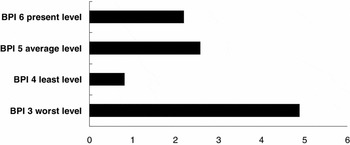
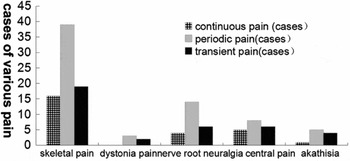
According to the BPI scale, the degree of pain for past 24 h is listed in Figure 1. The characters of different pains are shown in Figure 2.
BPI scores in 106 PD patients with pain. It showed degree of pain for past 24 h, according to the BPI scale. In 106 PD patients, the average BPI score (BPI = 5, average level) was 2.56 ± 1.435; and the worst BPI score (BPI = 3, worst level) was 4.88 ± 2.0. BPI = 3, worst level means the number that best describes pain at its worst in the last 24 h. BPI 4 least level means the number that best describes pain at its least in the last 24 hours. BPI = 5, average level means the number that best describes pain on average. BPI = 6, present level means the number that tells how much pain is right now.

The duration characteristics of different pain types. It showed characteristics of five different types of pain in 106 PD patients. Most of the patients had periodic pain and transient pain. However, there were more PD patients with continuous skeletal and central pain.

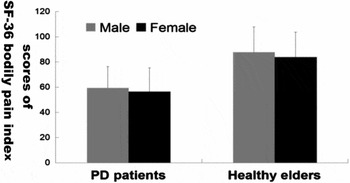
As shown in Figure 3, the mean bodily pain index of male PD patients (59.55 ± 17.871) was higher than that of female PD patients (56.40 ± 20.658) but with no significance (p = 0.25), while this index in healthy elderly males and females was 87.80 ± 19.07 and 83.97 ± 20.53, respectively (p = 0.17). Therefore, as compared with healthy elderly adults, PD patients had more pains according to the SF-36 bodily pain index (p = 0.00 in males, p = 0.00 in female).
The SF-36 bodily pain index of PD patients and healthy elderly adults during last month. It showed the mean bodily pain index. This index in male PD patients was higher than female patients, whereas in healthy elderly adults it was very high. So PD patients usually had more pain types according to the SF-36 bodily pain index compared with healthy elderly adults. Note: On this SF-36 scale, score of 0 means the most serious pain; and the score of 100 means no pain.

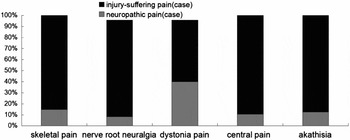
There were different proportions of neuropathic pain in PD patients. See Figure 4.
Proportion of neuropathic pain in different pain types in PD patients. It showed neuropathic pain in PD patients. There were different proportions of neuropathic pain in different pain types in PD patients. Dystonia pain appeared at higher proportion of neuropathic pain than other types of pain in PD patients.

Discussion
Pain is a common symptom in the general population, for example 19% Europeans and 30% Norwegians were reported with chronic pain for a long time (Breivik et al., Reference Breivik, Collett, Ventafridda, Cohen and Gallacher2006). Pain is considered to be one of the most painful symptoms in the progressive stage of PD patients, resulting in serious impact on their quality of life (Quittenbaum and Grahn, Reference Quittenbaum and Grahn2004; Ha and Jankovic, Reference Ha and Jankovic2012). The prevalence of PD with pain in the current literature varies from 23% to 83%, which was related with lack of objective pain measurement, different patient groups, and the methods of data collection. Currently, there are few case-control studies on the intensity and epidemiology of pain in PD patients compared with the general population. With increasing age, both incidence of pain and PD increase rapidly (Goetz et al., Reference Goetz, Tanner, Levy, Wilson and Garron1986), showing a significant correlation between these two. When pain was assessed in PD patients, the degree and morbidity of pain may be exaggerated without considering the age factor. In the present study, the incidence of pain in PD patients was 64%, and was significantly higher than in the general elderly population, and there was no significant difference on the incidence of pain between male and female patients. In most of the patients, pain appeared after the diagnosis of PD.
So far pain in PD patients has not been acknowledged and treated properly, and 64.1% of the patients in the present study did not receive any medication or physical therapy for pain. In the present study, we found that the patients with PD had more pain than those without PD, but the pain was not treated.
According to the SF-36 bodily pain scale, PD patients usually had more serious pains compared with the general elderly population (Fahn and Elton, Reference Fahn, Elton, Fahn, Marsden, Calne and Lieberman1987). Presently, the exact mechanism of pain in PD patients remains unclear. Previous studies have shown that pain in PD may be associated with the basal ganglia pathway, neurophysiology, biochemistry, and so on. Scherder et al. (Reference Scherder, Wolters, Polman, Sergeant and Swaab2005) considered some areas of the periaqueductal gray, parabrachial nucleus, locus coeruleus, locus coeruleus complex area, and medial thalamic nuclei as to be the medial pain system of PD, which was related to pain initiating, cognition, memory, and autonomic response. Damage to the nigrostriatal neurons increases the neuronal activity of the subthalamic nucleus, medial globus pallidus, and substantia nigra reticulata, which inhibit the activity of the lateral hypothalamic area. Different from the mechanisms of pain in patients not having PD, the dopaminergic neurotransmission system has been evidenced to be involved in the pain of PD patients (Lindvall et al., Reference Lindvall, Björklund and Skagerberg1983). There are five types of pain in PD with various pathogenesis (Klepstad et al., Reference Klepstad, Loge, Borchgrevink, Mendoza, Cleeland and Kaasa2002). Central pain is one of the most intensive factors in PD patients. Schestatsky et al. (Reference Schestatsky2007) found that sweating response in PD patients was significantly reduced after repeated pain stimulation, suggesting that autonomic nerve system was disregulated to painful stimuli. Dopamine could increase the threshold of PD patients’ objective pain (Brefel-Courbon et al., Reference Brefel-Courbon2005; Gerdelat-Mas et al., Reference Gerdelat-Mas2007). Ford's (Reference Ford1998) study revealed that akathisia was the fifth type of pain in PD patients. Akathisia and restless legs syndrome (RLS) are frequently confused in clinical practice. In the past, akathisia was not acknowledged as a kind of pain, but only an uncomfortable complaint. In addition, akathisia and RLS were not accompanied by pain sensation in all the patients. In our study, six patients with akathisia had mild pain, significantly affecting their quality of life. So, akathisia should be considered as one type of PD-related pain.
In the present study, depression was the only statistically significant factor related with the SF-36 pain index, highlighting that PD patients having depression may be a risk factor for pain. Ehrt et al. (Reference Ehrt, Larsen and Aarsland2009) had reported that depression was significantly correlated with pain in 227 PD patients. Therapy for depression in PD patients should include assessment and treatment of pain. Chou et al.'s (Reference Chou, Hurtig, Jaggi and Baltuch2005) study pointed that most PD patients may present pain two years after occurrence of depression. Pain and depression are comorbid and non-motor symptoms of PD. The basic experiments showed that there were common neurotransmitters, especially serotonin (5-HT) and noradrenaline (NA), underlying the mechanism of pain and depression (Vu et al., Reference Vu, Nutt and Holford2012). It has been a consensus that low levels of monoamine neurotransmitters, particularly 5-HT and NA, in cerebrospinal fluid results in depression (Csernansky and Sheline, Reference Csernansky and Sheline1993). Both 5-HT and NA are also involved in the down-regulation of pain. In addition, the hypothalamus–pituitary–adrenal (HPA) axis dysfunction may also be the reason of comorbid depression and pain (Blackburn-Munro, Reference Blackburn-Munro2004; Beiske et al., Reference Beiske, Loge, Rønningen and Svensson2009). Furthermore, most antidepressant drugs have significant analgesic effect, and some analgesics can significantly improve patient's depression. It is generally believed that there is a vicious circle between depression, pain, and heavier depression, seriously affecting patient's quality of life. Geotz et al.'s (Reference Goetz, Tanner, Levy, Wilson and Garron1986) study found that PD patients with pain were younger than those without pain; however, this had nothing to do with gender, H-Y stage, and Parkinson's motor symptoms. Lee et al. (Reference Lee, Walker, Hildreth and Prentice2006) found that pain was not associated with age, H-Y stage, duration, MMSE, and depression. Another study had found that female PD patients were more likely to have pain compared with the general population (Lee et al., Reference Lee, Walker, Hildreth and Prentice2006). Compared with previous studies, our study has found that pain is statistically independent clinical variable, and is evaluated through the entire course of the disease, thus the result might be relatively objective.
Pain is an important non-motor symptom in PD patients, and it is significantly associated with depression and the onset age of PD, but not with gender, duration, and severity of PD in our study. Pain and depression have a higher degree of comorbidity, and depression status could reduce pain threshold of PD patients to increase pain prevalence. Most PD patients have not received analgesic treatment. Initial diagnosis of pain should be performed for best treatment. In this process, depression should be given full attention with appropriate anti-depressant treatment.
Conflict of interest
None.
Description of authors’ roles
Wei-Guo Liu and Xing-Jian Lin designed the study and supervised the data collection. Nian Yu and Xiao-Guang Lin wrote the paper. Yan-Fang Zhang and Yan Chen performed much screening work of patients, collected the data, and assisted with writing the paper. Kang Zhang and Xiao-Shan Wang were responsible for the statistical design of the study and for carrying out statistical analysis. All authors read and approved the final manuscript.
Acknowledgments
This work was supported by grants from the Nanjing Medical Scientific and Technique Foundation of Jiangsu province, China (QRX11008 and QRX11119).