As part of a comprehensive risk-reduction program to limit surgical site infections (SSIs) in orthopaedics, we implemented a universal staphylococcal decolonization (USD) protocol for elective hip and knee replacement surgeries. According to Lucet et al,Reference Lucet and Regnier 3 20%–30% of admitted patients are colonized with methicillin-susceptible Staphylococcus aureus (MSSA), and 5% of admitted patients test positive for methicillin-resistant Staphylococcus aureus (MRSA). Studies have shown MSSA and MRSA decolonization is effective in reducing surgical site infection (SSI) rates.Reference Bode, Kluytmans and Wertheim 1 , Reference Kim, Spencer, Davidson, Li and Shaw 2 , Reference Thompson and Houston 4
We developed and implemented a USD kit for all elective hip and knee replacement procedures at an 865-bed academic medical center starting in October 2013. Our center performs approximately 800 elective hip and knee arthroplasties annually. The USD kit is delivered in a nylon, lightweight carry pack and contains intranasal mupirocin 2% ointment (Perrigo, 22 g tube), chlorhexidine 0.12% mouth rinse (Peridex, 3M ESPE Dental Products, St. Paul, MN), chlorhexidine 2% bath soap (ECOLAB, 118-mL bottle) and written instructions in English on why and how to complete the USD protocol. The USD kit is provided to the patient at the time of their outpatient preoperative risk assessment and optimization visit; MRSA nasal swab screening is also performed at that time. All patients are instructed to complete each component of the USD kit daily beginning 5 days prior to the day of surgery. This study was designed to assess orthopaedic healthcare personnel (HCP) knowledge of, perceptions of, and barriers to the implementation of the USD protocol.
METHODS
After Institutional Review Board approval, a voluntary, anonymous, 8-item questionnaire was distributed to all HCP (ie, attending surgeons, residents/interns, physician assistants, nurse practitioners, nurses, and nursing/medical students) involved in the care of hip and knee replacement patients at our center. The questions were scored on a Likert scale and focused on the perceptions of and barriers to the implementation of the USD kit. The responses were analyzed using Statistical Analysis System (SAS) software, version 9.2 (SAS Institute, Cary, NC). Pearson χ2 and Fisher’s exact tests were computed to compare physician responses to nurse responses.
RESULTS
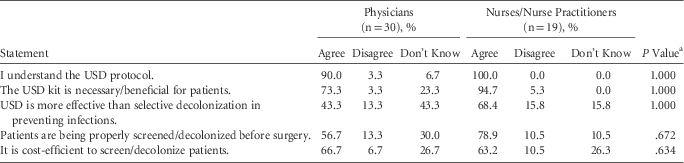
A total of 55 questionnaires were collected over a 5-week period. Respondents included 5 attending surgeons, 25 residents, 3 physician assistants, 9 nurse practitioners, 10 nurses, and 3 medical/nursing students. The overall response rate was 69.6% (55 of 79). No statistically significant differences were detected between physician (ie, attending physicians, residents and interns, and physician assistants) responses and nurse (ie, nurse practitioners and nurses) responses (Appendix Table 1).
Many respondents believed that USD of elective hip and knee replacement cases was cost-effective (67%, n=37), and 51% (n=28) felt that USD was more effective than selective decolonization. Nearly 18% (n=10) reported that USD was neither beneficial nor necessary for elective joint replacement surgeries. Among respondents, 62% (n=34) affirmed that patients were decolonized before elective procedures and 93% (n=51) reported having a thorough understanding of the USD protocol. The most common barrier identified for implementing USD was perceived inconvenience of USD kit dispensation (38%, n=21) and explanation at the time of the preoperative encounter. Furthermore, 20 HCP (36%) indicated concerns about both staff and patient education as a barrier to compliance with the USD kit.
DISCUSSION
In this study, we investigated the HCP knowledge of, perceptions of, and barriers to successfully implementing a USD protocol. It is imperative that HCP understand the USD kit protocol and the potential benefits of universally decolonizing patients who are undergoing elective surgical procedures. Approximately 93% of HCP understood the USD protocol, yet 15% were unsure whether the USD kit was necessary or beneficial for patients. Approximately 33% of respondents disagreed or were unaware of the cost efficiency of screening and/or decolonizing patients prior to joint replacement surgeries. Although a cost assessment was not performed for our patient population, a recent report suggests that staphylococcal decolonization is cost-effective in pre-surgical patient preparation for orthopedic joint-replacement surgeries.Reference Hacek, Robb, Paule, Kudrna, Stamos and Peterson 5 Approximately 50% of the survey respondents were either unaware or disagreed that USD is more effective than selective decolonization in preventing post-surgical infections in orthopaedics. Although many HCP understood the process of the USD protocol, many did not understand the importance and potential benefits of universal staphylococcal decolonization in orthopaedics, limiting their ability to educate patients.
Other barriers to successfully implementing the USD kit protocol include time and convenience, cost, patient and staff compliance, and lack of education. Only 62% of respondents believed that patients were being properly screened and/or decolonized before surgery. Although we now have data regarding adherence to USD kit protocols at time of preoperative visit (607 of 645, 94%), we do not have a method for determining patient compliance with USD kit use.
Our study has some limitations. The single-center design may not be accurately generalized to other care environments. In addition, we only had 55 respondents of a possible 79 who were given the questionnaire. Although the questionnaire was anonymous, responses may have been subject to recall bias or inaccuracy.
The successful implementation of a USD kit must be comprehensive. All providers involved in perioperative care must understand the rationale and expected impact of a USD program. Based on our study, we will provide education regarding the benefits of the USD kit, and we will clarify the complementary but distinct purpose of MRSA screening for all involved HCP. Our protocol for dispensation of USD materials is effective; however, we lack specific materials for non-English speakers. Assessment of patient comprehension and compliance monitoring may also improve performance. Finally, formalized feedback of USD dispensation to surgical departments will be added to existing SSI feedback along with ongoing monitoring of USD program effectiveness .
ACKNOWLEDGMENTS
Financial support: No financial support was provided relevant to this article.
Potential conflicts of interest: All authors report no conflicts of interest relevant to this article.
SUPPLEMENTARY MATERIAL
To view supplementary material for this article, please visit http://dx.doi.org/10.1017/ice.2015.290.
Appendix
Physician Versus Nurse and Nurse Practitioner Responses