Implications
The requirements of metabolizable energy for maintenance (MEm) for growing Texel lambs was 417 kJ/kg of the metabolic fasting BW (FBW) and the efficiency of use of MEm was 0.63. In addition, the requirement of metabolizable protein for maintenance (MPm) of Texel lambs was 2.98 g/day per kg0.75 FBW. These requirements are different from those reported in the literature. Therefore, the findings of this study may be relevant to determining more precisely the feed for Texel sheep flocks globally, implying on less costs for farmers as well as avoid environmental pollution by less losses of nutrients via urine and feces.
Introduction
The ability of Texel sheep to produce carcasses with a low fat content and high proportion of muscles has gained the breed prominence in the context of global sheep meat production (Ellis et al., Reference Ellis, Webster, Merrell and Brown1997). The breed is therefore increasingly being produced in countries such as Australia, New Zealand and southern Latin America, where there is less emphasis on wool in favor of advocating an increase in sheep meat production (Boutonnet, Reference Boutonnet1999).
Although the maintenance requirements for sheep may be affected by their genotype, there remain controversial findings in the literature (National Research Council (NRC), 2007), and recommendations on feed system requirements have not been addressed specifically to different sheep breeds. In the case of Texel sheep, it can be hypothesized that their body composition characteristics affect their nutritional requirements. Energy and protein maintenance requirements have been determined for Texel crossbred lambs (Galvani et al., Reference Galvani, Pires, Kozloski and Wommer2008 and Reference Galvani, Pires, Kozloski and Sanchez2009), and carcass composition studies of Texel-sired lambs have also been carried out (Latif and Owen, Reference Latif and Owen1980), as well as research on Texel sheep heat production (HP) (Freetly et al., Reference Freetly, Nienaber, Leymaster and Jenkins1995). However, no study has yet been carried out to determine the nutritional requirements for maintenance of Texel lambs. Therefore, the objective of the present study was to determine the energy and protein requirements for the maintenance of Texel lambs.
Material and methods
Animals, facilities and food management
Thirty-four Texel lambs, all intact males, were used. They were weaned at 50 days old, and had an initial average BW of 21.2±2.0 kg. The lambs were individually confined in 1 m² pens, equipped with feeders and water drinkers. Two experiments were conducted, as follows: Experiment 1, in which a digestibility assay was used to determine the energy content of the experimental diet; and Experiment 2, conducted in order to determine the energy and protein requirements for maintenance of Texel lambs.
In both experiments, the diet consisted of 50% sorghum silage (Sorghum bicolor (L.) Moench), 20.56% corn grain (Zea mays L.), 28.42% soybean meal (Glycine max L.) and 1.02% mineral mixture. The diet was calculated to meet the CP, metabolizable energy and macromineral requirements recommended by the NRC (2007) in order to achieve a daily gain of 0.200 kg. The lambs were fed twice a day, at 8am and 4pm. The silage and concentrate were weighed individually, and mixed before feeding. The amount offered to the lambs fed ad libitum was adjusted to maintain refusal feed at 10% of the total offered. In both experiments, in order to determine metabolizability and maintenance requirements, lambs were pair-fed an amount equivalent to 70% and 55% (feed restriction of 30% and 45%, respectively) of the lambs fed ad libitum.
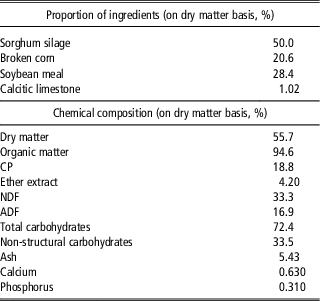
Samples of the feed offered and refusals were collected daily and frozen. These samples were then dried at 55°C for 72 h, milled at 1 mm and stored for further analysis. Table 1 shows the ingredient proportions and chemical composition of the experimental diet. The lambs were weighed at the beginning of the experimental period and at subsequent 7-day intervals. The interval between weighings was reduced as the lambs approached slaughter weight.
Proportion of the ingredients (on dry matter basis) and chemical composition of the experimental diet of Texel lambs

Experiment 1: digestibility assay
Experimental design
The digestibility assay was conducted using six intact males Texel lambs, with an initial mean live weight of 28.4±3.1 kg. The lambs were kept in metabolic cages in two 3×3 Latin square experimental design. In order to evaluate the energy value of the diet at the three levels of feed restriction (ad libitum, or restricted to 70% or 55% of the ad libitum intake), the trial was conducted in three 15-day periods, incorporating 10 days of diet adaptation and 5 days of sample collection. The feed quantities offered and refusals of lambs fed ad libitum were measured daily throughout the experimental period. The feed supply for the lambs fed either of the two restricted diets (70% or 55%) was calculated as previously described.
The food offered, refusals and feces were weighed individually and homogenized, and a sub-sample comprising 10% of the total amount was taken during the collection period. The samples were oven-dried at 55°C for 72 h, ground to pass through a 1 mm size sieve in a Wiley mill (Arthur H. Thomas, Philadelphia, PA, USA) and stored for further analysis. During the 5 sample collection days, urine was collected daily using bottles containing 100 ml of 7.2 normal H2SO4 solution; the total daily volume produced by each lamb was measured and 1% of this total volume was collected, diluted with distilled water until a volume of 50 ml was achieved, and then frozen at −20°C, also for further analysis. Samples of food, refusals, feces and urine were categorized according to the animal and period.
Chemical analysis
Dry matter (DM) content of the samples of feed offered, refusals and feces, was determined by oven drying at 105°C for 16 h. The ash content was determined after combustion at 600°C for 2 h and, after discounting DM ash, the organic matter content was determined. The ether extract content was determined by a reflux system (Soxtherm 2000 S 306M; Gerhardt, Königswinter, Germany) with ethyl ether at 180°C for 2 h. Gross energy was measured using a calorimetric bomb (Adiabatic Calorimeter; Parr Instrument Co., Moline, IL, USA). The total nitrogen content was determined using the Kjeldahl method (method 984.13; Association of Official Analytical Chemists (AOAC), 1997), modified as described by Kozloski et al. (Reference Kozloski, Perottoni, Ciocca, Rocha, Raiser and Sanchez2003). The NDF content was determined according to the method of Senger et al. (Reference Senger, Kozloski, Sanchez, Mesquita, Alves and Castagnino2008), with samples packed in polyester sachets (Komarek, Reference Komarek1993); α-amylase was included in order to determine NDF content in the samples (Mertens, Reference Mertens2002). Lignin and ADF concentrations were determined according to the method recommended by the AOAC (1997; method 973.18), except that asbestos was not included in the analysis. Analyses of neutral-detergent insoluble nitrogen was performed according to the method of Licitra et al. (Reference Licitra, Hernandez and Van Soest1996). Total carbohydrates were determined according to the method of Sniffen et al. (Reference Sniffen, O’Connor, Van Soest, Fox and Russell1992) and non-fiber carbohydrates were obtained by the following calculation: Organic matter−[(NDF−neutral-detergent insoluble nitrogen×6.25)+(nitrogen×6.25)+ether extract], according to Van Soest et al. (Reference Van Soest, Robertson and Lewis1991). Total nitrogen content of the urine samples was determined using the Kjeldahl method, as previously described.
Calculations
At each of the different levels of feed restriction (0%, 55% and 70% of ad libitum feed intake), the digestible energy of the diet was obtained by calculating the difference between the gross energy intake and gross energy excreted in feces, in proportion to gross energy intake. The concentrations of metabolizable energy in the diets were obtained from the difference between the digestible energy and the loss of energy in urine and gas energy. Urine energy was estimated on the basis of the equation predicted by Paladines et al. (Reference Paladines, Reid, Van Niekerk and Bensadoun1964). The energy lost in the form of ruminal fermentation gases was estimated as proposed by Blaxter and Clapperton (Reference Blaxter and Clapperton1965). The metabolizability of the diet was obtained by the relationship between metabolizable energy intake (MEI) and gross energy intake.
Statistical analysis
The results of the digestibility assay were analyzed as mixed models using SAS software (v. 9.4; SAS Institute Inc., Cary, NC, USA), in which the feed level was considered as a fixed effect, and the animal, Latin square, blocking of the groups by feed restriction, and experimental error were considered as random effects. When P-values were significant according to variance analysis (P < 0.05), the CONTRAST statement of MIXED procedure was used to perform orthogonal contrasts in order to verify the linear or quadratic effect.
Experiment 2: energy and protein requirements for maintenance
Experimental design
At the beginning of the experiment, 10 lambs weighing 21.0±0.77 kg were slaughtered after a 14-day dietary adaptation period, in order to provide a baseline according to the comparative slaughter methodology described by the Agricultural Research Council (ARC) (1980). In addition, in order to determine the maintenance energy and protein requirements, 18 lambs weighing 21.9±0.64 kg were randomly distributed between three levels of dry matter intake (DMI): ad libitum, 70% of ad libitum intake or 55% of ad libitum intake. A randomized block design was used for this experiment, where lambs submitted to feed restriction and lambs fed ad libitum were divided into six groups (six blocks) for slaughter, with each group (block) comprising one lamb from each of the three pair-fed nutritional levels (three lambs each block). The three lambs in each group were slaughtered together on the same day that the lamb fed ad libitum reached 40 kg BW.
Slaughter procedures
After 14 h of solid fasting, the lambs were weighed, electrically stunned and sacrificed through sectioning of the carotid arteries and jugular veins. The blood, viscera, skin, wool, head, feet, carcass and visceral fat from each individual lamb were weighed. The gastrointestinal tract was weighed both full and empty, and the difference used to obtain the gastrointestinal content weight. The empty BW (EBW) was calculated from the difference between FBW and gastrointestinal content, urine and gallbladder content (equation (1)):
 $${\rm EBW}{\equals}{\rm FBW}-\left( {{\rm gastrointestinal}\,{\rm content}{\plus}{\rm urine}{\plus}{\rm bile}} \right)$$
The carcasses were weighed and chilled at 2°C for 24 h. Subsequently, they were longitudinally sectioned, and the right half-carcass was dissected into muscle, fat, bone and other parts, and each component was weighed separately. The head, after being sectioned in half, and the anterior and posterior right foot of each animal, were also dissected. Ten groups of body components were formed in order to sample the animal as a whole, as follows: Group (1) internal organs (lung+trachea, heart, brain, kidneys, esophagus, tongue, thymus, spleen, pancreas, diaphragm, bladder, liver and reproductive system); Group (2) empty gastrointestinal tract (rumen, reticulum, omasum, abomasum, small intestine and large intestine); Group (3) intracavitary fat (heart fat, renal, fat associated with the reproductive system and the gastrointestinal tract); Group (4) total blood collected; Group (5) right half-carcass muscles; Group (6) intramuscular and subcutaneous fat of the right half-carcass; Group (7) skin; Group (8) wool; Group (9) right half-carcass bones; Group (10) other components (muscle fascia, cartilage and nerves) of the right half-carcass. With the exception of Group 4, in which the total collected formed the whole sample, each organ in each group was individually weighed and, after manual chopping, a homogeneous sample of 40% of the total weight of each organ was obtained to form the groups. With the exception of Groups 4, 8 and 9, samples in each group were then ground through an electric meat grinder (plate with holes of 4-mm diameter; Meat Grinder; CAF 22s, C. A. F. Máquinas, Rio Claro, São Paulo, Brazil) and then homogenized, after which samples of ~500 g were taken and frozen for further laboratory analysis. Group 8 was a sample comprising total sheared wool; and Group 9 comprised small portions (~10%) of each bone cut into small pieces.
Chemical analysis
The DM, ash, organic matter, ether extract, gross energy and nitrogen contents in the samples of the feed offered, refusals and feces were determined in a manner similar to that described for the digestibility test samples in Experiment 1. Analysis of the body components was as follows. With the exception of Group 4, in samples from each group (aliquot of 200 g of sample) was determined the greasy DM after oven drying at 105°C for a period of at least 72 h. These samples were then successively washed with petroleum ether to obtain pre-degreased DM, according to the method of Kock and Preston (Reference Kock and Preston1979). After degreasing, the samples were milled in a ball mill (closed chamber ball mill; Marconi Equipamentos para Laboratórios, Piracicaba, SP, Brazil), for further determination of nitrogen and residual fat using the methodology previously described. The blood was dried in a forced draft oven at 65°C for approximately 96 h; the residue was then milled in a ball mill (closed chamber ball mill), to determine the DM and nitrogen content, according to the previously described methods.
Calculations
The body energy concentration was calculated using the caloric equivalents of fat and protein, according to the methodology of the ARC (1980), where (equation (2)):
 $$\eqalignno{ {\rm Body}\,{\rm fat}{\equals} {\minus}316\left({\pm217} \right){\plus}109\left( {\pm11.3} \right){\times}{\rm EBW}, \cr P\,\lt\,0.001,{\rm RMSE}{\equals}79.5$$
The retained energy, protein and fat were determined from the difference between body composition at slaughter and at the beginning of the experiment, which was estimated from the equations based on the FBW and body composition of the baseline animals. Heat production was calculated according to the difference between the MEI (kJ/kg0.75 FBW) and retained energy in the lamb bodies (kJ/kg0.75 FBW). The MEI was estimated multiplying the gross energy intake by the metabolizability of the diet found in the Experiment 1. The net energy for maintenance (NEm) requirement was determined using the antilog of the log linear regression intercept on base 10 of the HP (kJ/kg0.75 FBW) as a function of the MEI (kJ/kg0.75 FBW), according to Lofgreen and Garret (Reference Lofgreen and Garret1968). The MEm requirement was calculated by iteration, assuming that MEm is the value in which MEI is equal to HP (Lofgreen and Garret, Reference Lofgreen and Garret1968). The efficiency of use of MEm was considered as NEm/MEm.
The net protein for maintenance (NPm) requirement was estimated using the comparative slaughter method as the absolute value of the regression intercept between the daily retention of protein in the lamb body and daily CP intake. The MPm requirement was estimated from the relationship between retained protein and metabolizable protein intake (MPI), assuming retention of protein equal to zero. The MPI was estimated from the chemical composition of the lambs’ diet, according to Luo et al. (Reference Luo, Goetsch, Nsahlai, Sahlu, Ferrel, Owens, Galyean, Moore and Johnson2004). In order to estimate MPm, the retained protein was considered as the retained nitrogen multiplied by 6.25. The efficiency of metabolizable protein (MP) utilization for maintenance was calculated as NPm/MPm.
Statistical analysis
The regression equations obtained from the baseline lambs in order to predict body composition at the beginning of the experiment were determined using the MIXED procedure in SAS v. 9.4. The slopes and intercepts of each equation were estimated using the ESTIMATE statement of the MIXED procedure in SAS. The regression equations used to estimate NEm, MEm, NPm and MPm were obtained with the MIXED procedure in SAS v. 9.4, using the ESTIMATE statement to obtain the equation parameters. The block effect was considered as random in the model. Analyses with results of P < 0.05 were considered to be statistically significant. Studentized residuals were plotted against predicted values to verify model assumptions, and no outliers (studentized residuals>|3|) were identified.
Results
Digestibility assay
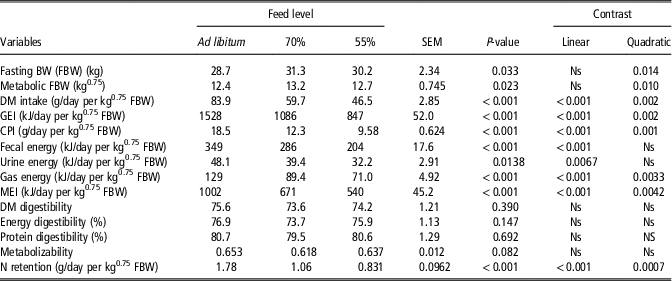
The digestibility assay showed that, with increasing feed restriction applied to lambs, the intake of DM, gross energy, CP and metabolizable energy decreased quadratically (P < 0.01; Table 2), energy excretion in feces and urine decreased linearly (P < 0.01; Table 2), excretion of gas energy decreased quadratically (P < 0.01; Table 2) and the nitrogen balance decreased quadratically (P < 0.01). The results for the digestibility of DM, energy, protein and diet metabolizability were similar between feed restriction levels, averaging 74.4%, 75.5%, 80.3% and 0.636, respectively (Table 2).
Intake, excretion and utilization of energy and protein obtained in the digestibility trial with lambs at different feeding levels (ad libitum, 70% and 55% feed supply in relation to the ad libitum ingested)

DM = dry matter; GEI = gross energy intake; CPI = CP intake; MEI = metabolizable energy intake; Ns = non significative.
Energy and protein requirements for maintenance
The protein and fat content of the lambs’ bodies at the beginning of the experiment was calculated from equations based on the relationship of EBW and BW (equation (3)), as well as the relationship of body composition with the EBW of baseline animals (equations (4) and (5)).
 $$\eqalignno{ {\rm EBW}{\equals} 0.125\left( {\pm2.29} \right){\plus}0.901\left( {\pm0.109} \right){\times}{\rm BW}, \cr P\,\lt\,0.001,{\rm RMSE}{\equals}0.840$$
 $$\eqalignno{ {\rm Body}\,{\rm protein}{\equals} 183{\rm }\left( {\pm486} \right){\plus}166\left( {\pm25.4} \right){\times}{\rm EBW}, \cr P\,\lt\,0.001,{\rm RMSE}{\equals}187$$
 $$\eqalignno{ {\rm Body}\,{\rm fat}{\equals} {\minus}316\left( {\pm217} \right){\plus}109\left( {\pm11.3} \right){\times}{\rm EBW}, \cr P\,\lt\,0.001,{\rm RMSE}{\equals}79.5$$
where EBW and BW are measured in kilogram, and body protein content and body fat content in gram.
From the estimates of body composition made at the beginning of the experiment, it was possible to determine the nutrient retained in the lamb bodies in order to calculate maintenance requirements.
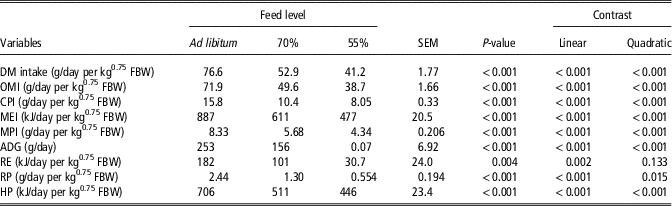
In the comparative slaughter trial, the DMI, organic matter intake, CP intake, MEI, MPI, RP and HP decreased at an increasing rate (quadratic effect, P < 0.05) with increased feed restriction (Table 3). The average daily gain decreased at a decreasing rate with increased feed restriction (quadratic effect, P < 0.01), so that the weight gain was practically null at 55% feed restriction, which showed that the imposed restriction caused the lamb intake to be very close to the maintenance level (Table 3). In addition, retained energy decreased linearly with increased feed restriction (P < 0.01). As a proportion of MEI, retained energy decreased and HP increased with increasing feed restriction, being 20.5%, 16.5% and 6.40% for RE, and 79.6%, 83.6% and 93.5% for HP at ad libitum, 70% and 55% restriction feed levels, respectively (Table 3).
Intake, average daily gain (ADG) and protein and energy balance of Texel lambs from 25 to 40 kg BW of the comparative slaughter trial at different feed levels (ad libitum, 70% and 55% feed supply in relation to the ad libitum ingested)

DM = dry matter; FBW = fasting BW; OMI = organic matter intake; CPI = CP intake; MEI = metabolizable energy intake; MPI = metabolizable protein intake; RE = retained energy; RP = retained protein; HP = heat production.
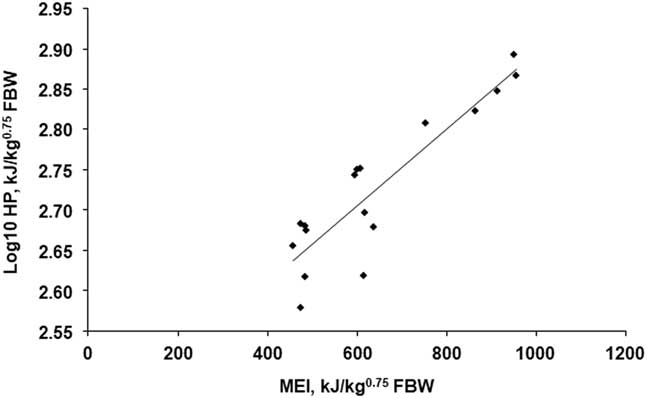
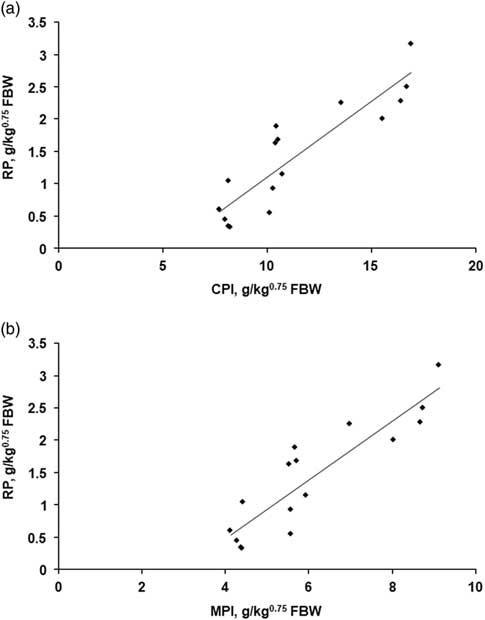
The NEm requirement was determined using the regression equation between the logarithm of HP and MEI (Figure 1). The daily NEm obtained was 263 kJ/kg0.75 FBW. The daily MEm obtained when HP was equal to MEI was 417 kJ/kg0.75 FBW, and efficiency of use of MEm was 0.630. For NPm, the value estimated from comparative slaughter was 1.24 g/day per kg0.75 FBW (Figure 2a), and the MPm obtained from the ratio of the retained protein (g/day per kg0.75 FBW) and protein intake (g/day per kg0.75 FBW), when retained protein was equal to zero, was 2.98 g/d per kg0.75 FBW (Figure 2b). The retention efficiency of MPm in NPm (MP utilization for maintenance) was 0.42.
Relationship between daily log heat production (HP) and daily metabolizable energy intake (MEI) of Texel lambs from 20 to 40 kg BW. Log10 HP, kJ/kg0.75 of fasting BW (FBW) = 2.42 (±0.0384)+0.00048 (±0.000057)×MEI, kJ/kg0.75 FBW; RMSE = 0.040; P < 0.001.

Daily requirements of net protein for maintenance (NPm) (a) and metabolizable protein for maintenance (MPm) (b) estimated by regression between body retained protein (RP) and CP intake (CPI) or metabolizable protein intake (MPI) in Texel lambs from 20 to 40 kg BW. Equation for NPm:RP, g/kg0.75 of fasting BW (FBW) = −1.24 (±0.367)+0.234 (±0.031)×CPI, g/kg0.75 FBW, P < 0.001, RMSE = 0.401; equation for MPm: RP, g/kg0.75 FBW = −1.36 (±0.377)+0.457 (±0.0598)×MPI, g/kg0.75 FBW, P < 0.001, RMSE = 0.398.

Discussion
Our results for DM, energy and protein digestibility, as well as the diet metabolizability, showed that feed restriction does not change the use of energy and protein ingested in Texel lambs, as long as MEI is above the level required for maintenance. In general, the literature shows that the digestibility of DM, energy and protein in sheep is increased through feed restriction (Galvani et al., Reference Galvani, Pires, Kozloski and Sanchez2009; Deng et al., Reference Deng, Diao, Jiang, Tu, Zhang, Liu, Ma, Zhao and Xu2012). However, in the current study, besides of DM digestibility, the proportion of energy losses in feces, urine and gas production followed the feed restriction, maintaining the metabolizability of the diet similar among the different feeding levels. The efficiency of feed utilization is directly related to the rate of both digestion and passage through the digestive tract (Mertens, Reference Mertens2005), but it was observed that sheep remain passage rate and digestibility constant across different feed intake levels (Clauss et al., Reference Clauss, Stewart, Price, Peilon, Savage, Ekris and Munn2016). Therefore, we suggest that the similar metabolizability of the diet among feed restriction levels may be mainly related to the passage rate that probably did not change with feeding levels. In other hand, we also observe in some studies an inappropriate statistical results analysis, in which authors treat the feed restriction as a simple regression (like a complete randomized design) and forget that feed restriction is performed based on ad libitum fed animals, forming blocks. This implies in wrong statistical significances in the results and also may contribute to differences observed among studies.
The DMI observed in the lambs fed ad libitum was higher than the value observed by Galvani et al. (Reference Galvani, Pires, Kozloski and Wommer2008) for lambs 11/16 Texel×5/16 Ile de France. Using an equation proposed by the NRC (2007), and taking a mean BW of 30 kg and a BW at maturity of 115 kg BW for Texel lambs, the DMI estimated (1.73 kg DM/day) represented an overestimation by 66% over the value determined in this study for lambs fed ad libitum. In addition, on the basis of a mean BW of 30 kg and average daily gain of 253 g (determined for lambs fed ad libitum), the equation proposed by Cannas et al. (Reference Cannas, Tedeschi, Fox, Pell and Van Soest2004) for predicting DMI yielded a value (1.17 kg DM/day) 13% higher than that observed in our study. This indicated that models still are not able to predict DMI accurately and we suggest that it is also necessary to take into account different environmental and sheep breeds to make improved adjustments to DMI prediction models. Different breeds may react differently to the environment factors that can affect feed intake, such as temperature, day length and parasite infestations. In addition, DMI is also highly dependent of diet NDF content (Mertens, Reference Mertens1994), and within the limits of the quality of forage used, the amount of feed taken in by sheep is determined by the digestibility of feed and rate of passage through the digestive tract (Blaxter et al., Reference Blaxter, Wainman and Wilson1961). In a review of DMI prediction for housed sheep it was observed that none of the models account for the effects of environmental conditions on DMI and the influence of diet quality on DMI is not considered by all models (Pulina et al., Reference Pulina, Avondo, Molle, Francesconi, Atzori and Cannas2013). In fact, the environmental conditions not only affect the voluntary feed intake, but also the feed quality that ultimately influences DMI (Van Soest, Reference Van Soest1994). Using the most recent Institut national de la recherche agronomique (INRA) feeding system for ruminants, which consider some environmental factors on DMI prediction, it was recommended a DMI of 1.14 kg/day for a growing lamb with 30 kg BW and 250 g of ADG (Sauvant et al., Reference Sauvant, Delaby and Nozière2017). This prediction is still 9.6% greater than the DMI observed in the current study; however, INRA model is one that predicted DMI closest of our observed value, indicating that models predicting DMI need to be more mechanistic and continuously improved in order to provide more accurate predictions.
The comparative slaughter trial showed that HP increased exponentially with increasing MEI and retained energy in the lambs; these results agreed with reports in the literature with beef cattle (Tedeschi et al., Reference Tedeschi, Boin, Fox, Leme, Alleoni and Lanna2002; Chizzotti et al., Reference Chizzotti, Tedeschi and Valadares Filho2008). As MEI increased, more heat was produced as a result of energy retention, but not in a directly proportional way, since at the 55% feed restriction level, the proportion of MEI spent in HP was close to 100%. This indicated that, although MEI and retained energy decreased, energy expenditure for maintenance has remained constant, reinforcing the validity of the method used in this study to estimate energy requirements for maintenance.
The NEm result obtained in our study was slightly above the value (245 kJ/kg0.75 FBW) determined by Galvani et al. (Reference Galvani, Pires, Kozloski and Wommer2008) for 11/16 Texel×5/16 Ile de France lambs; this is probably related to crossbreeding, since our study was conducted with non-crossbred Texel lambs. In addition, 11/16 Texel×5/16 Ile de France lambs supplied with ad libitum intake presented an average daily gain of 0.309 g/g of DMI (g/day), while the lambs in our study gained 0.243 g/g of DMI (g/day). This indicated that Texel lambs have a higher energy expenditure requirement for maintenance, implying a lower weight gain per DMI unit when compared with crossbred 11/16 Texel×5/16 Ile de France lambs. In addition, our results were somewhat closer to those reported by the Commonwealth Scientific and Industrial Research Organization (CSIRO) (2007) of 276 kJ/kg0.75 FBW, OVERSEER Technical Manual (2016) of 277 kJ/kg0.75 BW, and by Deng et al. (Reference Deng, Diao, Jiang, Tu, Zhang, Liu, Ma, Zhao and Xu2012) for Dorper crossbred ram lambs (278 kJ/kg0.75 FBW). In contrast, the value obtained for NEm in our study was greater than the value reported (234 kJ/ kg0.75 full BW) by the NRC (2007), and was on average 10% lower than that reported by the Agricultural Food and Research Council (1993) for intact males (289 kJ /kg0.75 BW). More recently, a meta-analytic study of male hair lambs by Oliveira et al. (Reference Oliveira, Pereira, Biffani, Medeiros, Silva, Oliveira and Marcondes2018) has reported an NEm of 246 kJ/kg0.75 EBW, which represents, on average, 20% less than the value we found, when presented based on EBW (306 kJ/kg0.75 EBW). It can therefore be observed that, although different studies used lambs of similar ages, many variations in NEm have been reported. This may be related to factors such as body composition of the animals, gender, breed, intake level, acclimatization, environmental effects and season (Blaxter and Boyne, Reference Blaxter and Boyne1982; Ferrell and Jenkins, Reference Ferrell and Jenkins1985; Cannas et al., Reference Cannas, Tedeschi, Fox, Pell and Van Soest2004; NRC, 2007). Therefore, we emphasize the need for further studies focused on determining variations in the nutritional requirements for raising sheep from different breeds in different environments, in order to better establish NEm values in diverse situations.
Similarly, we found divergences between the MEm values in our study and those reported in the literature, possibly due to differences between breeds, diets and environmental effects, as well as methodological differences. Taking into account studies using comparative slaughter, the value obtained for MEm in our study (417 kJ/kg0.75 FBW) was around 9% higher than that obtained by Galvani et al. (Reference Galvani, Pires, Kozloski and Wommer2008) for Texel crossbred lambs (381 kJ/kg0.75 FBW), and 13% lower than that reported for castrated lambs (470 kJ/kg0.75 BW) in a tropical climate (Silva et al., Reference Silva, Silva Sobrinho, Trindade, Resende and Bakke2003). However, our MEm value was somewhat closer to that reported by Deng et al. (Reference Deng, Diao, Jiang, Tu, Zhang, Liu, Ma, Zhao and Xu2012) for Dorper crossbred ram lambs (403 kJ/kg0.75 FBW). In addition, our MEm result was much lower than that reported by Salah et al. (Reference Salah, Sauvant and Archimède2014) for sheep (542 kJ metabolizable energy/kg0.75 BW). Using the equation proposed by the Agricultural and Food Research Council (AFRC) (1993), and basing the calculation on an intact lamb of 40 kg FBW and diet metabolizability of 0.636, the estimated MEm was 400 kJ/kg0.75 FBW, which is relatively close to the value we determined, underestimating the value of MEm by only 4%. However, when performing a simulation in which the efficiency of use of MEm used in the equation was replaced by that observed in our study (0.630), MEm was overestimated by 10%, indicating that the AFRC (1993) equation overestimates the fasting metabolism and activity allowance for confined growing lambs.
The efficiency of use of MEm value observed in our study was close to values reported for Texel crossbred lambs (0.64; Galvani et al., Reference Galvani, Pires, Kozloski and Wommer2008), the NRC (0.64; 2007) and CSIRO (2007), the latter for low-quality forage (0.62). On the other hand, when we estimated the efficiency of use of MEm according to the AFRC (1993) and based on the metabolizability of the diet value determined for the diet supplied in our study, a value of 0.72 was obtained, which overestimates the value we observed by 13%. However, it is worth noting that the overestimation of efficiency of use of MEm when using the AFRC (1993) equation has already been observed by other authors (Fernandes et al., Reference Fernandes, Resende, Tedeschi, Fernandes, Silva, Carstens, Berchielli, Teixeira and Akinaga2007; Galvani et al., Reference Galvani, Pires, Susin, Gouvêa, Berndt, Chagas, Dórea, Abdalla and Tedeschi2014), indicating that other factors, besides those related to diet quality, also interfere in dietary energy efficiency. In addition, although our NEm and MEm results were close to those reported for Dorper crossbred ram lambs (Deng et al., Reference Deng, Diao, Jiang, Tu, Zhang, Liu, Ma, Zhao and Xu2012), these authors report a efficiency of use of MEm value 9% higher than that found in our study. This suggests that the environment, as well as the breed characteristics of sheep, can influence feed energy use.
Our results for NPm and MPm were 1.24 and 2.98 g/day per kg0.75 FBW, respectively, and differed from those presented by other feeding systems. The NRC (2007) and AFRC (1993) both make recommendations for determining MPm, based on the method of endogenous losses obtained from digestibility trials, yielding values of 2.51 g/day per kg0.75 BW and 2.19 g/day per kg0.75 BW, respectively. Using the comparative slaughter method, Regadas Filho et al. (Reference Regadas Filho, Pereira, Villarroel, Pimentel, Medeiros, Fontenele and Maia2011), in their study using tropical hair lambs (BW from 15 to 30 kg), found an NPm value higher (1.73 g/day per kg0.75 BW) than that found in our study (1.24 g/day per kg0.75 FBW). Galvani et al. (Reference Galvani, Pires, Kozloski and Sanchez2009) found NPm to be higher (1.52 g/day per kg0.75 FBW) and MPm to be lower (2.31 g/day per kg0.75 FBW) than the values we observed, resulting in a higher protein utilization efficiency than that determined in our results. Our MPI estimation method (based on feed composition) was different to that used by Galvani et al. (Reference Galvani, Pires, Kozloski and Sanchez2009) (based on microbial nitrogen estimated by purine derivatives and estimated rumen undegraded protein), which may explain the differing results. Moreover, our result for MPm, if expressed on the basis of EBW (3.46 g/day per kg0.75 FBW), was higher than the result of 3.097 g/day per kg0.75 EBW found in the meta-analysis of tropical hair lambs undertaken by Oliveira et al. (Reference Oliveira, Pereira, Biffani, Medeiros, Silva, Oliveira and Marcondes2018). Few studies have been conducted to assess protein requirements for sheep maintenance; the different values reported in the literature probably arise due to methodological variations and/or bias in the estimates of MP ingested and nitrogen excreted in urine and feces used in equations, which would interfere directly in the values obtained for protein requirements. The comparative slaughter method seems to be more accurate in determining NPm. However, research on ruminant nutrition needs to make significant advances toward standardizing MP estimates, if an optimum MPm estimation method is to be achieved.
Conclusions
The NEm required for growing Texel lambs is 263 kJ/kg0.75 FBW, the MEm is 417 kJ/kg0.75 FBW and the efficiency of use of MEm is 0.63. In addition, the NPm is 1.24 g/day per kg0.75 FBW, the MPm is 2.98 g/day per kg0.75 FBW and the MP utilization for maintenance is 0.42.
Acknowledgements
The authors thank the Conselho Nacional de Desenvolvimento Científico e Tecnológico (CNPq, grant # 559034/2010-5) and the Coordenação de Aperfeiçoamento de Pessoal de Nível Superior - Brasil (CAPES) (grant # 001) for providing financial support.
Declaration of interest
There are no conflicts of interest to declare.
Ethics statement
This study was approved by the Committee on Ethics in Animal Use of the Center of Rural Sciences of the Universidade Federal de Santa Maria (# 2011/006).
Software and data repository resources
None of the data were deposited in an official repository.