Introduction
Malleostapedotomy was devised for surgical treatment of severe erosion of the incus, or of ankylosis of the malleus or incus.Reference Fisch1 Recently, it has been adopted more and more frequently in revised otosclerosis surgery, and represents an alternative to traditional incus stapedotomy.Reference Fisch, Acar and Huber2 Malleostapedotomy has not been used frequently to treat ankylosis of the incus and malleus associated with fixed stapes or fixed footplate.
The aim of this study was to present our personal experience of a series of patients suffering from this type of conductive hearing loss. The prospective study examined the criteria for patient selection for this type of operation, as well as its results and complications.
Materials and methods
Between 1999 and 2004, a total of 10 patients (six men and four women, aged between 52 and 67 years, average age 55.5 years) suffering from ankylosis of the incudomalleolar joint with fixed stapes, following tympanosclerosis, underwent malleostapedotomy at the otorhinolaryngology, audiology and phoniatrics department of the ‘La Sapienza’ University in Rome.
The patients were studied prospectively. The clinical symptoms, otoscopic findings, and pre- and post-operative audiometric results (250–4000 Hz) were evaluated for each patient. Only patients who had not had otorrhoea for at least five years were included. Before surgery, all patients underwent high resolution computed tomography. At the same time, they were also informed of the ineffectiveness of traditional techniques as well as the possibility of improving their hearing with malleostapedotomy; its results and possible complications (i.e. middle- and inner-ear infections) were also explained. The patients were also presented with the alternative possibility of wearing a hearing aid.
Surgical technique
The patients underwent surgery under local anaesthesia, following the technique described by Fisch and colleagues.Reference Fisch1, Reference Fisch, Acar and Huber2 We adopted an endaural approach, with a modified Shambaugh's incision combined with superior canaloplasty, in order to gain wider exposure. After anterior elevation of the tympanomeatal flap towards the anterior spine and the anterior malleal process, the mobility of the incudomalleolar joint was evaluated by palpating the malleus handle with a hook. When ankylosis was confirmed, the malleus head was removed, together with the anterior malleus process, using a diamond burr, preserving the chorda tympani. Removal of the incus and malleus head was then completed. Subsequently, a calibrated perforation of the footplate was created using manual perforators. Finally, a stapedotomy prosthesis was inserted onto the handle of the malleus. The other steps were carried out as for traditional stapedotomy. The ear packing was removed on the fifth post-operative day. In five patients, a fluoroplastic piston was preferred; in the remainder, a Nitinol prosthesis was inserted.
All the patients underwent otomicroscopy and audiometry one month and one year after surgery. The follow-up period varied from four months to five years, with an average of 2.8 years.
Chi-square testing was used to calculate the significance of the factors analysed.
Results
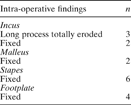
The ossicular pathologies causing pre-operative hearing loss are listed in Table I. Incus and malleus ankylosis were observed in 70 per cent of cases with fixed stapes.
Ossicular pathologies causing pre-operative hearing loss

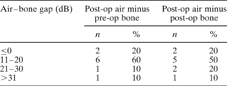
The post-operative hearing results are presented in Table II. The average post-operative air–bone gap at three frequencies (0.5, 1 and 2 kHz) was compared with the post-operative air–bone gap, including post-operative air conduction at 4 kHz. Post-operative air–bone gap closure was observed within 20 dB in 70 per cent of cases, and within 30 dB in 80 per cent, which lowered to 70 per cent when the post-operative 4 kHz bone frequency was taken into consideration. However, the post-operative hearing results were considered to be satisfactory (i.e. within 20 dB) in 80 and 70 per cent of cases, respective 0.5, 1, 2 kHz and 4 kHz.
Post-operative hearing results

Post-op = post-operative; pre-op = pre-operative
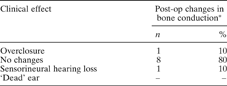
Table III shows the effect of malleostapedotomy on the post-operative bone conduction threshold, calculating the pre- and post-operative pure tone average at 0.5, 1, 2 and 4 kHz. Only one patient had a sensorineural hearing loss over 10 dB.
Effect of malleostapedotomy on post-operative bone conduction threshold

* Pre-operative bone conduction minus post-operative bone conduction
No cases of ‘dead’ ears were observed in our sample.
Discussion
In patients with fixed incudomalleolar joint and fixed stapes, due to tympanosclerosis, attempts to restore hearing using traditional techniques, aimed at restoring the functionality of the ossicular chain, have a high incidence of failure.Reference Goode, Ball and Nishihara3, Reference Willi, Ferrazzini and Huber4
Malleostapedotomy may represent a possible solution to the problem. The technique was made popular by Fisch and colleagues,Reference Fisch1, Reference Fisch, Acar and Huber2 in a setting of revised otosclerosis surgery and tympanosclerosis. It has been described in detail elsewhere, but some of the steps should be noted in order to obtain successful results. The anterior tympanomalleolar ligament must be removed, since in cases of calcification of this structure, seizure of malleus handle movement could be caused even when its head has been removed. Fisch et al. demonstrated that calcification of the anterior malleolar ligament may be misdiagnosed.
In order to ensure better stability of the prosthesis during closure of the loop, it is important to preserve the tendon of the malleus muscle. This particular step is less traumatic if a shape memory piston prosthesis (Nitinol; Gyrus, ENT llc, Bartlett, USA)Reference Rajan, Atlas, Subramaniam and Eikelboom5 is used.
• This paper describes the use of malleostapedotomy in the treatment of ossicular fixation secondary to tympanosclerosis
• Results are presented for 10 patients with stapedial fixation secondary to incudomalleolar joint fixation due to tympanosclerosis
• Air–bone gap closure to within 20 dB was achieved in 80 per cent of cases
• The authors describe their surgical technique in detail
The criteria for patient selection must be very strict. An empirical limit of no episodes of middle-ear infection for a minimum of five years prior to malleostapedotomy surgery was chosen. The possibility to reduce the duration of free-infection (5 years in this study) to enlist other patients. The duration would be less with larger series and an extremely low frequency of immediate or delayed post-operative labyrinthitis. In our experience, no ear infection was observed, supporting our selection criteria.
After malleostapedotomy, only one case out of 10 showed mild hearing loss (similar to results for otosclerosis revision).Reference Fisch, Acar and Huber2
No hearing loss due to toxic effect of the prosthesis. This also means that the prostheses showed good biocompatibility. In 80 per cent of cases, the air-bone gap ranged from 0 to 20 dB, representing a success. The stability of hearing outcome was another factor not to be underestimated. Although the observation period was limited, no worsening in hearing threshold was observed.
These results cannot be considered definitive because of the small number of patients and the short follow-up period. However, they are encouraging and deserve to be followed by further, more detailed research.