Introduction
Squamous cell carcinoma affecting the head and neck region can lead to significant physical and psychological morbidity. Patients with this disease require regular follow up so that evidence of locoregional recurrence and new primary tumour formation can be detected, and so that functional support of speech and swallowing, and psychosocial support can be provided. Recurrent cancer can also occur as an occult tumour detected on routine surveillance.
Follow-up protocols vary greatly throughout the country, with no supportive evidence as to which follow-up regimen provides the greatest improvement in long-term survival. The most common end point for discharge in the UK appears to be five years,Reference Joshi, Calman, O'Connell, Jeannon, Pracy and Simo1 although it is well known (based on the literature) that recurrence of head and neck squamous cell carcinoma (SCC) is maximal within the first two years.Reference Argiris, Karamouzis, Raben and Ferris2
With a continuing need to rationalise healthcare costs, it is justifiable to review the logic and value of the follow-up regimens currently employed for patients with head and neck SCC.
The primary disadvantage of long-term follow up is funding, with the present health economy necessitating the employment of tighter controls and cutbacks. Reducing the new patient to follow-up patient ratio may have significant financial implications for trusts and departments. Indeed, a directive specified in the National Health Service Modernisation Agency's 10 High Impact Changes for Service Improvement and Delivery guide is the achievement of a new to review patient ratio of less than 1:3.3 Furthermore, the requirement of patients to attend oncological follow-up appointments has been shown to increase anxiety levels in some patients;Reference Allen4 hence, some patients may benefit psychologically from being discharged earlier.
Patients who have been discharged back to the care of their general practitioner must continue to have clear and prompt access to the head and neck services when necessary. They should be given the contact details of the key worker in the department, and should be educated regarding the red flag signs and symptoms of recurrence so they can alert the head and neck team or their general practitioner to these. The two-week wait rule can facilitate an urgent appointment at the department for all patients.
We postulated that some head and neck SCC patients could be safely discharged back to their general practitioner after three years of follow up (with the provision of advice regarding prompt referral back to the department in the case of any new symptoms). The current study examined the recurrence rates of patients who had been treated for head and neck SCC at Cumberland Infirmary, where the current policy is to follow up patients for at least five years. We aimed to determine the feasibility of safe discharge of selected head and neck SCC patients after three years of regular follow up.
Materials and methods
Ethical considerations
All data were collected and collated as part of routine practice, and as all data were anonymised prior to analysis, ethical approval was not required. The handling of information was carried out in keeping with the Data Protection Act, with all information remaining on hospital premises.
Demographics
All patients included in the study were treated by the multidisciplinary head and neck team at Cumberland Infirmary, Carlisle. The unit covers a population of 350000–500000, over a widely dispersed area of north Cumbria and south west Scotland. The head and neck team consisted of one ear, nose and throat surgeon (AKR), one oral and maxillofacial surgeon (GDP), and one consultant oncologist (PD). Additional members included a consultant clinical psychologist, a dentist, a speech and language therapist, and a head and neck specialist nurse.
Database
Since 1997, the combined head and neck department at Cumberland Infirmary has prospectively collected and collated patient information as part of the British Association of Head and Neck Oncology minimum dataset. From 2003, this was moved over to the Data for Head and Neck Oncology dataset as part of the National Audit Clinical Support Programme. The data were stored using the InfoFlex version 5 tool (Chameleon Information Management, Rickmansworth, UK); data entry was initialised by the multidisciplinary team co-ordinator, and verified by the treating head and neck surgeon. Access to the database required a personalised login, with permissions defining reading and writing capabilities.
Follow up
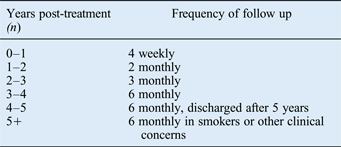
There was a standardised follow-up protocol for the patients with head and neck SCC, which included taking a history, a clinical examination and flexible nasolaryngoscopy when indicated. Radiological imaging and examination under anaesthetic were not part of routine follow up, and were reserved for patients whose symptoms or clinical signs required further assessment. Access to speech and language therapists, clinical psychologists, dieticians, and specialist nurses were available at follow-up visits. The follow-up schedule is outlined in Table I.
Follow-up protocol*

* Schedule used for the majority of patients treated for head and neck cancer at Cumberland Infirmary.
Data extraction
Both databases were individually accessed and a raw dataset was established, merging both sets of patient data into one; this was then exported as a text file to Excel 2008 (Microsoft, Redmond, Washington, USA). Specific exported data included patient hospital number, gender, tumour cell type, tumour stage, tumour site, date of treatment, mode of treatment and smoking status. The primary site of the tumour was classified into larynx, nasopharynx, oropharynx, hypopharynx, oral cavity and carcinoma of unknown primary.
A separate search of the original database sets was then carried out to identify recurrent cancer events. This generated two further lists of patients, which were subsequently merged and exported into a single Excel file. Specific fields were selected, including patient number, primary treatment date, recurrent event date and recurrent tumour site. The recurrent site was classified into local, regional or distant.
The complete raw dataset was manually filtered after inclusion criteria had been applied: all non head and neck SCC cases, skin cancer cases, and duplicate entries were removed. In addition, incomplete entries were removed if the original patient documentation was not accessible to enable verification of missing data. Any omitted data were clarified using a combination of patient case notes and clinic letters. These latter sources of information also provided the details of individual patterns of presentation for recurrences that occurred between three and five years.
The list of recurrent events was cross-referenced with the filtered dataset following filtration according to the same inclusion criteria. This provided us with the separate field of: interval between original treatment date and new cancer event.
New cancer events were classified as recurrence (local, regional or distant metastases) or a new primary (if occurring at either a separate subsite or more than five years after the original treatment).
Data analysis
Not all head and neck cancer patients could be followed up for the same length of time due to dropouts secondary to terminal events and failures to attend clinic appointments. A Kaplan–Meier analysis was therefore chosen to allow estimation of recurrence over time. The time to new cancer event (either true recurrence or new primary) was calculated. In patients who experienced multiple recurrences, the interval between each new cancer event was calculated.
All data were exported from Excel to the Statistical Package for the Social Sciences version 21 (IBM, New York, USA) for survival data analysis.
Results and analysis
Between January 1997 and November 2010, a total of 1266 patients with head and neck cancer were treated in our department. Of these, 743 patients, consisting of 517 males and 226 females, met our inclusion criteria. Inadequate data and absent notes led to the exclusion of 31 patients (5.9 per cent). The patient data are summarised in Table II.
Patient data*
* For all those treated for head and neck squamous cell carcinoma. **Interval from time of original treatment to that of a new cancer event. NCE = new cancer event; y = years; CUP = carcinoma of unknown primary
A review of the dataset identified the following numbers of tumours, classified by subsite: oral cavity, 276; laryngeal, 238; oropharyngeal, 124; hypopharyngeal, 57; carcinoma of unknown primary, 34; and nasopharyngeal, 14.
The principle cancer treatment modality was: primary surgery in 172 patients, radiotherapy or chemoradiotherapy in 287 patients; and a combination of surgery and radiotherapy or chemoradiotherapy in 284 patients.
A total of 149 new cancer events occurred in 122 patients, with 10 patients experiencing multiple recurrences. The numbers of new cancer events by site were: oral cavity, 49 (18 per cent); oropharyngeal, 29 (23 per cent); hypopharyngeal, 13 (23 per cent); nasopharyngeal, 0 (0 per cent); laryngeal, 55 (23 per cent); and carcinoma of unknown primary, 3 (9 per cent). New primary cancers occurred in 10 patients.
The percentages of new cancer events that occurred within 3 years of treatment were: oral cavity, 82 per cent; oropharyngeal, 97 per cent; hypopharyngeal, 77 per cent; laryngeal, 80 per cent; and carcinoma of unknown primary, 67 per cent. Figure 1 illustrates the new cancer events per year for each of the subsites. Figure 2 illustrates the Kaplan–Meier analysis of the individual subsites.
Bar chart indicating the number of new cancer events per subsite, stratified according to interval. CUP = carcinoma of unknown primary
Kaplan–Meier analysis results displaying cumulative survival per subsite over the total follow-up period. CUP = carcinoma of unknown primary
All of the 14 patients who developed new cancer events between 3 and 5 years were symptomatic at the time of follow up. Eight patients (35 per cent) acted upon their symptoms, and had their review appointments expedited via their general practitioner or the clinical nurse specialist. The remaining six patients waited until their routine appointment before indicating any new signs or symptoms. No new cancer events were picked up incidentally during this period.
Discussion
The follow up of head and neck cancer patients requires a multidisciplinary approach to aid early detection of recurrence, and to manage the consequences of the disease and treatment. The option to review all patients long-term is impractical due to the excessive demands it would place on both the patient and an institution's resources, and so decisions regarding follow up must be rationalised.
• Follow-up surveillance for head and neck cancer varies throughout the UK
• Head and neck squamous cell carcinoma has maximal recurrence within three years
• Early detection of recurrence may not lead to survival advantage, but aids emotional and functional support
• A prolonged follow-up interval may delay detection of recurrence
• Patient education is paramount to all follow-up regimens as recurrences after three years are unlikely to be occult
Synopsis of key findings
The data confirmed (in line with previous studies) that the risk of tumour recurrence in head and neck SCC patients was maximal within the first three years after treatment, with 83 per cent of new cancer events developing during this period. There was a similar recurrence rate for tumours at hypopharyngeal, oropharyngeal and laryngeal sites, which was higher than the rates for nasopharyngeal carcinoma and carcinoma of unknown primary. Although there were no nasopharyngeal recurrences, it is difficult to draw any conclusions from the data as the relative numbers are small.
All 14 patients with new cancer events between 3 and 5 years developed symptomatic recurrence, presenting with either localised symptoms or a new neck lump; the tumours in the latter cohort arose predominantly from oral cavity and hypopharyngeal primaries. One laryngeal primary presented with late nodal disease. Only eight of these patients (35 per cent) acted upon their new symptoms and expedited their clinical review; the remainder awaited their routine follow-up appointment. This highlights the fact that patient education is paramount to the early detection of new cancer events; each patient should therefore be made aware of the process by which to report any concerns. Some patients tolerate symptoms for longer than others, and may not want to alert their doctor to new symptoms because of the fear of recurrence and its consequences. Others are not aware that new symptoms may indicate a new cancer event, and hence do not act upon them. The patient's next follow-up appointment may be several months away; it is therefore crucial that patients are instructed regarding potentially concerning symptoms (e.g. signs and symptoms to look out for, and the appropriate action to take), and that a robust system is in place to enable prompt re-attendance.
Patients who continue to smoke may be maintained on life-long follow up due to the presumed increased risk of tumour recurrence and new primary tumour formation. However, we were unable to demonstrate this link with our data. The majority of those who developed recurrent tumours between three and five years were non- or ex-smokers (11 vs 3). In addition, patient age offered no predictability for tumour recurrence; the ages of patients were relatively evenly distributed between 54 and 93 years.
Comparison with other studies
Our cohort of patients exhibited a similar recurrence pattern to those reported in other studies, particularly patterns observed within the first three years of recurrence.Reference Boysen, Natvig, Winther and Tausjo5–Reference Kothari, Trinidade, Hewitt, Singh and O'Flynn7 In addition, our data suggest that laryngeal carcinoma had a preponderance to recur late compared with other subsites, which is also in keeping with the literature.Reference Kothari, Trinidade, Hewitt, Singh and O'Flynn7–Reference Lester and Wight9 One patient developed a local new cancer event after eight years, which, given the time interval, is likely to represent a new primary. The same patient subsequently developed a second lung primary six years following the second laryngeal carcinoma. This strengthens the proposal by Lester and Wight for seven-year follow up of laryngeal carcinoma.Reference Lester and Wight9 Regular follow up over such a prolonged period of time is likely to be impractical for all cases of laryngeal cancer (due to large numbers of patients). After three years, the recurrence rate drops; whilst this rate is still significant, it suggests that a different approach could be taken to support and follow up affected patients.
Early detection of a new cancer may be perceived to provide a survival advantage. However, the evidence supporting this is limited. A prospective study by Boysen et al. showed that successful treatment of recurrent carcinoma was limited to local recurrences; this relates to cases in which laryngeal carcinoma was initially treated with radiotherapy, and oral cavity carcinomas were treated with radiotherapy with or without limited surgical resection.Reference Boysen, Lovdal, Tausjo and Winther10 A retrospective analysis by Cooney and Poulsen showed that only 2 patients from a cohort of 119 recurrences survived 5 years, further confirming that follow up is more important for emotional and functional support than necessarily improving survival.Reference Cooney and Poulsen11
Patient education may be crucial for the early detection of a new cancer event. Boysen et al. demonstrated that 61 per cent of recurrences were diagnosed through symptoms presented by the patient, which in addition led to an improved survival benefit.Reference Boysen, Lovdal, Tausjo and Winther10 Kothari et al. reported that patient surveillance was highly sensitive in detecting new cancer events (98.1 per cent), with a high negative predictive value (99.6 per cent) in those who were asymptomatic.Reference Kothari, Trinidade, Hewitt, Singh and O'Flynn7 These findings support our view that improved patient education may encourage those who become symptomatic to seek medical advice. We accept that the level of understanding between patients will vary, but attempts must be made to ensure that patients and family members are taught how to respond in the advent of any new symptoms. Education should extend to incorporate what new symptoms to look out for and self-examination of the neck. Patients should also be educated on the risk factors for their cancer and be informed of how certain lifestyle choices may impact on their outcome.
With regards to oropharyngeal carcinoma, the incidence of pathology related to human papilloma virus (HPV) is significant to the patient's prognosis. Studies have demonstrated greater locoregional control, event-free survival and overall survival in tumours that are HPV-positive,Reference Hong, Dobbins, Lee, Jones, Harnett and Armstrong12 although an advanced tumour stage will offset this benefit to some extent.Reference Sedaghat, Zhang, Begum, Palermo, Best and Ulmer13 This issue could be considered when determining which patients may require long-term follow up. Whilst the prognosis for patients with HPV-positive oropharyngeal carcinoma can be better than for those with other head and neck cancers, prolonged survival in patients treated at a young age may present further challenges such as radiation-induced tumoursReference van der Laan, Baris, Gregor, Hilgers and Balm14 and the management of long-term complications.
Clinical application
For the purpose of detecting a new cancer event, it may be possible to adopt a three-year follow-up period. However, more research is clearly required to determine the predictability of tumour recurrence. The follow-up regime must be versatile and adaptable to suit the needs of the individual patient. Emphasis on patient-initiated visits may be appropriate after three years, allowing patients the opportunity to be seen when symptomatic.
More effort should be made to improve patient education through methods that are acceptable to the patient. This may be in the form of patient group sessions, information leaflets and/or useful internet-based site recommendations. In some patients perceived as low risk, follow up by a clinical nurse specialist and/or speech and language therapist, who have access to advice from consultant staff, may be an appropriate use of local resources.Reference Joshi, Calman, O'Connell, Jeannon, Pracy and Simo1
Study limitations
Patients with head and neck cancer do not represent a homogeneous group of individuals. As research progresses, more factors are being identified that can determine the behaviour of the tumour cells, which may in turn predict the likelihood of recurrence. We accept therefore that the patient data cannot be stratified according to such variables and have not included such predictors of disease recurrence.
Conclusion
In keeping with other series, the majority of head and neck SCC recurrences in our patients were within three years of treatment. Patient's smoking status did not appear to increase the risk of recurrence after three years. If the decision is made to discharge patients after three years, it is imperative that the patients are aware of the channels available for accessing head and neck services if they require further support. Patients must be educated on the risks of late recurrence and secondary complications, including which symptoms and signs to look out for, and what actions to take in the event of any concerns. We feel that discharging some carefully selected patients to the care of their general practitioner three years after primary treatment may represent safe and cost-effective management. This would require enhanced information (provided to the patient) and a robust route for referral to the specialist team.