The workload (WL) perceived by college students represents the main factor in generating academic stress. The consequences of such stress on the psychological well-being and performance of students make it necessary to assess and monitor the presence and intensity of stress factors in the education field (Gardner & Parkinson, Reference Gardner and Parkinson2011). The students’ WL has been evaluated from different perspectives. Sometimes, it has been associated to the number of hours students devote to their subjects (Ruiz-Gallardo, Castaño, Gómez-Alday, & Valdés, Reference Ruiz-Gallardo, Castaño, Gómez-Alday and Valdés2011; Sánchez-Reinoso, Franco, & Estrems, Reference Sánchez-Reinoso, Franco and Estrems2008). This requires that students keep a record of their activities for a specific period of time. Other research has focused on the evaluation of the WL perceived by students (Kyndt, Dochy, Struyven, & Cascallar, Reference Kyndt, Dochy, Struyven and Cascallar2011). This approach poses that perceived WL is determined by factors related to both, the task and the context in which it should be performed (complexity, temporal aspects, relationships with peers and teachers, administrative support), and the individuals that must perform it (ability, motivation, personality) (Hart & Staveland, Reference Hart, Staveland, Hancock and Meshkati1988; Young & Stanton, Reference Young and Stanton2002). This perception is considered the greatest stress factor (Kember & Leung, Reference Kember and Leung2006; Ramsden, Reference Ramsden1992). Hart (Reference Hart2006) defines WL as the result of the interaction between the requirements of the task, the circumstances in which it must be performed and the individual’s skills, emotions and perceptions. Young and Stanton (Reference Young and Stanton2002) include the consideration of not only objective but also subjective performance criteria, and point out the influence that task demands, external support and past experience have on perceived WL. According to Lizzio, Wilson, and Simons (Reference Lizzio, Wilson and Simons2002) or Ramsden (Reference Ramsden1992) among others, the students’ perception, influenced by their motivations and expectations, determines how situational factors affect their academic performance. From this point of view, it is clear that the context in which any activity takes place and, above all, how this context is perceived, can have an important role in the generation of feelings of overload.
Several authors have identified the context characteristics that can influence the WL perception and affect stress generation. For example, Karaseck and Theorell (Reference Karasek and Theorell1990) pose that the main dimensions of context would yield from the activity’s demands, from the individual’s control in organizing work and from social support. According to this model, individuals that must perform highly demanding tasks will feel less burdened if they have more freedom to control how to perform them. Social support would act as a protective barrier, reducing the adverse effects of exposure to a highly demanding context with low control. Siegrist (Reference Siegrist1996), introduces the perception of balance between the performed effort and the rewards received from such effort as a major factor. According to this author, a more negative perception of the situation is created as the individual perceives a greater imbalance between the two factors. In education, Struyven, Dochy, Janssens, and Gielen (Reference Struyven, Dochy, Janssens and Gielen2006) distinguish five dimensions of academic context (AC): quality of teaching, clarity of objectives, appropriate assessment, correct requirements and independent learning. Timmins and Kaliszer (Reference Timmins and Kaliszer2002), designed a questionnaire to measure the situational variables that generate stress in nursing students, composed by factors associated with academic activities’ demands and with relationships between peers and teachers. Using structural equation modelling, Kember and Leung (Reference Kember and Leung2009), found that perceived AC is determined by three dimensions: teaching (active learning, curriculum coherence, assessment), student-teacher relationships and student-student relationships. The AC characteristics found in these studies carried out in education can easily be framed within the dimensions of the aforementioned models of Karaseck, Theorell and Siegrist, since from these characteristics aspects related to demands, control and social support, and fulfilment of performance expectations (effort-reward balance) emerged.
One of the most widely used instruments for assessing perceived WL is the NASA-TLX (Hart & Staveland, Reference Hart, Staveland, Hancock and Meshkati1988). Hart (Reference Hart2006) and Young, Zavelina, and Hooper (Reference Young, Zavelina and Hooper2008) point out that NASA-TLX is a valid and reliable instrument for the analysis of perceived WL in different sectors: industrial, psychological, health, aviation or transport. Its use has been more limited within education. López (Reference López2010) discusses the generalizability of this scale and concludes that it is a useful tool in education. Kyndt et al. (Reference Kyndt, Dochy, Struyven and Cascallar2011) used it to analyze the mediating role of the load in the motivation-learning strategy relationship. Emerson and MacKay (Reference Emerson and MacKay2011), used it to compare the load of the two university teaching methods (traditional versus on-line).
The researched mentioned in this introduction has analyzed the relationships between context and stress, in which case the WL is often considered as a context factor, or as WL itself or as a modulating factor of the relationship between other variables. However, no previous studies have been found that have investigated the effect of AC on the WL perceived by students. Assuming that both aspects are related, the following objectives are proposed: (a) to evaluate the WL perceived by psychology students, (b) to group students according to their negative or positive perception of the AC and (c) to analyze the effects of the perceived AC on this WL, measured with the NASA-TLX.
Method
Participants
A total of 367 students in their third year of the Psychology bachelor degree at the Complutense University of Madrid took part in this study. They regularly attended their lectures during the morning period (9:00–15:00). The incidental sample consisted of 305 women (83%) and 62 men (17%), all volunteers, which constituted a representative distribution by sex of the population of psychology students (ANECA, 2005). Their mean age was 21.67 years (SD = 3.24). Only two of the participants had children (one had one child and the other had three). A 37.10% (n = 136) of students worked while undertaking their degree. As for their motivation, 69.30% claimed to have chosen Psychology because they liked it, 26.90% for personal or professional development and 3.80% for having difficulties in pursuing other studies. In relation to their study habits, 59.90% said they studied at weekends, while the remaining 40.10% studied only during the week. To have an indicator of their academic performance, participants were asked to write down in the socio-demographic data questionnaire the number of subjects they currently had with fail, pass, remarkable, outstanding and honors result. With these data the average score for each student was calculated considering fail as 0, pass as 1, remarkable as 2, outstanding as 3, and honors as 4. Since some students had difficulty in remembering exactly their marks, they were allowed to access their results transcripts through UCMNet on the classroom computer. The average rating of the participants was 1.17 (SD = .64).
Instruments
Socio-demographic Questionnaire
All participants completed a brief sociodemographic questionnaire which collected information on gender, age, whether they worked while studying, if they studied during the weekends as well as during the week and their reason for choosing Psychology. It also collected information on their academic results.
Workload (WL) evaluation
To evaluate the WL, the paper and pencil version of the NASA-TLX (Hart & Staveland, Reference Hart, Staveland, Hancock and Meshkati1988) was used. This instrument distinguishes six dimensions, each of which is evaluated on a scale of 0 to 100: effort, mental demand, physical demand, temporal demand, performance and frustration. The student was asked to assess to what extent each of his academic activities required each of the WL dimensions. Following Sánchez-Reinoso et al.’s (Reference Sánchez-Reinoso, Franco and Estrems2008) recommendation, seven activities were distinguished:
-
• Lecture attendance
-
• Practical class attendance
-
• Group work outside the classroom
-
• Material and literature search
-
• Study and personal work
-
• Attending Tutorials
-
• Other activities (attending seminars, courses, conferences, etc.).
An overall WL index for each activity was calculated as the average of the scores on each dimension.
Academic context (AC) evaluation
To assess the perceived AC, all participants answered a questionnaire with a Likert–type five-point scale, which was designed ad hoc (see Appendix) following the postulates of Karaseck and Theorell (Reference Karasek and Theorell1990) and Siegrist (Reference Siegrist1996). The factor analysis of the questionnaire showed a structure consistent with these models, consisting of four dimensions, which together account for 41.82% of the variance: (a) cognitive and time constraints (7.12%) (items 2, 12, 14, 15, 17, 21 and 28), (b) relationships with peers and teachers (14.72%) (items 5, 9, 16, 18, 22, 23 and 27), (c) results (11.37%) (items 1, 4, 7, 8, 13, 19 and 25) and (d) autonomy (8.61%) (items 3, 6, 10, 11, 20, 24 and 26). The total reliability, Cronbach α, was .76. Reliability was .70 for demands, .69 for results, .80 for relationships with peers and teachers and .71 for autonomy. For each dimension, the sum of the ratings (from 0 -strongly disagree- to 4 -completely agree) was calculated. To facilitate interpretation, each one of these added scores was multiplied by 100 and divided by 28, so that for each dimension, a score between 0 and 100 was obtained. All items were stated negatively, so that a high score is indicative of a negative AC, while a low score shows a positive perception (positive-AC).
Procedure
The application of the questionnaires was conducted in a group session during one of the students’ usual lectures. All participants were informed that the aim of the study was to find out the WL that each activity supposed for them, taking into account all of the subjects they were currently undertaking and those they had completed earlier in their degree. They were also informed that their participation in this study would be completely anonymous and voluntary. Data were collected in March 2008 (n = 109), 2009 (n = 128) and 2010 (n = 130). It is a time of year in which students have passed the first semester exams and second semester lectures have begun, so they are not under pressure by a close exam.
Results
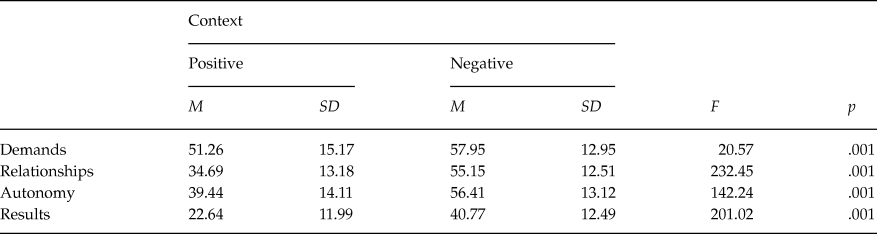
A K-means Cluster analysis was performed to classify students into two groups according to their perception of the AC. The first group consisted of 185 students and the second group had 182 students. According to the average scores obtained, the first group is composed of students with a positive perception, while the second group contains the students with higher scores and therefore with a negative perception (Table 1). All dimensions were significant in differentiating between the two groups.
Descriptive Statistics for the context dimensions

The relationship between sex and cluster membership was analyzed by χ2. No significant relationship between the two variables (χ2 = 0.369, p > .05) was found. Similarly, there were no significant relationships between membership to each cluster and the work factor (χ2 = 1.442, p > .05) or with studying during weekends factor (χ2 = 1.090, p > .05). To analyze the possible existence of differences in average grades for each group, a one-way ANOVA was performed. The results showed that although the negative-AC group had a slightly lower average rating (M = 1.11, DT = .59) than the positive-AC group (M = 1.24, DT = .68), the difference was not significant, F(1, 365) = 3.56, p = .06.
The relationship between the year of application and membership to each group was analyzed by χ2. The distribution of students in each year and group was: (a) 2008, positive-AC 33.0% (n = 36) vs negative-AC 67.0% (n = 73); (b) 2009, positive-AC 50.0% (n = 64) vs. negative-AC 50.0% (n = 64); (c), 2010, positive-AC 65.4% (n = 85) vs. negative-AC 34.6% (n = 45). This relationship was significant (χ2 = 24.844, p < .001), indicating an improvement in the perception of AC over the years.
Since the aim of the study is to analyze the differences in WL according to the AC, an ANOVA was performed on the global WL of each activity and the application year as a factor. The only significant difference was found for the group work outside the classroom, F(2, 364) = 6.19, p = .002; p > .1, for the other academic activities, and only between 2008 and 2009 (Scheffé = 7.97, p = .002, M = 59.93, DT = 16.81, in 2008, M = 51.95, DT = 19.44, in 2009, and M = 56.45, DT = 16, in 2010).
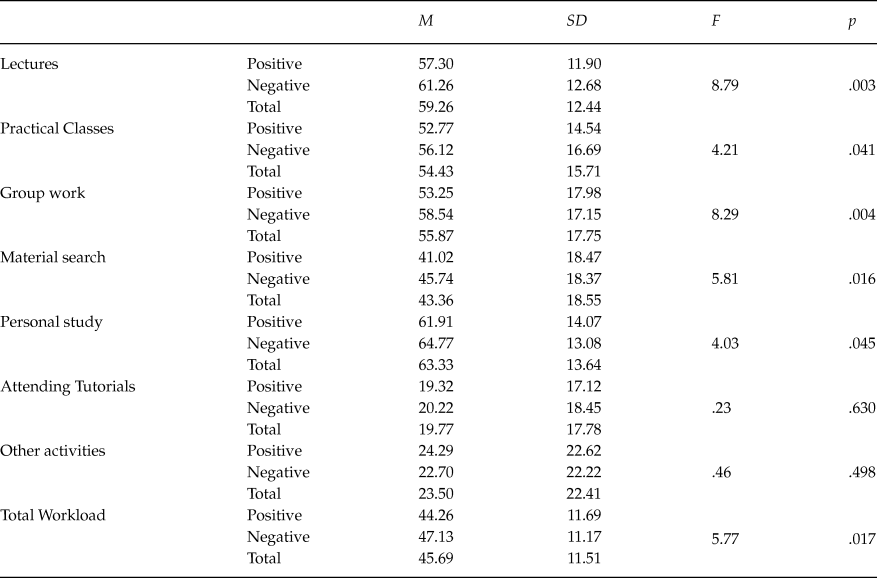
An ANOVA was performed on AC over the overall WL of each task (Table 2). Significant differences were found for attending lectures, attending practices, work outside the classroom, finding materials and personal study. The difference in the overall WL was also found to be significant. In all cases, the positive-AC group showed lower levels of WL.
Descriptive Statistics and ANOVA for the context over the total WL for each activity

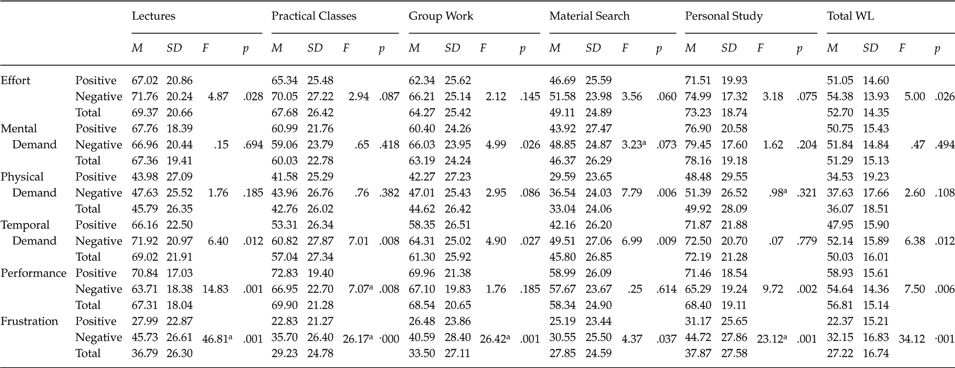
Different ANOVAs were performed to analyze the effects of AC on each dimension of WL in the activities that were found to be significant in the previous analysis. The results are shown in Table 3.
Descriptive Statistics and ANOVA for the context over each WL dimension

(a) Brown-Forsythe.
Discussion
Similarly to the results of Sánchez-Reinoso et al. (Reference Sánchez-Reinoso, Franco and Estrems2008), with engineering students, and of Oria et al. (Reference Oria, Jenaro, Meilán, Zubiauz, Mayor and Arana2011), with psychology students (both carried out using the calculation of the hours of work as a means of WL), the results of this study indicate that the activities with greatest WL were, in this order, personal study and work, lecture attendance, group-work outside the classroom and practical attendance. As in those studies, attending courses and seminars and attending tutorials received much lower WL ratings. Thus, for example, in Sánchez-Reinoso et al.’s (Reference Sánchez-Reinoso, Franco and Estrems2008) study, students only attended tutorials with some frequency 15 days before an exam.
On the other hand, the responses to the AC evaluation questionnaire yielded two different groups of students: positive-AC and negative-AC. The positive-AC group was characterized by higher demands, greater autonomy, better social support and better results. The negative-AC group was characterized by lower demands, less autonomy, less social support and less successful results. According to Karaseck and Theorell (Reference Karasek and Theorell1990), individuals subjected to high demands and high autonomy, show a high motivation for learning and developing new skills, known as positive stress or active work situation. However, when the situation involves or is perceived by the subject as being highly demanding with low autonomy (negative-AC), greater strain is generated which results in a high risk of stress. According to these authors, when social support is added to the demands-autonomy relationship, the model generates different work situations, among which the high demands, low autonomy and little support is considered to be the worst. Furthermore, Siegrist (Reference Siegrist1996) points out that stress is generated by high effort, inadequate rewards and low autonomy, and that these conditions cause a significant decrease in the individual’s self-esteem and self-efficacy. The combination of both models leads to the conclusion that the positive-AC group is composed of active, motivated learners, with high self-esteem and self-efficacy that take their academic situation as a challenge. In contrast, students in the negative-AC group would find themselves in the situation that Karaseck and Theorell (Reference Karasek and Theorell1990) called “high strain”, which leads to less motivation and lower feelings of self-efficacy and self-esteem (Cabanach, Valle, Rodríguez, Piñeiro, & González, Reference Cabanach, Valle, Rodríguez, Piñeiro and González2010).
According to Bandura (Reference Bandura2001), people who believe they are effective interpret the context’s demands and problems more as challenges than as uncontrollable threats. Thus, individuals with high self-efficacy will display active coping that are focused on the problem. Meanwhile, individuals with low self-efficacy, that therefore feel they cannot do anything to change their environment, will used more emotion-focused strategies, that is, trying to regulate their emotional response resulting from a stressful situation, for example by self-control or emotional discharge (Barnes & Van Dyne, Reference Barnes and Van Dyne2009; Cabanach et al., Reference Cabanach, Valle, Rodríguez, Piñeiro and González2010; Rueda, Pérez-García, & Bermúdez, Reference Rueda, Pérez-García and Bermúdez2005). Considering that WL is defined in terms of the relationship between the activity and the individual, those individuals that are most motivated and feel more capable will perceive less workload than those that feel incapable and discouraged (Hart & Staveland, Reference Hart, Staveland, Hancock and Meshkati1988). The results of this study are consistent with these postulates. The positive-AC group assigned lower WL levels to all activities (although the difference was not significant for attending tutorials or participating in other activities). Furthermore, these AC effects were especially important for the dimensions of temporal demand, performance and frustration. The negative-AC yielded greater temporal demand in classroom activities, subject to a set timetable imposed by agents external to the student. However, this was not the case with regard to personal study. A reduced satisfaction with performance in activities involving individual work was found for this group. In this sense, Misra and McKean (Reference Misra and McKean2000) pose that the proper handling of time devoted to studies is directly related to the improvement in academic results, and with a lower presence of strain and somatic stress. Frustration was the dimension in which greater AC effects were found. This dimension assesses the emotional impact of task demands on the individual (Hart & Staveland, Reference Hart, Staveland, Hancock and Meshkati1988) supporting the idea that negative-AC induces an emotion-focused strategy in students. For a detailed analysis of the effects that working under a positive or negative context has on the choice of a particular WL coping strategy can be found in Barnes and Van Dyne (Reference Barnes and Van Dyne2009).
Students consider academic activities that involve individual work more demanding, which might indicate that their experience in the education system has been marked by a traditional model in which proactive learning is neither valued nor encouraged. In contrast, in the degrees adapted to the Bologna education plan, the outside the classroom activities of individual character represent a large percentage of each ECTS credit, considered a measure of the work to be performed by a student in a course. Out of the presence-based academic activities, practical classes are perceived as less demanding, which may suggest that teaching based on this type of activity is more attractive to students than that based on lectures.
This study shows that although most students choose their degree by vocation and the perception of AC has improved in recent years, half of the sample still has a negative perception of the AC. This would indicate that it is necessary to intervene in some context dimensions to generate a more positive work climate. In this sense, the dimensions of AC which could be more easily intervened would be interpersonal relationships and students’ autonomy.
Another conclusion derived from this study is that AC influences the WL perceived by students. Studying within an AC, which is perceived as negative, produces higher estimates of WL. The pernicious effects of a negative-AC differ according to the activity and WL dimension, although they occur independently of the sex of the student and other extra-academic factors such as combining work and study. The WL dimension that has been more affected by the AC is frustration, which increases significantly as the AC is perceived as more negative.
The results obtained in this study with bachelor degree students may be useful as a basis from which to evaluate the changes produced by the adaptation of the Psychology degree to the European Higher Education Area as well as help in establishing policies and teaching methods that encourage an academic context positively valued by the students.
Finally, in future research it would be interesting to include other activities that have not been considered in this study that may also be affected by AC, such as sitting exams or making oral presentations. Furthermore, the possible mediating effect that individual student characteristics (personality profile, ability, motivation, etc.) could have over the relationship between WL and perceived CA should be investigated in the future.
Appendix Items for the academic context evaluation questionnaire.