Implications
This study was conducted after the Welfare Quality® project, which aimed at developing an on-farm monitoring system for animal welfare. Abnormal oral behaviours are an important component of the welfare of farmed ruminants as it gives an indication of possible mismatch between the animal's needs and its environment or diet. The choice of the observation method used to evaluate the prevalence of these behaviours might have an impact on the outcome of the animals’ welfare assessments on commercial farms. Two types of recording methods were tested in veal calves: direct observations and observations from video recordings.
Introduction
Farm animal welfare is a multidimensional concept (Fraser, Reference Fraser1995) that includes the ‘freedom to express normal behaviour by providing sufficient space, proper facilities and company of the animal's own kind’ (Farm Animal Welfare Council, 1992). Assessing welfare of farm animals therefore requires the evaluation of their behaviour (Botreau et al., Reference Botreau, Bracke, Perny, Butterworth, Capdeville, Van Reenen and Veissier2007).
Behavioural observations can be performed in different ways including observations from video recordings and observations directly on the spot (Martin and Bateson, Reference Martin and Bateson1993). Video recordings have several advantages: they can be stored, permit multiple viewing and can be slowed down to study short or complex behaviours (Martin and Bateson, Reference Martin and Bateson1993). On the other hand, they request high-quality devices to ensure a good quality of image and a broad angle to limit missing data because of animals not visible or behaviours difficult to assess (Tosi et al., Reference Tosi, Ferrante, Mattiello, Canali and Verga2006). Cameras need to be installed in advance in the animal's environment and the analysis of the recordings might be time-consuming. In the context of welfare monitoring on a large number of commercial farms, all information should be collected within a short period of time (often within 1 or 2 days). It is unpractical to install cameras for this purpose and therefore direct observations are often preferred. Direct observations have the advantage that they are less sensitive for technical failures.
A major concern related to direct observations, however, is the potential effect of the presence of the observer on the behaviour of the observed animals (Martin and Bateson, Reference Martin and Bateson1993). This effect has been shown in a number of mammals (Tamarin: Cain, Reference Cain1990; skunks: Lariviere and Messier, Reference Lariviere and Messier1998; non-human primates: Iredale et al., Reference Iredale, Nevill and Lutz2010). Humans can elicit three types of responses: attraction, habituation and avoidance (Whittaker and Knight, Reference Whittaker and Knight1998). Habituation is considered completed when ‘animals no longer respond to the presence of a human observer’ (McDougall, Reference McDougall2012). It is often advised (especially for animals that are not habituated to the presence of observers, such as wild animals) to spend long periods habituating subjects to the presence of the observer before starting the observation. Owing to time constraints, habituation is not possible when behavioural observations are carried out as part of welfare monitoring on large numbers of farms. The presence of the observer might influence particularly the expression of subtle behaviours such as play or sexual behaviours (Martin and Bateson, Reference Martin and Bateson1993) and also abnormal behaviours (Broom, Reference Broom1983). The effect of the presence of humans on the behaviour and expression of abnormal behaviours has been studied in zoo animals (see Fernandez et al., Reference Fernandez, Tamborski, Pickens and Timberlake2009 for review); however, only little has been studied on farm animals such as cattle.
Veal calves are raised in an environment providing little stimulation (Le Neindre, Reference Le Neindre1993). A barren environment can induce a high reactivity of calves to novel stimulations (Veissier et al., Reference Veissier, Chazal, Pradel and Le Neindre1997). In general, veal calves have little physical contact but more frequent visual contact with humans. A potential positive association with humans is related to feed distribution, which can induce a high motivation for calves to interact with them (Jago et al., Reference Jago, Krohn and Matthews1999; Lensink et al., Reference Lensink, Boivin, Pradel, Le Neindre and Veissier2000). Other contacts that veal calves might have with humans are often negatively associated because they are in fear- or pain-eliciting context (e.g. veterinary treatments, moving, transport, blood sampling). These experiences with humans can induce alertness towards humans. Knowing that calves are able to discriminate between people (de Passillé et al., Reference de Passillé, Rushen, Ladewig and Petherick1996), the presence of an unknown observer in the barn could represent a novel element for the calves. In addition, the observer might be present in the barn at an unusual time (outside feeding hours) and may show unusual behaviour (standing still, observing) compared with the caretaker (moving, providing feed). These aspects could again induce alertness, which might be reflected in fear and/or curiosity in calves.
For these reasons, it seems of prime importance to evaluate the effect of the presence of an observer on the observation of the behaviour of veal calves. The aim of the present study was twofold: (i) to compare two methods of on-farm observation of behaviours in calves, direct observation v. observation from video recordings, and (ii) to evaluate the effect of the presence of an observer on veal calves’ behaviour.
Material and methods
Calves and calves’ management
Observations were performed at a commercial veal farm in the Netherlands with Holstein-Friesian veal calves, 10 weeks after the arrival of the calves at the farm. Calves arrived at the farm at around 15 days of age and were kept individually in baby boxes until 5 weeks after arrival at the farm. Thereafter, they were group-housed in pens of four or five calves per pen. Calves were raised according to the EU Directive 97/2/EC (EU Council, 1997), with 1.8 m2/calf in an insulated and ventilated building with both natural and artificial lighting. The lights were on between 0600 h and 2100 h. Calves were fed standard commercial milk replacer and solid feed at 0900 h and 1830 h, according to a commercial feeding schedule (up to ∼10 litres of milk replacer and 250 g DM of solid feed per calf per day) and provided in a collective trough. They had access to water provided via water nipples. During observation days, the farmer only performed feed distribution activities in the barn (∼1 h in the morning and afternoon).
Pens and video recordings
The barn had seven units (six units with 10 pens and one unit with six pens). Four units were used for this study. Within these units, 24 pens were randomly chosen for video recordings (six pens per unit). In total, 105 calves were observed (nine pens with five calves and 15 pens with four calves). Eighteen cameras (Type RC516BH, 600 TVL) were installed 2 days before the start of the study and were attached to the ceiling of the barn so that they would not be accessible to calves. One camera could film one or two pens and provided good-quality black and white digital videos. Pens were video recorded on 4 consecutive days from 0600 h to 2100 h (15 h). Data were stored for later observation.
Observations for comparison of direct observation and observation from video recordings
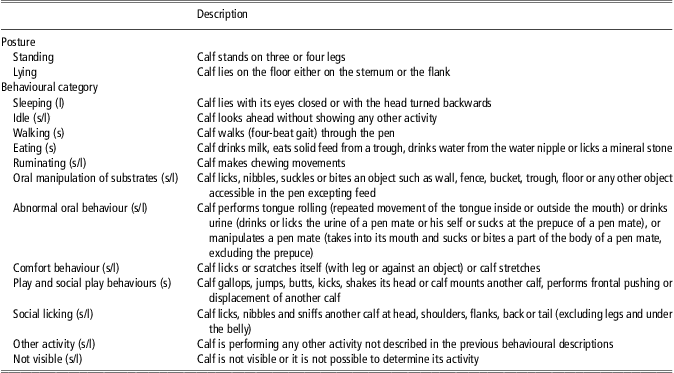
Direct observations and observations from video recordings were performed by two different observers trained to use the same ethogram (Table 1) and protocol. Both observations (direct and from video) were performed using instantaneous scan sampling (Altmann, Reference Altmann1973) with a 2-min interval. For each calf, the posture (standing or lying) and the behaviour was recorded. Direct observations were performed on day 3 of the recording days. Of the 24 pens, 20 were observed two times for 30 min by an observer (woman, 1.60 m, wearing a dark-coloured overall) between the morning (0930 h) and the afternoon (1600 h) feeding (4-h interval between these two sessions). Three to five pens in the same unit were observed simultaneously by the observer standing ∼1 m from the front of the pens. In total, 85 calves were observed (five pens with five calves and 15 pens with four calves).
List of recorded postures and behaviours

The ‘l’ and ‘s’ between brackets indicate whether the behaviour can be performed in a standing or lying posture.
Observation from video for comparison without and with observer
The video recordings of the 4 days (3 days without and 1 day with an observer present for two times 30 min) were analysed by a trained observer using the same ethogram (Table 1) and using instantaneous scan sampling (Altmann, Reference Altmann1973) for each pen with a 10-min interval for the 15 h of video recordings per day.
Statistical analyses
All data were analysed with the SAS® statistical program (SAS® Institute Inc. version 9.1). Data were expressed as percentages of calves performing a specific behaviour per scan, or as percentage of time spent on each behaviour by unit of time (either 60 min or 15 h), with the statistical unit being pen. In addition, the percentage of time the calves were in a standing posture by unit of time (either 60 min or 15 h) was analysed as an estimation of the activity level of calves.
For comparison of the observation method, all behaviours in the ethogram were analysed. The observations from video were performed exactly at the same period as the direct observations performed for each pen. Therefore, for both methods of observation there were two times 30 min of observation periods. For each pen, data from the two 30 min periods of observation were added up into one period of 60 min of observation. Means were calculated for the two types of observation and compared by a Wilcoxon matched-pairs signed-rank test for paired comparisons. Associations between the outcomes of the direct observations and the observation from video were calculated with Spearman's rank correlations (r s), and the strength of the correlations was described according to Martin and Bateson (Reference Martin and Bateson1993).
The behaviour of calves was assessed at day level (from 0600 to 2100 h). The percentage of time calves were standing, or spent on performing abnormal oral behaviour, and manipulating substrates were compared between days (without and with the presence of the observer). Means were calculated per day and compared with the Wilcoxon matched-pairs signed-rank test for paired comparisons and the Kruskall–Wallis test for overall comparison.
The effect of the observer when present in front of the pens was assessed by comparing the percentage of calves standing, performing abnormal oral behaviour and manipulating substrates (60 min in two observation sessions of 30 min, on day 3) with the exact same moment of the day on the other 3 days. Means were calculated for the 60 min period and compared with the Wilcoxon matched-pairs signed-rank test for pair comparisons and the Kruskall–Wallis test for overall comparison.
The duration of the effect of the presence of the observer was evaluated by an analysis of the behaviour of calves around the moment when the observer was present in front of the pens (starting 60 min before the observer arrived and ending 150 min after the observer had left). For each pen, for each scan (four scans during the observation, six scans before the observation and 15 scans after the observations, one scan every 10 min) the number of calves performing one behaviour during the first session was added to the number of calves performing the same behaviour during the second session. Then, for each scan, for the 20 pens, the percentage of calves performing one behaviour on day 3 was compared with the percentage of calves for the average of days 1, 2 and 4 using Wilcoxon matched-pairs signed-rank test.
Results
Effect of the observation method (direct v. from video)
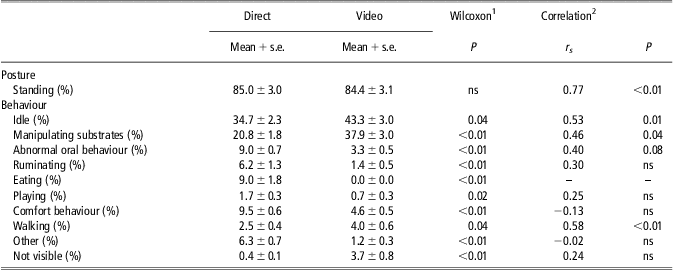
There was no difference in the percentage of time the calves were standing between the two observation methods (Table 2). The percentage of time the calves were not visible was higher for observations from video than for direct observations. The percentage of time spent idle was higher when observed from video than observed directly, although there was a positive correlation between the two measures (Table 2). The observations from video also resulted in a higher percentage of time the calves spent manipulating substrates and walking than with the direct observations. In contrast, a higher percentage of time the calves spent performing abnormal oral behaviour was obtained through direct observation compared with observation from video. The correlations between the two observation methods were poor but significant for manipulating substrate and walking, and showed a tendency to be correlated for abnormal oral behaviour. No calf was recorded as eating when observed from video, although this behaviour represented 9% of the time when directly observed (Table 2). Four behaviours (ruminating, playing, comfort behaviours and other behaviours) gave different outcomes with low and non-significant correlations between the two observation methods.
Percentage of time for the standing posture and the behaviours of calves assessed during 60 min (two observation sessions of 30 min) by two observation methods (direct and from video) (n = 20)
1Wilcoxon matched-pairs signed-rank test.
2Spearman's rank correlation.
Effect of the presence of the observer on the behaviour of calves
When analysing the percentage of time the calves spent standing, performing abnormal oral behaviour and manipulating substrates between days, we found that on average calves spent 33.0 ± 0.5% on standing, 3.5 ± 0.1% on abnormal oral behaviour and 12.6 ± 0.2% on manipulating substrates during the 4 days. A day effect was found for these three behaviours (Kruskall–Wallis test, P < 0.01). The percentage of time the calves spent standing was higher at day 1 than all other days, and days 2 and 3 were higher than day 4 (Table 3). Calves performed more abnormal oral behaviour on days 1 and 2 than on days 3 and 4, whereas manipulating substrates was performed more on day 1 than on the other days.
Mean ( ± s.e.) percentage of time spent standing, performing abnormal oral behaviour and manipulating substrates on days 1, 2, 3 and 4 (n = 24)

a,b,cValues within the same row with different superscripts differ significantly (P < 0.05), Wilcoxon matched-pairs signed-ranks test.
1Kruskall–Wallis test.
Calves were standing more often and spent more time on manipulating substrates when the observer was present than at the same moment on the other 3 days when the observer was not present (Table 4). They also spent a higher percentage of time standing (81.0 ± 2.7%) during the presence of the observer than on average during the 15 h of observation on that day (32.1 ± 0.8%, Table 3). No day effect was found for the percentage of time the calves spent performing abnormal oral behaviour.
Mean ( ± s.e.) percentage of time spent standing, performing abnormal oral behaviour and manipulating substrates during the 60 min of the presence of the observer in front of the pen on day 3 and at the same time on days 1, 2 and 4

a,bValues within the same row with different superscripts differ significantly (P < 0.05), Wilcoxon matched-pairs signed-rank test.
1Kruskall–Wallis test.
Figure 1a shows that more calves were standing on day 3 during the presence of the observer and during the 20 min after the observer had left compared with the average at the same moment for the other 3 days. A lower percentage of calves were standing between 40 and 100 min after the observer had left compared with the same moment on the other days. Figure 1b shows that less calves performed abnormal oral behaviour on day 3 during the first 10 min of the presence of the observer, but not during the rest of the time the observer was present as compared with the other days. Differences in the percentage of calves performing abnormal oral behaviour between day 3 and the other days can also be seen at the same time points before and after the presence of the observer. Figure 1c shows that manipulating substrates followed nearly the same pattern as standing behaviour with a higher percentage of calves manipulating substrates during the presence of the observer and during the following 10 min compared with the average at the same moment for the 3 other days. Then they performed less manipulating substrates between 50 and 110 min after the observer had left compared with the same moment on the other days.
Percentage of calves (+s.e.) standing (a), performing abnormal oral behaviour (b) or oral manipulation of substrates (c) 60 min before, during and 150 min after the presence of the observer in front of the pen on day 3 (black bar) and at the same time of the day on days 1, 2 and 4 (grey bar) (n = 20). On the x-axis, obs = the observer is present in front of the pen on day 3 at t = 0 (obs0), t = 10 min (obs10), t = 20 min (obs20) and t = 30 min (obs30). Wilcoxon matched-pairs signed-rank test *P < 0.05; **P < 0.01.
Discussion
The objectives of the study were to assess the effect of the observation method (direct or from video recordings) on the evaluation of the behaviour of calves and the effect of the presence of an observer during direct observations on behaviour in calves.
The direct observations and the observations from video gave comparable results for the percentage of time spent standing. Standing is an obvious posture that can be easily distinguished from lying. The two methods of observing gave different outcomes for all other behaviours analysed. More manipulation of substrates and less abnormal oral behaviour were observed with observations from video observation than with direct observation. These results were similar to those found by Tosi et al. (Reference Tosi, Ferrante, Mattiello, Canali and Verga2006). Except for idle and walking, all other behaviours were observed in lower percentages with the observations from video recordings. With respect to the behaviour eating, it was not possible to observe from the video recordings whether there was feed in the trough. Therefore, the observer might have recorded eating behaviour as manipulation of substrate (trough). Behaviour such as tongue rolling might also be difficult to observe from video recordings because it can only be clearly observed when calves face the camera, whereas with direct observations the observer can move and detect tongue rolling easily. The observations from video recordings also resulted more often in calves being not visible. This can be due to the presence of blind spots on the video recordings, calves hiding behind other calves or the light being of a too low intensity. Given these results, we could assume that observation from video recordings were less precise for a certain number of behaviours and therefore not suitable for precise observations for abnormal oral behaviour in calves. This is in accordance with the conclusions of Tosi et al. (Reference Tosi, Ferrante, Mattiello, Canali and Verga2006) that video recordings would badly replace direct observations and should only be used to assess inactivity, lying bouts or lying postures. The choice of using direct observations for the assessment of veal calf welfare focusing on abnormal oral behaviour seems to be suitable with the objectives of that type of observation.
Variation in the behaviour of calves was found between the 4 days for the three observed behaviours (standing, abnormal oral behaviour and manipulating substrates). However, average levels of these behaviours on day 3 – when the observer was present during 60 min of direct observations – were not systematically different from those obtained on the other 3 days (1, 2 and 4). Rather, they seemed to be well within the normal day-to-day variation. This suggests that the effect of the presence of the observer was short-lived, without affecting the daily average levels of behaviours.
There was an effect of the presence of the observer for the 60 min of observation. Calves stood more when the observer was present than at the same moment on days without an observer. Calves also stood much more than what was recorded on a 15-h basis on the same day. No effect of the presence of the observer was found on abnormal oral behaviour. At some observation points, the percentage of calves performing abnormal oral behaviour was different when the observer was present compared with the same moment on the other days. Such differences, however, were also found at other observation points when the observer was not present. This suggests that abnormal oral behaviour was consistent within days but variable between days. In this study, abnormal behaviours consisted of two behaviours: tongue rolling and manipulation of pen mates (including urine drinking). Webb et al. (Reference Webb, Bokkers, Engel, Gerrits, Berends and van Reenen2012) found that the expression of tongue rolling was relatively constant throughout a day. In contrast, sucking and manipulation of pen mates seem more related to specific events during the day as it has been found to be mostly observed after meals (Veissier et al., Reference Veissier, Ramirez de la Fe and Pradel1998). More substrate manipulations were observed in the presence of an observer. This result could be expected for two reasons. First, this behaviour is performed generally while standing and most calves stood when the observer was present. Second, calves might associate humans with feed (Jago et al., Reference Jago, Krohn and Matthews1999), and manipulating substrates such as nibbling objects is mostly observed just before meals (de Passillé et al., Reference de Passillé, Metz, Mekking and Wiepkema1992; Veissier et al., Reference Veissier, Ramirez de la Fe and Pradel1998; Webb et al., Reference Webb, Bokkers, Engel, Gerrits, Berends and van Reenen2012). The behaviour manipulation of pen mates (included in abnormal oral behaviours) could have been affected by the presence of the observer just like the behaviour manipulating substrates. Thirty minutes after the observer had left, calves showed an increased level of lying compared with the days when the observer was not present, which might be compensating behaviour for the increased activity level when the observer was present. Therefore, the monitoring of the calves’ behaviour for welfare purposes using direct observations might induce an overestimation of the behaviours standing and manipulating substrates. However, when the aim of monitoring is to benchmark farms relative to other farms or to see whether farms comply with certain welfare certification standard, it is of less importance. Relative values instead of absolute values therefore do not necessarily impair the welfare assessment of farms.
Conclusion
In this study, observations from video were not accurate for subtle behaviours such as abnormal oral behaviour. Some behaviours can be easily confused with other behaviours when observed from video. There was an effect of the presence of an observer on the behaviour of calves as it elicited more standing and manipulating substrates. Direct observations for welfare monitoring purposes can be a suitable method with regard to the effect of the observer's presence and the quality of observation. Nevertheless, when the exact level of certain behaviours needs to be evaluated, one should first habituate calves to the presence of the observer before starting the observations.
Acknowledgements
The authors thank the farmer for allowing us to collect data at his farm and Bas Engel for his help with the statistics.