INTRODUCTION
The last two decades of education policy have multiplied the options available to parents enrolling their child in a primary or secondary school. Partly as a response to the publication of A Nation at Risk (Gardner et al. Reference Gardner1983), which described a rapidly failing public school system, states adopted a wide range of policy innovations that sought to improve educational outcomes. While some policies attempted to reform public education from within (e.g., through more vigorous testing), many new policies looked outside of the traditional public school structure for change. Voucher programs, public charter schools, and tax credits to cover the costs of private schooling all expanded the educational marketplace by giving parents more alternatives and arguably increased accessibility to private education.
While studies have identified many of the demographic contours behind the demand for private schools, this scholarship has largely neglected another key factor in the decision to enroll in a private school within this new educational marketplace: the role of religion. Not only are an overwhelming proportion of private schools religiously affiliated, but school choice policies may have shaped the demand for these schools in particular ways. Moreover, pronounced changes among religious traditions and in levels of religiosity over the last three decades may have impacted private school enrollment vis-à-vis school choice policies. Shifting denominational and cultural divides among Christian, Jewish, and other traditions suggest that private schools themselves have had to adapt their “product” to the changing market, while the rise of those who do not identify with a religion suggests fewer consumers for religious-based education.
This study explores the interplay of religion and education policy in shaping private school demand over the last two decades. Specifically, we test two broad and concurrent theories on the relationship between religion and private school enrollment in this era. The social identity perspective proposes that school choice is a vehicle for parents to pursue their religious distinctiveness by selecting a private school that transmits their belief system. The secular good theory asserts that school choice opens up religious private schooling to new consumers who value the non-religious benefits (e.g., academics, discipline, safety) of a religion-based education. Using state-level private school enrollment data and educational policy and survey data from 1993–2011, we test these theories by estimating changes in the enrollment patterns of different types of private schools. Our primary interest in these models is determining how policy activates different types of schooling choices, as reflected in state-level enrollment patterns over time.
PRIVATE SCHOOLS, RELIGION, AND SCHOOL CHOICE
While most studies of private schools have focused on assessing academic achievement, particularly in relation to these schools’ public counterparts (Coleman, Hoffer, and Kilgore Reference Coleman, Hoffer and Kilgore1982; Mayer et al. Reference Mayer, Peterson, Myers, Tuttle and Howell2002; Altonji, Elder, and Tabor Reference Altonji, Elder and Taber2005), another body of research has examined the demand for private education among the American public. Three decades of scholarship have uncovered many of the demographic factors that lead parents to enroll their children in private schools. Researchers have identified race (Betts and Fairlie Reference Betts and Fairlie2001; Lankford and Wyckoff Reference Lankford and Wyckoff2001), income (Lankford and Wyckoff Reference Lankford and Wyckoff1992; Buddin, Cordes, and Kirby Reference Buddin, Cordes and Kirby1998), parental involvement (Buckley Reference Buckley2007; Goldring and Phillips Reference Goldring and Phillips2008), and social networks (Schneider et al. Reference Schneider, Teske, Roch and Marschall1997; Altenhofen, Berends, and White Reference Altenhofen, Berends and White2016) as particularly important variables in enrollment decisions. Another strand of literature suggests that parents choose private schools for their academic and curricular emphases, discipline, and safety (Bauch Reference Bauch1988; Altenhofen, Berends, and White Reference Altenhofen, Berends and White2016).
The role of religion, however, is underdeveloped in studies of private school demand. While many scholars note a relationship between parental religion and private school enrollment (Long and Toma Reference Long and Toma1988; Campbell, West, and Peterson Reference Campbell, West and Peterson2005; Sander Reference Sander2005), studies often assume that religion is secondary to other explanations of demand. More specifically, we know very little about whether and how the changing environment for schooling options has activated religious motivations to choose private schools.
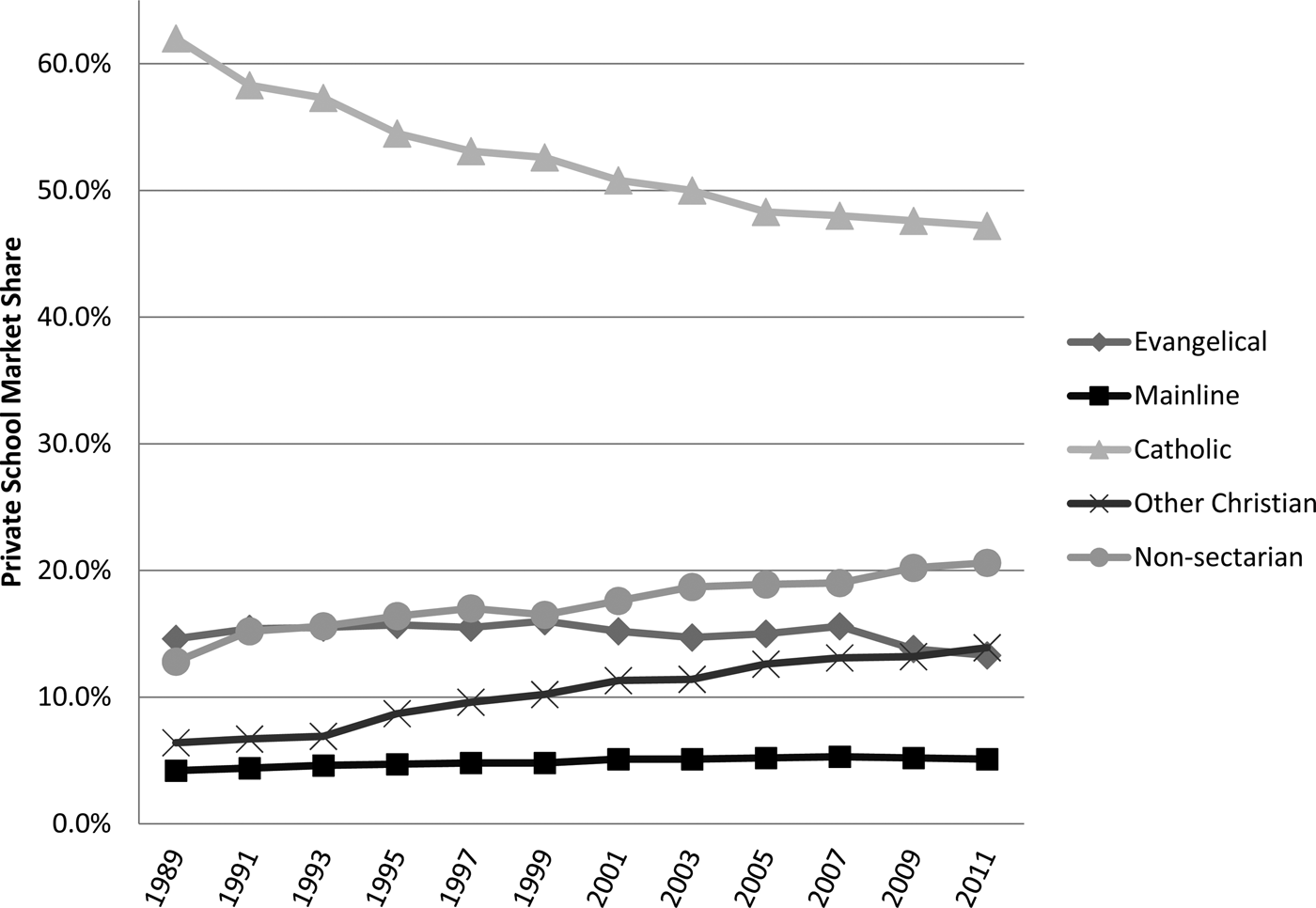
This lack of focus in the literature is surprising for at least three reasons. First, over 80% of the schools in this market are religious in nature (Broughman and Swaim Reference Broughman and Swaim2013). As Figure 1 demonstrates, enrollments in religious private schools have remained relatively stable with the notable exception of Catholic schools. While this proportion of religious private schools does not necessarily establish that demand is deeply rooted in the religious convictions of parents, its magnitude suggests a connection between parental faith and school choice. Second, substantial scholarship outside the educational arena suggests that religion often operates independently of socio-economics, race, or other demographic realities in a wide variety of decision-making processes, from voting to philanthropy (Verba, Schlozman, and Brady Reference Verba, Scholozman and Brady1995; Smidt et al. Reference Smidt, den Dulk, Penning, Monsma and Koopman2008; Putnam and Campbell Reference Putnam and Campbell2010). Finally, educational policy might change the competitive environment in ways that are propitious for religion, particularly through innovations that have been widely heralded as expanding educational options beyond the traditional state-assigned public school. We are referring particularly to policies of “school choice”: public vouchers (state grants to parents to defray tuition costs), tax subsidies for tuition costs (usually in the form of a means-tested tax deduction or credit), and charter schools (schools that receive public funding but are given greater autonomy than traditional public schools).
Change in private enrollment by school type. Source: Private School Universe Surveys, 1989–2011.
But do these policies have an effect (or effects) on religion-based demand for private education? To the extent these choice-based policies buttress private school enrollment, they stabilize and even increase a set of schooling alternatives available to students. But the very policies designed to increase choice might diminish some options at the expense of others (e.g., free public charters drawing students from tuition-based faith-based schools).
THE CHANGING ENVIRONMENT FOR BOTH EDUCATION AND RELIGION
Social scientists have only recently begun to fill the gap in our understanding of religion and private school demand. For example, using individual-level data, Cohen-Zada and Sander (Reference Cohen-Zada and Sander2007) show that both religious tradition and religiosity affect enrollment in Catholic, Christian fundamentalist, and non-fundamentalist schools. Subsequent research places these findings into the rich theoretical perspectives of social identity and socialization (Cohen-Zada and Justman Reference Cohen-Zada and Justman2012; Cohen-Zada and Elder Reference Cohen-Zada and Elder2012). We suggest, however, that the role of social identity in shaping enrollment choices cannot be detached from the complex and dynamic political and policy environments in which religion resides. In an era of school choice, policies such as school vouchers, charter schools, and tuition tax credits are all potential factors in the enrollment decisions of parents. But few studies have explored how religious affiliation and devotion interacts with this expanding mix of schooling options.
Cohen-Zada and Justman's (Reference Cohen-Zada and Justman2002) study of religious schools is limited to the public voucher program in the Cleveland area. Butler et al.’s (Reference Butler, Carr, Toma and Zimmer2013) more recent work examines a broader set of school options and leverages access to restricted data to link characteristics of families directly to school choices. But they include neither religious tradition nor religiosity in their models, instead focusing on the more limited measure of frequency of discussion about religion in a home. Neither of these studies features a complete assessment of school choice options across regions or religions. Thus, scholars only have a partial picture of how parents act upon their religious preferences within the present marketplace of schools nationally. Precisely how do these different and often compelling school choice alternatives impact the decision to enroll in a religious private school, particularly among distinct religious traditions and levels of religiosity?
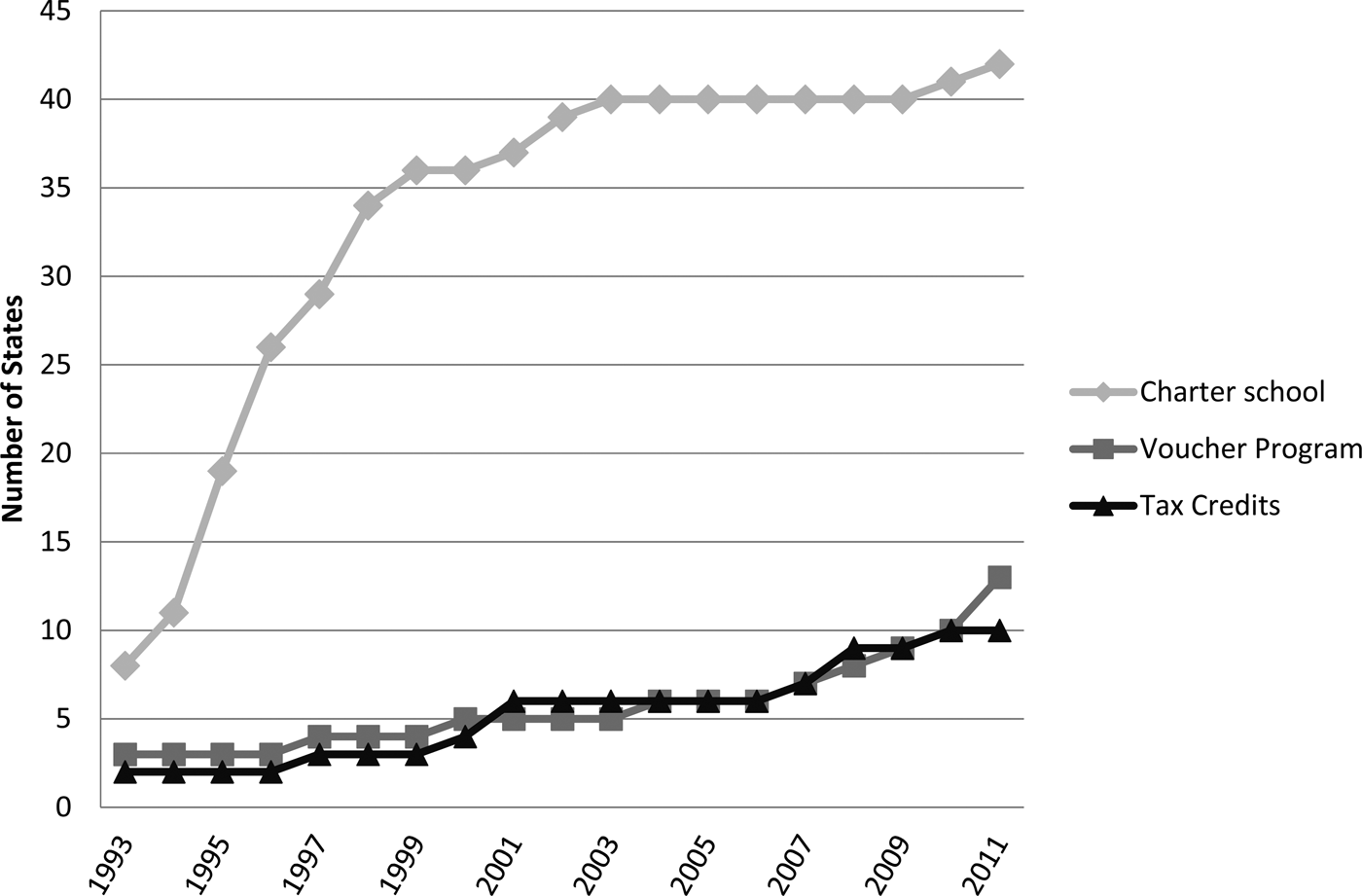
In addition, the environment for school choice does not simply vary across regions and clusters of religious groups. It also varies over time. While some school choice policies were proposed in theory by Milton Friedman and others already in the 1950s, they were generally not put into active practice until the 1990s. Figure 2 displays the number of states that adopted public vouchers programs, authorized charter schools, or introduced tuition tax credits from the early 1990s to the present. Clearly each policy has diffused across states over that period of time (Pelz Reference Pelz2015), with charters growing at a particularly rapid pace. At the same time that states introduced these new policy innovations, religion itself has also undergone profound changes in the United States. Social scientists have identified a restructuring of American religion, a shift from largely ethno-religious groups — denominations associated with distinct ethnic communities, often as the result of waves of immigration in the 19th and 20th centuries — to stronger alignments along theological lines (Wuthnow Reference Wuthnow1988). Thus, differences between broad religious traditions — mainline, evangelical, Catholic, etc. — may matter less today than the traditionalism shared across those traditions. Mainline Protestant traditionalists share more theologically and ideologically with traditionalist evangelicals than their fellow mainline Protestants. This restructuring suggests that the religious bases for private school demand may also shift as schools adjust their missions, curricula, and pedagogies to meet the demands of new religious realities. For example, the change in religion might result in fewer strictly bounded schools (Catholic schools for Catholics, Lutheran schools for Lutherans) and greater emphasis on a non-denominational outreach.
Rise in school choice policies. Source: U.S. K-12 Schools Database.
Recent evidence also suggests that the cultural influence of religion more generally is changing — and perhaps diminishing. On select high-profile social issues, Protestant traditions appear to have softened their perspectives (Putnam and Campbell Reference Putnam and Campbell2010; Bean and Martinez Reference Bean and Martinez2014). Surveys have also documented a decline in the religiosity of millennials and working class whites when compared to previous generations (Pew Research Center 2010; Twenge et al. Reference Twenge, Exline, Grubbs, Sastry and Campbell2015). As many of these millennials become parents, the value placed on religious education may also wane or change. Finally, the past decade has seen a rapid rise in the “nones,” or those who do not affiliate with any religious tradition (Hout, Fischer, and Chaves Reference Hout, Fischer and Chaves2013; White Reference White2014). This trend may bolster private education of a non-religious variety. None of the extant research on private school demand captures and assesses these significant changes in contemporary religion.
THE MECHANISMS OF SCHOOL CHOICE
We test two theories about how the interplay of policy and religion over time affects enrollment. One theory suggests that school choice has enabled parents to pass along their religious identity more easily through private schooling consistent with their belief system. A second theory argues that school choice has broadened religious private schooling to new consumers who recognize the various benefits of a religious-based education. While these theories are not mutually exclusive, they are nonetheless distinct in their hypothesized effects.
The most cited explanation for the link between religion and the decision to enroll in a private school is cultural transmission, a mechanism for parents to preserve their own distinctive religious culture through their offspring (Cavalli-Sforza and Feldman Reference Cavalli-Sforza and Feldman1981; Iannaccone Reference Iannaccone1990). We call this decision-making framework the social identity theory. In a pluralistic milieu, religions seek differentiation from others by presenting a distinguishing and compelling sense of meaning and community. Theories of subcultural identity suggest that religious groups that offer such satisfying distinctives without full withdrawal from mainstream society are attractive to new adherents (Smith Reference Smith1998; Evans Reference Evans2003). Schools are potential cultural sites for religious groups to demonstrate and transmit their identity (Cohen-Zada and Elder Reference Cohen-Zada and Elder2014). Moreover, the impulse to protect one's cultural identity is predominant among religious minorities, who face pressures to conform to majoritarian norms and practices (Bisin and Verdier Reference Bisin and Verdier2000). Whether greater religious pluralism diminishes the imperative to safeguard one's cultural identity among minority religions is still an open question (Berger Reference Berger1969; Finke and Stark Reference Finke and Stark1988). For example, studies show that religious commitment can both decrease and increase as the share of a religious group grows (Iannaccone Reference Iannaccone1991; Phillips Reference Phillips1998).
The social identity theory has new relevancy in an era of school choice. With the expansion of school choice policies promoting private school options, it is quite feasible that more parents will utilize these policies to preserve their religious identity through private schooling. Vouchers and tax credits allow parents to address one of the largest obstacles to enrolling in a religious private school — the financial costs associated with the decision.Footnote 1 Choice initiatives may also support the religious private school sector and foster the establishment of more schools in the academic marketplace. Initial reports on voucher programs around the country do confirm that a majority of schools receiving vouchers are religiously affiliated (Farrell and Mathews Reference Farrell and Mathews2006; Wolf et al. Reference Wolf, Puma, Kisida, Rizzo, Eissa and Carr2010). Recent research also reveals that religion can be an important predictor of voucher school enrollment. In their study of social networks in Milwaukee, Fleming et al. (Reference Fleming, Cowen, Witte and Wolf2015) find that parents who are Catholic and/or regular church attenders are more likely to use vouchers than their non-Catholics or low-attending counterparts. Parents attending religious services, in particular, relied upon the social networks found in churches to obtain information about voucher schools.
Parents acting according to the social identity theory will fit several patterns. First, they may enroll their children in schools that correspond to their particular religious tradition and not consider other types of religious schools. This expectation largely aligns with the ethno-religious understanding of religion. But parents might also put more emphasis on religious commitment and devotion than affiliation with a particular tradition. They may be traditionalists without prioritizing a specific tradition. Furthermore, these parents may also view voucher programs and tax credits favorably, which enables them to enroll their child more easily in a school that matches their religious orientation and commitments. Finally, given their priority to transmit their faith to their children, parents under this perspective will view public schooling options as inadequate or even harmful alternatives, including charter schools and even high-performing schools. Neither institutional arrangement can meet the religious priorities of these parents.
Another theory for private school demand is grounded in the non-religious benefits of religion-based schooling within the primary and secondary education marketplace. This theory may or may not operate in tandem with the social identity theory, but it is analytically distinct. This secular goods theory asserts that the demand for private schools comes from a broader group of parents with varied religious backgrounds (or perhaps no religion at all) who are looking for benefits that are unrelated or indirectly related to religion. Research on religious private schools has chronicled the positive academic and civic outcomes associated with these types of private institutions, especially among urban students (Jeynes Reference Jeynes2002; Hill and den Dulk Reference Hill and den Dulk2013; Elder and Jepsen Reference Elder and Jepsen2014). The reasons cited for these outcomes are varied, including the religious work ethic (Feess, Mueller, and Ruhnau Reference Feess, Mueller and Ruhnau2014), religion's capacity to instill an internal locus of control (Garner and Cole Reference Garner and Cole1986; Johnson Reference Johnson1992), and the relationship between religiosity and discipline, particularly in avoiding behaviors damaging to academic achievement (Brownfield and Sorenson Reference Brownfield and Sorenson1991; Figlio and Ludwig Reference Figlio and Ludwig2012). All of these factors would be attractive to parents choosing a school in their community regardless of their religious background.
There is scattered evidence for this type of behavior within religious private schools. A burgeoning body of literature demonstrates that religious and other private schools engage in branding and that parents respond to these marketing efforts when making enrollment decisions (Trivitt and Wolf Reference Trivitt and Wolf2011; Cheng, Trivitt, and Wolf Reference Cheng, Trivitt and Wolf2016). These brands may center on religious instruction, racial diversity, affordability, or small class sizes, among other characteristics. While detailed data on the religion of private school students are not available, the racial composition of private school enrollments also suggests some consumer choice. For example, African-Americans constitute 8.8% of Catholic school enrollment nationally, but only 3% of all Catholics are African-American (Broughman, Swaim, and Keaton Reference Broughman, Swaim and Keaton2009; Sahgal and Smith Reference Sahgal and Smith2009). Additionally, recent research has demonstrated some accommodation between different religious traditions in the area of education. Cohen and Justman (Reference Cohen-Zada and Justman2012) find bilateral affinities among Episcopalians and Catholics and among Catholics and Mainline Protestants in education attitudes. They find bilateral tension between evangelical Protestants and Catholics.
Parents acting according to the secular goods perspective will also follow certain patterns. First, parents may enroll their children in religious schools that lie outside of their specific religious tradition, including those parents with no religious affiliation, as religion is not the primary basis of these decisions. Similarly, the religious commitment of parents will likely not be a factor in the type of private schools they choose for their children. Under the secular goods theory, school vouchers and tax credits would accelerate these inter-religious enrollment arrangements by expanding the school options for parents in the educational marketplaces in which they are offered. Finally, unlike the social identity perspective, parents may also consider charter schools or high performing public schools as viable options for their children. Charter schools, in particular, can offer parents many of the benefits of a private education but without the hefty price tag.
The social identity and secular goods theories inform the following hypotheses on the interactions between religion and school choice policies in the state enrollment patterns of different types of religious private schools over the past two decades. If the social identity perspective explains enrollments, one might expect the following:
H 1 :
Religious tradition will be positively related to enrollment in private schools that correspond to a parent's tradition.
H 2 :
Religiosity will be positively related to enrollment in religious private schools in general.
H 3 :
Voucher and tax credit programs will be positively related to enrollment in religious schools within corresponding religious traditions and among those with high levels of religiosity.
H 4 :
Charter schools will be unrelated to enrollment in religious schools within corresponding religious traditions and among those with high levels of religiosity.
On the other hand, if the secular goods theory explains enrollments, one would expect:
H 5 :
Outside religious groups including those with no religious affiliation will be positively related to enrollment in different types of religious schools.
H 6 :
Religiosity will be unrelated to enrollment in different types of religious school.
H 7 :
Voucher and tax credit programs will be positively related to enrollment in religious schools among outside religious groups including those with no religious affiliation.
H 8 :
Charter schools will be negatively related to enrollment in religious schools among outside religious groups including those with no religious affiliation.Footnote 2
DATA AND METHODS
We obtained the state-level data for this analysis by merging several extant files from publicly available information into a master data file named the U.S. K-12 Schools Database. The National Center for Education Statistics’ (NCES) Common Core of Data (CCD), which includes annual data on enrollment, fiscal, demographic, and other information about public school and districts, represents the backbone of the master file (National Center for Education Statistics 1993–2011). Yet it is limited to public and charter schools. Consequently, we turned to the NCES's Private School Universe Survey (PSS), a biennial survey including similar information as the CCD for private schools, with the additional variable of the religious identity of individual schools (National Center for Education Statistics 1989–2011). The merged files of CCD and PSS include a case for each school in each year from 1993 to 2011, yielding over two million observations.
Neither the CCD nor PSS, however, includes data on school choice policies and the religious, racial, and economic characteristics within states. To measure the school choice policy mix in states, we coded for the presence of a charter law, voucher program, or tuition and scholarship tax credits in a state in a given year, using a cross-referencing of information at the Friedman Foundation's and Alliance for School Choice's websites.Footnote 3 The U.S. Census's Current Population Survey and the Federal Reserve Economic Database (FRED) provided additional key data on racial and economic characteristics in states (U.S. Census Bureau and U.S. Bureau of Labor Statistics 1993–2013; U.S. Bureau of Economic Analysis 1997–2013; U.S. Bureau of Labor Statistics 1993–2013).
Gathering accurate information about religion at a state level posed a more difficult challenge. The annual Cooperative Congressional Election Studies (CCES), which often have more than 50,000 respondents, and the Pew Research Center's Religious Landscape Surveys, which include over 35,000 respondents, have sufficient sample sizes to drill down into state-level (and even county-level) patterns. But these surveys started in the mid-2000s (2006 and 2007, respectively), and therefore do not allow for a longitudinal comparison that encompasses the growth of school choice policies since the early 1990s. The longer running Religious Congregations and Membership Study (RCMS) provides a rough census of religion across the country, but the RCMS poses at least two other challenges for our study: (1) as a decennial survey, it provides only three snapshots (1990, 2000, 2010) during the period of our study; and (2) it focuses solely on affiliation, not religious behavior (e.g., attendance).Footnote 4 While we could extrapolate to deal with the first challenge, albeit roughly, the RCMS lacks any data to address the second challenge. We relied instead on a series of quadrennial national surveys sponsored by Pew Charitable Trusts and the Bliss Institute at the University of Akron. These surveys provided more data points across time, but their sample size — generally approximately 3,000 respondents, but ranging from 2,000 to 5,000 — raise a question about measures in small states in any given year. We generally found they provided an acceptable number of observations to measure the distribution of major religious traditions and attendance at religious services in most states over time, but we also validated these surveys against the RCMS and Pew Landscape data in available years. The correlations suggest strong consistency between the quadrennial surveys and these more expansive sources.Footnote 5
The dependent variables throughout this study are student enrollments in various private schools as recorded by the PSS. Each dependent variable is the percentage of students enrolled in a particular type of private school out of the total private school student population in a state and at a particular time or, in other words, their relative market share in the private school marketplace.Footnote 6 We examine the enrollment trends of five types of private schools according to the schools’ self-reported religious affiliation in the PSS: evangelical Protestant schools, mainline Protestant schools, Catholic schools, other Christian schools, and non-sectarian schools.
Our study features two sets of independent variables. The first set of variables represents the religious dimensions within state populations over time. We measure two major aspects of religion. Religious tradition measures the percentage of white evangelical Protestants, white mainline Protestants, Catholics, black Protestants, other religion adherents, and those with no religious affiliation within each state.Footnote 7 These religious classifications are based on survey respondents’ self-reported denominational affiliation.Footnote 8 We measure religiosity through the percentage of survey respondents within a state that reports attending religious services weekly or more frequently. Again, more granular data on religious patterns at the country or school district level over time are more desirable, but no regularly fielded large surveys are available that include both religious tradition and attendance measures with sufficient sub-state numbers prior to the CCES in 2006.
The second set of independent variables captures the school choice policy environment within each state. We track three primary forms of school choice policies. A dichotomous variable measures the existence of a state voucher program. An interval variable coded 0–2 measures the presence of either a state tuition tax credit program or a state scholarship tax credit program. Charter schools are denoted by the percentage of children attending charter schools in a state, which captures the scope of this schooling option within a state.
Lastly, our analysis includes several relevant control variables. We measure the quality of public school education in a state using National Assessment of Education Progress (NAEP) 4th grade reading test scores.Footnote 9 We also measure several economic characteristics, including the fiscal status of states using state GDP (gross domestic product), and economic situation of individuals using state median income and state unemployment rate.Footnote 10
We estimate the effects of our religious and policy variables on shifts in student enrollment among different private religious schools using a series of state fixed effects and year fixed effects OLS (ordinary least squares) regression models. The rationale for using this type of statistical estimation is that we cannot assume that a state-level observation at one point in time is random relative to same-state observations at other points in time or that all dimensions of state heterogeneity are contained in our models. By assuming fixed effects, we impose time independence on our results and control for unobserved state-level variation. These models are also weighted by the total private school enrollment in each state in order to account for the size of the private school marketplace from state to state. Finally, we employ several interaction terms in our last set of models to test the reciprocal relationships between religious tradition and religiosity and policy on a state's private school enrollment patterns.
THE EFFECTS OF RELIGION ON PRIVATE SCHOOL ENROLLMENTS
We begin our analysis by first examining the unique effects of religious tradition and religiosity on the enrollment patterns of different private schools. All of our fixed-effects models predict enrollment in evangelical Protestant, mainline Protestant, Catholic, other Christian, and non-sectarian private schools. We also predict total private school enrollment in a state to assess the nature of general enrollment patterns. We report standard errors clustered to states to address within-group error correlations in our models. To maximize the number of observations in our models, we imputed a very small number of the missing values in our control variables.Footnote 11
Table 1 displays the primary effects of religious tradition on the market shares of the five types of private schools and all private schools, controlling for school choice policies and other educational and economic factors. Coefficients in this table can be interpreted as the percentage of relative enrollment shares. For example, the first coefficient of 0.068 indicates that the comparative enrollment shares in evangelical Protestant schools increases by almost 7% for every 1% increase in white evangelicals in a state. These initial models show that a state's religious make-up is relevant to private school enrollment in some cases. Specifically, outside religious traditions appear to be consequential in both evangelical Protestant and mainline Protestant schools. For evangelical Protestant schools, the number of white Mainline Protestants and Catholics in a state are associated with increases in relative enrollment shares of 7 to 9% points. For mainline Protestant schools, the numbers of white evangelical Protestants, white mainline Protestant, and those affiliating with other religions in a state are associated with a decrease in relative enrollment shares of 4 to 6% points. In general, these results suggest that the effects of religious tradition on enrollments are largely in line with the secular goods rather than the religious identity perspective.
Predicting private school enrollments using religious traditions, 1993–2011
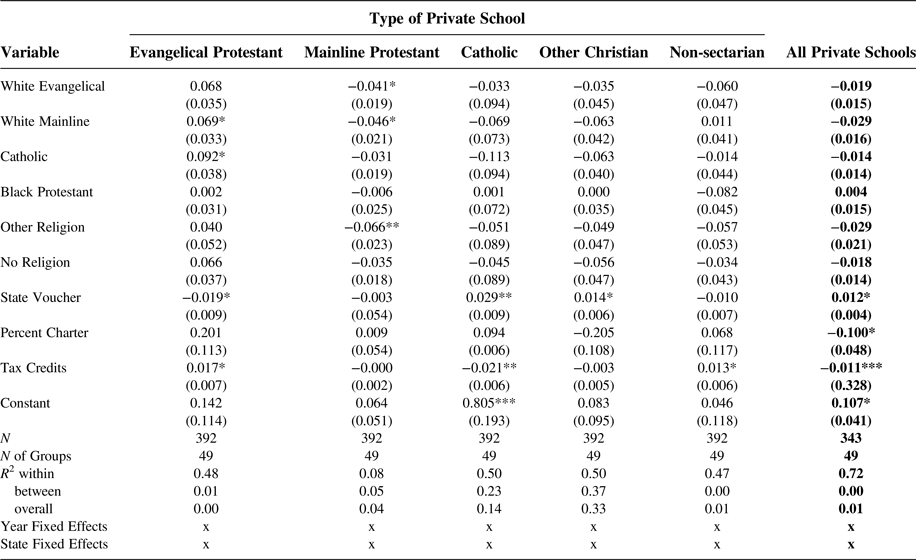
Standard errors clustered by state in parentheses. *p < 0.05; **p < 0.01; ***p < 0.001. Source: U.S. K-12 Schools Database.
This first series of models also highlight school choice policies that impact the enrollments of these five types of private schools. In general, these policies appear to affect the comparative market share of each of these schools differently. State voucher programs are associated with moderate increases in enrollment shares among Catholic, other Christian, and all private schools, and moderate decreases in enrollment shares among evangelical Protestant schools. Similarly, tax credits seemingly boost the student populations of evangelical Protestant and non-sectarian schools, but also hamper the student populations of Catholic schools and all private schools by approximately the same magnitude. The number of charter schools in a state does not have any statistical effect on the market shares of any of these five types of private schools; however, it does have a rather large negative effect on the overall private school market.
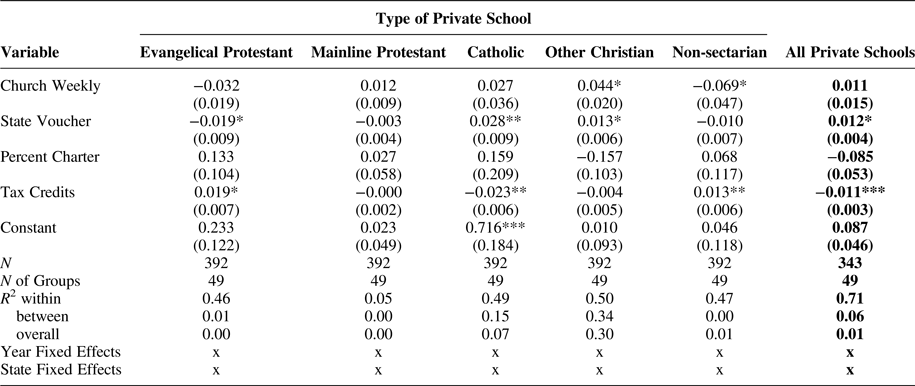
Table 2 examines the role of religiosity on the private school marketplace by looking at the effects of weekly church attendance on the enrollment trends of each type of school. In this case, religion has a sizable positive relationship to relative enrollment shares in other Christian and largely non-denominational private schools. This outcome is clear evidence that traditionalism based on religiosity is relevant to private school enrollments. Church attendance also has a sizable negative relationship to enrollment shares in non-sectarian schools. School choice policies continue to have an uneven and relatively small effect on the market shares of these five classifications of private schools. State vouchers appear to increase student numbers in Catholic and other Christian schools and decrease student numbers in evangelical Protestant schools. Conversely, tax credits seem to increase the number of students in evangelical Protestant and non-sectarian schools and decrease the number of students in Catholic schools.
Predicting private school enrollments using religiosity, 1993–2011
Standard errors clustered by state in parentheses. *p < 0.05; **p < 0.01; ***p < 0.001. Source: U.S. K-12 Schools Database.
THE EFFECTS OF RELIGION AND POLICY ON PRIVATE SCHOOL ENROLLMENTS
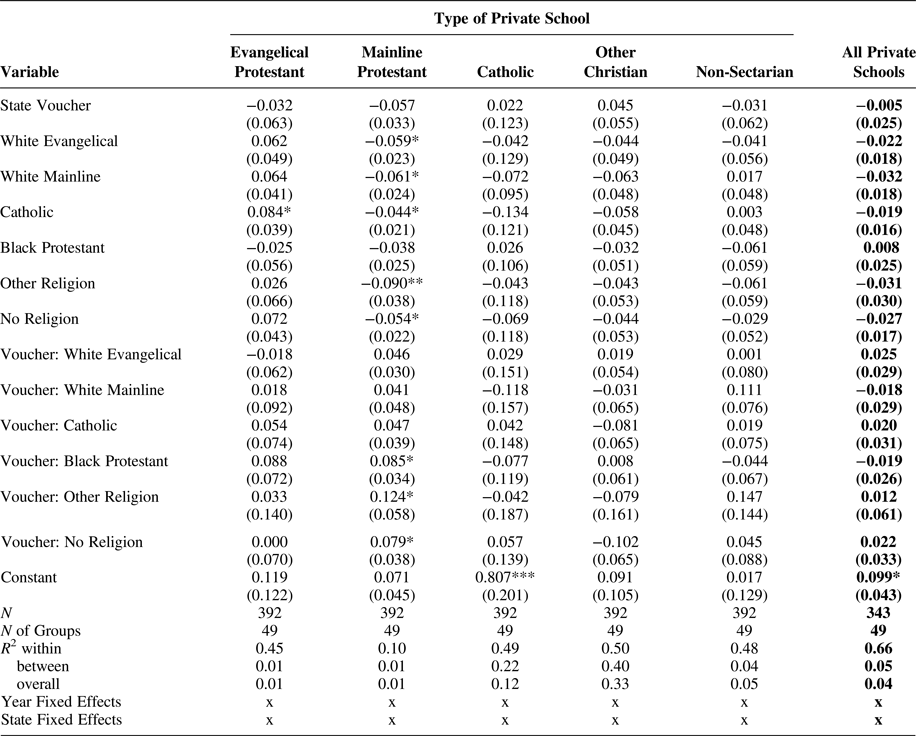
We also estimate models with interactive terms that explore the interplay between our two measures of religion and the school choice policies of vouchers, tax credits, and charter schools. We first ascertain the impact of school choice policies in enrollment patterns among different religious traditions and affiliations. Table 3 displays the estimates for the effects of statewide voucher programs on enrollment shares among the different religious traditions. The results of the interactive terms in these models suggest that while voucher programs influence private school enrollment shares, they do so selectively. Mainline Protestant schools appear to be the greatest beneficiaries of this policy, drawing from several different religious out-groups. In states with statewide voucher programs, black Protestants, those affiliating with other religions, and those with no religious affiliation are all related to positive enrollment trends in mainline Protestant schools. We do not observe any other effects among the other types of private schools including Catholic schools. These findings correspond with Hackett's (Reference Hackett2016) recent work, which asserts that Protestant-dominant states are more apt to promote vouchers than Catholic-dominant states due to group differences in political development.
Predicting private school enrollments using religious tradition and vouchers, 1993–2011
Standard errors clustered by state in parentheses. *p < 0.05; **p < 0.01; ***p < 0.001. Source: U.S. K-12 Schools Database.
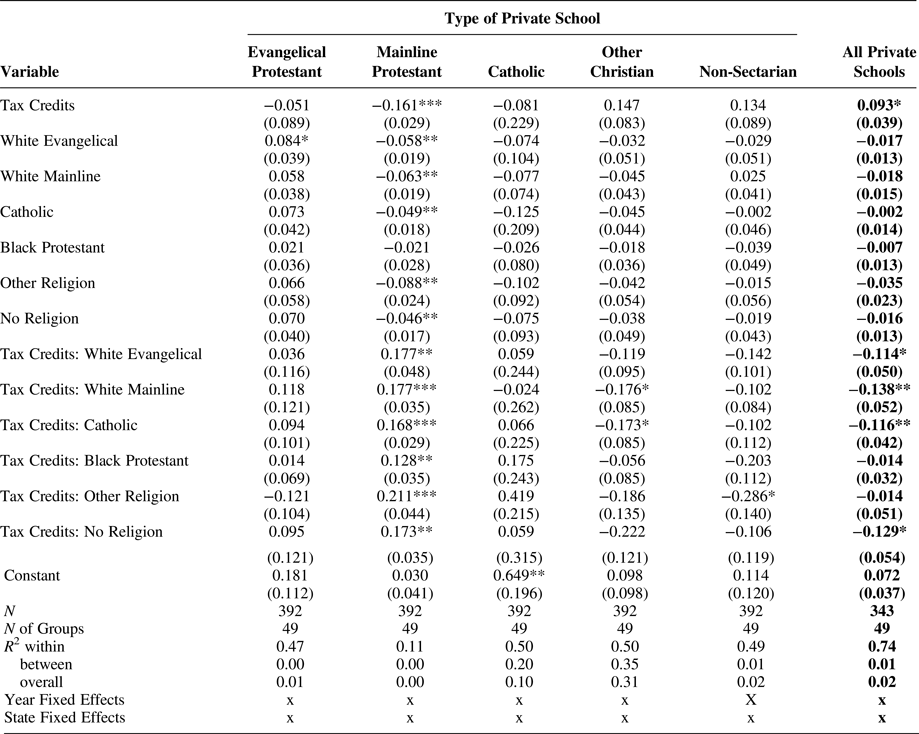
Another policy that may have an impact on private school enrollments among religious traditions is state tax credits for private tuition and scholarships. Table 4 reports the model estimates of the interactions between tax credit programs and the six distinct religious affiliations on private school market shares. This particular school choice policy provides even more market support to mainline Protestant schools than voucher programs, as it is related to higher relative enrollment rates in mainline Protestant schools among every religious group including those with no religious affiliation. Thus, tax credits appear to expand the student rolls in mainline Protestant schools from both inside and outside of this religious tradition. In addition, this policy seems to have some negative impacts on the enrollments of other Christian and non-sectarian private schools among certain religious groups. More broadly, Tables 3 and 4 demonstrate that voucher and tax credit policies largely promote student enrollment from outside rather than from within a school's affiliated religious tradition.
Predicting private school enrollments using religious tradition and tax credits, 1993–2011
Standard errors clustered by state in parentheses. *p < 0.05; **p < 0.01; ***p < 0.001. Source: U.S. K-12 Schools Database.
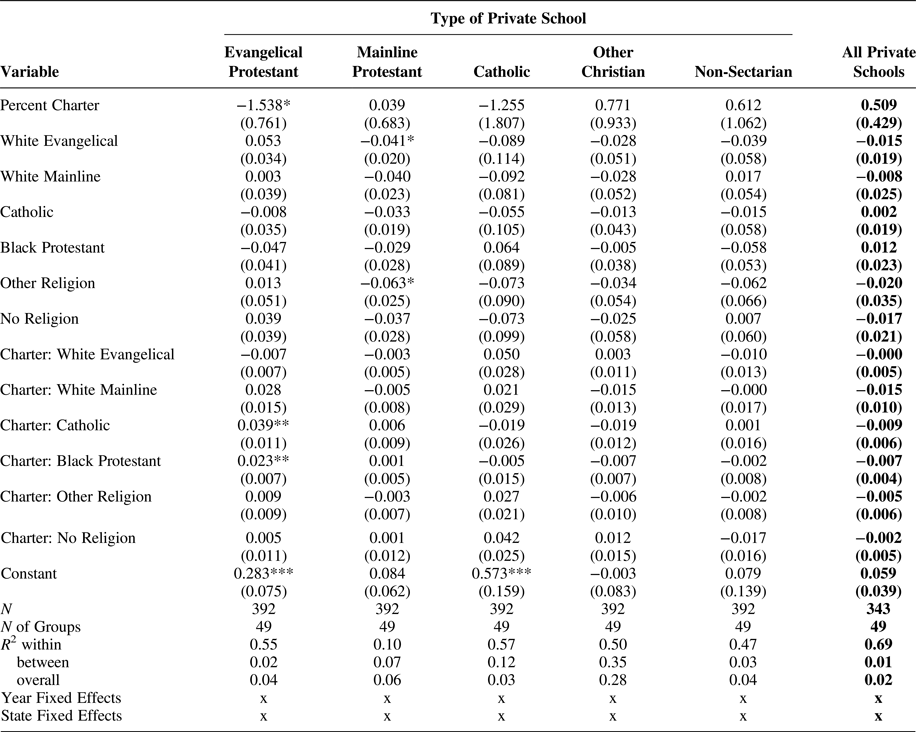
Unlike voucher and tax credit programs, the policy of charter schools may pose a challenge to private school enrollments particularly among parents who are not affiliated with the religious orientation of a private school. Initial studies on these publicly funded schools suggest that they are likely to enroll students who would otherwise attend private schools (Buddin Reference Buddin2012). Table 5 displays the interactive effects of the percent of students in charter schools and religious tradition on the enrollment patterns of each type of private school. We find that charter schools have no negative statistically significant relationships to private school market shares among the six religious groups. Moreover, we observe that greater relative charter school matriculation rates are related to greater relative matriculation rates in evangelical Protestant schools among Catholics and black Protestants. These findings would suggest that charter schools do not represent a risk to the market shares of the five types of private schools featured in this study.
Predicting private school enrollments using religious tradition and charters, 1993–2011
Standard errors clustered by state in parentheses. *p < 0.05; **p < 0.01; ***p < 0.001. Source: U.S. K-12 Schools Database.
We follow the same statistical methodology to examine the interactions between religiosity and different school choice policies. Table 6 reports the interactive term estimates of church attendance and the policies of vouchers, tax credits, and charter schools on private school market shares. Generally, these models reveal that these policies are also instrumental in enrollment patterns among the highly religious. The first set of models show that state voucher programs are associated with comparative increases in enrollment shares in other Christian schools among those who attend church services weekly. Voucher programs are also associated with comparative decreases in enrollment shares in non-sectarian schools among this same group. The second set of models show that tax credits have a positive effect on Catholic school market share and a negative effect on non-sectarian market share among those who attend church services weekly. The final set of models in Table 6 suggests that charter schools have neither a positive nor negative impact on private school enrollment trends when assessing the role of religiosity in enrollment trends.
Predicting private school enrollments using religiosity and various policies, 1993–2011
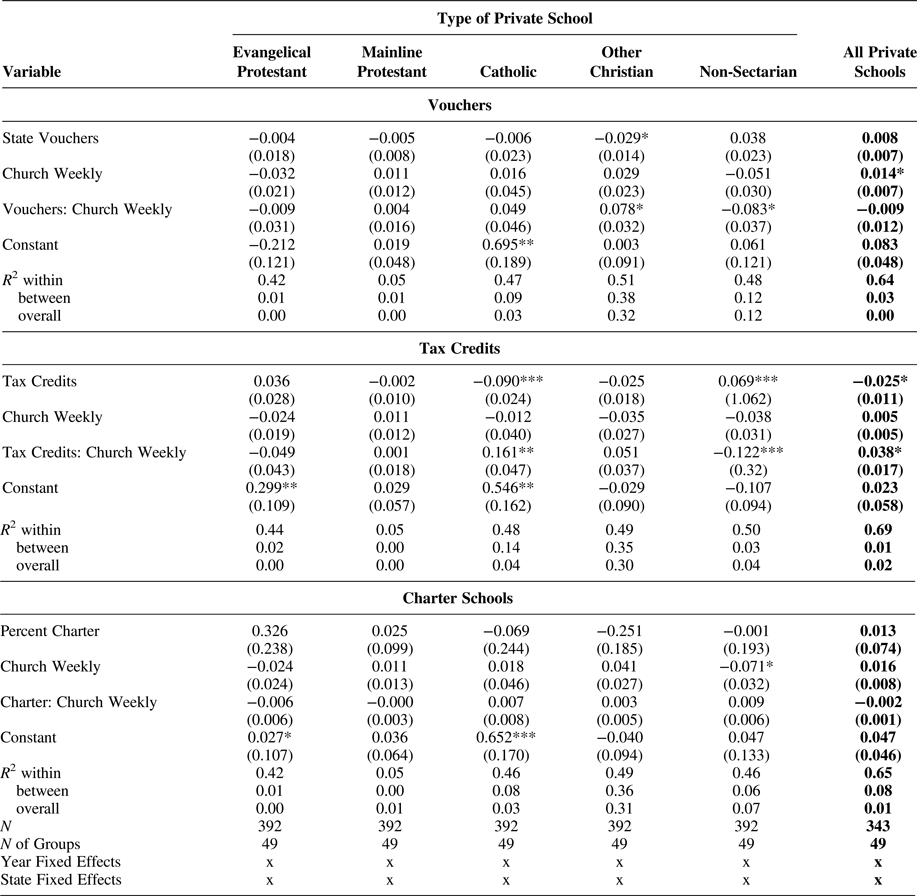
Standard errors clustered by state in parentheses. *p < 0.05; **p < 0.01; ***p < 0.001. Source: U.S. K-12 Schools Database.
DISCUSSION
Earlier in this article we outlined two concurrent theories for understanding the role of religion in private school enrollment over the last two decades. The social identity theory suggests enrollment in private schools is motivated by parents’ desire to retain a particular set of religious commitments while the secular goods theory suggests that enrollment in private schools is based in parents’ desire to access the secular benefits a religious-based education. Taken together, our models predicting different private school enrollments provide plausible support for both the social identity theory and secular goods theory.
First, we uncover some evidence for the religious identity theory. Specifically, religiosity is an important factor in the relative market share of other Christian or non-denominational private schools. School choice policies also appear to influence enrollment decisions among religiously devout parents. State voucher programs entice them to enroll their children in other Christian schools while tax credits entice them to enroll their children in Catholic schools. Religious tradition seems to play very little to no impact. Although white mainline Protestants are positively associated with enrollment shares in mainline Protestant schools when vouchers and tax credits are present, the lack of statistical significance in our religious tradition base model makes the social identity theory highly improbable in this case. Rather, our findings point to the popularity of mainline Protestant schools among all segments of the public. More generally, our models imply that the religiosity is much more applicable to private school enrollment than ethno-religious tradition.
Our models yield more evidence for the secular goods theory. Private schools are increasingly drawing from a larger pool of consumers with no direct religious ties to these schools. For example, evangelical Protestant schools appear to attract consumers from white mainline Protestant and Catholic traditions. Religiosity, on its own, is also unrelated to enrollment patterns in three of the four types of religious schools. Moreover, our models indicate that school choice policies can fuel private school demand from different quarters of religion. In particular, both voucher programs and tax credits increase the relative market shares of mainline Protestant schools across every major religious group. What explains this apparent competitive advantage of mainline Protestant schools? At this point, we can only speculate on this matter given that we do not test for the specific non-religious reasons for these enrollment decisions. It may stem from their superior academic performance, which has received some empirical support (Perie, Vanneman, and Goldstein Reference Perie, Vanneman and Goldstein2005). It may also be rooted in the broader historical prestige of certain denominations within this branch of Protestantism (Davidson Reference Davidson2008). Both of these explanations would suggest that mainline Protestant schools facilitate greater social mobility for their students than other private schools in this marketplace.
CONCLUSION
A general overview of private school enrollment over time shows that these educational institutions are in a period of decline. Our study offers a more nuanced picture of private schools by examining enrollment decisions in the context of both their religion and their policy milieu. Our analysis yields two general findings. First, even without school choice policies, private schools have an apparent wide basis of support from different religious groups. Private school enrollments seem to be motivated by the desire to preserve a religious identity and to consume the secular benefits of a religious based education. As a result, private schools draw students from both inside and outside of their religious orientation. Second, school choice policies have, on balance, improved the demand for private schools. Voucher and tax credits programs appear to impact schools in this marketplace unevenly by primarily increasing the market shares of mainline Protestant schools. Enrollments in all five types of private schools also remain unaffected by the growing presence of charter schools, a policy that offers a much more affordable alternative. Indeed, we find positive relationships between charter school enrollments and private school enrollments, indicating a highly diversified educational marketplace. The key to this marketplace may be the strategic location of charter schools, which we know at least are not in close geographical proximity to Catholic schools (McMullen, den Dulk, and Pelz Reference McMullen, den Dulk and Pelz2015).
Nevertheless, religious identity continues to be relevant to private school enrollments in an age of school choice. While we find limited support for private school enrollment based on religious identities tied to a specific tradition, enrollments are related to the religious identity tied to traditionalism in at least one important case. Private schools not necessarily affiliated with a particular tradition appear to be capturing students from families that demonstrate high levels of religious commitment. This trend in private education corresponds with the broader movement in Christianity to look beyond established denominational institutions. From this vantage point, these unaffiliated private schools may represent the latest incarnation of the dynamic influence of religion on the private school marketplace. Moreover, the non-denominational emphasis of these schools may also carry a degree of marketability in this marketplace, as it signals a certain set of values and priorities to an increasing number of adherents who subscribe to a less structured religious practice and identity.
Given this apparent broad religious and market support for private schools, what explains the declining enrollment patterns among many types of private schools? Apart from the idiosyncratic trends of Catholic school enrollment, an important facet of private school demand is the financial considerations associated with enrolling in a private school. Parents may be motivated to enroll their children in a private school for a variety of reasons, but without financial means or assistance, it is likely difficult to act upon these motivations in states without voucher or tax credit programs. In our analysis, we controlled for unemployment rates and median income, and indeed found relationships between low employment and income and enrollment at faith-based schools.10 A fuller explanation of private school demand would also focus more directly on the decline of the middle class (Pew Research Center 2016) and its relationship to the pricing structure of private schools. Studies on the price elasticity of different private school options given these income shifts would explicate the critical financial component of this decision, which may have become increasingly strained over time.
Our study also offers a window into the relationships between discrete traditions in the American religious landscape. Our results indicate that private schools are increasingly unbounded by their denominational affiliation in recruiting students. To the contrary, it appears that affinities between these different religious groups are forming and manifesting themselves in the private school marketplace. If private school enrollment is any indicator of religion, these enrollment patterns suggest that the new fault lines of religion may be more accommodating now than in the past, and the religious divisions of the so-called cultural wars are less pronounced in schools. Our research also illustrates that the restructuring of religion along traditionalist lines has distinctly shaped the private school market. Religious traditionalists are increasingly opting for schools that look beyond traditional denominational identities and casts.
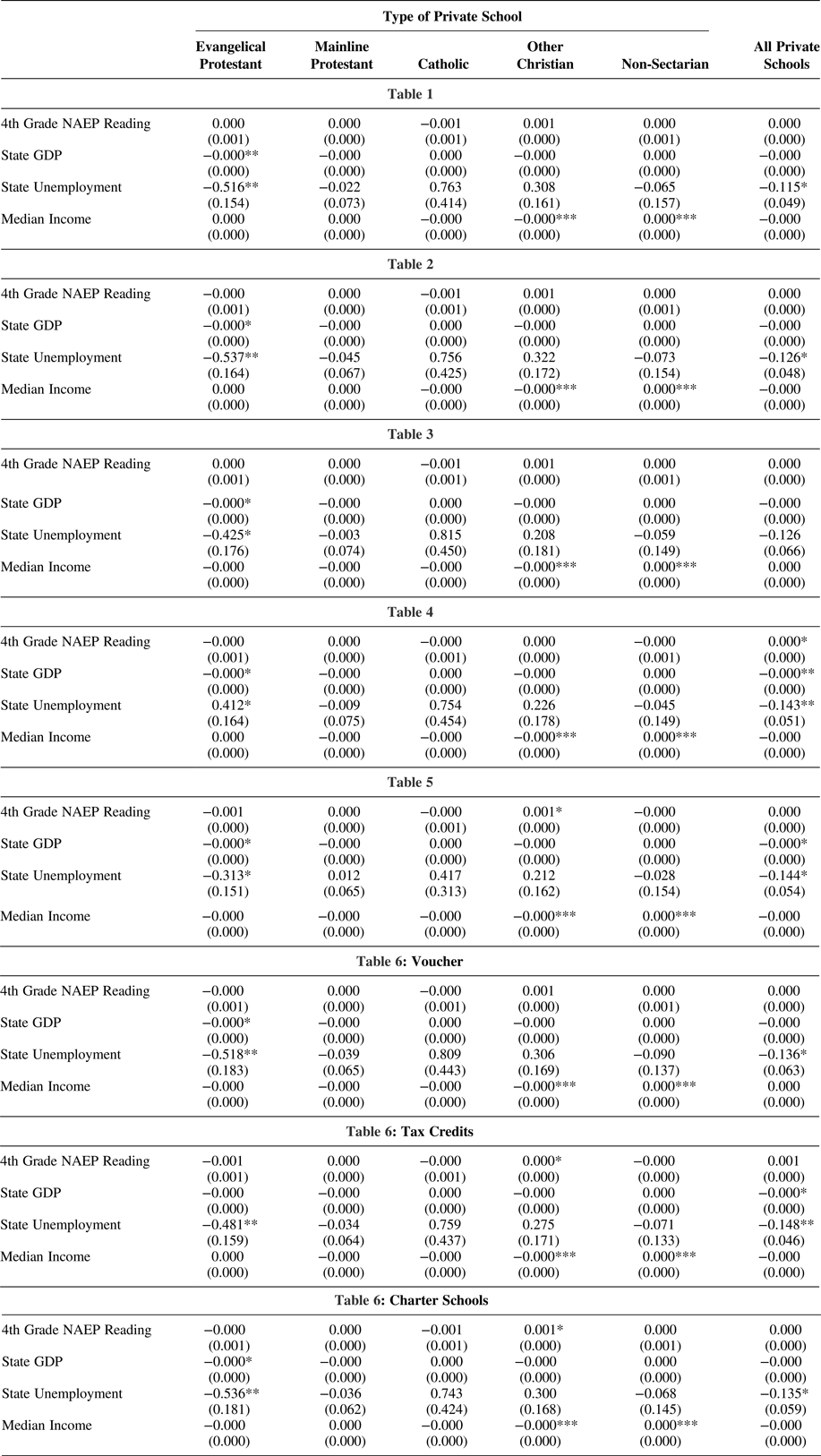
APPENDIX A: ESTIMATES OF CONTROL VARIABLES