Introduction
The question of how parties are, and ought to be, financed and regulated, has assumed an increased importance in recent years. As the levels of popular disengagement, disaffection and cynicism are rising, and as party leaders are increasingly perceived as incompetent, dishonest and corrupt, a growing number of voices have joined the chorus for more transparency, tighter controls and stricter regulations of the activities of political parties and politicians.
A host of national and international governmental institutions and non-governmental organizations, such as the Council of Europe, the International Institute for Democracy and Electoral Assistance (IDEA), the European Parliament, the OECD, or Transparency International (TI), are now independently investigating the funding practices of political parties and election campaigns, and are reporting on the ways in which illicit modes of party financing might be curtailed. Even the parties themselves have begun to show an increased interest in the issue of party funding and regulation. The UK, for example, where the financing of parties had been largely unregulated and unmonitored until the adoption of the 2000 Political Parties, Elections and Referendums Act, recently carried out a major independent review of the funding of political parties. Its purpose was to evaluate not merely the success of the new law in effectively regulating party financing but also, and perhaps more importantly, to assess the potential that changes to the law might have in addressing the high levels of popular discontent with the seemingly self-interested behaviour of the parties. Reform of the party funding system was deemed essential to restore public trust in the parties and the democratic system.1
Indeed, an important motivation underlying the general interest in party financing and regulation is a growing concern with the low levels of public confidence in political parties. While parties may well be seen as necessary for the effective functioning of democracy, this does not mean that they are very much liked or respected. If anything, parties are increasingly seen as driven primarily by their material self-interests. Political parties today are regarded by the public as the institution most susceptible to corruption and, perhaps as a consequence, they are one of the least trusted democratic institutions.Reference Dalton and Weldon2 As a result, an increasingly widely accepted view is that higher levels of external control and monitoring on party activity and behaviour are warranted in order to ensure that they perform their democratic functions more effectively.
More specifically, the general response to the perceived failings of parties has tended to involve conceding a greater responsibility to the state in managing their activities and behaviour, to the point that the state has now assumed a considerable, and increasingly legitimate, role in dealing with internal and external party affairs. Broadly speaking, this increased state intervention falls into two categories. On the one hand, there has been a significant increase of state support to political parties in the form of direct public subsidies, as access to public funding should relieve them of the need to satisfy private interests, should promote fair and equal party competition, and, it is argued, might even boost public engagement. On the other hand, the state has substantially increased its control over party affairs through public legislation, as external control should enhance the transparency of party activity and improve the accountability of parties more generally.
This article is concerned with a closer examination of these two trends – the increased availability of public funding to political parties, and the growing levels of public regulation of party activity and behaviour – arguing that both these dimensions constitute part of the way in which parties have strengthened their linkages with the state in recent years. It looks more closely at the extent of party regulation in European democracies from a comparative perspective, and discusses the underlying normative paradigms. Secondly, it examines the availability of public funding, and explores the motivations for its introduction in light of particular understandings of party democracy.
Political parties and the state
The role of political parties in contemporary democracies has changed profoundly over the course of the 20th century and into the 21st. Consequently, conceptions of party democracy have changed almost beyond recognition since parties first appeared and consolidated themselves with the advent of mass democracy, when they emerged to serve as the necessary linkage between citizens and the state. Political parties are typically understood as intermediary institutions located somewhere between society and the state. However, they have been analyzed primarily in terms of their relationship with society, as they used to be firmly rooted within civil society and drew their legitimacy from their capacity to represent key constituencies and interests within society. Although they have always fulfilled public functions, their real justification was derived from their representative character rather than their capacity to provide government. In fact, the legitimacy of the party as a mechanism for the recruitment of public office holders was given by the fact that the party constituted a channel of expressive selection and thus provided for representative leadership.Reference Sartori3
As the increased disengagement from conventional party politics demonstrates, however, the linkages between parties and society have substantially weakened in recent years, thus undermining the representative capacities of the parties (but see Saward in this issue). This is part of a process of organizational transformation of European political parties whereby, as Katz and Mair have argued, the erosion of the linkages between parties and society is accompanied by a concomitant intensification of their relationship with the state.Reference Katz and Mair4 Parties have maintained or even increased their institutional roles, in that they have retained the exclusive control over candidate recruitment, have become more office-seeking and are thus increasingly prioritizing their role as governing agencies as opposed to representative organizations, and are working together in taking advantage of the resources of the state – such as public subsidies, state-regulated media access, or party patronage – to ensure their collective survival. Indeed, parties are seen to have strengthened their relationship with the state such that they have almost become absorbed by the state and have begun to act as semi-state agencies.Reference Bartolini, Mair, Diamond and Gunther5 However, while the erosion of the representative linkages between parties and society in recent years has been relatively well-documented and explored theoretically and empirically, the precise dimensions of the relationship between parties and the state have been analyzed much less systematically, and with much less conceptual clarity.Reference van Biezen and Kopecký6
One of the reasons why relatively little scholarly attention has been paid to the linkage of parties to the state is that this relationship has traditionally been temporal, contingent and loose.Reference Kopecký, Mair and Salih7 To the extent that parties were linked to the state, this relationship tended to be confined to government rather than the state overall: parties recruited candidates for public office, placed their representatives in government positions and sought influence in the state, without necessarily becoming part of it. Parties did not depend on the state for their resources and legitimacy, nor were they managed by the state. The two key developments in the recent processes of organizational adaptation outlined above have altered these patterns: on the one hand, parties in contemporary democracies have become more dependent on the state, especially in financial terms. On the other hand, they are also increasingly managed and regulated by the state through public law. The relevance of state subsidies to political parties has received considerable attention since the cartel party article was first published, in particular because the parties’ increasing dependence on public subsidies was given a pre-eminent position as a key indicator of cartelization.Reference Katz and Mair4 The increased state regulation of party activity, organization and behaviour, however, has scarcely been the subject of systematic and comparative scholarly consideration.Reference Avnon8, Reference Karvonen9 In the following section, we will turn to this aspect first.
The regulation of parties
In addition to an increased financial dependence on the state, to which we will return later, parties in contemporary democracies are to a growing extent managed by the state, in that their activities are to an increasing degree subject to regulations and state laws which govern their external activities or determine the way in which their internal organization may function. Traditionally, given the fundamentally private and voluntary character of political parties, the state in liberal democratic societies would not intervene in the regulation of their behaviour and organization, but in recent years the legal regulation of parties has become more and more customary, to the point that party structures have now become ‘legitimate objects of state regulation to a degree far exceeding what would normally be acceptable for private associations in a liberal society.’Reference Katz, Luther and Müller-Rommel10 Many of these regulations were first introduced or were substantially extended in the wake of the introduction of public funding for parties, as the provision of state subventions inevitably demanded a more codified system of party registration and control. Controlling party access to the public broadcasting media has also required the introduction or extension of the system of regulation, which again has acted to codify the status of parties and their range of activities.
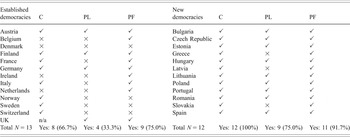
The evidence suggests that legislation on political parties is indeed extensive, as is illustrated by the data in Table 1. Naturally, the body of party law that determines the legal status of political parties and that specifies how parties may operate, must organize, or should be funded, may take a variety of forms. Party law is generally derived from a series of related bodies of law, including laws on political parties, political finance laws, electoral laws, campaign laws, and the constitution, as well as legislative statutes, administrative rulings and court decisions.Reference Janda11Table 1 provides an overview of only three, albeit significant, types of party regulation, namely through the constitution (C), special party laws (PL), and laws on the financing of political parties (PF).
Party regulation in European democracies

C = constitution; PL = party law; PF = law on party financing
Source: Adapted and updated from Refs Reference van Biezen and Kopecký6 and Reference Karvonen9.
As can be inferred from the table, the large majority of European democracies have established a regulatory framework for the financing of political parties. There are some, but only marginal, differences between the older and the more recently established democracies. For example, a system of regulation of party finances is in place in most countries that provide state subsidies to parties, as we shall see later, although there are some exceptions to this pattern (e.g. Denmark, Norway, and Sweden). Switzerland is the only country without regulation of political parties that also lacks public funding, and where parties are thus not strongly linked to the state in the sense of being financially dependent on, or regulated by, the state.
The table also indicates how many countries have adopted a special law on political parties. Here, the difference between old and new democracies is more pronounced. Only a handful of the established democracies – of which some in this context are probably better understood as re-established democracies – have adopted a special law on political parties (Austria, Finland, Germany and, most recently, the UK). In the younger democracies, on the other hand, including both Southern Europe and Central- and Eastern Europe, such party laws are more common, with only a small minority lacking such a law (Greece, Latvia and Slovakia). Indeed, it appears that party regulation in the newer democracies is generally much more exacting than in the older ones,Reference Karvonen9 tending to follow a ‘prescription model’ of regulation,Reference Janda11 whereby it seeks to mould parties to conform to a certain ideal type.
Thirdly, the table shows that a large majority of the countries now have enshrined political parties in their constitutions. Here, we see a significant difference between the old and new democracies as well, although slightly less pronounced than in the case of party laws. All of the recently established democracies have constitutionally codified the role political parties, but the constitutionalization of parties is much less common in the established democracies, where only about two thirds of the countries with a written constitution records a positive score. This absence is probably a legacy of the past, and a particular understanding of political parties that corresponds to their historically private character.
The body of party law broadly conceived may regulate a wide variety of aspects, ranging from the legal status and definition of parties to issues about their internal organization, mechanisms of candidate selection and party finances. Broadly speaking, party laws have been enacted for three basic purposes.12 First, the law may determine what formally constitutes a political party, who qualifies for ballot access, who benefits from public resources such as subsidies or broadcast media, etc. Second, laws may exist to regulate the type and form of activity in which parties may engage, such as campaign activities, or the raising and spending of (private and public) funds. Finally, and probably most controversially, the law may lay down the appropriate forms of party organization and behaviour, prescribing, for example, the mechanism for the selection of public office holders, demanding ethnic or gender parity on electoral lists, or constraining the ideological content of the party programme or electoral manifesto. It is this last aspect, by which the state intervenes in the parties’ internal organizational structure or their political profile, which is most likely to infringe upon associational freedoms.
From the perspective of normative democratic theory, the legal regulation of political parties raises serious questions and concerns. The presence of laws specifically targeted at political parties often implies that, in comparison to other organizations, the law either imposes greater restrictions on political parties or, conversely, confers special privileges upon them. This raises the fundamental question of whether parties ought, in fact, to be regulated differently from other types of organizations, and whether the special regulation of parties can be reconciled with basic freedoms, such as the freedom of speech and association, which are thought to be essential to democracy.12 Other concerns that may arise are similar to those emerging from the diffusion of constitutional review and the expansion of opportunities for judicial activism: these processes arguably undermine fundamental principles of democracy by effectively transferring powers from representative to non-representative institutions. Although the courts might sometimes act as a powerful constraint on the possible undemocratic behaviour of political parties, the legal regulation of parties not only evokes anxieties about the state centralization and control of political participation and public life, but also about the democratic legitimacy of transferring the ultimate decision-making authority on their behaviour and organization from the responsible organs of the party to a non-elected body of judges (Ref. Reference Avnon8, p. 285).
Despite the increased levels of party regulation, the empirical or normative dimensions of this phenomenon have thus far received relatively little systematic and comparative scholarly attention. This is even more so for their juridification through the formal constitution. Although the constitutional regulation of political parties has acquired an increased relevance in the European democracies in recent years, constitutions are not normally considered as a source of party law. However, in the post-war period, the relevance of political parties for democracy has gradually become more widely acknowledged in constitutional terms, to the point that pluralism, political participation and competition in many contemporary democratic constitutions have come to be defined increasingly, if not almost exclusively, in terms of party. Perhaps it is because the law has been so late in recognizing political parties, that scholars have taken insufficient note of the fact that parties are so central to the institutional arrangements of contemporary democracies.Reference Bogdanor13
According to Persily and Cain, different paradigms can be distinguished that govern and inform the contents of the law and the nature of the rules that affect political parties.Reference Persily and Cain14 In the ‘managerial paradigm’, for example, the primary goal is the preservation of the democratic order. With the primary interest of the state lying in the preservation of the stability of the party system, the party system is largely a state instrumentality. According to this approach, the state has the authority to set the rules of party behaviour and organization, with little importance accorded to a political party’s freedom to associate. This creates the potential for governing parties to prevent competitors from effectively organizing themselves, and furthermore implies that parties lose their own organizational autonomy. This type of regulation can probably most clearly be associated with the cartelization of the parties and the party system.
In the ‘libertarian paradigm’, on the other hand, far from instruments to serve the state, parties are a particular species of private, organized interest groups, whose primary purpose is to express the opinion of their members. They should therefore be given maximal rights of association, privacy, expression, and freedom from state intervention. This not only implies that parties are not the proper subject of state regulation, but also that they should not receive any state benefits (such as direct or indirect funding). Pushed to its logical conclusion, the libertarian paradigm is best reflected in the absence of any state regulation of parties (and public funding for that matter). In empirical and normative practice, the increased relevance and legitimacy of both state funding and state regulation suggests that this paradigm is rapidly becoming irrelevant.
For the advocates of the ‘political market paradigm’, values to be maximized are electoral choice and party competition, and the primary purpose of political parties is to offer political alternatives to their voter-consumers. The state interest in the party system is to facilitate effective political competition, and thus to construct rules that maximize or at least provide adequate competition between parties. Hence, the laws intervening in the political market serve to correct market failures and to prevent possible monopolistic partisan practices. Some of the principles that govern the public funding of parties, in particular those that aim to encourage fair and equal competition between parties, can serve as an example of this paradigm.
Finally, according to the ‘critical approach’, the primary purpose of political parties is to represent social cleavages. On this view, the state interest is to construct rules that maximize interest representation, and possibly to intervene to compensate for existing biases of the social and political system. In terms of the electoral system, the various mechanisms that enhance the proportionality of the system might serve as an example. In terms of party laws, one might think of norms that regulate gender balances on party electoral lists.
Because the regulation of parties has only recently become a focus for party and legal scholarship, it is too early to tell which, if any, of these paradigms applies to the regulation of parties by law and the constitution. However, they suggest that party law has become an important source for investigations into the character of modern democracy and the prevailing ideas about the place of political parties within it. Few, if any, institutional preferences and reforms are politically neutral, and choices and decisions about the character of regulation, are themselves not above politics.12 In fact, the position of political parties in this respect is particularly interesting because the parties themselves are of course the principal agents of their own legal regulation. The law thus reflects a particular vision of what the distribution of power actually is, as well as what it should be, as decisions on the regulation of party activity, organization and behaviour follow from particular conceptions of party and the preferred roles and functions of parties. Different norms and conceptions thus lead to different prescriptions about the appropriate legal regulation of parties.Reference Gardner15 The position of political parties as defined by public law and the national constitution, therefore, sheds light on a number of the crucial questions in the legal regulation of politics, ranging from questions about how parties should be understood in terms of normative democratic theory, to how they are to be financed.
State funding of parties
Public funding for political parties is a relatively recent phenomenon in European democracies, having gained importance only in the post-war period. Historically, political parties in the liberal democracies of Western Europe primarily depended on private contributions to finance their activities. Cadre parties generally relied on contributions from wealthy individuals or donations from private business; mass parties typically secured a structural flow of income from the fees paid by their members and the donations from affiliated trade unions; and catch-all parties broadened their financial support base by securing access to a wider variety of interest groups. Today, however, virtually all European democracies provide direct state subventions to political parties. The introduction of public funding for parties has encouraged the emergence of cartel parties, which depend to an important extent on the financial resources of the state for their own survival. Hence, while parties in Western Europe traditionally relied on contributions that were in one way or another derived from society (membership subscriptions, contributions from individual donors, private business or affiliated associations and so on), for most parties today the direct subsidies from the state have become a much more important, if not principal, resource.
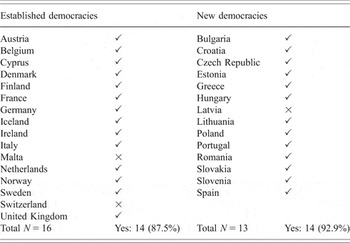
The evidence suggests that political parties in the vast majority of the liberal democracies now have access to direct state subsidies, although the actual amounts and their relative importance may vary. For the European democracies, this is demonstrated by Table 2, which summarizes the availability of direct public funding for political parties. As the table suggests, public subsidies have indeed become a widespread phenomenon, with little significant difference between the established and the newer democracies. It is only in three countries (Malta, Latvia and Switzerland) that the national parties do not have access to direct state support.
Availability of public funding for parties in European democracies

Source: Updated from Ref. Reference van Biezen and Kopecký6.
The growing prevalence of public subsidies can in itself be interpreted as an indication of the increasing financial dependence of parties on the state. In order to establish precisely how dependent parties are on the state, the key question, of course, is how important these public subsidies are in relation to the total party incomes. Existing studies suggest that there are significant differences between countries and between parties within one country.Reference Kopecký16, Reference Pinto-Duschinsky17 In some Central and Eastern European countries such as the Czech Republic, Slovenia, Hungary, and Estonia, the relative importance of state money is very large, with the state being the key provider of party income. The same is, by and large, true for the Southern European democracies of Spain and Portugal, where many parties are virtually entirely financially dependent on the state. In other countries, public funding is merely symbolic in comparison to the resources parties obtain from private and corporate donations. Examples include Bulgaria or, amongst the non-liberal democracies, countries such as Russia and the Ukraine. Among the established democracies, parties in countries such as Germany and France benefit from significant amounts of subsidies. The UK, on the other hand, provides only token amounts of financial support to parties, although there does seem to be increasing cross-party support in favour of an increase in direct state funding. A comparative analysis of several European democracies showed that state support ranged from just over one-fifth (Denmark) to almost 85% (Finland) of total party income.Reference Pierre, Svåsand and Widfeldt18 Unfortunately, more comprehensive cross-national data to evaluate the actual financial dependence on the state are not available. What we do know, however, is that the introduction of state support for parties has encouraged a dependence on public money that is critical in a lot of cases, and at the very least non-trivial in many others.
The introduction of direct state funding has thus made parties increasingly dependent on public money and state support. Although this has not implied that other financial resources have become entirely irrelevant, the introduction of state subsidies represents a turning point in the financing of political parties, in that it represents ‘a fundamental change in the character of the party, furthering its transformation from a private association into a semi-public entity’ (Ref. Reference Katz, Luther and Müller-Rommel10, p. 115). In this sense, state subsidies have contributed to a process by which parties are increasingly seen as an essential public good for democracy and less exclusively as private voluntary associations that are the instruments of civil society. This can be illustrated by an exploration of the most common arguments advanced in favour of state subventions to political parties, all of which underline the importance that parties are now seen to have for modern democracy and the positive contribution they (ought to) make to the public interest.
The first argument in favour of direct state subsidies relates to the desire to restrict the influence of private money and to limit its potential for distortion of the democratic political process. The concern here is that certain private interests rather than the general public interest would come to guide the conduct of parties and elected officials. Since public funding relieves parties from having to satisfy their financial supporters it is anticipated that this will diminish corruption. Coupled with the legislation on party financing, public funding gives the state a larger degree of control over the role of money in politics and a greater opportunity legitimately to exercise some degree of supervision over financial party activity, which should further reduce the potentially excessive influence of private contributors at the expense of the public interest.
A second motivation is concerned with the rising cost of politics, coupled with the decreasing revenues of political parties. Politics in the Western liberal democracies has become progressively more expensive as the result of the increased use of the mass media and more cost-intensive campaigning techniques, and as a consequence of the internal professionalization of parties. The overall resources of parties have increased substantially as well: their central headquarters and parliamentary groups are better staffed than they were 20 to 30 years ago, their annual income has increased and they are spending more money on election campaigns.Reference Farrell, Luther and Müller-Rommel19 At the same time, parties have seen their membership base decline, which has had two important consequences. First, this has deprived parties of an important source of revenue, as it has implied an effective reduction in the income derived from membership subscriptions. Secondly, the erosion of their membership organizations has implied that parties have lost a substantial share of their reservoir of volunteers who would work for the party as unpaid employees or who would carry out labour-intensive campaigning activities. For this loss, they have compensated by recruiting larger numbers of paid professionals. The public subsidies to parties and candidates should thus in part be understood as a response to the rising cost of the democratic process in a context of decreasing revenues. This motivation corresponds closely with the ‘managerial paradigm’ and with the public interest in maintaining party democracy.
A third justification for the state to be directly involved in the financing of political parties is associated with concerns for the fairness and equality of political competition. In this view, not all parties are equally resourceful and those that cannot successfully tap into the resources of private contributors should not necessarily be at a disadvantage. This consideration is primarily relevant for smaller parties, newly established parties, parties whose political programme is unlikely to appeal to wealthy or established interests, and parties that lack any linkages with affiliated interest organizations. State subsidies should thus create a more level playing field by enabling new, small and less resourceful parties to compete on a more equitable basis with the dominant and financially more privileged ones. This concern corresponds to the ‘political market paradigm’ and with the state’s interest in facilitating electoral choice and party competition.
All of these motivations in favour of a more prominent role of the state in the funding of political parties can be understood in light of the currently predominant discourse, which holds that parties make a positive contribution to democracy and to the public interest. The growing extent of state intervention in party financing, and indeed regulation, has in fact been legitimized by an ideational transformation that has accompanied the development of modern democracy, whereby parties have developed from organizations perceived as antagonistic to democracy, to institutions that are generally seen as its principal protagonists.
This transformation can be seen as having occurred in three sequential stages, with the introduction of universal suffrage and the reconstruction of democracy in the post-war period acting as the two major watershed events. The first of these stages corresponds to the period that is demarcated by the first appearance of political parties and the introduction of universal suffrage. In this period, parties were not seen as necessary, let alone desirable, institutions for democracy. On the contrary, they were primarily perceived as a threat to the general interest or as overriding the interests of the individual. Indeed, their existence was fundamentally incompatible with both the liberal democratic tradition rooted in the political philosophy of Locke and the radical democratic tradition inspired by Rousseau. Both of these are difficult to marry with partisan institutions, which by their very nature transcend individual interests and contest the existence of a general will.
However, the advent of mass democracy brought about by the introduction of universal suffrage, and the consequent final push in the adaptation of democracy to the scale of the modern nation-state, made the direct links between the state and the individual increasingly unrealistic and effectively impossible. The introduction of universal (male) suffrage thus served to legitimize the existence of parties as intermediary institutions between individual citizens and the state. In this second period, therefore, which is demarcated roughly by the democratization of competitive oligarchies through the extension of the franchise to all (male) adult citizens, on the one hand, and the restoration of democracy in the immediate post-war period, on the other, political parties came to be seen as necessary (or at least inevitable) institutions for democracy. From a normative perspective, however, for the same reasons as before, they were still largely seen as unwelcome and, at best, an unpleasant consequence of free government.
A more broadly shared and explicitly positive connotation came to be attached to the role of parties in representative democracy only in the immediate post-war period, nearly two centuries after Burke had come to see that that parties had a positive and necessary quality for democracy and made what has subsequently been described as ‘the first argument in the history of political philosophy for the respectability, not merely the necessity, of parties’.Reference Scarrow20 Beginning with the restoration of democracy in Italy and West-Germany, the political parties came to be seen as valuable and indispensable, to the point that they are now generally considered as the necessary condition for the organization of the modern democratic polity and for the expression of political pluralism and participation. The centrality of political parties for representative democracy is generally accepted both by contemporary party scholars – although arguably not by many political theoristsReference van Biezen and Saward21 – and by policy-makers charged with fostering the development of newly emerging democracies and with improving the quality of democracy in established democratic polities.
In sum, the gradual appreciation over the course of the 20th century of the positive contribution that parties make to democracy signals a dramatic shift in the normative conceptions of parties and democracy. Because political parties have now come to be seen as key democratic institutions, it has seemed possible, if not essential, for the state to intervene with direct financial support in order to facilitate their continued existence, to foster a level playing field, and to eradicate particularistic forms of financing. Indeed, it is only from a conception of democracy in which parties are the indispensable protagonists of representative democracy that the state should have come to play such an important and legitimate role in party financing.
The direct involvement of the state in internal party affairs has contributed to a transformation of parties from their traditional understanding as voluntary and private associations towards parties as public service agencies or, as I have argued elsewhere, public utilities.Reference van Biezen22 The notion of notion of parties as public utilities, which was observed earlier by Epstein for the American context,Reference Epstein23 implies at least four aspects. First, parties perform important functions which are necessary and indispensable for democracy. As these benefit the community as a whole, they are non-excludable and can be considered as a public good. Generally speaking, however, the delivery of public goods tends to suffer from market failures, but state intervention can be a solution in order to ensure the effective and efficient provision of the good. This can take several forms, an important one of which is government subsidies. Secondly, therefore, the value of the services provided by parties justifies financial support from the state. In contemporary democracies, this takes the form of indirect subventions and an increasing relevance of direct state subsidies. Thirdly, because of their special role in representative democracy, the internal affairs and external activities of political parties should be regulated by the state, both to enforce the proper management of their finances and to ensure that they perform their unique democratic services effectively. As is true for public services more generally, which are usually subject to a degree of regulation going beyond that applying to other economic sectors, this implies that, fourthly, relative to other types of organizations, political parties merit a privileged status in public law. This is shown by the growing importance of party regulation. Hence, the notion of parties as public utilities entails not only that parties ought to be financially supported by the state, but also that the state has a legitimate role in the regulation of their activities. It is this conception of parties and democracy that provides the core foundation of state intervention in party politics.
Conclusion
This article has shown that state intervention in contemporary European party politics has assumed significant proportions, in particular in the form of the extensive regulation of party activity and the widespread availability of public funding. The involvement of the state is legitimized by underlying normative paradigms according to which the state has an interest in maintaining the democratic party system, facilitating electoral choice and party competition, and maximizing the representation of social interests. As a consequence of the growing levels of state intervention in party affairs, the relationship between parties and the state has assumed an increased importance both in terms of legitimacy and organizational resources.
The increased dependence on public money and the growing involvement of the state in internal party affairs, whereby parties become subject to a regulatory framework that grants them an official status as part of the institutions of the democratic state, has contributed to a transformation of parties from voluntary private associations to a special type of public utility. As the internal life and the external activities of parties become regulated by public law, and as party rules become constitutional or administrative rules, the parties themselves become transformed into public service agencies, with a corresponding weakening of their own internal organizational autonomy (Ref. Reference Bartolini, Mair, Diamond and Gunther5, p. 340), and a shift of the primary locus of accountability from the internal organs of the party towards external and non-majoritarian institutions.
Whereas parties once drew their legitimacy from their capacity to represent key constituencies within civil society, they now justify themselves by appealing to a conception of democracy that sees parties as an essential public good. In this capacity, they are both supported and supervised by the state, which contributes to the financing of their activities and monitors their behaviour through an increasingly tighter framework of regulation. Because the linkages between parties and society have become increasingly loose and contingent with time, while those with the state have progressively acquired more prominence, political parties are now perhaps best understood in terms of their permanent linkages with the state rather than society. As the parties themselves become increasingly defined as semi-state agencies, modern party democracy effectively becomes a service provided by the government to its citizens.
Ingrid van Biezen is a Reader in Comparative Politics at the University of Birmingham, UK. She has taught at the University of Leiden and the Johns Hopkins University, and has held Visiting Fellowships at Yale University and the University of California, Irvine. She has published journal articles on party organization, party finance, and democratic theory, and is the author of Political Parties in New Democracies (Palgrave Macmillan, 2003) and Financing Political Parties and Election Campaigns (Council of Europe, 2003). Her current research focuses on the constitutionalization and legal regulation of political parties.