Introduction
Almost 1% of all men and 10–15% of infertile males are azoospermic, which is indicated by the lack of sperm cells in ejaculate (Cocuzza et al., Reference Cocuzza, Alvarenga and Pagani2013; Cetinkaya et al., Reference Cetinkaya, Onem, Zorba, Ozkara and Alici2015). In addition, ∼60% of azoospermia cases are the result of non-obstructive azoospermia (NOA), which is triggered by intense damage during spermatogenesis (Modarresi et al., Reference Modarresi, Hosseinifar, Daliri Hampa, Chehrazi, Hosseini, Farrahi, Dadkhah, Sabbaghian and Sadighi Gilani2015). Sperm cells that are recovered from testicular samples usually have little or no motility (Dutra et al., Reference Dutra, Scherer da Silva, Lazzari, Stein and da Cunha Filho2018). Injection of an immotile spermatozoa into the oocyte negatively affects the intracytoplasmic sperm injection (ICSI) outcome (Mahaldashtian et al., Reference Mahaldashtian, Khalili, Nottola, Woodward, Macchiarelli and Miglietta2021). Therefore, it is essential to find a method for selection of viable spermatozoa (Dutra et al., Reference Dutra, Scherer da Silva, Lazzari, Stein and da Cunha Filho2018). Alternatively, testicular biopsy and cryopreservation of spermatozoa for subsequent use can be considered in azoospermia patients; therefore, re-biopsy and ovulation induction are no longer necessary (Griveau et al., Reference Griveau, Lobel, Laurent, Michardière and Le Lannou2006). Although the consequences of freezing procedure on motility, morphology and viability of spermatozoa are recognized, the consequences of any probable change in the spermatozoa genome after cryopreservation are still controversial (Rahiminia et al., Reference Rahiminia, Hosseini, Anvari, Ghasemi-Esmailabad and Talebi2017).
At present, there has been no strong validation of whether the freezing process induces sperm DNA damage (Rahiminia et al., Reference Rahiminia, Hosseini, Anvari, Ghasemi-Esmailabad and Talebi2017; Le et al., Reference Le, Nguyen, Nguyen, Nguyen, Nguyen, Nguyen and Cao2019). The freezing process, especially for NOA, has led to complete immobility of the sperm cells (Griveau et al., Reference Griveau, Lobel, Laurent, Michardière and Le Lannou2006). The selection of living spermatozoa for ICSI from frozen–thawed samples of NOA patients is very time consuming, difficult and sometimes impossible (Griveau et al., Reference Griveau, Lobel, Laurent, Michardière and Le Lannou2006). Pentoxifylline (PTX), a phosphodiesterase inhibitor, increases c-AMP levels and protein kinase A activity, and can increase sperm motility (Manetta, Reference Manetta1998). Nevertheless, a concern has been voiced by some investigators to the possible effects on the genome (Meseguer et al., Reference Meseguer, Santiso, Garrido, Gil-Salom, Remohí and Fernandez2009; Asokan et al., Reference Asokan, Honguntikar, Uppangala, Salian, Kumar, Kalthur and Adiga2015) and clinical (Mahaldashtian et al., Reference Mahaldashtian, Khalili, Nottola, Woodward, Macchiarelli and Miglietta2021) damage induced by PTX.
Another concerning issue in male-assisted reproduction is fragmentation of the sperm chromatin, which may have a harmful effect on fertility rates (Muriel et al., Reference Muriel, Meseguer, Fernández, Alvarez, Remohí, Pellicer and Garrido2006; Meseguer et al., Reference Meseguer, Santiso, Garrido, Gil-Salom, Remohí and Fernandez2009). Designation of sperm DNA fragmentation (SDF) may be a special option for male infertility (Nabi et al., Reference Nabi, Entezari, Miresmaeili, Vahidi, Lorian, Anbari and Motamedzadeh2021). SDF seems to be associated with the capacity of sperm to fertilize an oocyte (Muriel et al., Reference Muriel, Meseguer, Fernández, Alvarez, Remohí, Pellicer and Garrido2006). One reliable test for assessment of DNA fragmentation is the sperm chromatin dispersion (SCD) test. In this test, spermatozoa with fragmented DNA are unable to form a ‘halo’ (dispersed DNA loops), whereas halos are formed in spermatozoa with intact DNA (Setti et al., Reference Setti, Braga, Provenza, Iaconelli and Borges2021b). The evaluation of DNA fragmentation via the SCD test is a good predictor of embryo development and clinical outcome (Tandara et al., Reference Tandara, Bajić, Tandara, Bilić-Zulle, Šunj, Kozina, Goluža and Jukić2014). As mentioned previously, the effectiveness of PTX on DNA fragmentation and clinical outcomes is doubtful (Mahaldashtian et al., Reference Mahaldashtian, Khalili, Nottola, Woodward, Macchiarelli and Miglietta2021). Some research has shown that PTX could improve sperm motility without any adverse effects on genome integrity (Asokan et al., Reference Asokan, Honguntikar, Uppangala, Salian, Kumar, Kalthur and Adiga2015; Salian et al., Reference Salian, Nayak, Kumari, Patel, Gowda, Shenoy, Sugunan, Managuli, Mutalik, Dahiya, Pal, Adiga and Kalthur2019) and clinical outcomes (Amer et al., Reference Amer, Metawae, Hosny and Raef2013; Navas et al., Reference Navas, Paffoni, Intra, González-Utor, Clavero, Gonzalvo, Díaz, Peña, Restelli, Somigliana, Papaleo, Castilla and Viganò2017). To our knowledge, there has been only one study that applied SCD analysis to the assessment of the effect of PTX on SDF in azoospermia cases (Meseguer et al., Reference Meseguer, Santiso, Garrido, Gil-Salom, Remohí and Fernandez2009). The aim of present study was two-fold: (1) Pilot study: Evaluation of the effects of PTX treatment on sperm motility and DNA fragmentation in both fresh and post-thawed testicular samples. (2) Clinical study: Assessment of the role of PTX in clinical outcomes of both fresh and post-thawed ICSI cycles of NOA patients.
Materials and methods
Study population
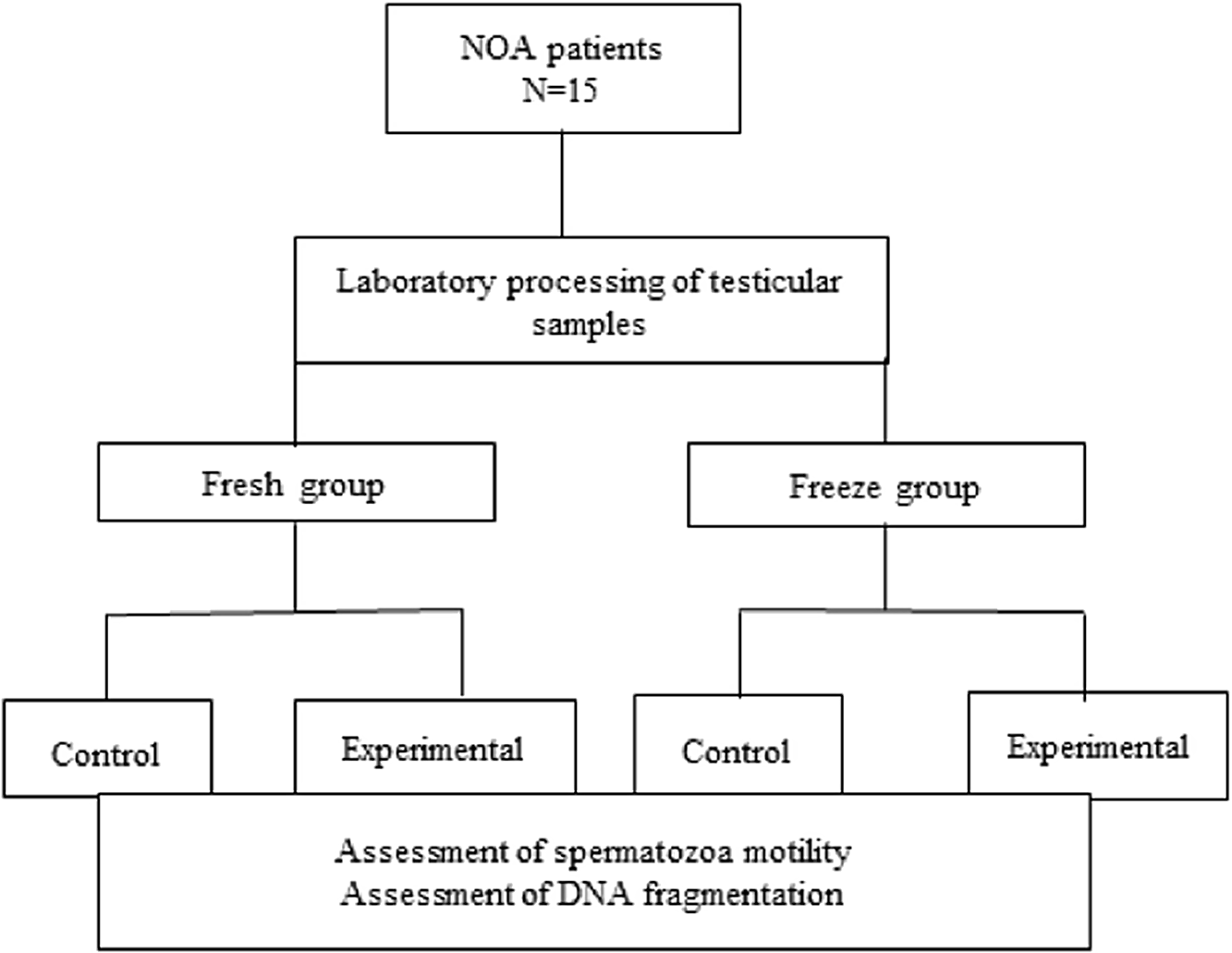
The pilot section of this prospective study included 15 NOA patients with an average age of 29.60 ± 2.13 years. Each sample was divided into fresh and frozen groups. In each group, half of the sample was treated with PTX and the remaining half was considered as the control (Figure 1). The clinical phase of the study included 52 patients and included fresh TESE (N = 30) and post-thawed TESE (N = 22) groups. The mean ages of men and women participants and duration of infertility were 36.17 ± 6.54, 31.34 ± 5.10 and 6.75 ± 3.98 (N = 52), respectively. The mean levels of anti-mullerian hormone (AMH) and luteinising hormone (LH) were 4.17 ± 2.94 (N = 47) and 3.490 ± 4.62 (N = 31) pg/ml respectively. The oestradiol levels before hCG injection were 1771.14 ± 1453.49 (N = 47) pg/ml. Metaphase II (MII) oocytes from each patient were divided and half of the oocytes were injected with non-treated sperm cells (control group) and the rest of oocytes were injected with PTX-treated sperm cells.
Diagram of pilot study design.

All patients had been referred to the Yazd Reproductive Institute for infertility treatment from November 2020 to August 2021. Inclusion criteria were as follows: male and female ages less than 50 and 40 years, respectively. The cases had at least 1 million spermatozoa in their samples, no history of varicocele or diabetes or tobacco addiction. Exclusion criteria were cases with no motile spermatozoa. The diagnosis of azoospermia was confirmed using the centrifugation of a semen sample for 15 min at 3000 g followed by high-powered examination of the pellet (Cocuzza et al., Reference Cocuzza, Alvarenga and Pagani2013). This research was approved by the Scientific and Ethics Committee of our institution (IR.SSU.RSI.REC.1398.013). All patients signed informed consent to participate in the research.
Ovarian stimulation and ICSI
Ovarian stimulation was carried out using a GnRH agonist or antagonist co-treatment procedure with recombinant urinary–follicle stimulating hormone (Gonal-FSH, Serono, Geneva, Switzerland). Human recombinant chorionic gonadotropin (hCG) (Pregnyl®; Organon, Oss, the Netherlands) was injected when at least three follicles were ≥17 mm diameter. Ovum pickup was performed 38 h post hCG trigger (Mangoli et al., Reference Mangoli, Khalili, Talebi, Kalantar, Montazeri, Agharahimi and Woodward2020).
Laboratory handling of testicular specimens
Testicular tissue was rinsed in a Petri dish containing 1–2 ml of Ham’s F10 medium (Biochrome, Berlin, Germany) supplemented with 5 mg/ml human serum albumin (HSA; Vitrolife, Englewood, CO, USA) and finely crushed and dissected mechanically using two sterile slides. Afterwards, the presence of sperm cells was evaluated at ×400 magnification under an inverted microscope (Diaphot, Nikon Corporation, Tokyo, Japan). Cell suspensions were aspirated and transferred to a sterile centrifuge tube and diluted with 3 ml of fresh culture medium and centrifuged at 300 g for 10 min. The supernatant was discharged and the pellet was gently resuspended in 0.5–1.0 ml culture medium (Esteves and Schneider, Reference Esteves and Schneider2011).
Cryopreservation and warming procedure
Cryopreservation and warming were performed as described previously (Desai and Rambhia, Reference Desai, Rambhia, Montag and Morbeck2017). In brief, the testicular sample was diluted with an equal amount of cryopreservation medium (Sperm Freezing Medium, ORIGIO, USA), mixed thoroughly, and allowed to equilibrate at room temperature (RT) for 10 min. The specimen was distributed among prelabelled cryovials (Cryo Bio System, Saint-Ouensur-Iton, France). Then, each vial was placed in a horizontal position 4–5 cm above the surface of the liquid nitrogen. After 1 h, the vial was immersed in liquid nitrogen (–196°C) and secured in a cryocane for storage. For warming, the sample was held at RT for 2–3 min and the cap was loosened to release any gas pressure from trapped liquid nitrogen. Then, the sample was placed in a warmer at 37°C for 20 min until it was completely thawed. After that, 0.5–1.0 ml of culture medium was slowly added to the sample, which was centrifuged at 300 g for 5 min. Following removal of the supernatant, the sperm pellet was resuspended in fresh medium.
Treatment of spermatozoa with PTX
The testicular cell suspension was added to the droplets of culture medium containing 1 mg/ml of PTX (Sigma, St. Louis, MO, USA) under paraffin oil (Kovacic et al., Reference Kovacic, Vlaisavljevic and Reljic2006) at the ratio of 1:1. So, the final concentration of PTX in the sample was 1.76 mM. Droplets were incubated at 37°C for 30 min. Then, the sample was examined for identification and isolation of viable motile spermatozoa.
Assessment of sperm motility
The droplets were observed under an inverted microscope for assessment of sperm motility. Some spermatozoa displayed twitching motility, whereas some sperm cells acquired an adequate grade of motility to reach the periphery of the droplet (Mangoli et al., Reference Mangoli, Mangoli, Dandekar, Suri and Desai2011).
Sperm DNA fragmentation test
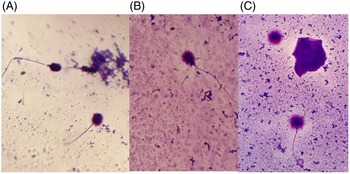
Sperm DNA fragmentation was assessed using the SDFA kit (Tehran, Iran) based on a previous study (Anbari et al., Reference Anbari, Khalili, Agha-Rahimi, Maleki, Nabi and Esfandiari2020). In brief, low-melting-point agarose gel was placed at 90–100ºC for 5 min and transferred to an incubator at 37ºC for equilibration. In each droplet of testicular tissue 10–15 motile sperm cells were selected. Next, 5 µl of low-melting-point agarose gel was deposited onto the pre-coated slide. Immediately, selected motile sperm cells were gently released onto the agarose gel. Slides were placed on a cold plate in the refrigerator (4ºC) for 5 min. Then, the slides were exposed to acid solution and lysing solution for 15 and 25 min, respectably. After rehydration, the slides were washed and allowed to dry and were evaluated under a bright field microscope. Depending on the halo size, the sperm cells were categorized as no halo, small (halo width is slighter than one-third of the minor diameter of the core), medium (halo size is between large and small halos), and large (halo width is similar to or larger than the minor diameter of the core) halos by observing under a light microscope (Meseguer et al., Reference Meseguer, Santiso, Garrido, Gil-Salom, Remohí and Fernandez2009). Spermatozoa with no or small halos were considered to contain DNA damage and results were expressed as a percentage (Figure 2).
Sperm DFI detected in NOA sperm cells. (A) Spermatozoa without halo and small halo. (B) Spermatozoa with medium-sized halo. (C) Spermatozoa with large halo assigned as without fragmentation.

ICSI procedure, embryo culture, selection, and transfer
After washing selected spermatozoa in droplets of HEPES buffer medium, the sperm were moved in a central droplet of polyvinyl pyrrolidone (PVP) solution. A single spermatozoon was aggressively immobilized and then injected using a microinjection pipette into the cytoplasm of an MІІ oocyte. Poor quality oocytes such as large polar body oocytes and those containing smooth endoplasmic reticulum clusters and large vacuoles (≥14 μm) within the ooplasm were discarded. Injected oocytes were cultured in SAGE 1-Step medium (Origio/Cooper Surgical) enclosed within mineral oil at 36.8°C, 7% O2 and 6% CO2 (Mangoli et al., Reference Mangoli, Khalili, Talebi, Agha-Rahimi, Soleimani, Faramarzi and Pourentezari2019). Fertilization was evaluated 16 h post ICSI. Embryo selection was performed according to Hill categories: grade A, embryo with even blastomere size and no fragmentation; grade B, embryo with slightly uneven size blastomere and up to 10% fragmentation; grade C, embryo with uneven blastomere size and 10–50% cytoplasmic fragmentation; and grade D, blastomere with significantly uneven size, large black granules and more than 50% fragmentation. Grades A and B are considered as good quality, and C and D as poor quality embryos (Hill et al., Reference Hill, Freeman, Bastias, Rogers, Herbert, Osteen and Wentz1989). Embryo transfer was carried out 2 d post fertilization and chemical pregnancy (positive β-hCG in the serum/transfer) was detected 2 weeks after transfer.
Statistical analysis
Assessment of data distribution was implemented using the Kolmogorov–Smirnov test. Pilot study design considered the dependencies between the groups. The DNA fragmentation index (DFI) was analyzed by repeated measurements test and the Mauchly’s sphericity test was used to validate a repeated measures analysis of variance. Sperm motility was analyzed using the Friedman test. In the clinical phase of the study, quantitative variables were compared between the groups using the Mann–Whitney test. Assessment of dichotomous parameters between the groups was accomplished by means of Pearson’s chi-squared (χ2) test, as well as Fisher’s exact test. Statistical analysis was performed using the Statistical Package for the Social Sciences 20 (SPSS Inc., Chicago, IL, USA) with significance level at P < 0.05. Correlations were examined using Pearson’s test. The results are presented as mean ± standard deviation (SD).
Results
Pilot study
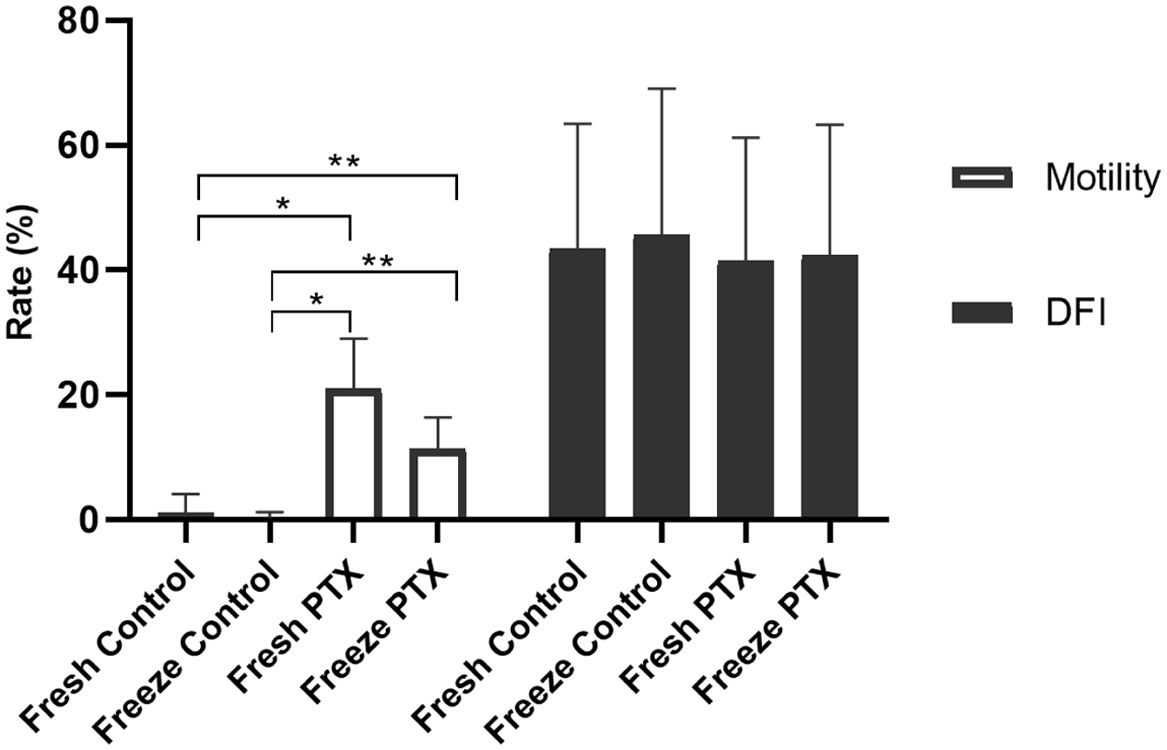
The mean sperm motilities before PTX treatment were 1.13 ± 2.99 and 0.33 ± 0.89 in fresh and frozen groups, respectively. After PTX treatment, the rates of motile spermatozoa in both fresh sperm (21.06 ± 7.92) and frozen sperm (11.46 ± 4.96) groups were significantly increased (P < 0.05) (Figure 3). There were no significant differences between the rates of motile spermatozoa in the fresh control and frozen control groups (P = 1.00), also between the fresh PTX and frozen PTX (P = 0.28) groups. Also, Mauchly’s sphericity test for DFI data gave a value of 0.574 (P = 0.217). According to the sphericality assumed test, there were no significant differences between the rates of DNA fragmentation in fresh and frozen samples in both control and PTX-treated groups (P = 0.291) (Figure 3). In addition, sperm DFI was not correlated with sperm motility (P > 0.05) (Pearson correlation: 0.01, P = 0.9).
Rates of sperm motility based on the Friedman test, there was a significant difference between groups (P < 0.05). Also, repeated measurements analysis of the DNA fragmentation, showing no significant differences between all groups (P > 0.05). Data are shown as bar graphs representing mean ± SD. Graphs were plotted using GraphPad Prism 8 software (GraphPad Software, Inc., La Jolla, CA, USA). Significance is shown as *P < 0.001 and **P < 0.05.

Clinical phase
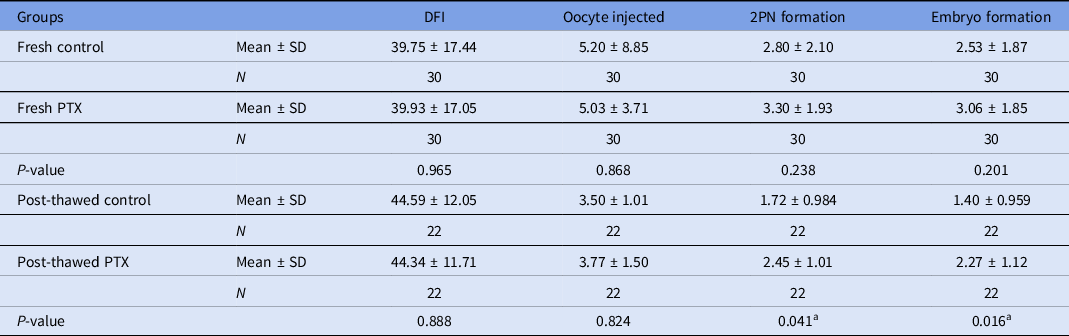
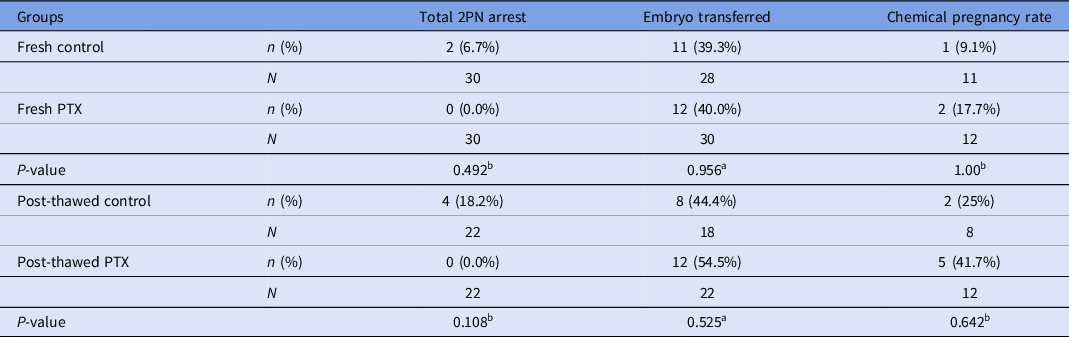
In both the fresh and post-thawed patient groups, there were no significant differences in DNA fragmentation between the control and the PTX groups (P > 0.05) (Table 1). As shown in Table 1, in both classes of patients, there was an insignificant difference in the number of oocytes injected between control and PTX groups. Overall, in the fresh TESE groups, there was no significant difference in the mean number of 2PN and embryo formation, total 2PN arrest and chemical pregnancy outcome of ICSI cycles between groups (P > 0.05). However, in the post-thawed TESE patients, there were significant differences in the number of 2PN and in embryo formation between groups (P < 0.05). Nevertheless, there was no significant differences in total 2PN arrest and chemical pregnancy of ICSI cycles (P > 0.05) (Table 2). Furthermore, there was no correlation between DFI and the number of 2PN and embryo formation, 2PN arrest, as well as chemical pregnancy.
Results of the Mann–Whitney test comparing DFI and clinical characteristics of embryos resulting from ICSI with non-treated and PTX-treated sperm cells

a Significance between groups (P < 0.05).
Results of the chi-squared test comparing pregnancy outcome of all transferred embryos resulting from ICSI with non-treated and PTX-treated sperm cells

a Pearson chi-squared test.
b Fisher’s exact test (P < 0.05).
Discussion
The findings showed that a 30-min incubation of testicular samples with PTX significantly increased sperm motility in both fresh and post-thawed samples without any detrimental effect on SDF, which agreed with findings of a previous study (Meseguer et al., Reference Meseguer, Santiso, Garrido, Gil-Salom, Remohí and Fernandez2009). Cryopreservation of testicular samples has many difficulties due to the very low concentration and motility of the sperm cells (Griveau et al., Reference Griveau, Lobel, Laurent, Michardière and Le Lannou2006). Furthermore, the success rate of this procedure has been limited because sperm freezing and thawing affect the vital parameters of spermatozoa (Nabi et al., Reference Nabi, Khalili, Fesahat, Talebi and Ghasemi-Esmailabad2017). Motility is one of the parameters that is extremely affected by cryopreservation. Reduction of sperm motility may be due to osmotic stress, intracellular ice crystal creation (Nabi et al., Reference Nabi, Khalili, Fesahat, Talebi and Ghasemi-Esmailabad2017) and damage to the mitochondrial membrane (Le et al., Reference Le, Nguyen, Nguyen, Nguyen, Nguyen, Nguyen and Cao2019). Application of PTX post freezing has been shown to recover the post-thaw motion of testicular specimens (Griveau et al., Reference Griveau, Lobel, Laurent, Michardière and Le Lannou2006; Xian et al., Reference Xian, Jiang, Liu, Zhao, Zhou, Liu, Liu and Li2022), which is consistent with our findings. The mechanism of PTX on sperm movement has not been fully recognized, but it appears that PTX increases the action of creatine kinase (Mahaldashtian et al., Reference Mahaldashtian, Khalili, Nottola, Woodward, Macchiarelli and Miglietta2021).
Conversely, the integrity of sperm chromatin is a valuable index of fertility potential (Zini et al., Reference Zini, Boman, Belzile and Ciampi2008). The SCD test provides a prognostic assessment for SDF in addition to terminal deoxynucleotidyl transferase dUTP nick end labelling (TUNEL) and sperm chromatin structure assay (SCSA) (Chohan et al., Reference Chohan, Griffin, Lafromboise, De Jonge and Carrell2006). Whereas TUNEL measures DNA damage, the SCD test measures damage after denaturation (Panner Selvam and Agarwal, Reference Panner Selvam and Agarwal2018). Our results indicated that PTX did not inflict any harmful effects on DNA fragmentation, which agreed with the findings in recent studies, indicating that PTX had no adverse effect on sperm chromatin/DNA fragmentation in TESA (Dutra et al., Reference Dutra, Scherer da Silva, Lazzari, Stein and da Cunha Filho2018) and asthenozoospermic (Asokan et al., Reference Asokan, Honguntikar, Uppangala, Salian, Kumar, Kalthur and Adiga2015; Nabi et al., Reference Nabi, Khalili, Fesahat, Talebi and Ghasemi-Esmailabad2017) patients. This may be due to the antioxidant characteristics of PTX (Chehab et al., Reference Chehab, Madala and Trussell2015) that, by preventing xanthine oxidase, decrease the levels of intracellular ROS formed by defective spermatozoa (McKinney et al., Reference McKinney, Lewis and Thompson1996). As mentioned previously, the consequences of cryopreservation on DNA fragmentation are still controversial (Di Santo et al., Reference Di Santo, Tarozzi, Nadalini and Borini2012; Le et al., Reference Le, Nguyen, Nguyen, Nguyen, Nguyen, Nguyen and Cao2019). After the freezing process, DFI increased in both control and PTX groups, but this increase was not significant. These results were similar to studies that indicated that cryopreservation does not impair the sperm genomic structure (Duru et al., Reference Duru, Morshedi, Schuffner and Oehninger2001; Rahiminia et al., Reference Rahiminia, Hosseini, Anvari, Ghasemi-Esmailabad and Talebi2017). Contradictory statements may be the result of different freezing methods and different tests used to assess DNA fragmentation (Di Santo et al., Reference Di Santo, Tarozzi, Nadalini and Borini2012). Recently, Rahimnia and colleagues compared different methods of cryopreservation in normal samples. Their data indicated that the vapour phase freezing method did not impair the sperm genome (Rahiminia et al., Reference Rahiminia, Hosseini, Anvari, Ghasemi-Esmailabad and Talebi2017). Spermatozoa have a high compartmentation structure, which results in a limited separation of proteins (Engel et al., Reference Engel, Springsguth and Grunewald2018). Furthermore, DNA in sperm cells is mostly protamine bound (Engel et al., Reference Engel, Springsguth and Grunewald2018), which could avoid DNA fragmentation to some degree.
When comparing clinical characteristics, a better outcome was surprisingly obtained in the post-thawed TESE group in terms of number of 2PN and embryo formation. We hypothesized that PTX can compensate for the detrimental effects of cryopreservation on spermatozoa. Use of frozen–thawed TESE specimens is usual in ART clinics, as it avoids multiple testicular surgeries (Griveau et al., Reference Griveau, Lobel, Laurent, Michardière and Le Lannou2006). However, the success rate of this procedure has been limited, as freezing and thawing expose the spermatozoa to various stresses that could lead to the loss of fertilization potential (Setti et al., Reference Setti, Braga, Iaconelli and Borges2021a). Griveau and co-workers reported that the ‘use of PTX in frozen–thawed testicular spermatozoa produces the same outcome after ICSI as that observed with fresh ejaculated spermatozoa’. This enhancement may be due to the selection of viable sperm cells (Griveau et al., Reference Griveau, Lobel, Laurent, Michardière and Le Lannou2006). Also, addition of PTX has led to improved spermatozoa–zona pellucida (ZP) binding and enhanced the acrosome reaction (Mehta and Sigman, Reference Mehta and Sigman2014).
However, Dutra and colleagues (Reference Dutra, Scherer da Silva, Lazzari, Stein and da Cunha Filho2018) reported that there was no correlation between spermatozoa movement and DNA fragmentation from TESA samples (Dutra et al., Reference Dutra, Scherer da Silva, Lazzari, Stein and da Cunha Filho2018). Some studies have reported that fragmentation in sperm chromatin is repaired to some extent by the oocyte, but negatively affects the clinical outcomes (Ferrigno et al., Reference Ferrigno, Ruvolo, Capra, Serra and Bosco2021). Nevertheless, there was no correlation between DFI and clinical characteristics and chemical pregnancy in our work. Our finding is in accordance with the Setti and colleagues (Reference Setti, Braga, Provenza, Iaconelli and Borges2021b) study that stated that when spermatozoa were injected into the oocytes of women less than 40 years old, there were insignificant differences in the laboratory and clinical results for cycles with SDF <30% or SDF ≥30%.
In conclusion, PTX enhanced sperm motility with no harmful effects on spermatozoa DNA integrity and ICSI outcomes. Therefore, it is recommended that the use of PTX is considered a safe method for sperm selection in NOA patients, especially in post-thawed ICSI cycles. This strategy provides an opportunity for patients to have their own children.
Acknowledgements
The authors thank the personnel of the andrology, research and ART laboratories at the Yazd Reproductive Sciences Institute for their excellent assistance throughout this research.
Conflict of interest
The authors state that no conflict of interest exists in this research.
Funding information
This study was supported by funding from Shahid Sadoughi University of Medical Sciences.