The allocation of cabinet portfolios among prospective coalition partners is at the heart of the coalition formation process. This is because the control of government departments is the most obvious and important – albeit not the only (Cutler et al. Reference Cutler, De Marchi, Gallop, Hollenbach, Laver and Orlowski2016: 42) – payoff for political parties in joining a coalition government (Ecker et al. Reference Ecker, Meyer and Müller2015; Raabe and Linhart Reference Raabe and Linhart2014). Since departments differ in the weight they carry in government policy as well as in their overall status and access to resources they provide, that payoff is not only the relative number of portfolios parties control but also their importance and seniority. Hence, there is both a quantitative and a qualitative dimension to portfolio allocation (Warwick and Druckman Reference Warwick and Druckman2006). At the coalition formation stage, political parties are therefore concerned with both how many and which ministries are allocated to them (Carroll and Cox Reference Carroll and Cox2007).
In this context, the department in charge of foreign affairs is among the most highly rated prizes of the coalition formation game. Apart from the office of prime minister, the foreign ministry ranks as one of the most senior portfolios in any government (Laver and Schofield Reference Laver and Schofield1998). There tends to be a broad consensus in the portfolio allocation literature about the ‘pecking order’ of government departments, and the foreign ministry is invariably included in lists of the most important departments (Lin et al. Reference Lin, Stevenson, Tromborg and Fortunato2017: 929–931). An expert survey in 14 Western European countries, for example, found that the foreign office was on average the third most salient portfolio, behind the office of the prime minister and the ministry of finance (Druckman and Warwick Reference Druckman and Warwick2005). In view of the growing politicization of foreign affairs (Zürn Reference Zürn2014) and the bigger scope for meaningful foreign policy choice in the post-Cold War era (Raunio and Wagner Reference Raunio and Wagner2017: 3–6), the electoral significance of the foreign office, if anything, might have further increased. While it is true that foreign ministries have lost some of their traditional exclusiveness in foreign policy and that more ministries have become involved in the field, the other side of the coin is that foreign ministries tend to remain the lead department in coordinating government foreign policy and increasingly deal with issues that reverberate in domestic politics (Greenstock Reference Greenstock2013: 107–9; Hill Reference Hill2016: 90–2; Hocking and Spence Reference Hocking and Spence2002). The expectation therefore is that parties will still often set their sights on the foreign ministry when they negotiate the allocation of portfolios in a coalition government.
At the same time, which party is in charge of the foreign ministry in a coalition matters for the foreign policies the coalition pursues. Contrary to the long-standing view that ‘politics stops at the water’s edge’, foreign policy is frequently contested between political parties (Rathbun Reference Rathbun2004: 1–14), and coalition partners also often disagree on foreign policy (Kaarbo Reference Kaarbo2017: 670). The distribution of ministries in the ‘foreign policy executive’ (Hill Reference Hill2016) between the partners, in turn, is the most fundamental parameter of how such disagreements are being resolved (Hagan Reference Hagan1993). Specifically, the party holding the foreign ministry can use the decision-making authority, agenda-setting power and informational advantages that come with its formal jurisdiction over the policy area to shape the coalition’s foreign policy according to its priorities (Laver and Shepsle Reference Laver and Shepsle1996). Control over the foreign ministry constitutes a path for ideologically committed junior partners to ‘hijack’ coalition foreign policy and push it into a more ‘extreme’ (more aggressive or more peaceful) direction (Kaarbo and Beasley Reference Kaarbo and Beasley2008).
Against this background, this article sheds light on the allocation of the foreign ministry at the coalition formation stage. This is relevant to our understanding of the foreign policy of coalition governments – the most common type of democratic government in Europe and worldwide (Oppermann et al. Reference Oppermann, Kaarbo and Brummer2017a: 458). Building on a review of the literature on coalition formation and portfolio allocation, the article develops hypotheses to explain under which conditions the foreign ministry is likely to go to a junior coalition partner. This contributes to the comparative politics literature on portfolio allocation in coalition governments and to existing research in foreign policy analysis on coalition foreign policy.
First, previous works on portfolio allocation have focused more on the quantitative than on the qualitative dimension of the topic. The key finding of this strand of research is that there is an almost one-to-one correspondence between the share of legislative seats a party brings into the coalition and the share of cabinet portfolios it receives as its payoff in the coalition formation game (‘Gamson’s law’), with a slight over-compensation for small coalition parties. Conversely, our understanding of qualitative portfolio allocation is much less developed. Despite growing acknowledgement that parties value different departments differently, exploring the portfolio-specific preferences of parties in coalition negotiations and their link to qualitative portfolio allocation has been singled out as ‘one of the most important pieces of unfinished business’ (Laver and Schofield Reference Laver and Schofield1998: 194) in the coalition formation literature. This gap has not yet been filled (Raabe and Linhart Reference Raabe and Linhart2015), and research on ‘who gets what’ in coalition negotiations very much remains the ‘ugly sister’ (Ecker et al. Reference Ecker, Meyer and Müller2015: 814) of studies on the quantitative distribution of portfolios. In particular, there is very little systematic work into the allocation of individual portfolios among coalition partners (Lin et al. Reference Lin, Stevenson, Tromborg and Fortunato2017: 929; for a notable exception, see Ecker et al. Reference Ecker, Meyer and Müller2015) beyond the unsurprising finding that the largest coalition partner is most likely to hold the office of prime minister (Warwick and Druckman Reference Warwick and Druckman2001). Virtually no work has specifically investigated the drivers behind the allocation of foreign ministries.
Second, the article contributes to the foreign policy analysis literature on coalition politics and foreign policy, which has focused on the foreign policy output of coalition governments and to a lesser extent on the process of coalition foreign policymaking (see Kaarbo Reference Kaarbo2012). As regards the former, the debate focuses on whether coalitions are internally constrained to pursue more moderate foreign policies than single-party governments or whether coalition foreign policy is rather more extreme (Beasley and Kaarbo Reference Beasley and Kaarbo2014; Hagan Reference Hagan1993), as well as on whether coalitions should be expected to pursue more peaceful or more conflict-prone foreign policies (Maoz and Russett Reference Maoz and Russett1993). With regard to the process of coalition foreign policymaking, the main issues are the effectiveness and quality of decision-making (Hagan et al. Reference Hagan, Everts, Fukui and Stempel2001) as well as the pathways of junior partner influence on coalition foreign policy. However, neither strand of this literature probes into the allocation of relevant departments in the foreign policy executive among coalition partners, but rather takes this allocation as a given starting point.
In methodological terms, the article uses qualitative comparative analysis (QCA). Emphasizing the context-specific importance of combinations of factors for producing results (Ragin Reference Ragin1987), QCA enables researchers to uncover causal relations between an ‘outcome’ and a certain number of ‘conditions’. More specifically, representing a set-theoretic approach that draws on Boolean algebra, QCA helps establish what are the necessary and sufficient conditions for an outcome to occur. Necessary conditions must be present whenever the outcome is observable. However, their presence does not guarantee the occurrence of the outcome; that is, there might be instances when the necessary condition is present but not the outcome. The outcome is thus a subset of the necessary condition. In turn, sufficient conditions are those that, if present, the outcome is also always present. However, the outcome might also occur as a result of other conditions. The outcome is thus a super-set of the sufficient condition. Moreover, an INUS condition is ‘an insufficient but necessary part of a condition which is itself unnecessary but sufficient for the result’ (Mackie, as quoted in Ragin Reference Ragin2008: 154). Thus, QCA highlights not only that one individual condition can lead to a certain outcome but also that certain ‘configurations of conditions can be jointly necessary and/or sufficient, while their constituent parts might be neither necessary nor sufficient for an outcome’ (Mello Reference Mello2012: 429). Overall, then, QCA enables us to identify combinations of factors that lead to the allocation of foreign ministries to junior coalition partners.
The remainder of this article is structured in two parts. First, it spells out a set of hypotheses about the allocation of the foreign ministry in coalition governments. Second, the article develops a research design to operationalize the hypotheses and to analyse the allocation of the foreign ministry in coalition governments in European parliamentary democracies.
Hypotheses on the allocation of the foreign ministry in coalition governments
The allocation of portfolios among parties during coalition negotiations can usefully be conceptualized as a two-stage process (Budge and Keman Reference Budge and Keman1990). This follows the common practice in the coalition formation literature to theorize portfolio distribution independent from the prior agreement, in principle, between parties to form a coalition (for a critical discussion, see Cutler et al. Reference Cutler, De Marchi, Gallop, Hollenbach, Laver and Orlowski2016: 32–5). At the first stage, each coalition partner lays claim to certain ministries. At the second stage, parties resolve competing claims by trading ministries and negotiate a weighted distribution of portfolios that is proportionate to the shares of legislative seats they bring into the coalition. The distribution of portfolios will likely follow a sequential process in which the most important departments, such as the foreign ministry, will be allocated first before the negotiations move on to lesser portfolios (Ecker et al. Reference Ecker, Meyer and Müller2015). In practice, the two stages are intertwined in that parties will probably formulate their portfolio claims in anticipation of what they can realistically hope to get in view of their relative size and the portfolio preferences of their coalition partners.Footnote 1
Against this background, different theoretical perspectives on coalition formation suggest five hypotheses about the allocation of the foreign ministry to a junior coalition partner, pertaining to: the relative size of coalition partners; their foreign policy positions; their party family; the relative salience of foreign policy to coalition partners; and past allocations of the foreign ministry. Each of these hypotheses can claim at least initial plausibility since they are all backed up by a well-established theoretical perspective on portfolio allocation in coalition cabinets and can invoke some empirical evidence in their support.Footnote 2
Moreover, there are likely to be various combinations of the factors, or conditions, which can be expected to affect the allocation of the foreign ministry that result in the same outcome – that is, the foreign ministry being obtained by junior coalition partners. This is what INUS conditions relate to. Indeed, the diverse set of factors and corresponding hypotheses deduced from the coalition formation literature and the interdependencies between these factors and hypotheses suggest that there will be multiple pathways featuring specific combinations of conditions for junior coalition partners to win control over the foreign ministry.
Hypothesis 1: A roughly similar seat share in parliament of the junior coalition partner compared to the senior coalition partner is an INUS condition for the allocation of the foreign ministry to the junior coalition partner.
Gamson’s law predicts that the share of portfolios which is allocated to a party corresponds to the share of legislative seats it brings into the coalition. It has been shown that this relationship also holds if departments are weighted according to their perceived standing and importance (Warwick and Druckman Reference Warwick and Druckman2006). The expectation would therefore be that larger parties in terms of seat share are more likely to receive the highest-ranking departments in a coalition government than smaller parties. First, the largest coalition parties will probably claim the largest share of leadership positions and the most important portfolios (Browne and Feste Reference Browne and Feste1975). Second, the proportionality principle in portfolio allocation dictates that large coalition parties will receive a large share of those departments they claim. Moreover, large parties are more likely to surrender less important ministries to their smaller coalition partners than give up one of the most valued departments (Browne and Franklin Reference Browne and Franklin1973). These expectations are borne out by empirical evidence, which shows that larger parties are indeed more likely than smaller parties to get their most preferred ministries (Ecker et al. Reference Ecker, Meyer and Müller2015: 810–11) and to control the most important portfolios in coalition governments (Bäck et al. Reference Bäck, Debus and Dumont2011).
Since the foreign ministry is one of the highest-ranking government portfolios, it follows that this department at first sight is unlikely to go to a junior coalition partner at all. However, the theoretical relationship between the relative size of coalition partners and the allocation of the foreign ministry is not straightforward. This is primarily due to the complications of deducing expectations about a specific department from more general predictions about overall portfolio allocation. Most notably, the Gamsonian logic has nothing to say about how coalition parties will trade similarly weighted ministries.
Indeed, the principle of proportionality between seat shares and weighted portfolio allocation suggests that the foreign ministry will under certain conditions be allocated to the largest junior partner of a coalition government. This hypothesis starts out from the empirical observation discussed above: that the prime ministership is in most coalition governments held by the senior partner, i.e. the largest coalition party. The office of prime minister, in turn, is of exceptional value to coalition partners and significantly more highly valued than any other portfolio (Druckman and Warwick Reference Druckman and Warwick2005). The proportionality principle may thus require the largest coalition party to compensate a junior partner with at least one senior department. This will be more likely in cases where the seat share of the second-largest coalition party is not significantly lower than the seat share of the largest party. Given its standing in most countries as the highest-ranked department after the prime ministership and the ministry of finance, the foreign ministry is a price the leading coalition party is likely to pay in order to secure the support of smaller coalition partners in the coalition formation game.
Hypothesis 2: Proximity in the foreign policy positions of junior and senior coalition parties is an INUS condition for the allocation of the foreign ministry to the junior coalition partner.
Coalition formation is marked by strong centripetal tendencies (Laver and Shepsle Reference Laver and Shepsle1996). A central position on important policy dimensions increases the chances of parties becoming part of a coalition government and is a key resource in coalition negotiations. Indeed, parties holding the weighted median position in a multidimensional policy space are often pivotal to coalition negotiations because no legislative majority will prefer any coalition which excludes this median party over coalitions which include it. What is more, policy centrality is closely related to size. For one thing, parties have better prospects of securing large shares of legislative seats if they occupy a central position in the policy space. For another, large parties are more likely to control the median legislator on key policy dimensions precisely because of their size (Laver and Shepsle Reference Laver and Shepsle1996).
Applied to the allocation of the foreign ministry among coalition partners, a first cut at this theoretical perspective suggests that the portfolio should go to the party which holds the median position on the foreign policy dimension. This is because the foreign policy this party can be anticipated to implement in office will be most likely to win the support of majorities in the legislature (Bäck et al. Reference Bäck, Debus and Dumont2011). Moreover, the odds are that the median party on foreign policy, given the close relationship between policy centrality and size, will also be the largest coalition partner.
Should the proportionality principle dictate that the senior coalition partner surrenders control over at least one major department, however, the smaller the foreign policy distance between the two parties is, the more likely is the senior coalition to leave the foreign ministry to a junior coalition partner (Browne and Franklin Reference Browne and Franklin1973). This is because the policy costs for the coalition leader from delegating responsibility for the foreign policy portfolio to a smaller coalition partner will be higher, the more different the foreign policy positions of the two parties are (Laver and Schofield Reference Laver and Schofield1998). Given that foreign policy decisions are often ideologically contested between political parties (Rathbun Reference Rathbun2004; Wagner et al. Reference Wagner, Herranz-Surrallés, Kaarbo and Ostermann2017: 21–3), this logic should not only apply to domestic portfolios. Moreover, ceding control over the foreign ministry to a smaller party under such conditions would imply the need for stronger control mechanisms and increase the monitoring costs of the leading coalition partner (Martin and Vanberg Reference Martin and Vanberg2004). Hence, policy positions that are close to the coalition leader should improve the chances of a junior partner obtaining the respective portfolio, even if it is not the median party in this regard. Since the largest coalition party, as discussed above, will probably occupy a centrist position in the policy space, junior coalition partners will be more likely to be allocated the foreign ministry if they hold centrist foreign policy positions themselves.
Hypothesis 3: The junior coalition party being a conservative party is an INUS condition for the allocation of the foreign ministry to the junior coalition partner.
Another strand in the coalition formation literature has investigated the link between the allocation of specific ministries and the party families of coalition partners (Budge and Keman Reference Budge and Keman1990). Specifically, belonging to a certain party family is expected to go hand in hand with distinct portfolio preferences, due to the ideologies and issue priorities of different party families as well as the expectations of grassroots and party supporters. Since coalition partners from different party families should thus value cabinet portfolios differently, there is scope for trading departments between coalition parties within the limits set by the proportionality principle. The existing empirical evidence broadly supports this line of argument to the extent that portfolios which are traditionally linked to a certain party family are significantly more likely to be claimed by and allocated to members of this party family (Bäck et al. Reference Bäck, Debus and Dumont2011).
With regard to the foreign ministry, the hypothesis is that this office will most likely go to conservative coalition partners. Since conservative party ideology is particularly concerned with preserving the existing order both domestically and internationally, and since it puts special emphasis on defending the national interest and prestige abroad, parties belonging to the conservative party family tend to put foreign affairs portfolios high on their list of preferences. Indeed, the foreign ministry and the ministry of defence have been listed among the second highest-ranking portfolios for conservative parties, after the interior ministry (Budge and Keman Reference Budge and Keman1990). From this perspective, therefore, conservative parties can be expected to claim the foreign ministries at the first stage of the portfolio allocation process. What is more, they are also likely to secure that portfolio at the second stage of the process insofar as the proportional allocation of ministries permits. This is because no other party family has the foreign ministry among its particular priorities for office and would thus be predisposed to challenge conservative claims for the foreign policy portfolio (Budge and Keman Reference Budge and Keman1990).
Hypothesis 4: The ascription of higher salience to foreign policy by the junior coalition party compared to the senior coalition partner is an INUS condition for the allocation of the foreign ministry to the junior coalition partner.
According to policy saliency theory, the qualitative allocation of government departments follows from the relative salience coalition partners attach to different policy dimensions (Laver and Hunt Reference Laver and Hunt1992). Specific ministries should go to those coalition parties which – depending on the specific political context rather than more general ideological and programmatic predispositions of party families – attach the greatest weight to the policy areas under the jurisdiction of the departments in question (Bäck et al. Reference Bäck, Debus and Dumont2011). This is because parties have a particular interest, either intrinsically or instrumentally with a view towards their electoral prospects, in controlling coalition policy on the policy fields which they have emphasized most in their party platforms and with which they have become linked in the public mind. Voters have been shown to use the topical affinity between ministries and policy areas that are most salient to a party as a heuristic to form expectations about which portfolios the party is likely to hold in a coalition (Lin et al. Reference Lin, Stevenson, Tromborg and Fortunato2017: 934). Even if foreign policy does not always surface as a salient electoral issue – although it not infrequently does (Oppermann and Viehrig Reference Oppermann and Viehrig2009: 933–7) – foreign affairs can thus become central to a party’s policy ‘brand’, and parties differ significantly in the salience they attach to foreign policy in their political strategy.
The prediction from the policy saliency framework for the allocation of the foreign ministry is that a junior coalition partner will likely obtain this portfolio if it attributes a higher salience to foreign policy than the senior coalition partner. Also, junior partners will be less likely to give up their claim to the foreign ministry in exchange for another portfolio, the more weight they give to foreign policy relative to other policy areas. The relative salience of policy fields to political parties, in turn, is most commonly being read off from the space the policies fill in their manifestos (Budge et al. Reference Budge, Klingemann, Volkens, Bara and Tanenbaum2001). Moreover, there is good quantitative and case study evidence that coalition parties are indeed more likely to win control over specific portfolios, the more salient they consider the respective policy areas to be (Bäck et al. Reference Bäck, Debus and Dumont2011).
Hypothesis 5: Past junior partner leadership of the foreign ministry is an INUS condition for the allocation of the foreign ministry to the junior coalition partner.
Coalition negotiations rarely start off with a completely clean slate. They are not one-off events but should be seen as iterated games in which experience with past coalition formations matters (Warwick Reference Warwick1996). Specifically, historical institutionalist reasoning would suggest that the allocation of ministries in previous coalitions creates expectations which serve as focal points in future coalition formations. Most notably, this may give rise to path dependencies in portfolio allocation to the extent that past coalition negotiations have established and reproduced clear patterns in this regard.
Along these lines, a junior partner will be more likely to get the foreign ministry at the coalition formation stage if previous allocations of the office have created strong expectations to this effect. This may be the case, most notably, if past portfolio allocations have established a ‘tradition’ of putting a particular party in charge of the foreign ministry. Junior partners that have often held this portfolio in previous coalition governments should thus have a greater likelihood of filling the post again in future coalition governments. While these expectations have yet to be systematically tested, they find some initial support from empirical findings in the broader coalition formation literature. Specifically, this evidence suggests that past government experience and a reputation for being a good and successful coalition partner increase the prospects of a party becoming a member of future coalition governments (Warwick Reference Warwick1996). Moreover, voters expect parties to receive departments in coalition negotiations which they have held in the past (Lin et al. Reference Lin, Stevenson, Tromborg and Fortunato2017: 930–5). It appears plausible, therefore, that allocations of the foreign ministry may be shaped by path dependencies.
Research design
To test these hypotheses, this article applies the method of QCA (see Ragin Reference Ragin1987, Reference Ragin2000, Reference Ragin2008; Rihoux and De Meur Reference Rihoux and De Meur2009; Schneider Reference Schneider2016; Schneider and Wagemann Reference Schneider and Wagemann2012). QCA is a case-oriented configurational comparative method in which ‘each individual case is considered as a complex combination of properties, a specific “whole” that should not be lost or obscured in the course of the analysis’ (Berg-Schlosser et al. Reference Berg-Schlosser, De Meur, Rihoux and Ragin2009: 6). As mentioned above, QCA emphasizes the context-specific importance of combinations of factors for producing results and enables researchers to uncover causal relations between an outcome and a certain number, as well as different types (necessary, sufficient, INUS), of conditions.
More specifically, this article engages in a comparative, cross-country analysis of parliamentary democracies in Europe (see below for details). With a total of 18 cases, the study addresses ‘an intermediate-N situation’ (Berg-Schlosser et al. Reference Berg-Schlosser, De Meur, Rihoux and Ragin2009: 4) for which QCA is ideally suited, as for instance Mathias Koenig-Archibugi (Reference Koenig-Archibugi2004) has demonstrated for Europe’s foreign and security policy or Adrián Albala (Reference Albala2017) for coalition formation and duration in presidential polities. More importantly, QCA is capable of grasping ‘causal complexity’ (Schneider and Wagemann Reference Schneider and Wagemann2012), which refers to equifinality and conjunctural causation. As the above-mentioned hypotheses suggest, for our research puzzle we expect to see multiple causal pathways leading to the same outcome (equifinality) as well as the effects of single conditions unfolding only in combination with other conditions (conjunctural causation). Hence, the outcome under scrutiny might indeed be caused by the kind of causal complexity that QCA is capable of grasping.
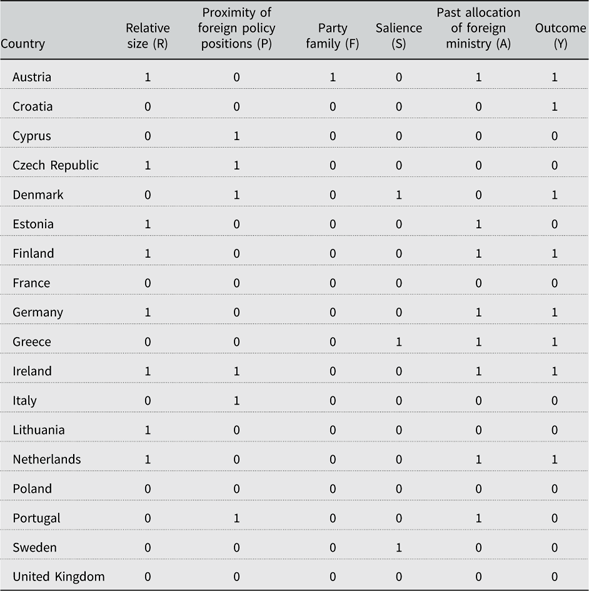
More specifically, the article engages in a crisp-set QCA (csQCA). While fuzzy-set QCA (fsQCA) is increasingly gaining prominence, csQCA is an established and widely used method (Rihoux and De Meur Reference Rihoux and De Meur2009; for recent applications see, for instance, Maatsch Reference Maatsch2014; Sager and Rielle Reference Sager and Rielle2013) that suits the research question at hand. First, as a special variant of fsQCA (one that only knows full membership or non-membership in sets), csQCA is also a method by which certain configurations of conditions can be discerned (Schneider and Wagemann Reference Schneider and Wagemann2012). Second, several of the conditions addressed in this article yield to a dichotomous classification of our cases, that is, the cases are either fully in or fully out of the set (for example, the junior coalition party belongs to the conservative party family or not). True, for some conditions fuzzy-set memberships could also have been devised. However, our hypotheses essentially focus on qualitative distinctions, or differences in kind, rather than on quantitative distinctions, or differences in degree (Schneider and Wagemann Reference Schneider and Wagemann2012). Therefore, we decided to use csQCA (for a similar argument, see Maatsch Reference Maatsch2014), whose dichotomization ‘forces the researcher to make a clear choice of threshold’, thus enhancing the ‘transparency’ of the research (De Meur et al. Reference De Meur, Rihoux and Yamasaki2009: 151). In this spirit, we specify as clearly as possible how (and where) the dichotomization thresholds, or cut-off values, for membership and non-membership for the respective conditions were set. Following Benoît Rihoux and Gisèle De Meur (2009), when we had to resort to mechanical cut-off points, the threshold was not placed in an area where many cases were located, in order to avoid dividing cases with similar values. Based on this information and the data matrix in Table 1, readers can judge the validity of our assignments.
Data Matrix

This article discusses parliamentary democracies in Europe. For many of the conditions under examination, information was drawn from the Manifesto Research on Political Representation (MARPOR) data set.Footnote 3 More specifically, we focus on coalition governments among EU member states as of 31 December 2014.Footnote 4 The recent cut-off date allows us to establish current patterns in the allocation of the foreign ministry within coalition governments, thus increasing the policy relevance of the findings. While we acknowledge that the analysis only captures a ‘snapshot’ in time, we hold that this does not preclude generalizations being drawn from our findings beyond the time frame under study. In particular, we are not aware of a straightforward theoretical case for why the political dynamics of portfolio allocation in modern European parliamentary democracies or the importance attached to foreign ministries in this process should have fundamentally shifted over recent years and decades. We thus do not expect our findings to suffer from a temporal bias.Footnote 5 It is also worth noting that the article represents the first systematic comparative study that zooms in on the allocation of foreign ministries and thus enables more extensive tests of our findings, including over time and in different world regions. Moreover, the empirical focus of the article on Europe is well suited to our primary interest in theory development. This is because the prevalence of coalition governments in a geographically confined as well as politically and culturally largely homogenous area provides an ideal testing ground for our hypotheses.
However, out of the EU’s 28 members, 10 countries were not included in the analysis. Three member states (Malta, Slovakia, Spain) were not governed by a coalition government at the end of 2014 (Bågenholm et al. Reference Bågenholm, Deegan-Krause and Weeks2015). In two instances (Bulgaria, Romania), the foreign ministers were independents and thus belonged to neither the senior nor the junior coalition party. The coalitions in Luxembourg and Belgium did not, for different reasons, allow for a meaningful differentiation between senior and junior coalition partners. For two countries (Latvia, Slovenia) the MARPOR data set contained no information on the respective senior coalition party.Footnote 6 Finally, in the case of Hungary the senior party and the largest junior coalition party (Fidesz, KDNP) ran on a joint platform and were thus not listed separately in the MARPOR data set. This leaves us with a total of 18 cases, out of which the foreign ministry went to a junior coalition party in eight cases (‘positive cases’) and in 10 cases did not (‘negative cases’), providing a sufficient degree of heterogeneity.Footnote 7 Within the EU context, our analysis covers the full universe of available cases and is thus not susceptible to a selection bias.
Our outcome measures the allocation of the foreign ministry in coalition governments (Y). More precisely, we are interested in the conditions under which the foreign ministry is being taken over by a junior rather than the senior party in a coalition government. The senior coalition party is defined as the largest party in the coalition based on the number of seats in parliament that also holds the prime ministership. Conversely, a junior coalition party has fewer seats in parliament than the senior coalition party and does not fill the prime ministership. The outcome is measured by the party affiliation of the foreign minister. It is scored as 1 when the foreign ministry is taken over by a member of the junior coalition party, and 0 when the department goes to a member of the senior coalition party. Data on the existence and composition of coalition governments as of 31 December 2014 were taken from the European Journal of Political Research Data Yearbook (Bågenholm et al. Reference Bågenholm, Deegan-Krause and Weeks2015). In addition, we consulted the homepages of national parliaments and governments to establish senior and junior coalition parties and the party affiliation of foreign ministers.
Our hypotheses point to five theory-informed conditions with a possible impact on the allocation of the foreign ministry to a junior coalition party: the relative size of the junior party compared to the senior party (R); the proximity of the foreign policy positions of senior and junior coalition parties (P); the party family of the junior coalition party (F); the salience ascribed to foreign policy by the coalition parties (S); and the past allocation of the foreign ministry to the junior coalition party (A).Footnote 8
The relative size of the junior party compared with the senior party (R) is measured by the ratio of seats held in parliament by the junior coalition party compared with the senior coalition party. Data were gathered from the European Journal of Political Research Political Data Yearbooks and from homepages of national parliaments. The distribution of the values for the cases reveals a ‘gap’ in the area where the junior coalition party holds between 39% and 58% of the number of seats compared to the seats held by the senior party. In order to avoid separating cases with similar values, we established the dichotomization threshold at 57% of the seats, with 1 (0) being assigned when the junior party holds more (less) than 57% of the number of seats held by the senior party.
The proximity of the foreign policy positions of senior and junior coalition parties (P) is established through comparisons of the foreign policy positions of the coalition parties as laid down in their election manifestos for the most recent national election. Data were drawn from the MARPOR database.Footnote 9 More precisely, we focused on indicators 101 to 110 that cover foreign policy related statements. The indicators pick up on positive and negative statements on ‘special relationships’ (101/102); the military (104/105); ‘internationalism’ (107/109); and the ‘European Union’ (108/110); as well as negative statements on imperialism (‘anti-imperialism’, 103) and declarations on the belief in ‘peace’ (106). For comparative purposes, we calculated the absolute score for positive and negative statements for each of the above-mentioned four pairs of indicators (101/102; 104/105; etc.). We then compared the positions of the senior and junior party along the six dimensions (special relationships; anti-imperialism; etc.) covered in the data set. Similar positions were ascribed when the difference between the respective scores was less than a third. When the senior and junior parties exhibited similar positions in three or more dimensions we judged them as having high proximity in their foreign policy positions (score=1); if they showed similar positions in two or dimensions or fewer, the score was 0. The theoretical intuition behind this operationalization is that the threshold needed to be sufficiently demanding to qualify as a meaningful indicator of proximity without being too restrictive.
The third condition addresses the party family (F) affiliation of the junior party. Data were taken from the MARPOR database. If the junior party is coded as ‘CON’ (conservative party) in MARPOR it scored 1; if not, 0.
The salience (S) ascribed to foreign policy by the coalition parties is measured by the total number of foreign policy statements found in the election manifestos of the respective parties. Again, data were drawn from indicators 101 to 110 of the MARPOR database.Footnote 10 We aggregated the scores for each indicator to a total score that represents the overall amount of attention the parties devoted to foreign policy related issues. The more extensively parties address foreign policy issues in their manifestos, the more salience they attach to this field. In the values distribution among the cases, there are several ‘gaps’, with the most important for our purposes being the one where junior parties devote a similar amount of attention to foreign policy related issues as the senior partner (up to 1.15 times as much) compared with cases where they devote a significantly larger share of their manifestos to foreign policy than the senior partner (at least 2.4 times as much). Therefore, if a junior party devotes more than twice as much attention in its manifesto to foreign policy issues, it received a score of 1; if not, the score is 0.
The past allocation of the foreign ministry to the junior coalition party (A) is measured by the number of times parties held the portfolio in previous democratically elected governments. Data were gathered from the European Journal of Political Research Political Data Yearbooks and the websites of governments and parties of the respective countries. Since several EU members democratized only in the 1970s (Spain, Portugal, Greece)Footnote 11 or after the end of the Cold War (Central and Eastern European as well as Balkan countries), we differentiate between those ‘newer’ democracies and longer established democracies. For the latter group (for example, the six founding members of today’s EU), we require junior coalition parties to have held the foreign ministry portfolio at least twice for the effects of path dependencies to kick in, and thus for scoring 1 (if not, 0); for the other countries, junior parties that held the portfolio at least once before are scored 1 (if not, 0). The data matrix shown in Table 1 provides the results of our coding.
Analysis and results
We now turn to the empirical results for the analysis of the outcome (that is, the junior coalition party taking over the foreign ministry).Footnote 12 The analysis shows that none of the single conditions (or their negations) is necessary for obtaining the outcome (see Table 1). This (non-)finding confirms our initial expectation that our research puzzle is marked by significant causal complexity. The conditions we have explored were derived from diverse and partly competing theoretical literatures in coalition politics, suggesting a range of causal mechanisms through which portfolio allocation in coalition governments can take shape. Regarding the allocation of the foreign ministry, our analysis shows that none of these literatures can claim to have identified a condition that has to be present for this ministry to go to junior coalition partners. No theoretically plausible condition is present in every causal pathway leading to this outcome. In other words, none of the main theoretical drivers of portfolio allocation in coalition governments stands out as the sine qua non in explaining the allocation of the foreign ministry to a junior coalition partner.
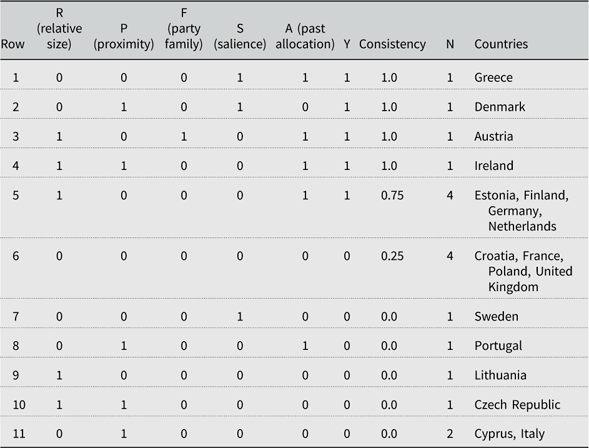
The analysis now turns to the exploration of sufficient conditions for the outcome. To this end, a truth table (see Table 2) was created using the fsQCA 2.5 program based on the crisp-set membership scores for the conditions and the outcome.Footnote 13 The rows of the table show configurations of our five conditions, with the conditions being linked by a logical AND. Since we are using five conditions, a total of 32 rows (2k rows, with k being the number of conditions) is logically possible. However, Table 2 contains only those 11 rows to which at least one of our empirical cases could be assigned. The other 21 possible rows represent logical remainders – that is, truth table rows that do not contain sufficient evidence, with the threshold typically being a minimum of at least one case per row. Using the complex, or conservative, solution term to treat those logical remainders (Schneider and Wagemann Reference Schneider and Wagemann2012), which focuses exclusively on the available empirical information (that is, whether at least one case can be assigned to a row), we refrain from making any assumptions about the sufficiency of the conjunctions shown in these rows for the outcome. As a result, those conjunctions are not displayed in the table or considered in the Boolean minimization process.
Truth Table for the Outcome (Y)

Two of the rows (rows 5 and 6) reveal contradictions, in the sense that the members/cases ascribed to the respective rows do not share the same outcome. To solve this contradiction, we follow Carsten Schneider and Claudius Wagemann (Reference Schneider and Wagemann2012: 122), who suggest taking into account the degree to which a contradictory truth table row ‘deviates from a perfect set relation’. In our case, in row 5 three of the four cases (0.75 consistency) share the membership score in the outcome, whereas only one out of four cases covered in row 6 exhibits the outcome (0.25 consistency). The configuration of conditions displayed in row 5 is thus much more consistent ‘with the assertion that it is a sufficient condition for the outcome’ (Schneider and Wagemann Reference Schneider and Wagemann2012: 122). Therefore, we attributed the outcome (score=1) to row 5 but not to row 6 (score=0). In Table 2, the consistency scores for each row are shown, which highlight the degree to which the conjunction of the conditions of the respective row is sufficient for the outcome and is thus in accordance with the empirical evidence.
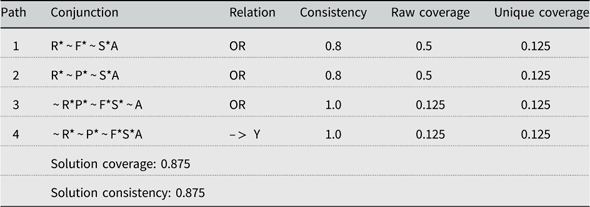
Next, a logical minimization process using Boolean algebra of the conjunctions, or primitive expressions, contained in the truth table was conducted with the fsQCA program. This led to a complex solution term towards the outcome comprising four paths. Those paths are shown in Table 3, together with the respective scores for coverage and consistency. Taken together, the complex solution term exhibits a consistency of 0.875 (solution consistency) and coverage of 0.875 (solution coverage).
Complex Solution Terms (Sufficient Conditions) for Outcome (Y)*

Note: * Raw coverage refers to the proportion of outcomes (Y) covered by the respective path/term. Unique coverage refers to the proportion of outcomes (Y) uniquely/exclusively covered by the respective path/term – that is, positive cases that are only covered by this path/term. Solution coverage refers to the proportion of cases covered by all terms/paths.
Three results of our analysis of sufficient conditions for the allocation of the foreign ministry to junior coalition partners are particularly noteworthy. First, two of the four pathways towards the outcome (paths 1 and 2) are driven by the presence of junior coalition partners which control a roughly similar seat share in parliament to the senior partner (R) and which have held the foreign ministry in the past (A). In both pathways, these two conditions are the only ones for which it is theoretically plausible that they contribute to the outcome. In contrast, the other conditions which are part of the first two pathways (~F and ~S in the first path; ~P and ~S in the second path) should rather be expected, if they have any effect at all, to work against the allocation of the foreign ministry to junior coalition partners. The two pathways also have the highest raw coverage of the four pathways. In fact, what is striking is that in our truth table for the outcome (Table 2) each configuration for which the scores for R and A are 1 also scores 1 on the outcome, irrespective of the other three conditions. Our results thus provide strong support for the theoretical arguments in the portfolio allocation literature that the relative size of the junior partner (Hypothesis 1) and its record of having led the foreign ministry in the past (Hypothesis 5) matter greatly for the junior partner being allocated the foreign ministry in coalition negotiations.
Second, the other two pathways to the outcome we have identified (paths 3 and 4) suggest that junior partners which do not hold a roughly similar seat share in parliament compared with the senior partner (~R) have to ascribe a higher salience to foreign policy than the senior partner (S) in order to be allocated the foreign ministry. In both pathways, the higher relative salience attached to foreign policy by the junior partner is one of two theoretically plausible drivers of the outcome, being complemented either by the proximity of the foreign policy positions of junior and senior partners (P) or by past junior partner leadership of the foreign ministry (A). This confirms the expectations of policy salience theory (Hypothesis 4). What is more, our results appear to point to a substitution effect between the relative size of the junior partner and the salience it attaches to foreign policy. In coalition negotiations, the necessary bargaining power of junior partners to secure the foreign ministry has to come from either the share of seats they bring into the negotiations (Hypothesis 1) or the importance they attach to foreign policy and thus the intensity of their preference for the foreign ministry (Hypothesis 4).
Third, our results provide strong support for the significance of path dependency in portfolio allocation (Hypothesis 5). Indeed, the condition of past junior partner leadership of the foreign ministry (A) is present in three of the four pathways towards the outcome, more than any of the other conditions. This suggests that the allocation of the foreign ministry in coalition negotiations does not follow a pure bargaining logic that is determined fully by the negotiation resources the coalition partners bring to the table. Rather, previous allocations of the foreign ministry to a junior partner become a focal point in coalition negotiations which privilege the junior partner in future allocations of the portfolio. The only pathway towards the outcome (path 3) which does not involve the condition of past junior partner leadership of the foreign ministry (~A) depends on the quite demanding combination of proximal foreign policy positions of the junior and senior partner (P) and the junior partner ascribing higher salience to foreign policy than the senior partner (S). This is also the only pathway to the allocation of the foreign ministry to a junior partner in which the condition of the proximity of junior and senior party positions in foreign policy is present (P). Overall, our analysis does therefore not lend much support to theoretical arguments in the portfolio allocation literature which focus on the policy distance between the senior and junior partner (Hypothesis 2).
Conclusion
This article examined the reasons for the foreign ministry being taken over by a junior party of a governing coalition rather than the senior coalition party. Drawing on the theoretical literatures on coalition politics, we identified five factors (conditions) proposed as explanations for the allocation of the foreign ministry to junior coalition parties. Those conditions are: the relative size of the coalition parties; the proximity of the foreign policy positions of the coalition parties; the party family of the junior coalition party; the salience ascribed to foreign policy by the coalition parties; and the past allocation of the foreign ministry to the junior coalition party.
The empirical part of the article, which employs csQCA, confirms our initial expectations that the phenomenon under scrutiny is marked by significant causal complexity, referring to equifinality (multiple causal pathways leading to the same outcome) and conjunctural causation (the effects of single conditions unfolding only in combination with other conditions). Rather than pointing to one or another explanatory condition, the empirical analysis demonstrates that the allocation of the foreign ministry to junior coalition parties can only be explained through a complex interaction of conditions. Indeed, not a single condition passed the test of necessity. Regarding the test of sufficiency, four different paths comprising different combinations (conjunctions) of the conditions are identified. Although the conjunction of the relative size of the junior partner and its record of having led the foreign ministry in the past is not sufficient by itself, the analysis offers strong support for theoretical arguments around these two factors (Hypothesis 1, Hypothesis 5). In addition, though, the results seem to point to a substitution effect between the relative size of the junior partner (Hypothesis 1) and the salience it attaches to foreign policy (Hypothesis 4). Having said that, the results provide little support for theoretical accounts that emphasize the proximity between the foreign policy positions of the junior and senior partner (Hypothesis 2) and no support for an effect of party family (Hypothesis 3).
These findings should be seen as the starting point for a forward-looking research agenda which takes different methodological routes to interrogate and refine the results of our study. First, quantitative studies can test our argument in a large-N setting, extending both the time frame and geographic scope of the article. Second, qualitative case studies on coalitions representing the four pathways towards the outcome would promise to improve our understanding of the processes through which the interplay of different conditions shapes allocations of the foreign ministry. Similarly, case studies which explore in more depth the ‘outlier’ cases identified in this article might clarify the scope conditions under which our argument holds, shed more light on possible exceptions and help further refine our theoretical argument. Such research should also include parliamentary democracies in non-Western settings in order to establish whether similar dynamics are in place in the Global South. Third, future research might want to explore whether the allocation of other high-profile portfolios to junior coalition parties, such as the finance ministry or the home office, follows similar pathways to the allocation of the foreign ministry. To this end, it would be useful to replicate our analysis for other ministries or to compare the allocation of different portfolios within single countries.
Supplementary material
To view supplementary material for this article, please visit https://doi.org/10.1017/gov.2018.19