One of the more entertaining pastimes during the presidential campaign is the “veepstakes,” or speculation about who the presidential nominee will select for a running mate. While much of this speculation occurs after the nomination has been decided (Alter Reference Alter2004; Feldmann Reference Feldmann2004; Kennedy Reference Kennedy2004; Lehigh Reference Lehigh2004; Starr Reference Starr2004), speculation about the 2008 selections had begun as early as 2007 (Cain Reference Cain2007; Klein Reference Klein2007; Mackowiak Reference Mackowiak2007; Sanderson Reference Sanderson2007). Most are grounded in a good understanding of what presidential candidates look for in a running mate, but one writer has not unfairly referred to the veepstakes as a “largely fact-free parlour game” (Harding Reference Harding2004).
Perhaps there is a better way. After all, we have long understood the basics of vice presidential selection. This understanding has come to us by way of practitioners, observation of vice presidential candidates in the past, and even some few scholarly studies (e.g., Goldstein Reference Goldstein1982; Sigelman and Wahlbeck Reference Sigelman and Wahlbeck1997; Mayer Reference Mayer and Mayer2000). Moreover, political scientists are no strangers to predictive models, especially those dealing with presidential elections. For example, the October 2004 issue of this journal featured seven forecasting models of the 2004 election; this issue, of course, features 10 such articles. Many of the participants in that symposium also contributed to an edited volume forecasting the 2000 presidential election (Campbell and Garand Reference Campbell and Garand2000) as well as to the October 1996 issue of American Politics Quarterly dealing with the election of 1996.Footnote 1
In this paper I first present a model of vice presidential selection dealing with election cycles from 1960 to 2004. The model builds off of an earlier study by Sigelman and Wahlbeck (Reference Sigelman and Wahlbeck1997). I employ conditional logit to identify significant factors in the selection of the 18 vice presidential candidates during this time period from an overall list of 123 possible running mates. Unlike presidential forecasting models, the analysis relies on individual-level data, namely, characteristics of the presidential and vice presidential candidates. After the model is presented I extend the analysis to include possible Republican and Democratic vice presidential candidates for 2008, generating predicted probabilities to identify the likely selections of Barack Obama and John McCain.
Why should we care about vice presidential selection? Beyond being the constitutional successor to the president in the event of a presidential vacancy, vice presidents play an increasingly important role, formally or otherwise, in their presidents' administrations (Goldstein Reference Goldstein1982; Light Reference Light1984; Nelson Reference Nelson1988; Hatfield Reference Hatfield1997; Baumgartner Reference Baumgartner2006b). This is in sharp contrast to the nineteenth-century vice presidency. It matters who becomes vice president, and therefore it is important to understand the factors that influence their selection.
Vice Presidential Selection: What We Know
Very little empirical research examines what presidential candidates look for in a running mate. Textbook (Keefe and Hetherington Reference Keefe and Hetherington2003; Wayne Reference Wayne2004; Polsby and Wildavsky Reference Polsby and Wildavsky2004), journalistic (e.g., White Reference White1961; Thomas Reference Thomas2005), and scholarly (e.g., Ceaser and Busch Reference Ceaser and Busch2005; Nelson Reference Nelson2005) accounts of different campaigns usually devote only a few pages to the question. Most of our understanding comes from observation of the characteristics of previous vice presidential candidates.
Historically, vice presidential selection has been driven by electoral concerns (Goldstein Reference Goldstein1982, 66). In the nineteenth century, “the principal criterion for evaluating vice presidential contenders was whether they brought additional votes to the party's presidential ticket” (Mayer Reference Mayer and Mayer2000, 325). The size of the vice presidential candidate's home state was one of the factors in this regard. From 1804 through 1900 the average state had 3.6% of available Electoral College votes, while the average for vice presidential candidates' home states was 7%.Footnote 2
Selecting a vice presidential candidate from a region of the country different than that of the presidential candidate has also been a norm (Goldstein Reference Goldstein1982). For example, from 1844 to 1916 there was only one regionally unbalanced ticket (Mayer Reference Mayer and Mayer2000). This norm has continued into the modern era, with the notable recent exception of Bill Clinton and Al Gore, both southerners. Relatedly, the selection often provided ideological (or factional) balance as well. The federal organization of the U.S. party system all but guarantees that the major parties will have internal divisions based on ideological, regional, or other differences (Polsby and Wildavsky Reference Polsby and Wildavsky2004, 132; Nelson Reference Nelson1988, 859). The vice presidential selection was often made to provide “some support, consolidation, or recognition to those interests and factions within the party that had not prevailed in the presidential balloting” (Bryce Reference Bryce1893, 865; see also Mayer Reference Mayer and Mayer2000, 326).
However, the vice presidential selection process has changed throughout the twentieth century (Mayer Reference Mayer and Mayer2000), and other factors have emerged as being important. The list of factors that seem to be considered has grown, probably diminishing the overall impact of the historical factors while making the calculus used in the selection process more complex.
For example, it might be the case that the number of Electoral College votes a potential candidate could bring to the ticket is weighed against the likely ability to carry that state. Although presidential tickets have carried the home state of the vice presidential candidate 17 of 24 times (71%) since 1960, coming from either a safe state or a state the ticket has no chance of winning would seem to offer no electoral advantage. On the other hand, selecting a running mate from a competitive state might boost the ticket's chances of winning that state.Footnote 3
In the primary era, having been a rival of the eventual nominee in the presidential nomination contest is thought to negatively affect one's chances to win the vice presidential nomination. While it is popular to speculate that other primary opponents, especially those who have run especially well, will be selected as the presidential nominee's running mate, this is the exception rather than the rule. This is mainly due to the fact that presidents in the modern era value loyalty in their vice presidents (Light Reference Light1984, 233–4), which cannot be assumed from a bitter rival. This explains why George W. Bush reportedly never seriously considered John McCain in 2000 (Mitchell and Brunei Reference Mitchell and Brunei2000). Those who have been selected (e.g., George H.W. Bush in 1980, John Edwards in 2004) could probably not be characterized as having been bitter rivals, since they toned down their campaign rhetoric soon after it became clear that they would not receive the nomination.Footnote 4 Sigelman and Wahlbeck's (Reference Sigelman and Wahlbeck1997) analysis confirms the negative effect that rivalry for the nomination has on vice presidential selection.
Bringing demographic balance to the ticket in terms of gender, race, or religion may be a plus as well (Sigelman and Wahlbeck Reference Sigelman and Wahlbeck1997). Age also seems to matter, either in terms of balancing (Sigelman and Wahlbeck Reference Sigelman and Wahlbeck1997) or simply adding youth to the presidential ticket (Watson and Yon Reference Watson and Yon2006). Other factors that may be important are education (Baumgartner Reference Baumgartner2006a) and having served in the military (Watson and Yon Reference Watson and Yon2006). Those individuals who add Washington insider-outsider balance to the ticket are thought by some to have a greater chance of being selected (Sigelman and Wahlbeck Reference Sigelman and Wahlbeck1997). This may be especially important when the president is an outsider, as many recent U.S. presidents have been.
An additional consideration, largely ignored in the literature, is exposure in the national media. In the first instance this is important because greater media exposure typically translates into greater name recognition. Scandals aside, this could add electoral appeal to the ticket in many (though certainly not all) cases (Wayne Reference Wayne2004, 124). In addition, because the vetting process for potential vice presidential candidates has become more intensive since the Eagleton affair in 1972, the media now plays an important, if informal, role in this process. Since “no presidential candidate has the resources to fully research every aspect of a potential vice president's background … [presidential] nominees have increasingly in recent years turned to … people who not only have been fully investigated but also have extensive experience dealing with the national media” (Polsby and Wildavsky Reference Polsby and Wildavsky2004, 132). We can assume, for example, that most presidential candidates remember the bad press generated by the selection of the then largely unknown Geraldine Ferraro in 1984 or Dan Quayle in 1988 (Baumgartner Reference Baumgartner2006b, 85–6).
A final factor, again mostly ignored in the literature, is the issue of experience.Footnote 5 As noted earlier, the selection of vice presidential candidates is driven primarily by electoral considerations (Miller Center Commission 1992; Watson and Yon Reference Watson and Yon2006). However, with so much attention paid to the veepstakes, “the presidential candidate who pays insufficient attention to competence … pays a price” in the campaign (Nelson Reference Nelson and Nelson1997, 68). One need only recall the storm surrounding the selection of Dan Quayle in 1988 to understand this. Of course, it is not necessarily the case that experience translates into competence, but few would argue that a lack of experience makes one more competent. Therefore, it is reasonable to assume that presidential candidates factor the issue of experience into their selection calculus.
A few other “desirable qualities the presidential nominee lacks” (Polsby and Wildavsky Reference Polsby and Wildavsky2004, 129) are sometimes mentioned as important in the selection of a running mate, but most are specific to particular presidential candidates. For example, Al Gore brought a reputation as a family man to the Clinton ticket in 1992; Jack Kemp brought energy to the Dole campaign in 1996; Joe Lieberman added a certain morality, if not piousness, to Gore's effort in 2000; and the charismatic John Edwards balanced Kerry's somewhat wooden style in 2004. However the above list covers the main factors mentioned in various accounts of what presidential nominees are looking for in a running mate.Footnote 6
Modeling the Vice Presidential Selection
Using the above candidate characteristics, I constructed a model examining vice presidential selection. The model focuses on the individual-level decision making of presidential candidates, and thus begins with the election of 1960. The last time the choice of vice presidential candidate was made by the party convention was in 1956, when Democratic presidential candidate Adlai Stevenson II announced he would defer to the convention for the choice of his running mate. Since then, while any number of actors may be involved in selecting the running mate, the final decision is made by presidential candidates themselves (Mayer Reference Mayer and Mayer2000).
Restricting attention to the two major parties and excluding cases where an incumbent vice president was running for reelection, there were 18 cases of vice presidential selection during this time period. To identify potential candidates from 1960 through 1992 I relied on Sigelman and Wahlbeck (Reference Sigelman and Wahlbeck1997), the only empirical analysis of vice presidential selection I could find in the literature. To identify candidates from 1996 through 2004 I first consulted various scholarly and journalistic sources (including Woodward Reference Woodward1996; Ceaser and Busch Reference Ceaser and Busch1997; Reference Ceaser and Busch2001; Reference Ceaser and Busch2005; Singular Reference Singular2000; Fiedler Reference Fiedler and Sabato2002; Brewer Reference Brewer and Sabato2005; Burden Reference Burden and Nelson2005; and Thomas Reference Thomas2005). I then crosschecked the resultant list against a variety of news reports published within the last week prior to the announcement of the vice presidential nominee that cited campaign sources and made specific references to “short lists” of vice presidential possibles. Because this method of case selection relies on anecdotal evidence, some potential candidates may have been missed, but the resultant list in all likelihood is fairly reliable (Sigelman and Wahlbeck Reference Sigelman and Wahlbeck1997, 859). In total, I identified 123 potential vice presidential candidates from 1960 to 2004.Footnote 7
I used various biographical and other works as data sources for candidate characteristics.Footnote 8 In some cases operationalization was fairly straightforward, including size of the candidate's home state (number of electoral college votes), age at the time of the election year, and military service (a dummy variable). Regional balance was coded 1 if presidential and vice presidential candidates were from different regions (North, South, Border, Midwest, West, and Pacific), or 0 if they were from the same region.Footnote 9 To measure whether a candidate came from a competitive state I averaged the difference (using absolute values) between the percentage of Democratic and Republican presidential vote in the state for the previous three elections. Here, a smaller value is indicative of a more competitive state, and so the effect of this variable should be negative.
To measure ideological balance, I first coded presidential and vice presidential candidates as liberal, moderate, or conservative, relying on Sigelman and Wahlbeck's (Reference Sigelman and Wahlbeck1997) classification for candidates from 1960–1992. For the years 1996 to 2004 I consulted thebiographical sources mentioned above to find qualitative assessments of candidate ideology.Footnote 10 If the presidential and vice presidential candidate were not of the same ideological family (e.g., a liberal and a moderate), the ticket was coded as ideologically balanced (1).
I measured demographic balance by determining if both candidates were (non-Hispanic) white male Protestants. If either—but not both—candidate lacked any of these qualities, the ticket was coded as 1. Education was measured on an ordinal scale, coded 0 if the candidate did not have a four-year college degree (one case), 1 for a four-year college degree (28 cases, or 22.8%), and 2 for any post-undergraduate education (94 cases, or 76.4%).
I originally constructed an insider-outsider balance dummy variable based on the last office held by each candidate, but this proved to be insignificant in any model I ran. Therefore I constructed two separate dummy variables that captured whether the candidate's last public office was as governor (outsider) or U.S. senator (insider). Although this does not capture insider-outsider balance as such, it seemed like a reasonable strategy to capture this aspect of the selection process since most vice presidential candidates seem to be drawn from one of these offices (especially the latter).Footnote 11
Sigelman and Wahlbeck (Reference Sigelman and Wahlbeck1997) included two variables in their analysis measuring whether the presidential and prospective vice presidential candidate had ever been rivals for the presidential nomination. I used one of these (rivals, a dummy variable) as is, coding it as 1 if the vice presidential candidate challenged the presidential nominee for the nomination in the election cycle in question. I expanded on their second rivals variable, which measured presidential rivalry in any previous election cycle, to include whether the vice presidential candidate had ever run for the presidency, or, been considered for the vice presidential nomination in any previous election cycle. This would raise their public profiles, potentially adding to their electoral appeal. In addition, it would signal other political actors of their desire or ambition for higher public office. Thus, the effect of this “ambition” variable should be positive.
I measured exposure in the national media by searching the archives of Time magazine (http://www.time.com) and the New York Times (http://www.nytimes.com) for the individual's name from January 1 of the year prior to the election through June 30 of the election year. I then recorded the number of stories, and since there was considerable variation, standardized the scores. The two standardized scores were then added to create an index of media exposure.Footnote 12 Finally, I counted the total number of years the candidate served in various levels of public office (either elected or appointed) through the year of the nomination. These included all levels of subnational office, the House of Representatives, the U.S. Senate, and other national government office.
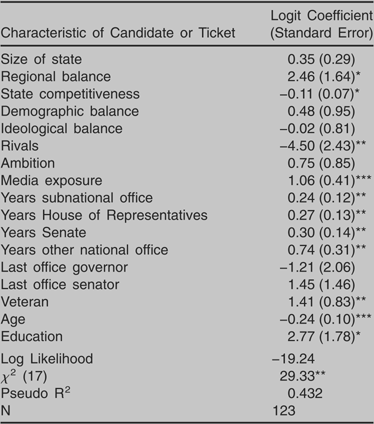
The resultant model is admittedly less than parsimonious.Footnote 13 My expectations are that all of the variables except state competitiveness, rivals, and age should have a positive effect on vice presidential selection. I tested the model using conditional logit, which estimates effects within predefined strata (e.g., Democrats, 1960, or Republican, 1980; see McFadden Reference McFadden and Zarembka1974; Greene Reference Greene2003). This is necessary since presidential candidates make their selections from a discrete pool of potential running mates.Footnote 14 The results are shown in Table 1.
Vice Presidential Selection, 1960–2004

* p < .10,
** p < .05,
*** p < .01 (one-tailed).
As Table 1 illustrates, almost all of the variables perform in the expected direction. Of the historical factors associated with vice presidential selection, size of state was found to be not significant, while regional balance was significant. Both of these results run counter to Sigelman and Wahlbeck's (Reference Sigelman and Wahlbeck1997) earlier analysis of vice presidential selection from 1940 to 1992. This is probably due to the changing nature of the selection process, since our analyses cover different time periods. The effect of ideological balance was negative in the model, counter to expectations, but was not significant. Moving beyond the historical factors, we can see that the rivals variable was negative and significant, as suggested by Sigelman and Wahlbeck's analysis. In addition, state competitiveness, veteran status, youth, education, exposure in the national media, and experience in (all types of) public office all had the expected effect and were significant.
Taken together, the analysis forces us to re-think the conventional wisdom about vice presidential selection. Most people engaging in veepstakes-like predictions rely on the historical factors and little else. The model presented here suggests that in the modern era the calculus used by candidates to select their running mates is more complex. In particular, the model empirically demonstrates that rivalry for the nomination, state competitiveness, youth, veteran status, education, media exposure, and years in public office, factors that are often slighted in journalistic and scholarly accounts of vice presidential selection, are all important in the selection of a running mate.
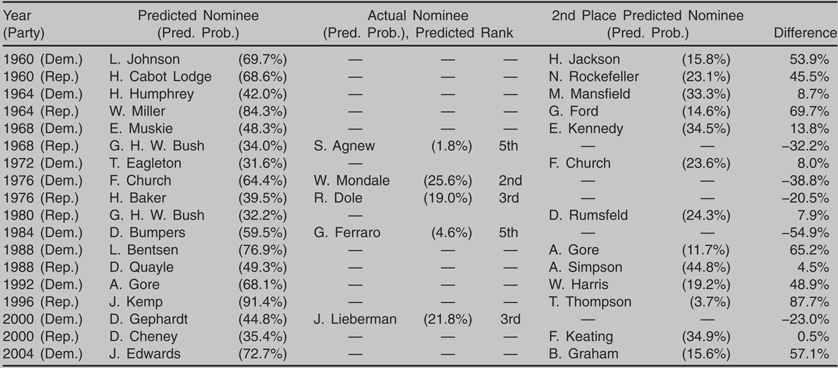
Table 2 shows the predicted probabilities generated by the model. When the model correctly predicted the actual nominee I show the predicted second-place finisher (with associated predicted probability). When the model did not correctly predict the nominee, I present the predicted probability and rank of the actual nominee.
Vice Presidential Selection, 1960–2004: Predicted Probabilities

Given the small number of cases, the model seems to perform reasonably well, correctly predicting 13 of 18 cases (72.2%). This is a slightly higher percentage than the model presented in Sigelman and Wahlbeck (Reference Sigelman and Wahlbeck1997). Interestingly, the model suggests that Spiro Agnew and Geraldine Ferraro were especially bad choices, a view that many observers would probably agree with.Footnote 15 The model also correctly predicts a few candidates that surprised many observers at the time and arguably stand out today as being anomalies.
William Miller, the Republican choice of Barry Goldwater in 1964, is one such example. A member of the House, Miller hailed from New York, which at the time had 43 Electoral College votes. Arguing against his selection was the fact that New York was only a marginally competitive state (while Eisenhower easily won New York in 1956, Kennedy took the state in 1960 by more than five percentage points). In addition, Miller was not (and is not) a well-known national figure. In fact, in the early 1970s he appeared in one of the first American Express “do you know me?” commercials. Nelson Rockefeller, who on the face of it might have been a logical choice, was far more well known, and also from New York.
However, Miller brought other attributes to the ticket that may help us to understand his selection. For example, unlike Rockefeller he was not a rival for the presidential nomination and was a veteran. In addition, he was 50 years old, below the mean age of 51 for the entire pool of four candidates, and had more years in political office than the other four (18), well above the mean (13.3). Finally, to look beyond the model, Miller was the first Catholic nominated to a Republican presidential ticket, adding demographic balance to the ticket. He was also a conservative, important to Goldwater's campaign of principled conservatism (Baumgartner Reference Baumgartner2006b, 75). Rockefeller, on the other hand, represented the liberal wing of the Republican Party. Miller was also chair of the Republican National Committee from 1961–1964, so his selection represented an alternative to selecting Rockefeller in terms of unifying the party. In every variation of the model I ran Miller is predicted as the overwhelming first choice.
Another surprise choice that the model (again, in almost every variation) correctly predicts is George H.W. Bush's selection of Dan Quayle in 1988. Quayle's home state, Indiana, was solidly Republican, and brought only 12 Electoral College votes to the ticket. By contrast, former California governor George Deukmejian, another possible choice, brought 43. Adding Quayle to the ticket did not add demographic balance, and he was below the mean for the pool of potential choices in terms of years in public office (12 years, as opposed to the mean of 18.2).
On the other hand, Quayle was not as unknown as modern accounts seem to suggest. He ranked third in terms of media exposure of the six possible choices. In addition, he was one of two candidates who brought ideological balance to the ticket and was not a rival for the presidential nomination. Finally, he could point to some military service (although his National Guard experience eventually became a problem for the campaign) and was young, well below the mean age of the six choices. Reports suggest that this age factor was extremely important to Bush, who was 64 at the time (Polsby and Wildavsky Reference Polsby and Wildavsky2004, 130). The second predicted choice, Alan Simpson, had more than double Quayle's experience in political office (29 years), and like Quayle, added ideological balance to the ticket, but came from a smaller and even less competitive state (Wyoming) and was 57 years old.
The Veepstakes 2008
In 2008, both parties will be nominating a vice presidential candidate for the first time since 1988. Who should we expect to receive the nominations? In this section I extend my analysis to present predictions, based on the model above, to this question. Before turning to the analysis, however, a note about methodology is in order. The method of case selection for 2008 was, of necessity, different from that used in the previous section. Unlike previous election cycles, where I could rely on accounts of who the presidential nominee was actually considering, in 2008 I had only informed speculation to rely on.Footnote 16
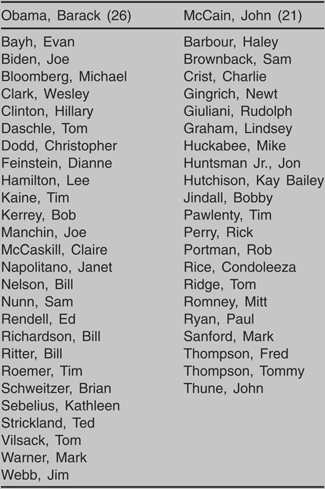
To being to compile a list of likely candidates, I found approximately four dozen veepstakes articles written through June of 2008 by individuals who I judged to be fairly well-qualified political observers. These were culled from a rather exhaustive search of news accounts, op-ed pieces, and commentary. I ignored most blog commentary, polls and essays by interest groups, and so on. From these sources I compiled two lists totaling well over 80 names. I then conducted a raw count of the number of stories that mentioned each individual andselected those individuals who were mentioned in at least two sources. From this list I excluded several names. Al Gore, John Edwards, and Joe Lieberman were excluded because they had previously run for or served as vice president, and John Hagel (for Obama) was excluded since he is not a Democrat (see note 7). The resultant lists are presented in Table 3.
Vice Presidential Possibilities, 2008

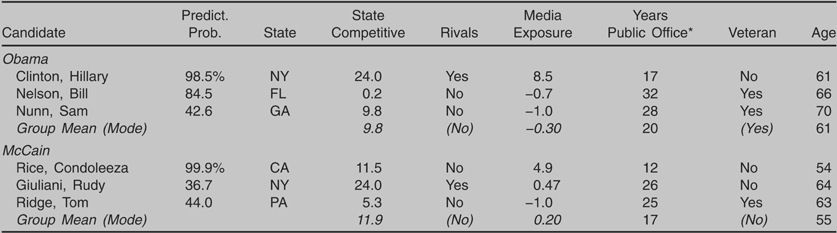
My predictions were generated by adding these cases to the previous 123, leaving the dependent dummy variable “nominated” blank. I again used conditional logit and generated predicted probabilities from the model. Table 4 presents the first three choices of each candidate. Since it is not clear if these individuals are even being considered for the vice presidency, or, if they are willing to accept the nomination if it is offered, the predicted probabilities of the second choices are generated without the first choice in the model. Similarly, the values for the third choices are calculated without the first two choices.
Veepstakes 2008: The Finalists

* Public office is a combination of years served in subnational government, Congress, and other national government office.
In terms of the factors identified in the model as important in vice presidential selection, all of the finalists would balance the ticket regionally, and all have some post-graduate education (these results are not shown in the table).
According to the model, Barack Obama's first choice for a running mate would be Hillary Clinton. This may seem convenient, given media hype about a “dream ticket.” However, based on the factors the model identifies as being significant in selecting a running mate, at first blush the choice does not seem to make much sense. New York is not a competitive state (well above the mean of 9.8% for Obama's pool), she was a bitter rival for the nomination, and she is below the mean for years in public office. However, her score on the media exposure variable is dramatically above the mean, more than compensating for the lack of fit of her candidacy in these other areas.
Obama's second choice is the popular Florida senator Bill Nelson. He comes from a highly competitive state, was not a rival for the nomination, is a veteran, and would bring 32 years of political experience to the ticket. His third choice, the former senator from Georgia, Sam Nunn, was also not a rival, is also a veteran, and has 28 years of experience in public office. On the downside, he comes from a much less competitive state. Both of these men are somewhat older, and while that may be to Obama's advantage in terms of the perception that he may be a bit inexperienced, the model suggests that youth is an important factor in the selection process (in fact, a youthful yet less experienced candidate may play well with Obama's campaign theme of change).
John McCain's first choice also seems fairly clear-cut: President Bush's secretary of state Condoleeza Rice. With no military experience, less than average years in public office, she comes from a state that has gone Democratic for the past several elections (assuming she would represent California). However, she was not a rival for the nomination and seems to be the right age. Like Obama's first choice, she also scores quite high on the media exposure variable (although both Mitt Romney and Rudy Giuliani each scored higher).Footnote 17
The second choice for the presumptive Republican nominee is Rudy Giuliani. He comes from a non-competitive state, was a (weak) rival for the nomination, and is above the mean age for McCain's possible choices. On the positive side of the ledger, he scores slightly above the mean for media exposure, and has 26 years of experience in public office, well above the mean. Former Pennsylvania governor and director of homeland security Tom Ridge is McCain's third choice. He is slightly older, and, has below average media exposure. However his state is competitive, he was not a rival for the nomination, he is a veteran, and he has an above average amount of experience in public office.
This particular venture into forecasting has several shortcomings. It does not, for example, account for the amount of campaigning potential vice presidential candidates do in order to secure the nomination (yet another feature of vice presidential selection in the modern era; see Baumgartner, Reference Baumgartner2006b), or how effective those efforts might be. Moreover, it does not account for the idiosyncrasies that particular presidential candidates bring to the campaign that a vice presidential candidate might be called upon in order to balance. Both of these factors would be difficult to operationalize. Perhaps most importantly, the forecasts are based on a pool of candidates that observers think are likely choices—not on the actual lists the candidates compile themselves. Of course, it will be simple enough to check of the model's predictive power to run the analysis again after each candidate's short list and eventual selection are known.
Finally, the forecasting model presented here is not very parsimonious, and is therefore difficult to summarize. While there are exceptions with particular nominations, since 1960, presidential candidates seem to be looking to individuals who will add regional balance to the ticket, come from a relatively competitive state, and have not challenged them for the nomination. Other desirable characteristics these individuals have include being able to point to some type of military service on their résumés, education beyond a four-year college degree, a fairly long career in public office, and some higher degree of exposure in the national media. This latter factor may be especially important, inasmuch as greater exposure during the spring and early summer of the election year could, in some cases, capture attempts by the individual to campaign for the nomination.
It speaks to the appeal of the veepstakes game that after having finished this analysis, I set about reviewing the finalists according to my own understanding of the political landscape, the strengths and weaknesses of each presidential and vice presidential candidate, and so on. This of course misses the point. Identifying and quantifying the significant factors in vice presidential selection allows us to rely on empirical analysis to identify likely frontrunners. While political science forecasting models, including this one, may not be perfect, they can show us “what happens most of the time…. [providing] a baseline against which we can tell whether there really was something unusual about a particular event or result, or whether it was just business as usual” (Mayer Reference Mayer2008). Surely an empirical approach, while it might be improved upon, is a more fitting method for prediction than is common punditry.
Postscript
The predictions made in this paper for 2008 were generated from lists of vice presidential candidates that were mentioned in the media throughout the campaign. There was no assurance that these individuals would actually be considered by the presidential candidates. The editors have allowed me to add a short postscript including predictions generated from actual candidate short lists. I will leave commentary about the relative strengths and weaknesses of the eventual picks to others and simply report the results.
Barack Obama announced his vice presidential choice on August 23. Reports indicated that the Democratic nominee was seriously considering five names during the final week: Sen. Evan Bayh (IL), Sen. Joe Biden (DE), Rep. Chet Edwards (TX), Gov. Tim Kaine (VA), and Gov. Kathleen Sebelius (KS). Hillary Clinton was, by all accounts, never seriously considered. From these five names the model predicts Joe Biden as Obama's pick, with an 83% probability. Following Biden were Chet Edwards (6.5%), Tim Kaine (5.3%), Evan Bayh (4.9%), and Kathleen Sebelius (0.3%).
John McCain, who announced his pick on August 29, was reportedly considering Sen. Joe Lieberman (CT), Gov. Sarah Palin (AK), Gov. Tim Pawlenty (MN), Tom Ridge, and Mitt Romney. From this list, the model predicts Tom Ridge with a probability of 42.8%. Following Ridge are Joe Lieberman (31.0%), Tim Pawlenty (17.4%). His eventual choice, Sarah Palin, was not even included in the original model, which contained approximately one-half of all of the names mentioned throughout 2007–08. Regardless, she was predicted with a 7.2% probability, and Mitt Romney rounds out the list at 1.7%. Thus, the model correctly predicted one of the two 2008 picks. This lower the overall success rate of the model from 72.2 (13 of 18) to 70% (14 of 20).
Author Bio
Jody C Baumgartner received his Ph.D. in political science from Miami University in 1998, specializing in the study of campaigns and elections. He is currently an assistant professor of political science at East Carolina University. He has authored, co-authored, edited, or co-edited several books, articles, and book chapters, including a recent book on the vice presidency (The American Vice Presidency Reconsidered, Praeger, 2006).