


Childhood overweight and obesity rates have been increasing globally for several decades and are a growing public health concern(Reference Harris and Taillie1). The prevalence of children (defined as any person under 18 years old according to the South African constitution(2)) who are living with overweight or obesity in South Africa was 31 % in 2020 and is predicted to increase to 71 % by 2035(3). Complications as a result of overweight and obesity in children include insulin resistance, dyslipidaemia, non-alcoholic fatty liver disease and long-term CVD(Reference Park, Choi and Jun4). Central obesity, particularly, is associated with psychological effects leading to a lower quality of life and poor academic performance in children(Reference Ntimana, Seakamela and Mashaba5).
Social media platforms such as YouTube and TikTok have become popular among children, including adolescents, with YouTube being the most popular site and TikTok being the third most popular site amongst 3 to 17 year olds(6). Even though the age requirement for most social media platforms is 13 years old, 36 % of parents allow their children to have a profile on these sites before they have reached the minimum age requirement, and 40 % of 8–17 year olds have admitted to giving a fake age to gain access to these sites(6). South African users spend the most time on YouTube and TikTok compared to all other social media platforms, at an average of 26 h and 39 min on TikTok per month and 25 h and 15 min on YouTube per month(Reference McInnes7) and spend an average of 3 h and 36 min on social media daily, compared to the global average of 2 h and 21 min(Reference McInnes7).
Food and beverage companies have capitalised on the growing popularity of social media platforms by using social media for targeted advertisements, as well as influencer marketing(Reference Kent, Pritchard and Mulligan8). Influencers come across as more trustworthy and relatable than traditional celebrities, and they use product placement where branded foods and beverages are strategically placed in their content without it being obvious to viewers that it might be an advertisement(Reference Coates, Hardman and Halford9). Social media influencer marketing is usually more subtle than direct advertising of a product, as the products are often in the background of posts or used in everyday settings, such as posts of them socialising(Reference Qutteina, Hallez and Mennes10). In most instances, these posts are not labelled as a sponsored post, and the audience, who are often children, may find it difficult to recognise it as marketing, as it may be viewed as just entertainment(Reference Kent, Bagnato and Amson11).
The increase in childhood obesity has been linked to social media marketing of unhealthy foods, which includes marketing by social media influencers(Reference Coates, Hardman and Halford9) and the lack of regulations surrounding the marketing of ultra-processed foods(Reference Harris and Taillie1). Children, including adolescents, trust social media influencers and social media influencers play a role in shaping their dietary preferences(Reference Amson, Bagnato and Remedios12). A study that reviewed YouTube influencers that are popular with children aged 5 to 15 years old showed that children were exposed to 29·9 food cues per hour and that 49·4 % of these food cues were of less healthy foods and beverages(Reference Coates, Hardman and Halford9). Children are also more susceptible to the marketing techniques used by social media influencers, such as the use of cartoon characters, promotions and sports celebrities on food packaging(Reference Castronuovo, Guarnieri and Tiscornia13). The effectiveness of marketing is high because children often associate the influencer’s success with the product that is marketed(Reference Zhu and Szekely14), regardless of influencer age(Reference Coates, Hardman and Halford9,Reference De Veirman, Hudders and Nelson15) .
Restricting marketing of unhealthy products to children is a crucial step towards addressing childhood obesity. There is a need for evidence to support these restrictions, particularly in the South African context. Studies conducted in other countries have indicated that children of all ages are exposed to food marketing by social media influencers on YouTube and TikTok(Reference Coates, Hardman and Halford9,Reference Kent, Bagnato and Amson11,Reference Amson, Bagnato and Remedios12,Reference Alruwaily, Mangold and Greene16,Reference Brooks, Christidis and Carah17) , and this study aimed to determine the prevalence and types of marketing of commercial food and beverage products found in posts by influencers on YouTube and TikTok that children and adolescents are exposed to, by analysing posts of adult (19–39 years old) and child (6–17 years old) influencers, in the South African context.
Methodology
Study population and sample
YouTube and TikTok were chosen as the social media platforms to investigate in this study, as TikTok has gained popularity in South Africa in recent years and, as previously mentioned, South African social media users spend the most time on YouTube and TikTok as both platforms are in the top 3 most popular platforms among 3–17-year-olds. A previous study conducted by the authors covered Facebook and Instagram (not yet published). Social media posts of influencers on these platforms were analysed retrospectively over a 1-year period from 1 July 2023 to 30 June 2024.
Nineteen social media influencers were purposefully selected for this cross-sectional study and can be divided into four groups: South African child influencers (n 6, 3 from YouTube, 3 from TikTok), international child influencers (n 3, 2 from YouTube, 2 from TikTok -1 from YouTube and 1 from TikTok was the same influencer), South African adult influencers (n 6, 3 from YouTube, 3 from TikTok) and international adult influencers (n 4, 2 from YouTube, 2 from TikTok). The most-followed influencers from each group were selected where information was available, using the Social Blade (YouTube influencers) and Promoty (TikTok influencers) websites. When information was not available, resources such as South African Social Media Awards specifically social media kid influencer of the year 2024 were used to identify popular child influencers, as this was difficult to find in other lists of most popular influencers in South Africa. As influencer follower demographics were not publicly available, it was assumed that children using these social media sites would be exposed to the most followed influencers. The influencers selected posted content in the entertainment, gaming, music, lifestyle, children’s content, comedy and sport categories. This was to identify if food and beverage marketing was present in non-food-related content, where marketing may not be as obvious. A combination of child and adult influencers was selected, as child influencers would be more likely to have younger children as an audience, and adult influencers would more likely to have adolescents in their audience and because children are exposed to content that is not directed at them due to algorithmically driven content(Reference O’Neill18). The popularity of the selected influencers ranged from 18 120 to 1 220 000 followers for South African child influencers, 5 310 000 to 18 800 000 followers for South African adult influencers, 941 300 to 123 000 000 followers for international child influencers and 15 520 000 to 288 000 000 followers for international adult influencers at the time of data collection.
Data collection
All videos posted on each influencer’s public YouTube or TikTok profiles were downloaded using ClipGrab software, version 3.9.11. International adult influencers posted 102 YouTube and 339 TikTok videos, South African adult influencers posted 532 YouTube and 798 TikTok videos, international child influencers posted 295 YouTube and 11 TikTok videos and South African child influencers posted 94 YouTube and 514 TikTok videos. Each video’s social media interactions (views, comments, likes and shares) were screengrabbed. The videos and screengrabs were saved to SharePoint in Microsoft 365. The South African social media influencer codebook was adapted and used for this study. This codebook was developed by the first author for her master’s degree and has not been published. The codebook consisted of eight sections: (1) basic information consisting of administrative details of the post such as which social media influencer the post was from and which platform it was posted on, (2) content information categorising the post (food, education, entertainment, etc), (3) social media engagement likes, comments, views, shares, saves, (4) food and beverage cues and classifications detailing whether the post had visual, verbal or text cues and if the influencer encouraged the consumption of the product, (5) health claims describing any health claims on the product packaging or if the influencer mentioned any health claims, (6) food brand marketing contained information about the product such as brand and product name, the number of food and beverage and any promotional information on the product in the post, (7) additional marketing appeals describing any marketing techniques including child directed marketing such as the use of cartoons, special effects or children and their voices and (8) nutrition information contained the nutrition information and the ingredients list of each product. Nutrition information was obtained by checking the product website (n 360), a grocery store website (n 197) or the University of the Western Cape’s 2023 database of packaged food labels (n 134).
A data collection tool was developed in Research Electronic Data Capture (REDCap) version 14.5.34, where all data was captured by three data capturers, all with a tertiary-level nutrition qualification. The data capturers were trained to use the codebook and data collection tool prior to data entry to ensure data entry standardisation. Double data entry was completed (100 posts), and discrepancies (39 posts), consisting of the type of marketing in the post and products missed within the posts, were discussed until consensus was reached between the three data capturers. Videos were watched slowed down in order to avoid missing products and marketing techniques.
Data coding
Posts by child and adult influencers were combined to determine the overall prevalence of food marketing children of all ages are exposed to. Posts were classified as containing food and beverage cues if there were any visible foods or beverages in the post; however, marketing techniques (such as special effects, music, promotions, among others), marketing types (if paid partnerships were disclosed in the post) and nutrition information were only collected if the food and beverages were branded. If a post had at least one product with branding, it was considered as a post with marketing, regardless of whether or not there were other products in the post that did not have branding. Posts were classified as containing marketing if branding was visible, whether the post was labelled as sponsored or not. The post was classified as containing encouragement to purchase from the brand or to consume the product if any of the following were present: influencers consuming the product, stating that the product should be consumed or purchased, that they enjoyed the product or frequently consumed it, or if they tagged the brand or store the product was purchased from in the post.
Posts containing fast food names (n 56), fast food products (n 41) and restaurant names (n 3) were classified as a post that contained an unhealthy product, since these establishments predominantly sell less healthy foods. Posts containing alcohol brand names (n 7) and alcoholic products (n 11) were also classified as a post that contained an unhealthy product. Products were excluded from the nutrient analysis if there was no available nutrition content information (n 131). Some examples of these products include chocolate, lollipops and corn chips. Posts containing only grocery store names (n 2) without any products were excluded, as they sell a variety of products.
Data analysis
Data were exported from REDCap to International Business Machines (IBM) Statistical Package for Social Sciences (SPSS) statistics 30 for analyses. Data cleaning was conducted to correct any missing or invalid data based on the information reviewed in the associated post. Descriptive analysis and compute variable analyses were used to determine the types of marketing used and marketing techniques used. Nutrient composition of products in posts classified as posts with marketing was analysed according to the thresholds provided by the proposed South African nutrient profiling model(Reference Frank, Thow and Ng19) and Draft Regulations for Labelling and Advertising of Foodstuffs(20). The product nutrient composition values for total sugar, saturated fat, Na and the presence of non-sugar sweetener were used to determine if the product would carry a warning label, as per the thresholds in the proposed South African nutrient profiling model (Draft Regulations for Labelling and Advertising of Foodstuffs)(20). The thresholds are as follows: sugar per 100 g ≥10 g for solids and ≥5 g for liquids, saturated fat per 100 g ≥ 4 g for solids and ≥ 3 g for liquids, Na per 100 g ≥400 mg for solids and ≥ 100 mg for liquids, and if the product contains any non-sugar sweetener. These thresholds were determined by a study proposing a nutrient profiling model for South Africa(Reference Frank, Thow and Ng19,20) .
If at least one product in a post exceeded the threshold amounts for these nutrients, the post was classified as a post that contained an unhealthy product. Posts were also classified as unhealthy if they contained alcohol or fast food meals.
Results
Food and beverage cues and marketing
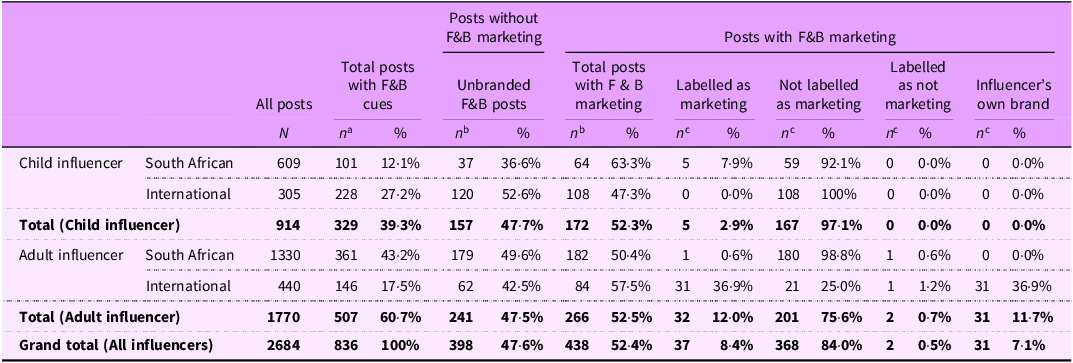
A total of 2684 posts were collected from nineteen influencers, with 38·1 % of posts from YouTube and 61·9 % of posts from TikTok. Eight hundred and thirty-six posts (31·1 %) contained food and beverage cues (branded products and unbranded products), 502 from YouTube and 334 from TikTok (Supplemental Table 1). Amongst the products with food and beverage cues, 438 (52·4 %) posts contained branded products and were considered as posts with marketing. Of the posts with marketing, 8·4 % (n 37) were labelled as such, 0·5 % (n 2) were labelled as not containing marketing, 7·1 % (n 31) were products from the influencer’s brand, and 84·0 % (n 368) contained branded products but were not explicitly labelled as containing marketing. South African adult influencers had the highest number of posts containing marketing at 41·5 %, followed by international child influencers (24·8 %), international adult influencers (19 %) and South African child influencers (14·7 %) (Table 1).
Social media posts with F&B (food and beverage) cues with and without marketing per influencer category

Table 1. Long description
Influencer categories are divided into South African child influencers, international child influencers, South African adult influencers, and international adult influencers. The total number of posts collected for each influencer category is listed. The total number of posts containing food and beverage cues is listed by influencer category. The number of posts containing food and beverage cues with unbranded products, and therefore without marketing, is listed by influencer category. The total number of posts containing food and beverage cues with branded products, and therefore containing marketing, is listed by influencer category. Posts containing marketing that were labelled as containing marketing are listed by influencer category. Posts containing marketing but not labelled as marketing is listed by influencer category. Posts containing marketing and labelled as not marketing are listed by influencer category. Posts containing marketing and containing products of the influencer’s own brand is listed by influencer category.
a Percentages are calculated as a proportion of all posts.
b Percentages are calculated as a proportion of total posts with F&B cues.
c Percentages are calculated as a proportion of total posts with F& B marketing.
Not labelled as marketing = branded products present in the post, but the post is not labelled as containing marketing.
Labelled as not marketing = branded products present in the post and the influencer clearly states it is not a marketed post.
Nutrient composition of products and marketing
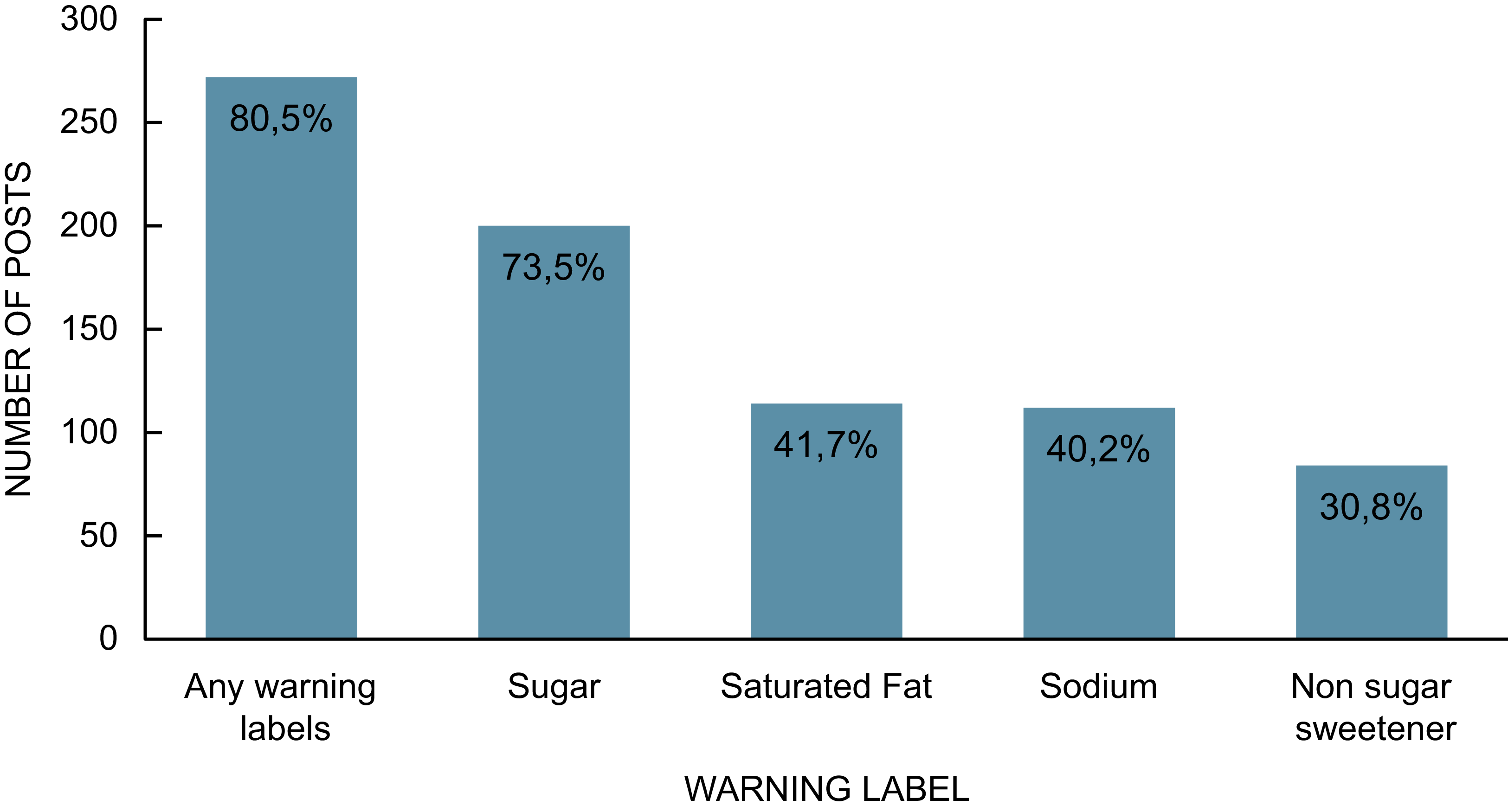
Amongst the 438 posts that contained marketing, posts had a mean of 1·99 food and beverage products (Supplemental Table 2) with 22·8 % of posts having no products and only food and beverage brand marketing, and 3·7 % of posts having 10 products (Supplemental Table 3). Of the 338 posts with branded products, 80·5 % (n 272) of posts contain at least one unhealthy product that would carry a warning label under Draft R3337, and 19·5 % (n 66) of posts would not carry any warning labels (Supplemental Table 4). Seventy-three percent (n 200) of posts would carry at least one warning label for sugar, 41·7 % (n 114) at least one warning label for saturated fat, 40·2 % (n 112) at least one warning label for sodium and 30·8 % (n 84) at least one warning label for non-sugar sweetener (Figure 1).
Posts marketing unhealthy products subject to carry warning labels under Draft R3337*. *Many posts carry more than 1 warning label. The numbers in this figure are representative of the number of posts when a warning label is present on at least one product in the post.

Figure 1. Long description
Under Draft Regulation R3337, unhealthy products would carry at least one warning label. The warning labels are: high in sugar, high in saturated fat, high in sodium, and containing any non-sugar sweeteners. Products can carry more than one warning label. The figure illustrates the total number of marketed posts containing at least one product carrying a warning label, and the number of marketed posts containing a product carrying a warning label, for each warning label category.
A total of thirty-nine posts contained products from fast food establishments, seventy-eight posts contained fast food establishment branding either with other branded products or with no products, two posts contained products from restaurants and seven posts contained restaurant branding either with other branded products or with no products. These posts were labelled as unhealthy due to the establishments selling predominantly unhealthy products. Eleven posts contained alcoholic products, and seven posts contained alcohol branding with no products. These posts were labelled as unhealthy as alcohol is not permitted to be consumed by children under the age of 18 in South Africa.
YouTube posts with unhealthy products that would be subject to carry at least one warning label under Draft R3337 had a median of 122 000 likes compared to the median of 47 000 likes for posts with marketing and without warning labels, 12 for comments (0 for posts without warning labels) and 9 598 838 for views (12 493 229·50 for posts without warning labels) (Supplemental Tables 5 and 6). TikTok posts with unhealthy products that would be subject to carry at least one warning label had a median of 16 900 likes compared to the median of 19 000 for posts without warning labels, 80 for comments (62·50 for posts without warning labels), 162 for shares (96 for posts without warning labels), 1445 for saves (837 for posts without warning labels), and 1 100 000 for views (621 250 for posts without warning labels) (Supplemental Tables 7 and 8).
Marketing techniques
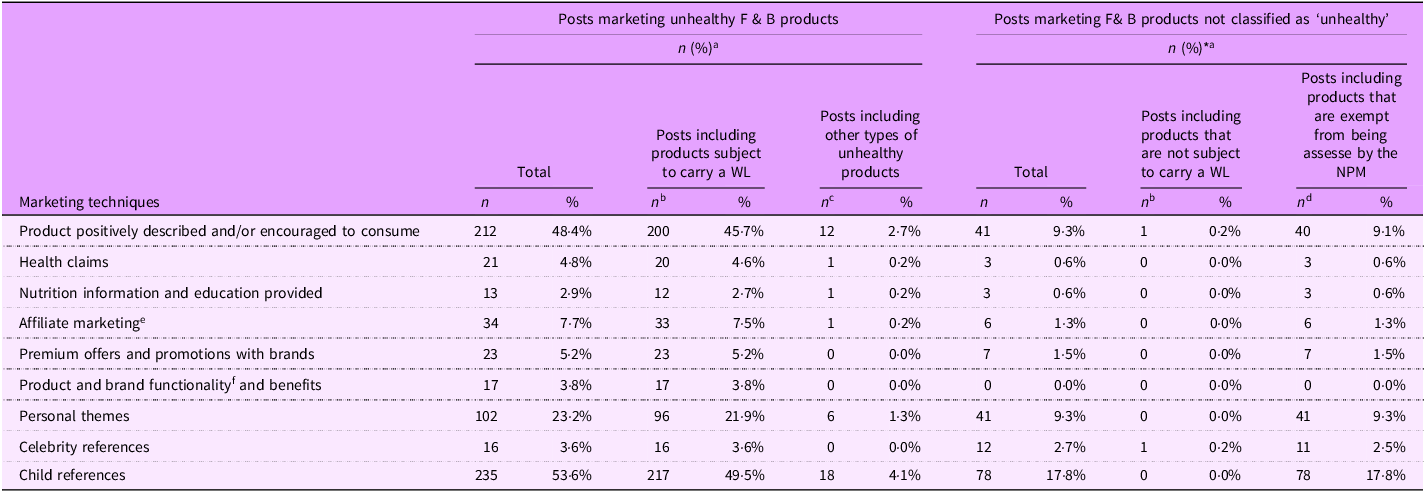
The marketing technique most used in posts containing food and beverage marketing included references to children (53·6 % of posts classified as unhealthy and 17·8 % of posts classified as not unhealthy) such as cartoons, special effects and licensed characters and used mostly by child influencers. This was followed by products being positively described by influencers (e.g. this product tastes good) in 48·4 % of posts classified as unhealthy and 9·3 % of posts classified as not unhealthy. Personal themes, such as family and friendship, were used in 23·2 % of posts classified as unhealthy and 9·3 % of posts classified as not unhealthy (Table 2).
Marketing techniques by post nutrient classification

Table 2. Long description
Nine marketing techniques observed in the social media posts are listed. The total number of posts marketing food and beverage products classified as unhealthy are listed for each marketing technique. The number of posts marketing unhealthy food and beverage products that would carry a warning label as per the South African nutrient profiling model proposed by Draft Regulation R3337 are listed for each marketing technique. The number of posts containing products that could not be analysed by the nutrient profiling model, but would still be considered unhealthy (alcohol products and food from fast food outlets) is listed for each marketing technique. The total number of posts marketing food and beverages that are not classified as unhealthy as per the nutrient profiling model is listed for each marketing technique. The number of posts containing products that are not subject to carry a warning label as per the nutrient profiling model is listed for each marketing category. The number of posts containing products that are exempt from being assessed by the nutrient profiling model, such as single ingredient products or unpackaged products, is listed for each marketing technique.
a Values are based on posts with food and beverage marketing (n 438).
b Products are subject to carry a warning label if they contain nutrients of concern above the threshold values set out by the NPM proposed by Draft Regulation R3337.
c Other types of unhealthy posts are posts that contain alcohol products, and posts containing foods from fast food outlets (other types of unhealthy products).
d Posts containing products that are not subject to be analysed by the NPM do not meet the criteria to be assessed by the NPM (e.g. single ingredient products, unpackaged products, etc.).
e Links to products or discount codes for products in the post.
f The user will gain something from using the product/brand.
Discussion
This study analysed videos posted to YouTube and TikTok by both adult and child influencers to determine the prevalence and types of marketing of commercial food and beverage products. South African adult influencers had the highest number of posts containing marketing of branded products. Products were often used within these videos as props or could be seen in the background of the video and were not labelled as marketing. Only 8·4 % of posts were labelled as marketing, which is consistent with the findings of similar studies(Reference Coates, Hardman and Halford9,Reference Kent, Bagnato and Amson11,Reference van der Bend, Beunke and Shrewsbury21,Reference Dupuis, Musicus and Edghill22) . Brand sponsorships should be disclosed as children often have difficulty distinguishing between entertainment and marketing; such disclosures help younger children to recognise persuasive selling intents(Reference Wannapaschaiyong, Saleepatcharaporn and Rojmahamongkol23) while encouraging older children to critically evaluate and prompt scepticism towards sponsored content(Reference Van Dam and Van Reijmersdal24).
Eighty percent of marketed posts contained at least one product identified as unhealthy according to the proposed nutrient profiling model in draft regulation R3337. Similarly, other studies have also reported a higher proportion of unhealthy foods in influencer posts than healthy foods(Reference Coates, Hardman and Halford9,Reference Kent, Bagnato and Amson11,Reference Alruwaily, Mangold and Greene16) . This is a concern as studies have shown that the exposure to social media influencer content containing unhealthy products increases the intake of these products(Reference Coates, Hardman and Halford25). Additionally, it is concerning that alcoholic products and branding were identified in posts as influencer marketing of alcoholic products is associated with alcohol purchase and consumption by adolescents(Reference Hou, Huang and Chang26,Reference Hendriks, Wilmsen and van Dalen27) . Influencer marketing of these products may give children the impression that it is part of the influencer’s regular diet(Reference Vassallo, Kelly and Zhang28) and, because they admire influencers(Reference van der Bend, Beunke and Shrewsbury21), may encourage them to consume these products as well(Reference Martínez and Olsson29).
The marketing technique most frequently used was references to children. This included the use of cartoons, special effects, music, the presence of children as guests, among others. Similar marketing techniques were observed in a study by Kent et al.,(Reference Kent, Bagnato and Amson11). These techniques appeal to children (aged 10–12) and could make unhealthy food more appealing to them(Reference Kent, Bagnato and Amson11), particularly if it is being marketed by a child influencer, who other children (under 12) might view as a relatable peer and could lead to influence on brand preferences and consumption behaviours(Reference De Veirman, Hudders and Nelson15). Adolescents are more likely to be influenced by influencers of the same gender as them(Reference Amson, Pauzé and Remedios30), as well as the product being described positively, the use of music and price promotions(Reference Amson, Bagnato and Remedios12), which were observed in this study. According to van der Bend et al.,(Reference van der Bend, Beunke and Shrewsbury21) children perceive their exposure to food marketing as low because of how integrated the products are in the content, and if posted by those they deem as peers, they do not consider it as marketing. Children define food marketing as professional product placements with clear and direct product information, such as those that would be broadcast on television(Reference van der Bend, Beunke and Shrewsbury21). Social media marketing practices increasingly rely on indirect brand and product placements, leading to children processing these messages emotionally and peripherally. This type of processing happens without conscious thought, therefore not triggering critical consumer defences, such as scepticism(Reference Buijzen, Van Reijmersdal and Owen31).
Using social media influencers to market brands and products is part of 90 % of marketers’ strategies, as consumers often make purchases inspired by influencers’ posts(Reference Han and Balabanis32). This study highlights the use of social media influencer marketing by the food and beverage industry, which includes using child influencers and child-directed marketing techniques to target children of all ages. Considering that marketed products are often unhealthy, and marketing to children are at the forefront of many marketing restriction efforts on television and product packaging(Reference Gage, Liu and Pearson33), it is concerning that the food and beverage industry would target children on platforms where marketing is less regulated.
A study by Boyland et al.(Reference Boyland, Backholer and Kent34), outlines research and policy challenges surrounding social media marketing of unhealthy foods. The food marketing codes that exist in certain countries are often written, monitored and enforced by the food industry themselves which indicates a conflict of interest and is an avoidance tactic used to deter government-led regulations. Industry-led regulations are less effective than mandatory regulations(Reference Boyland, McGale and Maden35). Previous attempts at regulating the marketing of unhealthy foods to children in South Africa have been unsuccessful,(36) as it was an attempt at industry self-regulation, only focused on television marketing, and did not include marketing to adolescents. The Strategy for the Prevention and Management of Obesity in South Africa 2023–2028(37) notes that nutrition misinformation and the marketing of fast foods on social media is a contributor to unhealthy eating, as it influences children’s food preferences, selection and intake(Reference McCarthy, de Vries and Mackenbach38). The Strategy also lists restricting the marketing of unhealthy foods, such as ultra-processed food, to children as one of the successful obesity prevention interventions that have been implemented in other countries and lists this as one of their strategy objectives for television marketing but does not include social media marketing(37).
Government-led regulations on unhealthy food marketing should be mandatory, cover different forms of marketing, including social media and influencers and should include all children up to the age of 18 years old. Restricting social media marketing to only those targeted at children will be ineffective, as children consume different types of content outside of that scope and will leave adolescents vulnerable. Similar regulations include the United Kingdom’s ban on the online advertising of unhealthy food and beverage products (due to take effect from October 2025) and Australia’s proposed ban on the online marketing of unhealthy foods, which includes social media(Reference Northcott, Sievert and Russell39). Once mandatory regulations are in place, marketing practices by brands and influencers should be monitored and appropriate consequences, such as fines, should be established for violations.
Strengths and limitations
This study had some limitations. The selected videos for this study may not be representative of the most popular videos amongst South African children as that is often largely determined by each user’s algorithm for each platform. However, in an attempt to include the most relevant content, the most followed influencers – where this information was available – were selected for each influencer category. Additionally, the engagement on the videos may have been exaggerated, as some influencers could make use of programmes that create bot accounts that complete automated engagement tasks on their posts, such as viewing or liking videos(Reference Radivojevic, McAleer and Conley40). Lastly, although data capturers slowed and paused videos when food products were shown in the videos, it is possible that some food products could have been overlooked during the data capturing process.
Strengths from this study included the use of an extensive codebook, capturing a wide range of marketing information that may have otherwise been overlooked, such as affiliate marketing. Additionally, our study supports the use of the proposed South African nutrient profiling model to identify products that, in accordance with Draft Regulation R3337, should not be marketed to children. This study has also addressed the need for research on the prevalence and types of marketing of commercial food and beverage products found in posts by both child and adult influencers on YouTube and TikTok.
Conclusion
In conclusion, the food and beverage industry use social media influencers, including child influencers, who subtly integrate branded food and beverage products into their content, and very few of these posts are labelled as marketed. The majority of these posts market unhealthy food and beverages. References to children were the most commonly used marketing technique, highlighting the fact that children are targeted in the marketing of unhealthy products. Mandatory government-led regulations on the marketing of unhealthy products to children should include social media and cover children up to the age of 18 years old. Suggestions for these regulations include prohibiting posts featuring unhealthy products in child-directed content, adding warning labels to social media posts of unhealthy products, similar to that of alcoholic beverage advertisements, and mandatory disclosure of marketing if the influencer is getting paid for posting unhealthy products. Monitoring, evaluation and proper enforcement of the regulation will be required for it to be effective.
Supplementary material
For supplementary material accompanying this paper visit https://doi.org/10.1017/S1368980026103668.
Acknowledgements
We would like to thank Kim Rutgers and Gareth Coetzee from the Food Environment Research Team at the University of the Western Cape for their contribution towards capturing data for this study.
Authorship
Lisa Deyce: Formal analysis, Investigation, Project administration, Writing -original draft. Tamryn Frank: Validation, Visualisation, Writing -review and editing. Alice Khan: Validation, Visualisation, Writing -review and editing. Elizabeth Swart: Conceptualisation, Funding acquisition, Methodology, Resources, Supervision, Writing -review and editing.
Financial support
Bloomberg Philanthropies (https://www.bloomberg.org/) funded this work through subagreement number 124183. The funder had no role in the design of the study; in the collection, analyses or interpretation of the data; in writing the manuscript, or in the decision to publish the results.
Competing interests
The authors declare no competing interests.
Ethical standards
Ethical approval to conduct this research was received from the Humanities and Social Sciences Research Ethics Committee at the University of the Western Cape (ethics number HS24/10/46).


 Open access

