The relationship between diet and health/disease, as well as economic interests of industry and health care costs, stimulate the development of new products in which health-promoting functional properties can exceed the sensory and nutritional concerns of foods. Increasingly, the concept of functional foods has to be taken into account, which implies the ability to beneficially influence body functions in order to improve the state of well-being and health, reducing the risk of diseases (Granato et al. Reference Granato, Branco, Nazzaro, Cruz and Faria2010). Probiotic microbial strains are among the functional components with properties to alter intestinal microbiota and/or immune barriers, moreover the probiotic-containing foods are generally perceived as ‘safe’ and ‘natural’ (Begley et al. Reference Begley, Hill and Gahan2006).
Reduction and prevention of diarrhoea from different origins, improvement of the intestinal microbial balance by antimicrobial activity, and alleviation of lactose intolerance symptoms are among the scientifically established and/or clinically proved health effects of probiotics (Parvez et al. Reference Parvez, Malik, Kang and Kim2006; Vasiljevic & Shah, Reference Vasiljevic and Shah2008). Furthermore, some studies have shown that certain lactic acid bacteria possess antioxidant activity (Lin & Chang, Reference Lin and Chang2000; Kullisaar et al. Reference Kullisaar, Zilmer, Mikelsaar, Vihalemm, Annuk, Kairane and Kilk2002).
Lactobacillus species are desirable members of intestinal tract microbiota and increasingly being explored as probiotics in various food products. Since not all lactobacilli can confer health benefits to the host, the isolation and characterization of strains with specific and well-characterized activities appears appropriate not only to improve the quality and functional properties of probiotic products but also to advance both applied and fundamental science in the probiotics area (Pan et al. Reference Pan, Chen, Wua, Tang and Zhao2009). Resistance to the manufacturing process of the carrier food and subsequently to the gastrointestinal ecosystem are required (Valerio et al. Reference Valerio, Bellis, Lonigro, Morelli, Visconti and Lavermicocca2006). The ability of probiotic bacteria to reach, survive and persist in the environment in which it is intended to act have to be assessed to ensure optimal functionality and expression of health promoting physiological functions (Zanoni et al. Reference Zanoni, Pompei, Cordisco, Amaretti, Rossi and Matteuzzi2008). The selected bacteria should be tolerant to low pH, proteolytic enzymes and bile salts, and should be prevalent in the upper digestive tract (Huang & Adams, Reference Huang and Adams2004). For adhesion purposes and colonization, surface hydrophobicity and aggregation properties may be relevant (Collado et al. Reference Collado, Meriluoto and Salminen2008; Xu et al. Reference Xu, Jeong, Lee and Ahn2009).
The autochthonous microbial content of cheeses may play a relevant role in the sensory characteristics, the safety hazards and potential health benefits of that product (Pisano et al. Reference Pisano, Fadda, Deplano, Corda, Casula and Cosentino2007; Nespolo et al. Reference Nespolo, Correa, Ritter and Brandelli2010). Few studies have focused on probiotic characteristics of lactobacilli isolated from ewe's cheeses (Caldini et al. Reference Caldini, Trotta, Corsetti and Cenci2008; Corsetti et al. Reference Corsetti, Caldini, Mastrangelo, Trotta, Valmorri and Cenci2008). The aim of the present work was to investigate the probiotic potential of novel Lactobacillus strains isolated from ovine cheese manufactured in the South Region of Brazil.
Materials and Methods
Isolation of Lactobacillus strains
Starter-free raw ovine milk cheeses (60 d ripening) were collected from a commercial cheese plant in Southern Brazil. Samples (25 g) were diluted in 225 ml of 1 g l−1 peptone water and homogenized in a blender. Serial 10-fold dilutions were done and inoculated on Man–Rogosa–Sharpe (MRS) agar (Himedia). After anaerobic incubation at 30°C for 72 h, typical colonies were randomly selected from countable plates, and then transferred to the MRS broth. The LAB selection included those strains showing Gram-positive staining, rod-shaped, catalase-negative and reaching pH below 5·0 in MRS broth. The strains denominated as LCN 35 and LCN 39 were isolated previously from Brazilian regional ovine cheese by Nespolo & Brandelli (Reference Nespolo and Brandelli2010), but not yet identified and characterized concerning probiotic effect. The standard strains Lactobacillus plantarum ATCC 8014 and Lb. fermentum ATCC 9338 were used for comparison purposes. All bacteria were stored at −20°C in 20% (v/v) glycerol and propagated twice on MRS broth before use.
Identification of lactic acid bacteria
Strains were identified by 16S rDNA sequence analysis as described elsewhere (Lisboa et al. Reference Lisboa, Bonatto, Bizani, Henriques and Brandelli2006). The BLAST algorithm was used to search for homologous sequences in GenBank and the software CLUSTAL W version 1.8 was used for sequences alignment (Thompson et al. Reference Thompson, Higgins and Gibson1994).
Haemolysis
The lactobacilli strains were streaked on blood agar plates and incubated for 48 h at 30°C (Maragkoudakis et al. Reference Maragkoudakis, Zoumpopoulou, Miaris, Kalantzopoulos, Pot and Tsakalidou2006). Strains that produced green-hued zones around the colonies (α-haemolysis) or did not produce any effect on the blood plates (γ-haemolysis) were classified as non haemolytic. Strains displaying blood lysis zones around the colonies were considered haemolytic (β-haemolysis).
Acid and bile salts tolerance
The tolerance to upper gastrointestinal tract was evaluated in simulated gastric and intestinal juices (Huang & Adams, Reference Huang and Adams2004). Bacterial cells with 24 h incubation in MRS broth were harvested by centrifugation (12 000 g for 5 min at 4°C), washed twice in 10 mmol l−1 phosphate buffer pH 7·0 and suspended in 5 g l−1 NaCl solution. An aliquot of 0·2 ml cellular suspension was incubated at 37°C in the presence of 1·0 ml of simulated juices. Viable cell counts were determined at initial time and at 180 min for gastric transit tolerance and after 240 min for intestinal transit tolerance.
Simulated gastric juice was prepared fresh daily containing 3 mgpepsin ml−1 (Sigma Co., St Louis, MO, USA), 5 g NaCl l−1 and acidified with HCl to pH 3·0, 2·5 and 2·0. Otherwise, simulated intestinal juice consisted of 1 mgpancreatin ml−1 (Merck, Darmstadt, Alemanha), 5 g NaCl l−1 and adjusted to pH 8·0, with or without 5 g l−1 of a 1:1 mixture of sodium cholate and sodium deoxycholate (Sigma Co., St Louis, MO, USA). Both solutions were sterilized by filtering through 0·22 μm membranes (Millipore, Bedford, USA).
Bile salt deconjugation
Overnight cultures were spotted (5 μl) onto MRS agar plates containing 0·5% (w/v) sodium taurodeoxycholate (Sigma Co., St Louis, MO, USA) and 0·37 g CaCl2 l−1 and incubated anaerobically for 72 h at 37°C (Pinto et al. Reference Pinto, Franz, Schillinger and Holzapfel2006). Opaque white colonies or colonies with precipitated zones were considered to indicate deconjugation of bile salts. MRS agar plates without supplementation were used as controls.
Autoaggregation and hydrophobicity
The in vitro properties of autoaggregation and hydrophobicity were performed as a preliminary screening of adhesive probiotic strains (Collado et al. Reference Collado, Meriluoto and Salminen2008). Lactobacilli strains were incubated at 30°C for 24 h in MRS broth and cells were harvested by centrifugation, washed twice and suspended in 10 mmol l−1 phosphate buffer pH 7·0 to 0·25±0·02 absorbance at 600 nm.
The autoaggregation assay was performed as follows: the cellular suspensions were incubated at 37°C and absorbance values at 600 nm of the upper layer were measured at different interval times (2, 16, 20 and 24 h). The results were expressed as percentage: 1−(A 600 nm of upper suspension/A 600 nm of total bacterium suspension)×100.
In the hydrophobicity evaluation, xylene was used to determine bacterial adhesion to the hydrocarbon. Then, a cellular suspension volume (3 ml) was thoroughly mixed by vortexing for 60 s with 400 μl xylene. After 2 h at 37°C, the aqueous phase was carefully removed and absorbance at 600 nm was measured. The hydrophobicity was reported as adhesion percentage: [(A 0−A)/A]×100, where A 0 and A are the absorbance before and after extraction with xylene, respectively.
β-Galactosidase activity
The β-galactosidase (β-gal) activity was determined according to Vinderola & Reinheimer (Reference Vinderola and Reinheimer2003). Briefly, isolates were cultivated in lactose-MRS broth and the cells washed and permeabilized with 1:9 (v/v) toluene:acetone by vortexing. After, the bacterial suspensions were incubated with o-nitrophenyl-β-D-galactopyranoside (ONPG: Sigma Co., St Louis, MO, USA) at 37°C for 15 min and the reaction was stopped with 1 mol l−1 Na2CO3. Absorbance values were measured at 420 and 560 nm and results expressed as Miller units as follows:

where A1 was the absorbance just before assay and A2 was the cell density of the reaction mixture.
Antioxidant activity assays
Antioxidant activity of whole cells (optical density of 2·5 at 600 nm) was determined by two different assays. Linolenic acid peroxidation assay was carried out according to Kullisaar et al. (Reference Kullisaar, Zilmer, Mikelsaar, Vihalemm, Annuk, Kairane and Kilk2002) based on the ability of bacteria to inhibit linolenic acid oxidation, expressed in percentage. In addition, DPPH radical scavenging capacity of the isolates was verified using the method of Brand-Williams et al. (Reference Brand-Williams, Cuvelier and Berset1995). An aliquot of 0·05 ml of cellular suspensions was transferred to test tubes with 2 ml of freshly prepared 60 μmol l−1 DPPH methanolic solution. After 45 min, the mixture was centrifuged and the scavenging activity was measured spectrophotometrically by the decrease in absorbance at 517 nm. Likewise, blank value was determined by using 1·15 g KCl l−1 solution.
Screening for antimicrobial activity
Detection of antibacterial activity against Listeria monocytogenes ATCC 7644, Bacillus cereus ATCC 14579, Staphylococcus aureus ATCC 1901, Escherichia coli ATCC 8739 and Salmonella typhimurium ATCC 14078, was performed by the agar spot test (Jacobsen et al. Reference Jacobsen, Rosenfeldt, Hayford, Møller, Michaelsen, Pærregaard, Sandström and Tvede1999). A 5 μl volume of overnight cultures was spotted onto MRS agar plates and incubated anaerobically to develop colonies at 30°C for 24 h. Then, 10 ml Brain Heart Infusion (BHI, Oxoid) soft agar (7·5 g l−1) inoculated with indicator strain (107 CFU ml−1) was poured onto plates and incubated aerobically at 37°C for 24 h. The inhibition results (mm) were calculated subtracting the diameter of the inhibition zone from the diameter of lactobacilli colony.
The same agar spot method was further used to test the activity of cell free supernatants, obtained from overnight cultures grown in MRS broth at 30°C. After centrifuging the culture at 12 000 g for 5 min at 4°C, the supernatants were obtained, neutralized or not with 5 mol l−1 NaOH and filtered through 0·22 μm membranes. In addition, well diffusion and microtrite plate assays were carried out as described by Maragkoudakis et al. (Reference Maragkoudakis, Zoumpopoulou, Miaris, Kalantzopoulos, Pot and Tsakalidou2006).
Heat sensitivity was checked by heating supernatants at 121°C for 15 min and later antimicrobial activity was evaluated by microtitre plate assay. Supernatants were also treated with 2 mgtrypsin ml−1 for 60 min at 37°C before testing for antimicrobial activity (Bizani & Brandelli, Reference Bizani and Brandelli2002). MRS broth (pH 6·5) and MRS broth acidified with lactic acid and HCl solutions to the pH value reached normally by Lactobacillus strains (pH about 4·0) were used as controls.
Results
Identification of lactic acid bacteria and haemolysis
A total of 12 lactobacilli strains from ovine cheese manufactured in the South Region of Brazil were considered in this study, two of which were previously isolated (Nespolo & Brandelli, Reference Nespolo and Brandelli2010). The molecular identification of the isolates showed Lb. plantarum as the predominant species (7 strains), followed by Lb. brevis (2 strains) and Lb. casei (2 strains). Additionally, one strain was identified as Lb. parabuchneri (Table 1). None of the Lactobacillus strains were positive for haemolytic reaction (all of them γ-haemolytic).
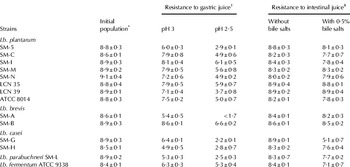
Resistance to biological barriers for Lactobacillus strains isolated from cheese of Southern Brazil and for the reference strains (mean±sd)

* Means of viable cell counts (log orders CFU/ml) at the initial time of the treatments
† Viable cell counts (log orders CFU/ml) after exposure to low pH (3 and 2·5) solutions during 3 h at 37°C
‡ Viable cell counts (log orders CFU/ml) after exposure to pancreatin solutions (with and without 0·5% bile salts) during 4 h at 37°C
Resistance to simulated gastric and intestinal juices and bile salt deconjugation
Lb. brevis SM-B was the most resistant strain at pH 3·0 and pH 2·5 in pepsin-containing simulated gastric juices (reduction of 0·3 and 2·3 log, respectively), followed by Lb. plantarum SM-I, LCN 35, SM-M and SM-C strains (Table 1). In contrast, Lb. brevis SM-A exhibited the highest decrease in viable counts at pH 2·5. Lb. parabuchneri, Lb. plantarum SM-5 and Lb. casei isolates also showed significant loss of viability in both treatments. None of the strains could survive at pH 2·0 for 3 h, only Lb. brevis SM-B could be detected above detection limit (>1·7 CFU ml−1) after 1 h (data not shown) in this condition.
All strains showed little reduction in viability after 240 min in simulated pancreatic juice (Table 1). However, with the addition of 0·5% unconjugated bile salts (sodium cholate and deoxycholate) a more pronounced decrease was often observed, especially for Lb. casei SM-G (3·8 log orders). In relation to the ability to deconjugate the sodium deoxycholate, only Lb. plantarum strains SM-C, SM-I, SM-N, LCN 35 and LCN 39 could not hydrolyse this bile salt (data not shown).
Autoaggregation and hydrophobicity
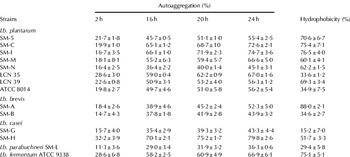
Autoaggregation values increased through the incubation time (Table 2). Although the behaviour of strains could not be clearly denoted in the first 2 h, it was more apparent from 16 h until final incubation period. Most strains showed more than 50% aggregation after 24 h, highlighting Lb. casei SM-H as the most autoaggregative strain (79·8%) and Lb. parabuchneri SM-L as the lowest autoaggregative strain (36·3%).
In vitro adhesion properties of Lactobacillus strains isolated from cheese of Southern Brazil and for the reference strains (mean±sd)

The degree of hydrophobicity (Table 2) was high for Lb. plantarum isolates, except for LCN 35. Lb. brevis SM-A was the most hydrophobic (88%), while Lb. casei SM-G was the isolate showing the lowest hydrophobicity (15·2%).
β-Galactosidase activity
To determine the enzymatic activity, lactose was used as inducer, replacing the glucose in the MRS medium. Results revealed strains with different values of enzymatic activity (Fig. 1), Lb. casei SM-H having the lowest value (47·7 Miller units) and values higher than 500 Miller units were only observed for Lb. fermentum ATCC 9338 and Lb. plantarum SM-I (1941 and 2503 Miller units, respectively).
β-Galactosidase activity of Lactobacillus strains isolated from ovine milk cheese and the reference strains. Values are the means of three independent determinations±sem.

Antioxidant activity
Linolenic acid oxidation assay was used to determine the capability of the strains to inhibit lipid peroxidation. The results are summarized in Fig. 2, indicating that all strains, except Lb. parabuchneri SM-L, possess antioxidant ability ranged from 14·5 to 33·1%. In contrast, none of the strains showed scavenging capacity of DPPH radical (data not shown).
Inhibition of linolenic acid peroxidation by Lactobacillus strains isolated from ovine milk cheese and the reference strains. Values are the means of three independent determinations±sem.

Antimicrobial activity
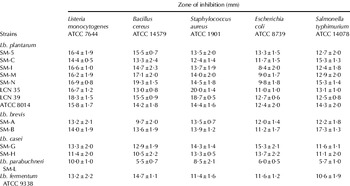
The results of antibacterial activity demonstrated that all strains inhibited both Gram positive and Gram negative bacteria (Table 3). In general, Lb. plantarum strains showed greater inhibitory zones against most of the pathogens tested. Lb. casei strains showed better inhibition of Esch. coli, in comparison with other tested strains. Lb. parabuchneri strain had little inhibitory effect against all tested pathogens.
Antagonistic activity by colonies of Lactobacillus strains isolated from cheese of Southern Brazil and for the reference strains (mean±sd)

When supernatants were evaluated by agar spot test and well diffusion assay, no inhibition was observed, even when non-neutralized supernatants were analysed. When microtitre plate assay was performed, only supernatants at pH about 4·0 (normally reached by the Lactobacillus strains) could inhibit the pathogens tested, even after heat treatment or trypsin incubation (data not shown). In the same way, controls acidified at pH 4·0 with HCl and lactic acid also inhibit pathogenic strains by that method.
Discussion
Lactobacillus species isolated from ovine cheese manufactured in the South Region of Brazil were identified by 16S rDNA. Other reports on ovine cheeses also found the species Lb. plantarum, Lb. casei and Lb. brevis (Sánchez et al. Reference Sánchez, Seseña, Poveda, Cabezas and Palop2006; Majhenic et al. Reference Majhenic, Lorberg and Rogelj2007; Navidghasemizad et al. Reference Navidghasemizad, Hesari, Saris and Nahaei2009). Lb. parabuchneri is an obligatory heterofermentative occasionally isolated from cheeses (Coton et al. Reference Coton, Berthier and Coton2008), though it is reported as a frequently isolated species from Civil cheese (Sengül, Reference Sengül2006) and the predominant species in Tulum cheese samples (Sengül & Cakmakci, Reference Sengül and Cakmakci2003).
The determination of haemolytic activity is considered a safety aspect for the selection of probiotic strains (FAO/WHO, 2002) and none of the Lactobacillus tested exhibited it. Also, the resistance to gastric acidity and to bile salts are the two currently most used in vitro tests according to the guidelines for the evaluation of probiotics in food (FAO/WHO, 2002).
In most in vitro assays, pH 3·0 has been chosen to evaluate resistance to gastric transit due to substantial decrease in the viability of strains at pH 2·0 or lower (Vinderola & Reinheimer, Reference Vinderola and Reinheimer2003). Our results also showed that acid tolerance is strain-specific and, as described by Zanoni et al. (Reference Zanoni, Pompei, Cordisco, Amaretti, Rossi and Matteuzzi2008), it is a trait of individual strains and strongly affected by experimental conditions. Thus, a direct comparison with other studies is difficult to be established. Nevertheless, similar studies often demonstrated that lactobacilli had increased sensitivity at pH values below 3·0 (Maragkoudakis et al. Reference Maragkoudakis, Zoumpopoulou, Miaris, Kalantzopoulos, Pot and Tsakalidou2006; Ortu et al. Reference Ortu, Felis, Marzotto, Deriu, Molicotti, Sechi, Dellaglio and Zanetti2007). Guo et al. (Reference Guo, Wang, Yan, Chen and Liu2009) emphasized that variation in the acid tolerance might be related to the difference in H+-ATPase activity, which controls the intracellular H+ concentration, thereby maintaining pH homeostasis and cell viability (Corcoran et al. Reference Corcoran, Stanton, Fitzgerald and Ross2005). The quantity and physiological state of the bacteria influence the survival during the gastrointestinal transit. Likewise, when probiotic bacteria are delivered from food, the buffering capacity of food matrix constitutes a major factor affecting stomach pH and could enhance gastric tolerance, as demonstrated by several studies (Pinto et al. Reference Pinto, Franz, Schillinger and Holzapfel2006; Valerio et al. Reference Valerio, Bellis, Lonigro, Morelli, Visconti and Lavermicocca2006; Guglielmotti et al. Reference Guglielmotti, Marcó, Golowczyc, Reinheimer and Quiberoni2007).
The presence of bile salts and pancreatin in the small intestine is another biological barrier for probiotic bacteria survival and colonization. The concentration of bile salts and specific bacteria properties are possible factors influencing the effect of bile salts on growth. Our results are in agreement with other studies for propionic bacteria (Huang & Adams, Reference Huang and Adams2004) and lactobacilli (Maragkoudakis et al. Reference Maragkoudakis, Zoumpopoulou, Miaris, Kalantzopoulos, Pot and Tsakalidou2006). In contrast, some reported strains are able to grow in presence of high concentration of bile salts (Vinderola & Reinheimer, Reference Vinderola and Reinheimer2003; Ortu et al. Reference Ortu, Felis, Marzotto, Deriu, Molicotti, Sechi, Dellaglio and Zanetti2007).
Bile salt hydrolase activity (BSH) is not always related to high tolerance to bile salts (Moser & Savage, Reference Moser and Savage2001; Guglielmotti et al. Reference Guglielmotti, Marcó, Golowczyc, Reinheimer and Quiberoni2007). Cholic acid is one of the most common free bile acids in the intestine and one of the mechanisms of resistance is the capacity to deconjugate bile salts (Vinderola & Reinheimer, Reference Vinderola and Reinheimer2003; Guglielmotti et al. Reference Guglielmotti, Marcó, Golowczyc, Reinheimer and Quiberoni2007; Mathara et al. Reference Mathara, Schillinger, Guigas, Franz, Kutima, Mbugua, Shin and Holzapfel2008). Moreover, deconjugation of bile salts may play a role in maintaining the equilibrium of the gut microflora, and could be used for selecting cholesterol-reducing strains, but conversion of primary to secondary procarcinogenic bile salts in the intestine is a potential risk associated with BSH activity (Begley et al. Reference Begley, Hill and Gahan2006; Pinto et al. Reference Pinto, Franz, Schillinger and Holzapfel2006; Mathara et al. Reference Mathara, Schillinger, Guigas, Franz, Kutima, Mbugua, Shin and Holzapfel2008). The two strains of Lb. casei, SM-G and SM-H, can deconjugate taurodeoxycholic acid, differing from strains of the same species described by Vinderola & Reinheimer (Reference Vinderola and Reinheimer2003), Guglielmotti et al. (Reference Guglielmotti, Marcó, Golowczyc, Reinheimer and Quiberoni2007) and Mathara et al. (Reference Mathara, Schillinger, Guigas, Franz, Kutima, Mbugua, Shin and Holzapfel2008).
The autoaggregation and hydrophobicity properties can be useful to select potentially probiotic bacteria (Collado et al. Reference Collado, Meriluoto and Salminen2008; Xu et al. Reference Xu, Jeong, Lee and Ahn2009). Hydrophobicity could enable interaction with organic mucin layer of the gut (Mathara et al. Reference Mathara, Schillinger, Guigas, Franz, Kutima, Mbugua, Shin and Holzapfel2008), confer a competitive advantage for bacterial maintenance in the gastrointestinal tract (Vinderola & Reinheimer, Reference Vinderola and Reinheimer2003) and imply a potential capacity to activate the gut immune response (Vinderola et al. Reference Vinderola, Capellini, Villarreal, Suárez, Quiberoni and Reinheimer2008). Sometimes, highly hydrophobic cell surfaces are associated with self-aggregation ability (Collado et al. Reference Collado, Meriluoto and Salminen2008; Xu et al. Reference Xu, Jeong, Lee and Ahn2009). Thus, the correlation between these properties was shown by SM-G, SM-L and SM-B isolates, which presented the lowest values for both self-aggregation and hydrophobicity. These two properties are likely to be correlated with adhesion ability to epithelial cells and mucosal surfaces (Collado et al. Reference Collado, Meriluoto and Salminen2008; Martins et al. Reference Martins, Silva, Vieira, Barbosa, Arantes, Teixeira and Nicoli2009; Xu et al. Reference Xu, Jeong, Lee and Ahn2009). However, lactobacilli adhesion is a complex phenomenon dependent not only on achievement of an adequate mass through aggregation and physicochemical properties (like hydrophobicity) but also on more specific mechanisms involving chemical composition of both intestinal and microbial cell surfaces (Collado et al. Reference Collado, Meriluoto and Salminen2008; Martins et al. Reference Martins, Silva, Vieira, Barbosa, Arantes, Teixeira and Nicoli2009).
All strains tested exhibited β-gal activity. This enzyme is produced by most lactobacilli with both hydrolase and transglycosilase activities, advantageous from technological and health point of views. Thus, the discovery of new strains producing high level of β-gal has gained importance for potential applications as probiotic cultures in dairy industry or as producers of the prebiotic ingredients galacto-oligosaccharides (Ibrahim & O'Sullivan, Reference Ibrahim and O'Sullivan2000; Ustok et al. Reference Ustok, Tari and Harsa2010).
Comparable results are described by Vinderola & Reinheimer (Reference Vinderola and Reinheimer2003), with higher values obtained for the Lb. delbrueckii subsp. bulgaricus starter strain (2053 Miller units) and for Lb. acidophilus probiotic strain (1301 Miller units), while low values or absence of β-gal were detected in Lb. casei strains. Cebeci & Gürakan (Reference Cebeci and Gürakan2003) also found strong variation among Lb. plantarum strains. In the present work, several strains showed higher β-gal activity in comparison with Lb. plantarum ATCC 8014. These results are in contrast with those reported by Pinto et al. (Reference Pinto, Franz, Schillinger and Holzapfel2006) for lactobacilli isolated from faeces and fermented products.
Lactic acid bacteria possess different antioxidative mechanisms such as reduced glutathione, superoxide dismutase, NADH oxidase, NADH peroxidase, thiol compounds, metal ion chelating ability, scavenge of reactive oxygen species and reducing activity. These protective capabilities result in antioxidant properties by some lactobacilli and potentially provide additional dietary source of antioxidants or probiotic bacteria able to reduce oxidative stress (Kullisaar et al. Reference Kullisaar, Zilmer, Mikelsaar, Vihalemm, Annuk, Kairane and Kilk2002; Zanoni et al. Reference Zanoni, Pompei, Cordisco, Amaretti, Rossi and Matteuzzi2008; Wang et al. Reference Wang, Yi, Yu, Dong and Qiao2009).
The same total antioxidant assay used in this work carried out in different groups of intestinal lactobacilli revealed the highest values for obligate homofermentative lactobacilli, whereas for facultative and obligate heterofermentative lactobacilli the activity was strain-specific (Annuk et al. Reference Annuk, Shchepetova, Kullisaar, Songisepp, Zilmer and Mikelsaar2003). Zanoni et al. (Reference Zanoni, Pompei, Cordisco, Amaretti, Rossi and Matteuzzi2008) described an effective antioxidant activity by intact cells of Lb. plantarum LP1 and Streptococcus thermophilus Z57, with 33·1 and 33·8% inhibition of linolenic acid oxidation, respectively. These values are similar to those observed for Lb. brevis SM-B and Lb. casei SM-H, the most antioxidative strains of this study. However, the scavenging capacity of DPPH radical was not observed (data not shown). Wang et al. (Reference Wang, Yi, Yu, Dong and Qiao2009) reported in vitro scavenging capacity against the DPPH radical in a dose dependent manner by whole cells of a strain of Lb. fermentum. Then, whereas no DPPH scavenging ability was detected in our strains, they could inhibit linolenic acid peroxidation and further experiments are needed to substantiate antioxidant activity.
Lactic acid bacteria may exert a protective barrier to intestinal cells by preventing colonization of pathogenic microorganisms. Antimicrobial metabolites include certain organic acids (lactic and acetic acid), hydrogen peroxide, ethanol, carbon dioxide, diacetyl, acetaldehyde, reuterin, acetoin, fatty acids, other low molecular mass compounds and bacteriocins (Holzapfel et al. Reference Holzapfel, Geisen and Schillinger1995; De Vuyst & Leroy, Reference De Vuyst and Leroy2007). Moreover, competitive exclusion for nutrients and adhesion sites and stimulation or modulation of immune responses reinforces the antimicrobial activity (Servin, Reference Servin2004).
The Lactobacillus strains isolated from ovine cheese and the reference strains could inhibit all pathogens tested by direct antagonism. The non-neutralized culture supernatants were inhibitory when the microtitre plate assay was performed, but not using agar spot test and well diffusion assay. The inhibitory activity observed may be associated with the production of organic acids and low pH, since no inhibition was observed when the pathogens were grown either in the presence of neutralized supernatants or with the MRS broth at pH 6·5. Similar situation was described by Maragkoudakis et al. (Reference Maragkoudakis, Zoumpopoulou, Miaris, Kalantzopoulos, Pot and Tsakalidou2006), who found that none of the supernatants of 29 lactobacilli strains, at pH 6·5 or 4·5, inhibited the growth of Esch. coli, Sal. typhimurium and Helicobacter pylori, using either the spot-on-lawn or the well diffusion assay. Only when microtitre plate assay was performed, the authors described the inhibition of pathogens by supernatants at pH 4·5 and by the control of MRS at pH 4·5.
Production of organic acids, the most important and best characterized antimicrobials from LAB, is the probable mechanism of inhibition of the strains analysed in this work. It is interesting because the ability to adequately acidify the intestine is a beneficial property derived from probiotic lactobacilli to create a hostile environment for pathogens.
The results of this work suggest that ripened cheeses elaborated with raw ewe's milk in Southern Brazil are interesting sources for isolation of bacterial strains with differentiated functional traits. Notably, probiotic characteristics are very variable among strains, even those belonging to the same species, and none of strains possess all the desired properties. However, isolates that demonstrate the greatest number of biological and functional attributes together are Lb. brevis SM-B, with the better acid tolerance and remarkable antioxidant activity, and Lb. plantarum SM-I, the highest β-gal producer and displaying higher autoaggregation, hydrophobicity and acid tolerance properties.
This work was supported by CNPq and CAPES (Brazil).