In response to the work of Borges et al. (Reference Borges, Real, Cabral and Jones2012), Hulkower (Reference Hulkower2012) poses questions regarding the relative merits of the Condorcet and the Borda methods; a topic which has been taking place in socio-political studies for a very long time. While both approaches have their supporters and their detractors (Young, Reference Young1988; Risse, Reference Risse2005; Saari, Reference Saari2006), below we present the reasons for choosing Condorcet's method to obtain a consensus ranking of a region's vintage quality (Borges et al., Reference Borges, Real, Cabral and Jones2012).
Our decision to use the Condorcet method was based on research by Young (Reference Young1988) and Balinski and Laraki (Reference Balinski and Laraki2011). In his work, Young (Reference Young1988) states that “Thus we must either jettison the whole idea of selecting the ‘best’ candidate with high probability or admit that Borda's rule is a good way of estimating which candidate that is. On the other hand, when the problem is to rank a set of alternatives, Condorcet's rule is undoubtedly better than Borda's.” Similarly, Balinski and Laraki (Reference Balinski and Laraki2011) said that “The properties imply that Borda's approach makes sense only for designating a winner and Condorcet's only for designating a ranking.”
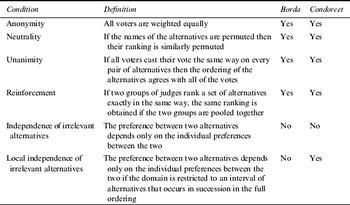
The quotes above follow the analysis of the two methods with respect to a set of conditions proposed by Arrow (1950) which has become a standard in the social choice literature (Young, Reference Young1988; Balinski and Laraki, Reference Balinski and Laraki2011). In Table 1 we present an informal definition of each of the conditions discussed by Young (Reference Young1988) and compare the two approaches with respect to each condition.
Table 1The Standard Conditions for Social Choice
In social choice theory the condition of Independence of Irrelevant Alternatives (IIA) is known as a condition of Arrow's impossibility theorem (Balinski and Laraki, Reference Balinski and Laraki2011), a theorem that shows that it is impossible to have a method that meets each of the first five conditions in Table 1. However, Young (Reference Young1988) has shown that the Condorcet method can satisfy the IIA condition if the domain is restricted to an interval of alternatives that occurs in succession in the full ordering. As a result, the ordering within a given set of alternatives remains unaffected by the removal of alternatives outside that set. For example, the ordering of the alternatives towards the top of the ranking remains unchanged if alternatives towards the bottom are removed. This property is commonly referred as the Local Independence of Irrelevant Alternatives (LIIA), which states that any interval of top or bottom consecutive ranked alternatives is ranked as it would be in the absence of the other alternatives outside that interval.
Young (Reference Young1995) also shows that Borda's method does not satisfy the LIIA condition. We will illustrate this shortcoming of the Borda method by means of an example from CRG4 (2012). Consider that there are four alternatives and that 25 voters rank the alternatives ABDC, 24 rank BACD, 22 rank CBAD and 29 rank CDAB. In this example C is the Borda's winner and the resulting ranking is CABD. However, if D, the worst candidate, is removed the winner becomes A and the resulting ranking ACB. In contrast, the Condorcet method gives the ranking CABD in the first case and the ranking CAB if D is removed.
LIIA is a very desirable property for a rank aggregation method which aims to combine a collection of vintage charts for a region into a ranking of the vintages that represents the consensus of the input vintage charts (Borges et al., Reference Borges, Real, Cabral and Jones2012). In the wine rating context, a publisher might decide not to evaluate a vintage which has a perceived low quality. Thus, the information regarding low quality vintages may be too incomplete leading to the option of removing such vintages from the analysis. Therefore, the possibility of excluding the worst vintages from the initial list of ranked vintages and maintaining the relative ordering of the retained vintages is very important. There is no systematic reason why the inclusion or exclusion of the k worst vintages should change the relative ordering of the other vintages.
We agree with the comment regarding the Condorcet n-tuple (Hulkower, Reference Hulkower2012) and note that the quoted sentence should have been stated in a way that excluded the Condorcet n-tuples situation. However, the occurrence of Condorcet n-tuples in the context of vintage charts seems very unlikely, in contrast to the potential case of the exclusion of the k worst bottom ranked vintages from the analysis, which seems much more likely.
Another important property of voting systems is their non-manipulability (Balinski and Laraki, Reference Balinski and Laraki2011). A voting system is said to be ‘manipulable’ if voters have incentives to misrepresent preferences, meaning that coalitions of voters are able to improve the outcome for themselves. The Gibbard-Satterthwaite's Impossibility Theorem states that there is no voting rule, except for dictatorial rules, that is always non-manipulable. However, we believe that in the context of aggregating vintage charts into a consensual ranking the manipulability of the consensual ranking is not a factor since: (i) vintage chart publishers work independently and produce their charts unaware they will be used for an aggregated consensual ranking; (ii) as the publishers work independently the formation of coalitions focused on manipulating the aggregated ranking is highly unlikely; and (iii) there is no evident incentive for a publisher to try to manipulate the consensual ranking since their credibility is established by their own vintage charts, which are public and therefore subject to scrutiny.
In summary, the discussion of the relative merits of adopting the Condorcet method instead of the Borda method is an unsolved matter and the scientific community is not unanimous on which method is the best overall. However, there is evidence that when the problem is to rank a set of alternatives, the Condorcet method is undoubtedly the better choice (Young, Reference Young1988; Balinski and Laraki, Reference Balinski and Laraki2011).





 You have
Access
In response to the work of Borges et al. (Reference Borges, Real, Cabral and Jones2012), Hulkower (Reference Hulkower2012) poses questions regarding the relative merits of the Condorcet and the Borda methods; a topic which has been taking place in socio-political studies for a very long time. While both approaches have their supporters and their detractors (Young, Reference Young1988; Risse, Reference Risse2005; Saari, Reference Saari2006), below we present the reasons for choosing Condorcet's method to obtain a consensus ranking of a region's vintage quality (Borges et al., Reference Borges, Real, Cabral and Jones2012).
Our decision to use the Condorcet method was based on research by Young (Reference Young1988) and Balinski and Laraki (Reference Balinski and Laraki2011). In his work, Young (Reference Young1988) states that “Thus we must either jettison the whole idea of selecting the ‘best’ candidate with high probability or admit that Borda's rule is a good way of estimating which candidate that is. On the other hand, when the problem is to rank a set of alternatives, Condorcet's rule is undoubtedly better than Borda's.” Similarly, Balinski and Laraki (Reference Balinski and Laraki2011) said that “The properties imply that Borda's approach makes sense only for designating a winner and Condorcet's only for designating a ranking.”
The quotes above follow the analysis of the two methods with respect to a set of conditions proposed by Arrow (1950) which has become a standard in the social choice literature (Young, Reference Young1988; Balinski and Laraki, Reference Balinski and Laraki2011). In Table 1 we present an informal definition of each of the conditions discussed by Young (Reference Young1988) and compare the two approaches with respect to each condition.
The Standard Conditions for Social Choice
In social choice theory the condition of Independence of Irrelevant Alternatives (IIA) is known as a condition of Arrow's impossibility theorem (Balinski and Laraki, Reference Balinski and Laraki2011), a theorem that shows that it is impossible to have a method that meets each of the first five conditions in Table 1. However, Young (Reference Young1988) has shown that the Condorcet method can satisfy the IIA condition if the domain is restricted to an interval of alternatives that occurs in succession in the full ordering. As a result, the ordering within a given set of alternatives remains unaffected by the removal of alternatives outside that set. For example, the ordering of the alternatives towards the top of the ranking remains unchanged if alternatives towards the bottom are removed. This property is commonly referred as the Local Independence of Irrelevant Alternatives (LIIA), which states that any interval of top or bottom consecutive ranked alternatives is ranked as it would be in the absence of the other alternatives outside that interval.
Young (Reference Young1995) also shows that Borda's method does not satisfy the LIIA condition. We will illustrate this shortcoming of the Borda method by means of an example from CRG4 (2012). Consider that there are four alternatives and that 25 voters rank the alternatives ABDC, 24 rank BACD, 22 rank CBAD and 29 rank CDAB. In this example C is the Borda's winner and the resulting ranking is CABD. However, if D, the worst candidate, is removed the winner becomes A and the resulting ranking ACB. In contrast, the Condorcet method gives the ranking CABD in the first case and the ranking CAB if D is removed.
LIIA is a very desirable property for a rank aggregation method which aims to combine a collection of vintage charts for a region into a ranking of the vintages that represents the consensus of the input vintage charts (Borges et al., Reference Borges, Real, Cabral and Jones2012). In the wine rating context, a publisher might decide not to evaluate a vintage which has a perceived low quality. Thus, the information regarding low quality vintages may be too incomplete leading to the option of removing such vintages from the analysis. Therefore, the possibility of excluding the worst vintages from the initial list of ranked vintages and maintaining the relative ordering of the retained vintages is very important. There is no systematic reason why the inclusion or exclusion of the k worst vintages should change the relative ordering of the other vintages.
We agree with the comment regarding the Condorcet n-tuple (Hulkower, Reference Hulkower2012) and note that the quoted sentence should have been stated in a way that excluded the Condorcet n-tuples situation. However, the occurrence of Condorcet n-tuples in the context of vintage charts seems very unlikely, in contrast to the potential case of the exclusion of the k worst bottom ranked vintages from the analysis, which seems much more likely.
Another important property of voting systems is their non-manipulability (Balinski and Laraki, Reference Balinski and Laraki2011). A voting system is said to be ‘manipulable’ if voters have incentives to misrepresent preferences, meaning that coalitions of voters are able to improve the outcome for themselves. The Gibbard-Satterthwaite's Impossibility Theorem states that there is no voting rule, except for dictatorial rules, that is always non-manipulable. However, we believe that in the context of aggregating vintage charts into a consensual ranking the manipulability of the consensual ranking is not a factor since: (i) vintage chart publishers work independently and produce their charts unaware they will be used for an aggregated consensual ranking; (ii) as the publishers work independently the formation of coalitions focused on manipulating the aggregated ranking is highly unlikely; and (iii) there is no evident incentive for a publisher to try to manipulate the consensual ranking since their credibility is established by their own vintage charts, which are public and therefore subject to scrutiny.
In summary, the discussion of the relative merits of adopting the Condorcet method instead of the Borda method is an unsolved matter and the scientific community is not unanimous on which method is the best overall. However, there is evidence that when the problem is to rank a set of alternatives, the Condorcet method is undoubtedly the better choice (Young, Reference Young1988; Balinski and Laraki, Reference Balinski and Laraki2011).