INTRODUCTION
The efficacy of radiation treatment of cancer patients is inhibited by the lack of comprehensive knowledge of radiation effect for normal human organs. No comprehensive radiation sensitivity data are available for normal human organs. The cell population kinetic parameters derived from either the multi-target or linear quadratic models are not readily available. The spin lattice relaxation time (T1) of water protons varies from organ to organ in all species. This variation within the organ may be due to changes in the physiological state of the organism. It is generally argued that the water content of the organ is responsible for the observed changes in T1.Reference Akber1 Many investigators have observed that the T1 changes cannot be correlated with water content.Reference Akber1 AkberReference Akber2 showed that the T1 is very much influenced by the weight of the organ in all species. AkberReference Akber3,Reference Akber4,Reference Akber and Kehwar5, also showed that radiation tolerance dose (TD50) and mean lethal radiation dose (D0) correlates well with organ weight in humans. As both the T1 and TD50 dose are dependent on organ weight,Reference Akber4,Reference Akber and Kehwar5 it is interesting to assess the D0 for radiation injury of normal human organs with the water proton nuclear magnetic resonance (NMR) T1. It is important to note that as the T1 value decreases, D0 increases.
MATERIALS AND METHODS
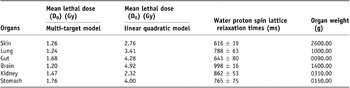
CohenReference Cohen6 has reported D0 using the multi-target model and linear quadratic model for few human organs (Table 1). These mean lethal radiation doses are computed for the patients of different age, sex, and body weight as well as organ weight. Cohen,Reference Cohen7 in personal communication, had provided us the values of D0 for different organs, such as skin, spine, lung, and gut, whereas D0 for brain and kidney were extracted from his published works. The water proton T1 values of normal human tissues are abstracted from Damadian et al.Reference Damadian, Zaner, Hor and DiMaio8 and are given in Table 1.
Mean lethal radiation dose along with spin lattice relaxation times of water protons and organ weights in human.

RESULTS
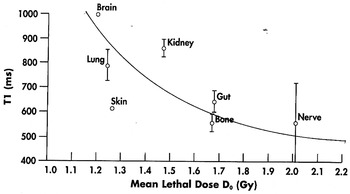
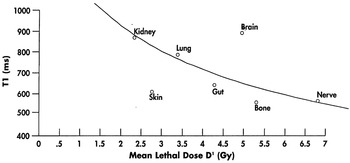
An assessment of mean lethal radiation doses both from the multi-target and linear quadratic models with water proton NMR T1 yield a correlation of 0.90 and 0.82, respectively. It is interesting to note that as D0 increases in both models, the T1 value decreases (Figures 1 and 2).
Correlation between mean lethal radiation dose (single hit multiple target model) and water proton nuclear magnetic resonance (NMR) spin lattice relaxation times in human organs.

Correlation between mean lethal radiation dose (linear quadratic model) and water proton NMR spin lattice relaxation times in human organs.

DISCUSSION
It has been shown that the D0/TD50 is dependent on organ weight.Reference Akber2,Reference Akber3 It also appears that as the D0 increases, water proton T1 decreases as well. It is, however, important to realize that many physiologic functions such as heat loss and oxygen diffusion from the blood to the tissue across the capillary walls are indeed functions of the tissue organization. The most important contributing factor in the increase in organ weight is water content. The dissolved oxygen in cell water determines both the rate of metabolism and radio sensitivity. Therefore, the overall metabolism cannot be independent of tissue organization/organ weight, neither is the mean lethal dose nor the water protons T1. At present, we do not have any reliable technique to assess the onset of radiation injury. Most often, radiation injury is assessed after the irreparable damage to the organ has taken place. It appears that changes (variation) in T1 value during or after radiation treatment may provide a sensitive index to evaluate the onset of radiation damage. However, it would be worthwhile to investigate this concept for different human organs to get applicable results in radiation oncology. Animal models would also be very helpful in providing an insight to the present approach.