Who is an “authentic” speaker of a language variety, as opposed to someone who is putting on or emulating a variety that is not his or her native vernacular? This is a question asked not just by sociolinguists, but also by speakers in their own communities. People have used linguistic tests to establish authenticity for at least 3000 years, if we rely on the evidence of the biblical story of the ‘shibboleth' test (Judges 12:6). But how reliable are such tests? Given that there is a range of variability within any community, what place on the range establishes authentic membership? And given that any community is likely to share at least some of its linguistic traits with other communities, which features will be definitive?
These issues arise in connection with the speech of white youth who affiliate with hip-hop culture and attempt to incorporate in their own speech certain features of African American Vernacular English (AAVE) that are widely used in the hip-hop community. These include characteristics such as /ai/ glide reduction and verbal /s/ absence that are not part of the unmarked style of most white American English speakers. Quantitative analyses show that white hip-hoppers' use of such variables rarely approaches the rate of use found among AAVE speakers, although it may differ markedly from that of other white speakers (Cutler, Reference Cutler2002). This leaves white hip-hoppers (WHH) in a position of chronic tension about their linguistic authenticity. They are effectively style shifting or attempting to stylize their speech in ways that deviate from the variety they grew up speaking. To the extent that their usage is a speech style that they are “putting on,” as opposed to an unreflecting vernacular style that they speak “natively,” WHH are open to a charge of inauthenticity.
One variable that can provide some insight into this linguistic dilemma is coronal stop (–t,d) deletion (CSD), the omission of coronal stops from word-final consonant clusters. This variable differs quantitatively between the language varieties in question. It is a general phenomenon shared by all English dialects, but it is shown by previous research to occur at characteristically high rates among speakers of AAVE, even in prevocalic contexts (Wolfram & Fasold, Reference Wolfram and Fasold1974:134). The work of Guy (Reference Guy and Labov1980, Reference Guy1991a, Reference Guy1991b) and others has shown that the phonological process of CSD interacts with the morphological processes of tense marking in English in such a way that makes it possible to estimate speakers' unmarked, underlying rates of deletion. Contrasting this result with the speakers' surface rates of CSD allows us to identify degrees and directions of style shifting. In this paper, we use such internal evidence found in patterns of CSD in the speech of WHH as a measure of their convergence toward AAVE, and their style-shifted deviation from their own underlying vernacular.
THEORETICAL BACKGROUND
One of the clearest constraints on English CSD is morphological; systematically, for essentially all speakers of English, we encounter relatively high rates of deletion for monomorphemic forms such as west, old (henceforth M), relatively low rates for regular past tense verbs such as kissed, rolled (henceforth R), and, for many speakers, intermediate deletion rates for “semiweak” irregular past tense forms (henceforth I), such as lost, told.Footnote 1 It is argued in Guy (Reference Guy1991a, Reference Guy1991b), using the descriptive framework of lexical phonology, that the different rates of deletion in these three morphological categories are due to differences in derivational history. Assuming that the CSD rule is available whenever its structural description is met, there are three sites where it could apply in the course of a derivation: at two levels in the lexicon, and once again in the postlexical phonology. If the rule fails to apply to a given form at a nonfinal level, that form retains a final coronal stop that is again eligible for a potential application of the rule at subsequent derivational levels. The differing deletion rates for the three morphological categories are therefore a consequence of their distinct derivational histories. Regular past tense forms have their -ed suffix attached at the end of level two; hence, they assume the consonant cluster configuration that the deletion rule applies to only after bracket erasure at the end of the lexicon, meaning they are candidates for deletion only at the single postlexical rule application. Semiweak irregular past tense forms, on the other hand, are candidates for deletion two times (at lexical level two, and again in the postlexicon), whereas monomorphemic words are eligible for deletion throughout lexical and postlexical operations, for a total of three exposures to the rule.
This model has several precise quantitative consequences. First, the rates of stop retention (i.e., nondeletion) in the three categories are exponentially related. If, say, 20% of tokens underwent deletion on the first pass of the rule, that would leave 80% remaining as undeleted, a retention rate of 80%. On a second pass, the corpus of retained forms that are eligible for deletion is precisely this surviving 80%, of which a further 20% are deleted: .2 × 80% = 16%. After this further attrition of 16%, the surviving corpus of retained forms is down to 64% of the original amount: .64 is the square of .8. A third pass would delete another 20% of these 64%, leaving 51.2% retention, or the cube of .8. Consequently, if we represent the retention rate (note, retention, not deletion!) in regular past tense forms by R, then retention rate in semiweak irregular past tense forms will be I = R2, whereas the retention rate in monomorphemic words will be M = R3.
Empirically, these predictions have been confirmed in several studies (Bayley, Reference Bayley1994; Guy, Reference Guy1991a, Reference Guy1991b, Reference Guy1992; Santa Ana, Reference Santa Ana1992;). The evidence suggests that, in fact, English speakers show exponentially related retention rates across these three categories: patterns such as 80%, 64%, 51.2% or 90%, 81%, 72.9%, but not, say, 75%, 50%, 25%, or 90%, 60%, 50%, and so on.
The model makes several further predictions with respect to the effect of other constraints on the rule. In the case of external constraints, from outside the lexicon, the constraint can only be operative in the final, postlexical application. Because such a constraint is not iterated in the lexicon, data drawn exclusively from such a context will deviate systematically from the exponential relationship, in a direction that depends on whether that given context promotes or reduces retention rates. If the context promotes retention, retention rates will fall short of the exponential relation (M < R3, I < R2), because the M and I categories will not have the retention-promoting increment operating three and two times, respectively, but rather just once, the same as in the R category. In the reverse situation, for an external (postlexical) context that reduces retention (i.e., promotes deletion), observed retention rates will exceed the exponential relation (i.e., M > R3, I > R2) (because the retention-reducing effect of the context is not iterated in the M and I categories, leaving, so to speak, an excess of retention.)
These predictions are summarized below, using the labels IVa and IVb following Guy (Reference Guy1991b), which presented empirical confirmation of the predictions. Their relevance to the present case lies in the status of stylistic variation. Guy (Reference Guy1992) argued that style, in lexical phonological terms, is a postlexical constraint: a late, surface-level adjustment of rate of application of some variable phenomenon, and not a deep process permeating the lexicon. Hence, if we analyze a data set in which a speaker deviates from his unmarked, neutral level of CSD in the direction of greater conservatism—as would be the case for a style shift in which speakers strive for greater conformity to prestige norms and hence greater retention of final –t,d, then the predictions of IVb should apply. On the other hand, when data are drawn from a speech style in which the speaker exaggerates her unmarked level of CSD in the direction of more deletion, the predictions of IVa should apply.
External constraint effects in Variable Lexical Phonology (from Guy, Reference Guy1991b):
Prediction IV: For external constraints, words showing the same constraint but differing in derivational history will deviate from the exponential relationship.
• IVa: When the external constraint disfavors retention (favors rule application), retention rates will exceed an exponential relation (i.e., M > R3, I > R2);
• IVb: When the external constraint favors retention, retention rates will fall short of the exponential relation (M < R3, I < R2).
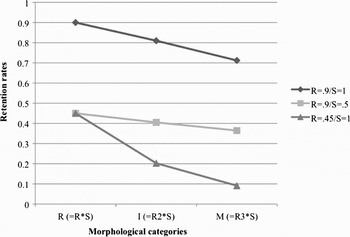
Applying these predictions to the present data permits a diagnostic test of whether a speaker's data are style shifted or not, depending on whether they deviate from an exponential function. As shown in Figure 1, if speakers conform to the relationship, they are speaking in a neutral, unshifted style. If they show M > R3, they have shifted in the direction of marked informality, and if they show M < R3, they have shifted in a conservative direction. The top line in Figure 1 shows a speaker with a base rate of 90% retention and no style shift. They obtain .9, .81, and .712 retention rates for R, I, and M. The bottom line shows a (hypothetical AAVE) speaker with a retention rate of .45, and no style shift. They obtain .45, .20, and .09 retention rates in the three morphological categories. But, in between, we have a speaker with a base rate of .90 who style shifts enough to cut his or her base rate in half (a style coefficient of .50). In the R category, such a speaker can equal the rate of the hypothetical speaker in the bottom line. But as we see by examining the rates for I and M, because the style shift is not exponentially multiplied, the line keeps diverging from the speaker in the bottom line, resulting in a much flatter line.
Stylistic deviation from exponential relation in regular past tense (R), irregular past tense (I), and monomorphemic (M) forms (S = style coefficient).

Note that this assumes a somewhat different interpretation of style shifting than that implied by the model of Labov (Reference Labov1966, Reference Labov1972). Labov treats style as a continuum of self-monitoring, so that the vernacular forms, which would involve the highest rates of CSD, come about with the least self-monitoring. We imply here that speakers can adopt an AAVE-convergent style in emulation of another language variety that has still more deletion than their own; presumably, this also involves self-monitoring, but in a direction away from the normative standard. According to LePage and Tabouret-Keller (Reference Le Page and Tabouret-Keller1985:182), a speaker's successful linguistic identification with another group requires “adequate access to that group” (Principle 2), and “the ability to modify one's own behavior” (Principle 4), one or both of which may be lacking or limited in some of our speakers.
With reference to the data we are considering here, the expectations are as follows. Native AAVE speakers (e.g., the African American rap performers Dr. Dre and NAS) should be using a relatively unshifted, vernacular style; hence, their CSD rates should be high, but should conform straightforwardly to the exponential model. The WHH in the sample, however, have had, for the most part, limited access to AAVE speakers and usage during primary language acquisition; hence, their approximations of AAVE usage constitute adaptations of their vernacular linguistic system. We also expect their baseline rates of CSD in most cases to be lower than those of the African American rappers in the sample, but perhaps also higher than those of other white speakers. In some respects, emulating AAVE will involve adopting new forms that are completely absent from their prior vernacular, but when the difference between their vernacular and the AAVE target is one of frequency of use of a variable process that is shared by both, they can easily adapt quantitatively, by shifting stylistically toward increased use of the form favored by AAVE speakers.
This is the case with CSD. The AAVE speakers tend to use considerably higher deletion rates than are commonly found among white vernacular American English speakers. Guy (Reference Guy1991a) showed that white speakers, ages 22–30 years, from various parts of the United States had deletion rates between 23% and 26% for monomorphemes, whereas Wolfram (Reference Wolfram1969) reported working class African American speakers from Detroit using CSD rates of 65%–72%, even in conservative prevocalic contexts. We hypothesize that a speaker's p0 or base rate for a variable process such as CSD is relatively stable, fixed by experience, so in the short term, any adaptations made in production are achieved by the mechanism of style shifting. Hence, to approximate AAVE rates of CSD, white speakers would have to raise their deletion rates, which is equivalent to a shift toward an AAVE-convergent style. This shift should distort the exponential relationship between M and R, such that retention rates in M are greater than the cube of the retention rates in R, following prediction IVa.
Life span studies (e.g., Sankoff & Blondeau, Reference Sankoff and Blondeau2007) suggest that some speakers do adopt higher rates of variable use in adult life. Therefore, over the long term, it is conceivable that WHH with extended exposure to AAVE could shift their base rates.
SOCIOLINGUISTIC OVERVIEW
The primary data for this study come from sociolinguistic interviews with eight white male speakers and one white female speaker, ages 16–20 years, who were involved in hip-hop (Cutler, Reference Cutler2002). The analysis also draws on data from a survey of undergraduates at three east coast universities (N = 253) who were asked to guess the ethnic identity of some of the WHH discussed here (Cutler, Reference Cutler2003a, Reference Cutler2010). The results showed that five of the speakers were identified as African American by more than 20% of the respondents.
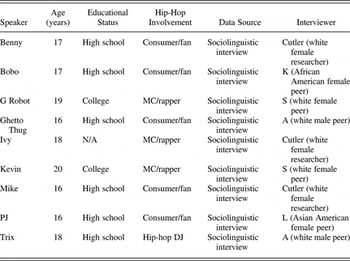
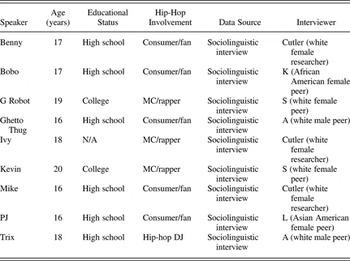
Biographical data for the speakers in the present study appear in Table 1. Most of the informants were attending high school at the time the data were collected. Two were attending college and the one female, Ivy, had finished high school and was working. Hip-hop affiliation (column 4) refers to the nature of an individual's involvement in hip-hop, whether as a consumer or more actively also as a performer. A number of the informants were heavily involved in hip-hop activities such as rap performances and MC battles. An MC is the term used to describe someone who writes and performs raps or rhymes, whereas a DJ typically mixes beats and music with turntables, providing a rhythmic and musical backdrop for the MC. The remaining informants have chosen hip-hop as a lifestyle that informs the way they dress and the music they listen to.
Biographical data for WHH (age at time of interview)
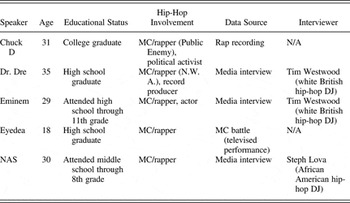
The data from the white speakers will be contrasted with data from three African American male rappers (Dr. Dre, NAS, and Chuck D) and two white male rappers (Eminem and Eyedea) shown in Table 2. Dr. Dre (Andre Young) is a leading figure in the hip-hop world. He grew up in the impoverished and gang-plagued city of Compton, California, and came to fame as a performer with the “gangsta rap” group N.W.A. (Niggas With Attitude) based in Los Angeles. He is now a rap music producer and, coincidentally, has produced and promoted the white rapper Eminem's music. Eminem (Marshall Mathers) comes from Detroit where he grew up around African Americans and rapped with an African American crew. He achieved success as a rapper in 1998 with his Slim Shady LP and is currently one of the top record-selling rap artists of all time. Eyedea (Michael Larsen) is also a white MC from the Midwest (St. Paul, Minnesota). He achieved notoriety as a freestyler and won nationally televised MC competitions such as Scribble Jam (1999) and the Blaze Battle (2000).Footnote 2 NAS (Nasir Jones) is an MC from Queens, New York, who achieved fame in the late 1990s and early 2000s. He grew up in a housing project and dropped out of school in the ninth grade. Chuck D (Carlton Ridenhour) was an MC in the group Public Enemy known for its radical political views. He now travels the lecture circuit, appears on radio shows, and narrates documentaries. Unlike Dr. Dre and NAS, however, Chuck D comes from a middle-class background; he grew up on Long Island and has a university degree in graphic design. His data, like Eyedea's also have a different source than those of the other rap stars examined here. They are drawn from his performance of several songs on the Apocalypse 91 album. Eyedea's data were from a televised freestyle performance in 2000. The data for Dr. Dre and Eminem were obtained from a joint interview on BBC radio recorded in 2000 (Westwood, Reference Westwood2000). NAS's data were taken from a radio interview recorded in 2002 on the radio station WWPR 105.1 FM in New York City (Saunders, Reference Saunders2002).
Biographical data for rap artists (at the time of the recording)

We acknowledge that significant variation can result from differences in age, interview situations, interlocutors, and speech genres such as performances (as opposed to interviews or casual conversations). However, with respect to age, Guy and Boyd (Reference Guy and Boyd1990) found that rates of (–t,d) deletion were stable across the age spectrum for both monomorphemic words (e.g., mist, raft) and past tense (missed, laughed). The final clusters in semiweak verbs (kept, swept, told) did show evidence of changes over a speaker's lifespan, leading Guy and Boyd to conclude that younger speakers analyzed the vowel alternation in the stem as the indicator of past tense, treating final clusters in semiweak verbs like those in monomorphemic words, whereas older speakers had reanalyzed final (–t,d) in these clusters as carrying past tense information. Given that the present analysis relies on data from monomorphemes and regular past tense verbs rather than final clusters in semiweak verbs, the age differences we see between the WHH and white rappers (average age 18.5 years) and the African American rap stars (average age 31) are not likely to play a large role.
With respect to interlocutor, Rickford and McNair Knox (Reference Rickford, McNair-Knox, Biber and Finegan1994) observed clear (and most likely unconscious) variation in the speech style of Foxy, an African American teenager in an interview conducted by a familiar African American woman as compared with a subsequent interview conducted by an unfamiliar European American woman. Her speech was more vernacular in the first interview and more standard in the second. Numerous other studies have demonstrated conscious and unconscious speech stylization that may result when speakers desire to demonstrate affiliation with a specific subgroup, such as politicians who converge toward a community norm, rather than the standard (Hernández-Campoy & Cutillas-Espinosa, Reference Hernández-Campoy and Cutillas-Espinosa2010; Nunberg, Reference Nunberg2004), and in certain communities, speakers may converge toward a more working-class norm (Trudgill, Reference Trudgill1974).
We acknowledge that we have not controlled for variables such as interlocutor, type of interview, or setting, all of which likely influenced the direction of the style shifting in different ways. However, our focus, as will be discussed in greater detail, is the baseline rate of CSD, which gives an indication of the speaker's natural, unperformed style as compared with his or her observed rate of CSD. This baseline rate can be derived regardless of the variation in the observed rate that may be caused by external factors such as the desire to project a particular persona or by the constraints of an interview with an unfamiliar person. These effects are certainly important, and we discuss a number of possible external factors that may have affected the variation between the baseline and the observed rates of CSD; the real focus here is to establish the degree and direction of apparent shifting, which is then interpreted in light of the social context.
In previous work (Cutler, Reference Cutler2002, Reference Cutler2010), white hip-hop–affiliated youth are shown to be converging toward AAVE across a number of variables (e.g., /ai/ glide reduction, /r/-lessness, verbal /s/, subject-verb agreement). These data show that most also show elevated baseline rates of CSD as compared with the rates for non-hip-hop–affiliated white youth. The hip-hop–affiliated white speakers in our sample fall between 33% and 81% deletion in monomorphemes, which is well above the 23%–26% range reported by Guy (Reference Guy1991a) for younger whites (presumably not hip-hop–affiliated). This indicates that WHH are diverging from the usage patterns of their white age cohort and converging toward rates that are more commonly found among the African American male rappers in this sample (70%–89% deletion). Whereas over the short term, WHHs make adaptations in production by the mechanism of style shifting, over the long term, they appear to have raised their baseline rate of CSD somewhat closer to the rates found among African American male rappers.
QUANTITATIVE RESULTS
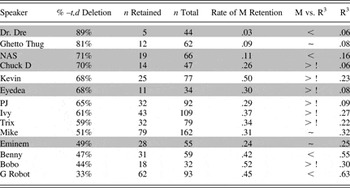
Table 3 contains the data used to determine the degree and direction of style shifting for each speaker. Speakers are listed in descending order of their observed deletion frequency, and the rows for the rap stars (Dre, NAS, Chuck D, Eyedea, and Eminem) are shaded. The second, third, and fourth columns show the overall percentage of CSD for each speaker, the N of retained tokens, and N total of coronal stop tokens. The fifth and seventh columns give the relevant retention rates for our analysis: M in column 5 (rate of –t,d retention in monomorphemes), and R3 in column 7 (the cube of the retention rate in regular past tense verbs). The relationship between M retention (column 5) and the cube of R (column 7) is shown in column 6. Recall that an AAVE-convergent style shift should yield M > R3, indicated by the > symbol, or by >! if the shift is quite large. A style shift in the conservative direction will yield M < R3, indicated by a < symbol. Very small shifts (0–1) are indicated by a~symbol.
CSD in WHH and rap stars (shaded)

<= conservative style; >= casual; > ! = AAVE-convergent; ~ = almost no shift.
The data in Table 3 demonstrate two points. First, as previous studies have indicated, African American speakers typically have substantially higher rates of –t,d deletion than most of the WHH. All three African Americans in the sample—Dr. Dre, NAS, and Chuck D—delete at rates of 70% or above, whereas 10 of the 11 WHH have deletion rates below this figure (the one outlier is Ghetto Thug, at 81%). But with respect to our indicator of style shifting, the relationship between M and R3, all of the WHH, other than Ghetto Thug, who have achieved substantially elevated rates of deletion (above 50%) appear to have arrived there by means of a substantial shift toward AAVE. The remaining WHHs with lower rates of deletion mostly show small shifts in a conservative direction, except for Bobo. This raises a clear possibility that many of these subjects are effectively performing a hip-hop identity by seeking to emulate the high rates of deletion that are characteristic of AAVE speakers.
The style-shifting indicator for the rap stars shows a different picture. The three whose data were obtained from radio interviews (Dr. Dre, NAS, Eminem) all show a modest style shift toward more conservative speech, suggesting that their use of CSD is not far from their natural style, fortifying their image as “authentic” speakers. Chuck D and Eyedea—the rappers whose data were drawn from performances—however, show M > R3, suggesting an AAVE-convergent shift.
Thus far in our analysis, we have only examined whether M is greater or lesser than R3, without any quantitative precision about magnitude of shift nor any estimates of what each speaker's unshifted or neutral rate of –t,d deletion is. But the exponential model, in combination with the logistic model of variable constraint interaction, permits more exact calculations of these values. The mathematics are presented in the Appendix (the online version of which can be viewed at http://cambridge.journals.org/LVC), but briefly, an estimate of the speaker's base rate of retention in neutral style (the value of R in the exponential model, equivalent to the speaker's p0 or input probability for this process), can be obtained from the equation:

where Mo and Ro are the observed, surface rates of retention in monomorphemic and regular past tense words. We can then use this value of R to calculate a coefficient of shift S (which is convertible to the equivalent of a variable rule factor weight) according to the formula:

This measure of stylistic shift can then be used to obtain an approximate estimate of what the speaker's deletion rate would be for their entire corpus if they were speaking in a neutral, unshifted style.
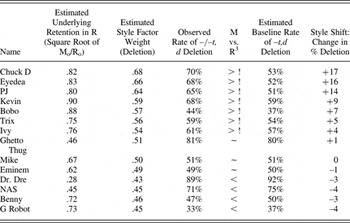
The values obtained from these analyses are summarized in Table 4. Here the speakers are presented in descending order of the style-shift measure from most AAVE-convergent to most conservative.
Estimates of baseline rates of deletion and magnitude of style-shift for each speaker, based on deviation from exponential relationship (M = R3)

< = conservative style; >= casual; > ! = AAVE-convergent;~ = almost no shift.
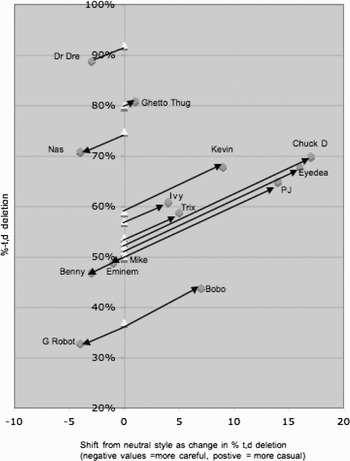
The principal results of Table 4 are presented graphically in Figure 2. The x axis shows the degree and direction of style shifting, using the percentage point measure appearing in the last column of Table 4. The y axis indicates the rate of –t,d deletion. Speakers with higher rates of deletion are toward the top. Speakers who style shift toward AAVE cluster on the right side of the chart. Those who are employing their natural, unshifted style are grouped around the zero line and those who are style shifting in a more formal direction are located toward the left side of the figure. Each speaker is plotted twice, once for his or her observed deletion rate, and once again on the zero line, indicating their estimated deletion rate in neutral style; the two points are connected by a line indicating the direction and magnitude of style shifting.
Coronal stop deletion as performance of identity: deletion rate by apparent style shift.

Three general tendencies emerge from this analysis. There are seven speakers who appear to be style shifting toward the AAVE norm involving greater deletion: PJ, Eyedea, Ivy, Kevin, Bobo, and Trix, as well as the rap star Chuck D; these speakers have increased their rates of deletion above what we reconstruct as their neutral rate by +4% to +17% points. Next are two speakers with shifts of 0% to +1% point—Ghetto Thug and Mike. Finally, there are five who are style shifting in a slightly more conservative direction—Benny and G Robot, along with the rap stars Dr. Dre, NAS, and Eminem (–1% to –4% points).
Although a variety of social factors might potentially affect a speaker's usage of CSD, we will suggest that these results find some explanation in the ethnographic characteristics of the speakers, and the social circumstances under which their data were observed. We adopt three terms to describe these patterns: the AAVE-convergent style shifters who shift in the direction of AAVE by increasing the rate of deletion; the nonshifting stylers who do not deviate from their unmarked style, and the conservative shifters who have shifted (albeit very slightly) toward more formal speech, reducing deletion rates. Clearly, these groups are being imposed on a continuum and involve small differences between the nonshifting and conservative shifters, so they should be seen as tendencies rather than definitive categories.
AAVE-convergent style shifters
The AAVE-convergent style shifters—Bobo, PJ, Trix, Ivy, Kevin, Eyedea, and Chuck D—are deleting –t,d at a rate higher than their unmarked style. As we see in Table 4, column 5, most of their baseline rates cluster between 50% and 60%, except Bobo whose estimated baseline rate of CSD is just 37%. The largest shifts are found for Chuck D and Eyedea, followed closely by PJ. Strikingly, the data for Eyedea and Chuck D are both drawn from rap performances; Chuck D's was taken from a 1991 rap recording and Eyedea's from a televised MC Battle broadcast in 2000. Eyedea is an aspiring white MC from Minneapolis; his performance style, shown by these data, deviates quite noticeably from the unmarked conversational speech style he displays in broadcast interviews.
As we have noted, Chuck D is a successful African American rap performer. He was the MC of a group called Public Enemy that was popular in the early 1990s. Like Eyedea's, his data here are taken from a public performance and show clear evidence of style shifting. The fact that these two cases of performance data also represent the two most extreme values of shifting by our measure cannot be coincidental; rather, it suggests that rap performers accentuate or exaggerate characteristics of AAVE when they are performing. This is consistent with Alim's (Reference Alim2002) analysis of rap lyrics, showing that style shifting is a natural stance for artists such as Eve and Juvenile.
However, there is another notable result in the data for Chuck D. In his performance style, he achieves a high deletion rate close to that of NAS, another African American rap star, but the data suggest that he does so by means of a fairly drastic style shift. This implies that his unmarked style actually involves a substantially lower level of CSD, around 53%. Significantly, Chuck D differs markedly in social background from the other two African American rap stars examined here. As discussed earlier, he has middle-class suburban origins and a university degree, whereas Dr. Dre and NAS come from inner-city backgrounds and never went beyond high school. These differences in status and education support the hypothesis that Chuck D, although he clearly commands a stylistic repertoire that overlaps with the usage of AAVE speakers such as Dr. Dre and NAS, possesses a neutral style in which his baseline rate of CSD is appreciably lower than the other two African American rappers. In fact, his estimated underlying CSD rate falls very close to the median value for the white speakers in this corpus.
The data for the remaining speakers in this group were obtained from sociolinguistic interviews, yet they still show a strong tendency to style shift toward AAVE. This is particularly notable for PJ, whose rate of CSD still approximates the level of style shift found in the performance data of Eyedea and Chuck D. PJ heavily identified with hip-hop culture and claimed that he spoke “Ebonics.” Forty-six percent of the respondents in Cutler's (Reference Cutler2003a) survey identified him as African American as opposed to just 14% who thought he was white. Yet several of his friends (who were present at the interview) contested his status as an authentic speaker, accusing him of trying to talk black rather than actually talking black. His style-shifting data appear to confirm this interpretation; we estimate his baseline rate of deletion to be some 14% points lower than his observed rate.
Kevin was a college student and MC who often performed at progressive New York City venues such as the Nuyorican Poet's Café at the time he was interviewed. He grew up in upper-middle-class Westchester County outside of New York City and had generally quite standard-sounding speech. Fifty-two percent of the respondents in Cutler's survey identified Kevin as European American versus just 11% who thought he was African American. Although he employed some AAVE phonological features such as /ai/ glide reduction, his speech was entirely rhotic and he never omitted verbal /s/ or the copula as some other WHH did. Clearly, CSD deletion was a significant component of his rather limited stylistic inventory, and he had one of the higher rates of shift (9% points) in the direction of AAVE.
Bobo is another speaker who shifts toward a much higher rate of deletion. Although his overall rate of CSD is among the lowest in the sample, he shows a strong shift toward AAVE usage in this data, with a difference of 7% points between his estimated base rate and observed rate of CSD. He claims to be able to speak what he calls Ebonics because of his contacts with African Americans on the football team, but shows little evidence of this during the interview. He was interviewed by his friend “K,” a female African American classmate who is a straight-A, college-bound student with quite standard-sounding speech. Rickford and McNair-Knox (Reference Rickford, McNair-Knox, Biber and Finegan1994) in their study of an African American female's speech, show that race and level of familiarity of the speakers are crucial variables in determining speaker style. Although he differs from K in terms of race and gender, their friendship may make him feel comfortable enough to retain a feature such as elevated CSD usage while suppressing other features he might use with his African American male teammates.
Trix was a high school age hip-hop DJ from Queens. He identified very strongly with rappers like NAS, who also comes from Queens. Trix commented extensively in the interview about how much grief he gets from his girlfriend for the way he talks. He reported having made conscious efforts to “tone down” his speech to please her, but has obviously not completely given up stylizing his speech. He is among the stronger shifters with a 5% point difference between his estimated baseline rate (54%) and his observed rate of CSD (59%). In the results of the survey described by Cutler (Reference Cutler2003a), 30% identified Trix as African American versus 13% European American.
Ivy's data show a modest AAVE-convergent shift of about 4% points; this is somewhat surprising given the extent of her involvement in hip-hop as an aspiring MC, and the fact that her speech was in other respects a convincing performance of African American English. Indeed, 64% of the respondents in a survey of undergraduates identified her as African American (Cutler, Reference Cutler2003a).Footnote 3 She may have grown up without much of an AAVE model to emulate in Ann Arbor, Michigan (other than rap music), but she was later heavily involved in African American hip-hop networks in New York City. One explanation for her rather modest shift could be what Sweetland (Reference Sweetland2002) and Coupland (Reference Coupland2001) have alluded to as the maxim not to overdo authenticity. White hip-hoppers who “overuse” stereotypical features of AAVE are often labeled inauthentic “wannabes” (Bucholtz, Reference Bucholtz1999; Cutler, Reference Cutler1999; Jacobs-Huey, Reference Jacobs-Huey1997), and speakers such as Delilah in Sweetland's study, Ivy in this study, and even the white rapper Eminem, by virtue of their integration into the AAVE speech community, appear to be especially keen to avoid this label.
Thus, each of the AAVE-convergent shifters has possible social reasons for the shifting that is evident in his or her speech. On the evidence of Chuck D and Eyedea, an AAVE-convergent style also appears to be a feature of performance, as was also noted by Alim (Reference Alim2002). Notably, the WHH in this group appear to be using the same device to “perform” a hip-hop identity in their interviews. It is also noteworthy that most of these AAVE-convergent style shifters (with the exception of Bobo) have estimated baseline rates of 51% to 59% that fall in between the highest deleters (75%–92%) and the two lowest deleters, who have 37% CSD.
Nonshifting stylers
Neither Ghetto Thug nor Mike appears to be shifting their rates of CSD on the evidence of these data. The difference between them, however, is that Ghetto Thug's rate of CSD exceeds the deletion rates of all other white speakers in the corpus as well as two of the African American rappers (only Dr. Dre exceeds his rate of CSD). He seems particularly keen to project a “street identity” in marked contrast with his affluent family origins and stated in his interview that he “hangs” with a crew of Puerto Rican boys in a part of town away from the well-to-do part of Queens where he and his parents live. Indeed, his speech was judged to be that of a Latino speaker by 63% and African American by 21% of listeners in Cutler's (Reference Cutler2003a) survey. Wolfram (Reference Wolfram and Fasold1974) speculated that consonant cluster reduction among Puerto Ricans was potentially traceable to influences from either Spanish or AAVE and was more frequent among some Puerto Rican speakers than among African Americans (cited in Slomanson & Newman, Reference Slomanson and Newman2004:201). Slomanson and Newman (Reference Slomanson and Newman2004) also noted that rates were higher for New York Latino English speakers who had a high degree of contact with African Americans than for those who had a lower degree of contact, suggesting that the Spanish and AAVE influences converged to yield a higher rate of deletion than either would have produced by itself. This sort of generalization may be relevant to the high overall rates of –t/d deletion shown for Ghetto Thug (both his estimated baseline rate and his almost identical observed rate) because he is presumably emulating the patterns used by his Puerto Rican friends.
Mike also seems to be employing an unshifted speech style with respect to CSD. Like Ghetto Thug, he immersed himself in the street-tough world beginning around age 13, although in Mike's case, his “crew” consisted of other white adolescents from his wealthy Manhattan neighborhood. He was involved in a number of physical encounters that landed him in the hospital on two occasions during high school. His own rather rough and tumble experiences with gangs—although primarily white and upper middle class—may have helped to shape his speech style at a crucial moment during adolescence. He and Ghetto Thug, despite their upper-middle-class, private school backgrounds may have adapted linguistically to norms of AAVE use in terms of their phonology. Yet another interpretation for the lack of any notable shift in CSD rates for these speakers may lie once again in the desire to avoid overdoing authenticity (Coupland, Reference Coupland2001; Sweetland, Reference Sweetland2002), and this effect, rather than the successful acquisition of a second dialect, may be a better explanation of the lack of style shifting found for these three speakers.
Conservative shifters
Finally, there are five speakers who appear to shift in the opposite direction, toward a more conservative style with greater retention of coronal stops than we would expect to find in their baseline frequency. Interestingly, this group is composed of speakers at both ends of the social spectrum, with markedly different rates of deletion. Dr. Dre and NAS are the two highest deleters in the corpus with estimated baseline rates of 92% and 75%, respectively; Figure 1 shows how they may function as the target that some of the WHH appear to be emulating. The white rapper Eminem is somewhere in the middle, with an estimated baseline rate of 50% CSD. Benny and G Robot, both products of elite private high schools, on the other hand, are two of the lowest deleters, with observed rates of 47% and 33%, respectively. What unites this group is the conservative direction of their style shifting.
NAS and Dr. Dre are very prominent and popular figures in the hip-hop world; as such, their authenticity is hardly in doubt. They both hail from the “gangsta” rap world where street connections and a rejection of middle-class norms prevail, and their baseline deletion rates are very high. Their high baseline rates along with their iconic status as gangsta rappers may free them from having to perform or project any particular identity through style shifting. Eminem is a well-known rapper and, although white, is effectively an insider in the hip-hop world. He grew up next to an African American neighborhood in Detroit and has been fostered and promoted by African American rap icons such as Dr. Dre, so it is perhaps somewhat unsurprising that he does not attempt to shift in either a more standard or more vernacular direction. However, his baseline deletion rate is much lower than for Dr. Dre and NAS, which is consistent with the general relationship between white and black varieties of English in the United States.
Nevertheless, all three show a very modest shift in the conservative direction. We interpret this as a consequence of the interview situation. In all three cases, the data were drawn from radio interviews with well-known hip-hop DJs who knew the rappers from previous interviews. Although a radio interview may be a context that for most speakers should evoke a more conservative style, the familiarity between the radio DJ and the artists may explain why each speaker's shift in this direction is quite modest, only 1%–4% points.
The other two conservative shifters are WHH with much lower rates of deletion. Benny has an estimated baseline CSD rate of 50% that conforms to many of the other white speakers, but he shifts in the opposite direction, toward a lower observed rate of 47%. His case is interesting because he affiliates with an African American peer group, and although he does some rather interesting things with his speech during the interview in terms of intonation and voice quality, the setting of his interview (headmistress's office at his private school) was hardly conducive to eliciting a casual or AAVE-convergent style. In other contexts, he may perform a hip-hop identity by means of a casual style shift, but his behavior in this interview suggests a typical response to a formal context.
G Robot has the lowest rate of CSD of all the speakers, yet his speech appears to depart significantly from his unmarked style in a still more conservative direction. G Robot is a college student who participates in a hip-hop club at his school. His speech style overall shows little evidence of AAVE influence. He was interviewed by a white female college classmate who attended the same privileged high school in a suburb of Boston, and he expressed reservations at the outset about the purpose of the interview and what it would be used for. Later in the interview, he grew more talkative, but his speech remained consistently conservative throughout the conversation. We estimate his baseline deletion rate to be 37%, which is higher than his observed rate of 33%.
In sum, the conservative shifters appeared to be affected to varying degrees by the constraints of the interview situation. The question is whether and to what extent the speakers might tend to use higher deletion rates in circumstances other than a constraining interview. This predicts that speakers such as Dr. Dre would have a higher baseline rate of CSD on the order of about 92% (vs. 89% in the interview). Similarly, NAS is predicted to have a baseline rate of 75% CSD (vs. 71% in the interview). Had Benny been conversing with his peers, we would predict his rate to be about 50% (vs. 47% in the interview). As for G Robot, neither his observed nor his estimated base rate give evidence that he commands more AAVE-like levels of CSD for the performance of hip-hop identity.
Baseline rates of CSD
Thus far, we have divided the speakers into three groups based on the degree and direction of shift from their baseline to their observed rates of CSD. Another way to organize them is simply in terms of their estimated baseline frequencies. Accordingly, the speakers with the highest baseline rates of CSD from 75% to 92% include Dr. Dre, Ghetto Thug, and NAS. If these upper ranges can be said to characterize the speech of male gangsta rappers, then they may well function as models for WHH who want to project that sort of affiliation. High rates of CSD also appear to signal a speaker's established authenticity, obviating the need to shift dramatically in either direction.
The middle group of speakers has estimated baseline rates of CSD between 50% and 59%, which are intermediate between the rates that have been reported for white Americans and those found for working-class African Americans. Overall, this group contains the speakers who have the largest shifts toward higher rates of CSD use. For Chuck D and Eyedea, this is no doubt affected by the fact that their data are drawn from rap performances. But for all of the speakers that shift in this direction, including Chuck D and Eyedea, shifting toward a CSD rate higher than one's base rate appears to be associated with the projection of a hip-hop identity. None of these speakers shifts so far as to approximate the base rates that we estimate for professional gangsta rappers such as NAS and Dr. Dre (75%–92%); this may be because of inability, or because they do not wish to go that far, or because they wish to avoid the charge of inauthenticity (as noted earlier, PJ was in fact accused of being a wannabe by his friends). Nevertheless, they all achieve levels of CSD dramatically higher than those found for white Americans who have no hip-hop affiliation. Interestingly, at the low end of this range, we find three speakers (Eminem, Mike, and Benny) who show no shift or a modest negative shift, suggesting a degree of comfort with their own speech style, and no desire to approximate the levels of the gangsta rappers. For Eminem, this may be particularly important to avoid the charge of inauthenticity or to avoid the appearance of copying his style from his mentor, Dr. Dre.
Although they style shift in opposite directions, the last two speakers, Bobo and G Robot, stand out as having the lowest estimated baseline rates of CSD (both 37%). It is possible that one or both can shift their levels of CSD to a higher rate than what we observe here, but this shift would have to be quite large to match even the estimated baseline rates of white MCs such as Eminem or Eyedea (50% and 52%, respectively). These speakers are much closer to the range of CSD that we would expect to find among white, non-hip-hop–affiliated youth (22%–26% cited in Guy, Reference Guy1991a). Coronal stop deletion is part of an apparently limited inventory of linguistic resources that they use to project a hip-hop affiliation.
DISCUSSION: AUTHENTICITY AND IDENTITY
Recent studies of language and identity in anthropology and sociolinguistics illustrate how identity is a social and cultural process that emerges in various forms of social and sociolinguistic practice. Studies of out-group language use have challenged the idea that the use of a particular linguistic form associated with a particular group automatically signals membership in that group, yet it is the social contextualization of features that establishes an indexical link between linguistic forms and particular groups of speakers (Irvine & Gal, Reference Irvine, Gal and Kroskrity2000). Crucially, such forms constitute resources that can be used to reinforce or contest social boundaries or to index traits associated with social categories (Eckert, Reference Eckert2008). Deletion of coronal stops would appear to be one such stylistically salient variable that speakers can manipulate to express their affiliation with hip-hop as well as qualities they associate with male hip-hop–affiliated AAVE speakers (e.g., toughness, street smarts). How they employ this variable provides a view into whether they have actually adopted an AAVE-influenced grammar as part of their own vernacular, as opposed to having simply style-shifted toward AAVE. The stylistic shifts observed here may be influenced by a variety of factors, but it is notable that most of the speakers fall into one of two groups with respect to identity and context of use. Those who do not show evidence of shifting toward higher rates of CSD use, or in fact shift toward slightly lower rates, have unquestioned hip-hop identities (Dre, NAS, and Eminem), and/or contexts of production (in this case interviews) that disfavor shifting toward a more casual style (Dre, NAS, Eminem, Benny, and G Robot). Those who do show evidence of shifting, often substantially, toward higher deletion rates all aspire to or affirm a hip-hop identity that is in some respects at odds with their race or class background (Kevin, Ivy, Trix, PJ, Bobo, Eyedea, and Chuck D.) Another speaker who also affirms such an identity, Ghetto Thug, also uses very high rates of CSD, but apparently does so by an actual change in his base rate rather than superficial style shifting, perhaps as a consequence of influences from his personal network of Latino male friends.
These data illustrate the need for a distinction between true second dialect acquisition and in-group status and “language crossing”—the emblematic, ritualized use of characteristics of another group's language (cf. Rampton, Reference Rampton1995). Rampton referred to the ephemeral, momentary nature of crossing, and emphasized that it does not imply a claim of membership in the group being “voiced.” It reflects a temporary alignment with speakers of that group, in a Bakhtinian sense (Bakhtin, Reference Bakhtin1984). Similarly, we could say that many WHH who style shift toward AAVE levels of use of linguistic variables may be trying to express a range of qualities associated with African American (male) hip-hoppers rather than claiming an African American identity. However, those whose speech not only targets that of AAVE speakers, but also has been adopted at an underlying level may be demonstrating a deeper identification with the referenced group, especially a gangsta rapper identity.
The question of authenticity is a central one when linguistic and cultural resources clearly derive from another group. In a paper about Australian country music singers, Snider (Reference Snider2002) observed that some artists define authenticity in terms of how closely they can imitate, both linguistically and lyrically, the singing style of American country music artist, whereas others believe that singing with a natural Australian accent about Australian themes is more authentic. In Sweetland's (Reference Sweetland2002) study, we saw how “Delilah,” a white woman who is a long-term accepted member of the AAVE speech community is distinguished from certain other whites who are not accepted as members of the AAVE community by actually using fewer AAVE phonological markers and at a lower frequency than her African American peers. Thus, authenticity may involve considerable restraint in the degree to which one imitates the reference group.
There is a similar dialectic regarding authenticity within hip-hop. Ethnographic data from WHH suggest that there are differing interpretations of what it means to “keep it real” (Cutler, Reference Cutler2003b). Some white (mostly male) hip-hoppers feel that “realness” or authenticity is about emulating African American gangsta rappers from their attitudes and gestures to their speech patterns (however essentialized these may be). For others, “keepin' it real” is about representing yourself for what you are and being honest about where you come from (Rickford & Rickford, Reference Rickford and Rickford2000). White middle-class youth who participate in hip-hop as MCs or rappers insist that authenticity should be about one's skills rather than one's ethnicity or socioeconomic status. Even rap stars face challenges to their authenticity based on their ethnicity; a notable lyrical response to such a challenge is found in a performance by Eminem at Scribble Jam 1997. When a black MC dissed him for being white, Eminem responded with characteristic explosiveness:
I let a razor split you so they have to staple stitch you
And nobody in this place will miss you,
‘Cause you try to turn my facial tissue into a fuckin' racial issue
Forcefully, and using four-syllable end-rhymes, Eminem asserts here that authenticity in rap music does not depend on the color of one's skin, and that suggestions to the contrary deserve a violent response (at least rhetorically). However, authenticity is still supremely important in the hip-hop world: keeping it real is one of the highest values in this community. The worst scorn is directed at wannabes or those who fail to present themselves honestly and pretend to be something (e.g., from the ghetto) that they are not.
Linguistic behavior is obviously an important aspect of authenticity. But, is nativelike competence even necessary to be considered an authentic speaker of a variety (cf. Sweetland, Reference Sweetland2002)? Cutler (Reference Cutler2003a) showed that listeners seem particularly attuned to suprasegmental features, phonological features, and lexical items, and concluded that speakers do not have to control the full range of AAVE morphosyntax to pass as AAVE speakers. Our findings on CSD as a measure of style shifting provide another diagnostic for linguistic authenticity. Under one interpretation, the less a speaker style shifts the more authentic his or her speech would seem to be. If white speakers such as Eminem, Ghetto Thug, and Mike can approximate AAVE deletion rates without style shifting, perhaps we can say that they have, in effect, acquired a second dialect, or at least, one feature of that dialect. The lack of a shift appears to index one's status as a hip-hop insider. Thus, in terms of linguistic authenticity, we can surmise that style shifting represents a degree of inauthenticity in that speakers are not representing themselves for what they are and are “playing up” their hip-hop status via stylistic convergence toward AAVE.
In the final analysis, therefore, linguistic authenticity has more than one dimension. In one direction, being an authentic speaker of a variety means approaching or achieving the rates of use of linguistic variables that are typical of that variety. But in another dimension, it matters how you get there: whether you do so by changing your own basic vernacular usage, or by massive style shifting away from your unmarked use. Grammar turns out to be a vital part of identity. You are what you speak.
APPENDIX:
A mathematical model of style shifting: English coronal stop deletion in the exponential model and the variable rule model
The exponential model (Guy, Reference Guy1991a) predicts these relationships among rates of final coronal stop retention in monomorphemic (underived) words (M), semiweak irregular past tense verbs (I), and regular past tense verbs (R):

Word-internal constraints do not affect the exponential relationship among word classes, but external constraints, applying only postlexically, alter the exponential relationship because they are not iterated at all levels of the phonology (Guy, Reference Guy1991b). We postulate that style is a surface phenomenon, not a deep process permeating the lexicon and the underlying phonology; hence, it functions as an external constraint in this model. Hence, when speakers adopt a style that diverges from their neutral unmarked style (i.e., their vernacular usage), the retention rates will appear as follows, where S represents a shift coefficient summarizing the single surface adjustment in the process of CSD, and Mo, Io, and Ro represent observed surface rates of retention.

(Because tokens of semiweak irregular past tense verbs are so infrequent, we will pay no further attention to the I class here.)
Dividing across in the above equations gives a formula for calculating the underlying base rate of retention R from the observed surface rates:

According to the model, R is equivalent to the speaker's individual p0 for this variable process. Using this value, we are then able to calculate the value of the shift coefficient by either of the following equations:

In practice, because there are usually more tokens of monomorphemic words available, we will generally prefer to use the Mo/R3 formula for this calculation, as it will be more reliable. Note that the S thus obtained is a coefficient of shift stated as a ratio of the observed rate of deletion to the underlying rate. It can be converted to more familiar form equivalent to a variable rule factor weight for speech style by the expression S/1 + S.
Finally, the analysis can be used to obtain an estimate of what each speaker's overall deletion rate would be in the entire corpus in his or her neutral style. Although the shift coefficients (and corresponding factor weights) calculated by this method are, strictly speaking, defined just for the ratios of Ro/R and Mo/R3, they will nevertheless approximate the shift ratios for each individual's total corpus. Hence, in the familiar logistic equation of the variable rule model (making appropriate adjustments for the change of focus to deletion instead of retention), the relationship between observed deletion rates (represented as Do), unshifted deletion rates (D), and the style shift factor weight (Ps) is:

Solving this equation for D gives the estimated neutral style deletion rate for each speaker.