INTRODUCTION
An array of psychosocial research has considered various aspects of life for young people who have, or have had, cancer (Bleyer & Barr, Reference Bleyer and Barr2007; Mattsson, Reference Mattsson2008; Palmer et al., Reference Palmer, Mitchell and Thompson2007). However, as argued in Patterson et al. (Reference Patterson, Millar and Desille2009), much of the available research has focused on children or adolescents, resulting in a relative lack of studies that concentrate on older young people, or 18–25 year olds, termed “emerging adults” by Arnett (Reference Arnett2000).
“Emerging Adulthood” is described by Arnett (Reference Arnett2000) as a developmental stage that occurs between, and is theoretically and empirically distinct from, adolescence and young adulthood. He explains that “having left the dependency of childhood and adolescence, and having not yet entered the enduring responsibilities that are normative in adulthood, emerging adults often explore a variety of possible life directions in love, work and, world-views” (p. 469). Essentially, this work in identity exploration is said to be the main focus of emerging adulthood, whereas earlier developmental theories, such as Erikson (Reference Erikson1963), posited it as the main focus of adolescence.
Particular attention is paid, in Patterson et al.'s (Unpublished manuscript) qualitative study, to the ways in which a cancer experience can impact upon the four developmental tasks considered most crucial for the transition of emerging adults into young adulthood (Arnett, Reference Arnett2001). These four tasks include accepting responsibility for oneself, making independent decisions, establishing a relationship with one's parent(s) as an equal adult, and being financially independent from one's parent(s). It is argued that psychosocial care of emerging adults with cancer must be mindful of the challenges that a cancer experience poses to the young person's achievement of these developmental tasks.
Aspects of this argument have been mentioned in previous research. For example, in his discussion on the psychosocial care of 15–29 year olds, Bleyer (Reference Bleyer2002) noted that particular challenges include “autonomy and independence, peer pressure, education, graduation from school, social development, sexual maturation, intimacy, marriage, reproduction, fertility, employment, parenting, and insurability” (p. 5). Also, Roberts et al.'s (Reference Roberts, Severinsen and Carraway1997) survey of 46 cancer survivors aged 22–35, uncovered the following six areas of concern — anxiety about health, loss of physical well-being, worry about children, problems in relationships, financial and vocational concerns, and feelings of unattractiveness.
However, more work is required in researching the needs of emerging adults with cancer in ways that are age-appropriate, measurable and action-oriented. Asadi-Lari et al. (Reference Asadi-Lari, Tamburini and Gray2003) stress the importance of ascertaining the individual's needs “if health services are ever to move away from a top-down approach to health care towards a needs-driven system” (p. 37). The identification and monitoring of an individual's unmet needs in relation to their cancer experience enables health care providers to better target, prioritize and meet these needs, with the aim of minimizing the psychological distress with which a high number of unmet needs is expected to be associated.
The use of quantitative measures, such as a needs-based questionnaire, would enable the much-needed gathering of needs-based information that is sensitive to the ways that unmet needs may vary at different stages of treatment and recovery. Mullan (Reference Mullan1985) defined three “seasons of survival” for people (of unspecified age) with cancer — acute, spanning diagnosis and treatment (involving the primacy of fear and anxiety); extended, spanning remission and consolidation therapy (involving fear of recurrence and dealing with toxicity of treatment), and; permanent, spanning long-term “cure” or being cancer-free (involving long-term risks and late effects). It is anticipated that time-sensitive information would assist health care providers, as well as friends and family, to better meet the emerging adult's unmet needs by understanding how those needs can change as time-since-treatment increases.
Recently, Shakeshaft et al. (Unpublished manuscript) have been developing the first known needs-based measure for young people with cancer, the Cancer Needs Questionnaire for Young People (CNQ-YP). The CNQ-YP seeks to gain a comprehensive understanding of a young person's unmet needs in relation to their cancer experience, covering issues relating to health care provision, school/occupation, relationships, emotional/psychological issues, daily living, and information. However, it was felt by the present authors that additional need items could be included to address certain issues that an emerging adult might be facing. As such, a qualitative study, using focus groups and telephone interviews with 14 emerging adults with cancer, was undertaken, identifying 24 needs items that were not covered in the CNQ-YP. These items related to issues of identity renegotiation (particularly autonomy, transition, and existential concerns), family concerns, residual trauma, and additional practical and treatment-related concerns.
Using both the CNQ-YP and the additionally developed need items, the present study seeks to: (1) identify the most unmet psychosocial needs of 18–25 year olds with cancer, (2) explore the ways that these needs might vary at various stages throughout the cancer experience, and (3) situate these needs within the developmental framework of emerging adulthood. The quantitative measurement of unmet needs will also allow for an investigation into proposed associations between unmet needs and psychological distress in emerging adults with cancer.
METHOD
Sample
Drawn from the membership database at CanTeen, the Australian Organisation for Young People Living with Cancer, 63 emerging adults with cancer completed the survey. Ages ranged from 18–24 (M = 20.4 years), and there were 40 females and 23 males. The participants were in various stages of treatment, recovery and post-recovery for one or more of a variety of cancers — 21 were on treatment or within one year since treatment, 22 were between one and five years since treatment, and 20 were beyond five years since treatment. There was no significant difference in the distribution of gender between the three time-since-treatment groups, χ2 (2, n = 63) = 2.35, p = .309.
Measures
The Cancer Needs Questionnaire for Young People
In its unpublished 2006 form, the CNQ-YP (Shakeshaft et al., Reference Shakeshaft, Sanson-Fisher and Girgis2006) contains 108 items covering the following seven domains: Structure of Care, Process of Care, Relationships, Information, Daily Living, Emotional/Psychological, and School/Occupational. Participants are asked to circle the level of need (on a four-point scale of no need, low need, moderate need, high need) for each item. In the present study, the questionnaire was modified such that, if some level of need was circled, the participant was also asked to indicate whether it was met or unmet. Also, each need item was prefaced with the sentence stem “In the last 12 months I needed…”.
Additional Need Items
The 24 additional items developed from previous qualitative research focussing specifically on emerging adults were included to supplement the CNQ-YP. These items were presented in the same format as the CNQ-YP items.
Depression, Anxiety and Stress Scales (DASS-21; Lovibond & Lovibond, Reference Lovibond and Lovibond1995)
The DASS-21 is a 21-item (short version) self-report screening scale designed to measure the negative emotional states of depression, anxiety, and stress (Lovibond & Lovibond, Reference Lovibond and Lovibond1995). The three subscale scores can be combined to produce a score of total distress. The scale has been shown to have high internal consistency, possess good construct validity (Lovibond & Lovibond, Reference Lovibond and Lovibond1995; Antony et al., Reference Antony, Bieling and Cox1998) and to yield meaningful discriminations in a variety of settings (Brown et al., Reference Brown, Korotitsch and Chorpita1997).
Procedure
The measures were posted out to participants in the form of a paper-and-pen survey (listing the option to complete it online) along with questions gleaning demographic information, after receiving ethics approval from CanTeen's Ethics and Young People Committee. The accompanying instructions assured the participant of the anonymity of their responses and that their relationship with the peer support organization could not be affected in any way. The participant's consent was considered given if they chose to complete and return the survey.
Analysis Considerations
As the CNQ-YP, in its 2006 form, had not yet been psychometrically validated and has since undergone revision, all of the need items in the study are analyzed in this present study based on their frequency of being rated as unmet. This also allows for the inclusion of the additional need items developed from the present authors' previous work.
The correlational analysis of the psychological distress and unmet needs data was exploratory and was therefore considered significant at an alpha-level of 0.1. This was seen to be warranted in order to decrease the probability of a Type II error (Hays, Reference Hays1973).
Finally, to reflect the three stages of survival suggested by Mullan (Reference Mullan1985), the 10 most unmet needs are reported separately for each of the three time-since-treatment groups – those on, or within one year since, treatment; those between one and five years since treatment, and; those beyond five years since treatment.
RESULTS
Unmet Needs
Of the total 132 need items, the participants reported an average of 17.7 unmet needs each. Fifty-three participants reported a range from one to 67 unmet needs, while 10 reported no unmet needs — five of these were between one and five years since treatment, and five were beyond five years since treatment. Those participants currently on, or within one year since, treatment reported an average of 25.5 unmet needs (range: 1–67); those whose treatment was between one and five years ago reported an average of 13.2 unmet needs (range: 0–36), and; those whose treatment was more than five years ago reported an average of 14.5 unmet needs (range: 0–54). These means differed significantly, F (2,62) = 3.87, p <.05. Post-hoc contrasts revealed that those currently on, or within one year since, treatment reported significantly more unmet needs than both those whose treatment was between one and five years ago (t(60) = 2.55, p < .025) and those whose treatment was more than five years ago (t(60) = 2.24, p < .05).
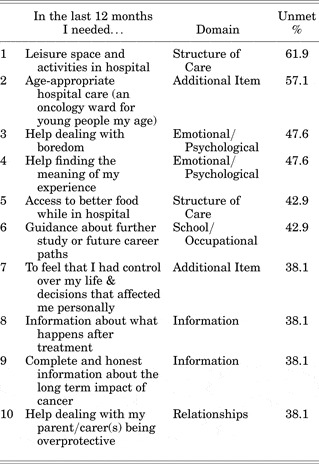
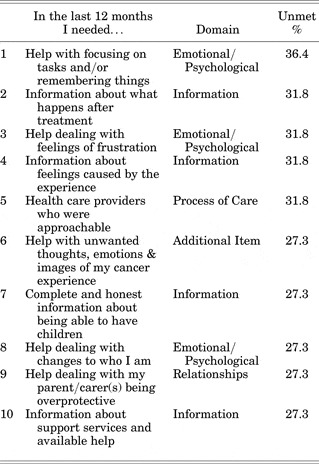
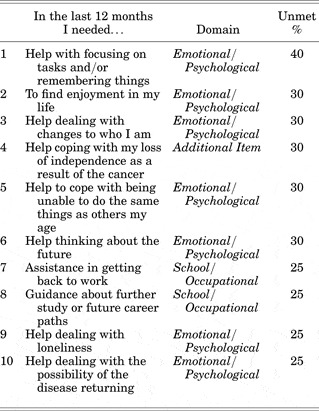
Tables 1, 2, and 3 display the 10 most unmet needs for each of the time-since-treatment groups respectively. The percentage next to each need item indicates the percentage of the participants in that group who rated the need as being unmet for them in the last 12 months.
Ten most unmet needs for emerging adults on or within one year since treatment (n = 21)

Ten most unmet needs for emerging adults between one and five years since treatment (n = 22)

Ten most unmet needs for emerging adults five years or more since treatment (n = 20)

Psychological Distress
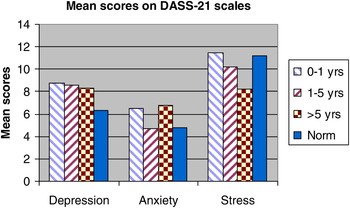
Figure 1 shows the psychological distress scores for the 60 participants who completed the DASS-21, with the fourth column for each subscale displaying the population norm (Lovibond & Lovibond, Reference Lovibond and Lovibond1995).
(Color online) Psychological distress for each time-since-treatment group.

On average, scores on the depression, anxiety and stress sub-scales fell within the “normal” range. However, while normative statistics for the DASS-21 (Lovibond & Lovibond, Reference Lovibond and Lovibond1995) show that approximately 15–20% of the general population score in the “at-risk” and clinically-elevated ranges, the present study showed that 25% of the total sample scored in the at-risk range for depression, 24% scored in the at-risk range for anxiety, and 17% scored in the at-risk range for stress. No significant difference arose between the three time-since-treatment groups, F(2,57) = .14, p = .87, indicating that levels of psychological distress do not significantly improve as time-since-treatment increases.
Needs and Psychological Distress
In order to investigate the relationship between unmet needs and psychological distress scores, Pearson's correlations were conducted on the total number of unmet needs and each DASS-21 subscale for all three time-since-treatment groups combined (given that no significant differences were noted between them). There was a significant positive relationship between unmet needs and anxiety, r = .27, p < .05, and between stress and total unmet needs, r = .24, p = .068 (significant at an exploratory alpha-level of 0.1). The non-significant correlation result for unmet needs and depression was r = .18, p = .17.
DISCUSSION
This cross-sectional questionnaire-based study produced informative descriptions of emerging adults with cancer by time-since-treatment, in terms of their most unmet needs across a wide range of psychosocial, medical, and practical concerns, and has revealed significant correlations between higher levels of unmet needs and psychological distress. These most reported unmet needs paint a particular picture of the major concerns for each group, also describing ways in which unmet needs change as time-since-treatment increases. These results will now be discussed separately for each group.
Emerging Adults on or Within One Year since Treatment
The most prominent unmet needs for those on or within one year since treatment included the need for age-appropriate hospital care, better food, and better leisure space and activities while in treatment, reflecting the primacy of care-related concerns at the time of treatment. Also highly unmet was the need for help dealing with boredom. These concerns are particularly pronounced for emerging adults who, in Australia's present health care system, are placed in general adult cancer wards, often alongside elderly patients. The current results regarding the importance of age-appropriate cancer care for emerging adults echo Grinyer's (2002) call for a therapeutic environment that is carefully designed to suit the young person's needs for privacy, personal space, opportunities for peer interaction, and appropriate décor, helping to restore some sense of “normality” in their lives. Further, Bleyer (Reference Bleyer2002) argues that “specialised adolescent and young adult cancer units should be developed with the anticipation that the centralisation of care and availability of age-targeted clinical trials will lead to improved treatment, survival, and quality of life” (p. 9).
Informational needs regarding treatment, what happens after treatment, and the long-term impact of cancer, were also highly unmet for this group of emerging adults. This concurs with the finding of Dunsmore and Quine (Reference Dunsmore and Quine1995) that many young people with cancer reported feeling under-informed by health care providers. Feeling under-informed may limit the emerging adult's sense of personal autonomy and their opportunities to make independent decisions about their treatment and situation.
Highly unmet emotional/psychological needs included help with finding the meaning of one's experience. That cancer represents a major disruption to one's life and life plans is reinforced by the prominence of other unmet needs involving guidance about further study or career options, and re-establishing a sense of control in one's life and decisions. The issue of independence is also underscored by the need for help dealing with parental over-protectiveness (rated 10th most unmet). These findings resonate with Bleyer's (2002) description of the challenges facing young people in treatment for cancer, including “… the time away from friends, school, work, and community that therapy requires and the financial hardships that occur at an age when economic independence from family is an objective” (p. 6).
Emerging Adults between One and Five Years Since Treatment
The most unmet need for this group involved help with focusing on tasks and remembering things, possibly related to the pervading disruption that a cancer experience can pose to one's state of mind and one's ability to focus or concentrate on day-to-day living. The possible role of neurological impairment resulting from some treatments should also be considered.
Other prominent unmet needs of a more emotional or psychological nature included help dealing with frustration, dealing with changes to “who I am” (reflecting the identity struggle that a cancer experience can cause), and the need for information about the feelings caused by the experience. Indicative of post-traumatic stress symptoms often found in young people with cancer (Hobbie et al., Reference Hobbie, Stuber and Meeske2000; Kazak et al., Reference Kazak, Alderfer and Streisand2004), the need for help dealing with unwanted thoughts, emotions, and images of one's cancer experience was also rated as unmet for more than one quarter of emerging adults in this group. In sum, these findings highlight the importance of timely and responsive professional psychological support for emerging adults after cancer treatment, further reinforced by the highly unmet need for information about support services and available help.
The highest rated informational needs for this group involved information about what happens after treatment, feelings caused by the experience, one's fertility status, and support services. This reflects the changing nature of informational needs as time-since-treatment increases, as described by Decker et al. (Reference Decker, Phillips and Haase2004) who emphasise the importance of ongoing information support for young people throughout the cancer journey. Related to the delivery of this information is the also highly unmet need for approachable health care providers.
The issue of parental over-protectiveness was also highly rated for this group, indicating that the issue of independence is also prominent as the emerging adult transitions out of the treatment stage and negotiates a new sense of “normal life” out of the hospital.
Emerging Adults beyond Five Years Since Treatment
The need for help with focusing on tasks and remembering things was also the most unmet need for this group, highlighting the long-term disruption that a cancer diagnosis and its treatment effects can cause, and the need for the development and refinement of cognitive-focused interventions for cancer survivors.
A number of the most unmet needs for this group involved issues of identity renegotiation and independence, such as help dealing with changes to “who I am,” help coping with the loss of independence as a result of the cancer, and help coping with being unable to do the same things as one's peers. In addition, unmet needs regarding uncertainty about the future, the fear of relapse or recurrence, finding enjoyment in life and dealing with loneliness, indicate a substantial need for improved psychosocial support across a range of complex intrapersonal and interpersonal issues.
The highly unmet needs for guidance about further study or career paths, assistance with getting back to work, and help thinking about the future, underline more practical concerns regarding the task of revising one's future plans in light of having had cancer. This disruption to one's future plans is explored by Grinyer (Reference Grinyer2002) who describes the tension between one's anticipated “life trajectory” and the impacts that one's “treatment trajectory” has had — such as delaying entry to, or completion of, higher education.
It should also be noted that the level of “unmetness” in these needs was almost equivalent to that of the previous group's 10 most unmet needs. In other words, the prominence of unmet needs was just as pronounced for those who were five years or more since treatment, as for those who were between one and five years since treatment. This highlights the need for long-term support and the availability of guidance for emerging adults with cancer.
Implications
In sum, the findings for each of the above groups underscore the appropriateness of utilizing a time-sensitive approach in understanding the unmet needs of emerging adults who have or have had cancer – and this study is among the first in psycho-oncological research on young people to do so. Perhaps the most pronounced difference that emerges when investigating the three lists of unmet needs is that the primacy of care-related needs for those on or within one year since treatment was not as pronounced for those who were five years or more since treatment. This is to be expected given that the hospital or treatment center becomes less of a feature as time-since-treatment increases. Instead, for those whose treatment was five years ago or more, the most highly unmet needs were predominantly of a psychological or interpersonal nature. This kind of time-sensitive information can assist service providers in better targeting the needs of emerging adults, in relation to their treatment/recovery stage.
The findings of this study also highlight the importance of long-term follow-up and support for cancer survivors, in light of the high levels of unmet need that persist beyond five years since treatment, particularly regarding emotional and social support, conceptualizing one's future and finding enjoyment in life. The importance of long-term support is also underscored by the persisting levels of psychological distress across the three time-since-treatment groups. The high ratings of uncertainty about the future and help dealing with changes to “who I am” in those no longer on treatment, resonate with the recommendations of Parry (Reference Parry2003) that “as survivors finish treatment and begin to contemplate life after cancer, a different approach to conceptualising and interacting with uncertainty may be needed” (p. 244). As such, Parry argues that “…integrating a non-pathologising discussion of uncertainty and existential issues into care plans for cancer patients and survivors could be an important part of future psychosocial interventions” (p. 244). Little et al. (Reference Little, Jordens and Paul2001) explore concepts in the relatively underdeveloped discourse on survivorship, explaining that while the survivor is no longer ill, she or he is also not simply “back to normal.” “The survivor reviews the life lived thus far and must choose what kind of life to live hereafter, what kind of “future memory” to construct… [and] can be said to be surviving a radical challenge to continuity of identity” (p. 102).
Furthermore, this study underscores the importance of understanding unmet needs within the developmental context of “emerging adulthood.” A number of the most unmet needs of the emerging adults surveyed directly relate to the four tasks described in Arnett (Reference Arnett2001) as most necessary for completing the transition into young adulthood. For example, a range of the most unmet needs reported in this study relate to a loss of independence or autonomy, which is strongly connected to the highest-rated task in Arnett (Reference Arnett2001) of accepting responsibility for oneself. The importance of a wide range of informational needs and the need to “feel that I had control over my life and decisions that affected me personally” relate to the second task in Arnett (Reference Arnett2001) of making independent decisions about one's beliefs and values. The prominence of the need for help dealing with parental over-protectiveness directly involves the third task in Arnett (Reference Arnett2001) of establishing a relationship with one's parents as an equal adult, and combines with concerns about future study and career paths to reflect the fourth task of becoming financially independent from one's parent(s). The consideration of these four developmental tasks of emerging adulthood is useful in understanding the far-reaching impact that cancer diagnosis, treatment and recovery, can have on an emerging adult.
In terms of the study's limitations, it should be restated that as the CNQ-YP had not yet been fully validated psychometrically at the time of use in this study, the analysis of its results in this paper was expressed at the level of individual need items only. This also enabled the inclusion of the additionally developed need items. However, its validity is partially evidenced by the correlations between number of unmet needs reported and higher scores on the DASS-21. Further, while limiting the analysis to the 10 most rated items for each group prevented statistical comparisons, it did provide highly descriptive snapshots of the most prominent needs for each time-since-treatment group. It is suggested that future research with the finalized version of the CNQ-YP should aim for longitudinal data in order to more definitively track the ways in which unmet needs change across time.
CONCLUSION
The usefulness of this study's time-sensitive approach to understanding each emerging adult's needs is evidenced by the informative story that is told by the changing nature of unmet needs as time-since-treatment increases — that is, that the primacy of care-related needs in those on or within one year since treatment recedes as time-since-treatment increases, while the most unmet needs of those whose treatment was more than five years ago were more concentrated around emotional and psychological issues such as life direction and psychosocial support. Informational needs were also seen to vary with different stages of treatment and recovery, while levels of psychological distress, as measured by the DASS-21 were found to persist across time, with significant correlation with unmet needs, further underscoring the importance of long-term monitoring and time-sensitive support for emerging adults throughout their cancer experience.
ACKNOWLEDGMENTS
The authors would like to thank the young people who participated in the study, and Angela pearce and Dr. Jim Beattie for their help in editing the paper in readiness for submission. A special thanks to Associate Professor Anthony Shakeshaft, Laureate Professor Robert Sanson-fisher, and Professor Afaf Girgis for allowing the use of their questionnaire.