THE PLURALIZATION OF HABER
In normative Spanish, presentational haber ‘there is/are’ is used in subjectless, impersonal constructions, exemplified in (1). This means that the nominal argument—in this case, árboles ‘trees’, mangos ‘mangos’, and grosellas ‘gooseberries’—does not function as a subject, but rather as a direct object, as is shown by the fact that it pronominalizes as an accusative pronoun in example (2). As a result, in both examples, the verb presents default third-person singular agreement (e.g., Real Academia Española & Asociación de Academias de la Lengua Española, 2009:§41.6).
(1) Sí, porque tenía patio y todo. Y había árboles y cosas, había una, ha, hab, había a, árboles, árboles frutales. Sí, había mangos, había grosellas (SJ14H22 /SJ1672).Footnote 1
‘Yes, because it had a garden and all. And there were Imp trees and stuff, there was a, ther, ther, there were Imp t, trees, fruit trees. Yes, there were Imp mangos, there were Imp gooseberries.’
(2) Y viví tres años en Nueva Orleans, que, digamos, yo no tuve problemas pero sé que losAcchay, no (SJ19H22/SJ2231).
‘And I lived in New Orleans for three years, that, let's say, I never had any problems, but I know that there Accare Imp, right.’
However, speakers of many varieties of both Peninsular (e.g., Blas-Arroyo, Reference Blas-Arroyo1995–1996) and Latin American Spanish (e.g., DeMello, Reference DeMello1991) tend to establish verb agreement with the noun phrase, as in (3), a phenomenon that is known in the literature as “the pluralization of haber.”
(3) E, no había, por ejemplo, nos, yo, nosotros vivíamos en una finca de veintisiete cuerdas. Era grande, enorme. . . . Habían mangos, habían piñas (SJ16H21/SJ1949).
‘E, there wasn't, for example, we, I, we lived on a farm of twenty-six acres. It was big, enormous. . . . There were Pers mangoes, there were Pers pineapples.’Footnote 2
In Hispanic sociolinguistics, the pluralization of haber has received much attention (e.g., Bentivoglio & Sedano, Reference Bentivoglio, Sedano and de Granda1989, Reference Bentivoglio, Sedano and Díaz-Campos2011; Brown & Rivas, Reference Brown and Rivas2012; D'Aquino-Ruiz, Reference D'Aquino Ruiz2004, Reference Davies2008; Díaz-Campos, Reference Díaz-Campos2003; Freites-Barros, Reference Freites-Barros2004; Quintanilla-Aguilar, Reference Quintanilla-Aguilar2009; Rivas & Brown, Reference Rivas and Brown2012). In broad strokes, earlier studies have shown that the phenomenon covaries with social factors and is sensitive to the properties of the noun phrase (NP) and the verb tense, but the cognitive constraints underlying these linguistic factors are yet to be uncovered. Therefore, to deepen our understanding of haber pluralization, in this paper, I will try to answer the following questions:
1. What are the cognitive factors that constrain the pluralization of presentational haber in the Spanish of San Juan, Puerto Rico?
2. What is the social distribution of haber pluralization in San Juan, Puerto Rico?
3. How can the phenomenon, these constraints and its social distribution be modeled in Cognitive Construction Grammar?
THEORETICAL PERSPECTIVE
Cognitive Construction Grammar
Cognitive Construction Grammar (CCxG) is particularly fit to model sociolinguistic data for a number of reasons. First, it is a usage-based syntactic theory, which means that language is taken to represent variability and change at any given moment in time and that knowledge of language is assumed to include knowledge of the quantitative patterns in this variation (Bybee & Beckner, Reference Bybee, Beckner, Heine and Narrog2010:830). Second, CCxG assumes an encyclopedic/experiential view of semantics, which means that recurrent aspects of the usage events in which a particular structure is used are recorded as part of its meaning (Bybee & Beckner, Reference Bybee, Beckner, Heine and Narrog2010:846; Goldberg, Reference Goldberg2006:10; Langacker, Reference Langacker1987:63). Third, this theoretical approach includes a commitment to producing corpus (see, e.g., Goldberg, Reference Goldberg2011), psycholinguistic (see, e.g., Bencini & Goldberg, Reference Bencini and Golberg2000; Goldberg, Reference Goldberg2006:69–92; Goldberg, Casenhiser, & Sethuraman, Reference Goldberg, Casenhiser and Sethuraman2004), and even neurological (see, e.g., Allen, Pereira, Botvinick, & Goldberg, Reference Allen, Pereira, Botvinick and Goldberg2012) evidence for the constructs the framework depends upon, which ensures that the model is psychologically plausible.
CCxG claims that language consists entirely of form-meaning pairs of different degrees of abstractness, called “constructions” (Goldberg, Reference Goldberg1995:7, Reference Goldberg2006:45). As a result, no differences are posited between rules/generalizations (e.g., grammatical patterns such as transitivity) and lexical items/idiosyncratic patterns (e.g., idioms), because both are captured with the same principles (Goldberg, Reference Goldberg2009:94; Langacker, Reference Langacker1987:28). In other words, in this framework, the grammar is depicted as a network of interconnected construction schemas that offers speakers symbols to express conceptualizations (Langacker, Reference Langacker1987:409).
For example, in the short utterance given in (4), no less than five constructions can be distinguished: Juan, coger ‘take’, el ‘the’, vaso ‘glass’, and the transitive pattern <Subject Verb Object>.Footnote 3
(4) Juan coge el vaso.
‘John takes the glass.’
Contrary to low-level constructions (or words) such as Juan, coger, el, and vaso, the transitive pattern possesses a more schematic meaning, which, according to Langacker (Reference Langacker1991:302) relates to the conceptualization of a transfer of energy from the agent/subject to the patient/object participant. Based on this abstract meaning, the argument-structure construction determines that there will be two profiled argument roles (i.e., without these two participants, events of this type cannot take place): agent and patient. In addition, the schema determines the mapping of these roles onto syntactic functions and specifies the information structure of the clause. In sum, in this framework, argument-structure constructions, rather than individual verbs, are taken to be the determinants of clause structure.
A Cognitive Construction Grammar approach to the pluralization of haber
Within this theoretical setting, I would like to propose the hypothesis that the pluralization of haber results from a competition within the grammarFootnote 4 between two variants of the presentational construction with this verb, which allows speakers to position themselves in the social landscape. Formally, both are characterized by an adverbial phrase (AdvP) and an NP argument. In the impersonal argument-structure construction, the nominal is a direct object; in the personal variant, the NP functions as a subject.
When it comes to semantics, both construction schemas encode the POINTING-OUT event type proposed by Lakoff (Reference Lakoff1987:490):
It is assumed as a background that some entity exists and is present at some location in the speaker's visual field, that the speaker is directing his attention at it, and that the hearer is interested in its whereabouts but does not have his attention focused on it, and may not even know that it is present. The speaker then directs the hearer's attention to the location of the entity (perhaps accompanied by a pointing gesture) and brings it to the hearer's attention that the entity is at the specified location.
Because both variants refer to the same event type, the constructions also assign the same semantic role to the NP slot. That is, as the referent of the NP is simply present in the scene that is being presented through the construction, it is probably safe to assume that it is assigned the “zero” semantic role (Langacker, Reference Langacker1991:288).
As these constructions are used to introduce referents into discourse, the nominal argument cannot be “given” with respect to the hearer's beliefs, consciousness, or world-knowledge (i.e., “hearer-old” in Prince's [Reference Prince, Mann and Thompson1992] terminology). This is not to say that it is impossible to use definite NPs in haber clauses. Rather, Ward and Birner (Reference Ward and Birner1995) showed that the nominal argument of presentational constructions can be definite and/or discourse-old as long as it can somehow be construed as hearer-new. This possibility is exemplified in (5), where the “reminder” (Lakoff, Reference Lakoff1987:561–562; Ward & Birner, Reference Ward and Birner1995:730–731) presentational reading emerges when the speaker treats condominios ‘condominiums’ as hearer-new, although this referent has already appeared in discourse and the interview takes place in such a building.
(5) Inv: ¿Este, cuando se mudó aquí, habían cosas a la que tuvo que acostumbrarse?
Subj: ¿Tales cómo?
Inv: No sé por ejemplo. E, este, no sé, cosas.
Subj: Este, bueno, no, me tuve que acostumbrarme a vivir en un condominio cuando yo viví en una casa. . . .
Inv: ¿Y usted recuerda como la ciudad era antes? O sea, cuando era niña.
Subj: Cuando yo era niña, sí. No habían estos condominios, desde luego (SJ01M22/ SJ07).
Inv: ‘Eh, when you moved here, were there things to which you had to get used to?’
Subj: ‘Such as?’
Inv: ‘I don't know, for example. E, eh, I don't know, things.’
Subj: Eh, well, no, I had to get used to living in a condominium, when I had lived in a house. . . .
Inv: And do you remember how the city was like before? That is to say, when you were a child.
Subj: ‘When I was a girl, yes. There weren't Pers these condominiums, of course.’
Concerning the adverbial phrase that frequently appears with presentational expressions (e.g., Lyons, Reference Lyons1967), Lakoff (Reference Lakoff1987:542–543) argues that in the English presentational there construction, the adverbial denotes the nature of the “mental space,” that is, “partial assemblies constructed as we think and talk for purposes of local understanding and action” (Fauconnier, Reference Fauconnier, Geeraerts and Cuyckens2007:351), that is set up by the expletive (the “space builder”). Examples (6) to (8) give reason to believe that in haber clauses the adverbial phrase fulfills a similar function. However, the difference between English and Spanish presentationals appears to be that, as the haber construction does not involve an expletive, the adverbial does not only specify the nature of the mental space, it also functions as the space builder (i.e., it sets up the mental space).
(6) En mi salónhabían treinta o treinta y un niños, sí (SJ12M12/SJ1404).
‘In my classroomthere were Pers thirty or thirty-one children, yes.’
In contrast, without the adverbial phrase, as in (7), the expression localizes the referent of the NP in the current “base space,” that is, “the mutually known world of the interlocutors” (Croft & Cruse, Reference Croft and Cruse2004:33), or a previously built mental space, such as the time when the speaker was in high school in (8).
(7) Hay veces que tú sales a la calle y ves personas jóvenes hablando con palabras feas (SJ01M22/SJ60).
‘There are Imp times that you go out on the streets and you see young people talking with ugly words.’
(8) E, pero yo diría que, que las electivas, las, los cursos electivos probablemente en la escuela superior eran los más que me gustaban. . . . Podrían haber días en que yo tenía dos horas libres entremedio (SJ13H11/SJ1566).
‘E, but I would say that, that the electives, the, the elective courses, probably in high school were what I liked most. . . . There could be Pers days that I had two hours of free time in between.’
However, the grammatical status of the adverbial phrase does not imply that it is completely optional, because its absence makes the expression uninformative when the NP argument cannot be located in the base space or a previously evoked mental space (Hernández-Díaz, Reference Hernández-Díaz and Company-Company2006:1130–1132; Lyons, Reference Lyons1967; Meulleman & Roegiest, Reference Meulleman and Roegiest2012). If we consider, for example, the last utterance of (8) in isolation of the evocation of the “high school” mental space, we cannot help but wonder against which setting we have to interpret the assertion. Therefore, the adverbial as well is most accurately described as profiled.
A Cognitive Construction Grammar approach to the social distribution of alternating constructions
Before we start exploring how the social distribution of alternating constructions can be incorporated in CCxG, first, it is important to recall that constructional variation will only be interpreted in social terms if the variants refer to exactly the same event type (Lavandera, Reference Lavandera1978). With these limitations, because CCxG is a usage-based framework, it is hardly controversial to claim that speakers notice that, in the absence of other differences of meaning between two formally distinct options to refer to a given event type, individuals instantiating a particular social type use a certain alternative more often and that they store this social distribution as part of the meaning of the relevant alternating constructions (Bybee & Beckner, Reference Bybee, Beckner, Heine and Narrog2010:830, 846; Goldberg, Reference Goldberg2006:10; Langacker, Reference Langacker1987:63). Therefore, it is rather unproblematic to suppose that if two constructions refer to exactly the same event type, each will include a social distribution specification, such that the use of one of these constructions at a certain rate where the constructional semantics is observed will be interpreted as signaling social subgroup membership (“1st-order index” in Silverstein's [Reference Silverstein2003] terms) and, potentially, everything there is to know about this social subgroup (“1 + nth order index” in Silverstein's [Reference Silverstein2003] terms).
All of this knowledge will not be activated every time a particular distribution is observed in a particular context. Rather, the context will activate or background certain things language users know about a particular social group (see Langacker, Reference Langacker1987:154–166), which explains how the multiple context-dependent interpretations of sociolinguistic variables arise (e.g., Eckert, Reference Eckert2008). In other words, CCxG can readily accommodate the social meaning of alternating constructions that refer to the same event type. In this paper, I will only be concerned with the links Puerto Ricans establish between the distribution of presentational haber and (knowledge on) social groups.
HYPOTHESES AND CODING
In this study, I will explore the following main hypothesis:
In San Juan, Puerto Rico, the pluralization of presentational haber corresponds to a slowly advancing language change from below: the personal presentational schema with haber (<AdvPhaber Suj>) is replacing the impersonal presentational construction with this verb (<AdvPhaber Obj>). The variants only differ with regard to the syntactic function of the NP (impersonal variant: object; personal variant: subject) and the social groups associated with their relative frequencies.
This is a very abstract hypothesis, which on its own, does not allow for any predictions. However, through reference to three cognitive factors (markedness of coding, statistical preemption, and structural priming) and Labov's (Reference Labov2001) principles of linguistic change, a list of more detailed extrapolations can be drawn up.
Markedness of coding
Against the background of the main hypothesis, a first cognitive factor that can be expected to condition haber pluralization is the preference for unmarked coding, that is, the tendency for a “notion approximating an archetypical conception [to be] coded linguistically by a category taking that conception as its prototype” (Langacker, Reference Langacker1991:298). This leads to the first hypothesis:
Hypothesis 1. Markedness of coding. A more prototypical subject will more likely be coded as a subject. Conversely, a more prototypical object will more likely be coded as an object. This will lead speakers to select the personal variant more often with NP arguments that are more similar to prototypical subjects and the impersonal variant with NP arguments that are more similar to prototypical objects.
This hypothesis raises the question as to which features can portray the NP of presentational haber as a more prototypical subject or object. In this regard, the typological literature suggests that prototypical subjects are agents in events (Comrie, Reference Comrie1989:66; Keenan, Reference Keenan and Li1976:321; Lakoff, Reference Lakoff1987:64; Langacker, Reference Langacker1991:294). However, as we have seen in the previous section, the nominal argument of presentational haber is clearly not an agent, because it is merely present in a static situation. Still, it is inarguably the case that some entities (say, driver) are intrinsically more likely than others (say, victim) to be agents in events. Therefore, with constructions such as presentational haber, which do not explicitly construe the nominal argument as an agent or a patient, entities such as driver may be perceived as more potential agents, and, thus, as more prototypical subjects (Langacker, Reference Langacker1991:294) than entities such as victim.
In cognitive linguistics, the semantic roles “agent” and “patient” are defined in relation to what Langacker (Reference Langacker1991:283–285) called the “canonical event model” or the “action-chain model”: the head initiates physical activity, resulting “through physical contact, in the transfer of energy to an external object” (Langacker, Reference Langacker1991:285) and an internal change of state of that entity, the tail of the chain. The semantic roles of agent and patient, in turn, are defined as, respectively, “action-chain head,” and “action-chain tail.” Additionally, events take place in a particular setting, such that the event model minimally includes three elements: action-chain head/agent, action-chain tail/patient, and setting.
To test the first hypothesis, I coded the data for the typical action-chain position of the entity indicated by the noun, for which I relied on the answers to the question in (9).
(9) Is the referent of the noun highly likely to cause an internal change of state to a second entity without being affected by a third entity first?
Yes: Typical action-chain head (i.e., more potential agent; e.g., temblor ‘earth quake’, madre ‘mother’, carro ‘car’)
No: Typical action-chain setting or tail (i.e., more potential setting or patient; e.g., actividad ‘activity’, víctima ‘victim’, daño ‘damage’)
I also evaluated the influence of the polarity of the clause. As we will see in the section dealing with the results for markedness of coding, this factor can be connected to subject/objecthood because, with presentational haber, negative polarity originates a nonspecific indefinite reading for the NP argument, which is prototypical of direct objects (Croft, Reference Croft2003:132).
Statistical preemption
A second likely cognitive constraint is statistical preemption. That is, in a usage-based framework such as CCxG, forms that occur in more than one construction are taken to have stronger independent cognitive representations than those that only occur in one construction (Bybee, Reference Bybee, Joseph and Janda2003:619; Croft & Cruse, Reference Croft and Cruse2004:292). In particular, if a form presents high token frequency in one construction schema, but only occurs sporadically in other patterns, it is taken to be stored as a partially lexically filled instance of this construction with a much stronger representation than both the independent form and the abstract pattern (Goldberg, Reference Goldberg1995:79; Langacker, Reference Langacker1987:59–60, Reference Langacker1991:48). As expressions based on this partially prefabricated unit require less constructive effort than do expressions involving the fusing of more abstract construction patterns and words, the prefab disfavors the use of a novel expression based on a competing construction schema that shares the same pragmatic and semantic constraints (Goldberg, Reference Goldberg2006:94, Reference Goldberg2009:102–103, Reference Goldberg2011). This is called “statistical preemption.”
In other words, if certain verb forms of haber occurred mainly in the <AdvPhaber Obj> pattern before <AdvPhaber Subj> emerged as a conventional alternative for referring to POINTING-OUT, upon actuation of the change, the personal variant would not have been used frequently to refer to a conceptualization that involved this event type in the temporal setting encoded by those tenses. In subsequent generations, repetition usually ensures that a given distribution remains intact (Bybee, Reference Bybee2006:715). This leads to:
Hypothesis 2. Statistical preemption
Hypothesis 2A. If the third-person singular form of a particular tense of haber was frequently used outside of the impersonal construction before the actuation of the change, this verb tense will favor the personal variant.
Hypothesis 2B. The other verb tenses will disfavor the personal construction, provided the conceptualization can be expressed with an entrenched instance of the impersonal construction.
Because these hypotheses assume that the preempting effect of certain verb tenses is a function of the degree of entrenchment of a particular form in the impersonal construction, the following prediction follows quite naturally:
Hypothesis 2C. When the need to encode an aspectually/modally more complex conceptualization forces speakers to construct a new expression involving a compound verb form rather than retrieving a partially prefabricated expression from long-term memory, the tenses that were predominantly used in the impersonal construction before the actuation of the change will favor the personal variant.
The testing of these hypotheses raises two questions: When did the variation that affects presentational haber emerge as a community-wide phenomenon? Which tense forms of the verb enjoyed a relatively high frequency in a variety of constructions before this happened? The answer to the first question can only be tentative, as it is virtually impossible to know for a fact when and how the variation that affects presentational haber started exactly in Puerto Rican Spanish. For Buenos Aires, Fontanella de Weinberg (Reference Fontanella de Weinberg1992b) showed that the alternations between singular and pluralized presentational haber are already present in written discourse from the 18th century onward. Because there is usually a considerable lag between the actuation of a linguistic change and its trickling down into writing, the variation probably emerged somewhere in the 17th century, which blends in nicely with research in historical linguistics that shows the most prominent features of American Spanish to stem from a koiné variety that emerged through language and dialect contact during that century (Fontanella de Weinberg, Reference Fontanella de Weinberg1992a:42–54).
Therefore, to formulate an answer to the second question, in Appendix A, I tabulated the distribution of the third-person singular forms of haber in a 16th-century Latin American subset of the Spanish Royal Academy's Corpus Diacrónico del Español (Real Academia Española, 2008). The results show that before presentational haber became involved in large-scale variation in American Spanish, the present and preterit tense forms occurred primarily in presentational clauses, which suggests that the most salient representations of these forms were <AdvPhay Obj> and <AdvPhubo Obj>. The other tense forms, on the other hand, were either used more productively (spread over more different constructions) or are restricted to a very low frequency in the corpus (n < 100), which indicates that their independent forms probably also constituted their strongest cognitive representations. This distribution suggests two relevant tense groups: synthetic expressions in present and preterit tense versus all others.
Structural priming
Furthermore, sociolinguistic and psycholinguistic research has shown that once speakers have used or processed a constructional pattern, they tend to recycle it in the following stretches of discourse (Bock, Dell, Chang, & Onishi, Reference Bock, Dell, Chang and Onishi2007; Goldberg, Reference Goldberg2006:120–125; Labov, Reference Labov1994:550), which is known in the psycholinguistic literature as “structural priming.” Therefore, if the variation amounts to a competition between two argument-structure constructions, as the main hypothesis claims, I expect that:
Hypothesis 3. Structural priming. The earlier mention of one of the variants in discourse will promote the use of the same variant in the next occurrence, regardless of variations in tense, aspect or mood.
To test this hypothesis, all tokens were coded for the last variant of the haber structures that was used by the speaker (production-to-production priming) and the investigator (comprehension-to-production priming). Additionally, I binned together the occurrences in 5-clause lag groups (e.g., lag: 0–4 clauses; 5–9 clauses, etc., up to a 20-clause lag) and I separated the occurrences in which speakers repeated the verb form and the argument structure from those in which they only repeated the argument structure. This resulted in a total of 17 factors for both factor groups. However, as the initial results displayed a similar priming effect until reaching a 20-clause lag, independently of whether speakers would repeat the specific verb form or not, I collapsed the factors into the following broader categories: first occurrence/distance 20+ clauses, primed with the personal presentational haber construction, primed with the impersonal presentational haber construction.
Principles of linguistic change
The claim that the variation reflects a slowly advancing language change from below also predicts that the alternations will display patterns of social and stylistic covariation typical of this type of linguistic evolution. More specifically, the “apparent-time” construct (Labov, Reference Labov1994:43–72) predicts that:
Hypothesis 4. The youngest speakers will favor the personal construction, whereas older speakers will make (slightly) more use of the impersonal construction.
By the same token, Labov's Gender Principle (Labov, Reference Labov2001:292) predicts that:
Hypothesis 5. In comparison to men of the same social characteristics, women will use the personal construction more often.
However, because gender-differentiated behavior is also found for changes from above (Labov, Reference Labov2001:274) and because the possibility of age-graded behavior always exists for apparent-time distributions (Labov, Reference Labov1994:45), more evidence will be needed before we can confidently conclude that this alternation constitutes a linguistic change from below. In this regard, the most conclusive indication of an ongoing change from below seems to be the curvilinear pattern (Labov, Reference Labov2001:188), which entails the following description:
Hypothesis 6. The middle class will show higher frequencies of use of the personal construction than will the groups of lower and higher social status.
In addition, in change from below, the innovative variants usually show no style-shifting or increase in frequency when formality rises (Labov, Reference Labov2001:95–101), which leads to the following hypothesis:
Hypothesis 7. When formality increases, the frequency of the personal variant will not decrease.
Finally, Labov (Reference Labov1972:138) observed that highly educated speakers tend to conform to the supralocal prestige norms, which suggests that:
Hypothesis 8. Higher educational achievement will favor the impersonal variant, whereas a shorter formal education will promote the personal variant.
To test these predictions, a mixed-effect logistic regression analysis was performed. However, before we can go on to discuss the results, a few words are in order concerning the methods that were used in compiling the corpus from which this investigation draws.
METHOD
The sample
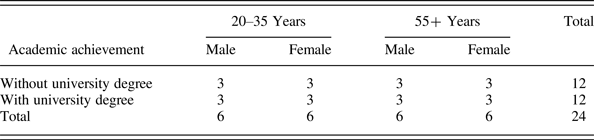
The analyses are based on a 200,000-word corpus of sociolinguistic interviews (about 24 hrs. of speech) that was recorded in March and April 2011 with 24 native speakers of Puerto Rican Spanish who reside in the San Juan metropolitan area. As is shown in Table 1, the corpus is stratified by three social parameters: academic achievement (university degree vs. no university degree), age (20–35 years vs. 55+ years), and gender (male vs. female).
Configuration of the sample

To have access to more variable contexts and to investigate whether the variation is sensitive to style-shifting, as is predicted by Hypothesis 7, the author, who was also the fieldworker, structured the recordings into three sections:
1. Interview. Speakers were interviewed for about 30 mins. on a variety of topics related to their day-to-day life. The interview format was loosely based on the conversational modules that are found in Moreno-Fernández (Reference Moreno-Fernández2003), Quintanilla-Aguilar (Reference Quintanilla-Aguilar2009), and Tagliamonte (Reference Tagliamonte2006:App. B). In addition, a set of questions containing the variable, such as (10), was included to investigate comprehension-to-production priming effects. In these questions, the variants were used randomly.
(10) ¿Cuántos estudiantes podía haber/podían haber en tu época?
‘How many students could there have been Imp/could there have been Pers in your time?’
2. Reading passage. After the first part, speakers were instructed to read out a two-page children's story (Juan Sin Miedo, ‘John Without Fear’) in which 31 selection contexts, as in (11), had been inserted (20 trials, 11 fillers).
(11) En una pequeña aldea, había/habían un anciano padre y sus dos hijos . . .
‘In a small village, there were Imp/there were Pers an old father and his two sons . . .’
3. Questionnaire. Finally, the interviewees were instructed to read out loud a questionnaire consisting of 45 items (32 trials, 13 fillers) preceded by a description that evoked the right pragmatic context for the interpretation of the test sentence, as can be seen in (12). For both the reading passage and the questionnaire, whenever a speaker had difficulties reading, the author read the tests to him/her and asked him/her which form he/she preferred.
(12) A Inés le acaban de robar el carro, que tenía aparcado en algún callejón obscuro. Aunque no es la cosa más sensata que se pueda hacer, una amiga trata de consolarla diciendo: “No es culpa tuya, es que siempre ______ unas personas malas.”
a. habrá b. habrán
‘They've just stolen Ines' car, which she had parked in a dark alley. Although this is not the most intelligent thing to do, a friend tries to comfort her, saying: “It is not your fault, ______ always be a few bad people.”’
a. There willImp b. There willPers
Poststratification: Social class
After transcription, this sample was poststratified by social class, a combination of the speaker's weighted scores for the following variables:
1. Academic achievement: 0: less than high school; 0.5: high school; 1: university.
2. Housing conditions: 0: house/apartment in poor condition; 0.5: house/apartment in good condition with up to two bedrooms; 1: house/apartment in good condition with three or more bedrooms.
3. Profession: 0: for example, street vendors, unskilled workers; 0.25: for example, shop-holders, secretaries, mechanics; 0.5: for example, college-educated professionals, teachers; 0.75: for example, liberal professions, mid-level managers, university professors; 1: senior managers/officials (see Moreno-Fernández, Reference Moreno-Fernández2003, for the full scale).
Rather than relying on my own intuitions, in order to establish the relative importance of each factor for social prestige, after the recording sessions, I presented the informants with an additional questionnaire with the instruction to rank academic achievement, housing, and profession by their importance for social status. Subsequently, each speaker's score for a given variable was first multiplied by the average impact factor that had been established for that variable, and these weighted scores were summed together. Then, the raw numbers were converted into percentages of the maximally possible score. Finally, speakers were grouped together in three equal bins by their score on the prestige index: those who scored 0% to 33% were considered to be members of the lower class (7 speakers), those who scored 34% to 66% were considered to belong to the middle class (7 speakers), and those who scored 67% to 100% were considered to be members of the higher classes (10 speakers).
The variable context
Earlier studies did not find any variation with present-tense hay. However, my corpus provides a handful of tokens of hayn, such that the alternation between hay and hayn cannot be excluded from the scope of this investigation. In contrast, some previous surveys (e.g., DeMello, Reference DeMello1991; Quintanilla-Aguilar, Reference Quintanilla-Aguilar2009) have included cases in which haber agrees with first-person plural NPs. Nevertheless, as examples such as (13) and (14) display a clear difference in meaning, personalized first-person plural presentational haber was considered to be outside the envelope of variation.
(13) Y habían bastantes, bastantes estudiantes en, e, los salones de clase (constructed example).
‘And there were Pers plenty, plenty of students in, e, the classrooms.’
(14) Y habíamos bastantes, bastantes estudiantes en, e, los salones de clase (SJ03H22).
‘And we were plenty, plenty of students in, e, the classrooms.’
Statistical tools
After selecting and coding all the cases of presentational haber + plural NP, I performed a mixed-effect logistic regression analysis with Rbrul (Johnson, Reference Johnson2009). In order to evaluate the hypotheses, I tested the statistical effect of 11 factor groups, which either instantiate the three cognitive constraints referred to in Hypotheses 1 to 3 (markedness of coding, statistical preemption, and structural priming) or try to establish the social distribution of haber pluralization. Additionally, the individual speakers and the lemmas of the NPs’ head nouns were included in the runs as grouping factors. However, as these were collinear, I ran parallel analyses for the grouping factors, and I only report as statistically significant those fixed effects that proved to condition the variation for all speakers and all lexical items.
RESULTS
Table 2 shows that, using these methods, I collected 1655 observations of presentational haber + plural NP, of which 41% are pluralized. This number is significantly lower than the 50% to 60% or even 80% that is observed in, respectively, Caracas (Bentivoglio & Sedano, Reference Bentivoglio, Sedano and de Granda1989; D'Aquino-Ruiz, Reference D'Aquino Ruiz2004; Díaz-Campos, Reference Díaz-Campos2003) and San Salvador (Quintanilla-Aguilar, Reference Quintanilla-Aguilar2009). However, the difference between the figures that are reported here and the findings of earlier investigations is due to the fact that I did not exclude the present-tense forms hay-hayn. Without these two forms, the frequency rises to 54% (n = 661 of 1217), which is significantly higher than the 44% (n = 83 of 190) of plural forms obtained by Brown and Rivas (Reference Brown and Rivas2012:329) for Caguas, Cayey, and San Juan, but these fluctuations could be due to methodological differences and/or the fact that these investigators base their conclusions on a rather limited number of tokens.
Distribution of the singular and pluralized forms of haber

In what follows, I will discuss the results in the order of the hypotheses they are meant to test, starting with those relative to the properties of the NP (i.e., typical action-chain position and polarity, as well as two additional factors).
Cognitive factors
The preference for unmarked coding
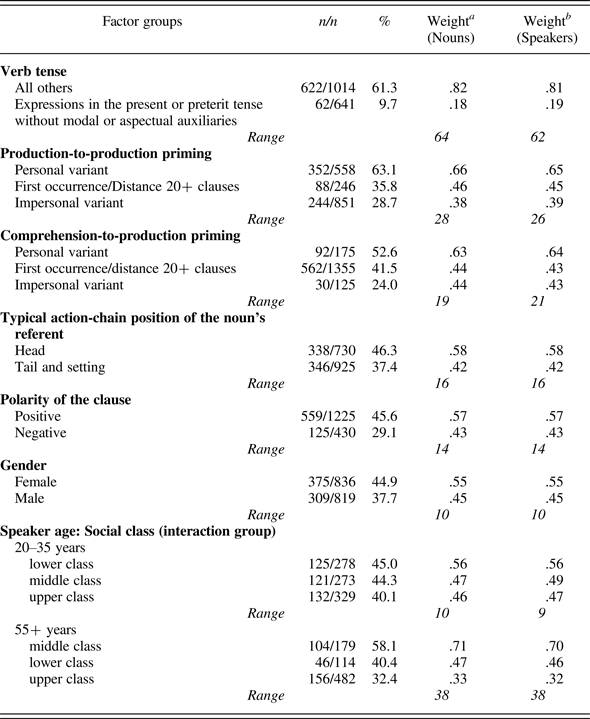
Table 3 indicates that, as hypothesized, nouns that refer to typical action-chain heads/more potential agents (i.e., entities that are highly likely to cause an internal change of state to a second entity without being affected by a third entity first), as in (15), favor haber pluralization, whereas nouns that refer to typical tails of an action chain, as in (16), or its setting (17) clearly disfavor the personal presentational haber construction.
(15) For example, humans such as madre ‘mother’, natural phenomena such as huracán ‘hurricane’, self-propelling objects such as carro ‘car’.
(16) For example, tangible objects such as libro ‘book’, animate beings that undergo an action, e.g., víctima ‘victim’, invitado ‘invitee’.
(17) For example, lugar ‘place’, año ‘year’, event nouns such as actividad ‘activity’, discusión ‘discussion’.
Significant constraints on the pluralization of haber: Number, percentage, and weights for the personal presentational construction with haber
Note: AIC = Akaike information criterion.
aLog likelihood: –759.778; deviance: 1519.556; AIC: 1549.556; input probability: 0.35; bLog Likelihood: –774.559; deviance: 1549.19; AIC: 1579.19; input probability: .32.
In contrast, earlier studies on haber pluralization have claimed that human versus nonhuman reference (e.g., Bentivoglio & Sedano, Reference Bentivoglio, Sedano and de Granda1989, Reference Bentivoglio, Sedano and Díaz-Campos2011) or the noun's proportion of subject use are the relevant constraints connected to the nominal argument (Brown & Rivas, Reference Brown and Rivas2012). More particularly, Bentivoglio and Sedano (Reference Bentivoglio, Sedano and de Granda1989), among others, have shown that human-reference NPs favor haber pluralization. In turn, Brown and Rivas (Reference Brown and Rivas2012) have shown that haber pluralization occurs more often with nouns that are frequently used as subjects in Spanish. However, I would like to argue here that these results are actually epiphenomenal of differences in typical action-chain position.
In this regard, although the typological literature shows that animate-reference nouns are more likely to be used as subjects (Ashby & Bentivoglio, Reference Ashby and Bentivoglio1993:71; Croft, Reference Croft2003:130; Du Bois, Reference Du Bois1987:840; Keenan, Reference Keenan and Li1976:321; Langacker, Reference Langacker1991:306–307), it should also be observed that animate reference is only connected to subjecthood through the tendency for animate beings to be agents in events (Langacker, Reference Langacker1991:322). In other words, most animate-reference nouns also typical action-chain heads. Similarly, chances are high that nouns of high proportion of subject use also refer to more typical agents.
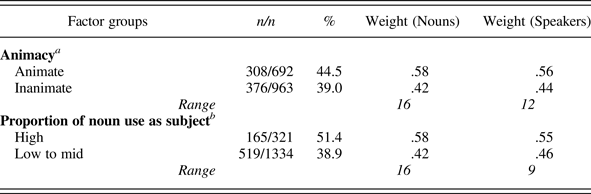
To gain more insight in this matter, I ran two additional, parallel models besides the model presented in Table 3: one in which the noun's typical action-chain position had been replaced with, respectively animacy (i.e., animate vs. inanimate reference) and one in which it had been replaced with Brown and Rivas' (Reference Brown and Rivas2012) factor group “proportion of noun use as subject” (low to mid vs. high), which was established by tracing the grammatical distributions of the nouns’ lemmas in 200-token samples drawn from Davies' (Reference Davies2002) Corpus del español.
Although the results in Table 4 show that pluralized haber indeed occurs more often with animate-reference NPs and nouns that are frequently used as subjects, this does not necessarily mean that animacy (e.g., Bentivoglio & Sedano, Reference Bentivoglio, Sedano and de Granda1989) or the proportion of subject use of a noun (Brown & Rivas, Reference Brown and Rivas2012) condition haber pluralization. Rather, as I suspected, a close comparison of the lemmas of the corpus (see Appendix B and examples (18) and (19)) unveils that most animate-reference nouns and nouns that are frequently used as subjects refer to more typical action-chain heads.
(18) Hubo una vez que salí del trabajo mi esposo me fue a recoger y veníamos por el expreso y habían muchas motoristas al f, al frente y uno fue a esquivar al otro y se dio, le dieron con la goma posterior y se cayó (SJ05M12/SJ660).
‘There was one time when I left the office and my husband came to get me and we were driving on the express road and there were Pers a lot of motor cycle drivers in f, in front and one went to evade the other and he hit, they hit him with the back tire and he fell.’
(19) Inv: E, bueno, y ahora tú estás viviendo en una casa de madera. ¿Nunca te da miedo con los huracanes? Porque esto no es . . .
Subj: ¿Seguro, seguro?
Inv: ¿No?
Subj: Bueno, este, fíjate ahora, ahora no estoy pensando en huracanes porque me mudé en una época que no es de huracán. Pero sí, han habido terremotos (SJ12M12/SJ1412).
Inv: ‘E, well, and now you are living in a wooden house. Aren't you ever afraid of hurricanes? Because it is not . . . ’
Subj: ‘Safe-safe?’
Inv: ‘No?’
Subj: ‘Well, eh, you figure, now, now I'm not thinking of hurricanes because I moved at a nonhurricane time of the year. But there have been Persearthquakes.’
Results for animacy and proportion of noun use as subject in parallel models: Numbers, percentages, and weights for the personal presentational construction with haber
Note: As signaled in text, I permuted action-chain position for either animacy or noun proportion of subject use and I ran the model again. AIC = Akaike information criterion.
aNouns: deviance: 1520.113; AIC: 1550.113; input probability: .35; speakers: deviance: 1557.986; AIC: 1587.986; input probability: .32. bNouns: deviance: 1524.264; AIC: 1554.264; input probability: .38; speakers: deviance: 1567.728; AIC: 1597.728; input probability: .33.
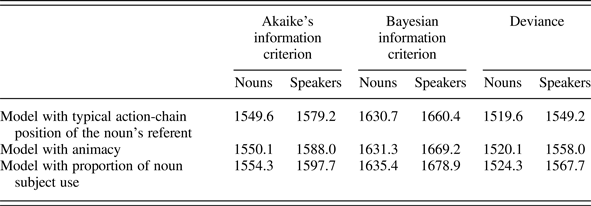
Moreover, the model fit indicators displayed in Table 5 show that the fit of the model with typical action-chain position is significantly better than that of the other two (see Baayen, Reference Baayen2008:275–276 for the procedure and the necessary R code). These and the other findings presented in this section strongly suggest that neither proportion of noun use as subject nor animacy is a relevant restriction. Rather, as I have argued when introducing Hypothesis 1, the true constraint connected with the NP appears to be the typical position of its referent on the action chain and the tendency to encode more potential agents as subjects (i.e., the preference for unmarked coding).Footnote 5 Analogously, in lieu of supporting Rivas and Brown's (Reference Rivas and Brown2012:87) claims that temporal persistence (in terms of independent existence and reference) is a feature of prototypical subjects and that “stage-level nouns” (i.e., nouns that refer to entities with a conceivable beginning and end, such as parrandas ‘surprise-party visits’ in (20)) disfavor haber pluralization because they are not temporally persistent, the results of this study suggest that these authors’ findings as well are epiphenomena of differences in typical action-chain position, as such nouns (e.g., event nouns, temporal nouns, deverbal nouns) (Rivas & Brown, Reference Rivas and Brown2012:81) refer to typical action-chain settings rather than heads.
(20) Sin embargo, en los pueblos hay parrandas siempre (SJ04M22/SJ446).
‘Nevertheless, in the smaller towns, there are Impsurprise-party visits all of the time.’
Comparison of model fit indicators for the three models
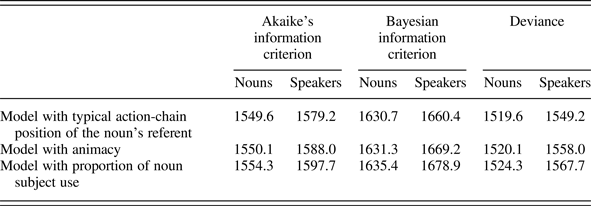
Note: Likelihood ratio tests indicate p = .001 for the differences in model fit.
Finally, Prince (Reference Prince, Mann and Thompson1992:299–300) observed that the NP of an affirmative presentational clause can only be interpreted as referring to “a specific instance or token whose identity is unknown to the hearer and possibly also the speaker” (Croft, Reference Croft2003:132) or, in terms of the definiteness/specificity hierarchy given in (21), as being specific indefinite. Under negative polarity, in contrast, the NPs reference is suspended (Keenan, Reference Keenan and Li1976:318), such that it becomes “identifiable only as a type, not as a specific instance or token” (Croft, Reference Croft2003:132), in other words, it is interpreted as a nonspecific indefinite NP.
(21) Definite > specific indefinite > nonspecific indefinite (Langacker, Reference Langacker1991:308).
As nonspecific indefinite is the pragmatic definiteness/specificity value associated with prototypical direct objects (Croft, Reference Croft2003:132; Du Bois, Reference Du Bois1987:847; Keenan, Reference Keenan and Li1976:319; Langacker, Reference Langacker1991:308), negation may cause speakers to categorize the nominal argument more often as such, which could explain why Table 3 shows speakers to disfavor <AdvPhaber Subj> in negative clauses.Footnote 6
Statistical preemption
Table 3 shows that the distributional pattern presented in the section concerned with Hypothesis 2 (i.e., synthetic expressions in present and preterit tense vs. all others) turns out to be the strongest overall predictor for the variation. In addition, the verb tenses for which an entrenched instance of <AdvPhaber Obj> was posited (i.e., present and preterit) disfavor <AdvPhaber Subj> strongly whenever the conceptualization speakers wish to express matches the entrenched instance (i.e., whenever coding the conceptual import does not call for temporal, aspectual, or modal periphrases). However, Table 6 indicates that, although the personal construction is significantly less frequent in the preterit tense (excluding periphrastic expressions), as in (22), it is already used in about 20% of cases, whereas hayn, in (23), only appears in about 5%.
(22) Pero entonces tuve tantos vecinos que fueron como mis hermanos y en adición a mi madre hubieron tantas madres de otros amigos míos que fueron matriarcales para mí (SJ09H12/SJ1051).
‘But, then I had so many neighbors who were, like, my brothers and in addition to my mother, there were Pers (Preterit) so many mothers of other friends of mine who were mother-like for me.’
(23) Pero, este, sí, hayn platos como que es, específicos de diciembre (SJ05M12/SJ655).
‘But, e, yes, there are Pers dishes like sp, specific of December.’
This pattern is readily accounted for by the analysis that is being developed here. Although hubo rarely appears in isolation from the presentational schema in spontaneous discourse, every speaker will have observed it a limited number of times in four patterns: the impersonal presentational construction, hubo de + infinitive ‘have to’, hubo que ‘have to’, and the preterit perfect construction (e.g., hubo hablado ‘had spoken’). In contrast, in no matter what type of discourse, hay only appears in two patterns: the impersonal presentational construction and the impersonal obligation modal hay que + infinitive ‘have to + infinitive’. Consequently, speakers possess more evidence that the preterit of haber can occur independently of <AdvPhaber Obj> than they have for the present tense and, as a result, the preempting effect that is exercised by the latter is stronger than the one that goes out from the former.
Additionally, Hypothesis 2C claimed that complex conceptualizations, that is, with verbal periphrases, as in (24), would favor the personal variant because these would bypass the entrenched instances of hay and hubo, as the coding of such more elaborate conceptualizations results in the calculation of a novel expression involving aspectual or modal auxiliaries.
(24) Tú sabes como Estados Unidos, cuando empezaron a haber huracanes era como que se llevó todo, pero estamos acostumbrados (SJ09H12/ SJ1088).
‘You know, like the United States, when there began to be Pers hurricanes it was like it took away everything, but we are used to them.’
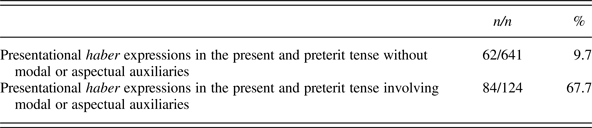
As can be derived from Table 7 this seems to be the case, because the rates of pluralization are more than six times higher in clauses that involve a modal or aspectual auxiliary than in synthetic expressions, which was already observed in earlier investigations (Hernández-Díaz, Reference Hernández-Díaz and Company-Company2006:1150; Quintanilla-Aguilar, Reference Quintanilla-Aguilar2009:164–165).
Frequencies of the forms hayn and hubieron

Note: p < .000.
Pluralized cases of haber in the present and preterit tense, by presence/absence of modal or aspectual auxiliaries
Note: p < .000.
In sum, the true constraint imposed by the verb tense seems to be the generally observed pattern that more specific knowledge (i.e., the entrenched instances of the impersonal variant) preempts the generalization (i.e., the computation of a novel expressions based on the personal variant) for conceptualizations that could be coded equally well using both patterns (Goldberg, Reference Goldberg2006:94–98, Reference Goldberg2009:102).
Structural priming
Regarding this factor, Table 3 indicates that production-to-production (i.e., the earlier use of a variant by the speaker) and comprehension-to-production (i.e., the earlier processing of a variant by the speaker) priming effects are among the most important cognitive constraints that condition this variation. In addition, the results indicate that whenever speakers have used a personal presentational haber clause, they are more prone to use another one, whether or not they repeat the specific verb form, if the next variable context is situated within a 20-clause range. The same results were obtained for the impersonal presentational haber construction. Similarly, when speakers have processed a personal clause, they are more likely to utter an expression based on this pattern and vice versa.
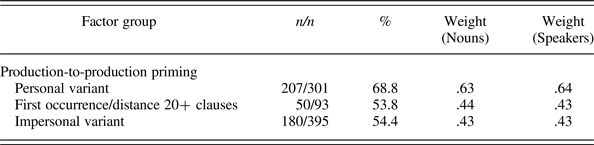
However, as a reviewer points out, it could be the case that some of the speakers are strongly biased toward one of the variants, such that, their singular or pluralized tokens following a singular or pluralized instance could lead Rbrul to attribute too much importance to the structural priming variables. In addition, because we have just seen that haber pluralization only occurs rather limitedly in synthetic expressions in the present and preterit tenses, it could be the case that the tokens of hay and hubo have a similar effect in contexts following an impersonal variant. To control for these possible sources of error, I first excluded the synthetic present and preterit tense tokens and, subsequently, the six speakers whose rates of pluralization in this subcorpus were either below 30% or above 75%. As Table 8 shows, when I run the model on this subset of the data, the priming effect remains intact for production-to-production priming, with almost identical factor weights. However, as this procedure effectively eliminates about 50% of the tokens (n = 866 of 1655), for comprehension-to-production priming, unfortunately, the number of observations for the primed conditions drops to the point that no statistically relevant conclusions can be drawn up (personal variant: 77%, n = 59 of 77; impersonal variant: 62%; n = 23 of 37). Still, the robustness of the production-to-production priming effect advocates strongly in favor of treating haber pluralization as a competition between two argument-structure constructions, because, if there were not an overarching schema that could be repeated, we would not expect plurals to prime plurals and singulars to prime singulars regardless of variations in verb form.
Production-to-production priming effects for speakers representing robust variation, without synthetic expressions in present and preterit. Numbers, percentages, and weights for the personal presentational construction with haber
Finally, structural priming also seems to offer an explanation for cases such as (25), in which the verb agrees with a direct object pronoun.
(25) Un abuelo está contándoles a sus nietos de su niñez. Uno de ellos, ansioso de saber de esos tiempos pasados, pregunta: “¿Papi, cuando usted era niño, acá ya habían carros?” Contesta el abuelo: “¡Claro que losAcchabían, no soy tan viejo!” (SJ02M12/SJ231).
‘A grandfather is telling his grandsons about his childhood. One of them, desiring to know about those past times, asks: “Granpa, when you were a child, were therePers already cars here?” The grandfather answers: “Sure that there Accwere Pers, I'm not that old!”’
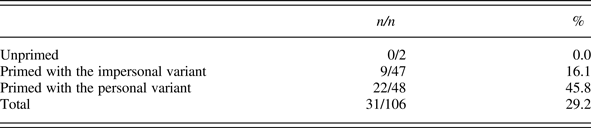
That is to say, a look at Table 9 shows that speakers are more likely to produce the object-verb agreement when they have just used or processed an expression based on <AdvPhaber Subj>, which is also evident from the example. As a matter of fact, 71% (n = 22 of 31) of the cases in which the verb agrees with a direct object pronoun occur in contexts primed with this variant. Therefore, rather than constituting counterexamples to the main hypothesis, the results seem to suggest that the high level of activation of the personal presentational haber construction might cause individual speakers to reanalyze the object pronoun online as a hearer-new subject pronoun. This characterization finds some support in the fact that certain speakers use the unexpected agreement multiple times, whereas others do not use it at all, without there being any clear social pattern.
Pluralized cases of haber that agree with a direct object pronoun, by production-to-production priming and comprehension-to-production priming
Note: p = .003.
Social factors
Concerning Hypotheses 4 to 8, Table 3 shows that Rbrul does not consider age, educational achievement, and style to be significant constraints. For age, this result is already implicit in the main hypothesis, which describes the phenomenon as a slowly advancing change from below. By the same token, Hypothesis 7, which states that the rates of pluralization will not decrease as formality rises, already anticipates that the alternations between the two constructions will not display any style shifting. For educational achievement, in contrast, the results do not confirm the expectations formulated in Hypothesis 8. Still, the findings seem to be supported by earlier studies on Puerto Rican Spanish, which have shown haber pluralization to occur frequently in educated speech (e.g., DeMello, Reference DeMello1991; López-Morales, Reference López-Morales1992:147; Vaquero, Reference Vaquero1978:135–140).
In addition, Table 3 shows that social class is only significant when considered jointly with speaker age, as for older speakers, frequent haber pluralization signals middle-class identity, whereas younger speakers associate high frequencies of pluralized haber with the lower class. This pattern could suggest that some sort of stigma is developing, which, however, would not be all too salient, because haber pluralization is still associated with female behavior and no significant interaction could be found between this factor and speaker age. The absence of a stylistic dimension also seems to support this interpretation of the results.
Finally, let us zoom in on the question whether the variation constitutes a change from below, as is argued by the main hypothesis. In this regard, although the phenomenon does not display any progress in apparent time, the facts that haber pluralization does not show any significant style shifting, that older speakers display the social class pattern that is characteristic of ongoing changes from below, and that women favor the personal construction suggest that in San Juan, as in Buenos Aires (Fontanella de Weinberg, Reference Fontanella de Weinberg1992b) and Caracas (D'Aquino-Ruiz, Reference D'Aquino Ruiz2008; Díaz-Campos, Reference Díaz-Campos2003), the variation constitutes a very slowly progressing change from below, which, however, might be evolving into a stable variable.
DISCUSSION AND CONCLUSIONS
Let us now take stock of the results for some concluding remarks. The findings that were obtained for the factor groups that sought evidence for the claim that subjectlike NPs would favor the personal construction indicate that speakers are only mildly influenced by such conditions when they decide between singular and plural presentational haber. Nonetheless, I have shown that the tendency to pluralize haber more often with animate nouns and nouns that are frequently used as subjects is better stated in terms of typical action-chain position: nouns that refer to entities that are easily conceptualized as action-chain heads favor the personal presentational haber construction. In addition, conceptualizations that involve negation have been shown to disfavor the personal variant, as was already observed in Caracas (D'Aquino-Ruiz, Reference D'Aquino Ruiz2004:18) and San Salvador (Quintanilla-Aguilar, Reference Quintanilla-Aguilar2009:175), and I have suggested that this could be due to the fact that, in negative contexts, the NP receives a nonspecific indefinite reading, which, in turn, renders it more objectlike. These findings support the analysis that presentational haber occurs in two argument-structure constructions and that, as formulated in Hypothesis 1, the variation between these two patterns is constrained by the generalized preference for unmarked coding (Langacker, Reference Langacker1991:288).
With regard to Hypotheses 2A to 2C, the distribution of the tense forms of haber in a 16th-century corpus has proven to be the strongest overall predictor for the choice between the two variants of the presentational construction with haber. Yet, the results that were presented for this factor group are not readily explained by an analysis that takes the unit of change to be the verb and focuses on token frequency, as, for example, in Waltereit and Detges (Reference Waltereit, Detges, Detges and Waltereit2008:27). That is to say, without recurring to two construction schemas, entrenched instances and differing strengths of statistical preemption, it is difficult to explain why the personal variant is used less in the preterit vis-à-vis other nonpresent tenses. By the same token, if the effect of the verb tense were somehow due to a differing degree of morphophonologic contrast between the singular and plural forms across tenses (e.g., Bentivoglio & Sedano, Reference Bentivoglio, Sedano and Díaz-Campos2011:174; Hernández-Díaz, Reference Hernández-Díaz and Company-Company2006:1151) rather than to statistical preemption, we would not expect to find that expressions involving modal or aspectual auxiliaries, which display the same contrasts, favor the personal construction. In other words, the results seem to confirm Hypotheses 2A to 2C and support the main hypothesis.
Similarly, Hypothesis 3 turns out to be correct, as comprehension-to-production and production-to-production priming are important predictors for speakers’ choice between singular and plural presentational haber. Most importantly, the results for these independent variables suggest, in line with earlier research at this regard (e.g., Bock et al., Reference Bock, Dell, Chang and Onishi2007), that speakers do not repeat the specific tense forms and their argument structures, but rather that they repeat argument-structure constructions (Goldberg, Reference Goldberg2009:107). Therefore, these findings also contribute to the characterization of this phenomenon as a competition between two conventionalized argument-structure schemas, rather than a token-by-token reanalysis of haber as an intransitive verb (e.g., Waltereit & Detges, Reference Waltereit, Detges, Detges and Waltereit2008) or of the NP slot of the presentational construction as a subject, as was argued in recent papers (Brown & Rivas, Reference Brown and Rivas2012; Rivas & Brown, Reference Rivas and Brown2012).
The discussion of social factors (Hypotheses 4 to 8), on the other hand, has been concerned with the answers to two questions: Do Puerto Ricans use the pluralization of haber to position themselves within social categories of gender, class, and educational achievement? Does the variation constitute an ongoing linguistic change from below? In this regard, the results show that high rates of pluralization correlate with female gender and, for older speakers, middle-class membership, which suggests an ongoing change from below. Although this is supported by the findings for speech style, the fact that for the group 20 to 35 years of age a linear social class alignment was observed might point to incipient stigmatization and/or stabilization of the change.
In sum, this discussion allows for two final, broader conclusions. First, regarding the phenomenon studied in this paper, the data confirm the main hypothesis to a large extent. In San Juan, Puerto Rico, the pluralization of haber corresponds to an ongoing language change from below in which the argument-structure construction <AdvPhaber Subj> is replacing the canonical <AdvPhaber Obj> pattern, but it might be evolving toward a situation of stable variation. The effect that goes out from the independent variables that were tested in this investigation was shown to come down to the same three general principles of language organization and use that may constrain any type of linguistic encoding (the preference for unmarked coding, statistical preemption, and structural priming) and speakers’ desire to position themselves in the social landscape. This, in turn, shows the potential Cognitive Construction Grammar possesses for the exploration/explanation of ongoing syntactic changes. It is in this framework that syntactic change and the variation that is inherent to it can be modeled for what they are: a competition within the system, constrained by general principles of language change, organization, and use that allows speakers to position themselves within social categories.
APPENDIX A
Distribution of the third-person singular forms of haber across constructions in American texts from CORDE (1492–1600)
APPENDIX B
Lemmas of the nouns that occur with haber, by proportion of use as subject in 200-token samples