Introduction
In adult ruminants, choline is extensively degraded in the rumen; for this reason, dietary choline contributes insignificantly to the choline body pool, and methyl group metabolism is generally conservative with a relatively low rate of methyl catabolism and an elevated rate of de novo synthesis of methyl groups via the tetrahydrofolate system (see Pinotti et al., Reference Pinotti, Baldi and Dell’Orto2002 for references). In dairy ruminants, the dietary availability of choline is still low, but the output of methylated compounds in milk is high, and precursors from the tetrahydrofolate pathway are often limiting, especially at the onset of lactation (Pinotti et al., Reference Pinotti, Baldi and Dell’Orto2002; Girard and Matte, Reference Girard and Matte2004). Based on those considerations, the effects of rumen-protected choline (RPC) supplementation to transition cows have been investigated in several studies. Findings in transition and early lactating dairy cows suggest that greater choline availability can improve not only milk production (Erdman and Sharma, Reference Erdman and Sharma1991; Hartwell et al., Reference Hartwell, Cecavqa and Donkin2000; Pinotti et al., Reference Pinotti, Baldi, Politis, Rebucci, Sangalli and Dell’Orto2003) but also lipid (Piepenbrink and Overton, Reference Piepenbrink and Overton2003; Pinotti et al., Reference Pinotti, Baldi, Politis, Rebucci, Sangalli and Dell’Orto2003) and methyl group metabolism (Baldi and Pinotti, Reference Baldi and Pinotti2006). Furthermore, in the Pinotti et al. (Reference Pinotti, Baldi, Politis, Rebucci, Sangalli and Dell’Orto2003) study, although plasma concentrations of vitamin E declined after parturition in choline-supplemented animals, the reduction was less than in controls, suggesting improved vitamin E status. However, the mechanisms of this effect have not been elucidated with certainty, even though an improved fat absorption and transport induced by choline supplementation has been proposed (Pinotti et al., Reference Pinotti, Baldi, Politis, Rebucci, Sangalli and Dell’Orto2003). Janovick Guretzky et al. (Reference Janovick Guretzky, Carlson, Garrett and Drackley2006) found that choline supplementation did not affect milk production in either Holstein or Jersey transition cows, but on discussing their results they noted that calculated methionine balance was negative post partum, so that supplemental choline might not have spared enough methionine to produce a physiological benefit. This conclusion is in line with another recent study (Brüsemeister and Südekum, Reference Brüsemeister and Sudekum2006) that, in reviewing several published works on choline supplementation in dairy cows, concluded that negative methionine balance – and therefore a basal diet of adequate quality and composition (Baldi and Pinotti, Reference Baldi and Pinotti2006) – is essential for obtaining a response to RPC. The more recent study of Zahra et al. (Reference Zahra, Duffield, Leslie, Overton, Putnam and LeBlanc2006) reported that choline supplementation improves milk production (1.2 kg/day) in the first 60 days of lactation, although supplementation was only from 21 days pre partum to 28 days in milk. However, choline’s effect on milk yield was attributable mainly to increased milk production (4.4 kg/day) in animals with body condition score ⩾4 at 3 weeks before calving, that were also consuming more feed.
The effects of choline infusion on transmethylation reactions have been studied in sheep by Lobley et al. (Reference Lobley, Connell and Revell1996), while Emmanuel and Kennelly (Reference Emmanuel and Kennelly1984) investigated methionine and choline incorporation into plasma and milk of lactating goats, and Banskalieva et al. (Reference Banskalieva, Puchala, Goetsch, Luo and Sahlu2005) assessed the efficacy of RPC supplementation in meat goats. By contrast, data on choline supplementation and its effects on milk production, vitamin E and methyl group status in periparturient dairy goats are lacking. For this reason, we investigated the effect of RPC and vitamin E administration on milk production and status of folate, vitamin B12 and vitamin E during the periparturient period of dairy goats.
Material and methods
Seventy pregnant multiparous Saanen goats of uniform weight (mean 63.5 ± 4.3 kg) at the G. P. Guidobono Cavalchini experimental farm of the University of Milan were selected for the 72-day experiment. Thirty days before expected parturition, the goat groups were moved to contiguous maternity lots and assigned randomly to one of the four experimental groups (see below) in a 2 × 2 factorial design of treatments, considering RPC v. no RPC and vitamin E (VITE) v. no VITE. The animals, identified individually by bolus transponders, were weighed weekly during the experimental period by means of an electronic balance (TS100, Tecno System, Brescia, Italy) except during the 8-day kidding window. The pre-partum and lactation basal diets (twice daily feeding) were formulated according to the National Research Council (1981). Only 48 of the 70 animals (goats that kidded within an 8-day window, 12 per group) were used for the lactation trials. The number of kids per animal was noted. After kidding the animals were housed in contiguous indoor stalls, one stall for each group, and milked automatically twice a day. The animals were treated in accordance with European Union guidelines (86/609/EEC) approved by the Italian Ministry of Health.
The experimental groups were: control (CTR), no choline or vitamin E supplementation; choline (RPC), supplemented with 4 g/day choline chloride in rumen-protected form (Sta-Chol 50%; Ascor Chimici, Forlì, Italy); vitamin E (VITE), supplemented with 200 IU/day vitamin E (DL-α-tocopheryl acetate) in rumen-protected form (Vit E by pass 40%; Ascor Chimici); choline and vitamin E (RPCE), supplemented with 4 g/day RPC chloride and 200 IU/day vitamin E.
RPC was 85% rumen-stable (measured using in situ protocol) as already reported (Baldi and Pinotti, Reference Baldi and Pinotti2006). The quantities of choline and vitamin E given were based on experiments in dairy cows (Baldi et al., Reference Baldi, Savoini, Pinotti, Monfardini, Cheli and Dell’Orto2000; Pinotti et al., Reference Pinotti, Baldi, Politis, Rebucci, Sangalli and Dell’Orto2003) and metabolic BW0.75 at the beginning of the experiment. The formulations containing RPC and vitamin E were microencapsulated with fats, so the CTR, RPC and VITE groups were given additional empty microcapsules to ensure equal fat intake in all four groups. Treatments were administered individually by oral dosing before the morning feed to ensure complete consumption. Supplementation started 30 days prior to expected kidding and continued for 35 days after parturition.
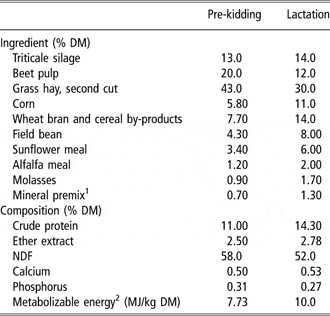
The total mixed ration (Unifast SpA, Padova, Italy) was sampled 3 times before kidding and 4 times during lactation and analyzed for dry matter (DM), crude protein, neutral detergent fiber, ether extract, and calcium and phosphorus concentration (Association of Official Analytical Chemists, 2005). Diet ingredients and composition are shown in Table 1. Pre-kidding and lactation dietary metabolizable energy (ME) were estimated using the Small Ruminant Nutrition System software, version 1.8.1. (Cannas et al., Reference Cannas, Tedeschi, Atzori and Fox2007), which includes a module for assessing goat energy and protein requirements and supply. Methionine supply in the lactation diet was estimated using a pre-release module of the same system (Cannas, personal communication) as 1.95% of metabolizable protein. Naturally occurring vitamin E in pre-kidding and lactation diets was estimated from feed tables in Antongiovanni and Gualtieri (1998) and McDowell (Reference McDowell1989). Both pre-kidding and lactation diets contained 23 to 35 IU/kg of DM of naturally occurring vitamin E. Although the estimates of methionine and vitamin E content may have been only moderately accurate, they are useful for the interpretation of results. Dry matter intake (DMI) was assessed weekly for each group as the difference between feed DM offered and feed DM refused.
Ingredient and nutrient composition of basal pre-kidding diet (fed from −4 weeks through day 0 kidding) and basal lactation diet fed from 1 through 42 days in milk (DM basis)

1Containing 50% dicalcium phosphate, 30% sodium bicarbonate, 10% magnesium oxide, 10% trace-minerals.
2Estimated using Small Ruminant Nutrition System (Cannas et al., Reference Cannas, Tedeschi, Atzori and Fox2007).
From day 7 to day 42 of lactation, milk yield and composition were measured weekly. On sampling days, morning (06.30 h) and evening (18.30 h) milk samples from each animal were collected and composited in proportion to milk yield. Milk samples of each animal were treated with preservative (sodium azide) and stored at 5°C pending analysis for milk fat, milk protein (Milkoscan, Foss Technology, Denmark) and SCC (somatic cell count) (Fossmatic Somatic Cell Counter; Foss Technology, Denmark). On day 21 of lactation (middle of lactation trial), two milk samples from each animal were obtained. One was treated with sodium azide and stored at 5°C pending analysis as reported. The other was analyzed for free choline by the method of Takayama et al. (Reference Takayama, Itoh, Nagasaki and Tanimizu1977) with the phospholipase-D step omitted, as described in Pinotti et al. (Reference Pinotti, Baldi, Politis, Rebucci, Sangalli and Dell’Orto2003). Total daily free choline secretion was obtained by multiplying milk choline concentration by milk yield recorded on day 21 of lactation for each goat.
Jugular vein blood samples were taken weekly, before the first meal of the day, from about 4 weeks (33 ± 3 days) before kidding to 1 week before kidding, and on days 0, 7, 14, 21 and 28 post partum. Blood samples were collected into heparinized tubes (Venoject; Teruno Europe, Leuven, Belgium) and centrifuged (14 000 × g for 15 min at 10°C) to obtain plasma, which was stored at −20°C pending analysis. α-Tocopherol (Baldi et al., Reference Baldi, Savoini, Pinotti, Monfardini, Cheli and Dell’Orto2000), folate (ECLIA, Roche Laboratories, Mannheim, Germany) and vitamin B12 (ECLIA, Roche Laboratories) were measured in all blood samples taken, while glucose (Glucose oxidase method, Diagnostic Glucose Kit; Alfawassermann, Milan, Italy), non-esterified fatty acids (NEFA) (acyl CoA synthetase, acyl CoA oxidase method – NEFA Kit, Randox test; Randox Clinical Diagnostic, Crumlin, UK), cholesterol (Cholesterol oxidase method, Diagnostic Cholesterol Kit; Alfawassermann), β-hydroxybutyrate (BHBA) (β-hydroxybutyrate dehydrogenase method, RANBUT Kit, UK) and urea (urease/glutamate dehydrogenase method, BUN Reagent Kit; Beckman Coulter, Fullerton, CA, USA) were measured in the blood samples taken 4 weeks and 1 week before kidding and all post-partum blood samples. Both folate and vitamin B12 in plasma have been indicated as markers of methyl group metabolism (Baldi and Pinotti, Reference Baldi and Pinotti2006).
Data were analyzed using the MIXED procedure of Statistical Analysis System Institute (SAS, 1999) and the following model:

where yijk is the observation of the lth animal at the ith treatment and the kth week (or day); μ is the overall mean; α i is the effect of ith choline (RPC) treatment; β j is the effect of the jth vitamin E (VITE) treatment; γij is the interaction effect of the ith choline treatment with the jth vitamin E treatment (RPC × VITE); δk is the effect of the kth week; xijkl is the first measurement of milk yield on day 7 (and in another analysis) associated with yijkl; b is the linear regression coefficient of milk yield at first milk measurement; and ε (ij )kl is the random experimental error of the lth animal at ith choline treatment, at the jth vitamin E treatment and the kth week (or day). Litter size was initially included in the model, but was removed after no significant effect was observed (P = 0.69). Body weight (BW), BW change and plasma metabolites were analyzed using the MIXED procedure of SAS (1999) and the following model:

where yijk is the observation of the lth animal at the ith treatment and the kth week (or day); μ is the overall mean; αi is the effect of the ith choline (RPC) treatment; βj is the effect of the jth vitamin E (VITE) treatment; γij is the interaction effect of the ith choline treatment with the jth vitamin E treatment (RPC × VITE); δk is the effect of the kth week; and ε (ij )kl is the random experimental error of the lth animal at the ith choline treatment, at the jth vitamin E treatment and the kth week (or day).
The REPEATED statement was used for variables measured over time (BW, BW change, milk yield and milk components (except free choline in milk), and blood metabolites). The random error term used for all mixed models was goat within treatment group.
Pre-kidding and post-kidding DMI data were analyzed separately using the GLM procedure of SAS (1999), and the following fixed model:

where yij is the observation of the jth group at the ith treatment; +αi is the effect of the ith treatment and e (ij ) is the random error. Differences between RPC treatments and VITE treatments were evaluated by the ESTIMATE statement. Litter size, milk free choline concentration and total free choline secretion, measured on day 21 of lactation only, were analyzed by the GLM procedure of SAS (1999). LSmeans were compared with PDIFF, and the Adjust = Dunnet option for the mixed model. Differences with P values <0.05 were considered significant; P values ⩽0.10 were considered to indicate a tendency.
Results and discussion
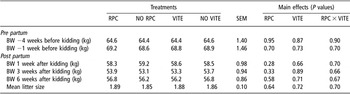
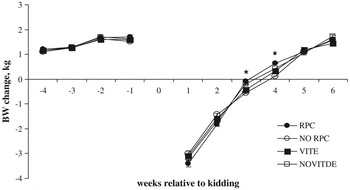
Mean ± s.e. group DMI before kidding were 21.8 ± 1.8, 22.0 ± 1.8, 21.8 ± 1.8, 21.9 ± 1.8 kg/day and during lactation were 28.2 ± 1.4, 28.3 ± 1.4, 28.2 ± 1.4, 28.4 ± 1.4 kg/day, respectively, in animals assigned to the no RPC, RPC, no VITE and VITE treatment. Mean BW at different times before and after kidding did not differ between treatments (Table 2; P = 0.71). Notwithstanding the lack of BW differences, Figure 1 shows that BW changes differed in the four groups around kidding; choline-supplemented goats recovered BW more quickly on week 3 and 4. Time trend of BW changes observed in RPC-supplemented goats is in line with findings in transition cows receiving RPC (Hartwell et al., Reference Hartwell, Cecavqa and Donkin2000; Janovick Guretzky et al., Reference Janovick Guretzky, Carlson, Garrett and Drackley2006). Other studies however have found no effect of choline on the BW changes in cows (Erdman and Sharma, Reference Erdman and Sharma1991; Piepenbrink and Overton, Reference Piepenbrink and Overton2003). Vitamin E and RPC × VITE had no affects on BW changes.
Body weight (BW) recorded from week 4 to week 1 before kidding and from weeks 1 to 4 after kidding, and litter size, according to treatment group

Weekly body weight changes of goat during experimental period (means ± s.e.). Asterisks (*) indicate a post-kidding RPC treatment effect (P < 0.05).

Litter size did not differ between groups (Table 2; P = 0.64). It has been reported that multiple births are associated with greater milk yield: in non-suckled Alpine goats an additional 32 kg more milk per lactation was estimated by Crepaldi et al. (Reference Crepaldi, Corti and Cicogna1999). We compared milk yield in relation to litter size but the differences were not significant (P = 0.69).
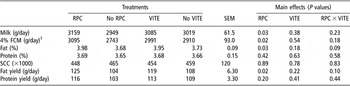
Choline supplementation had effects on milk yield (Table 3). During the first 6 weeks of lactation, milk yield and 4% fat-corrected milk (FCM) yield were, respectively, 210 and 350 g/day higher in RPC-supplemented goats than in non-supplemented goats. Milk fat concentration and fat yield were also increased by RPC treatment. Milk yield and composition were unaffected by both vitamin E and choline × vitamin E treatment, although a tendency for a choline × vitamin E effect was observed on fat percentage (P = 0.09) and fat yield (P = 0.10).
Milk yield and composition according to treatment group from week 1 to weeks 6 of lactation

14% FCM = 0.4 (g of milk) + 15 (g of fat).
As expected, free choline and total free choline secretion in milk were increased by choline supplementation: when measured at 21 days in milk, free choline and total free choline secretion in milk, respectively, were higher (P < 0.05) in choline-supplemented goats (35.2 mg/l; 123 mg/day) than in un-supplemented animals (25.9 mg/l; 85.6 mg/day). Vitamin E supplementation did not affect (P = 0.88) these variables (30.2 mg/l, 103 mg/day, 29.8 mg/l, 98.5 mg/day in vitamin E-supplemented and un-supplemented goats, respectively). Similarly, no choline × vitamin E effect was observed (P = 0.65). These findings show that choline supplemented in the rumen-protected form is available for absorption in goats, and that milk choline is sensitive to postruminal choline supply and bioavailability in goats, as is also the case for dairy cows (Deuchler et al., Reference Deuchler, Piperova and Erdman1998; Pinotti et al., Reference Pinotti, Baldi, Politis, Rebucci, Sangalli and Dell’Orto2003).
In the present experiment, a greater choline availability (by feeding RPC) increased milk production in goats, as also reported in dairy cows (Hartwell et al., Reference Hartwell, Cecavqa and Donkin2000; Pinotti et al., Reference Pinotti, Baldi, Politis, Rebucci, Sangalli and Dell’Orto2003; Zahra et al., Reference Zahra, Duffield, Leslie, Overton, Putnam and LeBlanc2006). The link between choline supplementation and milk response has been mainly attributed to the metabolic interchangeability of choline and methionine, in the sense that both can furnish labile methyl groups. This interchangeability in goats has been investigated by Emmanuel and Kennelly (Reference Emmanuel and Kennelly1984), who estimated that 6% of the choline pool was derived from methionine and that approximately 28% of methionine is used for choline synthesis via the pathway for the de novo biosynthesis of the choline moiety involving sequential methylation of phosphatidylethanolamine. In that study, after infusion of methyl group-labelled choline, this was not recovered in the milk methionine pool; however, the contribution of choline to milk fat was 10 times greater than that of methionine. Sharma and Erdman (Reference Sharma and Erdman1988) investigated the infusion of choline and of methionine into the abomasum of dairy cows, either alone or with the choline synthesis inhibitor 2-amino-2-methyl-1-propanol (2-AMP). They found that abomasal infusion of 30 g of choline was more effective than infusion of 45.6 g methionine in increasing milk yield and milk fat concentration. Furthermore, milk production, milk fat percentage, milk fat yield, milk protein percentage and milk protein yield of cows infused with 2-AMP plus methionine were all lower than in cows infused 2-AMP plus choline. Lobley et al. (Reference Lobley, Connell and Revell1996) investigated the importance of transmethylation reactions in sheep infused intravenously with choline and creatine. They found that irreversible methionine loss (net methionine catabolism) decreased significantly in the presence of these compounds and concluded that irreversible loss of methyl groups as methionine normally results in insufficient methyl groups to meet metabolic demands. They also concluded that methionine cycling is sensitive to the metabolic supply of methyl groups.
Thus, it seems that methionine can indeed replace choline as the methyl group source and that choline can reduce methionine utilization for methylation reaction. Reduction of methyl group demands from the methionine pool may therefore offer production benefits to dairy ruminants and might be achieved by nutritional manipulation other than alteration of the methionine supply (Lobley et al., Reference Lobley, Connell and Revell1996). This was probably the situation in the animals of the present study, at least during the early stages of lactation when dietary methionine was probably limiting. The animals in fact received about 80% of the optimal level of methionine (assumed to be about 2.4% of the metabolizable protein, as proposed in dairy cows). These considerations imply that feed composition, mainly protein supply and the availability of methionine (National Research Council, 2001), influences the effects of choline supplementation (Baldi and Pinotti, Reference Baldi and Pinotti2006; Brüsemeister and Südekum, Reference Brüsemeister and Sudekum2006; Janovick Guretzky et al., Reference Janovick Guretzky, Carlson, Garrett and Drackley2006).
It is also important to consider the role of betaine (trimethylglycine), which is derived from choline in animal metabolism and is the actual methyl group donor. Fernàndez et al. (Reference Fernández, Sánchez-Seiquer, Sánchez, Contreras and de la Fuente2004) found that a supplementation of 4 g/day of unprotected betaine to periparturient primiparous dairy goats from 10 days before kidding through 5 months of lactation significantly increased milk yield and fat concentration from the third and fifth month of lactation, respectively. Similar quantities of methyl groups were provided in the present study and that of Fernàndez et al. (Reference Fernández, Sánchez-Seiquer, Sánchez, Contreras and de la Fuente2004), although the milk response was delayed in the latter. This is probably due to the higher level of crude protein (18.00%) in the diet of the animals in the Spanish study compared to the 14.30% in the present study. The lower protein percentage of the diet probably means that dietary methionine was insufficient for both protein synthesis and as a provider of methyl groups at the onset of lactation, so that the response to choline was evident at this time.
Although milk yield and composition were unaffected by vitamin E supplementation, a tendency for choline × vitamin E effect on fat percentage (P = 0.09) and fat yield (P = 0.10) was observed. The exact mechanism by which vitamin E alone or in combination with choline can affect milk fat is not known. Although it is plausible that choline can have a positive effect on lipid trafficking and lipid transport to extra-hepatic tissues, including the mammary gland (see Pinotti et al., Reference Pinotti, Baldi and Dell’Orto2002 for references), effects of vitamin E on this situation are difficult to envisage and may merit further investigation.
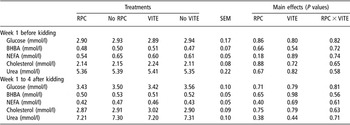
At the beginning of the present study, mean levels of plasma metabolites were closely similar in the four treatment groups (P = 0.64). In detail, 4 weeks before kidding, plasma glucose, BHBA, NEFA, cholesterol and urea were 2.89 ± 0.14 (mmol/l mean ± s.e.), 0.39 ± 0.05, 0.26 ± 0.05, 2.23 ± 0.10 and 5.67 ± 0.22, respectively. One week before kidding, these variables did not differ significantly between groups (Table 4). Post-partum levels of these plasma metabolites were closely similar between the groups and in general comparable with that reported by other studies in periparturient dairy goats (Sahlu et al., Reference Sahlu, Hart, Le-Trong, Jia, Dawson, Gipson and Teh1995; Stella et al., Reference Stella, Paratte, Valnegri, Cigalino, Soncini, Chevaux, Dell’Orto and Savoini2007). Absence of a plasma constituent response to choline supplementation has also been reported in transition dairy cows (Piepenbrink and Overton, Reference Piepenbrink and Overton2003; Janovick Guretzky et al., Reference Janovick Guretzky, Carlson, Garrett and Drackley2006). Other studies however have reported lower plasma NEFA in choline-supplemented animals around parturition (Pinotti et al., Reference Pinotti, Baldi, Politis, Rebucci, Sangalli and Dell’Orto2003; Chung et al., Reference Chung, Cassidy, Girard, Cavassini and Varga2005) or during the dry period (Grummer, Reference Grummer2006); Zahra et al. (Reference Zahra, Duffield, Leslie, Overton, Putnam and LeBlanc2006) found lowered serum cholesterol. Thus further studies are needed to clarify the mechanism of action of choline on plasma metabolites in periparturient dairy ruminants.
Plasma metabolites according to treatment group recorded 1 week before kidding and from weeks 1 to 4 after kidding

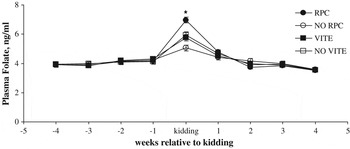
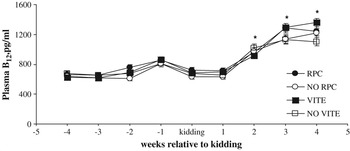
Trends of plasma folate and plasma vitamin B12 over the study period in the four groups are shown in Figures 2 and 3, respectively. Folate levels differed only at parturition when choline-supplemented animals had significantly (P < 0.05) higher folate levels than choline unsupplemented goats. Vitamin B12 concentrations were unaffected (P = 0.58) by choline and vitamin E supplementation; however, a significant time effect was observed after the second week of lactation, when B12 levels started to increase in all groups. The folate trends we observed are broadly similar to those reported in Saanen goats (Ford et al., Reference Ford, Knaggs, Salter and Scott1972) and also in ewes (Girard et al., Reference Girard, Castonguay, Fahmy and Matte1996). In both these studies, plasma folate peaked around parturition. Ford et al. (Reference Ford, Knaggs, Salter and Scott1972) suggested this was due to mobilization of folate from the liver and other tissues. In any event, our findings indicate that folate availability at kidding was higher in choline-supplemented goats than in non-supplemented goats. Note, however, that our folate findings differ from those reported in dairy cows, where choline supplementation also improved folate status after parturition (Baldi and Pinotti, Reference Baldi and Pinotti2006; Girard et al., Reference Girard, Chung and Varga2006).
Plasma folate from week −4 before kidding to week +4 after kidding. Values are means ± s.e. The asterisk (*) indicates an RPC treatment effect (P < 0.05) at kidding.

Plasma vitamin B12 levels (mean ± s.e.) from week −4 before kidding to week +4 after kidding. There was no treatment effect. Asterisks (*) indicate a post-kidding time effect (P < 0.05).

When choline is in short supply, methyl groups (e.g. for methionine resynthesis from homocysteine) must be synthesized de novo by the tetrahydrofolate system or derived from other sources. The tetrahydrofolate system consumes gluconeogenic precursors, so in periods of glucose imbalance (e.g. early lactation) this pathway can also be limiting. The folate finding of the present study therefore indicates that although choline supplementation improved methyl group status around parturition, later the demand for methylated compounds was greater than the supply. However, lack of a drop in plasma folate in the choline-supplemented animals, associated with no drop in vitamin B12, suggests that good methyl group status was maintained in choline-treated goats, even though they were producing more milk than the choline unsupplemented goats.
Investigations of methyl group metabolism in relation to choline supplementation in cows (Baldi and Pinotti, Reference Baldi and Pinotti2006; Girard et al., Reference Girard, Chung and Varga2006) showed a fall in plasma vitamin B12 in choline-supplemented animals, suggesting that when choline and folate are in plentiful supply, vitamin B12 can be the limiting nutrient in the system; evidently this was not the case in the present study. These considerations suggest, as also noted by Girard and Matte (Reference Girard and Matte2004) and Girard et al. (Reference Girard, Lapierre, Matte and Lobley2005), that an adequate supply of methyl group precursors (including choline) and appropriate co factors (folate and vitamin B12) are important for the optimal metabolic support of milk production, even though methionine may not always be involved in this scenario (Preynat et al., Reference Preynat, Thivierge, Lapierre, Matte, Desrochers and Girard2006). It is likely, however, that these differences in plasma concentrations of folates and vitamin B12 could be at least partly due to interspecies differences: plasma folate levels in goats are about 75% lower than in dairy cows during the peri-partum period (Girard et al., Reference Girard, Lapierre, Matte and Lobley2005). The difference for plasma B12 is even greater: 100 to 200 pg/ml (observed range) in cows in early lactation and 600 to 1100 pg/ml in goats around the same time (Girard et al., Reference Girard, Lapierre, Matte and Lobley2005).
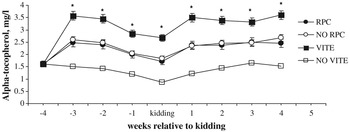
Time trends of plasma α-tocopherol levels in the four treatments are shown in Figure 4. Vitamin E administration resulted in plasma α-tocopherol levels that were 2 to 2.5 times higher than in non-supplemented goats throughout the study period. However, in the groups not given vitamin E, plasma levels were close to 1.5 mg/l except around kidding, when they dropped to about 0.8 mg/l. These levels may have been barely sufficient to maintain adequate vitamin E status in the critical periparturient period. Van Metre and Callan (Reference Van Metre and Callan2001) gave general reference values of plasma α-tocopherol in the range 0.6 to 1.5 mg/l for goats, but did not specify levels around kidding in dairy goats. The NRC (1981) does not recommend vitamin E levels for goats; nevertheless, our findings indicate that supplementation at the 200 IU level improves vitamin E status in goats. This level of supplementation was also suggested by Morand-Fehr (Reference Morand-Fehr1981).
Plasma α-tocopherol from week −4 before kidding to week +4 after kidding. Values are means ± s.e. Asterisks (*) indicate VITE effect (P < 0.05) throughout the study period.

Irrespective of vitamin E intake, Figure 4 shows that plasma vitamin E dropped at parturition (by 23% in vitamin E-supplemented and over 30% in non-supplemented groups), suggesting that an extra dose of the vitamin may be useful at this time. Extensive data in dairy cows support this suggestion (Weiss et al., Reference Weiss, Hogan, Smith and Williams1994; Weiss, Reference Weiss1998; Allison and Laven, Reference Allison and Laven2001; NRC, 2001; Baldi, Reference Baldi2005). It is noteworthy that there was no interaction between vitamin E and choline (P = 0.78), specifically that choline treatment did not influence vitamin E status compared with the unsupplemneted RPC goats. This finding differs from our previous finding in dairy cows that vitamin E levels were at least maintained around parturition in choline-supplemented animals (Pinotti et al., Reference Pinotti, Baldi, Politis, Rebucci, Sangalli and Dell’Orto2003; Baldi and Pinotti, Reference Baldi and Pinotti2006). The reasons for this difference are uncertain: we conjecture that it might be due to a species-specific difference in antioxidant capacity, similar to the difference reported between sheep and goats (Lightbody et al., Reference Lightbody, Stevenson, Jackson, Donaldson and Jones2001) and supported by the longer time to recovery of plasma α-tocopherol following the parturition fall in dairy cows (Weiss et al., Reference Weiss, Hogan, Smith and Williams1994), compared to what we found in goats.
Conclusions
The main conclusion of this study is that rumen-protected choline supplementation can increase yield and fat concentration of milk in periparturient dairy goats. The milk production response to choline supplementation was obtained without a detrimental effect on plasma metabolites including folate and vitamin B12. Furthermore, the lack of a decrease in plasma folate in choline-supplemented animals associated with no decrease in vitamin B12, suggests that good methyl group status was maintained in the choline-treated animals. Hence the dietary supply of choline may not always be sufficient to maximize milk production in the dairy goat; and although the requirement for choline can, in theory, be satisfied by other nutrients, it is unlikely that this happens in practice, especially at the onset of lactation. The magnitude of the production response is likely to be affected by basal diet composition, the dose and mode of administration of the rumen-protected choline, and the stage of lactation, as discussed in dairy cows (NRC, 2001; Baldi and Pinotti, Reference Baldi and Pinotti2006). With regard to vitamin E, its administration alone did not affect milk yield, although it increased plasma α-tocopherol two-fold compared with non-supplemented animals. Furthermore, there was no choline–vitamin E interaction, while such an interaction has been found in dairy cows (Pinotti et al., Reference Pinotti, Baldi, Politis, Rebucci, Sangalli and Dell’Orto2003), suggesting that more investigations in this area are needed in periparturient dairy goats.
Acknowledgments
The authors wish to thank Dr G. Cigalino for his help at the experimental farm, Ascor Chimici srl. for providing choline and vitamin E, Dr Rita Rizzi for her help in statistical analysis and Don Ward for help with the English.
This study was supported by PRIN 2005 n. 200579198 Coordinated by Prof. G. Savoini.