Decomposition of leaf litter is an important process that releases energy and nutrients in both terrestrial and aquatic environments (Moore et al. Reference MOORE, BERLOW, COLEMAN, DE RUITER, DONG, HASTINGS, COLLINS JOHNSON, MCCANN, MELVILLE, MORIN, NADELHOFFER, ROSEMOND, POST, SABO, SCOW, VANNI and WALL2004, Wallace et al. Reference WALLACE, EGGERT, MEYER and WEBSTER1997); therefore, the physical, chemical and biological processes controlling leaf-litter decomposition rates can affect nutrient cycling and productivity in these systems (Cross et al. Reference CROSS, WALLACE and ROSEMOND2007, Wood et al. Reference WOOD, LAWRENCE, CLARK and CHAZDON2009). Several studies have shown that leaf decomposition is faster in aquatic than in terrestrial habitats due to relatively constant temperatures, continuous leaching and the physical breakdown of leaves by flowing water (Hutchens & Wallace Reference HUTCHENS and WALLACE2002, Langhans & Tockner Reference LANGHANS and TOCKNER2006, Langhans et al. Reference LANGHANS, TIEGS, GESSNER and TOCKNER2008). Yet, comparatively few studies have examined these relationships in tropical systems with flooded forests. Flooding is a predominant feature of the upper Amazon Basin, but its occurrence and magnitude is complex and not strictly seasonal (Junk et al. Reference JUNK, BAYLEY, SPARKS and Dodge1989). To identify the dominant energy pathways and understand the nutrient dynamics of upper Amazon rain forests, it is imperative to investigate organic matter processing in the aquatic/terrestrial transition zones of these ecosystems.
Leaf-litter decomposition rates are affected by the physical conditions (Vasconcelos & Laurance Reference VASCONCELOS and LAURANCE2005), chemical characteristics (Bergfur et al. Reference BERGFUR, JOHNSON, SANDIN, GOEDKOOP and NYGREN2007) and biological components (Didham Reference DIDHAM1998, Graça et al. Reference GRAÇA, FERREIRA and COIMBRA2001, Wright & Covich Reference WRIGHT and COVICH2005) of a site. Each of these factors might be affected by the duration of inundation. Thus, varied flooding regimes may alter the rate of leaf-litter decomposition across a landscape (de Neiff et al. Reference DE NEIFF, NEIFF and CASCO2006, Langhans & Tockner Reference LANGHANS and TOCKNER2006, Rueda-Delgado et al. Reference RUEDA-DELGADO, WANTZEN and TOLOSA2006). Moreover, the chemical and physical characteristics of leaf litter can affect decomposition (Cornelissen et al. Reference CORNELISSEN, PÉREZ-HARGUINDEGUY, GRIME, MARZANO, CABIDO, VENDRAMINI and CERABOLINI1999). The purpose of this study was to examine the relative effects of fungi and macro-invertebrates on leaf-litter decomposition rates across a flooding gradient with two tree species in an Amazonian floodplain. We hypothesized that tough, chemically defended Inga punctata Willd. (Fabaceae) leaves would decompose more slowly than ant-defended Triplaris dugandii Brandbyge (Polygonaceae) leaves. We posited that leaf decomposition rates would be greatest in permanently submerged habitats as moisture would not be limiting to the physical and biological processes. Additionally, we hypothesized that leaves in the intermittently submerged habitats would decompose faster than terra firme environments but slower than the leaves in the permanently submerged habitats. The sporadic flooding and drying events in the intermittently submerged habitats might periodically stimulate decomposition, but might also stress microbial decomposers and invertebrate detritivores.
We conducted our study between February and June of 2007 in the Ecuadorian Amazon. The study site was located in and around Numa Stream, a tributary of the Tiputini River in the Napo watershed, at the Tiputini Biodiversity Station (TBS) in north-eastern Ecuador (latitude 0°38′S, longitude 76°08′W). Annual precipitation varies between 2500 and 3200 mm and temperature ranges between 24 °C and 27 °C through the year (TBS unpubl. data). Typically, drier months are from December to January (~80 mm mo−1) and months with higher rainfall are from May to June (~400 mm mo−1) (TBS unpubl. data). Numa Stream was characterized by rapid flooding events in which water depth would increase from approximately 10 cm to 3 m within hours. We deployed litter bags of two mesh sizes, fine (0.5 mm, to exclude macro- and meso-invertebrates) and coarse (8 × 5 mm, to allow invertebrate access and consumption) with one of two tree species (I. punctata and T. dugandii) in three flooding regimes (submerged, intermittently submerged and terra firme). Submerged habitats were permanently flooded and terra firme habitats were never flooded throughout the study period. Intermittently submerged habitats were flooded several times throughout the investigation. These flooding events happened at least once per week throughout the study period and the length of inundation ranged from several hours to several days.
We collected leaves below individual trees at the TBS and dried them at room temperature. Each litter bag was filled with 3 (± 0.2) g of dried leaf matter. On 8 March 2007 we deployed 180 litter bags (2 mesh sizes × 2 tree species × 3 flooding regimes × 3 replicates × 5 blocks). Three litter bags of each mesh type (fine, coarse) and plant species (I. punctata, T. dugandii) were brought back to the laboratory on day 0 to estimate handling effects. Each experimental block of 36 leaf-litter bags was attached to a weighted PVC tube and anchored in one of the three habitats using steel rods. We anchored the experimental blocks to prevent movement during flooding. On days 7, 14, 21, 35 and 101 of the experiment, we collected 36 leaf-litter bags (2 mesh types × 2 plant genera × 3 hydrological regimes × 3 replicates), placed the individual litter bags in sealed plastic bags, and transported them in coolers back to the laboratory for analysis.
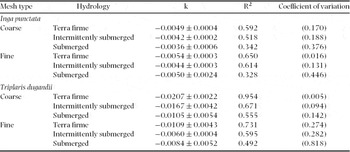
After we retrieved the litter bags, we gently rinsed the remaining leaf matter to remove detritus, inorganic material and macro-invertebrates. We dried the leaf matter at 60 °C for 48 h, weighed the dried material, combusted the leaf matter at 550 °C, and re-weighed the sample. We calculated ash-free dry mass (AFDM) as the difference in mass between dried and combusted samples. We calculated decomposition rates (k) as the slope of remaining mass over time, using the exponential model (Table 1). Differences in decomposition rates between litter from the two tree species and flooding regimes were analysed using a split-plot ANOVA, where the response variable was k. The whole-plot factors included: experimental block, flooding regime and experimental block × flooding regime. The split-plot level factors were mesh type and flooding regime × mesh type.
Leaf decomposition rates (k) obtained using the exponential model (mean ± SE; R2 (coefficient of variation)) of Inga punctata and Triplaris dugandii in two mesh types (coarse and fine) in terra firme, intermittently submerged, and permanently submerged habitats.

We estimated fungal biomass with ergosterol analysis (Gessner Reference GESSNER, Graça, Barlocher and Gessner2005) on a subset of leaves. From leaves retrieved on days 14, 21, 35 and 101 of the experiment, we cut five leaf discs from both I. punctata and T. dugandii leaves from each flooding regime using a cork borer (diameter, 1 cm). Briefly, the five-disc sets were preserved in 10 ml of methanol and stored in the dark at –4 °C in Quito, Ecuador. The samples were transported to the University of Coimbra on dry ice and analysed for ergosterol concentration following the methods outlined in Gessner (Reference GESSNER, Graça, Barlocher and Gessner2005). Fungal biomass data were square-root transformed and they were analysed using a two-way ANOVA, with hydrology and species as main factors. All statistical analyses were carried out using Statistica© software.
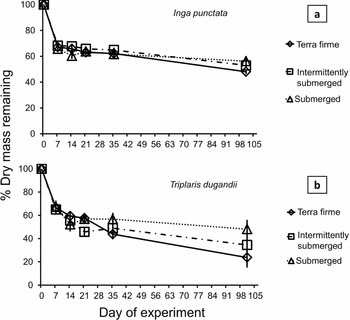
Leaf-litter mass loss occurred in two steps in each of the hydrological regimes – leaching and decomposition. Leaching was estimated as the mass lost during the first 7 d of the experiment. Leaching was intense and it accounted for approximately 33% of mass loss from leaf litter. Decay rates between the two species differed significantly, with T. dugandii breaking down at a considerably faster rate than I. punctata (ANOVA, F = 7.12, P = 0.0083). Unlike our initial hypothesis, the decay rates of I. punctata were slower when submerged (split-plot ANOVA, F = 28.1, P = 0.0009). The same pattern was evident in T. dugandii, but the results were not significant (split-plot ANOVA, F = 3.06, P = 0.121) (Figure 1). There was a significant experimental block effect on I. punctata decomposition rates (split-plot ANOVA, F = 9.01, P = 0.0154), but not on T. dugandii (split-plot ANOVA, F = 0.323, P = 0.736).
Average leaf-litter dry mass remaining from coarse- and fine-mesh bags through time (five sampling dates) from a litter breakdown experiment assessing the decomposition of leaves of two species, Inga punctata (a) and Triplaris dugandii (b), in three hydrological regimes in an Ecuadorian Amazonian forest.

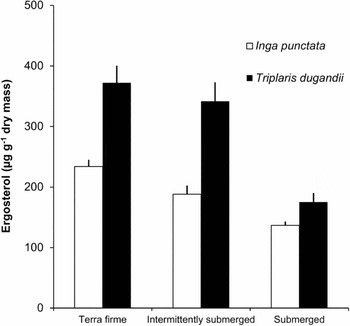
There was no significant difference in decay rates between coarse and fine mesh bags in either species (I. punctata, split-plot ANOVA, F = 0.454, P = 0.525; T. dugandii split-plot ANOVA, F = 3.31, P = 0.119), indicating that microbes may be driving decomposition in all three flooding regimes. Leaf type and hydrological regime also affected the fungal biomass found on the decomposing litter (Figure 2). We found higher fungal biomass on T. dugandii leaves than on I. punctata leaves (ANOVA, F = 44.5, P < 0.001). Furthermore, fungal biomass was greater on litter decomposing in terra firme habitats than on litter in submerged habitats (ANOVA, F = 33.6, P < 0.001).
Average fungal biomass (±1 SE) collected from leaf-litter samples from two taxa, I. punctata and T. dugandii, recovered on days 14, 21, 35 and 101 of a litter decomposition experiment in an Ecuadorian Amazonian forest.

Our primary finding was that the leaf litter in intermittently flooded streams of Ecuadorian forests decomposed slower than leaf litter in terrestrial habitats of the same forests in one of the two species we studied. This conclusion contrasted with the results of other studies that found that permanently submerged leaves had increased decomposition rates relative to leaves found in terrestrial environments (Battle & Golladay Reference BATTLE and GOLLADAY2007, Langhans & Tockner Reference LANGHANS and TOCKNER2006, Langhans et al. Reference LANGHANS, TIEGS, GESSNER and TOCKNER2008, Padial & Thomaz Reference PADIAL and THOMAZ2006). In many terrestrial environments, moisture may limit leaf-litter decomposition (Anderson Reference ANDERSON1991, Cisneros-Dozal et al. Reference CISNEROS-DOZAL, TRUMBORE and HANSON2007, Cornejo et al. Reference CORNEJO, VARELA and WRIGHT1994). However, the large amount of rain and the high relative humidity of TBS may have promoted rapid decomposition in terrestrial habitats. Thus, moisture may not be a factor limiting decomposition in tropical terrestrial environments.
We found that the small streams in the TBS were subjected to sudden changes in physical and chemical conditions, particularly in dissolved oxygen (ranging from 10% to 98%) and pH (4–7.4) (A. Encalada pers. obs.). These changes occurred within hours during the study period and they coincided with flooding events. Low dissolved oxygen could be a result of chemical or biological consumption and/or absence of water flow (less than 0.01 m s−1) during flooding events that could affect living organisms and hence, reduce decomposition rates. Anoxia created by flooding has been linked to reduced decomposition in other studies (Neckles & Neill Reference NECKLES and NEILL1994). Additionally, other investigations have also reported that hypoxic conditions slow down decomposition by aquatic hyphomycetes under laboratory conditions (Medeiros et al. Reference MEDEIROS, PASCOAL and GRAÇA2009).
Our results also demonstrated that forest composition may affect litter decomposition rates. In this study, I. punctata leaves decomposed significantly slower than T. dugandii leaves. This may have been due to intrinsic differences in the chemical composition and the physical properties of the leaves. Previous studies have determined that many species of I. punctata are chemically (Kursar et al. Reference KURSAR, DEXTER, LOKVAM, PENNINGTON, RICHARDSON, WEBER, MURAKAMI, DRAKE, MCGREGOR and COLEY2009, Lokvam et al. Reference LOKVAM, CLAUSEN, GRAPOV, COLEY and KURSAR2007) and physically (high leaf toughness and lignin concentration: Encalada et al. Reference ENCALADA, CALLES, FERREIRA, CANHOTO and GRAÇA2010) defended. These characteristics are likely to have retarded leaf litter decomposition relative to T. dugandii in our investigation. Conversely, T. dugandii are heavily defended by ants and would not need to invest many resources in chemical or physical defences (Haddad et al. Reference HADDAD, BICUDO and FRANSOZO2009, Larrea-Alcazar & Simonetti Reference LARREA-ALCAZAR and SIMONETTI2007, Ward Reference WARD1999).
Finally, similar decomposition rates between the coarse- and fine-mesh bags indicated that macro-invertebrate detritivores may play a limited role in decomposition within intermittently flooded watersheds in the Amazon Basin. Previous investigations have demonstrated that shredder invertebrates are poorly represented in many tropical watersheds, where litter decomposition could be very slow (Braga-Neto et al. Reference BRAGA-NETO, LUIZAO, MAGNUSSON, ZUQUIM and DE CASTILHO2008, Osono et al. Reference OSONO, ISHII and HIROSE2008, Rincon & Santelloco Reference RINCON and SANTELLOCO2009, Yule & Gomez Reference YULE and GOMEZ2009; but see Encalada et al. Reference ENCALADA, CALLES, FERREIRA, CANHOTO and GRAÇA2010, Graça & Cressa Reference GRAÇA and CRESSA2010, Ramseyer & Marchese Reference RAMSEYER and MARCHESE2009; for a review see also Abelho Reference ABELHO2001). Elucidating the limited effects of macro-invertebrates on decomposition was outside of the scope of this paper. However, unpredictable flooding events – common in Amazonian floodplains – may hinder the ability of macro-invertebrates to colonize leaf substrates and limit their impact on litter decomposition.
It is important to note that the decomposition rates documented in this study may have been influenced by the ability of decomposing organisms and detritivores to colonize the leaf litter. Initially, the mesh size of the litter bags used in this study may have prevented larger detritivores, such as crabs, from entering the bags, thereby reducing leaf decomposition. Conversely, mycorrhizas, which were not quantified in this study, may have enhanced decomposition in terrestrial environments.
In conclusion, unlike in other biomes, leaf litter decomposition in this region of the Amazon was faster in terrestrial environments than aquatic habitats. Moreover, micro-organisms seem to be the primary drivers of decomposition rates in all three of the flooding regimes we studied.
ACKNOWLEDGEMENTS
We would like to thank the staff of the Tiputini Biodiversity Station for their logistical support. Members of the Laboratorio de Ecología Acuática USFQ collected the leaves prior to the experiment and processed the leaves after the experiment. Dena Dechmann provided help collecting samples in the field. We would also like to thank Verónica Ferreira, Elsa Rodrigues, Ana Gonçalves from IMAR for sample processing and ergosterol analysis. Jose Paulo Sousa provided help and direction with the statistical analysis. Finally, we would like to thank the anonymous reviewers whose work enhanced the quality of this paper. This research was partially supported by the Portuguese Science Foundation through grants POCI/BIA-BDE/58297/2004 (M.A.S. Graça) and SFRH/BPD/34860/2007 (A. Encalada) and the US National Science Foundation Integrative Graduate Education and Research in Biogeochemistry and Environmental Biocomplexity (0221658) Small Grant Program (K. Capps).