




No CrossRef data available.
Article contents
Early and late life cognitive activity and cognitive systems in old age
Published online by Cambridge University Press: 01 July 2005
Abstract
Little is known about the relative benefits of cognitively stimulating activities at different points in the lifespan. In a cohort of 576 older persons without dementia, we assessed current and past (childhood, young adulthood, middle age) frequency of cognitive activity; availability of cognitively stimulating resources in the home in childhood and middle age; and 5 domains of cognitive function. Past cognitive activity and cognitive resources were positively correlated with both current cognitive activity and current cognitive function. The association with cognitive function was reduced after controlling for current cognitive activity, however. Current cognitive activity was associated with better cognitive function, especially semantic memory and perceptual speed, even after controlling for past activity. The results suggest that past cognitive activity contributes to current cognition principally through its association with cognitive activity in old age. (JINS, 2005, 11, 400–407.)
Information
- Type
- Research Article
- Information
- Journal of the International Neuropsychological Society , Volume 11 , Issue 4 , July 2005 , pp. 400 - 407
- Copyright
- © 2005 The International Neuropsychological Society
INTRODUCTION
Several large prospective studies have observed reduced cognitive decline, reduced risk of dementia, or both in older persons with more frequent participation in cognitively stimulating activities (like reading) compared to those with less frequent participation (Hultsch et al., 1999; Verghese et al., 2003; Wang et al., 2002; Wilson et al., 2002b; Wilson et al., 2002c). According to the neural reserve hypothesis (Bennett et al., 2003; Stern, 2002; Wilson et al., 2000), frequent cognitive activity is protective because it enhances the brain's capacity to tolerate neuropathology, referred to as neural reserve. Because these studies have focused primarily on patterns of cognitive activity in old age, however, they raise the questions of whether cognitive activity prior to old age is associated with late life cognitive function and whether this association is independent of the association between late life cognitive activity and late life cognitive function. Within the framework of neural reserve theory, the question is whether reserve capacity depends solely on late life cognitive activity or whether activity patterns across the life span contribute to reserve.
With few exceptions (Wilson et al., 2000), prior research on the association between a cognitively active lifestyle and cognitive function in old age has focused on how frequently specific activities are reported to occur. An alternative (but not mutually exclusive) approach used in research on children has been to assess diverse features of the home environment that can enhance or support cognitive activity. Such indices of the cognitive environment in the home have been associated with cognitive performance and academic achievement in childhood (Bradley et al., 1989). Little is known about the home cognitive environment in later life and its relation to late life cognition, however.
The aim of the present study was to assess the relation of cognitive activity during childhood and midlife to levels of cognitive activity and cognitive function in old age. In a group of more than 500 older persons, we developed separate measures of cognitive activity frequency at four points in the life span and of the level of cognitive resources in the home (e.g., globe, atlas) at two points. Cognitive function was assessed with a battery of 19 tests from which composite measures of five cognitive domains were derived. In a series of linear regression models, we examined the relation of past cognitive activity to current cognitive activity, the relation of past and current activity to current cognitive function, and the extent to which these latter associations were independent.
METHODS
Research Participants
All subjects are participants in the Rush Memory and Aging Project, an ongoing longitudinal clinicopathologic study of older persons recruited from about 25 residential facilities in the Chicago metropolitan area, including subsidized senior housing facilities, retirement communities, and retirement homes. Following a presentation about the study at a given facility, potential participants were asked to complete a form indicating their level of interest in receiving more information about the project. Those expressing interest were contacted later by study staff at which point procedures were discussed in detail and informed consent was obtained. The study involves assessment of risk factors, detailed clinical evaluation, and organ donation at the time of death. It was approved by the Institutional Review Board of Rush University Medical Center.
Eligibility for these analyses was restricted to persons who were free of dementia. Each participant underwent a uniform clinical evaluation that included a medical history, neurological examination, and cognitive function testing, as previously described (Bennett et al., in press; Wilson et al., 2003). On the basis of this evaluation, a physician clinically classified persons with respect to dementia using the criteria of the joint working group of the National Institute of Neurological and Communicative Disorders and Stroke and the Alzheimer's Disease and Related Disorders Association (McKhann et al., 1984), which require a history of cognitive decline and impairment in at least two cognitive domains. Of 616 people who completed the clinical evaluation, 40 met criteria for dementia and were excluded from analyses. The remaining 576 persons had a mean age of 80.2 (SD = 7.6), a mean of 14.4 years of education (SD = 3.0), a mean of 9.7 years of education (SD = 3.7) completed by their parents, 73.3% were women, and 90.5% were White and non-Hispanic. They had a mean of 1.4 (SD = 1.1, range: 0–6) chronic medical conditions, established by medical history for six conditions (e.g., diabetes, cancer) or by history and examination for a seventh (i.e., stroke).
Assessment of Cognitive Activity
Persons were asked to rate their frequency of participation in cognitively stimulating activities on a 5-point scale, with 1 indicating participation in the activity once or less per year, 2 indicating participation several times per year, 3 for several times per month, 4 for several times per week, and 5 for every day or about every day. There were 39 questions, three about activity at age 6, eight about age 12, ten about age 18, nine about age 40, and 9 about current age. We chose age 6 years because most children begin their formal education at about this time; age 12 years because it is a time when most children are still in school; age 18 years because it is a time of transition to adulthood; and age 40 years because it is in the middle of adulthood. We constructed as many items as possible from each epoch that met three criteria: seeking or processing information was central to the activity, relatively few physical or social barriers to participating in the activity, participation in the activity was likely to be relatively common. The activities included reading a newspaper or book, writing letters, keeping a journal, visiting a library, and attending a concert. The scale represents an expansion of a previously described 25-item version administered to 141 participants of the Memory and Aging Project, a subset of those included in these analyses (Wilson et al., 2003).
We also assessed features of the home environment that might support a cognitively active lifestyle, given evidence linking the home intellectual environment in childhood with cognitive and academic performance (Bradley et al., 1989). Specifically, we asked about the presence in the home at age 12 and at age 40 of seven items: newspaper subscription, magazine subscription, dictionary, encyclopedia, atlas, globe, and library card. In addition, we asked persons to estimate the number of books in the home on the following scale: less than 20 books, 20–49 books, 50–100 books, 101–250 books, or more than 250 books. We chose ages 12 years and 40 years because they occur in the middle of childhood and adulthood.
Assessment of Cognitive Function
A battery of 20 cognitive tests was administered in an approximately one-hour session. One test, the Mini-Mental State Examination (Folstein et al., 1975), was used to describe the cohort but not in analyses. The remaining 19 tests were chosen to assess five domains of cognitive function. There were seven measures of episodic memory: immediate and delayed recall of story A from Logical Memory (Wechsler 1987) and of the East Boston Story (Albert et al., 1991; Wilson et al., 2002a) and Word List Memory, Word List Recall, and Word List Recognition (Morris et al., 1989); three measures of semantic memory: a 15-item version (Morris et al., 1989) of the Boston Naming Test (Kaplan et al., 1983), Verbal Fluency (Morris et al., 1989; Wilson et al., 2002a), and a 15-item reading test (Wilson et al., 2002a); three working memory tests: Digit Span Forward and Digit Span Backward (Wechsler 1987) and Digit Ordering (Cooper & Sagar 1993; Wilson et al., 2002a); four measures of perceptual speed: Symbol Digit Modalities Test (Smith, 1982), Number Comparison (Ekstrom et al., 1976; Wilson et al., 2002a), and two indices from a modified version of the Stroop Neuropsychological Screening Test (Trenerry et al., 1989): the number of color names correctly read aloud in 30 s minus the number of errors, and the number of colors correctly named in 30 s minus the number of errors; and two measures of visuospatial ability: a 15-item version of Judgment of Line Orientation (Benton et al., 1994) and a 16-item version of Standard Progressive Matrices (Raven et al., 1992).
The results of a previous factor analysis of these tests produced five factors that corresponded closely with the five aforementioned cognitive domains (Wilson et al., 2003). Because the previous factor analysis was based on only 141 persons and did not include the two Stroop measures, we performed a principal-components factor analysis with varimax rotation. Five factors again emerged and both Stroop measures loaded with the Symbol Digit Modalities Test and Number Comparison. The agreement between the factor analytic grouping (using loadings of 0.50 or greater as a cut-off) and the hypothesized grouping was assessed with Rand's statistic (Rand, 1971) which ranges from −1 (perfect disagreement) to 1 (perfect agreement). Rand's statistic equaled 0.79, indicating a good fit (p < .001). Accordingly, we created composite measures of episodic memory, semantic memory, working memory, perceptual speed, and visuospatial ability, by converting raw scores on each component test to z scores and averaging the z scores to get the domain score, as previously described (Wilson et al., 2002a, 2003).
Data Analysis
We examined the relation of past activity to current activity and of the cognitive activity measures to cognitive function in a series of linear regression models. All models included terms to control for the potentially confounding effects of current age, sex, and education, with number of medical conditions controlled in some subsequent models. Initial analyses evaluated cognitive activity measures separately, with some activity measures examined together in subsequent analyses. Models were validated graphically and analytically. Programming was done in SAS (SAS Institute Inc., 2000).
RESULTS
Cognitive Activity Frequency Measures
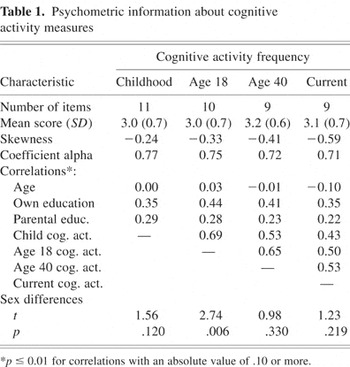
We constructed measures of cognitive activity frequency at four points in the life span: childhood (ages 6,12), age 18, age 40, and current age. For each measure, item scores were averaged to yield the scale score which ranged from 1 to 5, with higher scores indicating more frequent cognitive activity (Table 1). Each scale had an approximately normal distribution. Internal consistency, assessed with coefficient alpha, was adequate. The median correlation between the scales was .53. Age was not related to activity frequency except for a small inverse association with current cognitive activity. Women reported slightly more frequent activity than men, but this difference was only significant at age 18. Each cognitive activity frequency measure was positively correlated with the education of the participant and with parental education, supporting the validity of the scales.
Psychometric information about cognitive activity measures

We examined the relation of past to current cognitive activity frequency in a series of linear regression models. In separate analyses, after adjusting for the effects of current age, sex, and education, cognitive activity in childhood accounted for 15% of the variance in current cognitive activity; activity in young adulthood accounted for 19%; and activity in middle adulthood accounted for 23%. With all three past activity measures in the same model, 26% of the variance in current activity was shared with the activity frequency in childhood (estimate = .091, SE = .046, p = .047), young adulthood (estimate = .187, SE = .056, p < .001) and middle adulthood (estimate = .341, SE = .049, p < .001).
Cognitive Activity Frequency and Cognitive Function
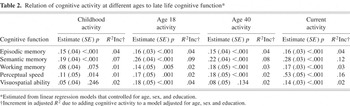
We examined the relation of each cognitive activity frequency measure to cognitive function in five domains in a series of linear regression models adjusted for current age, sex, and education (Table 2). With a few exceptions, higher frequency of cognitive activity at any age was associated with higher level of cognitive function in old age. The association of cognitive activity with cognition varied across functional domains, however, accounting for 7 to 12% of the variance in semantic memory but only 1 to 4% of the variance in working memory and visuospatial ability. In addition, the association of the current activity measure with cognitive function tended to be stronger than the associations of past activity measures with cognition. Thus, current cognitive activity frequency accounted for 16% of the variance in perceptual speed with past activity only accounting for 1 to 2%. A similar, albeit less striking, trend was present for semantic memory but not for the other three cognitive domains.
Relation of cognitive activity at different ages to late life cognitive function* %[dagger]Increment in adjusted R2 due to adding cognitive activity to a model adjusted for age, sex and education.

Because chronic conditions other than Alzheimer's disease can impair cognitive function and might also reduce frequency of current participation in cognitive activities, we repeated each of the linear regression models with a term added for the number of seven chronic medical conditions (e.g., stroke, diabetes) present (M = 1.4, SD = 1.1, range: 0–6). In these analyses, the associations between each of the activity frequency measures and each of the cognitive function measures were virtually identical, suggesting that the relation between cognitive activity and cognitive function was not strongly influenced by chronic illness.
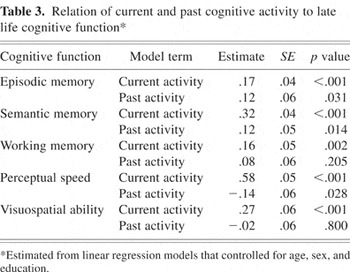
To further examine how current and past activity frequency were associated with cognition, we constructed a measure of past activity by averaging the 30 items about cognitive activity in childhood, at age 18, and at age 40. Scores ranged from 1.4 to 4.6 (M = 3.1; SD = 0.6; skewness = −0.33; coefficient alpha = .89; correlation with current activity = .55). We then constructed linear regression models with terms for current and past cognitive activity frequency in addition to age, sex, and education (Table 3). In these analyses, the associations of current cognitive activity with cognitive function in each domain were not substantially affected by controlling for past activity. By contrast, with the effects of current cognitive activity controlled, past cognitive activity accounted for an additional 2% of the variance in episodic memory and 4% of the variance in semantic memory, but was uncorrelated with working memory or visuospatial ability and inversely correlated with perceptual speed.
Relation of current and past cognitive activity to late life cognitive function*

Cognitive Resource Measures and Cognitive Function
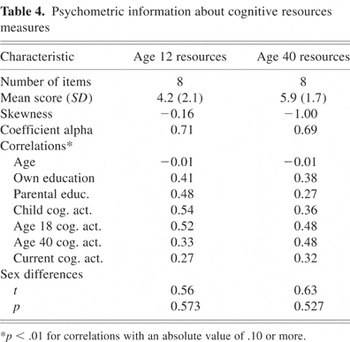
We constructed measures of cognitive resources in the home at age 12 years and age 40 years. Scores on each measure could range from zero to 8, with higher scores indicating more resources. One point was assigned for each of seven items (e.g., dictionary, atlas) present in the home, and for books in the home, an additional .25 was assigned for 20–49 books, .50 for 50–100 books, .75 for 101–250 books, and 1 for more than 250 books. Scores were approximately normally distributed for the age 12 measure, but people reported having relatively more cognitive resources in the home at age 40, and resource scores were negatively skewed (Table 4). Resources were unrelated to age or sex but had positive correlations with the educational attainment of the participant and of the participants' parents, supporting the validity of the measures. Cognitive resources were also positively correlated with frequency of cognitive activity, with the correlations somewhat stronger for past relative to current activity.
Psychometric information about cognitive resources measures

We examined the relation of the two cognitive resources measures to cognitive function, first separately and then together, in a series of linear regression models. As shown in Table 5, having more cognitive resources in the home at age 40 was associated with higher function in each cognitive domain, accounting for 3% (working memory, perceptual speed) to 11% (semantic memory) of the variation in cognition after adjustment for age, sex, and education. Cognitive resources in the home at age 12 years were related to cognition in three of five domains, but these associations were substantially reduced and no longer significant after controlling for cognitive resources at age 40 years. Results were comparable when analyses were repeated with a term added for chronic medical conditions.
Relation of cognitive resources in the home to late life cognitive function*

To examine the extent to which the association of cognitive resources with cognitive function was independent of cognitive activity frequency, we constructed a final set of linear regression models with terms for both home resources measures, past cognitive activity, and current cognitive activity (Table 6). In these analyses, current cognitive activity and home resources at age 40 years were positively associated with level of cognition in each domain. By contrast, resources at age 12 years and past cognitive activity were unrelated to cognition in any domain except for an inverse association between past cognitive activity frequency and perceptual speed. With age, sex, and education controlled, the combination of activity and resources measures in these models accounted for an additional 8% of the variance in episodic memory, 20% in semantic memory, 5% in working memory, 18% in perceptual speed, and 9% in visuospatial ability.
Relation of cognitive resources in the home and frequency of cognitive activity to late life cognitive function*

DISCUSSION
In a cohort of more than 500 older persons without dementia, we assessed past cognitive activity and cognitive resources in the home, current cognitive activity, and current cognitive function. Past cognitive activity was related to current cognitive activity. Past cognitive activity was also related to current cognitive function, but controlling for current cognitive activity substantially reduced the association whereas the association between current cognitive activity and cognitive function was independent of past cognitive activity. Overall, the results suggests that past cognitive activity contributes to late life cognitive function primarily through its association with late life cognitive activity.
Loss of cognitive function in old age is known to be due in part to the accumulation of age-related neuropathology like amyloid-beta, tau-positive neurofibrillary tangles, and cerebral infarctions. The association of these neuropathologic lesions with cognition proximate to death is substantially less than one, however. These individual differences in the ability to withstand the deleterious effects of age-related neuropathology have been attributed to neural reserve. That is, genetic and experiential factors are thought to contribute to the organization, efficiency, and plasticity of neural systems, thereby rendering them differentially vulnerable to common neuropathologic lesions in old age. A strength of the neural reserve concept is that it suggests that risk of clinical disease can be modified not only by affecting the accumulation of pathology but also by affecting the brain's capacity to tolerate that pathology. How might individual differences in reserve capacity arise? We suggest two mechanisms. First, during nervous system development, excess neurons, synapses, and dendrites are generated, and neural activity during development has been shown to be a key factor in determining the fate of individual neurons, synapses, and dendrites (Katz & Shatz, 1996; Penn & Shatz, 1999; Singer, 1995). For example, animals reared in environments that vary in level of complexity show structural differences in the neocortex and hippocampal formation (Beaulieu & Colonnier, 1989; Comery et al., 1996; Greenough et al., 1985). A distinctive feature of human nervous system development is its prolonged temporal course, with evidence of experience-based alterations of human brain structure through the second decade of life (Benes et al., 1994; Paus et al., 1999; Pfefferbaum et al., 1994; Steen et al., 1997). Second, neural plasticity, the process by which neural systems adapt to changes in the environment, continues after development is complete. Thus, changes in neurons, synapses, and dendrites have been documented in adult and aged animals following learning and environmental manipulation (Jones et al., 1997; Kempermann et al., 1997; Kornack & Rakic, 1999). Plasticity in the adult human brain has also been documented in terms of recovery following stroke (Nudo et al., 1996; Seil, 1997) and neurogenesis (Eriksson et al., 1998). These observations suggest that cognitive experiences during adulthood and old age as well as during development may contribute to structural and functional changes in the nervous system and imply that assessment of such cognitive experiences as done in the present study might provide an indirect measure of neural reserve capacity.
As alluded to above, previous research on cognitive activity in older persons has focused either on current activity (Christensen & Mackinnon, 1993; Hultsch et al., 1993; Wilson et al., 1999) or on past activity (Friedland et al., 2001; Wilson et al., 2000) but has not examined the relation between current and past activity or their independent associations with cognitive function. We found that measures of past cognitive activity and past access to cognitive resources in the home accounted for up to about 25% of the variance in current frequency of participation in cognitive activities. The association of these indices of past cognitive activity with current cognitive performance was not strong, however, after accounting for the effects of current cognitive activity, suggesting that in quantifying cognitive reserve capacity, assessing past cognitive activity may be somewhat redundant if measures of current activity are available. Prospective studies will be needed to establish the long term temporal stability of participation in cognitive activities and to test whether activity levels at different points in the life span differentially contribute to neural reserve capacity.
With few exceptions (Wilson et al., 2000), previous research has focused on activity participation rather than on features of the environment that may facilitate participation in cognitive activities. We found that having more resources in the home that support cognitive activity in childhood and middle age was associated with higher level of cognitive function in old age, consistent with research on the home intellectual environment in childhood (Bradley et al., 1989).
The relation of cognitive activity to cognitive function varied across functional domains. Current cognitive activity frequency accounted for 12% of the variance in semantic memory and 16% of the variance in perceptual speed compared to 4% or less of the variance in the remaining domains. This relatively selective association of current cognitive activity with semantic memory and perceptual speed is consistent with cross-sectional data from the Religious Orders Study (Wilson et al., 2002c) and the Victoria Longitudinal Study (Hultsch et al., 1993). Past cognitive activity frequency and cognitive resources were somewhat more strongly related to semantic memory than to other cognitive functions. The strong effect for semantic memory may reflect knowledge acquired through cognitive activity or the predominance of items about reading and related activities in the questionnaire. The dissociation between perceptual speed's strong association with current cognitive activity and its relatively weak association with past cognitive activity is noteworthy and suggests that effects of cognitive activity on perceptual processing may be relatively short lived.
This study has several strengths. On the basis of a uniform clinical evaluation of all participants and the application of widely accepted criteria, persons with dementia were excluded. The cohort was relatively large, enhancing our ability to detect the associations of interest and to control for potentially confounding variables. Composite measures of different domains of cognitive function were used in analyses, reducing random variability and floor and ceiling artifacts.
The study also has important limitations. The cohort is selected and so the full spectrum of cognitive activity and cognitive function is probably not represented though the association between current cognitive activity and cognitive function is comparable to the association described in a population-based sample of older persons (Wilson et al., 1999). In addition, the estimates of past cognitive activity and resources are retrospective, making them susceptible to bias and complicating comparisons with current activity. Further, the data are cross-sectional. Current cognitive impairment may cause people to be less cognitively active and thereby account for the relatively stronger associations observed for current compared to past activity. Longitudinal studies will be needed to elucidate the mechanisms underlying the association of cognitive activity with maintenance of cognitive function in old age. Finally, the number and nature of activities that we assessed varied somewhat from epoch to epoch, possibly contributing unwanted variance to the activity measures from different epochs.
ACKNOWLEDGMENTS
This research was supported by National Institute on Aging Grants R01 AG17917 and R01 AG022018, and the Illinois Department of Public Health. We thank the many Illinois residents for participating in the Rush Memory and Aging Project, Tracy Colvin, M.P.H., and Tracy Hagman for coordinating the study, Todd Beck, MS, for statistical programming, George Dobrowski, M.S., and Greg Klein for data management, and Valerie J. Young for preparing the manuscript.
References
REFERENCES
Albert, M.,
Smith, L.,
Scherr, P.,
Taylor, J.,
Evans, D., &
Funkenstein, H..
(1991).
Use of brief cognitive tests to identify individuals in the
community with clinically diagnosed Alzheimer's disease.
International Journal of Neuroscience,
57,
167–178.Google Scholar
Beaulieu, C. &
Colonnier, M.
(1989).
Number and size of neurons and synapses in the motor cortex of cats
raised in different environmental complexities.
Journal of Comparative Neurology,
289,
178–181.Google Scholar
Benes, F.M.,
Turtle, M.,
Kahn, Y., &
Farol, P.
(1994).
Myelination of a key relay zone in the hippocampal formation occurs
in the human brain during childhood, adolescence, and adulthood.
Archives of General Psychiatry,
51,
477–484.Google Scholar
Bennett, D.A.,
Schneider, J.A.,
Buchman, A.S.,
Mendes de Leon, C.F.,
Bienlas, J.L., &
Wilson, R.S.
(in press).
The Rush Memory and Aging Project: Study design and baseline
characteristics of the study cohort.
Neuroepidemiology.
Bennett, D.A.,
Wilson, R.S.,
Schneider, J.A.,
Evans, D.A.,
Mendes de Leon, C.F.,
Arnold, S.E.,
Barnes, L.L., &
Bienias, J.L.
(2003).
Education modifies the relation of AD pathology to level of
cognitive function in older persons.
Neurology,
60,
1909–1915.Google Scholar
Benton, A.L.,
Sivan, A.B.,
Hamsher, K.DeS.,
Varney, N.R., &
Spreen, O.
(1994).
Contributions to neuropsychological assessment
(2nd ed.).
New York:
Oxford University Press.
Bradley, R.H.,
Caldwell, B.M.,
Rock, S.L.,
Barnard, K.E.,
Gray, C.,
Hammond, M.A.,
Mitchell, S.,
Siegel, L.M.,
Ramey, C.T.,
Gottfried, A.M., &
Johnson, D.L.
(1989).
Home environment and cognitive development in the first 3 years of
life: A collaborative study involving six sites and three ethnic groups in
North America.
Developmental Psychology,
28,
217–235.Google Scholar
Christensen, H. &
Mackinnon, A.
(1993).
The association between mental, social, and physical activity and
cognitive performance in young and old subjects.
Age and Ageing,
22,
175–182.Google Scholar
Comery, T.A.,
Stamoudis, C.X.,
Irwin, S.A., &
Greenough, W.T.
(1996).
Increased density of multiple-head dendritic spines on medium-sized
spiny neurons of the striatum in rats reared in a complex
environment.
Neurobiology of Learning and Memory,
66,
93–96.Google Scholar
Cooper, J.A. &
Sagar, H.J.
(1993).
Incidental and intentional recall in Parkinson's disease: An
account based on diminished attentional resources.
Journal of Clinical and Experimental Neuropsychology,
15,
713–731.Google Scholar
Ekstrom, R.B.,
French, J.W.,
Harman, H.H., &
Kermen, D.
(1976).
Manual for kit of factor-referenced cognitive tests.
Princeton, NJ:
Educational Testing Service.
Eriksson, P.S.,
Perfilieva, E.,
Bjork-Eriksson, T.,
Alborn, A.M.,
Nordborg, C.,
Peterson, D.A., &
Gage, F.H.
(1998).
Neurogenesis in the adult human hippocampus.
Nature Medicine,
4,
1313–1317.Google Scholar
Folstein, M.,
Folstein, S., &
McHugh, P.
(1975).
Mental-Mental State: A practical method for grading the mental state
of patients for the clinician.
Journal of Psychiatric Research,
12,
189–198.Google Scholar
Friedland, R.P.,
Fritsch, T.,
Smyth, K.A.,
Koss, E.,
Lerner, A.J.,
Chen, C.H.,
Petot, G.J., &
Debanne, S.M.
(2001).
Patients with Alzheimer's disease have reduced activities in
midlife compared with healthy control-group members.
Proceedings of the National Academy of Science USA,
98,
3440–3445.Google Scholar
Greenough, W.T.,
Hwang, H.M., &
Gorman, C.
(1985).
Evidence for active synapse formation or altered postsynaptic
metabolism in visual cortex of rats reared in complex environments.
Proceedings of the National Academy of Science USA,
82,
4549–4552.Google Scholar
Hultsch, D.,
Hammer, M., &
Small, B.
(1993).
Age difference in cognitive performance in later life: Relationships
to self-reported health and activity life style.
Journal of Gerontology: Psychological Sciences,
48,
P1–P11.Google Scholar
Jones, T.A.,
Klintsova, A.Y.,
Kilman, V.L.,
Sirevaag, A.M., &
Greenough, W.T.
(1997).
Induction of multiple synapses by experience in the visual cortex of
adult rats.
Neurobiology of Learning and Memory,
68,
13–20.Google Scholar
Hultsch, D.,
Hertzog, C.,
Small, B., &
Dixon, R.
(1999).
Use it or lose it: Engaged lifestyle as a buffer of cognitive
decline in aging?
Psychology and Aging,
14,
245–263.Google Scholar
Kaplan, E.F.,
Goodglass, H., &
Weintraub, S.
(1983).
The Boston Naming Test.
Philadelphia:
Lea & Febiger.
Katz, L.C. &
Shatz, C.J.
(1996).
Synaptic activity and construction of cortical circuits.
Science,
274,
1133–1138.Google Scholar
Kempermann, G.,
Kuhn, H.G., &
Gage, F.H.
(1997).
More hippocampal neurons in adult mice living in an enriched
environment.
Nature,
386,
493–495.Google Scholar
Kornack, D.R. &
Rakic, P.
(1999).
Continuation of neurogenesis in the hippocampus of the adult macaque
monkey.
Proceedings of the National Academy of Science USA,
96,
5768–5773.Google Scholar
McKhann, G.,
Drachman, D.,
Folstein, M.,
Katzman, R.,
Price, D., &
Stadlan, E.
(1984).
Clinical diagnosis of Alzheimer's disease: Report of the
NINCDS/ADRDA Work Group under the auspices of Department of Health and
Human Services Task Force on Alzheimer's Disease.
Neurology,
34,
939–944.Google Scholar
Morris, J.,
Heyman, A.,
Mohs, R.,
Hughes, J.,
van Belle, G.,
Fillenbaum, G.,
Mellits, E.,
Clark, C., &
Investigators, C.
(1989).
The consortium to establish a registry for Alzheimer's disease
(CERAD). Part I. Clinical and neuropsychological assessment of
Alzheimer's disease.
Neurology,
39,
1159–1165.Google Scholar
Nudo, R.J.,
Wise, B.M.,
SiFuentes, F., &
Milliken, G.W.
(1996).
Neural substrates for the effects of rehabilitative training on
motor recovery after ischemic infarct.
Science,
272,
1791–1794.Google Scholar
Paus, T.,
Zijdenbos A., Worsley K.,
Collins, D.L.,
Blumenthal, J.,
Giedd, J.N.,
Rapoport, J.L., &
Evans, A.C.
(1999).
Structural maturation of neural pathways in children and
adolescents: In vivo study.
Science,
283,
1908–1911.Google Scholar
Penn, A.A. &
Shatz, C.J.
(1999).
Brain waves and brain wiring: The role of endogenous and
sensory-driven neural activity in development.
Pediatric Research,
45,
447–458.Google Scholar
Pfefferbaum, A.,
Mathalon, D.H.,
Sullivan, E.V.,
Rawles, J.M.,
Zipursky, R.B., &
Lim, K.O.
(1994).
A quantitative magnetic resonance imaging study of changes in brain
morphology from infancy to late adulthood.
Archives of Neurology,
51,
874–887.Google Scholar
Rand, W.M.
(1971).
Objective criteria for the evaluation of clustering methods.
Journal of the American Statistical Association,
66,
846–850.Google Scholar
Raven, J.C.,
Court, J.H., &
Raven J.
(1992).
Manual for Raven's progressive matrices and vocabulary:
Standard Progressive Matrices.
Oxford, UK:
Oxford Psychologists Press.
SAS Institute, Inc.
(2000).
SAS/STAT® User's Guide, Version 8.
Cary, NC:
SAS Institute, Inc.
Scarmeas, N.,
Levy, G.,
Tang, M.-X.,
Manly, J., &
Stern, Y.
(2001).
Influence of leisure activity on the incidence of Alzheimer's
disease.
Neurology,
57,
2236–2242.Google Scholar
Seil, F.J.
(1997).
Recovery and repair issues after stroke from the scientific
perspective.
Current Opinions in Neurobiology,
10,
49–51.Google Scholar
Singer, W.
(1995).
Development and plasticity of cortical processing
architectures.
Science,
270,
758–764.Google Scholar
Smith, A.
(1982).
Symbol Digit Modalities Test manual–revised.
Los Angeles, CA:
Western Psychological Services.
Steen, R.G.,
Ogg, R.J.,
Reddick, W.E., &
Kingsley, P.B.
(1997).
Age-related changes in the pediatric brain: Quantitative MR evidence
of maturational changes during adolescence.
American Journal of Neuroradiology,
18,
819–828.Google Scholar
Stern, Y.
(2002).
What is cognitive reserve? Theory and research application of the
reserve concept.
Journal of the International Neuropsychological Society,
8,
448–460.Google Scholar
Trenerry, M.R.,
Crosson, B.,
DeBoe, J., &
Leber, W.R.
(1989).
The Stroop Neuropsychological Screening Test.
Odessa, FL:
Psychological Assessment Resources.
Verghese, J.,
Lipton, R.B.,
Katz, M.J.,
Hall, C.B.,
Derby, C.A.,
Kuslansky, G.,
Ambrose, A.F.,
Sliwinski, M., &
Buschke, M.
(2003).
Leisure activities and the risk of dementia in the elderly.
New England Journal of Medicine,
348,
2508–2516.Google Scholar
Wang, H.-X.,
Karp, A.,
Winblad, B., &
Fratiglioni, L.
(2002).
Late-life engagement in social and leisure activities is associated
with a decreased risk of dementia: A longitudinal study from the
Kungsholmen Project.
American Journal of Epidemiology,
155,
1081–1087.Google Scholar
Wechsler, D.
(1987).
Wechsler Memory Scale–Revised manual.
San Antonio, TX:
Psychological Corporation.
Wilson, R.S.,
Barnes, L.L., &
Bennett, D.A.
(2003).
Assessment of lifetime participation in cognitively stimulating
activities.
Journal of Clinical and Experimental Neuropsychology,
25,
634–642.Google Scholar
Wilson, R.S.,
Beckett, L.A.,
Barnes, L.L.,
Schneider, J.A.,
Bach, J.,
Evans, D.A., &
Bennett, D.A.
(2002a).
Individual differences in rates of change in cognitive abilities of
older persons.
Psychology and Aging,
17,
179–193.Google Scholar
Wilson, R.S.,
Bennett, D.A.,
Beckett, L.A.,
Morris, M.C.,
Gilley, D.W.,
Bienias, J.L.,
Scherr, P.A., &
Evans, D.A.
(1999).
Cognitive activity in older persons from a geographically defined
population.
Journal of Gerontology: Psychological Sciences,
54B,
P155–P160.Google Scholar
Wilson, R.S.,
Bennett, D.A.,
Bienias, J.L.,
Aggarwal, N.T.,
Mendes de Leon, C.F.,
Morris, M.C.,
Schneider, J.A., &
Evans, D.A.
(2002b).
Cognitive activity and incident AD in a population-based sample of
older persons.
Neurology,
59,
1910–1914.Google Scholar
Wilson, R.S.,
Bennett, D.A.,
Gilley, D.W.,
Beckett, L.A.,
Barnes, L.L., &
Evans, D.A.
(2000).
Premorbid reading activity and patterns of cognitive decline in
Alzheimer's disease.
Archives of Neurology,
57,
1718–1723.Google Scholar
Wilson, R.S.,
Mendes de Leon, C.F.,
Barnes, L.L.,
Schneider, J.A.,
Bienias, J.L.,
Evans, D.A., &
Bennett, D.A.
(2002c).
Participation in cognitively stimulating activities and risk of
incident Alzheimer's disease.
Journal of the American Medical Association,
287,
742–748.Google Scholar
Psychometric information about cognitive activity measures
Relation of cognitive activity at different ages to late life cognitive function* %[dagger]Increment in adjusted R2 due to adding cognitive activity to a model adjusted for age, sex and education.
Relation of current and past cognitive activity to late life cognitive function*
Psychometric information about cognitive resources measures
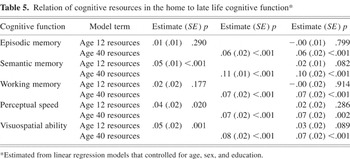
Relation of cognitive resources in the home to late life cognitive function*
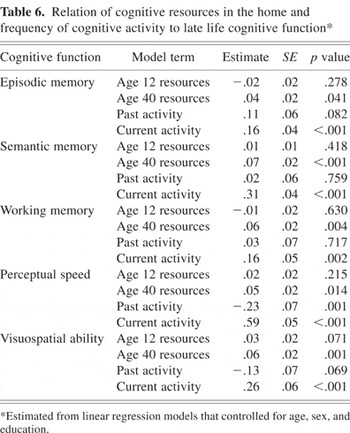
Relation of cognitive resources in the home and frequency of cognitive activity to late life cognitive function*
 You have
Access
- 235
- Cited by