




No CrossRef data available.
Article contents
Coparenting, family-level processes, and peer outcomes: The moderating role of vagal tone
Published online by Cambridge University Press: 01 September 2004
Abstract
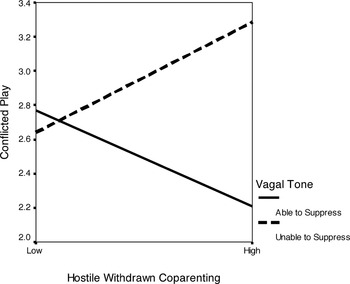
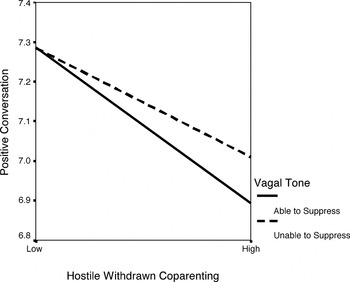
This article examines the relationship between coparenting and family-level processes during preschool and peer relationship outcomes in middle childhood, and the hypothesis that children's ability to regulate emotion (as indexed by basal vagal tone and the ability to suppress vagal tone) may moderate this relationship. We predicted that high vagal tone and a greater ability to suppress vagal tone would buffer children from the effects of negative coparenting and family processes. Results indicated that hostile–withdrawn coparenting predicted higher levels of conflicted play and lower levels of positive peer conversation. Vagal suppression also moderated the relationship between hostile–withdrawn coparenting and peer conflict. For children who were unable to suppress vagal tone, hostile–withdrawn coparenting was associated with higher levels of peer conflict, while for children who were able to suppress vagal tone there was no relationship hostile–withdrawn coparenting and peer conflict. The relationship between hostile–withdrawn coparenting and positive peer conversation was also moderated by children's ability to suppress vagal tone. For children who were unable to suppress vagal tone, there was no relationship between hostile–withdrawn coparenting and positive peer conversation, while for those who were able to suppress vagal tone, hostile–withdrawn coparenting was associated with less positive peer conversation. Cohesive family-level processes also predicted positive conversation in play at age 9 after controlling for positive conversation at age 5; however, this relationship was not moderated by vagal suppression. Basal vagal tone also did not function as a moderator of relations between hostile–withdrawn coparenting and peer play. Results are discussed in terms of the effects of negative coparenting on children with different patterns of modulating physiological arousal.This research was supported by a research grant from the National Institute of Mental Health to the second author (1 R01 49141). The authors thank the families involved for their participation.
Information
- Type
- Research Article
- Information
- Copyright
- © 2004 Cambridge University Press
Family theorists that take a systems approach have argued that the family is a context in which children learn many of the interpersonal skills they take with them into the world. As Minuchin (1985) stated: “It seems clear that the individual carries templates of the patterns of which he or she has been a part, and that these provide the repertoire for input into new systems.” Outside of the family, one of the first important interpersonal tasks that children face is to create and maintain relationships with their peers. Getting along well with other children is important for normative development, and research indicates that deficits in peer relationships are associated with several negative outcomes including school dropout, criminality, and adult psychopathology (Parker & Asher, 1987).
The quality of family relations has been identified as salient for children's overall adjustment including their peer relationships. For example, marital distress has been associated with internalizing and externalizing symptoms as well as anger and noncompliance in the best friend relationship (Gottman & Katz, 1989; Katz & Gottman, 1993). Marital conflict also has long-lasting effects on children's peer relations. How parents resolve conflict not only predicts concurrent level of peer adjustment, but also predicts whether children will continue to get along or have trouble with their peers as they develop (Gottman & Katz, 1989; Gottman, Katz, & Hooven, 1997). Positive coparenting and family-level processes have also been associated with children's social competence (McHale, Johnson, & Sinclair, 1999; McHale & Rasmussen, 1998); however, little is known about whether coparenting and family-level processes continue to influence how children get along with their peers as they develop. One of the aims of this article is to prospectively study the relationship between coparenting and family-level processes and children's interactions with peers over time.
This aim is particularly important when one considers the substantial links between problems in peer relationships and developmental psychopathology (for review, see Deater–Deckard, 2001). If the expectations, skills, and strategies that a child learns from participating in a noncohesive, conflictual family system are consistently applied to the peer system, over time these two socializing forces may act together to compound a child's risk for significant adjustment problems. For example, a child who learns from his or her family that relationships include a substantial amount of hostility and aggression may act in an aggressive manner with others their age. As the child matures, he or she may experience (a) peer rejection, which would reinforce negative views of interpersonal relationships, and (b) association with deviant others who share their relational approach. The child's aggressive or antisocial acts may be reinforced by their peers, which would, in turn, increase the likelihood of child externalizing problems (Dishion, McCord, & Poulin, 1999). In these ways, the quality of children's peer relationships may be associated with both concurrent and future adjustment, and understanding the links between family and peers systems will likely enrich our understanding of child psychopathology.
A second aim of this study is to investigate whether children's ability to regulate emotion buffers the relationship between negative family processes and peer relationships. The ability to modulate physiological arousal, one index of emotion regulation, has been found to buffer children from the negative effects of marital conflict (e.g., Katz & Gottman, 1995; El-Sheikh, Harger, & Whitson, 2001). We sought to extend these findings by examining whether children's ability to modulate their physiological arousal also buffers them from associations between poor coparenting and family-level processes and children's peer relations.
Coparenting, family-level processes, and children's adjustment
In the family system, the heads of the family are often expected to simultaneously function in both spousal and parenting roles. Coparenting is defined as the way members of a couple work together and support each other as parents. This relationship may be positive, characterized by cooperation and warmth, but it can also include hostility, competition, and detachment. Research indicates that the nature of the coparenting relationship is associated with child outcomes. For example, McConnell and Kerig (2002) reported that hostility and competitiveness in the coparenting relationship was related to internalizing and externalizing problems for boys, and that discrepancies in parenting were related to internalizing symptoms in girls. McHale and Rasmussen (1998) found that discrepancies in parenting behaviors and hostile–competitive coparenting when children were 8–11 months old predicted aggression 3 years later.
In addition to recognizing the importance of the dyadic parenting relationship, family systems theorists assert that it is important to look at families as whole entities. Because family members are part of a dynamic system, they constantly exert reciprocal effects on one another. Therefore, interaction at the family level is more than the sum of dyadic relationships (Kreppner & Lerner, 1989; Minuchin, 1974, 1985: Sameroff, 1994). Although some families display warmth, cohesiveness, and playfulness, others may be conflictual or characterized by strategic alliances within the family. As with coparenting, family-level processes have been shown to relate to child adjustment. Adams, Ryan, Ketsetzis, and Keating (2000), for example, found that cohesion in the family was related to children's high self-esteem. Similarly, low levels of family harmony in infancy have been linked to teacher ratings of children's hostility and aggression in preschool (McHale & Rasmussen, 1998).
Coparenting and family-level variables have also been linked to the quality of children's peer relationships. McHale, Johnson, and Sinclair (1999) found that children from families characterized by positive affect were more likely to display positive behavior with peers. Indirect relationships (mediated by children's representations of the family) were found between low levels of support and mutuality in the coparenting relationship and problematic peer relationships.
Several mechanisms have been suggested to explain these links between the quality of the coparenting relationship or family-level variables and children's peer relationships. It may be that children's behavior with peers is guided by what they learn observing their parents interact together as marital partners and as coparents. McHale et al. (1999) hypothesized that children develop schemas about how relationships work by observing their parents' coparenting relationship and experiencing the affective climates of their homes. They found mixed support for this hypothesis, because children's representation of the family mediated relations between low levels of coparenting support and mutuality and problematic peer relationships, but did not mediate relations between positive coparenting and positive peer behavior. Alternatively, it has also been suggested that children who observe negative coparenting and experience conflict or disengagement at the family level may miss out on the modeling of positive conflict resolution techniques that they can, in turn, apply with their peers (Katz & Woodin, 2002). Finally, it has been suggested that family-level processes come to affect the children indirectly, in that parents who function in supportive family environments are better able to engage in positive parenting practices (Erel & Burman, 1995). Although the mechanisms of linkage have not fully been elucidated, the relationship between family variables and peer outcomes has been consistently supported.
The present study extends previous research in this area in a number of ways. First, we sought to extend the particular dimensions of coparenting and family-level processes that have been linked to child adjustment. Although research has suggested that hostility and competitiveness in the coparenting relationship is associated with negative outcomes for children, few studies have investigated detachment within the coparenting relationship. Several studies have suggested that detachment within the marital relationship is related to poor marital satisfaction, increased likelihood of divorce, and poor child adjustment. For example, Katz and Woodin (2002) found that couples whose marriages were characterized as “hostile-detached” were more likely than other couples to have children that exhibited behavior problems. Detachment in the coparenting relationship has been examined in one prior study, which found that a pattern of hostility and withdrawal in coparenting relationships was related to withdrawal and internalizing problems in children (Katz & Low, in press). In the present study, we investigated whether detachment and hostility in the coparenting relationship is associated with difficulties in children's play. If children do indeed generalize patterns from the coparenting relationship, children who are exposed to negative coparenting processes may learn a tendency to disengage from their friends in the face of interpersonal problems or conflict. Children who consistently disengage when “the going gets tough” may not experience as much intimacy with their friends as other children who either problem solve with their friends or fight it out and come to a resolution.
In addition, up to this point very few studies have investigated the impact of coparenting and family-level processes on peer relationships over time. One important exception is a study by McHale and Rasmussen (1998) that linked coparenting and family-level processes in infancy with peer outcomes in preschool. Associations between early family relationships and peer functioning in middle childhood have not been previously examined, and it is important to understand whether the family system continues to be associated with peer relationships as children grow older and begin to spend less time with their family and more time interacting with peers. It may be, for example, that as children develop the impact of the family system on their peer relationship weakens. However, it may also be that spending one's early years within the context of a negative or hostile family system sets them on a trajectory for negative interpersonal relationships.
Moderating influence of children's ability to regulate emotion
A second objective of this research was to test whether children's ability to regulate emotion buffers them from the effects of family conflict (El-Sheikh et al., 2001; Katz & Gottman, 1995, 1997). Family-level and coparenting processes have been shown to impact children's emotion regulation and coping abilities when performing a frustrating task. McHale, Kuersten, and Lauretti (1996) found that children from families high in coparenting warmth and cooperation demonstrated more positive affect and less negative affect while performing a frustrating task than children from families low in coparenting warmth and cooperation. Children with parents high in verbal sparring also expressed more frustration during task performance relative to children whose parents were low in verbal sparring.
There is widespread agreement among emotion theorists that the expression and regulation of emotion involves not only behavioral but also physiological systems (e.g., Calkins, 1994; Davidson, 1993; Fox, 1994; LeDoux, 2000; Thompson, 1994). At the physiological level, cardiac vagal tone has received considerable attention as a psychophysiological marker of emotion regulation (Calkins & Dedmon, 2000; Porges, Doussard–Roosevelt, & Maiti, 1994; Porges, Doussard–Roosevelt, Portales, & Suess, 1994). Vagal tone is an index of parasympathetic nervous system influences on heart rate variability that occurs through the vagus nerve. Efferent fibers of the vagus nerve terminate on the sinoatrial node of the heart, and have an inhibitory effect in slowing heart rate by decreasing sinoatrial node firing. Porges (1995) has suggested that the tonus of the vagus nerve provides a theoretical basis for the child's ability to focus attentional processes, inhibit irrelevant activity, regulate emotion, and appropriately engage with the environment.
Evidence suggests that children's vagal tone may buffer them from the negative effects of family conflict (e.g., El-Sheikh et al., 2001; Katz & Gottman, 1995). Specifically, Katz and Gottman (1995) found that children with low resting vagal tone showed a strong link between the amount of marital hostility displayed by their parents and subsequent displays of externalizing behavior. However, for children with higher vagal tone, the relationship between marital hostility and negative outcomes was not observed.
Changes in vagal tone in response to environmental demand also has been linked to emotion regulation, attentional focus, and mood state (Beauchaine, 2001). In particular, a reduction in vagal tone in response to environmental challenge (vagal suppression) appears to be an index of skilled self-regulation, and may provide a useful index of children's self-regulatory abilities under stress (Porges, 1995; Porges, Doussard–Roosevelt, & Maiti, 1994; Porges, Doussard–Roosevelt, Portales, & Suess, 1994). Greater ability to suppress vagal tone has been shown to buffer children from negative outcomes in physical health and academic achievement associated with marital conflict (Katz & Gottman, 1997).
In the current study we examined both baseline vagal tone and vagal suppression in reaction to stressful interpersonal situations. We predicted that high resting vagal tone and the ability to suppress vagal tone when under stress would buffer children from the relationship between negative coparenting or family processes and peer interactions. In other words, we hypothesized that children who are better able to regulate their physiological arousal will be protected from negative peer interactions, even in face of negative family processes.
Method
Participants
Participants were recruited as part of a large-scale longitudinal study of family factors related to behavior problems in preschool-age children. One hundred thirty families were recruited for participation through preschools, newspaper announcements, and the offices of pediatric doctors and dentists. Children were on average 60.5 months old (range = 49–71) at Time-1 assessment.
Families were recontacted 4 years later when children were on average 9.6 years old. Of the original data set, 9% (n = 12) did not qualify to continue their participation due to age factors relevant to the original study design. Of the remaining families, 70% took part in the follow-up study (N = 83). Seventy-three families participated in procedures relevant to the current study (48 males, 25 females). Using data from Time 1, t tests were conducted to determine whether families that were dropped or chose not to participate in Time 2 were different from those who participated in both time points on measures of coparenting/family-level processes, vagal tone, vagal suppression, and play variables. Significant differences emerged between groups on measures of disconnected play and the suppression of vagal tone. Children who participated in Time 1 only were more likely to engage in disconnected play and were less able to suppress vagal tone than those who participate in both time points. At Time 2, average age of participants was 9 years, 6 months (range = 9 years, 0 months, to 10 years 11 months). The majority of the sample (88.0%) identified themselves as Caucasian, 8.0% were biracial or multiracial, and 2.7% were African American. A small portion (1.3%) of the sample did not provide ethnicity information.
Time 1
Procedures
Family interaction
Family interaction was assessed using a variant of the forbidden toy paradigm (Parke, 1977, Sears, Maccoby, & Levin, 1957). The family was seated in a room that contained two shelves of toys: one shelf of attractive, age-appropriate toys and one shelf of unattractive, age-inappropriate toys. Parents were informed that the attractive toys belonged to another research group, and were requested to keep their child from playing with those toys. Interactions lasted 10 min, and were videotaped for subsequent coding.
Peer interaction
To assess peer functioning, each child was audiotaped while playing with a same age, same sex peer that the mother had identified as the child's best friend. Best friends were chosen because best friend interaction is an index of a child's maximal social competence (Gottman & Parker, 1986). The play session was 45 min long and took place in the participant child's home.
Assessment of physiological functioning (overview)
To obtain relatively artifact-free physiological data from preschool-aged children, we used an astronaut fantasy theme in which children were dressed in a space suit and seated in a mock-up space capsule during assessments of physiological functioning (Katz & Gottman, 1993, 1995). All procedures were administered in the space capsule, beginning with the baseline assessment.
Baseline condition
Two assessments of baseline physiological functioning were made. During one assessment, children listened to a neutral story about a boy named Charlie. During the second assessment, children viewed two scenes of children playing together.
Interpersonal stress
Dodge and Somberg's interpersonal threat procedure was used as the interpersonal stressor (Dodge & Somberg, 1987). Children viewed nine standardized videorecorded vignettes depicting paid actors involved in a play activity. Prior to the presentation of the vignettes, each child was exposed to a threat manipulation. The threat manipulation involved the child expecting to interact with a peer with whom he might get into a conflict. However, instead of meeting an unfamiliar peer, the target child heard a prerecorded audiotape consisting of a staged “conversation” between the experimenter and “another child” in which the child stated his dislike for the experimenter and for any child with whom he would have to work. After the “conversation,” the experimenter explained that the other child “was in a bad mood,” and would not be coming in to play. This audiotaped segment lasted for 67 s. The children then watched the set of nine vignettes.
Measures
Family-level and coparenting processes
The Family-Level and Coparenting Interaction Coding System (FICS; Katz, Low, Young, & Kahm, 1997) was used to assess coparenting and family-level interaction. The FICS is a molar coding system that contains five scales that assess coparenting behaviors and five that assess family-level processes. For the purpose of this article we created two coparenting summary variables and two family-level summary variables. Hostile–withdrawn coparenting consisted of the coparenting codes disengagement/withdrawal, negativity, and rejection. Couples who engaged in high levels of hostile–withdrawn coparenting exhibited negativity toward each other in the form of tension, anger, irritation, or frustration. They also tended to be physically withdrawn (i.e., likely to turn or move away from each other), minimally communicative, and appeared emotionally detached. Positive coparenting was a summary code consisting of the codes positivity and cooperation. Couples that were high in positive coparenting were seen as engaged and validating of each other. They supported each other's parenting efforts and behaved in a warm and affectionate manner towards each other. Divided family was the sum of codes related to conflict and alliance formation at the family level. Families high in this code exhibited high levels of negative affect including anger, frustration, and contempt, but were also more likely to appear disengaged from one another. Positive family consisted of the codes adaptability, cohesiveness, and playfulness. Families high in this code exhibited a sense of unity, togetherness, and mutual appreciation. They engaged in playful interactions that were marked by fun and positive affect, and were easily able to adapt to environmental demands. All codes were rated on a 5-point Likert-type scale with the exception of alliance formation, which was a categorical code. Interrater reliabilities were calculated using intraclass correlations, and were moderate to high: positive coparenting (.70), hostile withdrawn coparenting (.76), cohesive family level (.85), divided family level (.64).
Child's vagal tone
Vagal tone was computed as the amount of variance in the interbeat interval (related to the heart rate: heart rate = 60,000/interbeat interval) spectrum that was within the child's respiratory sinus frequency band using spectral time-series analysis. The exact width and anchors of the frequency band associated with respiratory sinus arrhythmia depends on the respiration rate. Children in this age group breathe at a rate of 20–25 times per minute (Vaughan & McKay, 1975), which corresponds to the frequency band of 0.33–0.42 Hz. The sum of the power densities in the IBI spectrum within the 0.33–0.42 Hz band over the total amount of power across all frequency bands was used as the measure of vagal tone. For our computations, we used the program SPEC from the Gottman–Williams computer program time-series package to conduct spectral analyses (Gottman, 1981).
To obtain a more stable estimate of baseline vagal tone, vagal tone was averaged across two baseline conditions, while the child listened to a neutral story about Charlie, and while they watched two scenes of children playing. Children's physiological reactivity to the peer provocation was assessed while the child was listening to the audiotape of the staged “conversation” between the experimenter and the “other child” and during a recovery period of 25 s. Following recommendations by Willett (2000) and Rogosa (1995) regarding the merits of using difference scores, the ability to suppress vagal tone during peer provocation was estimated as a difference between baseline vagal tone and the child's vagal activity during the peer provocation. Suppression of vagal tone was characterized by a decrease in vagal activity between baseline and stressor conditions.
Peer interaction
Dyadic peer interaction was coded using the Rapid MACRO (R-MACRO) peer interaction coding system (Gottman, 1983). The R-MACRO consists of 43 (21 positive, 22 negative) specific behaviors that index children's ability to coordinate play with a close friend. They include (a) conversational skills (4 positive, 4 negative codes), (b) the level at which they play (e.g., parallel vs. fantasy play), (c) conversational repair and maintenance (3 positive, 4 negative codes), and (d) affective quality of the interaction (10 positive, 10 negative codes). All behaviors that occurred within a 3-min period were coded, and totals for individual codes were calculated by summing the frequency of each code's occurrence across all 3-min periods. For the purpose of this article, three summary codes were created to conceptually parallel the particular patterns of family interaction assessed at the coparenting and family level (positivity, conflict or hostility, and disengagement). A positive conversation summary variable was created by summing the following codes: information success, gossip success, self-disclosure success, and joy. Children who were high in positive conversation were willing and able to share information about themselves and others within the context of a joyful positive interaction. The conflict summary variable consisted of negative teasing, negative parallel play, and negative statement about the friend. Children high in this code tended to be critical of their friends and engaged in mean spirited teasing. They were also unable to sustain side by side play without dissolving into conflict. Disconnected play consisted of monologue, parental direction of play, and out of room behavior. Children who displayed high levels of disconnected play had trouble engaging with their play partner to such a degree that they often left the play room or needed their parents to intervene so that play could continue. When these children did engage in conversation with their play partners, they tended to talk “at” rather than “with” their friend. Reliability was calculated using intraclass correlations and it was moderate to high: positive conversation (.66), conflicted play (.78), and disconnected play (.86).
Time 2
Procedures
At Time 2, children were again audiotaped while playing with a same age, same sex friend that was identified by consensus of mother and child as the child's best friend. Interactions lasted 45 min and took place in the participant child's home.
Measures
Peer interaction
The dyadic peer interaction at Time 2 was coded using the R-MACRO coding system. Coders who rated Time-2 peer interaction data were independent from those who coded Time-1 peer data. As with Time-1 data, the summary variables used to code peer interaction included positive conversation, conflicted play, and disconnected play. Intraclass correlations were high: positive conversation (.76), conflicted play (.89), disconnected play (.92).
Results
Descriptives and zero-order associations among variables
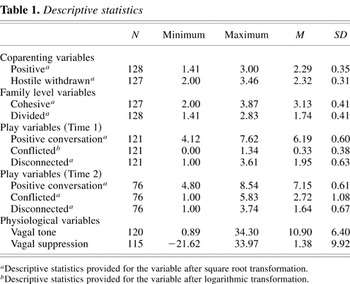
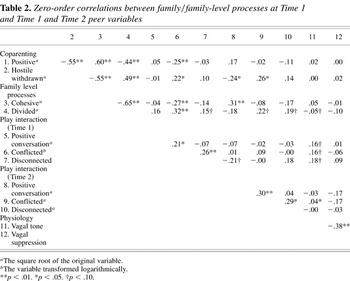
Preliminary analyses of descriptive statistics indicated that the distributions of some variables exhibited significant skewness and kurtosis. To reduce skewness and kurtosis, all variables were subjected to a square root transformation. Because conflicted play at age 5 remained significantly skewed, the logarithmic transformation of that variable is used in these analyses. Ns and descriptive statistics for all variables are presented in Table 1. Correlations among the primary variables are presented in Table 2. Correlations among coparenting and family-level variables indicated that positive coparenting was positively correlated with cohesive family-level processes. Positive coparenting and cohesive family-level processes were also negatively correlated with hostile withdrawn coparenting and divided family. No relationship emerged between hostile withdrawn coparenting and divided family-level processes. Surprisingly, correlations among Time-2 play variables showed that positive conversation was positively related to conflicted play. Conflicted play and disconnected play were also significantly correlated. No significant relationships were found between the potential moderators (basal vagal tone and vagal suppression) and any of the family or play variables.
Descriptive statistics

Zero-order correlations between family/family-level processes at Time 1 and Time 1 and Time 2 peer variables

Correlations between family and peer variables indicated that cohesive family-level interaction was related to positive peer conversation. hostile–withdrawn coparenting was also positively related to conflicted play and negatively related to positive conversation.
Longitudinal prediction of peer interaction
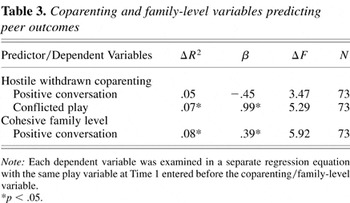
To understand the effect of coparenting/family-level processes over time, a series of multiple regressions were conducted to assess the relationship between family processes and Time-2 peer play while controlling for Time-1 peer play. Regressions were only conducted for those instances in which family variables were significantly related to peer play variables at Time 2. Three regressions were performed to examine (a) the relationship between cohesive family and positive conversation at Time 2 controlling for Time-1 positive conversation, (b) the relationship between hostile–withdrawn coparenting and positive conversation at Time 2 controlling for Time-1 positive conversation, and (c) the relationship between hostile–withdrawn coparenting and Time 2 conflicted play controlling for Time-1 conflicted play.
As can be seen in Table 3, results indicated that cohesive family-level continued to predict positive conversation at Time 2 after controlling for positive conversation at Time 1. Similarly, hostile–withdrawn coparenting continued to predict conflicted play at Time 2 after controlling for conflicted play at Time 1. The relationship between hostile–withdrawn coparenting and positive conversation at Time 2 approached significance after controlling for positive conversation in play at Time 1.
Coparenting and family-level variables predicting peer outcomes

The moderating role of vagal tone
Statistical tests for moderation effects were conducted using a series of hierarchical multiple regressions. Each of the family variables that were found to have a significant relationship with peer interaction outcomes was examined independently. Baseline vagal tone and the ability to suppress vagal tone were examined separately as potential moderators of the relations between family processes and peer play.
The first step of each regression equation consisted of entering the peer interaction variable at Time 1 that paralleled the variable under investigation at Time 2. For example, in regressions examining conflicted play at Time 2, conflicted play at Time 1 was entered as the first step of the regression. The main effects of the family process and moderator variable (i.e., vagal tone) were entered in the second and third steps of the regression. Finally, an interaction term representing the interaction between the family process variable and vagal tone was entered as the fourth step. Separate analyses were conducted to test whether baseline vagal tone and vagal suppression each functioned as potential moderators. In all, six regression equations were performed. Moderation was established when the interaction term was found to be significant and when the inclusion of the interaction term produced a significant R2 change. Because of the potential influence on the analyses, outliers were assessed for each regression analysis and deleted casewise.
Baseline vagal tone
There were no significant interactions between hostile–withdrawn coparenting and basal vagal tone in predicting either positive conversation or conflicted play. Cohesive family was also not found to interact significantly with basal vagal tone in predicting positive conversation.
Ability to suppress vagal tone
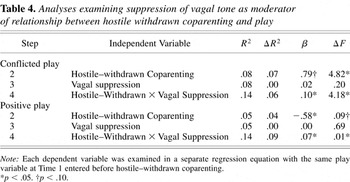
The ability to suppress vagal tone moderated the relationship between family variables and children's peer play. When predicting conflicted peer play, a significant interaction was found between hostile withdrawn coparenting and vagal suppression (ΔF = 4.18, p < .01, see Table 4). Consistent with recommendations by Aiken and West (1991) the simple regression lines for the significant interaction were plotted for high and low values of the moderator (+1 SD and −1 SD on vagal suppression). The slopes of the regression lines were then tested to determine if they differed significantly from zero. Plot and slope analyses revealed that for children who were unable to suppress vagal tone, there was a significant positive relationship between hostile–withdrawn coparenting and peer conflict at Time 2 (see Figure 1). The slope of this line was positive and was significantly different from zero. For children who were able to suppress vagal tone, there was no relationship between hostile–withdrawn coparenting and conflicted play. For these children, the slopes of the relations between hostile–withdrawn coparenting and conflicted play were not significantly different from zero.
Analyses examining suppression of vagal tone as moderator of relationship between hostile withdrawn coparenting and play


The interaction between hostile–withdrawn coparenting and vagal suppression predicting conflicted play.
A significant interaction between hostile–withdrawn coparenting and vagal suppression was also found to predict positive peer conversation (ΔF = .01, p < .05). Investigation of plots and slopes revealed that for children who were able to suppress vagal tone in response to stress, there was a negative relationship between hostile–withdrawn coparenting and positive conversation. The slope of this line was negative and was significantly different from zero. For children who were unable to suppress vagal tone, there was no relationship between hostile–withdrawn coparenting and positive conversation (see Figure 2). Cohesive family did not interact significantly with vagal suppression in predicting positive conversation.

The interaction between hostile–withdrawn coparenting and vagal suppression predicting positive conversation.
Discussion
A growing body of evidence suggests that coparenting and family-level processes are related to children's adjustment and behavior in peer relationships (McConnell & Kerig, 2002; McHale & Rasmussen, 1998; McHale et al., 1999). This study extends previous research by longitudinally examining the relationship between family processes and peer relationship outcomes as well as by investigating the moderating role of vagal tone. As children grow older, they tend to spend less time in the family home and more time engaged with peers. However, to the extent that children experienced hostile–withdrawn coparenting during the preschool period, these family processes continued to predict conflictual peer relations as children reached middle childhood. This supports the idea that parental models of how to interact in close interpersonal relationships remain salient across this developmental period.
To more fully understand the relationship between characteristics of the family and children's peer relationships, it is important to determine whether living in conflictual families is associated with particular types of peer behavior. Our results indicated that when parents were hostile and withdrawn in their coparenting, children were more likely to experience conflict with their friends. The type of conflict that we examined was especially mean spirited in nature and included behaviors like name calling and negative teasing. It seems that children exposed to hostile withdrawn coparenting are not only likely to get into conflicts with their friends, but within the conflict they are likely to engage in behaviors that may damage the relationship. This disparagement of the relationship partner may resemble the contempt displayed between partners in a hostile–withdrawn coparenting relationship.
Hostile–withdrawn coparenting in preschool was not only related to negative peer play, but also related to positive qualities of peer play. If parents exhibited hostility and withdrawal in their coparenting relationship when children were preschoolers, children were less likely to engage in fun and connected communication with peers in middle childhood. Thus, it appears that children whose parents are hostile and withdrawn are not only likely to experience conflictual interactions with their friends, but their interactions also lack the sharing and joy that characterize peer relations in other children. It may be that these children have not been exposed to models of interpersonal fun and intimacy in relationships because their parent's relationship is characterized by hostility and disengagement. Children whose parents display such interaction patterns might not hold expectations that peer relationships will contain a great deal of positivity. Additionally, they may have missed out on important opportunities to observe and learn skills that promote and maintain positivity between friends. Unfortunately, up to this point most research in this area has focused on such negative child outcomes such as anxiety, aggression, and interpersonal negativity (e.g. Schoppe, Mangelsdorf, & Frosch, 2001; McHale & Rasmussen, 1998, McHale et al., 1999; McConnell & Kerig, 2002), and we know little about the family's contribution to children's ability to engage positively with others.
There also appeared to be child-specific qualities that played a role in how children's peer relations were related to coparenting and family-level processes. Children's ability to suppress vagal tone when under stress was found to moderate the relationship between hostile–withdrawn coparenting and peer conflict. Children who were unable to suppress vagal tone when faced with an interpersonal stressor were more likely to engage in conflicted play if their parents displayed high levels of hostile withdrawn coparenting. However, for children who were able to suppress vagal tone, no such relationship was observed. It appears that children who are better able to suppress vagal tone are buffered from conflicted peer play even when their families demonstrate negative interaction patterns. It has been suggested that the ability to suppress vagal tone functions as an index of children's emotional regulation abilities (Porges, 1995). Therefore, it may be that children who are more emotionally regulated are less likely to engage in conflicted play even when their parents display hostility and withdrawal. These findings are consistent with studies of child temperament that have found that positive emotionality can serve as a buffer in the relationship between parental rejection and child adjustment problems (Lengua, Wolchik, Sandler, & West, 2000). The ability to regulate emotion may be an important individual child characteristic that plays a role in the way that family functioning is related to child outcomes.
Vagal suppression was also found to moderate the relationship between hostile–withdrawn coparenting and positive conversation. Children who were able to suppress vagal tone were less warm and connected in the face of hostile–withdrawn coparenting, while for children who were unable to suppress vagal tone, hostile–withdrawn coparenting was not associated with reduced positive conversation. Children who are physiologically well regulated may be more at risk than their poorly regulated peers for displaying reduced positivity with their friend when parents are hostile and disengaged. One possible explanation for this finding may be that children who are emotionally regulated are unlikely to act out, yet may still lack role models for how to engage in appropriate, warm interpersonal conversation. It appears that, even for well-regulated children, hostile–withdrawn coparenting is still associated with negative outcomes. However, for well-regulated children, this type of coparenting relates to diminished positive interaction rather than heightened negative interaction. It was somewhat surprising that the relationship between hostile–withdrawn coparenting and positive conversation was less robust for children who were unable to suppress vagal tone, although the pattern of results was in the expected direction. Replication of these findings with a larger sample of children who have difficulties regulating vagal tone is needed to more clearly determine whether these effects hold or whether they are influenced by sample characteristics.
An encouraging finding from the current study was that children from highly cohesive families were more likely to engage with their friends in a way that included joy and connectedness in their conversations. These results are consistent with those obtained in a younger sample by McHale and colleagues (1999). In our study, the relationship between cohesion and joyful, connected peer interactions was not moderated by vagal tone, which suggests that regardless of physiological regulation abilities, children who experience cohesion at the family level are able to generalize this positive and connected interpersonal pattern to their interactions with peers.
One advantage of the current study is that we were able to observationally examine both family processes and peer interactions. As a result, we obtained specific information about how children's peer relationships are related to family dynamics. With this increased level of specificity, we found that hostile–withdrawn coparenting was related to certain aspects of peer play but not others. Children who were exposed to high levels of hostile–withdrawn coparenting were not more disconnected from peers, but displayed more peer conflict. Thus, when parents show a pattern of both hostility and withdrawal, children do not seem to model the emotional withdrawal they observe but only the interpersonal conflict. Perhaps withdrawal is a more subtle interpersonal process that children in the preschool to middle childhood age range are less able to detect and emulate. One possibility is that withdrawal may emerge as a more salient way of managing interpersonal relations as children approach adolescence and experience an increase in their inhibitory control abilities (Williams, Ponesse, Schachar, Logan, & Tannock, 1999). It may be that, due to the development of these abilities, children in adolescence are better able to disengage from interaction by withdrawing. Continued longitudinal research into the adolescent period can help address this possibility.
A limitation of the current study is that we did not include a measure of coparenting and family-level processes when children were 9 years old (i.e., Time 2). Therefore, we do not know the extent to which children in middle childhood generalize their current family relationship patterns to the peer context. Future research may examine change in family process variables over time and whether early or later coparenting and family-level processes are most predictive of children's peer relationships in middle childhood. Additionally, it will be important to examine the dynamic interplay between child and family characteristics as it relates to the coparenting relationship. It may be that children who are physiologically dysregulated are more temperamentally difficult, and may behave negatively not only with their friends, but also with family members. Having a difficult child may bring the coparenting dyad closer by necessitating more conversation and joint action, but it may also cause conflict. Future research may examine how the coparenting relationship changes over time when children are more physiologically dysregulated.
In measuring adjustment, researchers have found that negative coparenting and family-level processes affect boys and girls differently (McHale et al., 1999). It may also be true that boys and girls respond differently with their peers when parents engage in destructive family interaction patterns. Our sample was predominantly male and the type of negative peer interactions that we assessed were overtly negative and included behaviors such as name calling and teasing. It may be that girls display different, more covertly negative peer behaviors when parents are hostile and withdrawn (Crick, Bigbee & Howes, 1996; Crick & Grotpeter, 1995). For example, a girl might spread rumors about other girl in her class or may intentionally try to exclude one individual from a social group. Although these types of behaviors could not be assessed in the observational measure of peer relations used in this study, they are nonetheless interpersonally negative, and have the potential to severely damage the child's social relationships.
In summary, our findings expand the current understanding of the associations between family-level processes and children's peer relations. Our results indicated that it is the interaction between child characteristics and characteristics of the family that were important in predicting the children's behavior with their peers. Negativity and withdrawal in the coparenting relationship was related both to children's experience of conflict and a lack of positive engagement in their peer relationships. However, individual differences in children's ability to modulate physiological arousal predicted which aspects of peer relations were likely to be related to this type of coparenting behavior. In the face of hostile and withdrawn coparenting, those children who were unable to suppress vagal tone appeared to experience more conflict in their friendships, while those who more physiologically regulated seemed to experience less joy and connectedness.
Extrapolating from these results, we may speculate about the way children with different patterns of physiological regulation function within the family system. If children's interpersonal exchanges with peers parallel their relationships with family members, those who are unable to suppress vagal tone are likely to engage in frequent and escalating conflicts with parents and siblings. Hostile or negative interpersonal behavior, which is maladaptive in other circumstances, may serve an important function within their family systems. One such function may be to attract negative attention away from the coparenting relationship. Because they are emotionally dysregulated, they may act out more than other children and become the scapegoat or “identified patients” of their families (Christensen, Phillips, Glasgow, & Johnson, 1983). It may be that children who are less physiologically regulated are not only at risk for experiencing negative peer outcomes but are also at risk for serving as a key contributor in maintaining a dysfunctional family system.
Within the context of their families, children who are physiologically and emotionally well regulated may not be very likely to act out. On the contrary, they may be children who stay “under the radar” and parents may not know when they are distressed. However, our data suggest that negative coparenting also has a cost for these children. Although they may not act out in ways that draw negative attention to themselves, their distress is more subtly expressed through lower levels of joyful and connected interaction with peers. Unfortunately, these children are likely to seem like they are functioning well, and parents may not recognize that they are experiencing less positivity or fun in their peer relationships. An inadvertent consequence may be that parents of well-regulated children may be unlikely to intervene and directly teach their children the interpersonal skills necessary to obtain more enjoyment out of their peer interactions.
These results may have interesting implications for the development of clinical interventions. Effective intervention with children who are having problems with their peers may include an assessment of the coparenting relationship. Children whose parents are hostile or detached from each other may need to be provided with more explicit interpersonal social skills training to maintain positive, engaged interactions with their peers. Additionally, it may be that those children who are able to suppress vagal tone may benefit most from interventions that are targeted at the development of intimacy and fun in their friendships, while those who are less physiologically well regulated would benefit from interventions aimed at decreasing negativity and conflict. By examining how family processes interact with individual child characteristics, more effective interventions can be developed to meet the specific needs of individual children.
References
REFERENCES
Adams, G. R.,
Ryan, B. A.,
Ketsetzis, M., &
Keating, L.
(2000).
Rule compliance and peer sociability: A study of family process,
school focused parent–child interactions, and children's
classroom behavior.
Journal of Family Psychology
14,
237–250.Google Scholar
Aiken, L. S., &
West, S. G.
(1991).
Multiple regression: Testing and interpreting interactions.
Newberry Park, CA:
Sage.
Beauchaine, T. P.
(2001).
Vagal tone, development, and Gray's motivational theory:
Toward an integrated model of autonomic nervous system functioning in
psychopathology.
Development and Psychopathology
13,
183–214.Google Scholar
Calkins, S. D.
(1994).
Individual differences in the biological aspects of temperament.
In
J. E. Bates &
T. D. Wachs (Eds.),
Temperament: Individual differences at the interface of biology and
behavior (pp.
199–217).
Washington, DC:
American Psychological Association.
Calkins, S. D., &
Dedmon, S. E.
(2000).
Physiological and behavioral regulation in two-year-old children
with aggressive/destructive behavior problems.
Journal of Abnormal Child Psychology
28,
103–118.Google Scholar
Christensen, A.,
Phillips, S.,
Glasgow, R. E., &
Johnson, S. M.
(1983).
Parental characteristics and interactional dysfunction in families
with child behavior problems: A preliminary investigation.
Journal of Abnormal Child Psychology
11,
153–166.Google Scholar
Crick, N. R.,
Bigbee, M. A., &
Howes, C.
(1996).
Gender differences in children's normative beliefs about
aggression: How do I hurt thee? Let me count the ways.
Child Development
67,
1003–1014.Google Scholar
Crick, N. R., &
Grotpeter, J. K.
(1995).
Relational aggression, gender and social–psychological
adjustment.
Child Development
66,
710–722.Google Scholar
Davidson, R. J.
(1993).
The neuropsychology of emotion and affective style. In
M. Lewis &
J. M. Haviland (Eds.),
Handbook of emotions (pp.
143–154).
New York:
Guilford Press.
Deater–Deckard, K.
(2001).
Annotation: Recent research examining the role of peer
relationships in the development of psychopathology.
Journal of Child Psychology and Psychiatry
42,
565–579.Google Scholar
Dishion, T. J.,
McCord, J., &
Poulin, F.
(1999).
When interventions harm: Peer groups and problem behavior.
American Psychologist
54,
755–764.Google Scholar
Dodge, K. A., &
Somberg, D. R.
(1987).
Hostile attributional biases among aggressive boys are exacerbated
under conditions of threats to the self.
Child Development
58,
213–224.Google Scholar
El-Sheikh, M.,
Harger, J., &
Whitson, S. M.
(2001).
Exposure to interparental conflict and children's adjustment
and physical health: The moderating role of vagal tone.
Child Development
72,
1617–1636.Google Scholar
Erel, O., &
Burman, B.
(1995).
Interrelatedness of marital relations and parent–child
relations: A meta-analytic review.
Psychological Bulletin
118,
108–132.Google Scholar
Fox, N. A.
(1994).
Dynamic cerebral processes underlying emotion regulation.
Monographs of the Society for Research in Child Development,
59,
(Serial Nos. 152–166),
250–283.Google Scholar
Gottman, J. M.
(1981).
Time series analysis: A comprehensive introduction for social
scientists.
Cambridge:
Cambridge University Press.
Gottman, J. M.
(1983).
How children become friends.
Monographs of the Society for Research in Child Development
48(2, Serial No. 201).Google Scholar
Gottman, J. M., &
Katz, L. F.
(1989).
Effects of marital discord on young children's peer
interactions and health.
Developmental Psychology
25,
373–381.Google Scholar
Gottman, J. M.,
Katz, L. F., &
Hooven, C.
(1997).
Meta-emotion: How families communicate emotionally (pp.
150–151).
Hillsdale, NJ:
Erlbaum.
Gottman, J. M., &
Parker, J. G. (Eds.).
(1986).
Conversations of Friends: Speculations on affective development.
Cambridge:
Cambridge University Press.
Katz, L. F., &
Gottman, J. M.
(1993).
Patterns of marital conflict predict children's internalizing
and externalizing behaviors.
Developmental Psychology
29,
940–950.Google Scholar
Katz, L. F., &
Gottman, J. M.
(1995).
Vagal tone protects children from marital conflict.
Development and Psychopathology
7,
83–92.Google Scholar
Katz, L. F., &
Gottman, J. M.
(1997).
Buffering children from marital conflict and dissolution.
Journal of Clinical Child Psychology
26,
157–171.Google Scholar
Katz, L. F., &
Low, S.
(in press).
Marital violence, co-parenting, family level processes and child
adjustment.
Journal of Family Psychology.
Katz, L. F.,
Low, S.,
Young, L., &
Kahm, N.
(1997).
Family-level interaction co-parenting system.
Unpublished manuscript,
University of Washington, Seattle.
Katz, L. F., &
Woodin, E. M.
(2002).
Hostility, hostile detachment, and conflict engagement in
marriages: Effects on child and family functioning.
Child Development
73,
636–652.Google Scholar
Kreppner, K., &
Lerner, R. M.
(1989).
Family systems and life-span development: Issues and
perspectives. In
K. Kreppner &
R. M. Lerner (Eds.),
Family systems and life-span development (pp.
1–33).
Hillsdale, NJ:
Erlbaum.
LeDoux, J. E.
(2000).
Emotion circuits in the brain.
Annual Review of Neuroscience
23,
155–184.Google Scholar
Lengua, L. J.,
Wolchik, S. A.,
Sandler, I. N., &
West, S. G.
(2000).
The additive and interactive effects of parenting and temperament
in predicting adjustment problems in children.
Journal of Clinical Child Psychology
29,
232–244.Google Scholar
McConnell, M. C., &
Kerig, P. K.
(2002).
Assessing co-parenting in families of school-age children:
Validation of the co-parenting and family rating system.
Canadian Journal of Behavioural Science
34,
44–58.Google Scholar
McHale, J. P.,
Johnson, D., &
Sinclair
(1999).
Family dynamics, preschoolers' family representations, and
preschool peer relationships.
Early Education & Development
10,
373–401.Google Scholar
McHale, J. P.,
Kuersten, R., &
Lauretti, A.
(1996).
New directions in the study of family-level dynamics during
infancy and early childhood. In
J. McHale &
P. Cowan (Eds.),
New directions for child development. No. 74: Understanding how
family-level dynamics affect children's development: Studies of
two-parent families.
San Francisco, CA:
Jossey–Bass.
McHale, J. P., &
Rasmussen, J. L.
(1998).
Coparental and family group-level dynamics during infancy: Early
family precursors of child and family functioning during
preschool.
Development and Psychopathology
10,
39–59.Google Scholar
Minuchin, P.
(1985).
Families and individual development: Provocations from the field of
family therapy.
Child Development
56,
289–302.Google Scholar
Minuchin, S.
(1974).
Families and family therapy.
Cambridge, MA:
Harvard University Press.
Parke, R. D.
(1977).
Some effect of punishment on children's
behavior–Revisited. In
E. M. Hetherington &
R. D. Parke (Eds.),
Contemporary readings in child psychology.
New York:
McGraw–Hill.
Parker, J. G., &
Asher, S. R.
(1987).
Peer relations and later personal adjustment: Are low-accepted
children at risk?
Psychological Bulletin
102,
357–389.Google Scholar
Porges, S. W.
(1995).
Orienting in a defensive world: Mammalian modifications of our
evolutionary heritage: A Polyvagal theory.
Psychophysiology
32,
301–318.Google Scholar
Porges, S. W.,
Doussard–Roosevelt, J. A., &
Maiti, A. K.
(1994).
Vagal tone and physiological regulation of emotion.
Monographs of the Society for Research in Child Development
59(2–3,
Serial No. 240).Google Scholar
Porges, S. W.,
Doussard–Roosevelt, J. A.,
Portales, A. L., &
Suess, P. E.
(1994).
Cardiac vagal tone: Stability and relation to difficultness in
infants and 3 year-olds.
Developmental Psychobiology
27,
289–300.Google Scholar
Rogosa, D.
(1995).
Myths and methods: “Myths about longitudinal research”
plus supplemental questions. In
J. M. Gottman (Ed.),
The analysis of change (pp.
3–66).
Mahwah, NJ:
Erlbaum.
Sameroff, A. J.
(1994).
Developmental systems and family functioning. In
R. D. Parke &
S. G. Kellam (Eds.),
Exploring family relationships with other social contexts (pp.
199–214).
Hillsdale, NJ:
Erlbaum.
Schoppe, S. J.,
Mangelsdorf, S. C., &
Frosch, C. A.
(2001).
Coparenting, family process, and family structure: Implications for
preschoolers' externalizing behavior problems.
Journal of Family Psychology
15,
526–545.Google Scholar
Sears, R. R.,
Maccoby, E. E., &
Levin, H.
(1957).
Patterns of child rearing.
Evanston, IL:
Row, Peterson.
Thompson, R. A.
(1994).
Emotion regulation: A theme in search of a definition.
Monographs of the Society for Research in Child Development
59,
250–283.Google Scholar
Vaughan, V. C., &
McKay, R. J. (Eds).
(1975).
Nelson textbook of pediatrics
(10th ed.).
Philadelphia, PA:
Saunders.
Willett, J. B.
(2000).
Measuring change: What individual growth modeling buys you. In
E. Amsel &
K. A. Renninger (Eds.),
Change and development: Issues of theory, method and
application. The Jean Piaget symposium series (pp.
213–243).
Hillsdale, NJ:
Erlbaum.
Williams, B. R.,
Ponesse, J. S.,
Schachar, R. J.,
Logan, G. D., &
Tannock, R.
(1999).
Development of inhibitory control across the life span.
Developmental Psychology
35,
205–213.Google Scholar
Descriptive statistics
Zero-order correlations between family/family-level processes at Time 1 and Time 1 and Time 2 peer variables
Coparenting and family-level variables predicting peer outcomes
Analyses examining suppression of vagal tone as moderator of relationship between hostile withdrawn coparenting and play
The interaction between hostile–withdrawn coparenting and vagal suppression predicting conflicted play.
The interaction between hostile–withdrawn coparenting and vagal suppression predicting positive conversation.
 You have
Access
- 60
- Cited by