INTRODUCTION
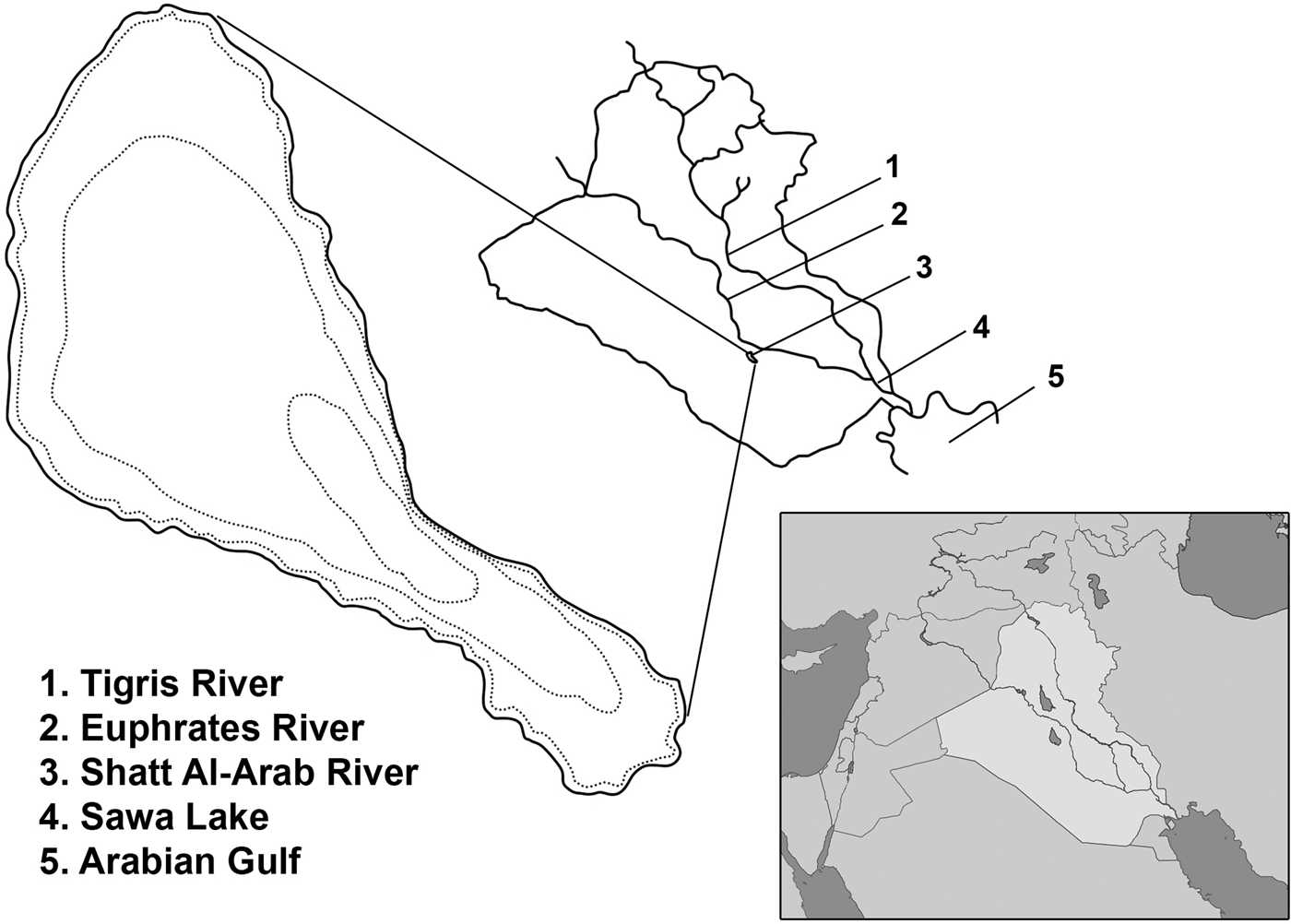
Several types of water bodies such rivers, streams, marshes, natural lakes and man-made lakes are found in Iraq. Among the natural lakes of Iraq, Sawa Lake stands out as an unusual lake both in terms of its structure and its geological formation. Sawa Lake lies between longitudes 44°59 29.01 and 45°01 46.61, and latitudes 31°17 43.10 and 31°19 49.79, about 240 km south-west of the capital, Baghdad, in the western desert of Iraq. It is a land-locked water body with the following dimensions: circumference, 12.257 km; maximum length, 5.13 km; maximum width, 1.936 km at the centre; and minimum width, ~0.5 km at its south-eastern end (Awadh & Muslim, Reference Awadh and Muslim2014). The lake is 18–16 m above sea level and ~2–5 m above the adjacent ground level (Jamil, Reference Jamil1977).
Sawa Lake is located between stable and unstable shelves of the western Iraqi desert (Ditmar, Reference Ditmar1972; Al-Sa'di, Reference Al-Sa'di2010), and was originally formed as a result of several tectonic faults, which occurred sometime during the Quaternary period 2.5 million years ago (Naqash et al., Reference Naqash, Benat and Al-Shamee1977; Al-Muqdadi, Reference Al-Muqdadi2003).
The lake is structured from three geological formations, including: the Rus Formation (early Miocene), the Dammam Formation (early to late Miocene) and the Euphrates Formation (early Miocene) (GEOSURV, 1983). The Dammam Formation is considered to be a very important structure, as it contains significant ground water resources, which are important for both drinking water supplies and for agriculture. The formation extends over the north-west of the Arabian Peninsula, from Saudi Arabia and Kuwait to the west of Iraq, and leaks to the surface along the fault area as springs (Jassim & Goff, Reference Jassim and Goff2006). The lake has no tributary entry of surface water (Jamil, Reference Jamil1977; Naqash et al., Reference Naqash, Benat and Al-Shamee1977), its water is highly alkaline (pH 8.5), rich in nutrients and mesohaline, with a salinity of about 18 ppt (Jamil, Reference Jamil1977).
Sawa Lake is not rich in aquatic organisms. Although there are some algae species (Mohammad, Reference Mohammad2005), the phytoplankton community is dominated mainly by diatoms (Hassan et al., Reference Hassan, Al-Saadi and Alkam2006). The lake supports only one species of brackish water gastropod, Pomatiopsis tryon, and only two species of fishes, Aphanius dispar and Planiliza abu (Ahmed et al., Reference Ahmed, Ali and Hussain2008; Awadh & Muslim, Reference Awadh and Muslim2014).
Gobies (Gobiidae) represent one of the largest families of fishes in the acanthomorph group. The family contains at least 1763 species belonging to 170 genera, with many more species yet to be described (Eschmeyer & Fong, Reference Eschmeyer and Fong2015). Gobies are found worldwide, in marine, estuarine and freshwater habitats (Thacker & Roje, Reference Thacker and Roje2011). The genus Acentrogobius contains only five species: Acentrogobius viridipunctatus, Acentrogobius dayi, Acentrogobius decaryi, Acentrogobius simplex and Acentrogobius therezieni (Larson & Wright, Reference Larson and Wright2003).
In the present paper, we report on the presence of Day's goby Acentrogobius dayi in Sawa Lake. This record is considered important because it not only represents the first record of a marine fish species from a land-locked lake in Iraq, but also a first record of Acentrogobius dayi for the marine fish fauna of Iraq.
Three adult specimens of Day's goby were observed, photographed in situ and collected by the fourth author during a scuba diving survey of Sawa Lake during 2014 (Figure 1). The specimens were encountered at a depth of 18 m amongst salt rocks containing several crevices of various sizes and were observed living in association with Palaemon shrimp species. Two of the specimens were deposited in the fish collections of the Smithsonian Institution, USA (USNM 435345) and the third, in the fish collections of the Marine Science Centre, University of Basrah, Basrah, Iraq (MSCUB).
Locality of Acentrogobius dayi, Sawa Lake, south-west of Baghdad, Iraq (after Sissakian, Reference Sissakian2000).

RESULTS
SYSTEMATICS
Order PERCIFORMES
Family GOBIIDAE
Genus Acentrogobius Bleeker, 1874
Acentrogobius dayi Koumans, 1941
MATERIALS EXAMINED
USNM435345, 2: 77.2 mm and 108.0 mm total length (TL); and MSCUB, 1: 88 mm TL, Sawa Lake, south-west of Baghdad, western desert, Iraq, 31°18′35.75″N 45°00′23.98 E, depth 18 m, 2014 (Figure 2).
Acentrogobius dayi, USMN 435345, 108 mm total length.
DESCRIPTION
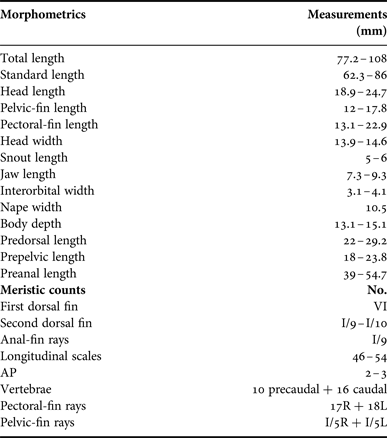
Body elongated with large head. Mouth directed upward. Gill opening reaching midpoint of the orbit. Villiform teeth in jaws and small canine teeth in the outer row. Canine teeth on the corner of the lower jaw. Round caudal fin. Pelvic fin fused to form a well-developed disc. Cheeks with two rows of papillae commencing at the corner of the mouth. Caudal fin rounded and shorter than head. First dorsal fin originates near the posterior end of the pectoral fin. Second dorsal fin originates a little anterior to the origin of anal fin. Body with large ctenoid scales posteriorly and small cycloid scales anteriorly. Head with no scales and embedded scales on top of operculum. Body greyish in colour with dark brown bands on its lower sides. Dark band behind eye. Pale, blue-green spots on the sides of body. Morphometric and meristic data are presented in Table 1.
The morphometric measurements and meristic counts for Acentrogobius dayi specimens collected from Sawa Lake, Iraq. All of the meristic values, except for longitudinal scale rows, and pelvic- and pectoral-fin rays, are based on radiographs. AP, number of anal-fin pterygiophores preceding the first hemal spine.
REMARKS
The range of TL in the present specimens (77.2–108.0 mm) is within the maximum range quoted for Acentrogobius dayi (110 mm) by Randall (Reference Randall1995) and Froese & Pauly (Reference Froese and Pauly2015), albeit smaller than that quoted by Ghanbarifardi & Malek (Reference Ghanbarifardi and Malek2007) for specimens obtained from the Arabian Gulf coasts of Iran (109 mm TL), and larger than the specimen collected by Rahimian & Pehpuri (Reference Rahimian and Pehpuri2006) (70 mm TL). The description of the present specimens agrees with the description provided by Mutsaddi & Bal (Reference Mutsaddi and Bal1974), Randall (Reference Randall1995), Rahimain & Pehpuri (Reference Rahimian and Pehpuri2006) and Ghanbarifardi & Malek (Reference Ghanbarifardi and Malek2007). No other species within the genus Acentrogobius is known to occur in the Arabian Gulf area (Froese & Pauly, Reference Froese and Pauly2015).
Acentrogobius dayi is distributed in the Western Indian Ocean, from the Arabian Gulf to Pakistan (Froese & Pauly, Reference Froese and Pauly2015), and the Mumbai region of India (Mutsaddi & Bal, Reference Mutsaddi and Bal1974). Within the Arabian Gulf area, it has been reported from Kuwait (Randall, Reference Randall1995; Bishop, Reference Bishop2003), Saudi Arabia and Pakistan (Randall, Reference Randall1995). Coad (Reference Coad1991) reported the presence of Acentrogobius dayi from Basrah, but it was originally recorded by Koumans (Reference Koumans1941) from Fao, south of Iraq. Although the present records of Acentrogobius dayi are not strictly from Iraqi marine waters, it seems reasonable to list it among the marine fish fauna of Iraq considering its previously known presence in nearby marine waters of the Arabian Gulf.
The occurrence of Planiliza abu in Sawa Lake most likely resulted from the transfer of acclimated individuals of this species to Sawa Lake for aquaculture purposes seven years ago. Alternatively, it is possible that P. abu might have reached Sawa Lake prior to their deliberate introduction in 2008 from the nearby lakes, such as Al-Tharthar Dam Lake and Razzazh Lake (Epler et al., Reference Epler, Bartel, Szczerbowski and Szypula2001), via waters of the Euphrates River running through aquifers within the Euphrates Formation. Either way, it now seems that P. abu has become established in the Sawa Lake (Ahmed et al., Reference Ahmed, Ali and Hussain2008; Awadh & Muslim, Reference Awadh and Muslim2014). The latter scenario may also explain the presence of Aphanius dispar within Sawa Lake (Ahmed et al., Reference Ahmed, Ali and Hussain2008).
The water of Sawa Lake originates from two sources. Firstly, the Euphrates aquifers that run through the Euphrates Formation carry freshwater; and secondly, the Dammam aquifers that run through the Dammam Formation carry brackish water (Dincer et al., Reference Dincer, Noory, Javed, Nuti and Tongiorgi1974; Mukhopadhyay et al., Reference Mukhopadhyay, Al-Sulaimi, Al-Awadi and Al-Ruwaih1996). Both of these aquifer systems are from the Euphrates River and the Arabian Gulf near Saudi Arabian coasts, respectively (Milton, Reference Milton1967; Dincer et al., Reference Dincer, Noory, Javed, Nuti and Tongiorgi1974; Al-Ruwaih, Reference Al-Ruwaih1995).
The presence of Acentrogobius dayi in Sawa Lake could be explained by either one of two possibilities: (1) the species may have gained entrance via the Dammam aquifers with the water from the Arabian Gulf at recharge points on the Saudi coasts, or (2) it was accidentally introduced along with other fish species for aquaculture purposes. Since Acentrogobius dayi is a small marine species, it seems unlikely that it could have gained access to Sawa Lake via ~430 km of an underground brackish water aquafer system. Consequently, it seems more likely that it was accidentally introduced with other fish species for aquaculture purposes.
Although Acentrogobius dayi has not previously been recorded from Sawa Lake, this may simply be due to the lack of appropriate ichthyological investigation methodologies. Previous investigations were mainly concerned with the lake's geology (Jamil, Reference Jamil1977; Naqash et al., Reference Naqash, Benat and Al-Shamee1977; Awadh & Muslim, Reference Awadh and Muslim2014). The current ichthyological investigation was the first time that scuba diving and specimen collection was included. The use of appropriate fish sampling methodologies such as scuba diving and underwater photography has already repudiated the presumed rarity of several species in other water bodies within the area (Jawad et al., Reference Jawad, Louisy and Al-Mamry2010), including the current first records of Acentrogobius dayi from Sawa Lake. Indeed, the present records of Acentrogobius dayi from Sawa Lake represent a significant contribution to the study of zoogeographical patterns within this area of Iraq.
In the current investigation, underwater photography revealed that Acentrogobius dayi may live in association with a species of shrimp (Figure 3), tentatively identified as Palaemon elegans (Sammy De Grave, personal communication). Palaemon elegans is known to have been introduced to Lake Abu-Dibic (Holthuis & Hassan, Reference Holthuis and Hassan1975). This lake is fed by the Euphrates River and the water of this river enters the aquifers of the Euphrates Formation, which in turn feed Sawa Lake. It is also possible that aquatic birds may have inadvertently introduced the shrimp species into Sawa Lake. Although many aquatic organisms living in the land-locked lakes that are surrounded by areas of non-suitable terrestrial habitats lack the capacity to disperse naturally by themselves to neighbouring water bodies, it has been shown that water birds can be important vectors in facilitating their widespread distribution (Figuerola & Green, Reference Figuerola and Green2002; Green et al., Reference Green, Jenkins, Bell, Morris and Kingsford2008).
Acentrogobius dayi inside small crevice at the bottom of the lake, watching Palaemon shrimp at the entrance of the hole, ready for a sudden attack (photo by Thomas Pohl).
ACKNOWLEDGEMENTS
We thank the Marine Science Centre, University of Basrah for providing the facilities to collect fish specimens from Sawa Lake and for all other technical assistance; Razak Mohamed, College of Agriculture and Marine Resources, University of Basrah, Farhan Mhaisen, Sweden and Thamer Salim Ali, Arabian Gulf University, Bahrain for providing information about Sawa Lake; Zeehan Jaafar, Smithsonian Institution for identifying the specimens; Edward Murdy for confirming the identification, for supplying the body morphometric and meristic data, and for reading the manuscript; Sammy De Grave, Oxford University Museum of Natural History for the identification of shrimp; Declan Quigley, Sea Fisheries Protection Authority, Dublin, Ireland for reading the manuscript and for his valuable advice and suggestions; and Joacin Naslund, Goteborg, Sweden for his technical assistant.