INTRODUCTION
The success of the Christian right in United States politics from the late 1970s raised the issue of British parallels (Bruce Reference Bruce1988). The obvious explanation for the lack of a British Jerry Falwell or Pat Robertson is the difference in religious composition: far more Americans were committed Christians and a far greater proportion of American churchgoers were both theologically and politically conservative. However, there is an important secondary difference. Such features of United States politics as the plethora of elected offices, the separation of legislature and executive, the openness of broadcasting, and the party primary election system created opportunities for conservative Christian pressure groups to become politically active. In contrast, the relatively closed nature of British politics (seen in such features as the preference for appointing rather than electing officials, the power given to party leaders by the combination of legislature and administration, controls on broadcasting and party expenditure, and party control over candidate selection) discouraged pressure groups from becoming involved in electoral politics. That is, even if the United States and Britain had been similar in religious composition, there were good structural reasons why Britain would not have had a Christian right.
The structure of British politics has changed considerably since 1997 in ways that, if not providing a crucial test, nonetheless help us to evaluate this argument. Considerable power has been devolved to an elected London Assembly, to a Scottish parliament, and to a Welsh legislative assembly. At the same time a variety of systems of proportional representation (PR) voting have been introduced for those elections and for elections to local government and to the European parliament. Christians have responded to those changes. Three Christian parties have contested a number of elections. This article will review their performance, agenda, and candidate profiles. It will also present survey data on British attitudes toward the mixing of religion and politics. It will conclude that, while the opportunity structure argument was not wrong, it was probably not necessary. The fortunes of the Pro-Life Alliance, the Christian Party (CP), and the Christian People's Alliance show that direct Christian intervention in politics is sufficiently unpopular in Britain to render consideration of other obstacles irrelevant.
BRITISH CHRISTIAN PARTIES
The first intervention straddles the old and new orders. In 1997 Josephine Quintavalle and her son Bruno founded the Pro-Life Alliance (PLA), which contested 56 seats in that year's general election and attracted 19,355 votes: an average of 345 votes per constituency contested. In only five seats in England and Wales did the PLA gain more than 1.0 percent of the votes. With its higher proportion of Catholic voters, Scotland offered a more fertile environment. The PLA contested nine seats; all in the Glasgow area where around one-third of the electorate is nominally Catholic. It averaged 1.5 percent of the vote and in three seats it gained more than 2 percent.
But the PLA failed to maintain momentum. Two years later it contested the first elections to the Scottish Parliament. These should have produced an improved performance. The additional member form of PR used in that election grouped 73 single member constituencies into eight regions and allowed each voter two votes: one for a candidate in the first-past-the-post constituency part of the election and the other for a party from the regional list. After the constituency elections are completed, the regional party vote is counted and additional seats allocated so as to compensate parties that have polled well across the pooled constituencies but failed to win seats. Voters could split the ticket and chose, say, Labor for the constituency and Liberal Democrat for the regional top-up. Parties that had little or no chance of winning a first-part-the-post constituency election could stand only on the regional list and hope to gain one or two representatives from the aggregation of their thinly-spread support.
Rather than improving on its previous performance, the PLA vote went down. Scots voters may have been too excited by the prospect of the restoration of the parliament after a gap of 292 years to be interested in apparently fringe issues. On the other hand, considerable effort was put into explaining that the new system allowed people to vote for two different parties. The PLA fielded no candidates in the Highlands and Islands, North-East Scotland and South of Scotland; regions with few Catholics. In Lothians, it won 0.3 percent and in Mid-Scotland and Fife 0.2 percent of the vote. In the three regions with the highest Catholic concentration (Central, West of Scotland, and Glasgow), it scored, respectively, 0.8, 1.0, and 0.8 percent of the vote (Scottish Parliament Information Centre 1999).
At the 2001 general election the PLA fielded 37 candidates; this time averaging only 74 percent of its 1997 votes per seat figure. It did not contest the next general election and for the 2004 European elections it had so much trouble recruiting candidates that seven of the 22 standing in England contested more than one region. It disbanded in December 2004.
A more significant electoral intervention came from two parties that presented themselves not as single-issue movements but as part of the continental European tradition of Christian Democracy. In 1990, a small group of Christian members of parliament formed the non-party Movement for Christian Democracy. A decade later some members of that group formed the Christian People's Alliance (CPA). The CPA described itself as embodying the following principles: active compassion, respect for life, social justice, wise stewardship, empowerment and reconciliation. It also said: “The CPA is a party rooted in the historic Christian faith that seeks to demonstrate the love of God through political service. Our faith and principles are drawn from the Bible, especially the life and teaching of Jesus Christ, as well as from Christian political insights through the centuries” (Christian People's Alliance 2001). Initially, the CPA had a surprisingly liberal agenda or, perhaps more accurately, its agenda was difficult to place politically. For example, under the leadership of Ram Gidoomal, an Indian multi-millionaire businessman, one of the CPA's main items on its “build reconciliation and seek justice” agenda was action to regularize the status of refugees and make it easier for them to find work legally (Christian People's Alliance 2002).
In May 2002, the CPA fielded 69 candidates in local government elections (mostly in London) and won one seat in the East London district of Newham. Gidoomal ran for mayor of London twice. In 2000, he gained 2.4 percent of the vote; coming behind the three main parties but ahead of the Green party candidate. In 2004, his percentage of the vote was exactly the same but he came behind the United Kingdom Independence party, Respect (a party led by former Labor MP George Galloway and supported largely by Asian voters), the Greens, and the British National party (BNP). In between, the CPA gained two further local council seats in Newham. The CPA also fielded candidates in the Scottish parliamentary elections where they competed with the Scottish CP.
This second intervention was the work of George Hargreaves: a Black British Londoner who had some success as a pop song writer before becoming a Pentecostal clergyman. Although a founder member of the CPA, Hargreaves left to mount his own election campaigns, initially under the title of Operation Christian Voice (OCV) and later the CP (with its Scottish and Welsh variants). In contrast to those of the early CPA, Hargreaves's interventions were based on the most controversial and newsworthy parts of a conservative Christian agenda. OCV stood on an anti-abortion platform in every region (except Northern Ireland) in the 2004 European parliament election. When contesting the Scottish parliament elections in 2007, Hargreaves concentrated on gay rights: he was against them. In that election, the CPA (with 15 candidates) and Scottish Christian Party (SCP) (with 76) competed, sometimes rather bitterly. Teresa Smith, leader of the CPA, said about the Scottish CP: “I can't stress enough that we have nothing in common with these people” (Scottish Christian Party. n.d.). With a change in leadership in the CPA, the two parties formed an alliance and contested elections on a common platform.
Finance was the key to these electioneering forays. Compared with the United States situation, tight British controls on campaign spending and on access to television and radio, mean that it is relatively cheap to contest a British election. To stand in all eight regions for the Scottish parliament requires only £4,000 in deposits that will be lost if the party gains less than 5 percent of the vote. Still, the PLA's difficulty in fund-raising caused it to fold and the relative unpopularity of the Christian program can be seen in the funding of the CPA and CP. Although they presented themselves as populist movements, very little of their money came from ordinary members. Between 2002 and 2010, the CPA was given £375,000 by a wealthy Cheshire businessman. The CP was primarily bankrolled by City of London money. Philip Richards, a hedge fund star who gave his bonuses to Christian causes, donated at least £200,000 (Dey and Marlow Reference Dey and Marlow2008). In 2010 it was given £100,000 by Visile Frank Timis, a wealthy Romanian-Australian businessman (Private Eye 16 May 2010).
THE CHRISTIAN AGENDA
The CPA believed that:
Christianity gives a vision for the whole of politics — through principles, policies, peacemaking, economic policy and ethics. The Bible as God's revelation and Jesus' words and life are our central guide. We see the death and resurrection of Jesus as the central human event, bringing peace with God, and renewed life. We want to live within God's love and forgiveness, rather than remain within the old patterns of human failure in life and politics (Christian People's Alliance 2001).
The party aimed to use the “talents of Christians in different callings” to bring the grace of the Gospel to bear upon the religious, spiritual, moral, and social problems in society. The problem with that ambition is that the Gospel does not automatically generate positions on the issues of the day. As noted, the CPA's initial attitudes to refugees (like immigrants and foreigners generally, disliked by the British right) was tolerant. It advocated “reconciliation among nations, races, religions, classes, gender, and communities” and made that rhetoric real by permitting non-Christians to join and even giving them important public roles. More predictably it was also anti-abortion, anti-gay rights, and anti-European Union though none of these issues was given a particularly high profile (Christian People's Alliance 2001).
Although the CP was described by Hargreaves as non-denominational Christian, its doctrinal basis was significantly narrower than that of the CPA. It may be that Hargreaves was simply insensitive to Catholic perceptions but the language was distinctly Protestant. Catholics could live with the first statement of faith: “We believe in one creator God, eternally existent in three persons, Father, Son, and Holy Spirit, as stated in the historic creeds of the Christian church.” But the phrase “solely in accordance with biblical principles” has an anti-Catholic flavor and the assertion that “Jesus Christ will come again to the earth, personally, visibly and bodily to consummate history and the eternal plan of God” would alienate a large body of Christians (Christian Party n.d.).
The difficulty of deriving a legislative program from Christian principles is demonstrated by the CP's manifesto for the 2007 Scottish Parliament elections. There was robust right-wing stuff: restoring the death penalty; banning abortion; increasing tax on alcohol and cigarettes; and reintroducing the right of teachers to hit children. There were some positions that are distinctly rum: curfews for under 11 year olds and “mandatory intervention of child protection agencies in relation to any child 10 years or younger that is found unaccompanied on the street after 9.00 pm” (Scottish Christian Party 2007).
There were conservative Christian items: greater observance of a weekly day of rest; corporate readings from the Bible in all Scottish state schools; public health campaigns to discourage homosexuality, excessive drinking, and the use of addictive substances; promotion in school of chastity before marriage; re-instatement of a prohibition on “promoting” homosexuality in schools; mandatory provision of Christian religious education with no obligation to promote other faiths; and a Creationist science curriculum.
Finally, there were some odd items. The SCP wanted the standard of “beyond reasonable doubt” in criminal trials to be replaced by the “more biblical” evidence of two or three reliable witnesses. It wanted the practice of addressing women as “Ms” to be discouraged. It was opposed to the practice of altering birth certificates to reflect gender confirmation surgery. And — the only economic item in its platform — it wanted “limits around coastlines to preserve stocks of fish and sand eels.”
The Welsh manifesto also seems to have been composited from every candidate's wish-list. Predictably the education section asked for Darwinism to be “balanced” with “Creation/Design in the Universe” but it also asked for Greek and Latin but not Welsh to be taught in every school. It proposed selling off the National Health Service — something even the most right-wing Conservative party manifesto has never openly advocated — and it wanted the dragon removed from the Welsh standard because it was Satanic (BBC 2007).
Given the variety of political positions that can be generated from even a conservative Christian faith, what the Christians actually stood for was heavily influenced by events. That is, campaigns were based on an opportunistic selection of themes to fit whatever the right-wing press seemed most interested in promoting. The main difference between the first CPA interventions and those of the CP (and afterward the CPA-CP Alliance) was that notions of reconciliation and justice got ditched in favor of xenophobia, homophobia, and islamophobia. The concerns over immigration and Islam grew as the CPA and CP recruited in London and won council seats in Newham, a borough where Muslims outnumbered Christians. In their statements, candidates were formal. One complained that “minority groups are privileged and preferred before the majority” (Scottish Christian Party 2007). Another elaborated the concern about the power of Islam:
Some of our cities will become predominantly Muslim in a relatively short time, and they will be naturally seeking political representation for their faith in some form or other, as Islam is more of a political ideology than a faith … Already, it has been estimated that there are some 90+ Sharia courts operating in the UK, in a parallel legal system, which has been given the force of law by the UK government where it does not contravene parliamentary laws … this will eventually open the door to a fuller implementation of Sharia laws in the UK, by Sharia courts, possibly leading to punitive justice (a somewhat worrying prospect!) (Booth Reference Booth2010).
In less guarded moments, the xenophobia was more pungently expressed. At a Vale of Glamorgan meeting during the 2010 general election, the Christian party candidate said: “I have heard that there are more white British people leaving this country to live elsewhere and more people coming in who do not actually want to integrate themselves — especially the Pakistani community. Shouldn't these people just go home?” (Guardian 2010).
The homophobia seems to have been adopted in a particularly opportunistic manner for the Scottish elections of 2007. In 2000, the Scottish parliament repealed Conservative legislation that had made it an offence to present homosexuality as an acceptable lifestyle in schools. Wealthy conservative Christian Brian Soutar funded a pressure group “Keep the Clause” and there was much talk about targeting members of the Scottish parliament but it came to nothing. Four years later gay rights again became an issue when a bed-and-breakfast provider in Wester Ross refused a booking from two gay men and provoked a long-running debate in the media over the government's equality agenda. Seeing the opportunity for good press coverage, Hargreaves stood in the Glasgow region so that he could confront Patrick Harvie, the openly bisexual leader of the Green party in Scotland.
I should add that many candidates seemed little interested in the manifesto or in electioneering; they saw elections as opportunities for old-fashioned evangelism. A Welsh candidate said: “In my speech after the count I appealed to the heart of all parties that this election was not about politicians, not about parties but about our nation, a nation that had turned away from Jesus Christ. It was about HIS LORDSHIP” (Griffiths Reference Griffiths2010). Another told the electors of Bolton South East: “It is time for the people to turn to the Great Healer Jesus. It is time for us to wake up and realise that with Jesus there is a hope and a future and there is real healing” (Christian Party 2010a). The candidate for Maidstone and the Weald was typical of those who used their election literature to testify. She began “My name is Heidi, I'm 23 years young, and I love God with all my heart. He really is my Everything” (Christian Party 2010b).
CHRISTIAN PARTY ACTIVISTS
The social characteristics of the Christian party candidates are interesting as both symptom and cause of the CP and CPA's limited appeal. Lists of those who stood in the General Election of 2010, the European parliament election of 2009, and the London Assembly election of 2008 provided names of 139 election candidates in England and Wales. Scotland will be discussed separately. Although the list is not exhaustive, it is long enough to be representative. For some, only name, which sometimes reveals ethnicity, could be ascertained. For most I was able to ascertain ethnicity, occupation, and gender. For many I was also able to identify the person's sect or denomination.
Of the 135 candidates whose gender is known, 32 percent or just over two-thirds were female. As 21 percent of all party candidates at the 2010 general election were female, the Christians were fielding an unusually high number of women (Centre for Women and Democracy 2010, 2). Two explanations suggest themselves for what, given the otherwise conservative orientation of the CPA and CPA, is an unexpected disparity. First, candidates were drawn from church circles, which are overwhelming female. Second, because winning was unlikely, there was little competition for places. Hence there was not the usual circumstance of men being more successful than women in gaining a valued asset. Indeed, far from competition for places, two things suggest that party leaders had to work hard to fill the lists. Many candidates had no connection with the constituency or region in which they stood: one candidate with a London address stood at various elections for Glasgow, the north-east of England, and the north-west. Secondly, there were a large number of spousal pairs.
Ethnic minorities are generally under-represented in British political parties. In 2005, there were only 15 non-white MPs, which at 2.3 percent is less than half of the ratio for the population at large (Jones et al. Reference Jones, Kavanagh, Moran and Norton2007, 415). The proportion of non-whites is usually higher in candidate lists than in lists of winners; for example, in the 2009 England and Wales local authority elections, 3.3 percent of candidates were non-white (Rallings et al. Reference Rallings, Thrasher, Borisyuk and Shears2009). Set against those proportions, the ethnic composition of the CPA/CP candidates was highly unusual. Of the 107 people whose ethnicity could be determined, 57 percent were White British and 8 percent were Black British. The most significant deviation from the norm was the very high proportion of African and Asian candidates: 13 percent in both cases. The majority of the former were Nigerian in origin; the majority of the latter were Pakistani.
This unusual pattern is partly explained by the London-centric nature of the CP and CPA. Although non-whites constituted only 3.3 percent of 2009 local authority candidates for the country as a whole, they accounted for 16 percent of those standing in London boroughs. Religiosity is also a consideration. Nigerians are a disproportionate part of the church-going population of London and the south-east.
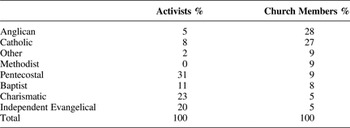
Almost every candidate who made any sort of presentation, self-identified as Christian and many also mentioned the seriousness of their religious commitment and their involvement in church activities. For 57 candidates, it was possible to identify a specific affiliation, which is summarized in Table 1. For comparison, I have placed alongside the rough proportions of those churches in the English and Welsh population as a whole.
Denominational Profile of CP/CPA Activists and Church Members, England and Wales, 2008–2010

Source: Church member data from Brierley (Reference Brierley2011).
That the order in one column is almost the reverse of the other graphically illustrates the reliance of the CP and CPA on religious minorities. Anglicans, Methodists, and Catholics are grossly under-represented. Three small sections of British Christianity are equally over-represented: Pentecostal churches that primarily recruit people from African backgrounds, independent evangelical churches, and charismatic fellowships. The absence of Catholics is especially noteworthy given the very high proportion of Catholics in the Pro-Life Alliance, from which the CPA drew a lot of its original support. I was able to identify the religious affiliation of eight of 22 CPA candidates in 2004: all of them were Catholic and almost all of them worked for anti-abortion organizations. At least four of the five CPA candidates in Wales in 2007 were Catholic. In contrast, the four Welsh CP candidates whose denomination is known were all minority Protestant: Charismatic, Independent Evangelical, Baptist, and Pentecostalist. In brief, the Christian parties in England and Wales draw their activists primarily from two minor tributaries of British religious life.
Information on candidates' occupations is scarce and the proportion whose occupation is unknown is so large that we should not make too much of the data but what is known is interesting. As with all political parties, manual workers (4 percent of Christian candidates) were under-represented. But so too (at just 9 percent) were the higher managerial and professional classes who make up the majority of candidates in the mainstream political parties. There was only one lawyer and the five university or college lecturers were relatively junior. Skilled white-collar workers, teachers especially, were 22 percent and routine white-collar workers (often National Health Services, social work and local government administrators) were 19 percent of the total. As populist parties have often relied heavily on self-employed business men and women, it is worth noting that relatively few of the Christian candidates were self-employed (13 percent) and with one exception their businesses were single-person or family operations (Canovan Reference Canovan1981).
By far the most significant feature of candidates' occupations was the extraordinary number of clergy. Nationally, clergy formed only 0.15 percent of the employed population in 2010 but they were at least 25 percent of those CP and CPA candidates whose occupation is known (Office of National Statistics 2010). What makes the clerical representation even more unusual is that only three were Anglicans (and one of those led a semi-detached charismatic group). The vast majority were Pentecostal preachers. As with religious affiliation, some of this over-representation may be explained by the movement's novelty: Hargreaves and other founders mobilized their colleagues in clergy networks. But as I will suggest below, that so many activists were pastors tell us something important about the limited appeal of an avowedly Christian intervention in British elections.
It would be revealing to augment the social class data with information about the sectors in which the activists worked. Unfortunately, the data are too thin to make solidly-founded comparisons with the population at large but there is one observation worth making. In addition to the full-time clergy, there was a considerable representation of people employed in promoting Christian causes and values. For example, many of the routine white-collar workers worked for Christian charities and pressure groups and many of the teachers mentioned being in “Christian education.”
New parties often recruit from a narrow base. Most political parties begin as supply rather than demand. The founders create the appearance of demand for their product in the hope that their stand will prove them correct by attracting others who share their vision. First wave activists are likely to be involved for reasons other than, or additional to, strongly sharing the movement's platform: supporting a friend or a spouse, perhaps, or working for an organization with cognate goals. For example, at least three of the CP's candidates in the West Midlands came from the same congregation. Only once the movement has grown beyond the initial phase of calling in favors and twisting arms can we suppose it represents what the promoters hope will be the enduring interface of their ideals and public support. However, given that the Christian parties have been in business for almost a decade, it seems reasonable to infer something from the characteristics of those who were willing to stand as candidates.
The first and most obvious point — given the little commitment required to be a nominal candidate — is that churchgoers are not attracted by the claim that Christian interests are best served by a separate party.
Second, few Christians feel the threat of Islam justifies novel political action. There may be a great deal of general disquiet about Islamic extremists. There are popular local campaigns against visible signs of Islam (such as the building of mosques). But the vast majority of British Christians clearly do not feel that Islam represents such a threat that they should put their religious identity before the complex of other interests that produced their previous political preferences. Hence the CP and CPA became reliant to an unusual degree on people from backgrounds that were shaped by enduring competition with Islam: Nigeria and Pakistan and, in one case, Bosnia.
Third, mainstream Christian clergy are not interested. Despite the complaints of senior Anglican clergy that the Christian voice has been neglected by governments keen to court non-Christian minorities, mainstream clergy are generally well-connected to central and local government bodies and often play important roles in their wider communities (Moyser Reference Moyser1985). As well as already providing some of what the CP and CPA hope to gain through electioneering, that acts as something of a constraint on getting involved with what, so long as it is polling only as many votes as the Monster Raving Loony party, looks like dangerously narrow enthusiasm. Mainstream clergy are often called upon to play the role of community “master of ceremonies.” They are the ones who speak to the media when a gunman runs amok in Cumbria or two young girls are murdered in a Cambridgeshire village. In a largely secular society, the clergy are well-aware that they can only perform such roles if their religion is seen as a source of a generally benign and inclusive attitude and not as a special interest. Hence they are reluctant to be associated with a narrowly partisan Christianity.
It may also be that mainstream clergy have sufficient experience of translating religious principles into political policies to make them wary of the notion that there is a Christian political agenda that can be pursued without serious risk to their pastoral position.
Finally, we can note that most mainstream clergy will have little sympathy for the secular right-wing elements of the CP and CPA platforms. Kenyan-born pastor James Gitau was campaigning for the racist BNP just three weeks before he was selected to stand for the CP. In his justification, he said he had only supported the BNP because it was against sodomy (Guardian 12 April 2010). It is hard to imagine any Methodist minister making the same choices or being happy standing alongside someone who did.
The Pentecostal and charismatic pastors who support the CPA and CP are typically outsiders with little public engagement or role beyond their own congregations. Almost all are entrepreneurial founders and leaders of independent congregations who do not answer to a national organization and who need not consider their relationships with people outside their congregation. Especially if their base is a relatively insulated ethnic minority, they may be more likely than mainstream clergy to combine a poor feeling for British political sensibilities with a high opinion of their own self-importance.
THE SCOTTISH ACTIVISTS
Scotland needs to be considered separately. In the 2007 election to the Scottish Parliament, the Scottish CP fielded 76 candidates and the CPA fielded 15. It proved to be more difficult to profile the Scottish candidates because, while all the CPA's candidates were sufficiently involved to provide personal details on the party's website and in election literature, a large proportion of the SCP candidates were purely nominal.
There were proportionately fewer women on the Scottish than the English and Welsh lists: 19 percent of the SCP and 20 percent of the CPA. There were also far fewer candidates from ethnic minority backgrounds. I left three London residents out of the SCP calculations. Of the remaining 73, all but two were White British, the vast majority of them Scots. Two may have been Asian. The story is the same for the CPA: all White British apart from one Rhodesian and one Glaswegian of Pakistani parentage.
As the occupations of only 42 percent of the sample could be identified we should not make too much of what is known but the Scots activists seem to be of higher status than the English and Welsh, possibly a reflection of them being older. For the SCP, about 10 percent were senior managers and professionals, with retired doctors and head teachers making up a large part of that group. Some 43 percent were skilled white-collar workers, with teachers again being prominent. There were proportionately fewer self-employed business people. There were also many clerics: 29 percent of those who occupations were known. This may well be a result of the large number of unknowns. Because pastors are public figures, my Google searching probably identified all of those who were religious officials while it failed to identify more humble or private occupations. However, if none of the unknowns were clergy and we express clergy presence as a proportion of the entire cadre, at around 12 percent it is lower than in the Christian parties in England and Wales but still be vastly greater than in the Scottish population at large.
The CPA social class profile was interestingly different. Over 40 percent were senior professionals and managers, a quarter were skilled white-collar workers (with teachers again being prominent), and a similar proportion was self-employed business people. However, there was only one religious official: an ordained Catholic deacon. The lack of clergy in the CPA is a reflection of the religious profile of the two parties, which was markedly different.
Of 21 SCP activists whose church connection is known, a disproportionate 13 were members of charismatic or independent evangelical congregations, two were Free Church, one Baptist, one Episcopalian, and three were Catholic. None were members of the mainstream Church of Scotland. The CPA had no clergy candidates because it was overwhelmingly Catholic: a reflection of the centrality to the CPA in Scotland of the abortion issue.
Those candidate profiles match the campaign issues. The CP and CPA in England (and to a lesser extent Wales) were increasingly concerned with Islam. With a far smaller Muslim population in Scotland, the Scottish CP concentrated on gay rights and the Scottish CPA focused on abortion. That the former was essentially Protestant and the latter Catholic may explain some of the ill-feeling between the two parties that was a feature of this period.
ELECTORAL PERFORMANCE
An exotic figure whose gift for self-publicity included starring in a “reality” TV show, Hargreaves attracted much media attention but few votes. In 2004, he won just 90 votes in a Birmingham by-election. In the 2005 general election, he stood in the more promising seat of the Scottish Western Isles. The last strongholds of conservative Presbyterians who reject the liberalism of the Church of Scotland, the Hebridean islands of Lewis and Harris are probably the most conservatively religious parts of Britain and their conservatives have been politicized by losing campaigns to prevent flights and ferries on the Sabbath. In addition, something of an opportunity had been created by the collapse of the Conservative party in Scotland. The economic reforms of the Thatcher government in the 1980s were particularly damaging to Scotland and its decision to trial an unpopular reform of local government funding in Scotland cost the Conservatives dearly, as did their opposition to devolution. Twenty years later the party had still not shifted the widespread perception that it was an English party and that left Scots conservatives with no obvious home. Despite those advantages, Hargreaves won only 7.6 percent of the vote. The following year Hargreaves gained just 1.2 percent of the vote in a Dunfermline and West Fife by-election.
It is always dangerous to infer the popularity of a value position from the performance of a single candidate. We might guess that Gidoomal attracted voters in the London mayoral elections for his winning personality, ethnic background, and business success rather than his movement's platform. We might similarly guess that Hargreaves's media success was offset by his naiveté and extremism. Hence it is important to consider aggregate performance of a large number of candidates in the elections the CPA and CP have fought.
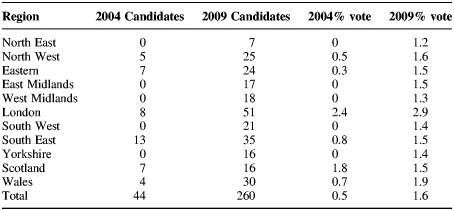
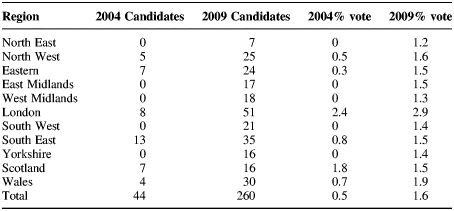
As Table 2 shows in the 2004 European Parliament elections, the CPA and the CP (under the title of Operation Christian Voice) together gained 0.5 percent of the votes cast. Five years later a far larger number of candidates did little better. In Scotland the vote went down. Only in London did the total get out of the basement of great British eccentrics but the change from 2.4 to 2.9 percent seems trivial given the opportunity to mobilize against the supposed heightened fear of Islam.
Christian Parties in European Parliament Elections, 2004 and 2009
In the 2010 United Kingdom general election, the CPA/CP alliance took 0.1 percent of the vote. As it fielded only 71 candidates, its votes per candidate ratio is more informative: 262. And it lost its only elected representatives in England. As part of a concerted effort to crush the BNP, the Labor party made strenuous efforts to mobilize its vote in those London boroughs where the BNP were gaining a foothold. It succeeded to the extent that, in the local elections that accompanied the general election, the CPA lost its three council seats in the borough of Newham.
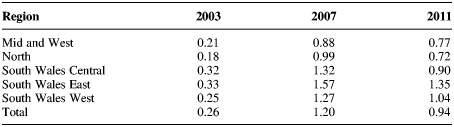
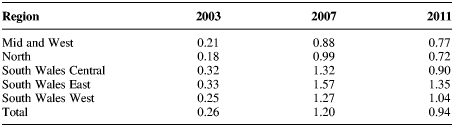
As we can see from Table 3, elections to the Welsh assembly, which used the same additional member system as those for the Scottish parliament, show a similar pattern to the European elections. At the first outing (when the Christian standard was carried by the PLA) the vote was trivial. In 2007, when the better-funded CPA replaced the PLA and the better-publicized Christian party entered the lists the vote rose, but then in 2011 it fell in all regions.
Christian Parties in Welsh Assembly Elections, 2003–2011, Regional Vote (% of votes cast)
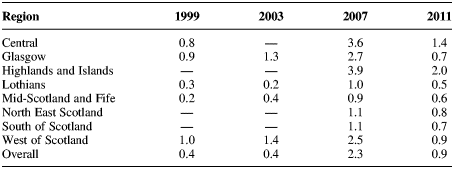
The Scottish parliament results follow a similar pattern. In 1999 and 2003, when the PLA was the sole standard carrier, it was unable to find enough candidates to contest all the regions and its vote was trivial. In 2007, when the CPA replaced the PLA as the largely Catholic party and George Hargreaves garnered a great deal of publicity for the SCP with his attacks on gay rights, the Christian vote began to register, notably in Glasgow (where Hargreaves stood) and in the Highlands and Islands (where there is a high concentration of evangelical Christians). But, as Table 4 shows, the 2011 election proved this to be a false dawn. The CPA was able to field candidates in only two of the eight regions and the SCP could only contest all the regions by fielding London residents as nominal candidates. Without Hargreaves, the SCP attracted almost no media attention. One possible explanation is that contesting only the regional list vote inadvertently denied the CPA and SCP an important source of publicity. Local papers, radio, and television gave a great deal of attention to the election but they did so by profiling the constituencies and the candidates standing in them. Parties that contested only the regional lists reduced their exposure to lost deposits but also lost a great deal of free publicity. Its strong evangelical presence explains why the Highlands and Islands gave the best Christian result but it is significant that this was also the only region in which the SCP contested a constituency: the party leader, a well-known local doctor, stood in Inverness and Nairn.
Christian Parties in Scottish Parliament Elections, 1999–2011, Regional Vote (% of votes cast)
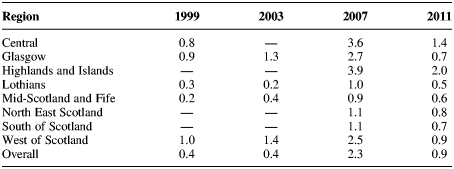
However, such contingencies need not stop us from taking the 2011 performance as representative of public attitudes to the Christian parties. Local churches, para-church networks, Christian magazines, and evangelical web-sites promoted the SCP and CPA sufficiently for us to suppose that regular churchgoers were reminded of their existence and most of those who voted Christian in 2007 were still alive and able to vote Christian in 2011. That they did not can be taken as a real loss of support. Although table 4 reports only percentages, the net votes cast mirror them. For example in 2007, 10,192 people in Scotland's Central region voted Christian; in 2011 only 3,173 did.
EXPLAINING FAILURE
Explaining PLA, CP, and CPA failure is not difficult. We can note that less than 10 percent of the British people regularly attend church. And most of those churchgoers are not socio-moral conservatives. Polls consistently show little appetite for restricting abortion. For example, in 2004, over 70 percent of Britons believed that abortion should be “always or mostly legal” and less than a quarter thought it should be always or mostly illegal (BBC 2006). In the British Social Attitudes survey of 2008, “over three-quarters believe that abortion is wrong only ‘sometimes’ or ‘not at all’ if there is a high risk that the baby will have a birth defect.” When respondents are divided by a variety of measures of religious belief and behavior, we find that 86 percent of the unreligious approve of abortion for good reasons but we also find that more than two-thirds of the religious sample take the same view (McAndrew Reference McAndrew, Park, Curtice, Thomson, Clery and Butt2010, 94). Attitudes to gay rights are similar. Only 19 percent of the unreligious respondents thought “homosexual sex is always or almost always wrong.” Only a third of the larger group of somewhat religious respondents agreed with that sentiment. And even the most religious respondents were far more tolerant than the Christian parties required: only half thought that homosexuality was always wrong (McAndrew Reference McAndrew, Park, Curtice, Thomson, Clery and Butt2010, 98).
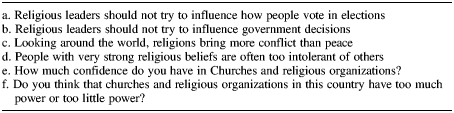
Secularization is a complex social process explained in great detail elsewhere (Bruce Reference Bruce2011). One obvious symptom is a decline in religion's popularity. Another is the privatization of religion. Modern societies are extremely tolerant of religious variety but expect faith to be a largely domestic matter with little presence in, or salience for, the public sphere. We have no good quality survey data on attitudes to Christian parties but we do have data on attitudes to the general principle of religious influence on public life. It shows that the British are hostile to the idea that religion should enjoy an enhanced public profile. As is described in Table 5, data from two sweeps of the British Social Attitudes (BSA) survey can be used to construct a scale of attitudes towards the influence of religion on public life.
Scale Construction: Religion, Politics and Public Life in Britain, BSA 2008 and 1998
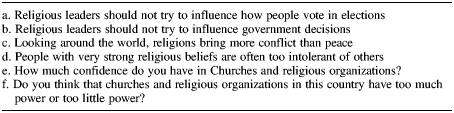
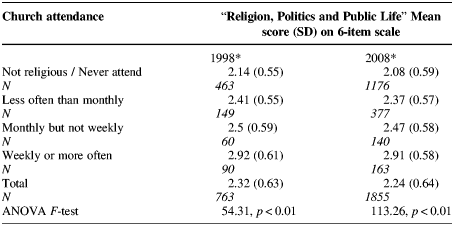
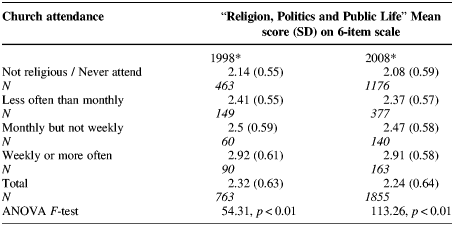
Technical information on the surveys and scale construction are presented elsewhere (Bruce and Glendinning Reference Bruce and Glendinning2011). Each of the six items invited responses that can be scaled from 1 to 5 so that 2.5 marks the midpoint of relative neutrality or indifference, scores of 2.6 and above represent being in favor of religion enjoying greater public influence, and scores of 2.4 and below show opposition. Table 6 shows the distribution of responses to the scale arranged by degree of religiosity measured by church attendance. Two clear conclusions that can be drawn. The first is that, at 2.32, the vast majority of Britons are opposed to religion enjoying any great public influence. Only for the 11.8 percent of respondents who attend church weekly or more often is the score above the midpoint of 2.5 and it is not far above. The second point is that the only discernible change over the decade between 1998 and 2008 — a decade that saw the World Trade Center bombings, the London Underground bombings, and a slew of disputes over the rights and privileges of religion — is a very slight hardening of attitudes against religion. That the shift is across the board suggests that even British churchgoers see virtue in the privatization of religion. In brief, the poor electoral performance of the Christian parties is what we would have predicted from what is known about British attitudes to religion in public life.
Religiosity and Religion in Public Life, BSA 1998 and 2008
*Test of homogeneity of variance (Levine statistic), p > 0.10.
CONCLUSION
The British have little appetite for overtly religious politics. Funding from a small number of wealthy backers allowed the CPA and the CP to create pressure groups that claimed Christian justification for an ad hoc and shifting set of complaints but they did not manage to create effective parties. They entirely failed to attract mainstream Christians to the cause and their reliance on minority religious traditions and minority ethnic populations confirmed the public impression that they were marginal movements rather than potentially serious parties.
We can now return to the comparison with the Christian right in the United States and to the salience of opportunity structures. My 1980s argument that the centralized nature of British politics prevented British Christians emulating their United States counterparts with direct intervention in electoral politics is confirmed by the fact that the introduction of devolution and PR voting systems was followed by the formation of Christian parties. However, the subsequent record of those parties suggests that opportunity structures are an unnecessary line in the explanation of Britain's lack of an effective Christian right. The Christian parties failed to recruit enough people to contest all constituencies in the 2010 general election. Putting together those who did not reside even close to the area they contested, who contested more than one seat, and who provided no biographical information to local media outlets or to the party's website, we can estimate that about half the candidates were purely nominal. Even at the third time of contesting the Scottish parliament elections and having ‘indigenized’ its leadership by replacing Londoner George Hargreaves with an Inverness doctor, the SCP had to field nominal outsiders to make up numbers and the CPA contested only two regions. At 0.9 per cent of the regional tally, Christian votes remained trivial: 99.1 per cent of Scots who cast a second vote voted for a party other than the SCP or CPA.
A fuller account of this electoral intervention would pursue other lines of comparison. We could explain how the combination of a Reformed Protestant (as distinct from Lutheran or Catholic) religious culture and a long history of party stability have prevented Britain from developing European Christian Democracy. We could note the deleterious impact of the example of Northern Ireland's ‘Troubles’ on religious interventions in British politics. We could also note one sense in which structural features of United States politics remain significant. Differences in party cohesion remain important because the Christian right did not achieve its influence by contesting general elections as a separate party. Instead it very effectively used the primary election system and other elements of party openness to insert its candidates into the Republican Party. British Christians were forced into the more exposed position of standing against the main parties because central party control prevented “entryism” (to use the term originally given to communist infiltration of social democratic parties). Of course, this brings us back to the fundamental unpopularity of Christian positions: the main parties exclude conservative Christian candidates (or the issues they would wish to highlight) because they fear they will lose votes than they will attract. While such nuanced comparisons are interesting, they are largely unnecessary. The rise and fall of the PLA, CP, and CPA documented here suggests a very simple explanation for the absence of a British parallel to the United States Christian Right. In two senses, Britain is considerably more secular than the USA. First, there are far fewer Christians. Second, the privatization of religion is popular.