Escherichia coli and other Enterobacteriaceae are the most commonly grown organisms in bloodstream infections.1 Extended-spectrum β-lactamase (ESBL)–producing Enterobacteriaceae have been increasing in prevalence.1 Predicting the production of ESBLs is important for ensuring effective empiric antimicrobial therapy and reducing mortality.Reference Schwaber and Carmeli2 We hypothesized that ESBL screening swab cultures would demonstrate high specificity for predicting antimicrobial resistance in subsequent sterile site infections.Reference Brasg, Elligsen, MacFadden and Daneman3, Reference MacFadden, Elligsen, Robicsek, Ricciuto and Daneman4
Methods
We performed a retrospective cohort study involving all adult patients at a large tertiary-care center in Toronto, Canada (Sunnybrook Health Sciences Centre) who had a sterile-site isolate of Escherichia coli or Klebsiella spp and prior surveillance screening for an ESBL-producing organism between April 1, 2010, and December 31, 2015. Only the most recent sterile isolate and screening result for each patient were included.
ESBL screening had been performed on the first day of admission via rectal swab for patients with known prior ESBL-producing organism colonization or infection, or with previous receipt of healthcare in a high-risk area outside of Canada. Surveillance swabs were also obtained during transfer to a critical-care unit or during an outbreak.
Rectal screening swabs were cultured on cefpodixime-based ESBL selective media, and subsequent E. coli and Klebsiella spp isolates were confirmed as ESBL producing if they had consistent B-LACTA (Bio-Rad, Marnes-la-Coquette, France) and double-disk diffusion results. Escherichia coli or Klebsiella spp were cultured and identified from sterile-site clinical specimens according to routine practices. All speciation (screening swabs and clinical specimens) was confirmed using Vitek automated biochemical detection (April 2010–August 2014) or the Vitek MS system (August 2014–December 2015) (bioMérieux, Marcy-l’Etoile, France). Susceptibility testing was performed using double-disk diffusion testing.
The ESBL swab results were examined for value in predicting ceftriaxone resistance in E. coli and Klebsiella spp sterile isolates. Test characteristics included sensitivity, specificity, negative predictive value, positive predictive value, positive likelihood ratio, and negative likelihood ratio. ESBL screening results and ceftriaxone sensitivity of sterile isolates were deemed the test and response variables, respectively. A sensitivity analysis was performed considering concordance of species between swab and culture. When the species differed, the screening swab result was deemed negative with this analysis. Confidence intervals were calculated using the Clopper-Pearson exact method; the log method was used for likelihood ratios; and the substitution method was used for ratios involving 0. We used Stata version 14.2 statistical software (StataCorp, College Station, TX) for these calculations.
Species and durations of time between screening swab and sterile isolate were collected and used for subgroup analyses. Time periods were categorized based on prior time frames used in the literature: recent (0–14 days) and remote (>14 days).Reference Goulenok, Ferroni and Bille5
Results
In total, 2,254 patients had positive sterile-site cultures for E. coli or Klebsiella spp. Prior ESBL screening swabs were available for 73 (3%) of these patients, of which 27 (37%) were positive. Sterile-site infections were caused by ESBLs in 28 of 73 patients (38%).
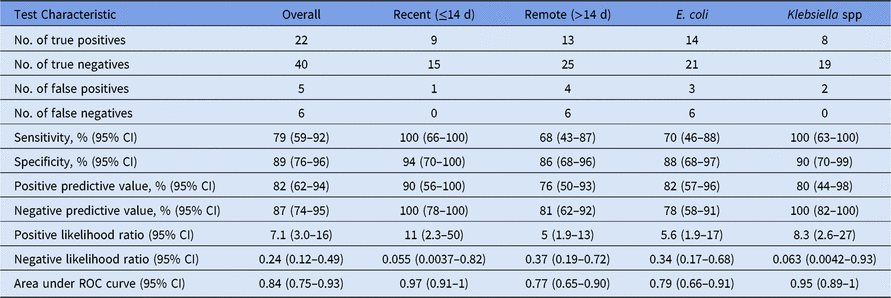
Test characteristics are summarized in Table 1 by duration between screening and sterile site results, as well as by sterile-site species. Overall, the specificity of ESBL screening swabs was 89% (95% confidence interval [CI], 76%–96%) and the sensitivity was 79% (95% CI, 59%–92%). The positive predictive value was 82% (95% CI, 62%–94%) and the negative predictive value was 87% (95% CI, 74%–95%). The positive likelihood ratio was 7.1 (95% CI, 3.0–16) and the negative likelihood ratio was 0.24 (95% CI, 0.12–0.49). In the subgroup with recent swabs, the specificity was 94% (95% CI, 70%–100%) and the sensitivity was 100% (95% CI, 66%–100%).
In a sensitivity analysis limited to genus-concordant swabs and cultures, the overall specificity of ESBL screening swabs was 98% (95% CI, 88%–100%) and the overall sensitivity was 71% (95% CI, 51%–87%). The positive predictive value was 95% (95% CI, 76%–100%). The negative predictive value was 85% (95% CI, 72%–93%). The positive likelihood ratio was 32 (95% CI, 4.6–226) and the negative likelihood ratio was 0.29 (95% CI, 0.16-0.53). In the subgroup with recent swabs and concordance, the specificity was 100% (95% CI, 79%–100%) and the sensitivity was 100% (95% CI, 66%–100%).
Test Characteristics for Using Prior ESBL Swab Screening Results to Predict ESBL Status Among Subsequent Sterile-Site Isolates of Escherichia coli or Klebsiella spp

Note. ESBL, extended-spectrum β-lactamase; ROC, receiver operating characteristic.
Discussion
Other published studies have alluded to the predictive utility of ESBL colonization. A French study found ESBL-EC (E. coli) colonization to be a risk factor for ESBL-EC bacteremia, with an OR of 11.3.Reference Denis, Lafaurie and Donay6 A Dutch study demonstrated that ESBL colonization was known at bacteremia onset in 31% of episodes. Nevertheless, only half received timely effective empiric antibiotics.Reference Frakking, Rottier and Dorigo-Zetsma7 Lastly, a Swedish study found that prior ESBL sterile-site infection was predictive of subsequent ESBL production among Escherichia coli, with an OR of 87.2.Reference Van Aken, Lund, Ahl, Odenholt and Tham8
Our study has demonstrated the utility of screening swabs for ESBL in predicting cephalosporin resistance in Enterobacteriaceae sterile-site culture isolates. A positive species-concordant ESBL screening swab would necessitate empiric carbapenem use in a population with an ESBL prevalence of 1% or more, using 20% probability of resistance as a threshold.Reference Harris, Tambyah and Lye9 Similarly, a recent negative ESBL screening swab would be enough to forgo empiric carbapenem use for an Enterobacteriaceae organism in a population with an ESBL prevalence of 45% or less, using 5% probability of resistance as a threshold. Appealingly, these screening-swabs are inexpensive and are commonly employed in many centers for infection control.
The potential limitations of this study include its retrospective, single-center design. The limited sample size resulted from the narrow indications for screening for ESBL in our center and resulted in wider confidence intervals, which may affect generalizability. Nevertheless, the restriction of the study to positive cultures from sterile sites increases confidence that included patients had clinically significant infections.
These study results indicate that ESBL screening swabs can serve as important tools for improving rates of effective empiric ESBL coverage and for tailoring antimicrobial stewardship initiatives.
Author ORCIDs
Ian A. Brasg 0000-0001-6342-3789
Financial support
No financial support was provided relevant to this article.
Conflicts of interest
All authors report no conflicts of interest relevant to this article.