Healthcare personnel frequently acquire pathogens on their hands and clothing during patient care activities. Reference Tomas, Kundrapu and Thota1 Such contamination places personnel at risk for colonization or infection with pathogens and contributes to transmission. Reference Tomas, Kundrapu and Thota1,Reference Donskey2 The use of gloves reduces the risk for hand contamination, including with Clostridioides difficile spores that are resistant to killing by alcohol hand sanitizer. Reference Johnson, Gerding and Olson3-Reference Alhmidi, Gonzalez-Orta, Cadnum, Mana, Jencson, Wilson and Donskey5 The addition of cover gowns to gloves has been shown to reduce contamination of the clothing of personnel. Reference Williams, McGraw and Schneck6 However, there is controversy regarding whether the addition of gowns offers a substantial benefit in reducing the risk for pathogen transmission. Some studies have demonstrated reductions in pathogen transmission with the use of gloves and gowns, Reference Srinivasan, Song, Ross, Merz, Brower and Perl7-Reference Boyce, Opal and Chow9 but others have not. Reference Slaughter, Hayden and Nathan10,Reference Webster and Pritchard11 Moreover, personnel often contaminate their skin and clothing during the removal of contaminated gloves and gowns. Reference Tomas, Kundrapu and Thota1,Reference Kwon, Burnham and Reske12
Simulations using benign surrogate markers can be useful in understanding the spread of pathogens and in testing interventions. Reference Tomas, Kundrapu and Thota1,Reference Oelberg, Joyner, Jiang, Laborde, Islam and Pickering13-Reference John17 Commonly used benign surrogate markers include live viruses (eg, enveloped and nonenveloped bacteriophages), viral DNA, and fluorescent tracers. Reference Oelberg, Joyner, Jiang, Laborde, Islam and Pickering13-Reference Alhmidi, John, Mana, Koganti, Cadnum, Shelton and Donskey18 The bacteriophages have characteristics similar to live pathogenic viruses (ie, susceptible to alcohol hand sanitizer and nonsporicidal disinfectants), whereas viral DNA is more similar to C. difficile spores (ie, not affected by alcohol or nonsporicidal disinfectants but denatured by bleach and reduced by mechanical washing or wiping). Reference Alhmidi, John, Mana, Koganti, Cadnum, Shelton and Donskey18 In this study, we used simulated patient care interactions to compare the effectiveness of different levels of barrier precautions in reducing the transfer of multiple surrogate markers. We hypothesized that the use of gloves would reduce transfer of pathogens and that the addition of a cover gown would further reduce transfer.
Methods
Simulated patient care interactions
The study protocol was approved by the Institutional Review Board of the Louis Stokes Cleveland VA Medical Center. The study was conducted in 2 adjacent simulated patient rooms with life-sized mannequins in hospital beds. One mannequin was contaminated with 4 benign surrogate markers and the other was not. Other items in each room included a bedside table, call button, an intravenous pole, and trash can. In randomly ordered sequence, 30 healthcare personnel performed 3 standardized examinations (90 total examinations) on 3 consecutive days of the mannequin contaminated with pathogen surrogate markers while wearing either no barriers, or gloves, or gloves plus a cover gown. The participants were provided with standardized verbal instructions during the simulations. The participants put on a clean scrub top or white coat over their clothing before each simulation. A clean stethoscope was provided before examination of the first mannequin. The standardized examinations included moving the bedside table, lowering the bed rail, examining the mannequin by auscultating the chest and palpating the abdomen and back, returning the bed rail and bedside table to their initial positions, and removing gloves and gown if worn. The participants were told to use their usual technique for donning and doffing gloves and gowns.
Following the examination of the contaminated mannequin and doffing of protective equipment, the participants were provided with access to alcohol hand sanitizer (2 mL automated dispenser), a sink for hand washing, and alcohol wipes for stethoscope decontamination. They were told to follow their usual practices for hygiene between patients. Participants in the glove or glove-and gown-group again donned their assigned protective equipment. A standardized examination of the noncontaminated mannequin was conducted as previously described, followed by removal of gloves and gown if worn. Participants were observed during the simulation. Sites on the mannequin and in the environment that were contacted were recorded and contact with the hands, stethoscope, or clothing of the participants was noted.
Culture-Swabs (Becton Dickinson, Cockeysville, MD) premoistened with Dey-Engley neutralizer (Remel) were used to sample sites on the second mannequin and on environmental surfaces. Separate single swabs were used to sample sites on the mannequin contacted only by hands and only by stethoscopes. A third swab was used to sample environmental sites contacted by hands and/or clothing. A black light (Ultra Light UV1 by Grizzly Gear, SCS Direct Inc, Milford, CT) was used to identify sites contaminated with fluorescent marker. After removal gloves or gloves and gowns if worn and prior to performance of hand hygiene, swabs were used to sample the clothing (sleeves and anterior and posterior neck) and entire hands of the participants as well as stethoscope diaphragms. The black light was used to assess fluorescent marker contamination. A commercial bleach product was used to disinfect the second mannequin and the surrounding surfaces after each simulation followed by rinsing with water. At the end of each day of testing (3–5 participants), the first mannequin was disinfected; the first mannequin was reinoculated with the markers at the start of each day of simulations. A single coordinator (H.A.) supervised and observed all simulations and collected the samples to assess contamination.
Surrogate markers used
A 4-mL solution containing the 4 benign surrogate markers was applied to the chest and abdomen of the mannequin that was examined first at the start of each day of testing. The surrogate markers included 0.5 mL fluorescent lotion (Glitterbug Potion, Brevis Corporation, Salt Lake City, UT), 107 plaque-forming units (PFU) of the nonenveloped bacteriophage MS2, 103 colony-forming units (CFU) of nontoxigenic C. difficile spores (American Type Culture Collection 43593), and 0.0001 µg of cauliflower mosaic virus DNA. Bacteriophage MS2 and nontoxigenic C. difficile spores were prepared as previously described. Reference Tomas, Kundrapu and Thota1,Reference Alhmidi, John, Mana, Koganti, Cadnum, Shelton and Donskey18 The cauliflower mosaic virus DNA marker was generated as previously described. Reference Alhmidi, John, Mana, Koganti, Cadnum, Shelton and Donskey18 Bacteriophage MS2 and nontoxigenic C. difficile spores were detected by culture, and the DNA marker was detected by polymerase chain reaction (PCR). Reference Alhmidi, John, Mana, Koganti, Cadnum, Shelton and Donskey18 When premoistened swabs were applied to the inoculated mannequin, the concentrations of MS2 and nontoxigenic C. difficile spores recovered were 104 PFU and 102 CFU, respectively.
Data analysis
The primary outcomes were the proportion of examinations of the clean mannequin in which transfer occurred. Secondary outcomes included the percentages of contamination of stethoscopes and of the clothing and hands of participants after completion of the simulations, stratified by whether the stethoscope was cleaned and/or hand hygiene was performed. We anticipated that mechanical wiping of the stethoscope would reduce all of the surrogate markers, whereas alcohol hand sanitizer would only reduce bacteriophage MS2. Reference Alhmidi, John, Mana, Koganti, Cadnum, Shelton and Donskey18-Reference Vajravelu, Vajravelu, Guerrero, Jury and Donskey20 Based on previous studies, we anticipated a transfer frequency of ~50% in the absence of barrier precautions. Reference John17,Reference Alhmidi, John, Mana, Koganti, Cadnum, Shelton and Donskey18 With 30 participants per group, we calculated 80% power to detect a 60% reduction in contamination with the use of gloves or gloves plus gowns.
Mixed-effects logistic models were used to predict transfer outcomes, both across surrogate marker types and for a composite of all markers. The types of barrier and types of surrogate marker were considered fixed effects, and random intercepts were estimated for each subject to adjust for possible correlated observations within subject. Additional transfer models incorporated hand hygiene and cleaning of stethoscopes, including assessment for interaction between transfer and detection of contamination of the stethoscope diaphragm or hands after completion of the simulations. Models also compared the frequency of contamination of hands, stethoscopes, and clothing after completion of the second simulation. Data were analyzed using R version 3.5.0 (The R Foundation for Statistical Computing, Vienna, Austria) and models were estimated using the lme4 package.
Results
Of 30 participants, 14 (46.7%) were physicians, 6 (20.0%) were nurses, and 10 (33.3%) were ancillary medical staff. Of 30 participants, 21 (70%) wore scrub shirts and 9 (30%) wore white coats. Hand hygiene was performed during 75 of 90 (83%) simulations between examination of the first and second mannequins with similar percentages of participants performing hand hygiene in each group (no barriers, 27 of 30, 90%; gloves, 23 of 30, 76.7%; and gloves plus gowns, 25 of 30, 83.3%); 4 participants (13.3%) used soap and water, 23 (76.7%) used hand sanitizer, and 3 (10%) did not perform hand hygiene during any of their simulations. Alcohol wipes were used to clean stethoscopes in 45 of 90 simulations (50%) between examination of the first and second mannequins. The percentages of participants cleaning stethoscopes between examinations was similar in each group (no barriers, 14 of 30, 47%; gloves, 13 of 30, 43.3%; and gloves plus gowns, 18 of 30, 60%). Contact between clothing and environmental surfaces occurred in 5 of 90 simulations (5.6%) and always occurred in conjunction with hand contact.
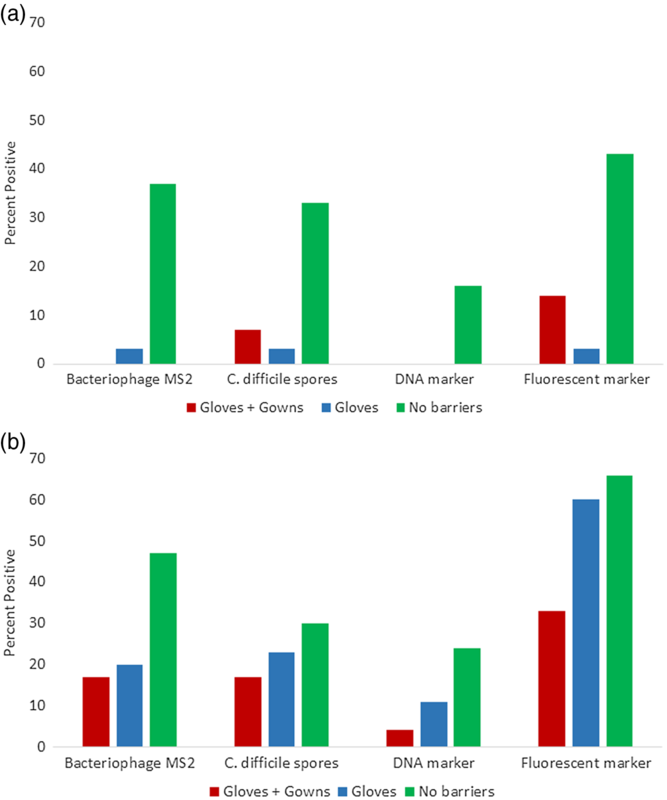
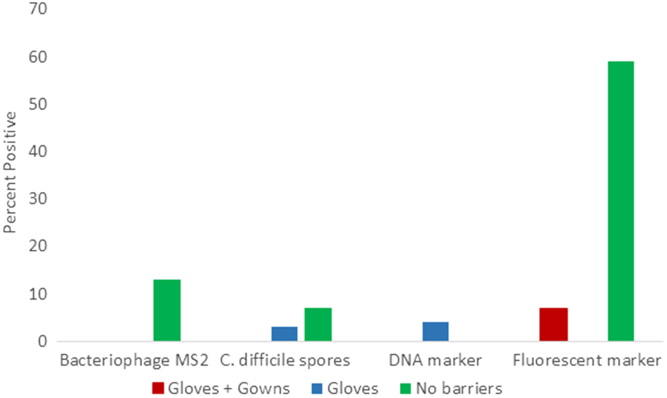
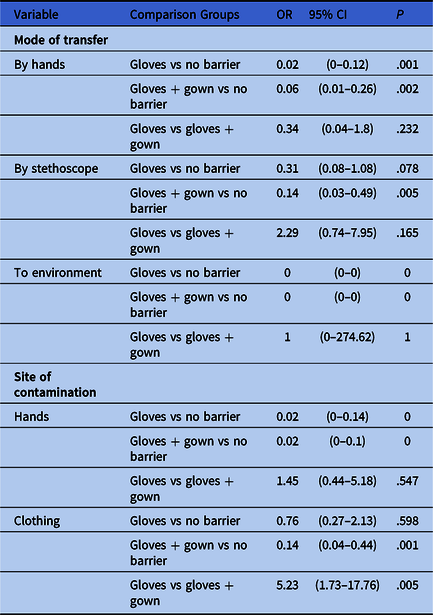
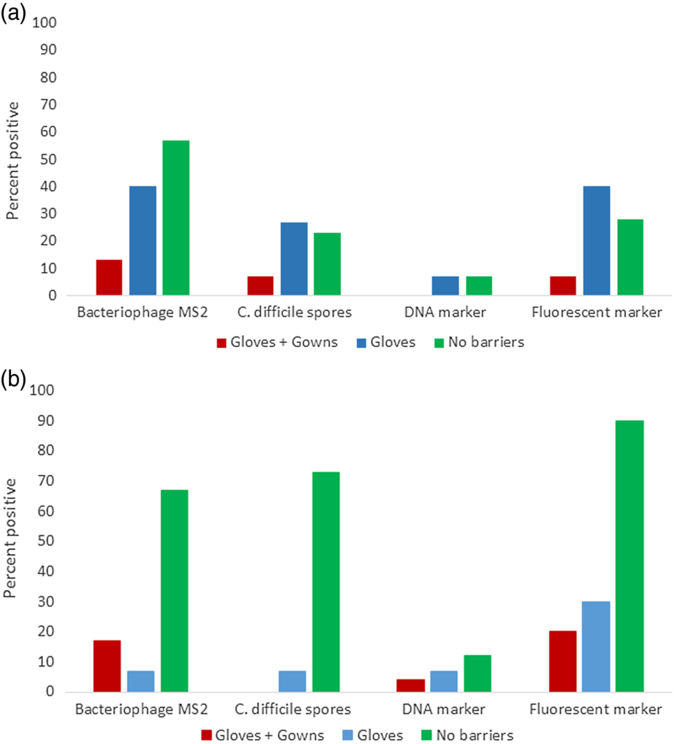
Figure 1 shows the proportion of examinations of the clean mannequin in which transfer occurred via the hands and stethoscopes of personnel. Figure 2 shows the proportions of transfer to environmental surfaces by hands and/or clothing. Table 1 provides odds ratios (OR) and 95% confidence intervals for transfer of a composite of all surrogate markers (ie, transfer of 1 or more markers) in the gloves-alone group and the gloves-plus gown-group in comparison to the no-barriers group. For the composite of all surrogate markers, transfer by hands occurred in a smaller proportion of observations in the gloves-alone group (OR, 0.02; P = .001) and the gloves-plus-gown group (OR, 0.06; P = .002) versus the no-barriers group. There was no difference between the gloves group and the gloves-plus-gown group in transfer by hands (P = .232).
Transfer of pathogen surrogate markers from a contaminated to a clean mannequin by the hands (A) and stethoscopes (B) of personnel during patient care simulations while wearing no barriers, gloves, or gloves plus cover gowns. Overall, 30 healthcare personnel participated with the order of barrier precautions randomly assigned for each participant. The percentage of positive results stratified by the type of barrier precautions is shown for 4 surrogate markers, including the nonenveloped virus bacteriophage MS2, Clostridioides difficile spores, a cauliflower mosaic virus DNA marker, and a fluorescent marker.

Transfer of pathogen surrogate markers from a contaminated mannequin to environmental surfaces during patient care simulations while wearing no barriers, gloves, or gloves plus cover gowns. Overall, 30 healthcare personnel participated with the order of barrier precautions randomly assigned for each participant. The percentage of positive results stratified by the type of barrier precautions is shown for 4 surrogate markers, including the nonenveloped virus bacteriophage MS2, Clostridioides difficile spores, a cauliflower mosaic virus DNA marker, and a fluorescent marker.

Transfer of and Contamination With a Composite of All Surrogate Markers in the Simulated Patient Interactions With No Barriers, Gloves Alone, and Gloves Plus Gowns

Note. OR, odds ratio; CI, confidence interval.
In comparison to the no-barriers group, transfer by stethoscopes was significantly lower in the gloves-plus-gown group (OR, 0.14; P = .005). Although stethoscope transfer occurred very frequently when no barriers were worn (30% for C. difficile spores, 47% for MS2, and 66% for fluorescent marker), stethoscope transfer also occurred ≥17% of the time for C. difficile spores and MS2 and ≥33% for fluorescent marker when gloves or gloves plus gowns were worn. The frequency of transfer to the environment was identical across the gloves-alone and the gloves-plus-gown groups (2 of 30 participants [6.7%] transferred at least 1 marker), and transfer in both groups was significantly lower than environmental transfer for the no-barriers group, in which 19 of 30 subjects (63.3%) transferred at least 1 marker.
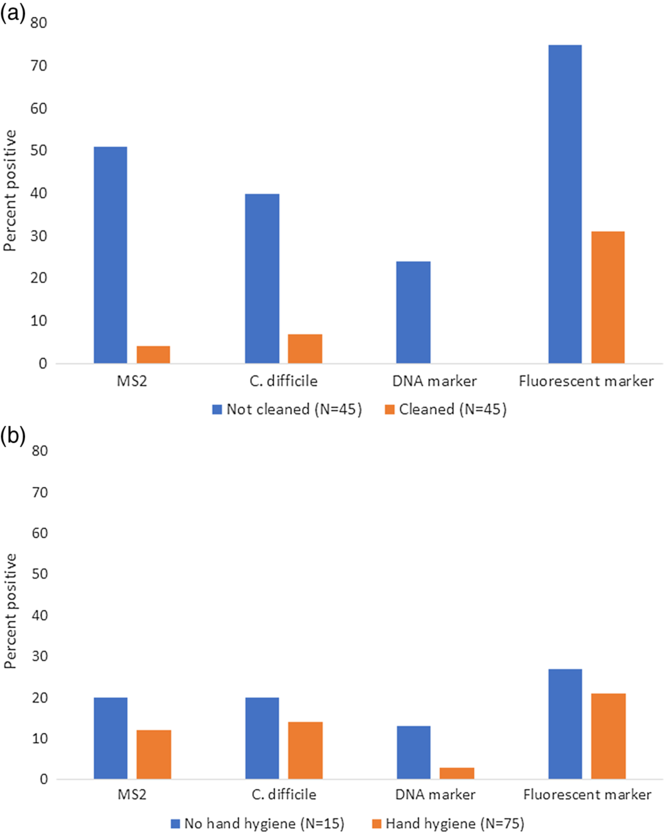
Figure 3 shows the percentage of transfer by stethoscopes (2A) or hands (2B) stratified based on whether decontamination was performed by wiping the stethoscope diaphragm (45 of 90 examinations, 50%) or hand hygiene (75 of 90 examinations, 83.3%), respectively. Cleaning of the stethoscope diaphragm was associated with a significant overall reduction in transfer of the markers by stethoscopes including after adjustment for barrier type and marker type (OR, 0.06; 95% CI, 0.02–0.14; P < .001). Using a similar model, hand hygiene between simulations was associated with a statistically significant reduction in transfer of the markers after adjustment for barrier type and marker type (OR, 0.18; 95% CI, 0.05–0.64; P = .008). Transfer of the alcohol-susceptible marker bacteriophage MS2 by hands was reduced when hand hygiene was performed versus not performed, but the difference was not statistically significant: transfer frequency, 9 of 75 (12%) versus 3 of 15 (20%) (P = .41).
Transfer of pathogen surrogate markers from a contaminated to a clean mannequin by stethoscopes (A) or hands (B) while wearing no barriers, gloves, or gloves plus gowns, stratified based on whether decontamination was performed by wiping the stethoscope diaphragm or hand hygiene. The percentage of positive results stratified by the type of barrier precautions is shown for 4 surrogate markers, including the nonenveloped virus bacteriophage MS2, Clostridioides difficile spores, a cauliflower mosaic virus DNA marker, and a fluorescent marker. Bacteriophage MS2 is susceptible to alcohol hand sanitizer, but the other markers are not affected by the use of hand sanitizer.

The general trends for transfer were similar for each of the surrogate markers, but there were some differences among the marker types (Figs. 1 and 2). The transfer frequencies of C. difficile spores and bacteriophage MS2 were similar for hands, stethoscopes, and surfaces (P > .05 for all comparisons). In comparison to transfer of C. difficile spores and adjusting for barrier type, the transfer frequency of the fluorescent tracer was significantly higher for stethoscopes (OR, 7.2; 95% CI, 3.22–17.18; P < .001) and for environmental surfaces (OR, 14.7; 95% CI, 3.31–65.42; P < .001), but not for hands (OR, 2.0; 95% CI, 0.74–5.39; P = .18). In comparison to C. difficile spores, the transfer frequency of the DNA marker was significantly lower for hands (OR, 0.3; 95% CI, 0.06–0.93; P = .05) and stethoscopes (OR, 0.32; 95% CI, 0.12–0.84; P = .02), but not for environmental surfaces (OR, 0.4; 95% CI, 0.03–3.80; P = .40).
Figure 4 shows the percentage of contamination of the participants’ clothing (4A) and hands (4B) after completion of the simulations. Table 1 provides odds ratios (ORs) and 95% confidence intervals for contamination, with a composite of all surrogate markers in the gloves-alone group and the gloves-plus-gown group in comparison to the no-barriers group. In comparison to the no-barriers group and adjusting for tracer type, hand hygiene, and stethoscope cleaning, significant reductions in contamination of clothing occurred in the gloves plus gown group (OR, 0.14; P = .001) but not in the gloves-alone group. Clothing contamination was significantly more common in the gloves-alone group versus the gloves-plus-gown group (OR, 5.23; P = .005).
Contamination of participants’ clothing (A) and hands (B) after completion of simulated patient care activities to assess transfer of pathogen surrogate markers from a contaminated to a clean mannequin while wearing no barriers, gloves, or gloves plus gowns. The percentage of positive results stratified by the type of barrier precautions is shown for 4 surrogate markers, including the nonenveloped virus bacteriophage MS2, Clostridioides difficile spores, a cauliflower mosaic virus DNA marker, and a fluorescent marker. Bacteriophage MS2 is susceptible to alcohol hand sanitizer, but the other markers are not affected by use of hand sanitizer.

In comparison to the no-barriers group, wearing gloves plus gowns or gloves alone was associated with a significant reduction in contamination of hands. Hand contamination was not significantly different in the gloves-plus-gowns and the gloves-alone groups. Notably, 20 of 30 (66.7%) participants wearing no barriers had hand contamination with bacteriophage MS2 after the simulations, including 17 of 27 (63.0%) who performed hand hygiene and 3 of 3 (100%) who did not perform hand hygiene.
Discussion
In simulations of patient care, we found that wearing gloves or gloves plus gowns markedly reduced hand transfer of multiple surrogate markers. However, transfer of the surrogate markers by stethoscope diaphragms was common both in the presence and absence of glove and gown use. Wiping the stethoscope diaphragm and performing hand hygiene between patient care simulations were associated with significant reductions in transfer of the surrogate markers. The addition of gowns to gloves did not reduce the risk for hand transfer but was associated with significant reductions in the contamination of clothing after completion of the simulations and in transfer by stethoscopes. These findings have important implications for efforts to prevent transmission of healthcare-associated pathogens.
Our results suggest that stethoscopes may be an underappreciated vector for pathogen transmission. Previous studies have demonstrated that stethoscopes often become contaminated with healthcare-associated pathogens. Reference Vajravelu, Vajravelu, Guerrero, Jury and Donskey20,Reference Longtin, Schneider and Tschopp21 Our findings expand on these studies by demonstrating the potential for stethoscopes to transfer viral and bacterial pathogens from patient to patient. Decontamination of stethoscopes by wiping or applying alcohol hand sanitizer has been shown to be effective in reducing contamination, Reference Mehta, Halvosa, Gould and Steinberg22,Reference Faulx, Emig and Alhmidi23 and wiping stethoscopes was effective in reducing transfer of the surrogate markers in the current study (Fig. 3A). Although stethoscope diaphragms were wiped in half of the simulations, stethoscopes are rarely cleaned in clinical settings. Reference Mehta, Halvosa, Gould and Steinberg22 There is a need for education of personnel regarding the potential for stethoscopes to transfer pathogens. Interventions such as dedicated individual patient scopes or disposable stethoscope covers also could be considered.
Our results are consistent with previous studies that have suggested that cover gowns may not add substantial benefit over gloves alone in preventing transmission of healthcare-associated pathogens. Reference Slaughter, Hayden and Nathan10,Reference Webster and Pritchard11 However, there are some caveats to this interpretation. As has been demonstrated in previous studies, Reference Williams, McGraw and Schneck6 the addition of cover gowns significantly reduced the frequency of contamination of the clothing of personnel. In the simulations, 70% of participants had short sleeves with scrub shirts worn over their clothing and contact between clothing and environmental surfaces was uncommon (6% of simulations). Cover gowns might have provided a greater benefit if long-sleeved clothing had been worn more often or if the simulation had incorporated activities requiring greater contact between clothing and surfaces or patients. Long-sleeved uniforms have been shown to be a potential vector for pathogen transfer. Reference John17
One notable finding from our study was that bacteriophage MS2 was transferred by hands 12% of the time even when hand hygiene was performed (Fig. 3B). Moreover, MS2 was recovered from hands after 66.7% of simulations with no barriers, including 63.0% of these simulations when hand hygiene was performed between simulations. Factors such as suboptimal hand hygiene technique or recontamination of hands after performance of hand hygiene (eg, touching contaminated clothing or stethoscopes) could contribute to the failure of hand hygiene to prevent hand contamination and transfer of the virus. In addition, MS2 is a nonenveloped virus that may be much less susceptible to alcohol hand sanitizer that enveloped viruses or vegetative bacterial pathogens. Reference Sickbert-Bennett, Weber, Gergen-Teague, Sobsey, Samsa and Rutala24 Finally, the burden of virus on hands was relatively high. However, similar high burdens of viral contamination have been demonstrated in clinical settings. Reference Boone and Gerba25 Thus, our findings highlight the potential benefit of wearing gloves to prevent acquisition of pathogens on hands as hand hygiene may provide less-than-perfect protection.
Our study has some limitations. Simulations provide valuable information on pathogen transfer, but they cannot mimic all conditions present in clinical settings. The burden of pathogens used in the simulations may be higher than is present in many clinical settings. Personnel participating in simulations may have followed more stringent infection control practices than they would in actual practice (eg, stethoscope cleaning was much higher in the simulations than has been observed in practice in our facility). Reference Faulx, Emig and Alhmidi23 Participants were told to follow their usual practices for hygiene between examinations, and no hand hygiene was performed during 17% of the simulations. However, even when only simulations that included hand hygiene were included in the analysis, transfer by hands occurred at significantly lower frequency in the gloves-alone group and the gloves-plus-gown group (data not shown). Although glove use reduced transfer, there is concern that in practice the benefits of gloves might be offset by a reduction in compliance with hand hygiene in personnel wearing gloves. Reference Flores and Pevalin26,Reference Cusini, Nydegger, Kaspar, Schweiger, Kuhn and Marschall27 Use of same PPE for examination of the contaminated and clean mannequins could have enhanced the benefit of either gloves plus gowns or gloves alone as in clinical practice no barriers might be appropriate during examination of the clean mannequin. Finally, the assessment of contamination was nonquantitative.
In conclusion, wearing gloves or gloves plus gowns was effective in reducing hand transfer of pathogens in simulations of patient care. However, our findings suggest that protective equipment may fail to prevent transmission if efforts are not made to address transfer by devices such as stethoscopes. Cover gowns were effective in reducing the risk for contamination of the clothing of personnel, but further studies are needed to clarify whether they offer a benefit in reducing the risk for transmission.
Acknowledgments
The authors thank the healthcare personnel at the Cleveland VA Medical Center for their participation in the study.
Financial support
This work was supported the Centers for Disease Control and Prevention (contract no. 2018-27564 to C.J.D.) and by the Department of Veterans’ Affairs.
Conflicts of interest
C.J.D. has received research grants from Pfizer, Clorox, PDI, and Boehringer Laboratories. All other authors report no conflicts of interest relevant to this article.