1. Introduction
Since China adopted democratic elections at the grassroots level after the 1987 villagers' committee (VC) elections, one of the most important puzzles regarding these elections is whether the elections will be a force driving regime transition or maintaining social stability in China (Schubert, Reference Schubert2002, Reference Schubert2003). This question is in line with current strands of theoretical developments in electoral authoritarianism (Levitsky and Way, Reference Levitsky and Way2002; Schedler, Reference Schedler2006; Lindberg, Reference Lindberg and Lindberg2009), which raise a similar debate over whether elections will serve as a governance tool for autocratic leaders or a trigger of the democratization process for the general public. This question is also key to China's policy practices. According to China's official statement, the so called ‘whole-process democracy,’ including grassroots elections, has successfully enhanced Chinese people's satisfaction with their life regarding the practices of political rights in China.Footnote 1 Yet from the western point of view, the adoption of grassroots elections is still far from real democracy. The influence of grassroots elections on the general public's life in China serves as an indicator to evaluate the success of democracy with Chinese characteristics.
While a great deal of research has attempted resolve this debate, the answer remains inconclusive. Many researchers have found that grassroots electionsFootnote 2 and electoral participation in China provide legitimacy to the Chinese Communist Party (CCP) because elections improve local governance (Manion, Reference Manion1996; Heberer and Schubert, Reference Heberer and Schubert2006). Others argue that grassroots elections have been incrementally changing public opinion toward a more favorable attitude towards democracy (Zweig, Reference Zweig2002; He, Reference He2006). Some scholars believe that grassroots elections in China may have simultaneously and paradoxically stabilized the regime and undermined it (Sun, Reference Sun2014). However, although a wealth of evidence shows that elections are associated with the formation of public opinion towards the regime, there is little evidence suggesting that elections change citizens' political behavior or prevent public resistance to the regime. Thus, while elections promote the public's image of the regime, do they also defuse the tension between the state and society in a way that lowers citizens' incentives to participate in contentious activities that will destabilize the regime?Footnote 3 This remains an unanswered question.
In this paper, I examine the attitudinal and behavioral consequences of holding elections in local China. Specifically, I look at the relationships between the citizens' awareness of elections, and their trust in government, involvement in collective activities against the authority, and their use of official channels to express their grievances. I argue that grassroots elections have neither a stabilizing nor a democratizing effect on the regime. Instead, elections exert a mixed effect: on the one hand, elections decrease citizens' motivations to join contentious collective activities, while on the other they increase people's use of government-sponsored channels to express their concerns. This argument is based on the idea that elections are not grievance-reducing but trust-enhancing mechanism. Since economic grievances have been a major cause of contentious activities in China and elections do not provide substantial solutions to the issues facing citizens, a mechanism to express their grievances is still required. As such, I expect that citizens who are aware of elections will pursue official channels as an alternative to popular protests to express their opinions. I test this argument using the Chinese General Social Survey 2010 and find empirical support for the proposition that public awareness of elections does bolster popular trust in government and decreases citizens' involvement in dissident collective action against the authorities. At the same time, elections encourage citizens to visit upper-level officials to express their discontent about local issues (the mechanism is called shangfang (letters and visits),Footnote 4 an official institution for ordinary Chinese to report their grievances or misconduct by grassroots cadres). The implication from this article is that elections conditionally stabilize the regime. While elections serve the CCP's purpose of social stability, they also increase pressure from the public within the system. When official channels for grievance resolution work effectively, elections can legitimize the regime. However, as official channels fail to deal with citizens' concerns, elections may eventually facilitate the process of democratization, for ultimately citizens will demand a system that can resolve their grievances.
The rest of this article is organized as follows. In the second section, I briefly review the literature on elections and regime stability in authoritarian contexts and elaborate on the importance of China's case study. In the third section, I turn to a discussion of current studies about the effects of grassroots elections on public opinion in China. Following this discussion, I develop a theoretical argument along with three testable hypotheses in the fourth section. In the fifth section, I describe the data and operationalization of the variables. Discussions of the empirical analysis are presented in the sixth section, and implications and conclusions are provided in the final section.
2. Elections and regime sustainability
Elections are one of the essential elements of democracy. Nevertheless, elections are widely adopted in authoritarian countries as a nominal democratic institution for regime legitimacy. Evidence shows that the type of regime governed by authoritarianism but holds regular elections is highly prevalent (Svolik, Reference Svolik2012; Seeberg, Reference Seeberg2013). For dictators, elections do not work as an instrument for transmitting public preferences to the leadership and influencing policies. Rather, it acts as ‘instruments of authoritarian rule’ that help autocrats legitimize their rule (Linz, Reference Linz, Hermet, Rose and Rouquié1978; Powell, Reference Powell2000; Schedler, Reference Schedler2002). Scholars consider countries that adopt democratic institutions but remain authoritarian rule as neither democracy nor pure authoritarian regimes, but a form of hybrid regime termed as competitive authoritarianism (Carothers, Reference Carothers2002; Diamond, Reference Diamond2002; Levitsky and Way, Reference Levitsky and Way2002; Schedler, Reference Schedler2002).
Elections in authoritarian regimes function as more than just window-dressing for dictatorships. From the view of elite politics, holding elections helps sustain authoritarian governance in a way that institutionalizes the existing power distribution. Evidence has shown that competitive multiparty elections prolong authoritarian rule. Gandhi and Przeworski (Reference Gandhi and Przeworski2007), for instance, find that authoritarian incumbents who institutionalize elections and legislatures in political systems remain in power for 5 years longer on average than those who do not adopt these democratic institutions. Elections are also found to be a tool to strengthen authoritarian resilience because they can provide information to incumbents on the regime's popularity; this appears to be a function of Vietnam's congress elections (Malesky and Schuler, Reference Malesky and Schuler2011). Elections can as well help construct a patronage network for rewarding loyal followers, as they operate in Middle Eastern countries (Lust-Okar, Reference Lust-Okar2009). For incumbents, multiparty elections signal rulers' credible commitment in power sharing. When incumbents can win a landslide victory, it shows the invincibility of the incumbent party, as was observed in the Mexican case before 2000 (Magaloni, Reference Magaloni2006). Thus, elections may lead to democratic transition only if the incumbent is weak and the opposition is powerful enough to pressure the regime to change (Donno, Reference Donno2013). In other words, as long as authoritarian rulers can effectively manage electoral competition and outcomes, elections stabilize authoritarian regimes (Brownlee, Reference Brownlee2009; Svolik, Reference Svolik2012).
However, from the view of public opinion, elections may eventually topple autocracy in the long run, since elections usually initiate democratic learning. For instance, Mattes and Bratton (Reference Mattes and Bratton2007) find that in African countries under democratic transitions, people learn the contents of democracy through their knowledge and awareness of political affairs. With regular elections, the public gradually perceives elements of democracy, such as voting and competition. Further, they believe that they ought to be able to influence their rulers and government policies. Democratically educated citizens would pursue further political reforms to facilitate democratization. This institutionalist argument can be traced to the observation of the linkages between elections and the democratization process, in which students in comparative politics posited that democratization could be triggered by citizens embedded in democratic institutions (Rustow, Reference Rustow1970; Dahl, Reference Dahl1971; Hermet, Reference Hermet, Hermet, Rose and Rouquié1978). The democratizing effect of elections is empirically supported by current scholarship as well. Lindberg (Reference Lindberg2006) reports that in Africa under third-wave democratization, repeated elections played a crucial role in prompting the democratization processes. Research on a global sample also finds that holding elections regularly increases the chance of democratization in electoral authoritarianism (Edgell et al., Reference Edgell, Mechkova, Altman, Bernhard and Lindberg2015).
Moreover, institutionalized elections may become an avenue for popular protests. For example, the ‘color revolutions’ in post-communist authoritarian regimes were partially stimulated by public dissent over electoral fraud, which eventually brought down incumbents (Tucker, Reference Tucker2007; Bunce and Wolchik, Reference Bunce and Wolchik2010; Beaulieu, Reference Beaulieu2014). Elections, particularly unfair ones, can backfire and decrease the public's political support for the regime. For instance, Rose and Mishler (Reference Rose and Mishler2009) find that perceived unfairness in the 2007 duma elections has led to a decline in popular support for incumbents in Russia.
While arguments for the democratizing effects of authoritarian elections have received empirical examination, some fundamental questions remain underexplored. First, despite the sturdy theoretical foundation in the research on electoral authoritarianism, the empirical justification for the micro-foundation, particularly the linkage between the public's preference for democratization and the adoption of elections, is insufficient (Pietsch et al., Reference Pietsch, Miller and Karp2015). Whether holding elections can be a driving force for political transition involves a causal chain in which elections implant democratic values in the public and encourage anti-regime activities among citizens that could ultimately destabilize authoritarian rule. In this causal progression, the change in the public's political values is rarely tested.
Second, the current research excludes one-party regimes where multiparty elections remained prohibited at the national level. In fact, however, elections could be more detrimental to rulers in one-party regimes because experiencing democratic institutions at the local level may generate public sentiment against undemocratically selected top-level leadership. This reaction to one-party regimes is less likely in electoral authoritarianism where top leaders come to power through competitive, though manipulated, elections. Incorporating one-party regimes into the analysis of authoritarian elections expands the scope of electoral authoritarianism. Furthermore, it contributes to the generalization of the current thesis on the effects of elections on authoritarian survival. This paper attempts to fill the gap by evaluating how grassroots elections adopted by the one-party regime in China can influence public attitudes and behaviors toward the incumbent government.
3. Elections and regime sustainability in China
In China, elections are allowed by the Communist Party at the local level with limited competition. Unlike the developments of electoral politics in Western society, grassroots elections were first introduced by the Chinese government in 1980s to resolve local governance issues as well as to recruit local elites as regime supporters (Kelliher, Reference Kelliher1997; Shi, Reference Shi1999b; O'Brien and Li, Reference O'Brien and Li2000; Tan, Reference Tan2009). In these local elections, opposition parties and organized campaigns are prohibited. The only way for ordinary citizens to run for office is to self-nominate to be candidates in elections. In elections for higher-level government units, such as county-level congresses, although citizens are allowed to cast their votes, they are not permitted to run for office. Despite these limitations, unlike Soviet-style elections where voters had no choices between candidates but could only approve the persons preselected by the Party, China stipulates that electoral procedures must employ a secret ballot and that elections should include multiple candidates for each office. In this respect, elections are meaningful to ordinary Chinese as they provide citizens with the right to practice democracy by selecting local leaders through voting as per preferences. Further on, I briefly review existing studies on the effects of these elections on Chinese citizens' political attitudes.Footnote 5
Research on China's grassroots election has revealed some impact of rural and urban committee elections on public attitudes toward the communist regime. Scholars have reported that participation in grassroots elections has produced essential effects on the public's political awareness of democracy. Li (Reference Li2001) found that villagers from villages where contested elections are held are more likely to engage in petitions than those from villages holding noncompetitive elections. His further research (Li, Reference Li2003) also confirms that rural elections significantly enhance villagers' external efficacy – villagers feel that they are more capable of influencing government policy-making after their first free and fair elections. Zweig (Reference Zweig2002) used survey data from Zhejiang and found that village elections have implanted democratic value in rural areas. Sun (Reference Sun2014) also argued that rural elections have empowering effects on villagers – villagers who participate in elections exhibit higher levels of support for democracy. Additionally, Kennedy (Reference Kennedy2009: 395) finds that village committee elections received popular support from villagers. He thus argues that voting in elections as a democratic practice will further initiate the institutionalization of democracy.
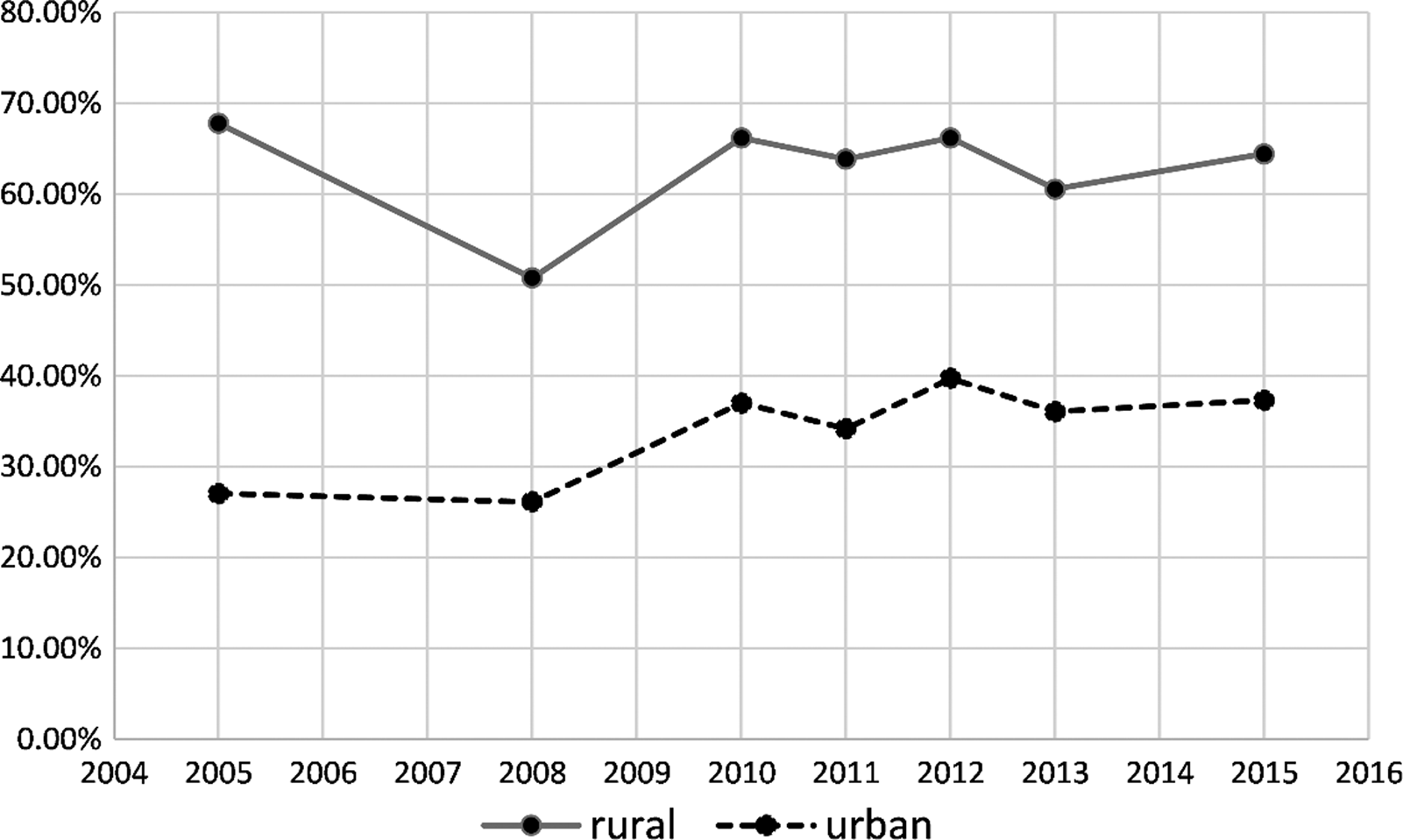
Notably, while grassroots elections are regularly held in China, significant differences exist between rural and urban elections (Chen and Yao, Reference Chen and Yao2005; Gui et al., Reference Gui, Cheng and Ma2006; Xiong, Reference Xiong2008; Tzeng, Reference Tzeng2020). Generally speaking, research brought out the facts that rural residents show a higher interest in taking part in VC elections than their counterparts in urban areas in residents' committee (RC) elections since rural residents have larger stakes in elections than urbanites as VCs, according to the Organic Law of Villagers Committee, are entitled to distribute local financial resources and manage the villages' collective assets while residents committees in urban areas are not given equivalent power (Gui et al., Reference Gui, Cheng and Ma2006). Therefore, not surprisingly, villagers engaged in electoral politics more actively than urban residents when it came to grassroots election participation (Xiong, Reference Xiong2008). Survey data from the CGSS also proved the rural–urban divide. For instance, Figure 1 shows the voter turnout rate from 2005 to 2015 using CGSS datasets. The voter turnout rate was around 60% in rural elections and was lower than 40% in urban areas. Considering such a large and diversified population engaging in elections, will become a sign for democratization or regime stability is a vital question for the political development in China.
Voter turnout rate in China's grassroots elections by year.

The argument that electoral participation will drive China's democratization is not self-evident, however. Several works point to the strengthening effect of electoral participation on the CCP regime. Schubert (Reference Schubert, Heberer and Schubert2009) and Heberer (Reference Heberer2009) conclude from their field observations in rural and urban committees that grassroots elections have played a role in channeling popular grievances to local governments, thereby improving policy implementation with popular support. They believe that local elections have reduced citizens' propensity to challenge local governments. Manion (Reference Manion2006) analyzed a representative survey and argued that voting in competitive elections with free and fair procedures could increase ordinary villagers' trust in government officials. Similarly, Ma and Wang (Reference Ma and Wang2014) reported that villagers experiencing quality electoral processes have higher levels of trust in the township government than those who do not have such experiences. Sun (Reference Sun2014) found that electoral participation promotes democratic values among villagers while at the same time enhancing their trust in the authoritarian government.
Based on empirical evidence, a temporary consensus seems to be that grassroots elections entail dual effects: elections enhance the legitimacy of the CCP regime but implant democratic values among the public simultaneously (Zweig, Reference Zweig2002; Sun, Reference Sun2014). However, the current studies have not driectly investigated the relationship between elections and popular contentious behavior. Using electoral participation and trust in government to evaluate regime stability would sometimes confuse the relationship. As Shi (Reference Shi2000: 557) pointed out from his survey research, electoral participation could be a result rather than a cause of public preference over democracy or support for the government. Indeed, previous research determines that democratic orientation or trust in government affects people's tendency to participate in grassroots elections but not the other way around (Shi, Reference Shi1999c; Zhong and Chen, Reference Zhong and Chen2002; Tao et al., Reference Tao, Su, Sun and Lu2011).
In addition, citizens could attach different meanings to ‘the government,’ particularly in the Chinese context, where trust in government usually involves multiple levels of authority (Li, Reference Li2004; Lü, Reference Lü2014; Zhong, Reference Zhong2014). Although popular trust in government is widely regarded as a source of authoritarian regime legitimacy, there has been no further evidence showing that trust can demobilize the public and prevent mass incidents that may threaten the authoritarian regime's stability, such as popular protests or organized dissident movements. Trust in government does not necessarily make citizens self-constrained in challenging authoritarian rule or abstaining from joining dissident collective action. Theoretically, trust in the central government may even encourage citizens to air their grievances against local authorities through mobilized protests or institutionalized petitions because they believe that upper-level governments will support their activities (Li, Reference Li2008). To understand the relationship between holding elections and CCP regime stability, we need to further evaluate the relationship between elections and public resistance to the regime. The next section explores the effect of the public's awareness of elections on participation in dissident collective action and in institutional channels for grievance resolution to clarify whether holding grassroots elections will substantially improve regime stability.
4. Awareness of elections and social stability in China
To shape public attitudes toward the regime, elections need to be meaningful and known by citizens. Ritualized political events such as the elections in the Soviet Union offer no material or psychological value to citizens and thus have a limited effect on public opinion toward the regime. In this paper, I look specifically at grassroots elections in China: rural VC elections and urban RC elections. As mentioned, in China, there are elections at multiple levels of governing units, among which only the VC and the RC elections allow Chinese citizens to select the leaders of local communities through competitive elections. In contrast, county and township people's congress elections are not for selecting local leaders but only for electing congress members, whose candidacies are usually predetermined by the party (Li, Reference Li2002; Dong, Reference Dong2006; Yuan, Reference Yuan2011; Manion, Reference Manion2014: ch. 2). In addition, elections in rural and urban communities are freer and fairer, and more influential on local governance than other types of elections in China. Grassroots elections not only engage Chinese people in democratic voting processes, but they also substantially enhance local leaders' accountability (Manion, Reference Manion1996; Brandt and Turner, Reference Brandt and Turner2007; Wang and Yao, Reference Wang and Yao2007; Luo et al., Reference Luo, Zhang, Huang and Rozelle2010). Therefore, the chance that ordinary Chinese people can learn and practice democracy is much higher in grassroots elections than in local congress elections.
The Chinese central government institutionalizes grassroots elections in national laws in order to establish authority for a bottom-level democratic system to alleviate social disturbance after economic marketization (Kelliher, Reference Kelliher1997; Shi, Reference Shi1999b; O'Brien and Li, Reference O'Brien and Li2000; Tan, Reference Tan2009). However, the entire population is not well informed about these elections, largely because of the selective implementation of election laws by local governmentsFootnote 6 and the fact that these elections are not synchronized (Tan, Reference Tan2009). The Chinese central authorities promulgated the electoral laws and delegated the power of implementing elections to local officials. Yet local officials have different incentives in offering authentic elections, and many of them choose not to adopt competitive elections at all (MacFarquhar, Reference MacFarquhar1998; Shi, Reference Shi1999a; Manion, Reference Manion2000). This makes citizens' learning experiences in elections unequal across subdivisions and subject to local officials' willingness to offer competitive elections. In local communities, whose party officials are willing to implement elections, citizens will be aware of and learn about elections, whereas in communities where local officials manipulate elections or block information about elections from reaching the residents, citizens usually do not know about such elections.
Public awareness of elections can alter citizens' perception of the authoritarian regime, create a positive evaluation of the regime, and eventually decrease their intention to become involved in dissident collective action that destabilizes the government. Holding elections influences public attitudes toward the regime in many ways. One of the most important ways for authoritarian rulers is to improve the image of the government or show the authoritarian incumbents' willingness to share power (Magaloni, Reference Magaloni2008). For the public, exposure to democratic elections informs citizens that the regime is attempting to hear the public's voice and incorporate their voice into the policy-making process. When citizens are aware of elections, they may be more likely to trust the political institutions setup by the government. Additionaly, they will be willing to exercise their political rights granted by the authoritarian regime, such as voting for state-appointed candidates (Heberer, Reference Heberer2006). As such, holding elections and letting residents perceive their political rights would enhance residents' support for the government. As Idiscussed, electoral participation substantially increases individual trust in the government and enhances voters' sense of political efficacy (Li, Reference Li2003; Sun, Reference Sun2014).
Based on improved trust, higher levels of public awareness of elections can thus lower the chance that the public will get involved in collective contentious activities against the regime's interests. In addition, elections provide an institutional alternative to political participation or opinion expression. In authoritarian countries, the lack of institutions for political participation is a cause of mass protests that destabilize the regime, as the only way for citizens to express concerns is through collective activities. Thus, grassroots elections can play a positive role in decreasing the destabilizing tendency of mass protests. When citizens are aware of elections, they know that they have the right to vote against unpopular local officials or at least express their discontent to higher-level authorities (Shi, Reference Shi1999c). Under this condition, awareness of elections may discourage the public from going to the street. Compared to citizens who are aware of elections, those who are not aware of elections will be less subject to being persuaded to employ more conventional alternatives for political participation.
Accordingly, individuals who are aware of grassroots elections will develop a higher level of trust in the government and will be less likely to be involved in collective dissident activities, such as participating in, donating to, or emotionally supporting collective protests, strikes, or demonstrations, all of which are considered by the government as anti-regime activities. In contrast, those who have no awareness of grassroots elections will not develop institutional trust in government and will be more likely to engage in these activities.
Hypothesis 1: All else being equal, people who are aware of grassroots elections will have higher individuals' levels of trust in the authoritarian government in China than those who are not aware of such elections.
Hypothesis 2: All else being equal, people who are aware of grassroots elections will have lower incentives to get involved in collective dissent activities than those who are not aware of such elections.
However, while elections can act as a buffer against democratizing pressure by enhancing citizens' trust in the government, they do not provide substantial solutions to popular grievances resulting from economic reform, which is a major reason why citizens engage in collective dissent activities in present-day authoritarian regimes. After the 1989 Tiananmen movement, most of China's mass incidents did not involve calls for democratic reforms at the national level. Instead they are grievance-based protests (Chan et al., Reference Chan, Backstrom and Mason2014). Laborers strive for pensions, job security, and salary increases (Lee, Reference Lee2007). Peasants resist unreasonable fees, levies, and land seizure from local governments (Guo, Reference Guo2001; O'Brien et al., Reference O'Brien, Li, McAdam, Tarrow and Tilly2006; Chen, Reference Chen2012). Citizens and farmers march against the environmental pollution caused by industrial expansion (Deng and Yang, Reference Deng and Yang2013). These grievances are growing rapidly as a byproduct of economic development. They have consistently aroused various levels of mass incidents that have forced the Chinese government to adjust its policies to address these grievances (Cai, Reference Cai2010). Although holding elections can promote local governance by improving local party officials' competence and accountability, indirectly mitigating social pressure for political reform, it is still difficult for elections to fundamentally eliminate social grievances.
Accordingly, elections will decrease the public's motivation to challenge the state. However, it should not be expected to decrease popular complaints about the grievances people have suffered. Resultantly, we should see that elections encourage citizens to choose official dispute resolution mechanisms rather than dissident collective activities that the regime considers illegal to convey their concerns to the government. In other words, the awareness of elections enhances the chance that citizens will adopt government-sponsored institutions to deal with their grievances. A similar observation can be traced to the social movement literature.It argues that opening the political system, such as liberalizing elections, will reformulate the political opportunity structure and increase the public's willingness to express their discontent to the regime through conventional, institutional mechanisms (Tilly, Reference Tilly1978; Kitschelt, Reference Kitschelt1986; Tarrow, Reference Tarrow1994). However, opening political systems does not necessarily mean that a regime is more vulnerable to popular protests. By contrary, openness can incorporate protests into the system. As Hipsher (Reference Hipsher, Mayer and Tarrow1998: 157) writes, ‘one of the ironies of democratization cycles is that the social movements that lead the push for democracy tend to become institutionalized once democracy becomes a reality.’ Cases such as the democratization of Chile and Brazil in the 1980s led social movement elites to choose elections and congresses instead of strikes or protests as a tool to influence policies (Hipsher, Reference Hipsher, Mayer and Tarrow1998).
Following a logic similar to Hipsher's argument, I expect that elections can channel social discontent into institutions that are manageable for the authoritarian regime. Since elections lead the public to expect greater responsiveness from the government, they will be more willing to adopt the mechanisms provided by the government to voice their opinions. In China, almost all organized collective dissident activities on the streets are considered illegal by the regime. For disgruntled citizens, an institutional way to express complaints and grievances can deliver their discontent to the upper level government officials by directly visiting those officialsFootnote 7 (shangfang) orsending complaints to them by mail. These institutional channels are established by the CCP to ‘gather information on popular responses to government policies and monitor the behavior of lower-echelon bureaucrats’ (Shi, Reference Shi1997: 234). Not surprisingly, scholars find that citizens' use of these official channels is associated with their support for the regime: the more citizens support the regime, the more likely they will be to choose official channels to air their complaints (Chen, Reference Chen2004: ch. 6). If awareness of elections enhances popular trust in government, it could just as well encourage citizens to adopt this official avenue to resolve their grievances.
Moreover, elections provide information for citizens that local party elites are subject to popular votes, which may embolden citizens to use institutional approaches to dispute resolution. In China, citizens are concerned about retaliation from local governments when they decide to go to upper-level governments to complain about local authorities (Chen, Reference Chen2004: 162). When local authorities cannot arbitrarily dominate local politics, and abuse their power to repress residents, people are more willing to use official channels to air their grievances. Elections show that people have the right to checkthe power of local governments. If citizens are aware of elections, the local government's failure to implement elections usually leads to complaints of citizens to ‘preserve’ their own rights. For instance, in Chen's research on villagers' shangfang behavior, villagers frequently go to higher authorities to complain about local governments' manipulation and unfairness in elections (Chen, Reference Chen2012). This suggests that awareness of elections creates incentives for the public to express discontent within the system.
Hypothesis 3: All else being equal, people who are aware of grassroots elections will be using shangfang mechanisms to express individual discontent more frequently than those who are not aware of such elections.
To sum up the theoretical argument, I argue that neither a democratizing nor stabilizing effect would precisely describe the relationship between elections and regime stability. Instead, from the view of political behavior, elections exert an institutionalizing effect: public awareness of elections can improve the public's trust in the government, thereby decreasing the public's willingness to get involved in activities that destabilize the regime. However, this does not essentially resolve social groups' grievances. Hence, as an alternative, those who are aware of elections and trust the government will choose to use official channels to express their discontent. In other words, elections can help prevent mass incidents from happening not because grievances are resolved, but because they help to institutionalize the public's dissent into the system.
5. Data and variables
To test the hypotheses, I employ the Chinese General Social Survey (CGSS 2010) dataset, a national survey dataset collected in 2010 by the National Survey Research Center at Renmin University of China (NSRC). The interviews were conducted through stratified probability sampling to select respondents, all of whom were aged 18 years or older. The response rate was 74.32% and the final number of valid observations (respondents) was 11,783. The nationwide large sample allows us to show the complete picture of public opinion in China with regard to their awareness of elections and intentions of getting involved in contentious behaviors or complaining through official channels. In this section, I discuss the operationalization of variables and specify the empirical strategy for testing the hypotheses.
It should be noted that while the CGSS project was launched in 2003 and the data were released every year (the latest released version is CGSS2017), only CGSS2010 contained questionnaires about respondents' participation behavior in contentious activities, which makes it the best available data for the purpose of testing our hypothesis. One caveat regarding the data could be that in recent years, the Chinese government strengthened political control over society, including the grassroots units. This tightened grip on power has changed the political contours of rural and urban electoral politics. Subsequently, after Chinese leader Xi Jinping came to power in 2012, the Communist Party tried to regain its hold on power for grassroots politics, which led to less autonomous rural and urban self-governing committees. This transition might not have been precisely captured by merely using the data from a decade ago. Nevertheless, the grassroots political system has not been overhauled. In addition, rather than identifying the political reconstruction in the Xi era, the research focus in this article is to investigate the general pattern of whether the public's awareness of elections is associated with their attitude toward the government and behavior in protests as well as official channels to air grievances. Using CGSS2010 therefore is an adequate methodological strategy in our empirical testing.
5.1 Dependent variables
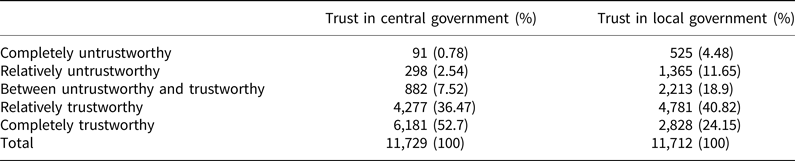
The hypotheses involved several dependent variables. Hypothesis 1 proposes that awareness of elections will improve people's trust in government. I evaluate trust in government using the question ‘what do you think the following organizations in terms of the level of trust?’ The scale is (1) completely untrustworthy, (2) relatively untrustworthy, (3) between untrustworthy and trustworthy, (4) relatively trustworthy, (5) completely trustworthy. Since the variable of interest is trust in government, I evaluate two types of governments – the central and local governments. Previous research has pointed out Chinese citizens trust the central government more than local ones (Li and O'Brien, Reference Li and O'Brien1996; Bernstein and Lü, Reference Bernstein and Lü2000; Shi, Reference Shi2001). Looking at the two types of governments separately helps to identify to which level of government citizens give credit when they are aware of elections. Table 1 shows the distribution of popular trust in government in China. Chinese generally have high trust in government regardless of the central or local governments, and, not surprisingly, Chinese do trust in the central government more than local governments (89% for trust in the central government and 65% for trust in local governments).
Citizens' trust in government

The second hypothesis proposes that awareness of elections can lower individuals' incentives to get involved in contentious activities such as protests, demonstrations, or strikes. To operationalize this variable, I use the question that asks respondents ‘what is your role if you ever engaged in the collective activities such as collective petitions, demonstrations, strikes, or against government's policies, unreasonable fees, land taking or demolitions in the past three years.’ The options included: (1) organizers, (2) participants, (3) not participated but offered material supports, (4) not participated but offered moral supports, (5) other roles, and (6) never participated. Since I am interested in whether a respondent has been involved in these activities, I recode them into a binary variable, in which if a respondent ever played a role in collective activities, coded 1; if a respondent answered ‘never participated’ or have chosen ‘these collective activities never happened in my community’ before answering this question, I coded it as 0. Table 2 shows the distribution of citizens' involvement in collective contentious activities. Generally speaking, the number of individuals who answered that they have been involved in these activities was low. Only 3.59% of the respondents had had these experiences. This may be because involvement in collective contentious activities is risky in an authoritarian regime with a powerful repressive capacity.Footnote 8
Distribution of involvement in collective contentious activities

The third hypothesis posits a positive relationship between public awareness of elections and individuals' use of official channels to air grievances. As mentioned earlier, shangfang is an official conduit for public complaints, by which citizens directly go to upper-level governments to report malpractices by local authorities. The variable that measures individuals' use of official channels to express their discontent is directly drawn from the question, ‘have you ever participated in collective shangfang in the past year?’Footnote 9 If a respondent answered yes, the dependent variable was coded as 1; otherwise, 0. Table 3 shows that the percentage of respondents who participated in shangfang (1.36%) was even lower than that of those who had been involved in collective contentious activities against the regime. This means that shangfang is not a popular choice for citizens. As previously discussed, shangfang could incur local officials' retaliation. Therefore, as I argued, the low occurrence of engagement in shangfang may be due to relatively limited trust in the local government.
Distribution of participation in shangfang

The likelihood of respondents' protests and shangfang participation is almost certainly under-reported in this survey. Perhaps because of the sensitive nature of the questions and fear of repercussion, only a small portion of respondents reported their involvement in anti-authority activities. The under-reporting of anti-government behavior is not unique to China. Rather, it is common in all surveys. Reporting bias, if any, should work against statistical significance and hence make any finding of a significant relationship more convincing. Thus, the limited observation cases should make the statistical results less likely to reach a significance level. The under-reporting bias thus will provide strong supporting evidence for my argument if I can find significant relationships between the awareness of elections and respondents' participation in contentious activities and shangfang. The smaller percentages reported in respondents' participation in the contentious collective activity and shangfang participation will not be detrimental, but in a sense even strengthening, to my attempts of using this survey data to draw empirical implications.
In the context of authoritarian China where self-censorship is high, and people tend to report the official desired answers (Shen and Truex, Reference Shen and Truex2021), it is possible that respondents would love to answer yes when asked about recognition of local elections while saying no to involvement in contentious activities or within-system policy demands such as shangfang.Footnote 10 This social desirability issue may generate certain bias in the respondents' answers in favor of hypothesis 2 (negative association between awareness of elections and engagement in protests) in the statistical test, but in opposition to hypothesis 3 (positive associations between awareness of elections and participation in shangfang). With the potential issue of social desirability in mind, all results from statistical models should be carefully examined, and overinterpretation should be avoided.
5.2 Independent variable
The independent variable of interest was public awareness of grassroots elections. I construct this variable from two questions. First, I use the question asking respondents whether they voted in the last VC or RC election to identify their knowledge about elections. Second, I use the question that asks nonvoters why they did not vote in the last election. The options included (1) don't know such elections; (2) know there was an election but don't know how to vote; (3) don't know candidates; (4) not qualified to vote; (5) no time; (6) not interested; (7) other reasons. To operationalize the awareness of grassroots elections, I recode these two questions into a binary variable. In the variable, nonvoters who answered ‘don't know such elections’ are coded as 0; voters and those who know elections but did not vote are coded as 1. In Table 4, we can see that most respondents have experienced or been aware of elections, while a quarter of respondents (25.5%) do not know the existence of grassroots elections. One might argue that individuals would prefer to give positive answers when being asked their knowledge about elections as recognizing the government's policy seems to be politically correct in China. To lay out the relationship between individuals' behavior in grassroots elections and their participation in protests and shangfang activities, I also use whether individuals have voted in the last grassroots election as an independent variable to test the second and third hypotheses since respondents' behavior in elections would provide additional information about their appreciation of the adoption of elections by the government.Footnote 11 As such, Vote is a binary variable coded as 1 if the respondents participated in the last election and 0 otherwise.
Distribution of awareness of elections

5.3 Control variables
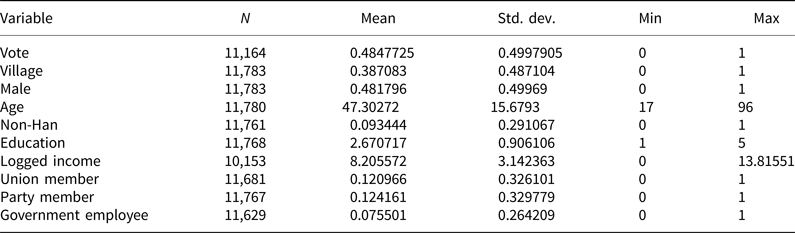
Given that Chinese public opinion varies across different social groups, I controlled several demographic and contextual variables to eliminate the possibility of spurious relationships. For demographic variables, I controlled the respondents' gender, age, ethnicity, education level, and income. Previous research has found that male Chinese are more politically active than female Chinese (Shi, Reference Shi1997). Thus, I add a binary gender variable, Male, in which male respondents were coded as 1 and females coded as 0. Older Chinese, who experienced communist rule before the market reforms of the 1980s might have more trust in government than younger citizens. Consequently, Age was added to the models. Age is the number of years since the respondent's birth. Non-Han Chinese may be more likely to engage in conflicts with the government than Han Chinese since minority groups may be involved in pursuing ethnic or cultural rights in a Han Chinese-dominated government. I coded non-Han respondents as 1 and Han Chinese respondents as 0. More educated people would have more knowledge about government policies, which may encourage them to use elections or official dispute resolution channels. I controlled individuals' Education levels by categorizing the respondents into five groups: (1) no education, (2) elementary school or lower, (3) high school education; (4) college education; (5) graduate school or above. In addition to education, income is also widely considered to be a determinant of political behavior. I measure Income by taking the logarithm of a respondent's family income in order to avoid the skewness of the income distribution.
Four contextual variables were controlled. First, the arguments propose that awareness of grassroots elections influences individual behavior in contentious activities. However, village committee elections in rural areas may differ from RC elections in urban areas. Many scholars have pointed out that rural elections are more competitive than urban elections in China (Ma et al., Reference Ma, Huang and Gui2000; Xiong, Reference Xiong2008; Gui et al., Reference Gui, Ma and Mühlhahn2009). I thus controlled the location of elections. If a respondent's household is village, I code it as 1, and if he or she is an urban resident, coded as 0. In addition, three variables are added to the model to control for individuals' memberships in the Party and a union, and their employment status in the government. Membership in the Party was coded as 1 if a respondent is a current Communist Party member and 0 otherwise. For union membership, members in the union were coded as 1 and non-members were coded as 0. Similarly, if a respondent is employed by the government, military, or the Party, I code it as 1 and 0 otherwise. Considering that membership or employment in these official organizations may promote individuals' loyalty to the regime, the Party Membership, Union Membership, and Government Employment are added to the model to control for potential group variation in regime loyalty (Table 5).
Description of control variables

6. Empirical analysis
This section specifies the empirical strategies used to test the hypotheses. Several models will be used to examine the relationships between awareness of elections and citizens' trust in government, involvement in collective contentious activities, and participation in official channels of expression complaints. The results are presented in this section.
6.1 Statistical models
I employed three major models to test my arguments. I used an ordered logit regression model to test the first hypothesis that awareness of elections will increase the public's trust in the government, given that the dependent variable in this hypothesis is ordinal. As for the second hypothesis that awareness of elections will decrease the public's intention to get involved in contentious collective action, and the third hypothesis that awareness of elections will increase the public's willingness to use official complaint channels, I examine the relationships using logit regression models since the dependent variables in these models are binary.Footnote 12
6.2 Awareness of elections and trust in government
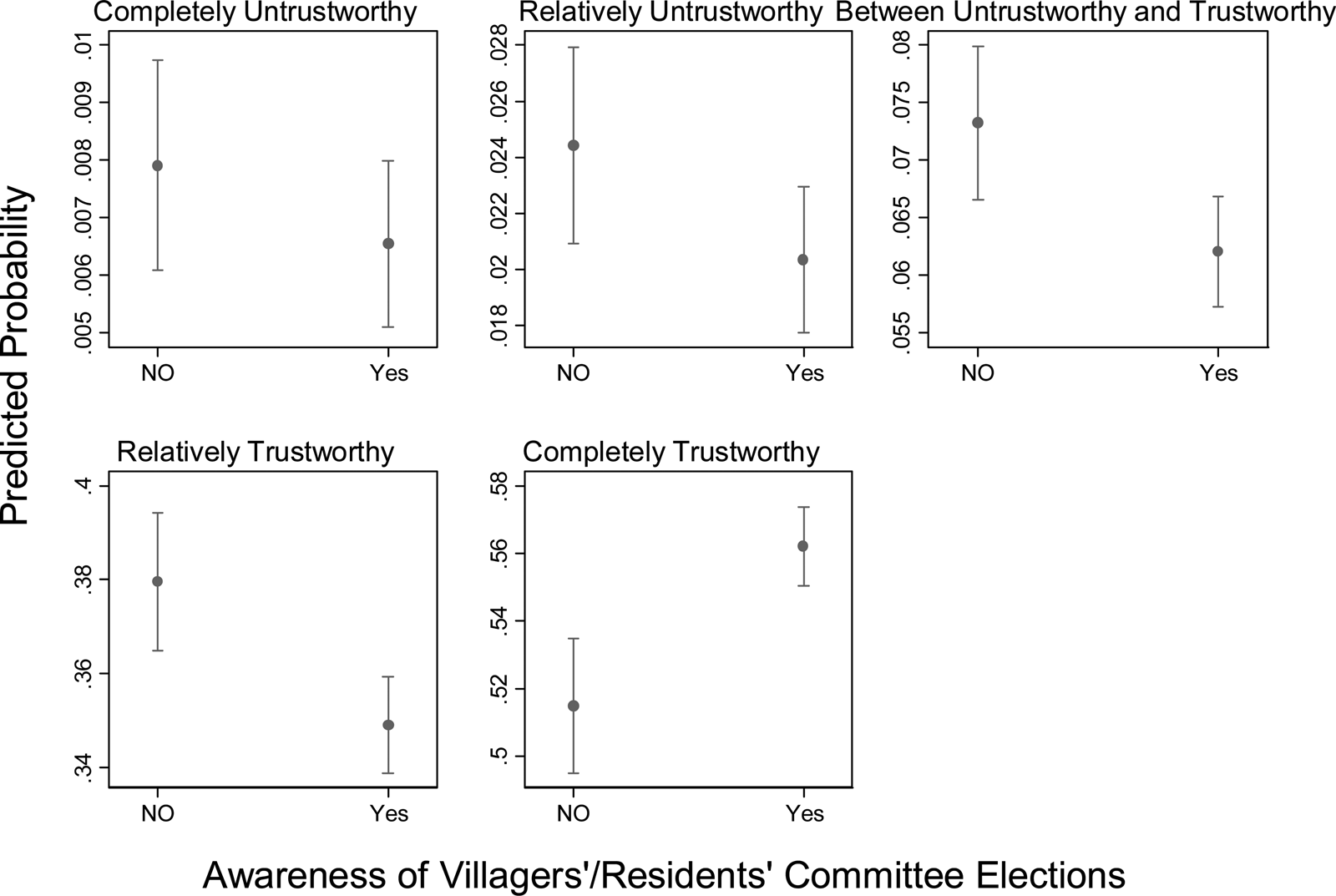
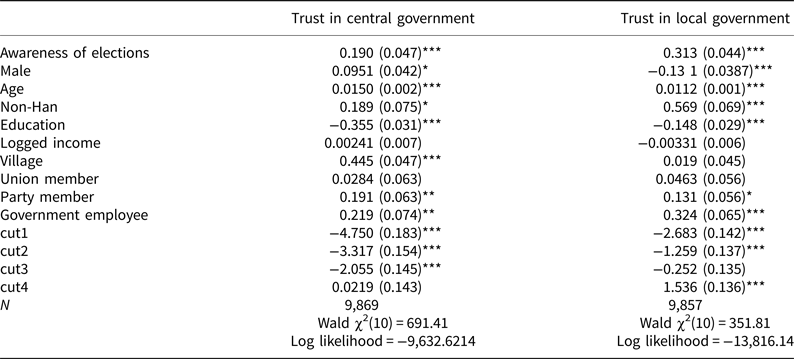
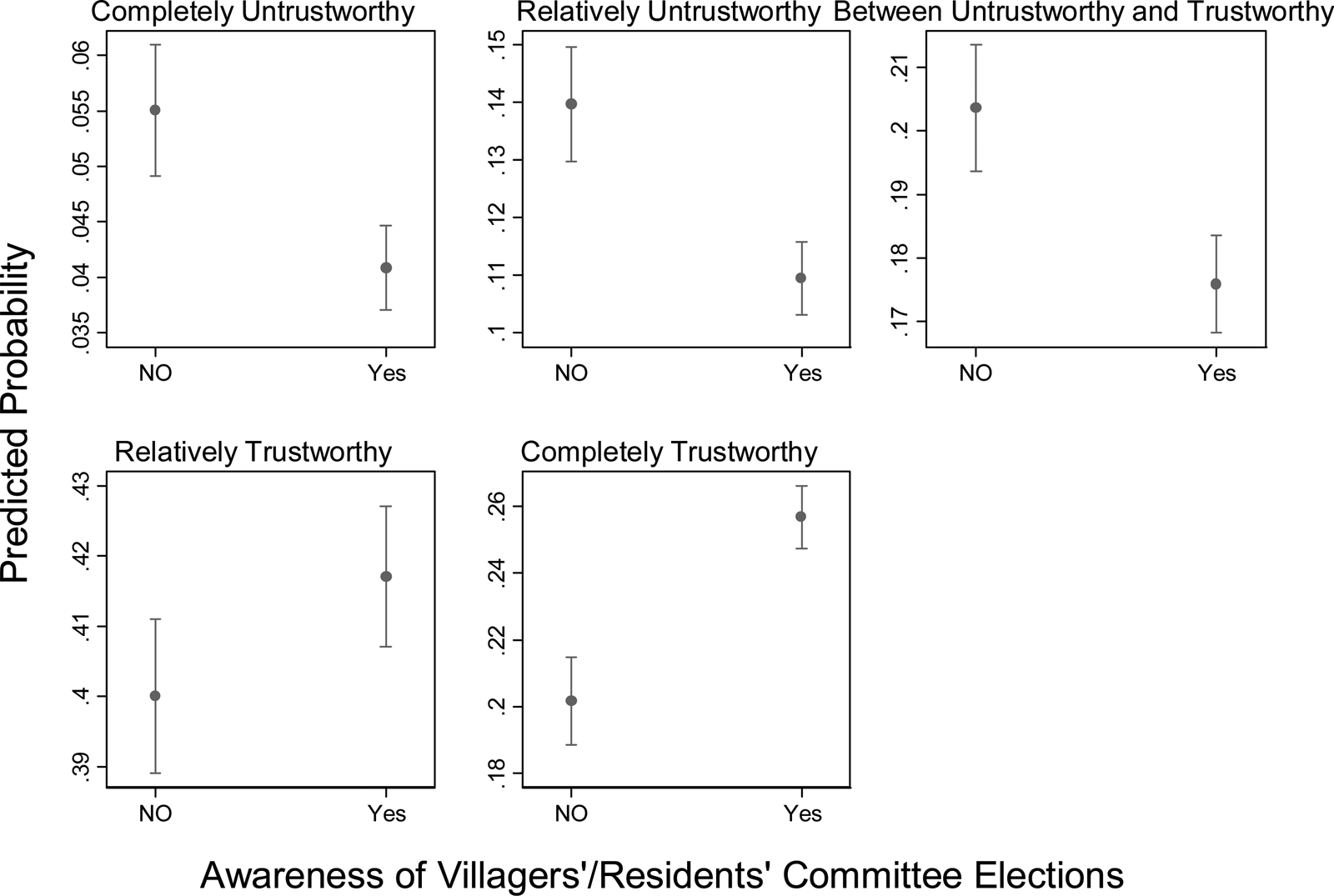
Table 6 shows the results of the relationship between Chinese citizens' awareness of grassroots elections and their trust in government. The coefficients lend support to the first hypothesis that awareness of elections will increase citizens' trust in government. The left-sided model shows that the awareness of elections is significantly and positively associated with individuals' trust in the central government. The marginal effects suggest that the chance that an individual who is aware of elections finds the central government completely untrustworthy will be 1.5% lower than that of an individual who is not aware of elections. Conversely, the likelihood that citizens who are aware of elections think that the central government is completely trustworthy will be 4.8% higher than for citizens who do not know there exist elections (see Figure 2).
Awareness of elections and trust in the central government.

Ordered logit estimate for trust in government

Standard errors in parentheses. Dependent variables ranged from 1 = completely untrustworthy to 5 = completely trustworthy.
*P < 0.05, **P < 0.01, ***P < 0.001.
Similar patterns were found regarding trust in local government. Figure 3 shows the predicted probability. Compared to those who do not know about grassroots elections, people who are aware of residents/village elections are about 1.5% less likely to think the local government is completely untrustworthy. Contrarily, awareness of elections increases the likelihood that people believe local governments are completely trustworthy by 5.5%. The analysis demonstrates the relationship between awareness of grassroots elections and trust in government in China. According to this model, citizens who are from villages, male, older, non-Han Chinese, lower-educated, and party members are more likely to trust the central government than others. The pattern of trust in local governments is generally similar tothat of the trust in central government but the gender effect is reversed. Male Chinese are less likely to trust local governments than female Chinese. This could be due to men participating in local politics more than women in China (Howell, Reference Howell2006; Pang and Rozelle, Reference Pang and Rozelle2010), which makes men who deal with local governments more unsatisfied than women.
Awareness of elections and trust in local governments.

6.3 Awareness of grassroots elections and involvement in contentious collective activities
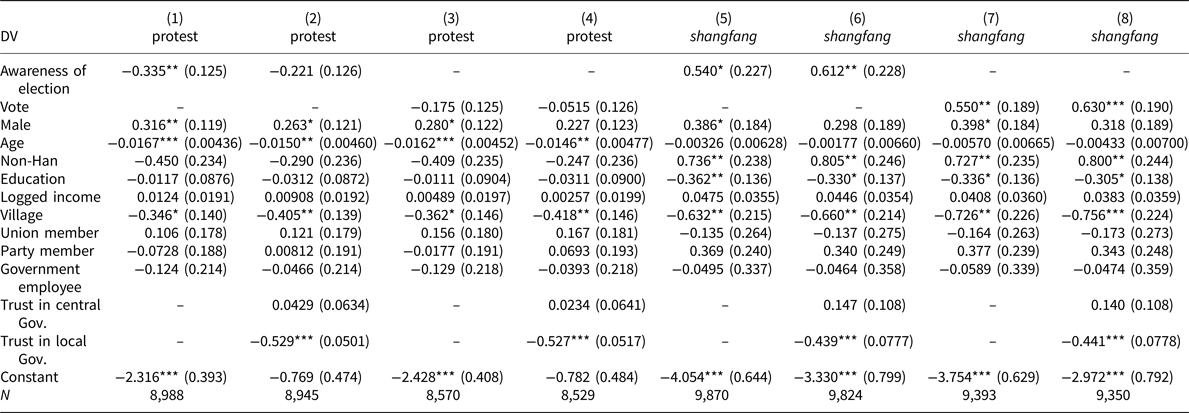
Table 7 includes eight models that show the empirical results for the statistical tests. The second hypothesis proposes that public awareness of elections will assist the regime to decrease the public's involvement (organize, participate, donate, or emotionally support) in contentious collective actions such as strikes, demonstrations, or protests. Models 1–4 (protest models) report the relationships between individuals' engagement (knowledge of or participation in) in elections and their behavior regarding contentious collective activities. In model 1, a negative relationship between awareness of grassroots elections and Chinese citizens' involvement in contentious collective activities suggests that individuals who are aware of grassroots elections are less likely to participate in collective action against the authority, which lends empirical support to the second hypothesis.
Logit estimates of involvement in collective contentious activities and shangfang

Standard errors in parentheses.
*P < 0.05, **P < 0.01, ***P < 0.001.
According to the predicted probability calculated from the coefficient, citizens who are aware of grassroots elections are 1.2% less likely to participate in contentious collective actions than those who have no idea about such elections. At first glance, the marginal effect seems to be minor, but should not be considered trivial. First, considering that involvement in collective action against authorities is highly risky in China, whose government has demonstrated a willingness to crack down on dissidents, it is quite a difficult decision for citizens to go to the street to fight for their rights. Second, in comparison with other variables, the awareness of elections in fact plays the most important role in lowering the chance of mass incidents. For instance, being a party member, union member, or government employee has no substantial influence on decreasing people's intention to participate in activities against the authorities. In this model, awareness of elections exerts the strongest influence on citizens' involvement in contentious collective activities. As far as regime stability is concerned, the influence of election awareness should not be deemed inconsequential. The control variables provide additional information: those who are male, younger, and from urban cities tend to be more active in contentious collective action. It is not surprising that urbanization can be a trigger for collective contentious activities because of the crowded population. The activeness of male adults and the youth could be interpreted as their higher willingness to participate in politics than that of women and older people.
In model 2, two variables – trust in central government and trust in local government as controls were added to the model, after which awareness of elections only reached significance level of 0.1 (P = 0.079). Interestingly, trust in central government is not significantly associated with people's participation in contentious activities whereas trust in local government has a significantly negative effect. In models 3 and 4, vote was used to test the relationship between individuals' behavior in elections and their willingnessto participate in protests. The results show no significant association between their participation in the last election and their participation in collective protests. However, trust in local governments remains a predominant factor in explaining their participation in protest activities: the lower the degree of trust in local governments, the higher the likelihood they will join in contentious collective activities. This shows thatpeople's trust in local governments matters in their choice to engage in contentious events in China.
6.4 Awareness of grassroots elections and participation in shangfang
The third hypothesis proposes that awareness of elections will increase citizens' use of institutional or official channels to express their grievances. It therefore is expected that individuals' awareness of or participation in elections will be positively associated with their use of shangfang. This proposition receives empirical support from models 5 to 8. As shown in model 5, individuals' awareness of grassroots elections is significantly and positively correlated with their participation in collective shangfang. The marginal effect suggests that citizens who are aware of grassroots elections are about 1% more likely to participate in shangfang activities than citizens who are not aware of such elections. Since the frequency of shangfang occurrence is relatively small, it is thus not surprising that the predicted probability is small as well. However, because participation in shangfang is also a risky task, considering that it could incur harsh retaliation from local officials, the significant, positive relationship between the awareness of elections and adoption of the shangfang approach should also be taken seriously.
In model 6, where trust in central government and trust in local governments were included, the relationship between the awareness of elections and participation in shangfang remains significant. In models 7 and 8, individuals' turnout in grassroots elections is used to examine the relationship between electoral participation and engagement in official shangfang. Not surprisingly, this relationship is positive and significant. That is, respondents who attended to the most recent elections were more likely to have participated in shangfang activities. The marginal effect shows that the likelihood that a person who has voted in grassroots elections would take part in shangfang activities is 1% higher than those who did not turn out in the elections. Comparing the results of the shangfang models with the protest models, the evidence seems to suggest that the adoption of elections actually exerts a stronger influence on individuals' choice in using official approved channels than on their participation in protest activities for airing their grievances. As for people's trust in government, as shown in models 6 and 8, just as in the models for contentious activities, people's trust in central government is not significantly correlated with their participation in shangfang while trust in local government is significantly and negatively associated with their participation in this official grievance-reducing mechanism.
The control variables in shangfang models as well offer some interesting information to feature the pattern of shangfang activity. Similar to the protest models, those who are male and live in urban areas seem to be more willing to use shangfang as a tool to send complaints to the government. Unlike the protest models, however, people's age has nothing to do with their behavior in joining shangfang. Further, those who are identified as minority and lower-educated are more likely to use shangfang to express their concerns to the government. This is quite interesting because one implication is that these groups who possess few financial resources in society may be incorporated into the government system as regime supporters, as previous research on authoritarian clientelism has pointed out (Magaloni, Reference Magaloni2006; Greene, Reference Greene2010; Croke et al., Reference Croke, Grossman, Larreguy and Marshall2016).
Overall, the empirical results are generally in line with our theoretical expectations. Awareness of as well as participation in grassroots elections have been negatively correlated with people's engagement in contentious activities such as protests, but positively associated with individuals' willingness to air their complaints using the mechanism shangfang approved by the government in China. In other words, the adoption of elections by the government did not take a toll on the social stability in China. Yet, it did not strengthen the government's control over the society either. Citizens in China still pursue the mechanism to resolve their grievances even though they trust the government.
6.5 Endogeneity test for the relationships
One caveat is the potential endogeneity of the relationships between the major variables. Some may argue that it is trust in government that improves the chances that a person will be aware of grassroots elections, or because of their involvement in different types of activities, citizens have different intentions to know whether there is an alternative political institution to express their opinions, such as elections. For instance, a citizen who went to the street may choose to ignore the existence of elections, and a citizen who visited higher level government officials more often could be better informed of the implementation of local elections by the government.
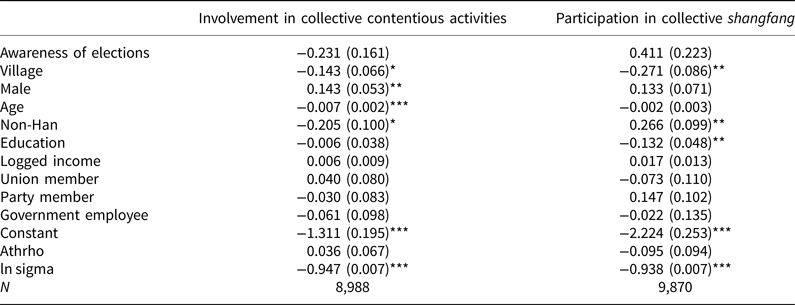
Instrumental variable models were run to investigate whether the relationship suffers from endogeneity. I used percentage of awareness of elections of the community (not including the respondent in the calculation) as an instrument. The higher the percentage, the more likely the respondent will have knowledge about elections. But since the respondent is excluded in the calculation of the average, there should be little expectation that this variable will be directly related to his or her intention to be involved in other political activities such as strikes, protests, demonstrations, or shangfang. Nor should it be associated with individuals' trust in government. The instrumental variable models were shown in the end of empirical analysis to provide additional check of our findings. The models in the Appendix suggest the endogeneity issue is statistically insignificant for the relationships between the major variables – the awareness of elections and individuals' use of shangfang or their participation in contentious activities. This test result boosts certain confidence for the empirical tests accounting for the associations between the adoption of grassroots elections and individuals' attitude and behavior in contentious politics in China.
Despite the positive feedback from the test, it should be noted that the endogeneity issue cannot perfectly be out due to the limit of the dataset, which does not allow for the instrumental variable approach in a satisfactory fashion, given that our choice of the instrument might not be exogenous. It is promising for future research to use better data such as panel data or exogenous variables and various approaches such as experiments to further justify the associations and causality between the awareness of elections and citizens' intention to join in contentious activities.
7. Conclusion
This study evaluates the relationships between holding grassroots elections and ordinary Chinese citizens' attitudes toward the government as well as their behavior against the regime. I propose that citizens' awareness of elections bolsters regime legitimacy by enhancing popular trust in governments. Additionally, elections can preempt potential social unrest by decreasing citizens' involvement in collective activities against authority. However, awareness of elections also prompts the public to adopt official channels to express grievances as an alternative to street protests. Combining these effects, elections do not alleviate pressure from society but make state–society conflict manageable for the communist regime. The findings provide empirical support for the theoretical arguments. Therefore, awareness of elections increases popular trust in the government among the Chinese people and substantially influences Chinese citizens' contentious behavior against authority. Being aware of elections decreases citizens' involvement in collective activities that destabilize the regime, but it does not alleviate the pressure on the CCP in governing society. Instead, grassroots elections translated social protests into petition activities by increasing people's willingness to use institutional mechanisms, such as shangfang, to solve their concerns.
These findings have implications for the survivability of the CCP. Since the 1978 economic reforms, China has pursued economic development to maintain its ruling legitimacy. Accompanying this development is social grievance. From rural to urban areas, many Chinese people experience economic and social transition at extraordinary speed but also suffer unwanted consequences of economic development, such as demolition of houses, land expropriation, pollution, or malpractice by local officials. Chinese central authorities have attempted to adopt local democracy to ameliorate the disturbances resulting from social grievances. However, elections are not a solution to economic grievances per se. Complementary institutions are required to reduce the chances that the public will challenge the government. The lack of such institutions could facilitate regime breakdown, as we saw in the Arab Spring event of 2011. China seems to do well in providing an official channel for the public to voice their grievances, under which elections have enhanced the regime's prospects for surviving the economic and social transition. Future attention should also be paid to investigating whether the (mal)function of shangfang, in turn, influences the public's pursuit of political reform such as direct elections at higher levels.
The findings also speak on the current debate between the democratizing and stabilizing effects of elections on authoritarian regimes, or at least, one-party dictatorships. From the view of public opinion, elections may simultaneously exert influence on the regime, as previous studies have suggested (Sun, Reference Sun2014). The findings in this paper imply that holding elections not only contains popular resistance outside the system but also increases the pressure within the system. Public awareness of elections decreases collective activities against the regime, but encourages usinggovernment-sponsored mechanisms to express opinions. Although more research is needed, one implication of the findings is that elections may eventually democratize China without revolution, as Taiwan, another Chinese society, wente through in the 1990s. As more citizens are aware of grassroots elections, social pressure within the system imposed on the regime will grow. This may finally lead to the opening of the political arena for interest articulations in China.
One limitation of our models is that while evidence shows that awareness of and participation in elections are associated with citizens' behavior in contentious activities or within-system policy demands, the real effects of elections may come from different mechanisms. For instance, the behavioral differences in people's decisions in absence or participation in protests and shangfang may originate from their support in the regime system. Furthermore, regime supporters are inherently reluctant to join in activities that are anti-regime or would arouse social instability. It would be possible that the regime uses financial resources to buy off public supports from society (Lee, Reference Lee2007), which results in the condition that people who were bought off may put high trust in the government, use the official channels frequently, and avoid to participate in contentious activities that are deemed as illegal. Although factors such as individual characteristics were controlled in the empirical models to identify regime supporters, such as party members or government employees, different mechanisms may still be in effect.
Understanding this limitation, this article contributes to the current literature on electoral authoritarianism and China's regime resilience by unraveling the relationship between the adoption of elections and regime stability using individual-level analysis. The political environment in China has gradually become unfriendly for research on such issues as discussed in this article. Survey research that investigates political attitudes and behaviors appears to be more arduous to conduct today than in the past. The results of this study have heralded potential developments ingrassroots governance. Future research, if possible, can employ sophisticated research designs or methodologies to uncover the mechanisms by which grassroots elections would have an impact on state–society relations in China under the leadership of Xi Jinping, whose rule has been considered weakened the autonomy of grassroots self-government and electoral democracy (Jacka and Chengrui, Reference Jacka and Chengrui2016; Zhang et al., Reference Zhang, Chen and Wang2019; Wu and Christensen, Reference Wu and Christensen2020). After all, the Communist Party under the centralized political system in the Xi era would strive to engineer the strengthened CCP's rule in local communities.
Supplementary material
The supplementary material for this article can be found at https://dataverse.harvard.edu/dataset.xhtml?persistentId=doi:10.7910/DVN/SUHMDP
Appendix A
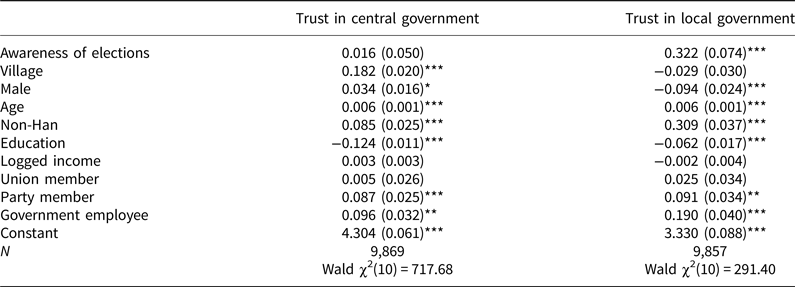
Tables A1 and A2 report the endogeneity test using the instrumental variable. In Table A1, the coefficients show that awareness of elections may have no substantial effect on citizens' trust in the central government when considering endogeneity while it is significantly associated with citizens' trust in local governments. Hence, we might conclude with more confidence that awareness of elections will increase individuals' levels of trust in local government than about the relationships between awareness of elections and citizens' trust in the central government.
Instrumental variable models for trust in government

Instrumental variable models for protest and shangfang participation

Table A2 shows the instrumental variable model for citizens' involvement in collective contentious activities and participation in collective shangfang. While the coefficients of awareness of elections in both models are insignificant, the Wald test suggests that the endogeneity in the original models is statistically insignificant (the athrhos in both models are insignificant, P > 0.05). Accordingly, the original logit models are appropriate to account for that awareness of elections is significantly associated with citizens' intention to participate in contentious collective action and to participate in collective shangfang.