

Asian Courts in Context
by Jiunn-rong YEH and Wen-Chen CHANG.
Cambridge: Cambridge University Press, 2015. xiv + 617 pp. Hardback: US$160.00.
Constitutional Dialogue in Common Law Asia
by Po Jen YAP.
Oxford: Oxford University Press, 2015. xix + 244 pp. Hardback: £60.00.
Constitutionalism in Asia: Cases and Materials
by Wen-Chen CHANG, Li-ann THIO, Kevin YL TAN, and Jiunn-rong YEH.
Oxford: Hart, 2015. Cxiv + 1056 pp. Paperback: £40.00.
Constitutionalism in Asia in the Early Twenty-first Century
edited by Albert HY CHEN.
Cambridge: Cambridge University Press, 2014. xv + 435 pp. Hardback: US$110.00.
Comparative Constitutional Law in Asia
edited by Rosalind DIXON and Tom GINSBURG.
Cheltenham: Edward Elgar, 2014. ix + 353 pp. Hardback: £90.00.
Constitutionalism and Good Governance: Eastern and Western Perspectives
edited by Dirk EHLERS, Henning GLASER, and Kittisak PROKATI.
Baden-Baden: Nomos Publishers, 2014. 395 pp. Hardback: €98.00.
Social Difference and Constitutionalism in Pan-Asia
edited by Susan H WILLIAMS.
Cambridge: Cambridge University Press, 2014. xx + 374 pp. Hardback: US$99.00.
Western scholars admit that comparative constitutional law has focused mainly on a limited set of established liberal constitutional systems of North America and Europe and a few other states with similar institutional settings.Footnote 1 However, the most recent years (2014 and 2015) have witnessed the publication of important work on constitutional law and practice in Asia authored by scholars across several continents. This essay will review and assess these books from a methodological and epistemological perspective.Footnote 2 There are two reasons for the focus of this essay. First, within a single review essay, it is impossible to discuss the substantial constitutional questions raised in the publications. Second, and more importantly, they tend to overlook issues of methodology and epistemology. While we acknowledge that scholars in the field have provided rich knowledge of constitutional experience in Asia, we argue that a sober consideration of methodology and epistemology is important for the further development of Asian constitutional studies.
We divide the publications into three groups, namely: macro-studies, country-studies, and micro-studies. To begin with, the macro-works have examined general constitutional issues in a wide range of Asian nations from Afghanistan to Vietnam. The first one to mention here is Constitutionalism in Asia: Cases and Materials (CA)Footnote 3 authored by Asian scholars Wen-Chen Chang, Li-ann Thio, Kevin YL Tan, and Jiunn-rong Yeh. The work takes the form of a book of cases and materials, weighing in at 1056 pages, which attempts to provide “both raw material and occasion for scholars to reflect upon the contours and concepts of the field.”Footnote 4 In addition to a short introduction, which reviews the existing scholarship in the field and sets down its aims, ambit, and approach, the book consists of ten chapters: (1) Constitution Making and State Building; (2) Constitutional Culture in Asia; (3) Government System and Structures; (4) Constitutional Change and Amendments; (5) Judicial Review; (6) Democracy and the Rights to Political Participation; (7) the Right to Equality and Equal Protection; (8) Free Speech and Res Publica; (9) Religion and State; and (10) Socio-Economic Rights. Each chapter includes an introduction, cases, and materials; and notes and questions to guide readers’ further reflection.
Another macro-work is Comparative Constitutional Law in Asia (CCLA)Footnote 5 edited by Rosalind Dixon and Tom Ginsburg. Differently from CA, CCLA is a collection of essays written by “global scholars.” Apart from the introductory chapter which introduces the methods and summarizes the main findings, the book includes 11 chapters organized into three parts. The first part (Constitutional Design, Amendment, and Interpretation) features chapters on participation in constitution-making, constitutional courts, judicial engagement, and weak-form judicial review in Asia. The second part (Constitutional Structure) includes three chapters – on legislative-executive relation, federalism, and emergency powers. Finally, the third part (Constitutional Rights) comprises of four chapters – on freedom of expression, the right to property, equality, and constitutional law and religion.
The second group of country-study works includes edited collections of essays on the constitutional experience of different countries in Asia. Although these works are mainly country-focused, the editors and other scholars in the collective projects have tried to address more general comparative questions, drawing on country-studies. The first work in this group is Constitutionalism in Asia in the Early Twenty-first Century (CAC)Footnote 6 featuring a collection of essays authored by both Western and Asian scholars, edited by Albert HY Chen and the outcome of the fourth Asian Constitutional Law Forum, held at the Faculty of Law, University of Hong Kong, on 16-17 December 2011. The focus of the book is on constitutional developments in Asia in this century. Although the book is by a large extent a county-study work, it includes three chapters (Chapters 1, 2, and 17) discussing general and comparative questions. In Chapter 1, Albert Chen develops a threefold classification of constitutionalisms in Asia, which is meant to serve as the conceptual framework for understanding the degree to which constitutionalism has been achieved in Asia. The second chapter, written by Tom Ginsburg, tries to identify distinctive features of constitutionalism in East Asia, drawing mainly on a comparative textual analysis of the constitutions. Chapter 17, written by Cheryl Saunders, discusses the impact of internationalization on national constitutions. The other county-chapters describe and analyse the latest constitutional developments (constitution-making or constitutional amendments, constitutional cases, constitutional laws developed by legislatures, and political developments) in 16 Asian jurisdictions which cover Burma, Cambodia, China, Hong Kong, Japan, Nepal, India, Indonesia, North Korea, Malaysia, Philippines, Singapore, South Korea, Taiwan, Thailand, and Vietnam.
The second collection of country-study essays is Constitutionalism and Good Governance: Eastern and Western Perspectives (CGG)Footnote 7 edited by Dirk Ehlers, Henning Glaser, and Kittisak Prokati, and written by European and Asian scholars. The book is not exclusively about Asian constitutional law and practice but covers 12 constitutional regimes in Europe and Asia. Henning Glaser’s conceptual and introductory chapter tries to address the European-Asian perspectives on constitutionalism and good governance. In addition, Albert Chen applies in the Southeast Asian contexts his threefold classification introduced in the aforementioned CAC. Other Asia chapters consider constitutional design in Nepal, Cambodia, and ASEAN, constitutionalism and freedom of assembly in Thailand, constitutional rights in Malaysia, and the Constitutional Court in Taiwan. Some general observations have been addressed in this book, such as “an increasing global tendency of the juridification of political power and legal shaping of constitutional regimes,” and “an image of multiple constitutionalisms and constitutionalizations.”Footnote 8
The third group of micro-studies focuses on particular constitutional issues arising in Asia. The first to mention in this group is Asian Courts in Context (ACC)Footnote 9 edited by Jiunn-rong Yeh and Wen-Chen Chang. This book attempts to situate the changing structure of courts in Asia within the changing economic and political context of Asia and identify whether there are distinctive features of Asian courts in comparison with Western courts. In addition to the Introduction, which describes the method and the structure of the book, and the Conclusion which summarizes the main findings and advances more general reflections, the book comprises 14 chapters in which contributors discuss 14 selected Asian jurisdictions (Japan, Korea, Taiwan, India, Indonesia, Mongolia, the Philippines, Hong Kong, Singapore, Bangladesh, Malaysia, Thailand, China and Vietnam.)
A related work in this group, which also is concerned with the courts, is Constitutional Dialogue in Common Law Asia (CDA)Footnote 10 by Po Jen Yap. The book focuses on the practice of judicial review in three common-law jurisdictions, namely Hong Kong, Malaysia, and Singapore. The book is an extended application in common law Asia of the theory of dialogic judicial review developed in commonwealth nations (Canada, New Zealand, the United Kingdom, and Australia). After setting down the background and the theory, the book focuses on leading case law in the areas of freedom of expression, freedom of religion, the right to equality, and criminal due process rights.
Finally, there is a micro-work focusing on the relationship between social difference and constitutionalism, entitled Social Difference and Constitutionalism in Pan-Asia (CDC)Footnote 11 edited by Susan H Williams. The book attempts to address how constitutions and constitutionalism deal with the challenge posed by different types of social difference – language, urban/rural divisions, ethnicity/race, religion, and gender and sexual orientation. The book consists of five parts dealing with the respective five areas of social difference selected
Focusing on methodological questions, this review essay will discuss these recent publications in four sections: constitutional orientalism, juricentrism, functionalism versus contextualism, and constitutionalism.
I. CONSTITUTIONAL ORIENTALISM?
Macro-works like the CA and the CCLA have started with modern constitution-making in Asia up to the end of the 19th century, presented as the copying of Western constitutions. The epistemological assumption tends to be that the idea of a constitution is a distinctively western and modern innovation, and that there were no constitutional practices in pre-modern Asia. This has resonated with the discourse of “legal Orientalism”,Footnote 12 the Western (normally biased) imagination of oriental law (mainly Chinese law), which has its root in more general discourses of orientalism.
Orientalism actually derives from European views of the Ottoman Empire. In this discourse, oriental despotism is associated with weakness as well as oppression. The Ottoman Empire was depicted as the “sick man of Europe”. This in turn goes back to Christian resentment of the taking of Constantinople in 1452; and perhaps all the way back to the Trojan Wars about 3000 years ago. The Romans also had a concept of “Asia” (Turkey was called “Asia Minor”) and Egypt as inferior to Roman muscularity expressed through its military might.Footnote 13 In Asia studies of the Opium Wars emphasize the orientalism of British attitudes to China during the 19th century.Footnote 14
Orientalism is reified in the legal field, generating what is called legal orientalism, “the ways in which ‘the Orient’ - as well as ‘the West’- have been produced through the rhetoric of law.”Footnote 15 Max Weber, for example, posits that among the great civilizations – Europe, India, Islam, and China – only Europe developed rational law supporting capitalism.Footnote 16 Early discourse of legal orientalism is closely related to public law questions, with China exemplified as a paradigm of “oriental despotism.” For example, according to GWF Hegel’s evaluation, in China “all that we call subjectivity is concentrated in the supreme Head of the State”, while “individuals remain mere accidents”.Footnote 17 This view can be traced back to CS Montesquieu’s description of imperial China as a despotic state.Footnote 18 In a comprehensive survey of “oriental despotism”, Karl A Wittfogel tries to argue for the “absence of effective constitutional checks” of the imperial ruler.Footnote 19 The phantom of “oriental despotism” has continued to dominate mainstream scholarship on Asian constitutional law, which reifies the constitutional form of legal orientalism, which can be called constitutional orientalism.
Constitutional orientalism can be referred to as the western imagination of constitutional law in Asia. Constitutional orientalists may include not only western scholars but also Asian scholars whose discourse is shaped by that imagination. To illustrate, Asian authors of the CA contend that:
Right up till the nineteenth century, most states in Asia were ruled by personal fiat. For centuries, the largest and most populous states, like China, India, and Japan, operated systems of government that might be described as undemocratic and illiberal at best, and despotic and tyrannical at worst.Footnote 20
These authors include a half page to review some documents which may be called “constitutions” in pre-modern Asia but quickly dismiss this intra-civilizational constitutional potentiality by arguing that “[t]hey were not concerned with curbing the power of sovereign rulers, and their ‘constitutions’ were primarily designed to enhance and centralize the power of the state.”Footnote 21 The CA has largely ignored the emerging scholarship on constitutionalism in pre-modern Asia.Footnote 22
Paradoxically,Footnote 23 the two western scholars who edited the CCLA have discussed “the constitutional legacy” in pre-modern Asia in their introduction to the volume. They point out the constitutional legacy in the Confucian tradition in East Asia, stating that: “the Confucian tradition had natural law elements, instantiated in the concept of ritual propriety, or li in Chinese, and scholars have analogized these constraints to constitutionalism.”Footnote 24 In particular, they underline that “perhaps the greatest body of work on the constitutional character of pre-modern law has been done in Korea …. Korean scholars have not been hesitant to find constitutionalist analogies in the neo-Confucian institutions of the Chosŏn dynasty.”Footnote 25 They have also mentioned “constitutional texts” in pre-modern China and Japan. In addition, they believe that “the constitutional legacy is rich” in other parts of Asia:
In South Asia and Southeast Asia, Hindu and Buddhist ideas also drew on natural law thinking. The Hindu Dharmaśāstra, for example, was treated as a source of “law” by the British, but in fact it integrated religion and law into a single normative order.Footnote 26 Buddhist thought distinguished the wheel of dharma from the wheel of power, implying that the former constrained the latter. An ideal society would be led by a righteous ruler, whose state was to embody good policy that upheld the dharma.Footnote 27
However, within three pages, the pre-modern constitutional legacy has not been thoroughly examined in the CCLA.
Constitutional orientalism is understandable. Given the hegemony of western scholarship in comparative constitutional law, it is comprehensible that the western lens is employed to view Asian constitutional practices. Western scholars seem to either critique Asian constitutionalism from the outside, which can be seen as orientalism; or they “go native” and see it only from the inside, which looks like an uncritical apologia. While constitutional orientalism is inevitable, it should not be dominant and exclusive. What can be done is to limit the potential prejudice by engaging in a wider and more open constitutional conversation. In this regard, one co-author of this essay (Andrew Harding) has suggested elsewhere a solution based on Peter Jackson’s theory of “sympathetic engagement”.Footnote 28 It is useful to restate the implications of this theory for Asian constitutional studies:
The implication of this approach is that the scholar begins by recognizing that she cannot take a neutral or objective position because no such position, in truth, exists. Rather the scholar is party to a series of transactions in which she herself becomes part of a social, cultural or political dialogue (‘ethical and political’, in Jackson’s formulation, and ‘can be likened to a methodology of diplomacy’) in which her actions influence events. Thus rather than simply eliciting answers or making observations she engages in a constructive dialogue in which the mutual eliciting and critiquing of ideas is both permissible and positive, creating mutual respect and understanding, and in which the interviewee (object) becomes also an interlocutor (subject). The researcher is therefore part of a process in which the research itself is only one aspect.From my perspective this is not just a pleasing theory but the actual way in which our research is in practice carried out. In the process of inquiring, probing, critiquing, learning, explaining, answering, comparing and teaching, a condition of mutual respect is achieved, and the role of researcher thereby merges with other roles. I wish to emphasise here that all Asian legal scholars have experienced in practice the standard scientific notion that the observer has an effect on that which is observed. While one is not a participant in the same sense as an actual citizen or stake-holder in the society in question, one is nonetheless a participant. One’s research has an effect; one’s triangulation of findings has an effect; one’s published work has an effect; one’s advice has an effect; even one’s presence has an effect. If we conceive of research of this kind as sympathetic, constructive and developmental, the potential difficulties are removed or at least reduced considerably. In researching new Asian constitutionalism we hope not just to analyze, understand and discuss it, but to assist and affect its growth in a positive way, which is essentially led (it is important to emphasize) by actors within the country in question, but has international and comparative resonance.Footnote 29
Therefore, it is important for mainstream scholars of Asian constitutional law to engage in a serious dialogue with the less common but emerging discourse of constitutional legacy in pre-modern Asia. One reason may be that the exploration is simply for the sake of knowledge.Footnote 30 There is also an anthropological reason, in that the exploration of potential constitutional practices in traditional Asia can help us simply to appreciate the diverse capacities of human societies in the domain of constitutionalism. But, one of the most substantial reasons is that the exploration of constitutional tradition in pre-modern Asia can help better understand constitutionalism in modern Asia. Scholars have widely agreed that successful constitutionalism must be rooted in cultural tradition.Footnote 31 Ruth Gordon’s theory of “growing constitutions” as a bottom-up process equally underlines the importance of political culture. She argues that any constitution grows at the bottom of a culture where the complex norms and relationships tie the people together as a society. She concludes:
Constitutions can flourish and succeed only if they are firmly planted in the cultural soil from which they gain legitimacy …. Constitutions that are not firmly grounded in the cultural mores of the society in which they operate are destined to fail, become irrelevant, or be reshaped and adapted to meet the needs of the culture and society in which they are situated.Footnote 32
So, investigation of Asian constitutional traditions can help us better understand the workings of constitutionalism in contemporary Asia. For example, an understanding of Confucian constitutional tradition can reveal the cultural factors explaining why contemporary constitutional courts in Taiwan and South Korea have operated in the manner of remonstrance, as Tom Ginsburg argues.Footnote 33
Moreover, there is a normative dimension for the study of Asian constitutional traditions. If the success of constitutionalism in part depends on the support of traditional culture, Asian nations should not simply copy constitutional institutions and values from the West. This does not mean a rejection of the possibility of constitutional transplantation. However, constitutional transplantation can be possible and successful only if the transplantation is contextualized by the sensitization and even incorporation of traditional constitutional values. Nikolai G Wenzel offers two useful case studies in Asia: Japan and the Philippines.Footnote 34 Post-war constitution-making in these two nations was under the same external influence – the United States Constitution – but resulted in different outcomes: Japan succeeded while the Philippines failed. Wenzel attributes successful constitutionalism in Japan to the congruence of formal constitutional parchment with the underlying constitutional culture. According to him, Japan’s 1946 Constitution, rather than parroting the US Constitution, drew on sufficient indigenous political, cultural sources (such as the communitarian orientations and the Shinto-Taoist tradition), which is instrumental to the half-century of constitutional stability, democracy, and economic development in Japan. In contrast, Wenzel states that the Post-war Filipino Constitution failed to appreciate the local political tradition, which led to a generation of martial law and dictatorship. He explains that several Anglo-Saxon liberal ideas, such as human rights, limited government, and rule of law influencing the Constitution are alien to the Filipino caudillo strongmen tradition and Spanish and Filipino traditions of family/communal rights and raison d'état.Footnote 35
A macro-work on constitutional experience in Asia should begin with a serious treatment on whether there is a constitutional legacy in traditional Asia, and what such a legacy may contain in the way of resources. In addition to many works on constitutional ideas and practices in Confucian polities in East Asia, some scholars have demonstrated the constitutional legacy in traditional Southeast Asia. To illustrate, the Undang-undang Melaka has been considered the first constitution in Malaya.Footnote 36 In Thailand, Prince Dhani argues that Thammasat “served for a long time as the Siamese Constitution.”Footnote 37 Similarly, Walter Vella contends that: “The sacred law, the Thammasat, also limited the king’s action.”Footnote 38 However, scholars have been occupied by topical constitutional questions, and hence have overlooked the potential of traditional constitutional practices in Asia to inform and develop contemporary constitutionalism.
If one adopts the prevailing Western understanding of constitutionalism as institutional restraints of the public power to protect individuals’ rights, which is rooted in the axiological ground of enlightenment liberalism, it is likely that one cannot find such thing in pre-modern Asia. But if we free ourselves from the modern and liberal conceptualization of constitutionalism, we may well discover that there is some form of “traditional constitutionalism” in Asia, rooted in philosophical, religious, or indigenous ideas which have the potential to subject the rulers to certain public goals and principles. These traditional models may include Confucian constitutionalism, Islamic constitutionalism, Hindu constitutionalism, Buddhist constitutionalism, and autochthonous or customary constitutionalism.Footnote 39 This area requires our further exploration.
II. JURI-CENTRISM
It is common that a western casebook on comparative constitutional law starts with a chapter on the courts.Footnote 40 Sometimes, constitutional law is narrowly understood as the laws produced by courts. This reality connects with the widespread assumption that constitutionalism is impossible without judicial review. The scholarly consequence is that scholars of comparative constitutional law have concentrated their energy on the courts. This juri-centric approach finds strong echoes in Asian constitutional studies. The idea of having a casebook on constitutionalism in Asia is in fact informed by juri-centrism. Therefore, constitutional cases occupy a large space in the CA, although the book includes chapters on constitutional history, constitution-making, and constitutional culture. Judicial issues are also the central concern of the CCLA. Similarly, with the exception of the CDC, micro-studies have focused mainly on the judiciary. Although the CDA mobilizes for a model of constitutional dialogue,Footnote 41 courts remain the main concern of the book: constitutional dialogue here means the dialogue between the courts and other political actors in an Asian common-law context. The ACC explicitly concentrates on Asian courts. The CAC, however, tends to move away from the central concern of the courts, as it considers different forms of constitutional developments, such as constitution-making, constitutional amendment, legislative constitutional laws, and judicial review. It is worth noting that even in Western constitutional studies the emphasis appears to be moving away from juri-centric approaches to ones based on constitutional dialogue.Footnote 42
Studies on judicial review and constitutional cases in Asia have deepened our knowledge and enriched comparative constitutional inquiry by reference to Asian practice. However, the juri-centric approach to Asian constitutional issues may limit our inquiry. To begin with, in the general literature of comparative constitutional law, there has been contentious debate on whether the courts are principal drivers of constitutional change. Judicial constitutionalism has been attacked by popular or political constitutionalists such as Mark Tushnet, Larry Kramer, and Richard Bellamy.Footnote 43 Other constitutionalists, such as Jack M Balkin, regard social movements rather than courts as the central force of constitutional change.Footnote 44
Turning to Asia, many jurisdictions in the region have adopted forms of judicial review,Footnote 45 and some successful constitutional courts have underpinned and facilitated stable constitutional democracies in East Asia (such as South Korea and Taiwan).Footnote 46 Unlike well-established constitutional polities in the West, where informal constitutional amendments take the form of changes in constitutional interpretation by courts, many Asian nations have been in the ongoing process of state-building and constitutionalizing, and formal constitution-making or constitutional amendment has been employed for this larger project.Footnote 47 Moreover, in some nations without judicial review, like China and Vietnam, constitutional law has been developed by the legislature.Footnote 48 Also, there are social movements in Asia that have struggled for constitutional developments or defended constitutional values, such as China’s Charter 08 and 2013 constitutionalism debate, Hong Kong’s Occupy Central Movement, Taiwan’s Sunflower Movement, Vietnam’s Petition 72,Footnote 49 and Malaysia’s Bersih movement,Footnote 50 which can be called “constitutional movements”. There may be also anti-constitutional movements, such as the Thailand’s People’s Democratic Reform Committee, or the “yellow shirt” movement, which in its 2013-14 protests rejected parliamentary government based on universal franchise, and the Thaksin-supporting “red shirt” protest movement of 2010, which rejected the 2007 Constitution.
Unfortunately, the domination of juri-centrism has prevented us from deeply exploring the role of non-judicial actors in constitutional engineering in Asia. It is therefore important to study thoroughly and comparatively non-judicial issues, such as constitution-making, constitutional amendment, political parties, parliament, government, and constitutional movements in Asia.Footnote 51 Comparative micro-studies on these issues are needed.
III. FUNCTIONALISM VERSUS CONTEXTUALISM
Functionalism and contextualism are the two competing epistemologies in comparative constitutional inquiry.Footnote 52 Functionalists assume that there are similar tasks carried out by governments everywhere, for example, going to war or coping with domestic emergencies.Footnote 53 Contextualism, in contrast, “emphasizes the fact that constitutional law is deeply embedded in the institutional, doctrinal, social, and cultural contexts of each nation.”Footnote 54 The tension between functionalism and contextualism resonates in Asian constitutional studies. The contrast between the CCLA and the CA illustrates this well.
The CCLA exemplifies the functionalist approach. This work is in fact an Asian version of the more general work, the Comparative Constitutional Law (CCL),Footnote 55 published previously (2011) by the same publisher, Edward Elgar, edited by the same scholars (Tom Ginsburg and Rosalind Dixon), and mostly written by the same “global” contributors. The contributors to the CCL write about the respective issues in the CCLA, such as: Justin Blount, constitutional design; Cheryl Saunders, judicial engagement; Mark Tushnet, weak judicial review; José Antonio Cheibub and Fernando Limongi, legislative-executive relation; Ran Hirschl, religion, and so forth. Two questions informing the work are: “to what extent is Asian experience distinctive, and to what extent can it inform debates in the rest of the world?”Footnote 56 The book identifies three patterns of constitutional development in Asia, namely convergence between Asian and global constitutional norms, structures, concepts, and principles, such as constitutional courts, judicial engagement, government types, and human rights to free speech; variation, or the difference between Asian constitutional experience and that of North American, European, and Commonwealth nations; and missing categories, that is, distinctive Asian experience, such as non-participation in constitution-making, and the hybrid nature of judicial engagement.Footnote 57
There are no Asian contributors in the CCLA.Footnote 58 The editors explicitly acknowledge “the danger” of inviting regional contributors, which:
is that in adding richness to our understanding of national constitutional systems, it [the book] may lose sight of the complexity of global constitutional archetypes – and the importance, and difficulty, of locating regional constitutional patterns within their full global context.Footnote 59
Alternatively, the editors propose their own approach:
The approach we take in this volume, therefore, is somewhat different to that in existing work on constitutional law in Asia – i.e., to invite leading voices on global constitutional law, many of whom contributed to our prior volume on Comparative Constitutional Law, to engage more closely with Asian constitutional systems and experiences.Footnote 60
Asian scholars, however, are invited to act as commentators.Footnote 61
The CCLA operates with the functionalist assumption that there are global constitutional issues. The CCL tries to identify the common issues, while the CCLA tries to locate Asian constitutional experience in a functionalist comparison. Two merits of this approach should be appreciated. First, the assumption regarding global constitutional issues is important for comparative constitutional inquiry. Constitutional studies would never be comparative and would only be national if there were no common constitutional questions. This does not assume these are the only questions worth asking. Second, the CCLA’s functionalist approach underlines the potential contribution of Asian experience to the global discourse and dialogue on constitutional issues. It has that potential but the framework in which this is done needs to be interrogated. And that can only be done by conversation between Western and other constitutional scholars, rather than simply asking the Asian scholars whether these ideas make any sense as discussed in more detail later.
However, Tushnet remarks that functionalism operates “on too high a level of abstraction.”Footnote 62 To illustrate, although we can agree that there may be general constitutional principles and practices, we can reasonably disagree on whether such principles and practices can be captured by terminology like “weak-form of judicial review” or “judicial engagement”, each with its underlying assumptions. More importantly, even though we can agree that there may be common constitutional questions, we are confronted with the difficulty of how the assumptions regarding common constitutional questions can be global enough to evaluate the cornucopia of constitutional experience in different corners of the globe. How global is comparative constitutional law? Unfortunately, Ran Hirschl laments:
The constitutional experiences of entire regions—from sub-Saharan Africa to Central America and Eurasia—remain largely a terra incognita, understudied and generally overlooked. While there are widespread scholarly accounts of constitutional matters in a handful of “usual suspect” settings that are mainly of the Western, liberal-democratic breed, the constitutional experience, law, and institutions elsewhere—say, in Indonesia (population 250 million), Pakistan (185 million), Nigeria (160 million), Bangladesh (155 million), Mexico (120 million), the Philippines (100 million), or Vietnam (90 million)—is seldom even referred to, let alone thoroughly studied, in mainstream European or North American comparative constitutional scholarship. How many comparative accounts of constitutional law in Russia (the most populous country in Europe and Eurasia) or Brazil (population 200 million, the second most populous country in the Americas, and the host nation of the 2014 World Cup and the 2016 Summer Olympics) immediately come to readers’ minds, let alone countries like Botswana (the most prosperous economy in Africa) or Kazakhstan (larger in size than the entirety of Western Europe)? Very few, I would guess. The unfortunate yet inevitable result of this is that purportedly universal insights concerning constitutions and constitutionalism are based, more often than not, on a handful of frequently studied and not always representative settings or cases.Footnote 63
The CCL is no exception to such limitations, and the CCLA attempts to supplement by engaging in Asian constitutional experience. However, the fact that the CCLA is based on the CCL may generate its corresponding limitations. How can assumptions developed based on a limited set of constitutional experiences in the “global north” or the West be conceived to be valid or useful to evaluate the constitutional experience of the “global south” and more generally the entire globe? It is debatable, for example, that the theory of “weak forms of judicial review”, basing its development on the experience of a limited set of Commonwealth nations (Canada, the UK, Australia, and New Zealand) is used to evaluate the experience of judicial review in Mongolia, Hong Kong, India, and Japan.
The CCLA acknowledges its limits but believes that it can make a global contribution:
‘Global’ authors in this project cannot hope to bring the same depth of knowledge to Asia, and Asian constitutional developments, as scholars whose work focuses largely or exclusively on Asia, or who are true experts on particular countries within the region. As the various chapters in this volume attest, however, they have capacity to enrich and deepen scholarship on Asian constitutional law in a different way – by connecting it more closely to global theoretical and empirical debates about constitutional design, change, interpretation and enforcement.Footnote 64
We contend that this approach implies many problematical assumptions: first, that Asian scholars are not capable of engaging with global constitutionalism when discussing their own countries; second, that they are only qualified to discuss their own countries based on special knowledge; third, that only a superficial knowledge of Asian constitutionalisms is required to make this link; fourth, that Asian constitutionalism only makes sense in terms of “global” categories; and fifth, that there are only “global” categories, and these are constructed by all except Asian examples. All of these assumptions are highly questionable.
On this theory, why then not get Asian scholars to use superficial understandings of Western constitutionalism to illustrate “global south” propositions with some brief comments from Western scholars? In a context in which a deep understanding of Asian constitutional experience is overlooked and comparative constitutional law has been predominantly informed by a limited set of Western constitutional experiences, the likely outcome will tend to be constitutional orientalism, which may limit the aspiration towards a genuinely global constitutionalism. At least a much more nuanced approach is needed.
Conversely, in the CA, the four distinguished Asian constitutional law scholars adopt a different approach, which exemplifies contextualism. They do not attempt to engage in a global conversation about constitutional issues but are more concerned with producing rich knowledge and material on Asian constitutional experience. This leads them to adopting the contextualist approach, although their relatively short introductory chapter to the volume insufficiently explains and justifies their approach. These Asian authors explicitly state that they are not writing another book on comparative constitutional law featuring Asian experience.Footnote 65 Alternatively, they “want to take Asia on its own terms, warts and all. Our focus is on a region, its constitutions, and how it uses constitutional law to meet its various challenges.”Footnote 66 But their focus is on national constitutional context rather regional constitutional comparisons: “Comparisons between the constitutional practices of the various Asian states can certainly be made, but that is not the primary object of this volume.”Footnote 67 Different chapters in the volume well illustrate the contextualist approach. In particular, the long chapters on constitutional history and constitutional culture are typical examples of expressivist contextualism, while other chapters on constitutional structures embody institutional contextualism.Footnote 68 For example, they situate constitutional history in Asia in the colonial and decolonization contexts; they consider how national constitutions in Asia express national identity; and they locate judicial review in Asia in the broader context of institutional settings. The ACC, edited by the two Asian scholars who are the co-authors of the CA, further illustrates institutional contextualism by the cases of Asian courts.
The ACC as well as the CA provides deep contextual knowledge and materials on Asian constitutional experience. Contextualism is a useful methodological tool for understanding national constitutional issues in Asia. Understandably, Hart’s series on constitutional systems of the world, edited by Peter Leyland, Andrew Harding, Benjamin L Berger, Gregoire Webber, and Rosalind Dixon, adopts a contextual approach, including many volumes on constitutional systems of Asian nations, the most recent of these featuring Singapore’s and Taiwan’s constitutions.Footnote 69 David Landau points out that contextualism “makes any kind of structured comparison between countries quite difficult; the jurisprudence of each individual country rests on its own unique historical factors, rather than depending on factors that might vary in predictable ways across countries.”Footnote 70 This may explain why although the ACC covers a number of Asian constitutional systems, it is not, strictly, a book on Asian comparative constitutional law.
Contextual study uses comparison as a means of explanation of divergence and discusses the use of comparative knowledge as a means of constitution-making and interpretation. The contextualist makes the job of the comparatist not exactly easier but at least better informed and therefore more likely to be valuable. There is in our view too much of a tendency in comparative law to engage in superficial generalization which is not sufficiently scholarly and not well informed. In particular such generalization tends to obscure legal conflicts within a given society, privileging an imagined “consensus” around high propositions that are highly contested.
IV. CONSTITUTIONALISM
The idea of “constitutionalism” has operated as the conceptual framework for major recent work on Asian constitutional issues, such as those books discussed here. As Nicholas Tsagourias states, “constitutionalism lacks ontological definition.”Footnote 71 This has resulted in different understandings and usages of the concept. The authors of the CA, for example, frame their comprehensive survey of constitutional experience in Asia against the concept of “constitutionalism”. They believe that the definition of constitutionalism as limited government with such requirements as the rule of law, human rights, and democratic representation, is too narrow for their project.Footnote 72 However, their alternative understanding is not clearly defined. It seems that in the CA constitutionalism is simply constitutional practice (the usage of constitutions and constitutional laws) rather than a normative concept. Consequently, the CA does not pursue any normative enterprises:
What this book is to show is how constitutionalism is practised in Asia. It attempts to paint a picture of what is actually going on, rather than normatively to suggest what should be done, or if an act or device qualified as ‘constitutional.’Footnote 73
In the series “Constitutional Systems of the World”, contextual analysis of constitutionalism includes the ways in which constitutionalism is conceived and debated, not just how it is practised as “lived constitutionalism”. The CAC has a much more modest purpose. The editor accepts that constitutionalism is a normative concept essentially associated with limited government. Locating this concept in Asia, the editor believes that constitutionalism is “a work in progress” in the region.Footnote 74 US and EU constitutionalism are also, however, works in progress. The implication seems to be that eventually Asian states will ”reach” positions similar to the West. But what exactly would this mean? The Western past, present, or future? Can nothing be learned by these works in progress from other works in progress? With this developmental approach, however, the CAC narrowly attempts to explore the degree to which constitutionalism has been achieved in Asia. In other words, its narrow aspiration is to reveal the constitutionalist aspects of constitutional life in early 21st century Asia. However, like the CA, the CAC is an empirical project, although it is dealing with a normative subject.
Although we do not have an authoritative definition of constitutionalism, it is generally accepted that it is a normative concept. What we reasonably disagree about is, what should constitute the normative requirements of constitutionalism? Albert Chen’s chapter in the CAC has dispelled the equation of constitutionalism with the mere existence of a constitution.Footnote 75 What should be further underlined is that constitutionalism is not merely equivalent to constitutional practice or constitutional enforcement. Even when power holders accept constitutional rules, does this mean that constitutionalism has been practised? David Landau’s idea of “abusive constitutionalism” suggests that would-be autocrats could constitutionally use the tools of constitutional amendment and replacement to underline constitutionalism and democracy.Footnote 76 At a minimum understanding, constitutionalism must require a normative constitutional order which authoritatively informs the real actions of those in power to make them accountable to the public.
With that minimum understanding, we believe that not many nations in Asia have established “constitutionalist” polities. A few examples of established constitutionalist polities in Asia with different levels may include Japan, South Korea, Taiwan, and Singapore.Footnote 77 Many other Asian nations are in the process of struggling for constitutionalism, and there may be incipient constitutionalist elements in their constitutional life. Thailand, for example, appears to oscillate from a more or less genuine constitutional democracy to non-constitutionalist praetorian military authoritarianism.Footnote 78 Myanmar’s adherence to constitutionalism is partially developed but shadowed by the military veto enshrined in its constitutional text.Footnote 79 Constitutionalism can be a suitable framework for exploring constitutional experience in some established Asian constitutionalist polities and particular normative dimensions of constitutional life in many other Asian nations. But a comprehensive investigation of various aspects of Asian constitutional experience (constitution-making, the role and nature of constitutions, including sham documents, military power, legislative-executive relations, or the constitutional role of the political parties) requires a more general and comparative framework than “constitutionalism”.
A related issue is whether an inquiry into constitutionalism in Asia should be normative. The CAC, which adopts a normative understanding of constitutionalism, also tries to avoid normative inquiry. The CDA, however, tends to be normative when it attempts to argue for dialogic constitutionalism in common-law Asian jurisdictions, although it focuses only on one aspect of constitutionalism, namely judicial review. The evasion of normative constitutional inquiry may connect to the liberal aspiration to constitutional neutralismFootnote 80 and “skepticism about normative constitutional advice.”Footnote 81 As Tushnet puts it, “In our capacity as scholars, we are better off observing what happens as constitutions are designed and implemented and trying to figure out why what happens happens, rather than offering normative advice on good constitutional design.”Footnote 82
A positive approach is useful in exploring general constitutional questions, but a positive inquiry into constitutionalism should not avoid taking a normative approach. There is a median path in which one tries to understand difference in its own terms as well as challenging with normative argument. As constitutionalism is itself a normative enterprise, serious investigation and theorization about constitutionalism inevitably rests on some normative assumptions and premises. Turning to Asia, as many nations in this region are struggling for constitutionalism and state-building, scholars should not merely observe and explain what is happening. Although we agree that “institutional design results far more from on-the-ground political circumstances than from reason and choice,”Footnote 83 we contend that the process of constitutionalization and state-building in Asia, especially in emerging states, must be rested on some normative constitutionalist assumptions and premises. Constitutionalism is about norms that constitute how the state ought to be, not merely how it is, organized. Scholars should actively reveal and argue for such constitutionalist norms and hence contribute to the process of constitutonalization and state-building in Asia.
Also, classification of constitutionalisms is an important approach in studying Asian constitutional questions. Classification is instrumental to clearer understanding and anticipation of the direction of constitutional development. There are some attempts in these works to classify constitutionalism in Asia. For example, basing his analysis on the nature and role of a constitution, Albert Chen, in the CAC and the CGG, develops a three-fold classification of constitutionalisms in Asia, namely “genuine constitutionalism” or liberal constitutionalism in the Western sense, “communist/socialist constitutionalism” or authoritarian rule by the communist party with a written “nominal” or “semantic” constitution, and “hybrid constitutionalism” which combines both liberal and authoritarian constitutional elements.Footnote 84 In the CGG, Chen classifies constitutionalism in Southeast Asia as follows:
Albert Chen’s Classification of Constitutionalism in Southeast Asia Footnote 85

Although classification in comparative constitutional law is not new,Footnote 86 classification of constitutionalisms in Asia is a novel enterprise. Chen’s work is creditable in this regard. Yet, Chen’s classificatory model can be further developed. First, can “Marxist-Leninist constitutionalism” qualify as constitutionalism at all, given its basis in a nominal or semantic constitution? In addition, can Marxism-Leninism be an ideational base in any sense for constitutionalism? There may be incipient constitutionalist elements in socialist Asian nations but they may not be informed by Marxism-Leninism. For example, the principle of “controlling the state power” adopted in the new 2013 Constitution of Vietnam is informed by the Western constitutionalist concepts of limited government, and checks and balances. Second, “hybrid constitutionalism” may be sensible, but need not refer to the combination of liberal and authoritarian elements. Authoritarian practices may render the polity non-constitutionalist or unconstitutionalist. Alternatively, “hybrid constitutionalism” may refer to the mixture of liberal and communitarian constitutional values and ideas. Third, assigning national constitutional systems in Southeast Asia into particular types of constitutionalism may in some respects mislead us, given the context of pluralism in the region.
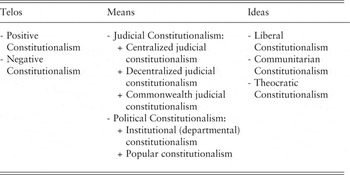
We suggest that multiple classifications of constitutionalisms, depending on the criteria of classification, are helpful in some respects. Chen has classified them using criteria representing the role and nature of the constitutional text. We would suggest three alternative criteria, namely telos or end, mechanisms or means, and ideas or values.
Classifying according to the telos, we have: (1) negative constitutionalism which aims at limiting the public power for protecting civil liberty; and (2) positive constitutionalism which aims at limiting the public power for the promotion of the common good. On the criterion of mechanism, we have: (1) judicial constitutionalism which is implemented by judicial review; and (2) political constitutionalism which is implemented by political institutional means, such as the separation of powers, checks and balances, and political non-institutional means like public discourse, social movements, or different kinds of public activism. Basing on ideas or values, we have: (1) liberal constitutionalism, which is informed by Western liberalism; (2) communitarian constitutionalism, which is informed by Asian communitarian philosophy, such as Confucianism; and (3) theocratic constitutionalism which is informed by religions. Put together, we have the following table:
Classification of Constitutionalisms in Asia

It should be underlined here that we are not classifying “national constitutionalisms”. We do not simply assign, for example, Singapore as belonging to communitarian constitutionalism, although this model may be said to prevail there.Footnote 87 The proposed method is a theoretical-classificatory construction of a system of ideas about certain types of constitutionalism which may inform constitutional practice in a given polity in Asia. Given the pluralist context of Asia, it is understandable that a single Asian polity may be informed by different types of constitutionalism, and a certain type may be more prominent while another type is less so. South Korea, for example, is prominently informed by liberal constitutionalism but also reflects certain aspects of communitarian constitutionalism.
V. CONCLUSION
Asian constitutional studies are an emerging area and are becoming more institutionalized. Since 2005, the Asian Constitutional Law Forum has provided the platform for scholars to share their research and engage in dialogue on Asian constitutional law; from this an Association for Asian Constitutional Studies is in the process of being established.
We have recently witnessed the advent of a good deal of creditable work in this field. Established assumptions may not capture the dynamic and changing nature of constitutional life in Asia. The exploration of Asian constitutional dynamics with improved methodologies can on the one hand deepen our understanding of constitutional experience in the region, and on the other hand can connect Asian experience to global discourse on constitutional issues. Yet, does this connection mean that Asian experience is used as an instrument to test or legitimize “global theories”? Alternative perspectives can in our view be developed based on unique Asian experiences, which can in turn contribute to the global constitutional dialogue which now, rightly, “pivots” to Asia. The volumes discussed in this essay make important contributions to this development but also pose many challenges.