Since the appearance of Brahms's Handel Variations, Op. 24, in 1861, the work has been accorded a special canonic stature by friends and foes alike: the usually captious composer himself confessed to his publisher that the Lieblingswerk was ‘particularly dear’ to him.Footnote 1 For Selmar Bagge, the appealing ‘fullness of music, grace, freshness and health’ contrasted with the ‘thoughtless, intricate, superficial’ salon music of the time.Footnote 2 Wagner, too, expressed genuine admiration, conceding that the young composer had proven ‘what could still be done with the old forms’.Footnote 3 In the twentieth century Donald Francis Tovey declared the composition as among the ‘half-dozen greatest variation sets ever written’Footnote 4; meanwhile Heinrich Schenker further concluded his analysis of the work by hailing Brahms as a Messiah-like figure in a hypostatic union of the divine and human.Footnote 5 Late in life, Schoenberg upheld the variations as a pedagogical exemplar of the form in his final text, Fundamentals of Musical Composition (1937–48).Footnote 6
Although Brahms's Handel Variations gains its stature as among the most complete yet original homages to the Baroque style, his selection of a theme by Handel was not in itself novel. In fact, a lineage of settings based on the popular Air and Variations movement of the Keyboard Suite No. 5 (HWV430), commonly known as the ‘Harmonious Blacksmith’, testified to Handel's enduring legacy, particularly in Austro-German lands in the first half of the nineteenth century. Variances in a composers’ reinterpretations of the Baroque master suggest an evolving process in musical historicism, that is, the preservation of past styles in the present, which gradually intensified alongside the growing scholarly interest in early music at mid-century. Robert Volkmann's Variationen über ein Thema von Händel, Op. 26, written five years before Brahms's in 1856 offers a strong case study for neo-Baroque expression in its modernization of early eighteenth-century rhythm, texture and timbre. Despite its originality, the work's debt to the prevailing ‘character variation’ reflected a continual reluctance for the full immersion and synthesis of Baroque styles manifest in Brahms's variations of 1861. Reviewing these predecessors throws into sharp relief the monumentality of Brahms's work, while underscoring a forgotten pathway of historicism devoted to Handel.
Brahms's reinstatement of a strict Baroque variation form culminating in a fugal finale effected a new horizon with which later composers had to contend. Gravitating to his model was the neglected Hungarian composer, Emanuel Moór (1863–1931). A former student of Volkmann in Budapest, Moór relied on Austro-Germanic, if not Brahmsian, examples early in his career, as he sought to forge his own national musical identity. Despite the absence of Handel, his Variations and Fugue on a Hungarian Theme (c. 1889) – coincidentally numbered Op. 24 as well – is one of several examples by which Brahms's revival of neo-Baroque techniques manifest in diverse manners for later composers.
I
The most enduring tune among Handel's instrumental oeuvre was the Air and Variations movement from his fifth keyboard suite (HWV430). Table 1 presents a few examples of composers in the early half of the nineteenth century adapting the theme.
Instrumental Treatments of Handel's Harmonious Blacksmith Theme

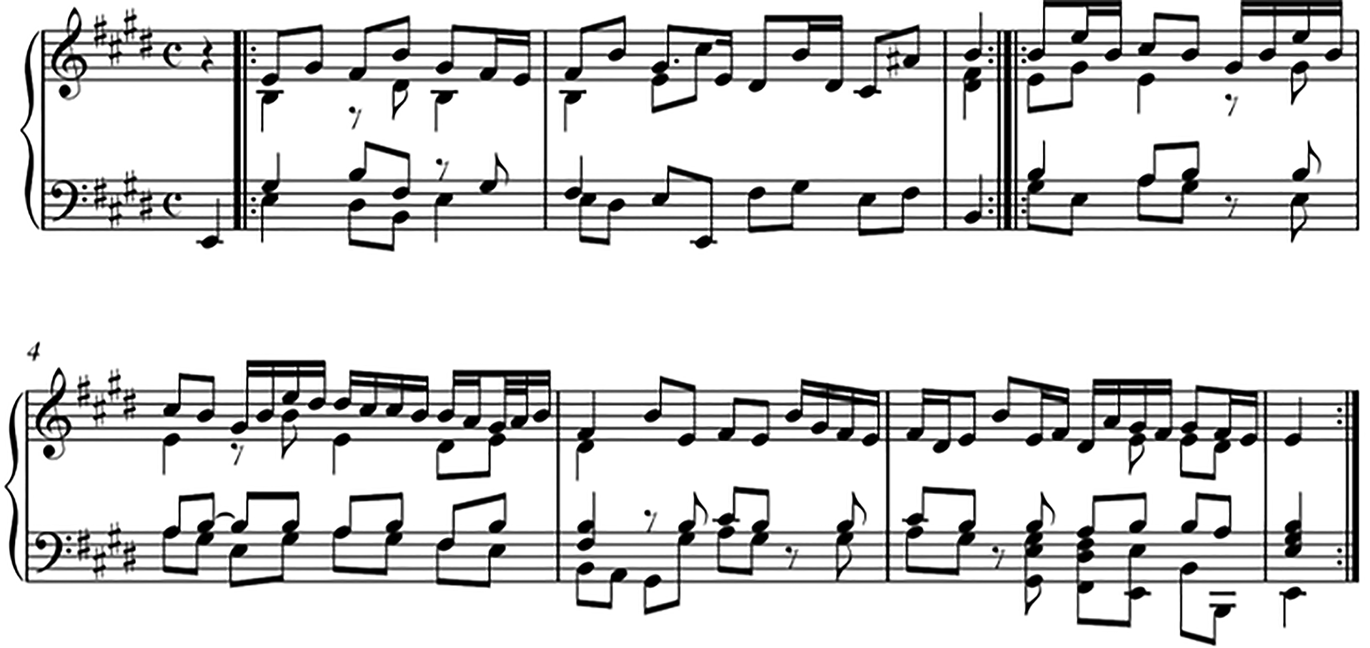
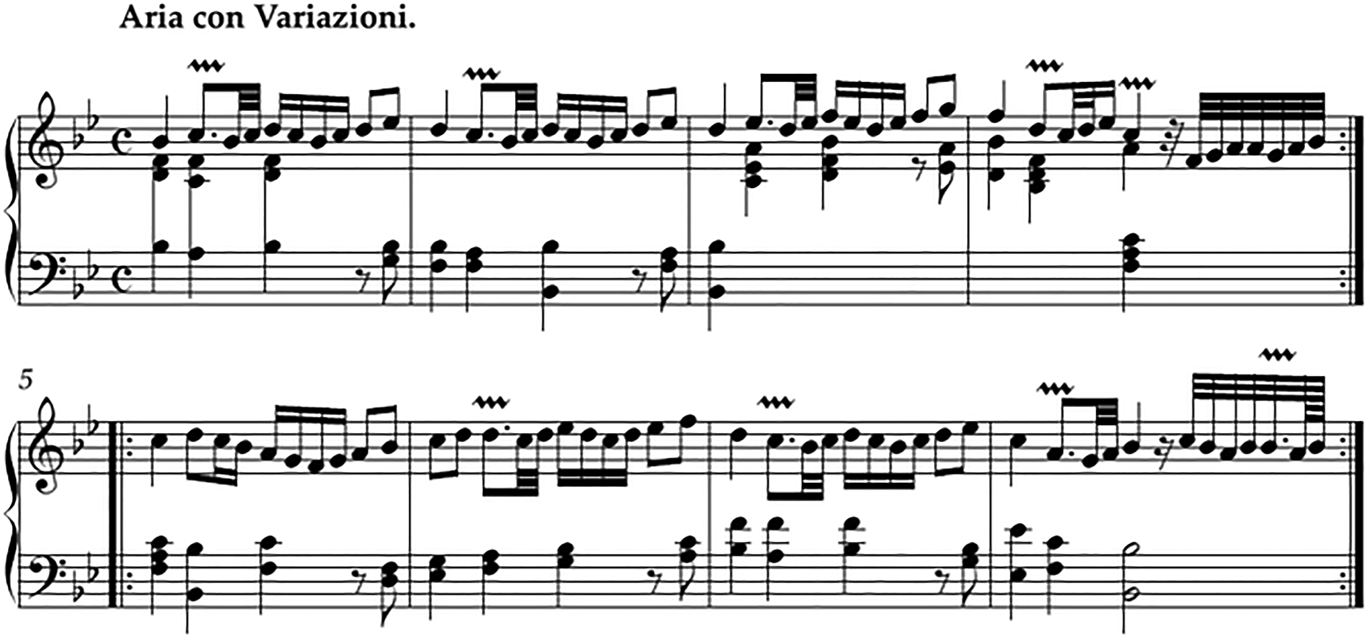
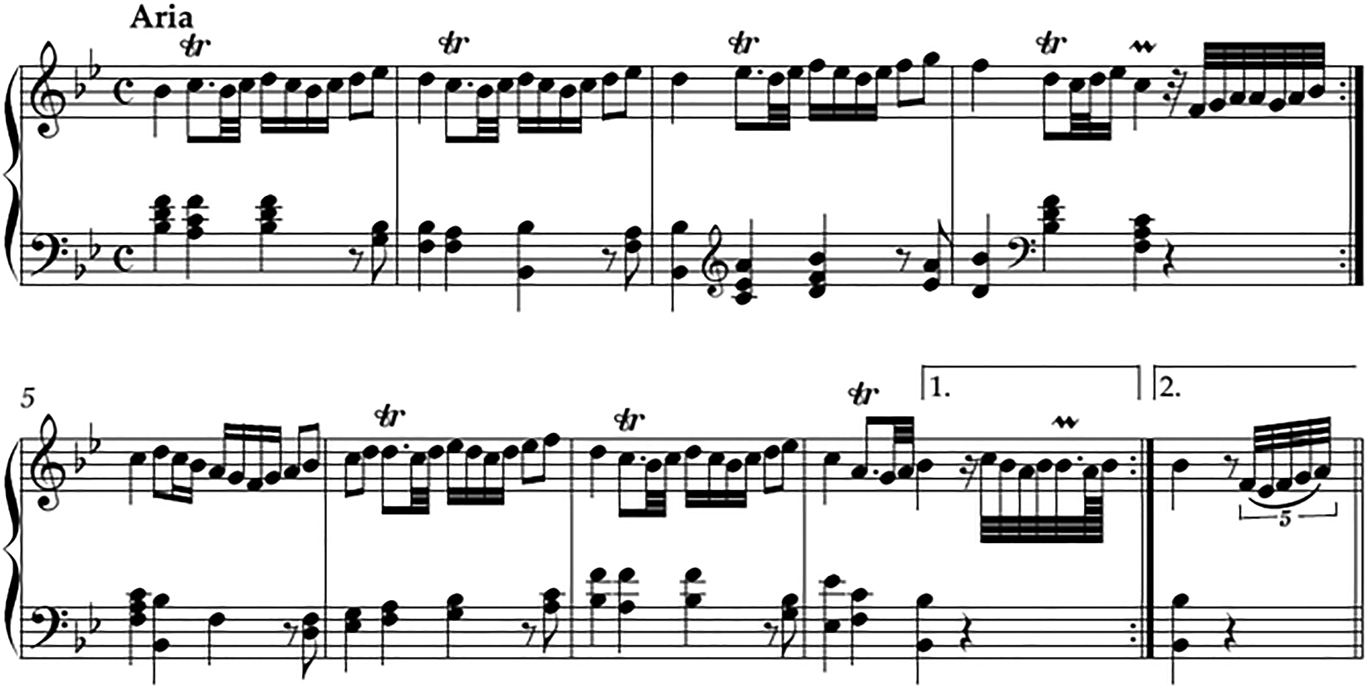
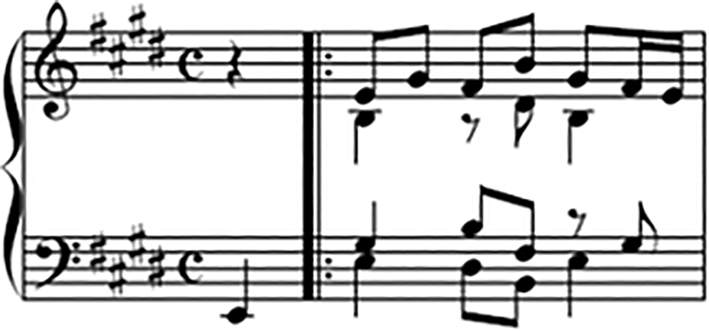
Dating from 1720, the Air (and its popular moniker) became one of the most endearing melodies linked to Handel's name. A sustained bass intonation initiates the movement, whereupon a six-bar theme in E major unfolds in binary form. The first two-bar phrase ends on a half cadence, followed by a four-bar phrase which returns to the tonic (Ex. 1).
Handel, Keyboard Suite No. 5, HWV430, ‘Air’, bars 1–8

The five doubles within the movement adhere to the same harmonic scheme. Rhythmically paired, variations 1 and 2 alternate semi-quaver accompaniment figures in the left and right hands, while variations 3 and 4 do likewise in semi-quaver triplets. The concluding fifth variation embellishes the theme with rhythmic diminution of demisemiquaver scales between the hands.
Among the earliest adaptations of the Blacksmith theme was from the 13-year-old Beethoven. Handel's theme forms the subject of his two-voice organ fugue, whereby the melodic contour is preserved, but transposed with slight rhythmic alterations (Ex. 2). The unpublished setting (WoO 31) was submitted in 1783 for an organist position in Bonn and foreshadowed the composer's lifelong reverence for Handel.Footnote 7
Beethoven, Fugue for Two Voices, WoO 31, bars 1–7

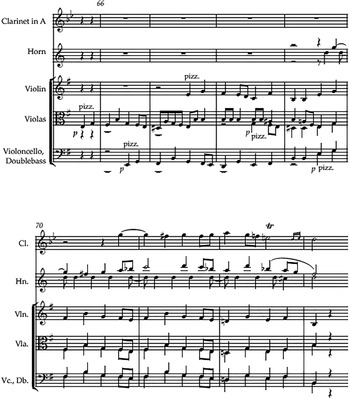
Three decades later, the bourgeoning reception of Handel in Vienna inspired three additional homages on the same tune. Louis Spohr, Ignaz Moscheles and Mauro Giuliani, then living in the Habsburg capital, contributed to the growing variation literature with works corresponding to their individual talents. In 1814, Spohr set the Harmonious Blacksmith in the third movement of his Octet, Op. 32.Footnote 8 His expanded chamber setting (clarinet, two horns, violin, two violas, cello and double bass) offered Handel's melody new dimensions of timbral variety: strings engage antiphonally with horns and clarinet, meanwhile virtuosic countermelodies in the solo violin enrich the theme, and instrumental pairings lend the movement a kaleidoscope of colours. Framing the theme according to Classical objectivity, the six-bar Blacksmith melody is now fitted into a regular, eight-bar periodic structure. In contrast to the uniform designs of Handel's original variations, Spohr employs contrasting dramatic styles, sudden sforzandos, and a variety of dynamics and rhythmic figurations. Furthermore, the roundness of symmetrical phrases, seamless transitions and vertical linearity in melody and accompaniment accentuate the late eighteenth-century style. Only briefly in the first five bars of the penultimate minor-key variation does Spohr set aside the dominant classicizing tendencies of his music. Here, staggered pizzicato voices in the lower strings enter at a halting crochet rhythm, offering a dry whiff of counterpoint (Ex. 3).
Spohr, Octet, Op. 32, Andante con variazioni, bars 66–73

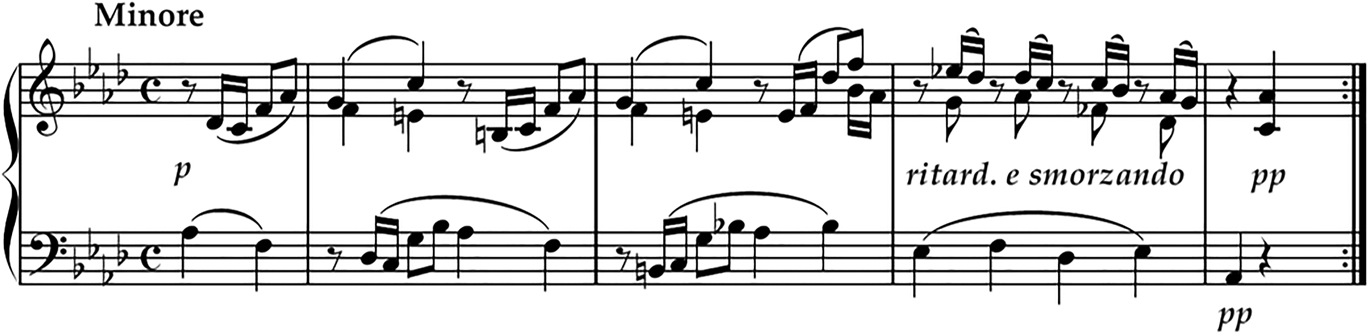
Also in 1814, a 20-year-old Moscheles published his Variationen über ein Thema von Händel, Op. 29, undoubtedly responding to the increasing demands for literature suitable for domestic music-making. Transposed to the more accessible key of F major, the variations avoid the extravagant brilliance expected of the virtuoso pianist, instead exploring the newly found expressive possibilities available on the pianoforte. Delicate transformations of the melody appear in alto and tenor registers, meanwhile pearly scales sweep across the expanded breadth of the new six-octave keyboard. As in Spohr's variations, Handel's melody is expanded into an eight-bar period, with the repeated binary form present throughout all variations. Perhaps imitating the soft timbres of Handel's keyboards, Moscheles employs a generally quiet range of dynamics (mostly pianissimo and piano), a deliberate contrast to the popular bravura variations of his time. Two instances of counterpoint acknowledge Handel: invertible counterpoint in variation 4 (Ex. 4a), and imitation in the penultimate minore variation (Ex. 4b).
Moscheles, Variations on a Theme by Handel, Op. 29, bars 55–59

Moscheles, Variations on a Theme by Handel, Op. 29, bars 73–76

Moscheles's variations likely influenced a third set, by his close friend, the Italian guitar virtuoso Mauro Giuliani. As the foremost guitarist in Vienna in the 1810s, Giuliani published his virtuosic rendition for the fretted instrument in 1826 near the end of his life. Having published several dozens of variations in his lifetime, the selection of Handel in his variations (Op. 107) underscores the ongoing tendency to select themes motivated by familiarity, meanwhile showcasing the performer's technical aptitude.
Over the next decades, what began as popular appeal for an antiquated theme gradually turned to a concern for historical awareness. In 1824, Moscheles composed his two-movement Hommage à Handel: Grosses Duo für zwei Pianoforte, Op. 92, a concert work in which the first movement (Andante patetico) distils the dramatic pathos of Handel's minor-key French overtures through dotted rhythms, contrasting cantabile melodies and orchestral flourishes onto a two-piano medium. Performed at least twice with Mendelssohn in 1824 and 1835, the work led Robert Schumann to praise those ‘moments of that period of health, honesty and fertility’.Footnote 9 Shortly after, Moscheles launched a series of historical concerts in London with programmes of Bach and Handel featured on the harpsichord. In 1842, Moscheles further served as one of the founders of the English Handel Society, for which he edited Handel's Suites de Pieces in two volumes.Footnote 10 Spohr, too, premiered his sixth symphony (‘Historische Symphonie im Styl und Geschmack vier verschiedener Zeitabschnitte’) in 1839, whereby the first movement pays tribute to Bach and Handel through the use of a fugue and pastoral.
One of the major impetuses driving the serious reassessment of Handel was Justus Thibaut's influential Über Reinheit der Tonkunst (1825) which exhorted composers to return to studying the masters, chief among whom he regarded Palestrina, Bach and the ‘incomparable Handel’:
But what is totally inexcusable is the general neglect of Handel, whose works can be obtained without trouble in English editions in full score … forming a most valuable treasury of the most real and masterly music of nearly every style. Handel is the Shakespeare of music … he stands up in all kinds of musical form as an immortal example for imitation … . In all styles, from the fond and playful to the sublime, he has provided us with unexcelled specimens of inspiration and culture.Footnote 11
Thibaut's influence extended to patriotic efforts to reclaim Handel's national heritage. In 1834, the novelist Johann Peter Lyser (1804–1870), anonymously published his own tale about the ‘Händel’ in the inaugural year of Neue Zeitschrift für Musik. Though fictional, Lyser's tribute was the first of its kind in German literature; aside from translated English biographies, no other German had undertaken an original panegyric of the composer. Endorsing Lyser's publication, Schumann shared the sentiment that despite his British naturalization, Handel was indeed a ‘freier deutscher Mann’ and ‘deutscher Meister’.Footnote 12 In 1837, the theorist and composer Gottfried Wilhelm Fink echoed similar convictions in his discussion of the oratorio: ‘The highest and the crown of all in this branch of composition [oratorio] is and remains until now our German Händel, without comparison to all who preceded and followed him, by far outstanding.’Footnote 13
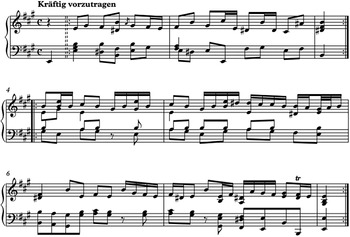
Meanwhile, the Blacksmith variations continued to be performed in the concert hall and household. Mendelssohn who, like Beethoven, owned Samuel Arnold's Handel edition (1787–97), improvised on the theme for one of Leipzig's four historical concerts in 1841, in addition to a concert in Exeter Hall, London the following year.Footnote 14 Clara Schumann also included Handel's variations on her tours; meanwhile Robert noted in the household diaries their 12-year-old daughter Marie playing the work at home.Footnote 15 Shortly after the success of the Album für die Jugend in 1848, the Schumanns began sketching plans for yet another children's collection, ‘Ein kleinere Lehrgang durch die Musikgeschichte’. Although unpublished, the miniature anthology traced the masterpieces of a foreshortened history of music, with the theme of Handel's Air movement inaugurating the set.Footnote 16 Marked ‘Kräftig vorzutragen’, the theme's key signature notates three sharps rather than the original four, with D#s inserted onto the score, perhaps to simplify the version for its youthful consumers (Ex. 5).
Robert Schumann, Ein Thema von Georg Friedrich Händel

II
In 1858, efforts to restore Handel's position within its Teutonic heritage climaxed with the establishment of a German Handel-Gesellschaft. Led by Friedrich Chrysander and Georg Gervinus, the undertaking recognized the need to safeguard a complete critical edition of the composer's oeuvre within its rightful territory. Claims on Handel, jus soli, had already been assumed in the literature, but an authoritative Gesamtausgabe (carried out with deutscher Sorgfalt und Gründlichkeit) would surely surpass other editions, namely those of England.Footnote 17 On the eve of the society's formal establishment, another setting on Handel's Harmonious Blacksmith appeared, this time by the north Saxon composer, Robert Volkmann. Familiarity with the melody had remained so fresh in Vienna at mid-century such that one critic described Volkmann's theme as that which, ‘Mozart, and later, I believe, all Viennese musicians have written’ (emphasis mine).Footnote 18
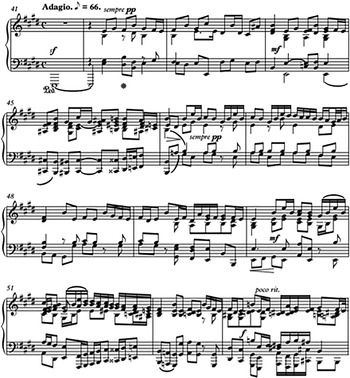
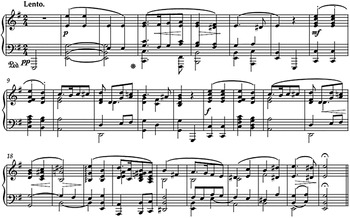
Volkmann's set contains an introduction, theme, seven variations and finale. The free, rhapsodic introduction initially dispenses with bar lines, later easing into a fluctuating metre, whereby episodes of Lisztian virtuosity alternate with the pensive introspection characteristic of Schumann's Eusebius. The improvisatory nature of the introduction is thinly disguised as an unmeasured prelude of a Baroque suite, although its harmonic language rests upon extemporizations on diminished-seventh sonorities. These tonal ambiguities resolve 40 bars later with the theme's arrival, heralded by the same sustained bass intonation featured in Handel's harpsichord suite over a century earlier. Above the low sforzando E, Volkmann presents the Air melody verbatim, yet the written out, repeated binary form is, in fact, a dialogue between the old and the new (Ex. 6).
Volkmann, Variationen über ein Thema von Händel, Op. 26, bars 41–53

Initially stated sempre pianissimo, the theme then yields to a reharmonization of the passage at mezzo forte with thick, sonorous chords and chromatic inner voices. The second four-bar phrase returns similarly at pianissimo, later yielding to a reiteration in bass octaves and a gradual crescendo to forte. The poco ritardano at the theme's close further attenuates stylistic differences between 1720 and 1856.
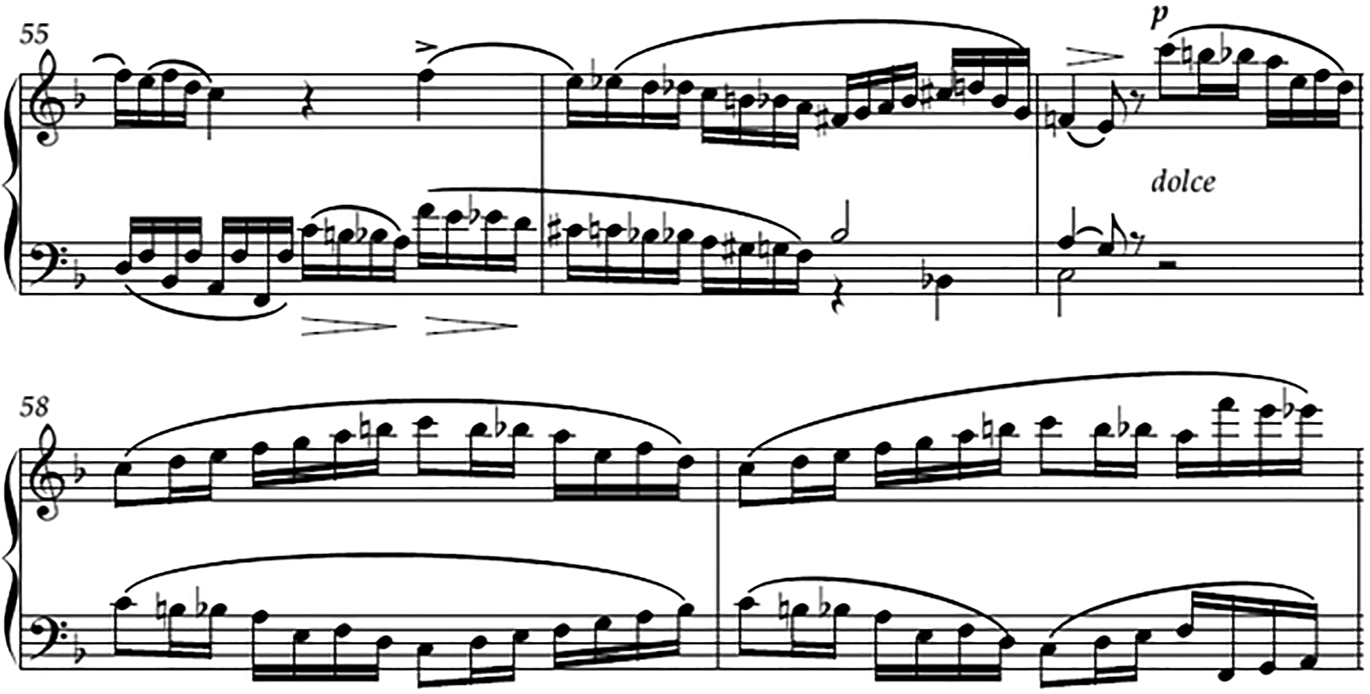
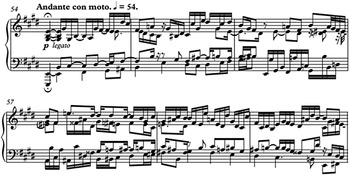
The seven variations that follow embrace the fantasy variation espoused by Schumann in works such as Carnaval and the XII Études Symphoniques two decades earlier. The first variation, Andante con moto, masks the theme in a free, semiquaver contrapuntal texture in which hints of the Blacksmith melody's rising third and fourth intervals appear (Ex. 7).
Volkmann, Variationen über ein Thema von Händel, Op. 26, bars 54–59

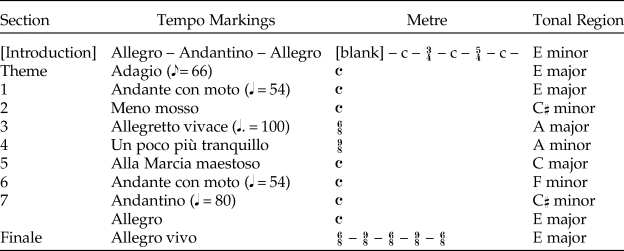
Variation two, Meno Mosso, plunges into a fretful C-sharp minor melody, interrupted by nervous, syncopated chords and bass interjections. The following Allegretto vivace (Var. 3) springs forth into an uplifting A major of dotted-quaver rhythms in compound duple metre, while Un poco più tranquillo (Var. 4) broods pensively over a steady portamento pedal on A. In contrast, the successive Alla Marcia maestoso (which Liszt regarded as the ‘masculine march’Footnote 19) offers octave chords in unremitting dotted rhythms sweeping toward the outer peripheries of the keyboard in contrary motion, a gesture reminiscent of the muscular finale of Schumann's XII Études Symphoniques. Embedded into the variation is a motif from Handel's ‘Hallelujah’ chorus from the Messiah.Footnote 20 The March in C major serves as the dominant for the following Andante con moto in F minor. Here, Volkmann casts a fragment of the Blacksmith theme in a contrasting dirge-like melody in the bass harmonized by dense chords in the treble. After four bars the theme metamorphoses into an essentially new melody in which the only lingering connection to the theme is the perfect fourth. The seventh variation modulates to C-sharp minor before a short six-bar interlude (Allegro) returns to the home key of E major for the Finale. Similar to Schumann's variations, each of the through-composed variations flow into the next, attacca, separated by double bar-lines, varied tempo markings and measured pauses (ritardando or fermatas). Harmonically, Volkmann links each variation with a chain of keys related by thirds (Table 2).
Parameters in Volkmann's Handel Variations

The dialogic juxtapositions of Romantic and Baroque found in the theme's binary construction are magnified onto the whole of the work. A near complete absence of Baroque topics in the work's seven variations is accounted for in the massive Finale, which in notated length alone exceeds the previous seven variations by a single bar.Footnote 21 In the final section, the Blacksmith theme now finds clear articulation against a revitalization of the homophonic, motoric style of the late Baroque.
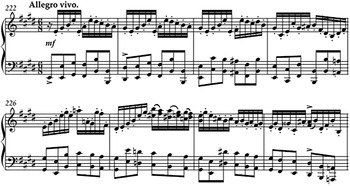
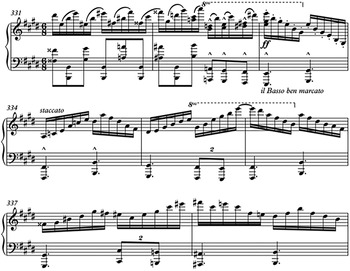
A buoyant Allegro vivo in compound metre contains the theme serving as an independent and active walking bass (Ex. 8). Offsetting the melodic bass line are rhythmically stratified upper voices in rapid semiquavers. These passages feature relentless triadic figurations, scales, alternating notes against a common tone, tremolos and angular leaps with wide intervals, all recalling the idiomatic violin writing of Corelli and Vivaldi, whose styles Handel (and Bach) had synthesized into their compositional language. Harmonically, first inversion chords, sequences driving towards cadences and long pedal points generate the powerful harmonic tensions that encapsulate the dramatic expression of the Baroque style. Volkmann imbues the rich harmonic rhythm with chromatic dissonances and temporary but sudden shifts to the minor key, thus deepening the coloristic qualities of Handel's theme. Rhythmically, the Baroque hemiola, used to demarcate the ends of sections or to offer cadential expansions, appears before the theme's restatement. A final iteration of Handel's tune undergoes rhythmic augmentation before yielding to a dominant pedal (Ex. 9).
Volkmann, Variationen über ein Thema von Händel, Op. 26, bars 222–229

Volkmann, Variationen über ein Thema von Händel, Op. 26, bars 331–338

Volkmann made a special effort to transfer to the modern piano the distinctive, incisive articulation of the eighteenth-century harpsichord. Strategically placed staccato markings emphasize the sparkling brilliance of the keyboard's timbre, recreating its immediate tonal decay. Two-note slurs ensure tonal clarity in the rapid harmonic motion, while portato articulations display one of the few timbral nuances available to the performer of the instrument. Detached and legato markings similarly offer linear clarity within the hand. These neo-Baroque effects become modernized as well: deep bass octaves and arpeggiated figures glide across registers previously unavailable, and pedalled passages offer lush shades in sonority, demonstrating the orchestral fullness of the modern piano. Texture, articulation and register are no longer the primary means for communicating terraced gradations in volume, but explicit dynamic markings underline the expressive capabilities of the modern instrument. From the fortissimo arpeggiations of harmonic dissonances to the mezzo forte recurrence of the theme, the nineteenth- and eighteenth-century performance traditions seem to merge in this finale. Such self-evident, historical references to the High Baroque not only displayed the composer's own intimate familiarity with repertoire and historical performance practices but his desire to root the present in the past.
On the whole, Volkmann's variations juxtapose points of contact between the present and past. On one hand, the work supports the ongoing aesthetic ideal of fantasy variations, pioneered by Schumann's Carnaval (1835) and the XII Études Symphoniques (1837) two decades earlier. Pursuing these ideals, elucidated by theorists A.B. Marx (1848) and Julius Schäffer (1860), Volkmann prioritized motivic development over mere thematic modifications, introspection over superficial displays of technique and cyclic procedures that unified its parts into a cohesive whole.Footnote 22 The manifestation of the ‘psychological bond’ between variations liberated the musical content from Handel's theme into a freely developed ‘fantasy-variation’ in which unbridled, inner expression assumed priority. Moreover, its significantly loose adherence to the theme is notable, wherein each variation embodies its own distinct profile and temperament and plays upon the idea of contrast – in sum, rather resembling Schumann's Carnaval with its motley assortment of characters.Footnote 23 Volkmann's nearly complete disassociation from Handel in the first half of the work would establish a sufficiently wide aesthetic gulf to would throw into relief the recreation of the late Baroque style.
III
All of which begs the question: from where did Volkmann gain such inspiration? To be sure, the conventional modus operandi to evoke antiquity was through fugues and canons. Mendelssohn composed his Six Preludes and Fugues, Op. 35 (1836) and Organ Sonatas, Op. 65 (1845), and Schumann, in his ‘contrapuntal’ year of 1845, published Six Studies in Canonic Form, Op. 56, Six Fugues on B-A-C-H for organ, Op. 60, and Four Fugues for piano, Op. 72, among others. Prior to Volkmann's variations, Liszt issued his Fantasy and Fugue on the Chorale ‘Ad nos, ad salutarem undam’ (1852) and the first version of his Präludium und Fuge über den Namen B-A-C-H for organ (1855). The common denominator among these compositions, however, remained a preoccupation with the strictest sense of imitation, far different from Volkmann's newly founded interests.
The most significant cornerstone for Volkmann's familiarity with tradition came from his teacher in Leipzig, Carl Ferdinand Becker, with whom he studied from 1836 to 1839. The conservative Becker had also been influenced by Thibaut's conviction that one's craft should be rooted in tradition, and this view is amply evident in his roles in Leipzig as organist, manuscript collector, editor and pedagogue. Aside from serving as the city's highest-paid organist, at the Nicholaikirche, Becker made substantial contributions to the then-inchoate field of musical scholarship.Footnote 24 His articles regularly appeared in Schumann's Neue Zeitschrift für Musik covering subjects from fifteenth- and sixteenth-century German church music and seventeenth- and eighteenth-century keyboard literature to theoretical treatises on counterpoint and fugues. In 1836, Becker was responsible for issuing the Systematisch chronologische Darstellung der Musikalischen Literatur von der Frühesten bis auf die neueste Zeit (1836), a comprehensive four-part bibliography of musical writings initiated in 1792 by Johann Forkel.Footnote 25 His personal library, donated to the Stadtbibliothek Leipzig in 1856, numbered upwards of 1,420 books and writings, with printed editions and scores dating from as early as the sixteenth century. Rare manuscripts by J.S. Bach, Kuhnau and Hasse, among others, formed the basis of various writings, namely Die Hausmusik in Deutschland in dem 16., 17. und 18. Jahrhunderte (1837), the first study of the social-cultural practice and its attending literature, composers and performance.Footnote 26 As editor, Becker published two collections of selected keyboard works from Baroque masters, featuring an international array of composers such as Scarlatti, Pescetti, Muffat, Couperin, Kuhnau, Benda and Böhm. Without question, Becker's erudition facilitated his lectures on music history at the Leipzig Conservatory (where he taught organ) and his service as a co-founder of the Bach-Gesellschaft in 1850. Three years later, Becker was tasked to edit the third volume (Clavierwerke), a decision the committee made over Ignaz Moscheles.Footnote 27 With Becker, Volkmann studied harmony, composition, voice, as well as the early periods of music history, undoubtedly reinforcing his strong historicist leanings in the process.
The conservatism of Leipzig was certainly conducive to Volkmann's engagement with tradition. Mendelssohn's arrival in the city in 1834 introduced concerts at the Gewandhaus aimed to restore original performance practices, among which the most distinguished was his offering of Handel's Israel in Egypt in 1836. Becker, reviewing the performance, lauded Mendelssohn's fidelity (or ‘purist approach’) to the ‘immortal Händel’ through the reinstatement of the organ, as well as former cuts.Footnote 28 The German premiere of Mendelssohn's own oratorio, Paulus, in the following year further demonstrated the success of revitalizing an older genre through the blending of idioms from Bach and Handel with modern instrumentation and techniques.
The three years spent in Leipzig established a foundation for Volkmann which would later be solidified by the friendship of yet another scholar, Gustav Nottebohm. After studies in Leipzig with Mendelssohn and Schumann (1840–46), Nottebohm had moved to Vienna and met Volkmann in 1854. The high esteem shared between the two north Germans remained until the end of their lives, such that even Brahms would remark that Volkmann always remained for Nottebohm, ‘the only person with whom [he] was genuinely seriously and cordially connected’.Footnote 29 Prior to being engaged as editor of the Beethoven Gesamtausgabe for Breitkopf and Härtel in 1862, Nottebohm had begun his musicological career with publications on the Baroque keyboard suite. Initially published in 1855 and later edited in 1857, Nottebohm's articles expanded Becker's chapter on the subject in his Die Hausmusik.Footnote 30 Nottebohm regarded the suite as a significant historical genre and one of the most ‘original creations’. In contrast to the later sonata, Nottebohm deemed the suite to be the first composite art form in history with its external features and sequence of characteristic dances corresponding to the small forms, as well as individualisierende Richtungen of pieces by Mendelssohn, Schumann and even Chopin.Footnote 31 Moreover, the unity achieved across the suite's dance movements found its best execution in J.S. Bach, who did not merely vary the thematic material of each movement, but developed the motives into entirely new content, such that their associations would be difficult to detect.Footnote 32 Volkmann's decision to blend genres of fantasy variation with the Baroque suite may well reflect in part Nottebohm's scholarship.
Another point of consideration is Volkmann's approach to historical performance. The textural brilliance emanating from the Finale's staccato markings recall the metallic plectrums of the harpsichord, an instrument that, at least in Austro-German lands, was regarded with disdain after the fortepiano's arrival in the final decades of the eighteenth century. The antiquated instrument held little fascination for Germany, unlike London and Paris where Moscheles's historical soirées on the harpsichord in 1837 sparked a revival. In 1855, the English pianist Charles Salaman presented a series of lecture recitals in London on the keyboard's history and development. One anonymous correspondent found the lecture performances of great interest and was particularly pleased to hear Salaman perform the original Blacksmith variations on Handel's own instrument at the close of the concert. To his Viennese readers he posed: ‘What had become of [our] old keyboards? Where are their ruins?’Footnote 33 Perhaps this article, in addition to Nottebohm's own discussion of the Baroque suite three months later in the same journal, encouraged in some part Volkmann's return to the century-old Air.
If Volkmann wished to offer an alternative route to musical historicism, attention to the retrospective Finale was largely eclipsed by the allure of the fantasy-like variations. The work won high praise, though few mentioned the Finale's replication of the late Baroque style. Pleased with Handel's revival, Hans von Bülow disclosed that the F minor and C-sharp variations were his favourites for their ‘sublime’ and ‘original’ qualities, thus underscoring his attraction to the work's Romantic underpinnings.Footnote 34 The Finale, however, merely struck the virtuoso as a festive splendour with long-winded (langatmig) flow, one which would not soon be replicated. In 1857, Eduard Hanslick offered a glimpse of Volkmann's contribution vis-à-vis contemporary variations, defining the work with superlative terms:
The most significant [work] that has been brought by native forces in the field of keyboard music is probably Robert Volkmann's Variations on a Theme by Handel … [T]he treatment of variation in recent times has become richer and freer … Works such as Schumann's C sharp minor Variations (op. 13) and Variations for Two Pianos, the variations by Brahms [Op. 21 from 1857], Volkmann and others show how much this form has gained freedom of movement and characteristic deepening. We indeed see the extreme of this freedom occasionally striking in Volkmann: the variations are all too removed from its theme. Whereas in the past every variation was so anxious to retain the number of bars and the harmonic outline of the subject such that the listener felt burdened with the monotony of this faithfulness, the new school emancipated itself too boldly from the theme and hardly allowed it to resonate for many pages. Instead of being the real reason for the whole performance, the theme becomes a mere pretext for the orator to indulge in the most remote things.Footnote 35
Neglecting the finale entirely in his review, Hanslick thus emphasized Volkmann's pioneering of a new level of the fantasy variation.
Liszt, to whom Volkmann had dedicated his Piano Trio, Op. 5, six years earlier, joined the chorus of delight for the composer's Blacksmith variations:
I should like to express to you herewith guiltily, my sincere thanks not only for the friendly token of your sending of your ‘Variationen über ein Thema von Händel’, but especially for my joy at this excellent and in all its essentials, as well as in its entire form, exceptionally successful work. In my opinion, it is a long time since such a rich, imaginative, original and beautifully formed piano piece has been published and I have played it frequently and with true passion to my young Weimar pianists … . If it is not inappropriate for me to single out details from such a completely rounded work, I would especially mention the Meno mosso on page 7, the magnificent masculine march (in C major), the following Variation (in F minor), then the charming Prelude (pages 12 and 13 with the coda in C-sharp minor) – finally the entire Finale, in a word, everything. Bravo my honored friend – You have produced a splendid work which praises its creator more than he thought himself capable.Footnote 36
Not everyone was convinced by the artistic licenses taken by Volkmann in his treatment of Handel's Air. The work furrowed the brow of Arrey von Dommer, critic of the Neue Zeitschrift für Musik, as he was unable to ‘discover in it a clear reason for what Volkmann has developed from [the theme]. I have not succeeded in clearly understanding the actual development of the variations and their internal relations to each other and to the main idea.’Footnote 37 Nonetheless, the work's popularity continued into the early twentieth century, as even the young pianist, Béla Bartók, performed the work on tour.Footnote 38
IV
In 1861, Brahms's Variations on a Theme by Handel (in B-flat) emerged from his self-directed studies of fugues, canons and early music: a separate route from previous homages to Handel and the Baroque. Discreetly (and probably deliberately) choosing a lesser known ‘Air’ from Handel's second collection of Suites de Clavecin from 1733 (Harpsichord Suite No. 1 in B-flat major, HWV434), Brahms distanced himself from the popular Blacksmith lineage, perhaps in a bid to redefine the Handelian tradition. Whether Brahms knew of Volkmann's variations is unclear, although a letter to Clara Schumann in 1856 is revealing: ‘When you see Volkmann, write me about it. He is very talented. Do you know his B-flat minor Trio and A minor Quartet?’Footnote 39
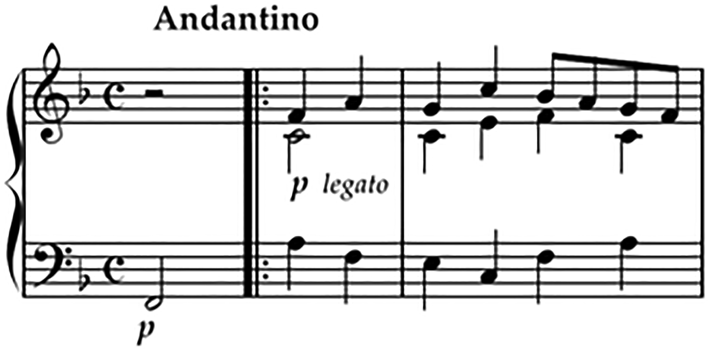
Realizing the relative obscurity of the Air theme, Brahms directed his publishers to the exact page number in Chrysander's second volume of the Handel Gesamtsausgabe.Footnote 40 Brahms preserved intact the embellishments of Handel's theme, and interwove visions of the past and present across 25 variations: strict canon at the octave and in contrary motion (var. 6) and invertible counterpoint (var. 8) are answered by chromaticism and polyrhythms (var. 9); hollowed fifths and sixths in the tenor recall echoes of the Waldhorn (vars. 7, 12, 17, 18); canon (var. 16) is preceded by a Hungarian Csardas (vars. 13 and 14); and an idyllic Siciliano (var. 19) and Baroque musette (var. 22) pave the way towards a Beethovenian fugal climax. Notwithstanding this wide range of styles, Brahms scrupulously preserved the binary structures and formal outlines of Handel's original variations. Handel's theme and five variations consists of two repeated four-bar phrases, in which the first ends on an imperfect cadence (Ex. 10a), imitated by Brahms's variations (Ex. 10b).
Handel, Suite No. 1, HWV434, ‘Air’, bars 1–8

Brahms, Handel Variations, Op. 24, bars 1–8

The second begins on the dominant and modulates back to the tonic, a scheme which similarly dictates Brahms's variations. Twenty-four of Brahms's 25 variations are cast in two repeated four-bar sections (or two eight-bar sections); the exception is Variation 15, which appends an additional bar to the second phrase.
As Elaine Sisman has elucidated, Brahms's adherence to the original structure was based on the conviction that the variations should be strict and pure with priority given to the bass (a reference to a fixed structure).Footnote 41 His rubric had been deduced from models given by the ‘ancients’, no less than Bach, Handel and even Beethoven. Disparaging his contemporaries’ use of the fantasy-variations with their deviations from the theme, Brahms instead furthered the aesthetic experience from his predecessors by returning to the original Baroque approach to variation form:
In a theme for [a set of] variations, it is almost only the bass that actually has any meaning for me. But this is sacred to me, it is the firm foundation on which I then build my stories … If I vary only the melody, then I cannot easily be more than clever or graceful, or, indeed, [if] full of feeling, deepen a pretty thought. On the given bass, I invent something actually new, I discover new melodies in it, I create.Footnote 42
Subjecting the works of Schumann, Herzogenberg and Nottebohm to the category of fantasy-variations, Brahms could well have described Volkmann's variations as such, as his variations indeed diverge from the theme into a barely recognizable ‘fantasy’.Footnote 43 Yet if Brahms knew of Volkmann's work, he could have recognized that there was a limit to how far Volkmann was willing to return to the eighteenth century. Brahms thus advanced the Baroque into the foreground of his creation, modernizing techniques of fugal writing, imitation, canon and historic genres for the present. His inclusion of the fugue similarly surpassed the historicity of his predecessors. In light of the contrast with Volkmann's work, it is no wonder that Brahms was adamant about publishing his Liebslingwerk, one which he was confident would spearhead new aesthetic direction for the variation form. Letters to Breitkopf & Härtel reveal the composer's uncustomary persistence despite the publishers’ initial reluctance to print the work. With its eventual publication in 1862, Brahms thus established a new lineage embracing the two pillars of German musical history from Bach and Beethoven, one which would cast new horizons for future composers.
V
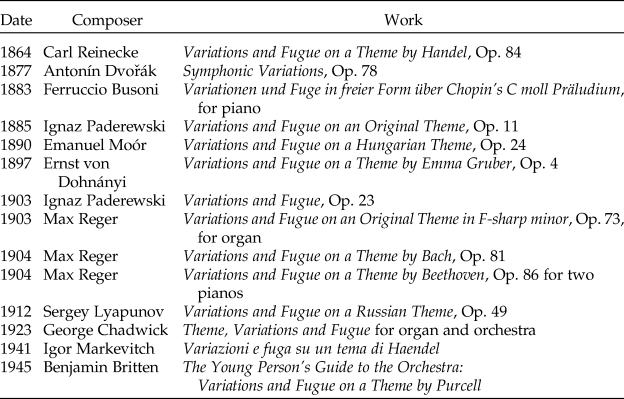
The success of Brahms's neo-Baroque variations rested on the inclusion of a fugue, as well as the return to formal-outline variations.Footnote 44 The fugue, apart from residing primarily in the domain of organ literature, had largely disappeared after its placement in multi-movement works from the classical Viennese school of Haydn, Mozart and Beethoven. Brahms's reinstatement of the ‘child of ancient aberration’, particularly with its motivic economy, use of inversion, augmentation and transposition, altogether capped by a powerful Beethovenian rhetoric in its grand design, stood at the end of a lineage of similar variation sets: Bach's Passacaglia and Fugue in C minor (BWV 582) and Beethoven's Eroica Variations, Op. 35, and Diabelli Variations, Op. 120, for example. This combination of Baroque forms was consequently taken up by a number of musicians in the latter third of the nineteenth century (see Table 3).
Select Variations and Fugues, post-1862

Emanuel Moór's Variations and Fugue on a Hungarian Theme, Op. 24 (c. 1890) affords one case study of a later composer clearly in the shadow of Brahms's work. For Moór, Brahms's variation and fugue offered one genre to showcase his grasp of the prevailing Austro-German model, while advocating for his national heritage.Footnote 45 Born in the Kingdom of Hungary four years before the 1867 Ausgleich, Moór spent his teenage years as a student of Volkmann at the Budapest Academy in the 1870s. After years of teaching and concertizing as a pianist, Moór turned to composition. As documented by the Australian-English pianist, Max Pirani (1898–1975), Moór purportedly met Brahms during a visit to Budapest and Austria in the latter half of 1889:
Between these excursions to his native land, he made the acquaintance of Brahms, who took great interest in the young composer, looking over many of his larger works. Anita [Moór's wife] described Brahms as being ‘perfectly charming’ to Moór, who spent several mornings with the master. The latter unbent to the extent of dining with the Moórs in Vienna … It was with no little reluctance that the Moórs tore themselves away from Austria; in cementing family ties, and in widening Moór's professional orbit, the visit of a few weeks had accomplished more than had been anticipated.Footnote 46
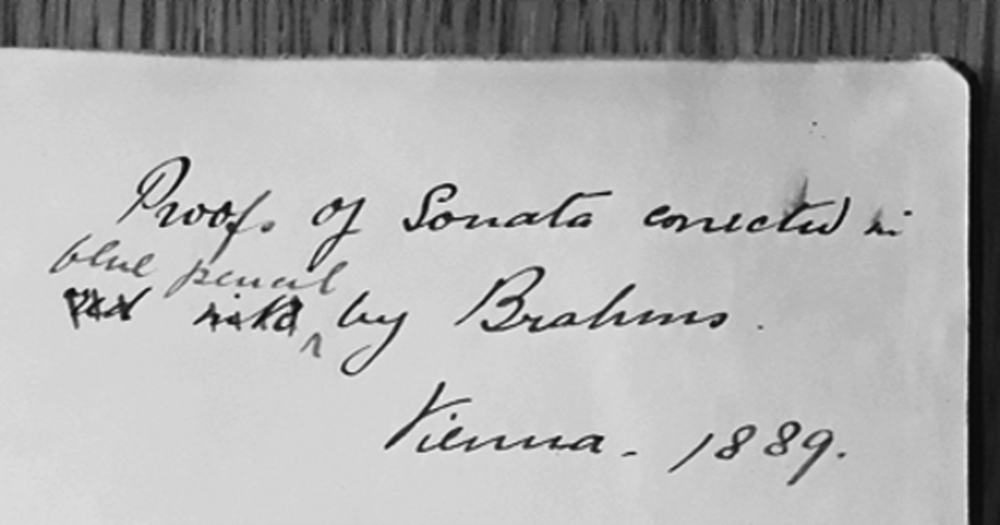
Although the Brahms literature contains no evidence or mention of such a meeting, Brahms indeed toured Budapest each summer from 1886 to 1891, with the exception of 1889 which was spent in Bad Ischl. If Moór missed the composer in Budapest, his visit to Budapest was not without gain: David Popper performed Moór's Cello Sonata, Op. 22, and the composer dedicated his Third Violin Sonata in A major, Op. 23, to Jenö Hubay.Footnote 47 Both musicians were among the most intimate members of Brahms's Hungarian circle between 1886 and 1891, offering a plausible connection between Moór and Brahms. Furthermore, a proof-copy of the Moór's Violin Sonata Op. 23, later published by Breitkopf und Härtel, located in the Westminster Public Library in London, contains a revealing note that the markings in ‘blue pencil’ were made by Brahms in Vienna, 1889 (Fig. 1). If such a claim had been concocted by either Pirani or Moór himself, it is clearly evident that Brahms was a lionized figure worthy of emulation.
Note of Brahms's markings made in ‘blue pencil’ of Moór's Violin Sonata, Op. 23

Presumably months, if not weeks, after meeting with Brahms, Moór began drafts of his Variations and Fugue on a Hungarian Theme, Op. 24, in December 1889.Footnote 48 Comprising a 26 bar theme, 13 variations and fugal finale, the work conflates the rhapsodic, Hungarian-Gypsy verbunkos style within formal-outline variations culminating into a neo-Baroque fugal finale.
The variations begin with a pianissimo E in the low bass, imitating both Volkmann, Moscheles and indeed, Handel's use of the introductory note (Exx. 11a–d). The intonation perhaps signals an aural division from preceding material (the original multi-movement suite of Handel and Volkmann's improvisatory introduction), although Moscheles and Moór's variations are independent sets. Nonetheless, its appearance denotes the common thread shared among these variations.
The shift from Handel is immediately made apparent by the choice of a Hungarian theme (Ex. 12). Moór's subject consists of three six-bar phrases, with a final eight-bar conclusion. The first six-bar phrase, ‘A’ (bars 2–7), is followed by a second phrase, ‘B’ (bars 8–13), which is characterized by a sudden modulation to the relative major. The second and third phrase are alike, with the second iteration (bars 14–19) returning to E minor. The fourth phrase (bars 20–27) A′ appends an additional two bars to close the theme. Thus, two ‘A’ sections in tonic E minor flank middle sections (B) in the major key, creating a mirrored, ABBA form (Table 4). Although Moór does not identify the specific melody, the ABBA form was frequently used in Hungarian folk tunes.Footnote 49
Moór, Variations and Fugue on a Hungarian Theme, Op. 24, bars 1–2

Volkmann, Variations on a Theme by Händel, Op. 26, bars 41–42

Moscheles, Variations on a Theme by Handel, Op. 29, bars 1–2

Handel, Keyboard Suite No. 5, HWV430, Air, bar 1

Moór, Variations and Fugue on a Hungarian Theme, Op. 24, bars 1–26

Moór, Variations and Fugue on a Hungarian Theme, Op. 24 – Tonal Organization of Theme

Moór follows this structural pattern for each of the subsequent 13 variations, all of which are exactly 26 bars. Harmonically, the variations also adhere to the minor to major scheme, with the exceptions of Variations 7 and 8 (both in E major) and the Variation 10, which is highly chromatic.
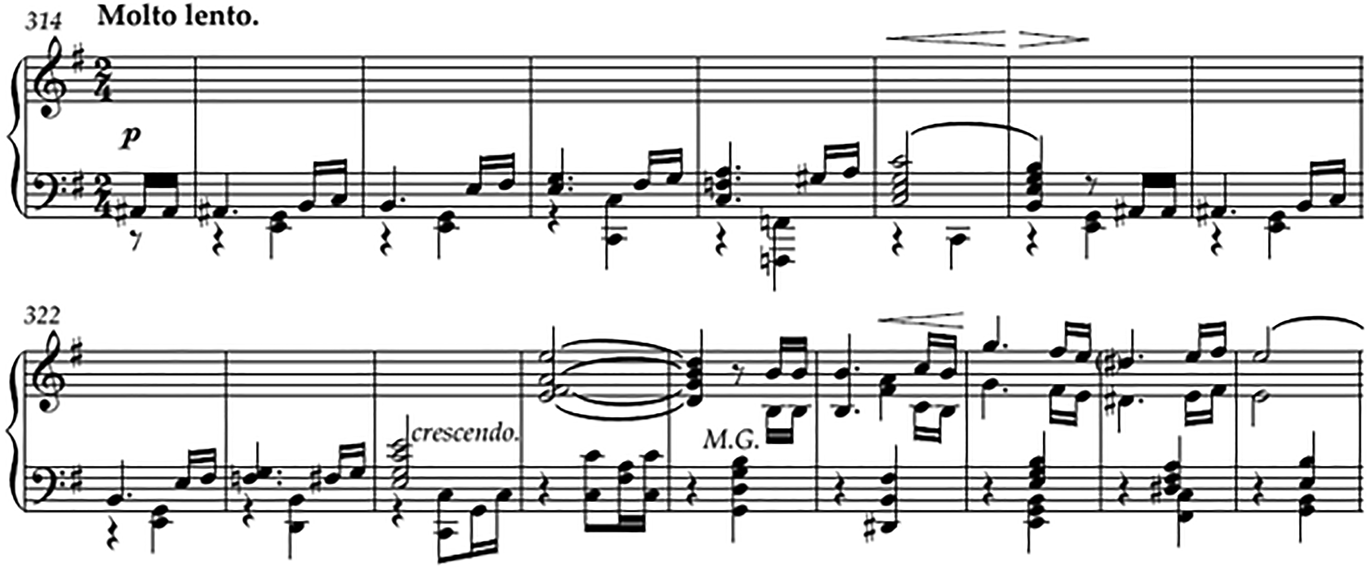
Within this framework, Moór grafts elements of his personal style with the Gypsy verbunkos style. As a virtuoso pianist,Footnote 50 Moór displays difficult octave runs and consecutive double intervals in rapid motion. The characteristic Gypsy augmented seconds (raised fourth and seventh scale degrees) radiate a distinct modal quality throughout the entire work, particularly in Variation 12 (Ex. 13). Moreover, Variation 9 features the lassú, the somber Hungarian dance characterized by double dots (Ex. 14).
Moór, Variations and Fugue on a Hungarian Theme, Op. 24, bars 314–329

Moór, Variations and Fugue on a Hungarian Theme, Op. 24, bars 245–621

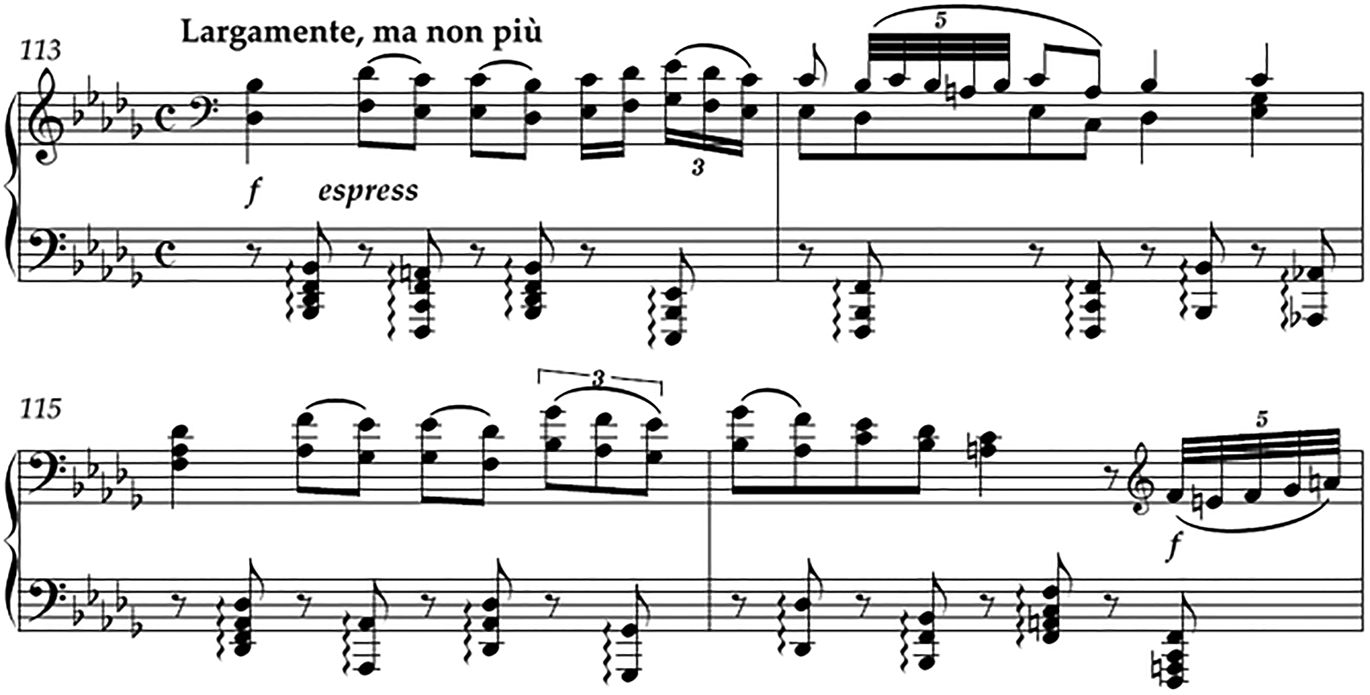
Moór may have noted that the centre of Brahms's variations (variation 13) was the Csardas, the Hungarian national dance wherein the dignified lassú is followed by the wild friska (Ex. 15). Brahms's sombre dance is cast in plaintive, declamatory sixths in the minor mode, which Jonathan Bellman describes as the crying, vocal character of Hungarian folk tunes.Footnote 51 Restatements of the theme in the major mode – also common in Hungarian vocal music – are used as well, in addition to melodic ornamentation, evocative of the spontaneously improvised quality of a Gypsy orchestra.
Brahms, Handel Variations Op. 24, bars 113–116

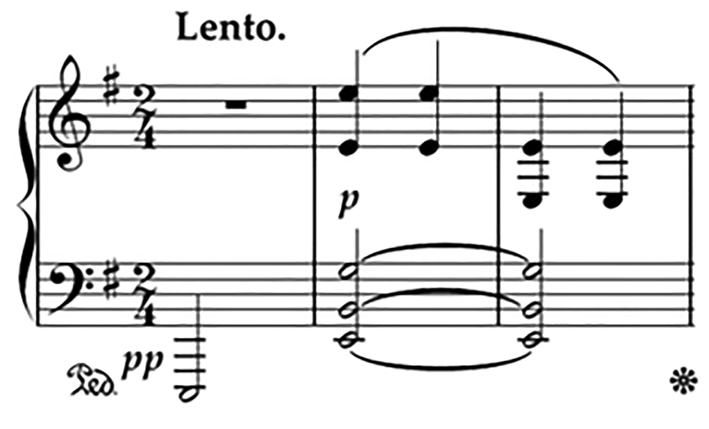
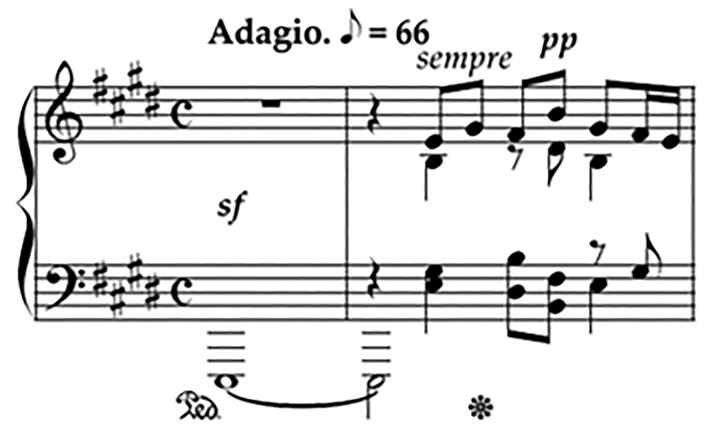
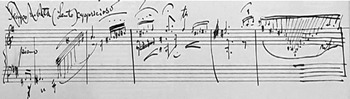
Earlier drafts reveal that Moór initially conceived an improvisatory passage, Lento capriccioso. The reason for its exclusion in the publication is unclear, although it may have hindered the regular six-bar phrase structure (Fig. 2).
Moór, Draft of variations located at the Westminster Public Library, London

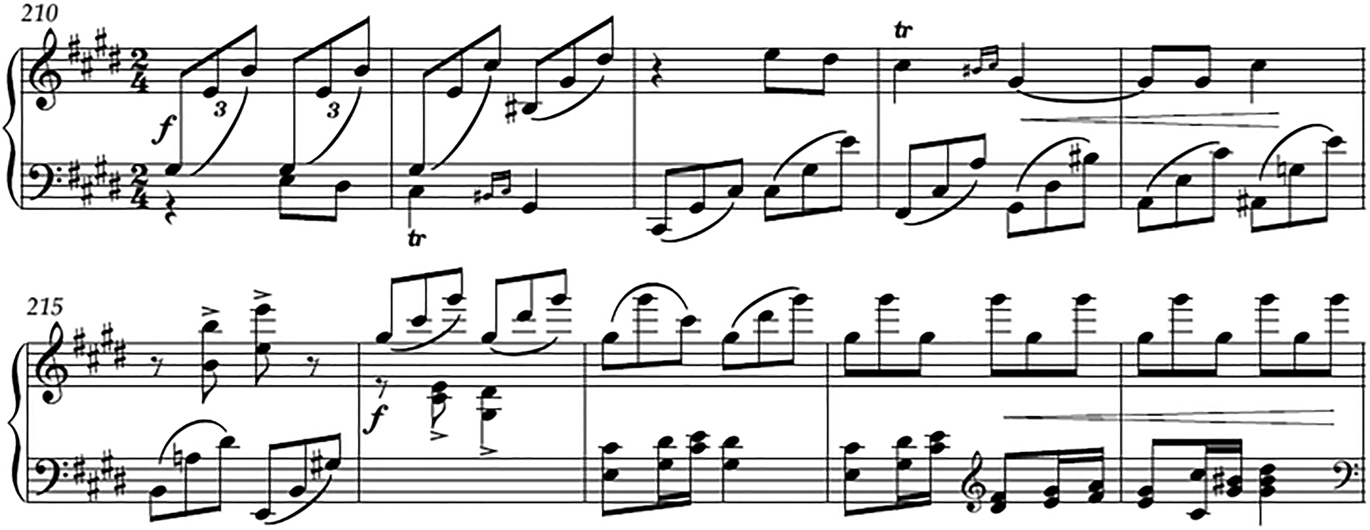
Variation 8, one of the major-key variations (Ex. 16), temporarily sheds references to the Gypsy style and instead borrows Brahmsian gestures: the ubiquitous two-against-three cross-rhythms, melodies in the tenor register and framing the melody in thirds, fifths and sixths, suggesting horn calls found also in variations 7, 12 and 17 of Brahms's Handel Variations.
Moór, Variations and Fugue on a Hungarian Theme, Op. 24, bars 210–219

In the concluding fugue we find Moór's attempt to master the difficult climax that crowned Brahms's own variations. To be sure, a Baroque fugue appeared anachronistic, if not incompatible with the free, improvised nature of the Gypsy style. Yet here Moór transformed his theme so that it could conjure up the Baroque. Marked non legato, the subject begins with octave leaps in the tonic followed by the dominant, gestures alluding to the theme's opening octave motion (Ex. 17). Moór's three-voice fugue – a nod to Beethoven's Eroica finale, also in three voices – begins with a theme that follows the same intervallic contours of Beethoven's theme.
Moór, Variations and Fugue on a Hungarian Theme, Op. 24, bars 366–370

Moór's subject follows the Baroque practice of starting the subject with long rhythmic durations before yielding to a semiquaver fuga (‘flight’). The angular melodic contours of the tail and countersubject – specifically the recurring minor sixth interval – situate the listener in the eighteenth century. Especially striking is that the tonal answer beginning four bars later is transposed to the subdominant, rather than the expected dominant (Ex. 16). Surely Moór was familiar with the prescribed convention of dominant answers, but again, he may have been looking at some historical examples. Rare as they are, subdominant answers do occur, for example, in Bach's French Overture in B minor, BWV 831; Beethoven's String Quartet, Op. 131; and the second of Schumann's seven Klavierstücke in Fughettenform, Op. 126.
This seeming faux pas, however, allows the answer to circle back to the tonic – given the subject's preference for the dominant harmony. As the English theorist Ebenezer Prout argued in his treatise on fugues (1891):
Whenever, in a subject which ends in the key of the tonic, particular prominence is given to dominant harmony, especially near the beginning of the subject, the answer may be in the subdominant key, in order to conform to the important general principle that dominant harmony in the subject should be replied to by tonic harmony in the answer.Footnote 52
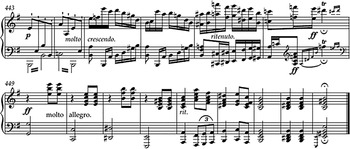
After an episode of non-thematic material, Moór's working out of the fugue begins with a restatement of the subdominant answer, followed by a second entry on the mediant, G. Then, both the subject and answer are presented in augmentation before an unexpected climax in C major – undoubtedly alluding to the contrasting major key taken from the B section of the original theme. Thus, Moór continues to preserve the overarching harmonic scheme even in the fugal finale. A break in the counterpoint shifts to brilliant passagework in the triumphant major tonality before lapsing again into counterpoint with the subject appearing in bass octaves at the coda. The subject then gives way to a dominant pedal point, over which a ‘stretto’ (bars 443–444) condenses the subject and answer's octave motifs into two bars. Finally, the closing bars restate an altered and augmented subject in a chordal fashion, and like Volkmann's example, conclude with the familiar yet archaic Picardy third (Ex. 18).
Moór, Variations and Fugue on a Hungarian Theme, Op. 24, bars 443–457

The fuga obbligato strictness and rigour of Brahms's neo-Baroque fugue with its economic use of two-note motifs contrasts with Moór's free approach. In Brahms's case, every rhythmic and intervallic motif of the fugue, including the episodes, uses material derived from the subject or countersubject, altered in inversion, augmentation, transposition, or doubling of the theme in thirds, sixths and octaves. In Moór's case, the fugue features augmentation of the subject, but the intervening episodes betray a tenuous grasp of the original subject material. Nonetheless, though Moór's inspiration depended on a Hungarian theme, the fugal subject and its working out suggest a young composer attempting to pattern his music after successful models within the canon.
VI
The comparison of these variations before and after Brahms's Variations on a Theme by Handel demonstrate two sides of a narrative. The individualism of Volkmann's variations compared to Brahms's Op. 24 reveals gradual striving towards originality based on close study of tradition. Continuing in the popular tradition of the Blacksmith tune, Volkmann straddled two separate aesthetics: on one side, the Romantic fantasy variation, and the other, the rhythmic, textural and timbral parameters of the late Baroque. While the Finale of his work displayed unprecedented fidelity to tradition, the allure of the earlier fantasy variations overwhelmed these historicist achievements. With Brahms's set in 1861, neo-Baroque expression reached new heights, with canonic and fugal writing in addition to a broad range of Baroque styles. By infusing his 25 variations with these techniques within the strict variation model of Bach and Beethoven, he demonstrated an unprecedented recommitment to history and revalidation of the Baroque for his own time. Brahms's choice of an obscure tune from a separate collection of Handel's keyboard suites established distance between him and his predecessors, and his close study of the Baroque produced a composition that freely and effectively juxtaposed the eighteenth-century past with the musical present.
Looking forward, the rigour of Brahms's variations brought composers such as Moór to re-evaluate tradition. Tracing the historic lineage from Bach and Beethoven to Brahms through the fugal finale, Moór found Brahms's Handel Variations a strong model, rather than the free variation approach of his teacher Volkmann. Although the rigour of Moór's fugal finale does not measure up to that of Brahms, the entire work is indicative of the influence Brahms held for future composers, and by extension, how the ‘Brahmsian fog’ spread beyond its Viennese centre.Footnote 53 In Moór's footsteps followed Carl Reinecke, Ferruccio Busoni, Ignaz Paderewski, Ernst von Dohnányi, Max Reger and the Russian Sergey Lyapunov, all of whom produced variations and fugues. Other, non-keyboard examples would include Dvořák's Symphonic Variations (1877), George Chadwick's Theme, Variations and Fugue for organ and orchestra (1923) and, considerably later, Benjamin Britten's Young Person's Guide to the Orchestra (1945) and Gemini Variations for flute, violin, and/or two pianos, Op. 73 (1964). Far from a complete list, these examples attest to the secure establishment of Brahms's Handel Variations for posterity. Although these works by Volkmann and Moór have since fallen from the repertoire, they nevertheless offer insights into revisiting history in order to comprehend the ever-changing present.