


Introduction
Self-consciousness can be both beneficial and detrimental to psychological well-being. Indeed, whilst self-consciousness can aid self-regulation (Grant et al., Reference Grant, Franklin and Langford2002), it is also implicated in a broad range of psychopathologies (e.g. Ingram, Reference Ingram1990), particularly if self-attention increases one’s awareness of personal shortcomings (Duval and Wicklund, Reference Duval and Wicklund1972). Self-consciousness has been found to positively relate to depression (Jones et al., Reference Jones, Papadakis, Hogan and Strauman2009), and more broadly, to psychological distress (Panayiotou and Kokkinos, Reference Panayiotou and Kokkinos2006). The contrasting findings that self-consciousness seems to relate to both well- and ill-being, is thought to indicate that self-consciousness is multi-dimensional, consisting of two theoretically distinct constructs: rumination and reflection (Trapnell and Campbell, Reference Trapnell and Campbell1999).
Rumination represents self-attentiveness motivated by threats, losses or injustices to the self. In contrast, reflection is self-attentiveness motivated by curiosity or epistemic interest in the self (Trapnell and Campbell, Reference Trapnell and Campbell1999). Rumination is considered harmful to psychological well-being whilst reflection is beneficial to psychological well-being. Whilst research consistently finds that rumination is harmful (e.g. Ciesla and Roberts, Reference Ciesla and Roberts2002, Reference Ciesla and Roberts2007; Nolen-Hoeksema et al., Reference Nolen-Hoeksema, Wisco and Lyubomirsky2008; Robinson and Alloy, Reference Robinson and Alloy2003), conflicting research findings have fuelled much debate as to whether or not reflection is indeed beneficial for psychological well-being. For example, some research has found non-significant longitudinal relationships between reflection and negative affect and depression (Burwell and Shirk, Reference Burwell and Shirk2007; Moberly and Watkins, Reference Moberly and Watkins2008), whilst other research indicates little relationship between reflection and ill-being (Joireman et al., Reference Joireman, Parrott and Hammersla2002). In other research a paradoxical positive relationship with depression and suicidal ideation has emerged (Fresco et al., Reference Fresco, Frankel, Mennin, Turk and Heimberg2002; Rude et al., Reference Rude, Maestes and Neff2007; Surrence et al., Reference Surrence, Miranda, Marroquin and Chan2009; Treynor et al., Reference Treynor, Gonzalez and Nolen-Hoeksema2003; Verhaeghen et al., Reference Verhaeghen, Joormann and Khan2005). Therefore, the role of reflection in psychopathology remains controversial.
Clearly, reflection has costs and benefits, partially because accurately reflecting on the self without rose-tinted glasses may engender a maladaptive view of the self (Trapnell and Campbell, Reference Trapnell and Campbell1999). It might be that the extent to which reflection is helpful or harmful for psychological well-being is partially dependent on additional psychological factors, such as individual beliefs, values and attitudes (Takano and Tanno, Reference Takano and Tanno2008). Şimşek (Reference Şimşek2013) put forth such a potential psychological factor by conceiving of Need for Absolute Truth (NAT), which reflects abstract self-analysis aimed at capturing absolute knowledge about the self. NAT cognitions are abstract, in that they are overgeneralized, superordinate, and valid in all contexts, and therefore NAT cognitions are likely to be deleterious for psychological well-being (Watkins, Reference Watkins2008). This is important because Watkins (Reference Watkins2008) suggests that reflection could be harmful for well-being if motivated by abstract analysis of personal experiences or the self. Indeed, Şimşek (Reference Şimşek2013) found that while reflection was positively related to psychological distress in bivariate correlations, the inclusion of NAT and rumination in a predictive model showed that reflection was negatively related to psychological distress.
One psychological factor that has sparsely been considered in self-consciousness research is irrational beliefs as posited within rational emotive behavior therapy (REBT; Ellis, Reference Ellis1957). Szasz (Reference Szasz2011) found that greater irrational beliefs predicted greater psychological distress, and that irrational beliefs were positively related to reflection and rumination. However, with irrational beliefs and reflection held constant, only rumination predicted psychological distress, and mediation analyses revealed that the direct effect between irrational beliefs and psychological distress became non-significant when rumination and reflection were included in the model. To be clear, only the indirect effect of irrational beliefs on distress through the mediator of rumination was statistically significant, therefore rumination appeared to be the most important mediator between irrational beliefs and psychological distress.
Szasz (Reference Szasz2011) does not speculate in detail as to why irrational beliefs might relate to self-consciousness, other than positing that rumination could be more strongly positively related to irrational beliefs due to the negative and self-critical nature of irrational beliefs (Rude et al., Reference Rude, Maestes and Neff2007; Trew and Alden, Reference Trew and Alden2009). By evaluating the nature of irrational beliefs it is possible to more clearly understand why irrational beliefs might interact with reflection and rumination to predict psychological distress. Specifically, irrational beliefs can be considered as abstract analyses of personal experiences and the self, not too dissimilar to NAT. Indeed, as absolute truth is impossible to achieve, NAT cognitions could be considered irrational. In REBT, irrational beliefs are considered to be extreme, rigid and illogical (Dryden, Reference Dryden2009), and are a well-supported risk factor for psychological distress (Turner, Reference Turner2016; see Visla et al., Reference Visla, Fluckiger, Grosse Holtforth and David2015, for a meta-analysis). In addition, irrational beliefs can be considered abstract in that they are cross-situational and aggregated (Stöber et al., Reference Stöber, Tepperwien and Staak2000), superordinate, decontextualized and overgeneralized (Watkins, Reference Watkins2008).
For example, the irrational belief ‘because I have failed in this task so that means I am a complete failure’ reflects self-depreciation beliefs as defined within REBT, where the consequences of a single event is generalized to the whole self (Artiran, Reference Artiran2015). This self-depreciation belief is cross-situational and decontextualized (since the self has been labelled and therefore being a ‘failure’ pervades all situations), aggregated (since it reflects the whole sum), superordinate (since it reflects a generic labelling of the self), and over-generalized (since the whole self has been labelled on the basis of one occurrence). Given the conceptual similarities between irrational beliefs and NAT, one might expect irrational beliefs to be an important construct to consider in the relationships between rumination, reflection and psychological well-being (e.g. Szasz, Reference Szasz2011).
The main aim of the present study was to investigate the mediational effects of rumination and reflection on the positive relationship between irrational beliefs and psychopathology. Szasz (Reference Szasz2011) indicated that irrational beliefs may interact with rumination and reflection to predict psychopathology, and therefore we hypothesized that rumination and reflection would mediate the positive relationship between irrational beliefs and psychopathology. We expected irrational beliefs to interact with rumination to positively predict psychological distress, and irrational beliefs to interact with reflection to negatively predict psychological distress. However, given that Szasz (Reference Szasz2011) found a small positive association between irrational beliefs and reflection, we were tentative about our hypotheses concerning reflection.
Method
Participants
The participants were 172 (mean age = 25.9 years; SD = 4.59, age range 18–35 years; female = 94) randomly selected using convenience sampling from Istanbul City in Turkey. Participants were from a non-clinical population and voluntarily participated in the study, and formally consented to taking part during an initial one-to-one meeting prior to any data collection. The questionnaire instructions and answer sheet were read aloud and administration took 20 minutes.
Measures
Rumination and reflection
The Rumination-Reflection Questionnaire (RRQ; Trapnell and Campbell, Reference Trapnell and Campbell1999) was used to measure reflection and rumination. The RRQ consists of 24 items; 12 for each dimension. Ratings are indicated on a Likert-scale from 1 (disagree strongly) to 5 (agree strongly) for each item. The scale was adapted into Turkish using a back-translation procedure (Şimşek, Reference Şimşek2013). Internal consistency of the scale was found to be .87 in this study. Cronbach’s alpha for rumination was .84, and .80 for reflection.
Psychological distress
The Brief Symptom Inventory (BSI), developed by Derogatis, Reference Derogatis1977, Reference Derogatis1993) as a shorter version of the Symptom Checklist-90-Revised (SCL-90-R), was used in the current study. Of the 90 items distributed to the nine factors of SCL-90-R, 53 items with the highest factor loading were chosen. The instrument consisting of nine subscales (somatization, obsessive compulsive disorder, interpersonal sensitivity, depression, anxiety disorders, hostility, phobic anxiety, paranoid ideations, psychoticism) has been adapted into Turkish (Sahin et al., Reference Sahin, Durak and Uğurtaş2002). The participants were asked to reply on a 5-point Likert-scale ranging from 1 (not at all) to 5 (extremely). The reliability coefficients of the subscales were between .71 and .85.
Irrational beliefs
The Attitudes and Beliefs Scale-2 (ABS-2; DiGiuseppe et al., Reference DiGiuseppe, Leaf, Exner and Robin1998, Reference DiGiuseppe, Leaf, Gorman and Robin2017) was used to determine rational and irrational beliefs. The ABS-2 is a 76-item scale with good internal consistency (ranging from .85 to .91; Macavei, Reference Macavei2002). It measures both the four irrational processes proposed by Ellis (Reference Ellis1957) (i.e. demandingness, catastrophizing, low frustration tolerance, and self–global evaluation) and the content of the beliefs (i.e. comfort, approval, achievement). Although it is constructed with a 4×3×2 subscale matrix, many researchers do not support this factor structure (Fülöp, Reference Fülöp2007). The ABS-2 is widely used and is theoretically appropriate to REBT.
Analytic strategy
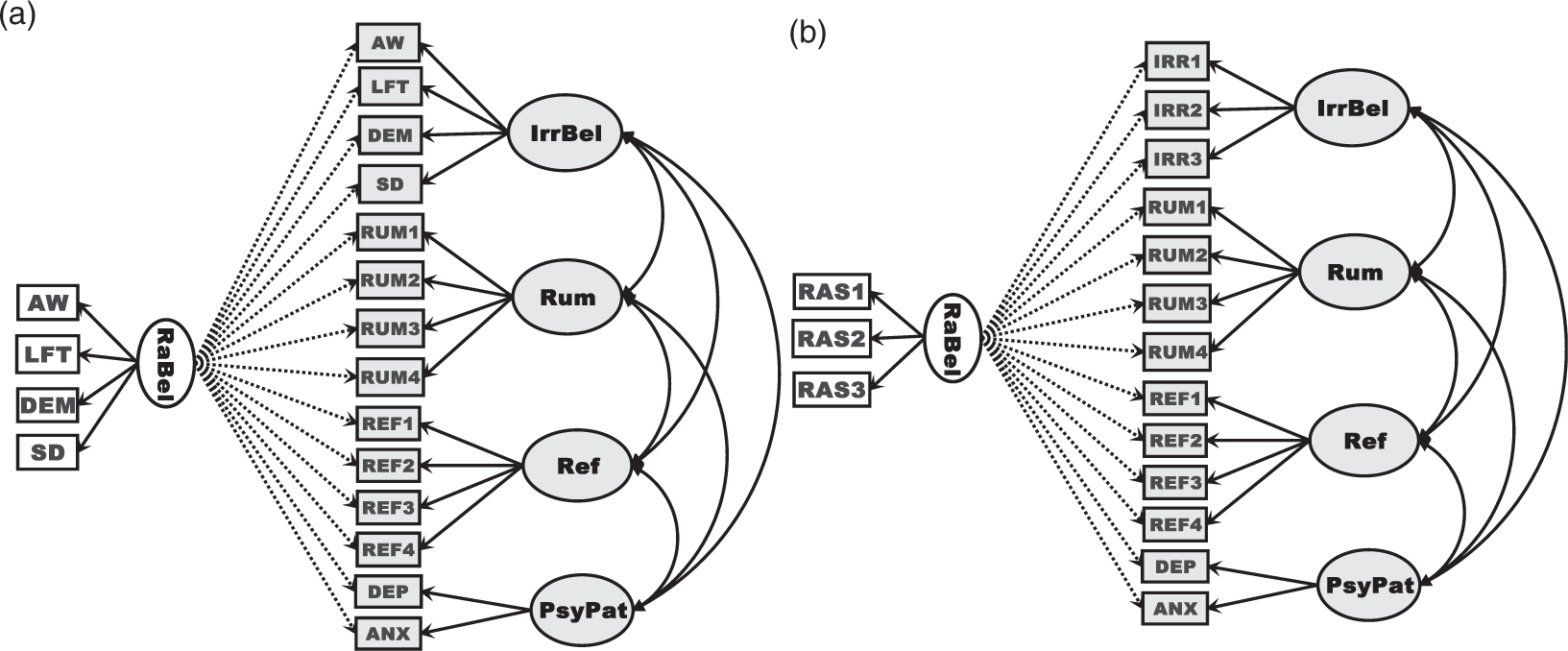
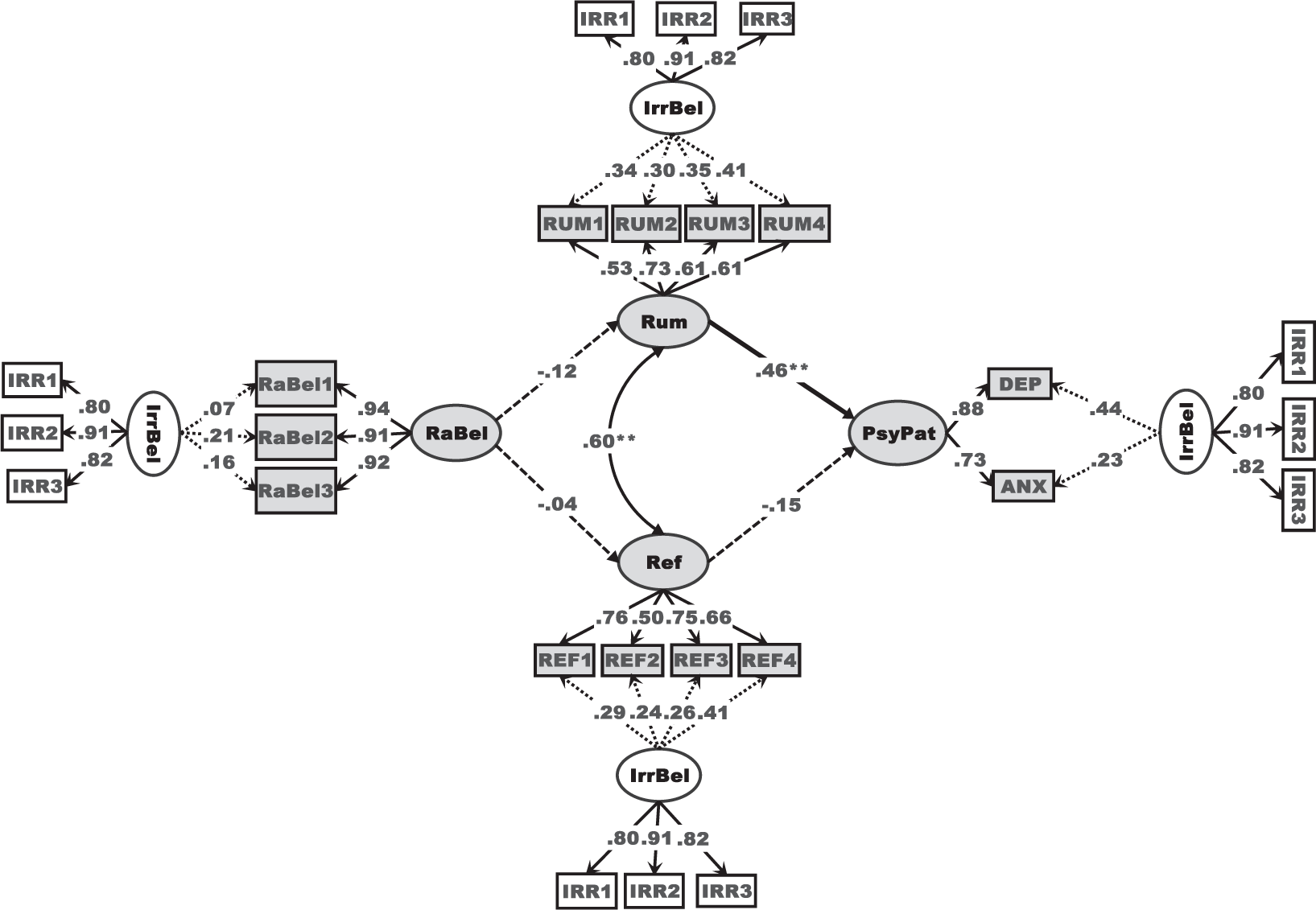
The model proposed in the current investigation was tested using structural equation modelling (SEM) using LISREL 8.80 (Joreskog and Sorbom, Reference Joreskog and Sorbom2005) with the maximum likelihood estimation method. A two-stage approach was used to test the proposed SEM, i.e. the measurement model was tested before the test of the SEM. Trait rational belief (RaBel) scores were statistically controlled for, as the aim of the present research is to test the effects of irrational beliefs (IrrBel) on the other target variables without the effects of participants’ rational beliefs. Statistical control of RaBel was achieved by adding paths from this latent variable to the indicators of other latent variables (see Fig. 1), while the covariance of this latent variable with other latent variables was constrained to be zero (Johnson et al., Reference Johnson, Rosen and Djurdjevic2011; Williams and Anderson, Reference Williams and Anderson1994). Additionally, the variance of RaBel latent variable was set to 1.00 in order to achieve identification. This procedure was used both in the tests of measurement and SEMs.
Measurement models for the present study. RaBel, rational beliefs; IrrBel, irrational beliefs; Rum, rumination; Ref, reflection; AW, awfulizing; LFT, low frustration tolerance; DEM, demandingness; SD, self-depreciation; IRR1–IRR4, parcels for the irrational beliefs measure; RAS1–RAS4, parcels for the rational beliefs measure; RUM1–RUM4, parcels for the rumination measure; REF1–REF4, parcels for the reflection measure; DEP, depression; ANX, anxiety; PsyPat, psychological pathology.

The mediation hypothesis was tested by the calculation of indirect effects produced by the LISREL program. The bootstrapping procedure suggested by Shrout and Bolger (Reference Shrout and Bolger2002) was also used as it has been shown to be the most effective way of testing mediation (MacKinnon et al., Reference MacKinnon, Lockwood, Brown, Wang and Hoffman2002). This method is based on testing the significance of the indirect paths from the independent variable (IrrBel) to mediator(s) (reflection and rumination) and from the mediator(s) to dependent variable (psychopathology). Bootstrapping produces a large number of samples from the dataset and uses them to obtain estimates of the standard errors. The confidence interval of these standard errors is considered when determining the significance of indirect effects. An indirect effect is statistically significant if the 95% confidence interval does not contain zero.
Results
Test of the measurement model
We tested alternative measurement models using confirmatory factor analysis (CFA) to understand whether observed variables were reliable indicators of their underlying latent variables. Given the reported measurement problems with the ABS-2 (Hyland, Reference Hyland2014), we used alternative indicators for both RaBel and IrrBel. The original four factors of the ABS-2 (awfulizing, low frustration tolerance, demandingness, and self-depreciation) were used as indicators of RaBel and IrrBel in the first measurement model (Fig. 1a). In the second measurement model three parcels were created for both (Fig. 1b). The aim of using an item parcelling technique was to form multiple groups of items selected at random and then use their sum scores as indicators of the latent constructs. Given that there is no such problematic issue in the other measures used in the present study, the rest of the measurement model was not changed. As reflection and rumination sub-scales of the RSQ are one-dimensional, we also created parcels for these latent variables in order to achieve statistical control of the measurement error. Depression and anxiety sub-scale scores of the BSI were used to define psychopathology latent variables. As a result of such a procedure, we tested two models in which only the latent variables of IrrBel and RaBel are differentiated (Fig. 1).
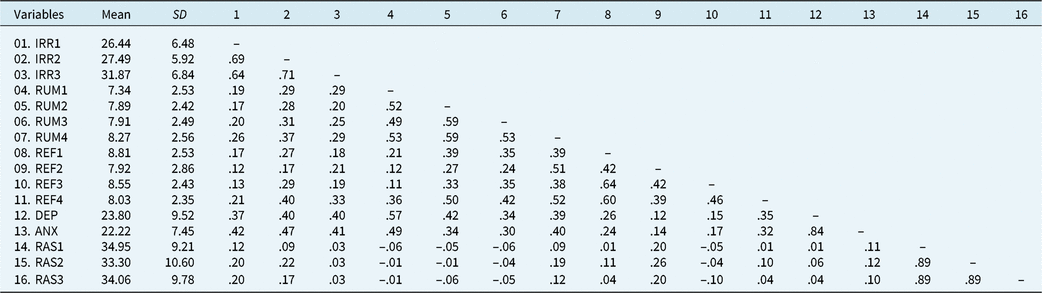
Means, standard deviations and correlations among the observed variables are given in Table 1. All skewness and kurtosis values were less than 3, ranging from –.01 to 1.49 for skewness and from –.72 to 2.83 for kurtosis, indicating no crucial problem in terms of normality assumption.
Means, standard deviations, and intercorrelations of observed variables

N = 172; IRR1–IRR3, parcels for the irrational beliefs measure; RAS1–RAS3, parcels for the rational beliefs measure; RUM1–RUM4, parcels for the rumination measure; REF1–REF4, parcels for the reflection measure; DEP, depression; ANX, anxiety; RAS1–RAS4, parcels for the rational beliefs measure. Correlation coefficients higher than .16 are statistically significant at p = .05.
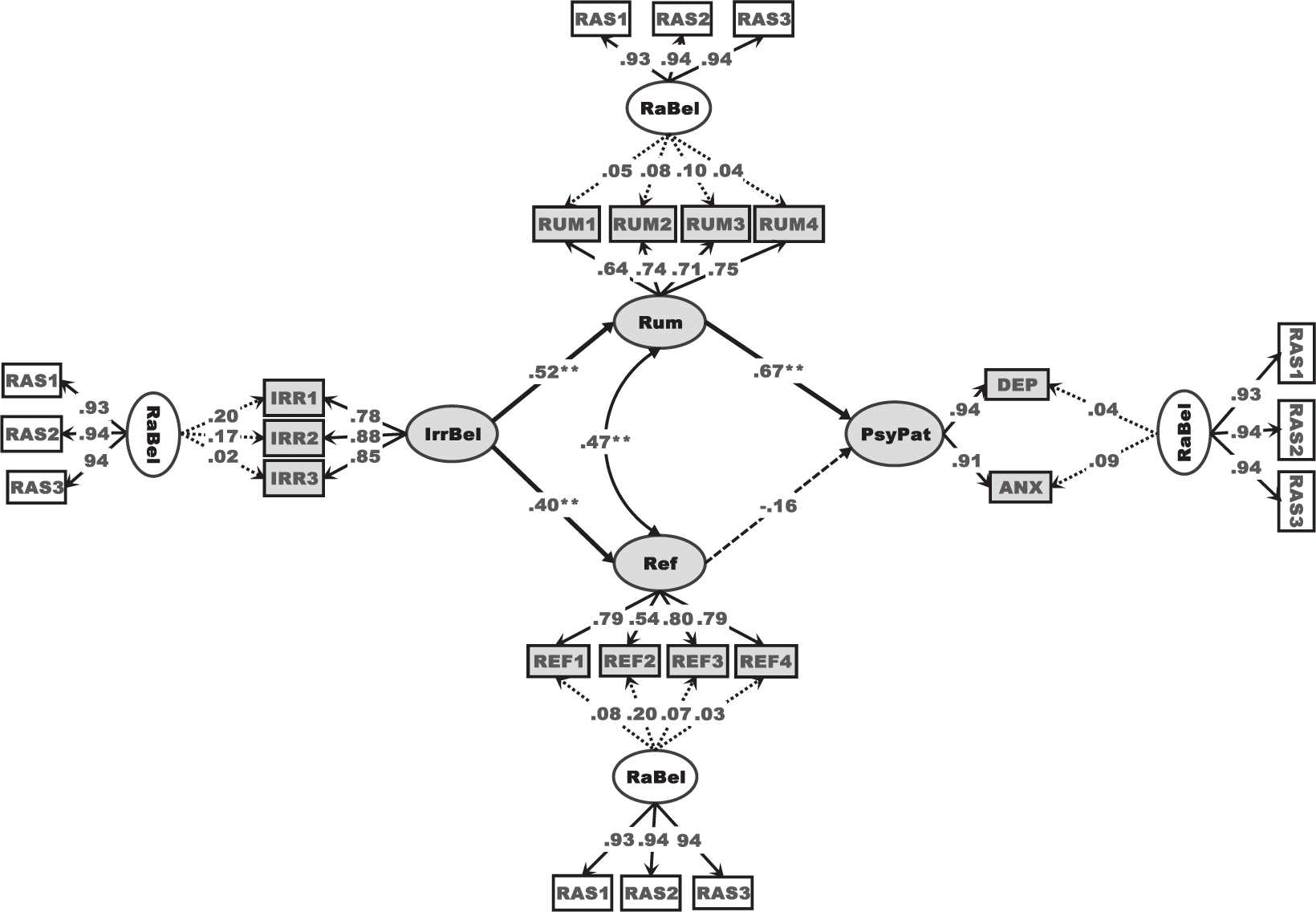
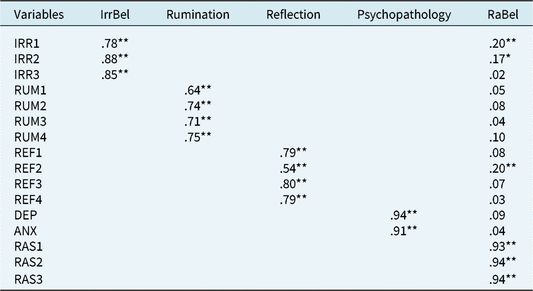
A test of the measurement model without the effects of IrrBel resulted in relatively acceptable goodness of fit statistics: χ2(93, N = 172) = 193.45, p < .05; IFI = .93; CFI = .93; SRMR = .071; RMSEA = .079 (90% confidence interval for RMSEA = .064–.095). The measurement model was again tested, this time by considering RaBel as a control variable, and produced an acceptable fit to the data: χ2(84, N = 172) = 157.01, p < .05; IFI = .95; CFI = .95; SRMR = .051; RMSEA = .071 (90% confidence interval for RMSEA = 0.054–0.088). A chi-square difference test (36.44, 9: p < .01) clearly showed that the second measurement model with the control variable was better than the first. These findings were deemed to be a support for the superiority of the model with the effects of RaBel. According to the results of this measurement model, the loadings of the IrrBel to the indicators of other latent variables ranged from .02 to .20, with the largest values for the two indicators of IrrBel and the second parcel of reflection (Fig. 2, Table 2).
Standardized parameter estimates for the proposed model. N = 172; RaBel, rational beliefs; IrrBel, irrational beliefs; Rum, rumination; Ref, reflection, IRR1–IRR3, parcels for the irrational beliefs measure; RAS1–RAS3, parcels for the rational beliefs measure; RUM1–RUM4, parcels for the rumination measure; REF1–REF4, parcels for the reflection measure; DEP, depression; ANX, anxiety; PsyPat, psychological pathology. Factor loadings higher than .16 are statistically significant at p = .05.

Factor loadings for the measurement model: completely standardized solution

N = 172; IRR1–IRR3, parcels for the irrational beliefs measure; RAS1–RAS3, parcels for the rational beliefs measure; RUM1–RUM4, parcels for the rumination measure; REF1–REF4, parcels for the reflection measure; DEP, depression; ANX, anxiety; RAS1–RAS4, parcels for the rational beliefs measure; *p < .05, **p < .01.
The correlations among the constructs with the effects of RaBel were calculated and are given in Table 3. The correlations among the latent constructs were relatively strong with the exception of a weak, though statistically significant, positive latent correlation between reflection and psychopathology.
Correlations of the latent constructs

N = 172; **p < .01.
Test of the structural models
A test of the proposed structural model resulted in acceptable goodness of fit statistics: χ2(85, N = 172) = 172.66, p < .05; IFI = .94; CFI = .94; SRMR = .066; RMSEA = .078 (90% confidence interval for RMSEA = .061–.094). These results showed that the proposed model accounted for the data well. Standardized parameter estimates for the paths in the proposed model are represented in Fig. 3. It is clear from Fig. 3 that the effects of IrrBel on psychopathology is mediated by rumination but not by reflection where the path from reflection to psychopathology was not statistically significant. On the other hand, the paths from IrrBel to rumination and from rumination to psychopathology are strong and statistically significant.
Standardized parameter estimates for the alternative model. N = 172; RaBel, rational beliefs; IrrBel, irrational beliefs; Rum, rumination; Ref, reflection, IRR1–IRR3, parcels for the irrational beliefs measure; RAS1–RAS3, parcels for the rational beliefs measure; RUM1–RUM4, parcels for the rumination measure; REF1–REF4, parcels for the reflection measure; DEP, depression; ANX, anxiety; PsyPat, psychological pathology. Factor loadings higher than .16 are statistically significant at p = .05.

The indirect effect of IrrBel on psychopathology through mediators was shown to be significant by LISREL estimates (.29, SE = .06, p < .01). An additional test of the statistical significance of the indirect effect was achieved by a bootstrap procedure. The bootstrapping procedure tests whether or not this indirect pathway is significantly different from zero. Significant mediation is indicated when the upper and lower limits of the 95% confidence interval (CI) do not include zero. Using 2000 samples produced from the data, the bootstrapping procedure results showed that the CI did not include zero (95% CI = .325 to .767), thus indicating the statistical significance of the indirect effect in the proposed model. Finally, in the model 33% of the variance was accounted for by self-rumination in psychopathology while irrational beliefs accounted for 27% of the variance in self-rumination and 16% of the variance in self-reflection.
It should be noted here that we also tested an alternative model in which the effect of RaBel on psychopathology was mediated by the same mediators, namely rumination and reflection. In this model, we used IrrBel as the control variable. In sum, the roles of IrrBel and RaBel were changed in this alternative model. The results of this alternative model also resulted in acceptable goodness of fit statistics: χ2(85, N = 172) = 168.69, p < .05; IFI = .94; CFI = .94; SRMR = .063; RMSEA = .076 (90% confidence interval for RMSEA = .059–.093). However, the paths from RaBel to both rumination and reflection were not statistically significant (Fig. 3) in addition to the non-significant path from reflection to psychopathology.
Discussion
The current study examined the mediational effects of reflection and rumination on the relationship between irrational beliefs and psychopathology. The present study expands previous research on rumination and reflection by including irrational beliefs in a structural model. The results of the data analysis revealed that the positive relationship between irrational beliefs and psychopathology was mediated by rumination, but not by reflection. In addition, there were positive associations between irrational beliefs and rumination, and between rumination and psychopathology. This study is the first to show how irrational beliefs and rumination interact to predict psychopathology using advanced statistical techniques.
There are numerous studies suggesting how cognitive behavioural therapies (including REBT) can reduce rumination (Hutchinson and Chapman, Reference Hutchinson and Chapman2005; Purohit and Nayak, Reference Purohit and Nayak2003), but there is sparse research exploring how rumination-focused interventions may assist REBT treatment applications particularly during the disputation of irrational beliefs. Despite the findings of the current study, the mediational role of reflection on the relationship between irrational beliefs and psychopathology remains unclear due to scarce research. We were tentative in our hypotheses regarding reflection due to an ongoing debate in the literature that propagates controversial views on self-reflectiveness. Kaufman and Libby (Reference Kaufman and Libby2012) discussed the findings of Wheeler et al. (Reference Wheeler, Morrison, DeMarree and Petty2008) and suggested that self-reflectiveness is a type of rumination and therefore and found that increased internal state awareness decreased the magnitude of the prime-to-behaviour effect, whereas increased self-reflectiveness amplified the effect. In our research, we have found similar results to Szasz (Reference Szasz2011), Thomsen et al. (Reference Thomsen, Jensen, Jensen, Mehlsen, Pedersen and Zachariae2013) and Nolen-Hoeksema (Reference Nolen-Hoeksema2000), in that rumination, but not reflection, is related to psychological ill-being. That is, the findings of the present study do not support the idea that reflection has a significant role in the relationship between irrational beliefs and psychological distress.
Rumination is defined as repetitive negatively self-centred thoughts, and coping with negative mood that involves self-focused attention (Lyubomirsky and Nolen-Hoeksema, Reference Lyubomirsky and Nolen-Hoeksema1993; Martin and Tesser, Reference Martin and Tesser1996). Some therapeutic applications such as meta cognitive therapy (Papageorgiou and Wells, Reference Papageorgiou and Wells2004) and rumination-focused cognitive behaviour therapy (RFCBT; Watkins, Reference Watkins2018) focus on rumination alone in sessions. One experimental research study applying RFCBT (Watkins et al., Reference Watkins, Scott, Wingrove, Rimes, Bathurst and Steiner2006) found that treatment focused on rumination produced significant improvements in depressive symptoms and co-morbid disorders. Indeed, research concerning depression and post-traumatic stress disorder (PTSD) shows that rumination is associated with psychopathological symptoms and distress (Aldao et al., Reference Aldao, Nolen-Hoeksema and Schweitzer2010, Chan et al., Reference Chan, Ho, Tedechi and Leung2011; Rinaldis et al., Reference Rinaldis, Pakenham, Lynch and Aitken2009).
The current study outcomes indicate that rumination plays an important mediational role in the positive relationship between irrational beliefs and psychopathology. In CBTs (including REBT) inappropriately focusing on cognition (e.g. analytical self-focus) may cause rumination and therefore may produce emotional distress (Rawal et al., Reference Rawal, Williams and Park2011). Therefore, the discovery of irrational beliefs by clients should be supplemented with therapeutic guidance on rumination to best help clients to dispute dysfunctional cognitions. When applying REBT it is unavoidable that clients are oriented towards self-focused thoughts (e.g. irrational beliefs, automatic thoughts, core beliefs) because this is part of the therapeutic process. Therefore clients may occasionally ruminate on their irrational beliefs in one-to-one sessions. Helping clients to recognize and reduce their rumination, in favour of reflection, may help them to dispute irrational beliefs and harness rational beliefs. That is, by working on both what (irrational beliefs) and how (the way of ruminating) clients think, may help them to more effectively apply REBT to alleviate their psychological distress.
In addition to the mediational analyses conducted in the present study, the correlational findings indicate a positive relationship between rumination and reflection (even though reflection has no role in the model). In addition, correlational findings indicate that whilst there is a relationship between reflection and psychopathology, the strength of the association is weaker than the relationship between rumination and psychopathology. In other words, reflection might not be as maladaptive as rumination, but may still be related to some psychopathology, which supports some past research (Thomsen et al., Reference Thomsen, Jensen, Jensen, Mehlsen, Pedersen and Zachariae2013). However, considering irrational beliefs, the results may help to distinguish rumination from reflection in the context of CBT whereby reflection is not as important as rumination when considering how irrational beliefs lead to symptoms of psychological distress. As irrational beliefs are strongly related to neuroticism (Ghumman and Shoaib, Reference Ghumman and Shoaib2013; Najafi, Reference Najafi2016) the outcomes of this study may support the idea that rumination is rooted in neuroticism, whereby reflection is rooted in openness to experience (Silvia et al., Reference Silvia, Eichstaedt and Phillips2005). The findings of the present study are similar to Trapnell and Campbell’s (Reference Trapnell and Campbell1999) and Şimşek’s (Reference Şimşek2013) findings, but in contrast to some previous research, suggesting that reflection is not associated with distress (Boyraz and Efstathiou, Reference Boyraz and Efstathiou2011; Jones et al., Reference Jones, Papadakis, Hogan and Strauman2009). According to Vassilopoulos (Reference Vassilopoulos2008), there are two modes of self-focus: active-analytic self-focus (called rumination) and experiential self-focus. While the former does not relieve social anxiety, the latter is associated with positive thoughts and decreased anxiety. As part of REBT it may be important for clients to engage self-reflection in the experiential form in the recognition and disputation of irrational beliefs. This may decrease distress related to rumination, and also facilitate the disputation process important for the treatment of clients using the REBT approach.
In our structural model, participants’ rational beliefs (RaBel) were statistically controlled for, but future research may wish to re-investigate the mediational roles of rumination and reflection on the relationship between rational beliefs (rather than irrational beliefs) and psychopathology. In this research we have tested the model with using rational beliefs (and controlling irrational beliefs) and psychopathology; however, according to our results, in the Rational Beliefs model (RaBel), rumination and reflection variables do not play a mediation role between rational beliefs and psychopathology (anxiety and depression) variables.
Assuming that the REBT concept of unconditional self-acceptance (rational belief) may involve self-reflection while depreciation beliefs (irrational belief) are more likely to be linked with rumination, we can state that the current study is limited to conclusions concerning irrational beliefs only. Research concerning rational beliefs is necessary to reach a clearer conclusion because outcomes of the correlation analysis indicated that there is little relationship between rational beliefs and psychological distress. The current study does not suggest that rational beliefs play a role in psychopathology. This result is inconsistent with some research (e.g. DiGiuseppe et al., Reference DiGiuseppe, Leaf, Gorman and Robin2017), that found rational beliefs to be correlated with psychopathology. However, research does indicate that irrational beliefs are important cognitive variables in post-traumatic stress (PTS) symptoms, while only rational acceptance beliefs seem to have a protective role in the emergence of PTS symptoms (Hyland et al., Reference Hyland, Adamson, Shevlin and Boduszek2014). Another explanation of why the RaBel model did not predict psychopathology is that rational beliefs are more likely to be associated with positive well-being variables such as happiness and optimism (Oltean et al., Reference Oltean, Hyland, Vallieres and David2018), rather than ill-being variables.
There are some limitations in the present study that, if addressed, would strengthen the findings. First, the sample size is small, therefore the results cannot be generalized more broadly. Second, as the sample is drawn from a non-clinical population, it is not known whether the findings can translate into clinical populations. Therefore, longitudinal research is needed in a larger and more clinical sample.
Author ORCID
Murat Artiran 0000-0003-1996-024X
Acknowledgements
None.
Financial support
This research received no specific grant from any funding agency, commercial or not-for-profit sectors.
Conflicts of interest
M.A., M.T. and Ö.F.Ş. have no conflicts of interest with respect to this publication
Ethical statement
The authors have abided by the Ethical Principles of Psychologists and Code of Conduct (American Psychological Association, 2010 including 2010 and 2016 amendments). Ethical approval for the study was granted by the Istanbul Arel University Research Ethics Committee.




Comments
No Comments have been published for this article.