Introduction
Due to rapid population ageing and the reform of welfare states in many Western countries, it is a vital question whether the social networks of older adults will be able to provide sufficient care in the near future. Informal home-care is unpaid, non-organised help offered to the old and dependent by partners, adult children, and other relatives, friends and neighbours. Rather than focusing on single characteristics of the social network or dyads, network types used in the current study (e.g. family-focused or friend-focused) indicate a web of supportive social ties and interactions that signal the social environment of a person (Wenger Reference Wenger1991). Network types give a parsimonious portrayal of the multiple interactions in the attributes that characterise individuals’ personal networks. In former studies, some attention has been devoted to how social networks evolve into care networks, with differential capacity to provide informal care (Fast et al. Reference Fast, Keating, Otfinowski and Derksen2004; Keating et al. Reference Keating, Otfinowski, Wenger, Fast and Derksen2003; Messeri, Silverstein and Litwak Reference Messeri, Silverstein and Litwak1993). Up-to-date information on the relation between network types and informal care use is lacking. Evidence on earlier birth cohorts suggest that people in family-focused networks (i.e. the family-dependent and locally integrated network) rely predominantly on relatives to provide care, whereas those that had networks that contained very little kin often used formal care to help in times of need (Litwin Reference Litwin1998; Wenger Reference Wenger1991; Wenger and Shahytahmasebi Reference Wenger and Shahytahmasebi1991). Studies have documented an increase in the proportion of non-kin in personal networks as well as social support received by those in friend-focused networks across birth cohorts (e.g. Ajrouch, Akiyama and Antonucci Reference Ajrouch, Akiyama, Antonucci, Wahl, Tesch-Roemer and Hoff2007; Suanet and Antonucci Reference Suanet and Antonucci2016), suggesting that non-kin become more salient for older persons. However, Allan (Reference Allan2008) argued that despite the increasing diversity in the prioritisation of different relationship types, the functions of family and friends remain distinct when it comes to informal care. The current study sheds light on the puzzle of whether non-kin step in as informal care-givers or whether this mostly remains the function of kin. We compare three ten-year birth cohorts (1908–1917 interviewed in 1992, 1918–1927 interviewed in 2002 and 1928–1937 in 2012) between the ages of 75 and 84 having functional limitations, who can be considered in need of care. The current study aims to answer two research questions:
• Research Question 1: Are there cohort differences in network types among those aged 75–84?
• Research Question 2: Does the impact of network type on informal care use differ across the three birth cohorts of older adults aged 75–84 who report having functional limitations?
Network types in old age
In the convoy model, individuals are portrayed as moving through life embedded in a personal network of individuals (Antonucci, Ajrouch and Birditt Reference Antonucci, Ajrouch and Birditt2014; Kahn and Antonucci Reference Kahn, Antonucci, Baltes and Brim1980). In old age, the network type reflects earlier transitions and choices made in the lifecourse. Networks have both structures and functions. The structure of the network relates to the total network size, proximity and frequency of contact with network members, amongst others. The functions of the network point to the exchanges of social support and informal care between network members. Individual (e.g. age, socio-economic status) and situational characteristics (e.g. role demands, values) shape the structure and functions of the social network. In addition, societal context influences convoys, such as the social structure and cultural norms in specific historical times and places.
Studies on network types, conducted in many different national contexts, have identified four network types that are relatively commonplace in Western societies (Fiori, Smith and Antonucci Reference Fiori, Smith and Antonucci2007; Litwin Reference Litwin2001; Suanet and Antonucci Reference Suanet and Antonucci2016; Wenger Reference Wenger1991), although their exact manifestation and prevalence tend to differ between social contexts. For example, in Southern and Eastern European countries, intergenerational kin ties are still much closer than in Northern and Western Europe, as shown in proximity, contact, support and co-residence (De Jong-Gierveld, Dykstra and Schenk Reference De Jong-Gierveld, Dykstra and Schenk2012; Hank Reference Hank2007; Kalmijn and Sarenceno Reference Kalmijn and Saraceno2006). Individuals in diverse networks have a range of relationships with family, friends and other non-kin, and have frequent community participation. Those in friend-focused networks or wider community-focused networks have frequent interactions with friends and other non-kin, high community participation, but fewer interactions with family members. In contrast, those in family-focused networks have frequent interaction with family members, but have lower levels of interaction with friends and other non-kin. Finally, individuals in (private) restricted networks have small networks and (very) limited interactions with all different types of social relationships and low to no community participation.
Network types and informal care
Research on the relationship between network type and informal care is scarce. Two studies documented substantial differences in the use of informal care by older adults in different network types (Litwin Reference Litwin1998; Wenger and Shahytahmasebi Reference Wenger and Shahytahmasebi1991). Those in diverse networks did receive informal care if needed, often from spouses, but their need for care is generally low due to good health. Those in restricted networks have very limited care potential in their networks, but they are still as likely as others, on average, to receive informal care from the network members they have (often children). Those in friend-focused or wider community-focused networks tend to rely on partners, if available, and friends, neighbours and formal services for care. In family-focused networks, the likelihood of receiving informal care is large. At high levels of dependency, only those with family-focused networks could remain supported within the community, and they were often supported by female relatives. This gender difference in providing intergenerational informal care still persists: adult daughters give more informal care than adult sons (Haberkern, Schmid and Szydlik Reference Haberkern, Schmid and Szydlik2015).
Several reasons for why relationship types differ in informal care-giving exist. First, normative expectations for contact and assistance are stronger in kin relationships than in non-kin relationships, particularly if this concerns intensive and prolonged care-giving (Allan Reference Allan2008; Finch and Mason Reference Finch and Mason1990). Second, norms of reciprocity of support given and received are stronger in non-kin and ongoing mutual satisfaction of interactions is more important (Antonucci Reference Antonucci, Shanas and Binstock1985). Friend ties and other non-kin ties are achieved rather than ascribed, and thus voluntary; it is assumed problematic to count on them for social support and care (Wellman Reference Wellman1992). Third, there is variation in emotional closeness in kin and non-kin. Relationships with the partner and children are often emotionally close, just as ties with close friends, but other non-kin ties less so (LaPierre and Keating Reference LaPierre and Keating2013). This has also been described in Cantor's (Reference Cantor, Borgatta and McCluskey1980) hierarchical compensatory model: kin, mainly the spouse/partner and children, are of principal significance for giving care, followed by friends and neighbours, and formal organisations in an ordered hierarchical selection process.
Cohort differences in the relation between network type and informal care
What we do not know yet is whether the use of informal care use differs between older adults in different network types across birth cohorts. The lifecourse perspective stresses that social change differentiates life patterns of successive birth cohorts by altering their opportunities and constraints, particularly if these changes are drastic (Elder Reference Elder1994). Since the 1970s, processes of individualisation have taken place that are likely to have changed the likelihood that older adults receive informal care if they have a certain network type. Individualisation has weakened considerably the strength of traditional communities, such as extended families, neighbourhoods and churches, and has promoted self-realisation and actively creating own life biographies as cultural values (Beck Reference Beck1992). Within this context, friendship and other non-kin relationships are likely to become more important (Allan Reference Allan2008), as these ties help to sustain and consolidate identities and lifestyles. Also, increasing divorce rates, new family forms such as stepfamilies and ongoing residential mobility are likely to have made kin ties less durable (Liebler and Sandefur Reference Liebler and Sandefur2002). Due to lower fertility since the mid-1970s (Billari and Kohler Reference Billari and Kohler2004), families have also become smaller. The increase in labour market participation of women over the last decades could render it more difficult for older adults in later birth cohorts to obtain informal care from female relatives (Haberkern, Schmid and Szydlik Reference Haberkern, Schmid and Szydlik2015). There has been an increased life expectancy in more recent cohorts of older adults (Mathers et al. Reference Mathers, Stevens, Boerma, White and Tobias2015), which is likely to delay the loss of a partner and other age-peers.
We know from previous studies that non-kin are becoming more numerous in personal networks of older adults in later birth cohorts, also up until higher ages than before (Ajrouch, Akiyama and Antonucci Reference Ajrouch, Akiyama, Antonucci, Wahl, Tesch-Roemer and Hoff2007; Suanet, Van Tilburg and Broese van Groenou Reference Suanet, Van Tilburg and Broese van Groenou2013). In our study, the early birth cohort (1908–1917) was between the ages of 53 and 62 in 1970 when these changes started, so largely past the age of child rearing and, in some instances, paid employment. The late birth cohort (born 1928–1937) was between the ages of 33 and 42 in 1970, thus in the rush hour of child rearing and paid work. Due to the placement of these birth cohorts in historical time, it is likely that societal and demographic developments have a larger impact on the late birth cohort in our study. Family-focused networks are therefore likely to become less common in the late birth cohort, whereas network types that are more non-kin-based (e.g. friend-focused, diverse and/or wider community-focused networks) are likely to be more common.
• Hypothesis 1: In the late birth cohort, older adults are more likely to have a network type that is more non-kin-based.
Even if more non-kin-based network types become more common, it can be questioned whether these networks give more informal care than in the past. Previous studies established that partners and children most often provide informal care and that friends can often only partly compensate for (close) kin (e.g. Fast et al. Reference Fast, Keating, Otfinowski and Derksen2004; Wellmann and Worthley Reference Wellman and Worthley1990). However, recent findings show that total received emotional and instrumental support in friend-focused networks increases in later birth cohorts of older adults aged 55–94 in 1992, 2002 and 2012, when compared to family-focused networks (Suanet and Antonucci Reference Suanet and Antonucci2016). As non-kin ties are voluntary in nature and based on solidarity and affection rather than on normative obligations (Komter and Vollenbergh Reference Komter and Vollenbergh1997; Merz and Huxhold Reference Merz and Huxhold2010), they resonate with recent changes in the societal structure that emphasise voluntariness and choice in relationships. Furthermore, family ties are less robust as a result of patterns of divorce and remarriage, as well as the rise of relationship types having weaker norms of solidarity than first-marriages, such as co-habitation and living-apart together relationships (Cherlin Reference Cherlin2010). These developments make it likely that those in family-focused networks less often receive informal care in later birth cohorts. Those in the network types that are more non-kin-based (e.g. friend-focused or wider community-focused) could receive informal care more often in later birth cohorts. As those in diverse networks have frequent contact with both kin and non-kin, and those in restricted networks lack both, it is unclear what to expect in cohort differences in informal care use for these network types.
• Hypothesis 2a: Older adults in more non-kin-based networks are more likely to use informal care in the late birth cohort than in the early birth cohort, when compared to those in family-focused networks.
But then again, giving informal care such as helping with household tasks or personal care might go one step further than giving social support, as this might demand more time, intimacy and commitment than giving advice or running an errand. Allan (Reference Allan2008) proposed that despite larger diversity in prioritisation of different types of relationships, a boundary at the cultural level between family and friends persists. In this view, both normative and institutional framings of kin and friend differ, even in the face of processes of individualisation. Demands that people can legitimately make on one another for informal care remain different for (close) kin and non-kin. In this view, normative obligations and lack of concern of reciprocity when care needs become higher are still felt mostly by (close) kin. As such, when kin is available, non-kin tends to step back (see also Fast et al. Reference Fast, Keating, Otfinowski and Derksen2004), and care given to kin is prioritised over care given to non-kin. If we follow this perspective, informal care will still be a matter of (close) kin mostly, and no cohort differences in informal care use by network type are to be expected.
• Hypothesis 2b: No cohort differences in the effect of network type on informal care of older adults are observed (i.e. older adults in more non-kin-based networks are equally likely to receive informal care in the early and late birth cohort).
Other factors influencing informal care use
Several other factors could influence informal care use. The informal care model of Broese van Groenou and De Boer (Reference Broese van Groenou and De Boer2016) specifies determinants of informal care use. Three types of determinant are distinguished at the individual level: (a) need factors that show the necessity for care due to illness, (b) predisposing factors that show the propensity to ask and give and receive care, and (c) context factors that indicate the possibility to receive care due to social, economic and community resources. Need and enabling factors influence informal care use most strongly. Concerning need, having a low functional capacity or a low level of cognitive functioning (Kemper Reference Kemper1992; Penning Reference Penning2002) is among the strongest predictors of using informal care. Past research has indicated that the prevalence of (mild) disability among Dutch older adults aged 55–84 between 1990 and 2007 has remained largely stable or even slightly increased (Van Gool, Picavet and Deeg Reference Van Gool, Picavet and Deeg2011), and that disability-free life expectancy has decreased (Bowling Reference Bowling2011). Cognitive functioning has increased strongly across birth cohorts (Piccinin et al. Reference Piccinin, Muniz-Terrera, Clouston, Reynolds, Thordvaldsson, Deary, Deeg, Johansson, Mackinnon, Spiro, Starr, Skoog and Hofer2013). About predisposition, older adults with a lower level of education are more likely to have stronger family ties and receive instrumental support from children (Kalmijn and Saraceno Reference Kalmijn and Saraceno2006). Educational level has increased strongly across Dutch birth cohorts (Liefbroer and Dykstra Reference Liefbroer and Dykstra2000). Concerning enabling factors, older adults that have privately paid help are generally less likely to receive informal care from network members as it can function as a substitute for informal care from network members (Broese van Groenou et al. Reference Broese van Groenou, Glaser, Tomassini and Jacobs2006). It is yet unclear how the use of privately paid help has changed across birth cohorts. Regarding formal care, studies have shown that (state-subsidised) formal care and informal care tend to ‘crowd in’ (complement) rather than ‘crowd out’ (substitute) each other (Motel-Klingebiel, Tesch-Romer and Von Kondratowitz Reference Motel-Klingebiel, Tesch-Roemer and Von Kondratowitz2005; Van Oorschot and Arts Reference Van Oorschot and Arts2005). Former studies have shown that the use of formal care in the Netherlands increased slightly in the last two decades (Da Roit Reference Da Roit2012; Swinkels et al. Reference Swinkels, Suanet, Deeg and Broese van Groenou2015). These need, predisposing and context factors are included when determining cohort differences in informal care use in different network types.
Design and methods
Data
Data are taken from the Longitudinal Aging Study Amsterdam (LASA), a longitudinal and multi-disciplinary research programme focused on physical, cognitive, social and emotional functioning of older adults (Hoogendijk et al. Reference Hoogendijk, Deeg, Poppelaars, Van der Horst, Broese van Groenou, Comijs, Pasman, Van Schoor, Suanet, Thomese, Van Tilburg, Visser and Huisman2016; Huisman et al. Reference Huisman, Poppelaars, Van der Horst, Beekman, Brug, Van Tilburg and Deeg2011). This programme employs a stratified random sample of men and women born between 1908 and 1957. The oldest participants, particularly the oldest men, are over-represented in the sample. The LASA sample is drawn from the population registers of 11 municipalities that vary in terms of religion and level of urbanisation. In total 3,107 respondents born in 1908–1937 took part in the first LASA observation (1992/1993, further denoted as 1992). The response rate was 63 per cent. Since 1992, follow-up observations were conducted every three years, the latest in 2015.
To study effects of network type on informal care use across cohorts, we select three birth cohorts of older adults between the ages of 75 and 84 years in 1992 (1908–1917, N = 1,136), 2002 (1918–1927, N = 564) and 2012 (1928–1937, N = 478). To ensure sufficient power in the analyses, we supplemented this sample by including those aged 75–84 in the subsequent wave three years later, 1995 (N = 812), 2005 (N = 552) and 2015 (N = 229), respectively. We excluded 286 observations of respondents who were institutionalised at the time of the interview, as their networks are incomparable with people living independently. Valid data on networks was available from 86 per cent of the 3,141 observations from 2,151 individuals. Reasons for missing data on networks include using an abridged version of the questionnaire at an observation (6%), a telephone interview for respondents who were too frail to be interviewed with the full questionnaire (5%), a proxy interview when the respondent was too frail to be interviewed themselves (2%) and premature termination of an interview or item non-response (1%).
Subsequently, to ensure independence between observations for the cluster analysis we selected one observation per individual based on two criteria: firstly, having functional limitations over no limitations and, secondly, baseline observation over follow-up observation. There were 630 individuals with limitations at baseline, 296 with limitations at follow-up and 1,325 individuals without limitations.
Finally, for our explanatory analyses on the relation between network type and informal care use we selected the observations of 926 respondents having functional limitations (cohort 1992: N = 508; cohort 2002: N = 226; cohort 2012: N = 192). The 309 men and 617 woman are aged 75–84 and have a mean age of 80 years (standard deviation = 2.9).
Measurements
Informal care (yes/no)
The use of informal care is measured by asking respondents whether they received household care (instrumental activities of daily living), such as cleaning the house and grocery shopping, and if so, from which sources. Similar questions were asked about personal care (activities of daily living), such as bathing and dressing. From these variables, we constructed a variable that indicates whether or not the respondent receives informal care with households tasks and/or personal care (0 = no, 1 = yes). We also constructed four variables that specify whether respondents receive help with household tasks and/or help with personal care from kin, including the partner, and non-kin (household tasks from kin, household tasks from non-kin, personal care from kin, personal care from non-kin).
Network type
We based the network type on solely structural elements of the network (size, composition, contact frequency), because it was central within this study to separate the structure of the network from the function it performs, i.e. informal care. We selected nine indicators that resembled most of the structural measures used to derive network types in previous studies. First, we employed a variable specifying whether the person is partnered (0 = no, 1 = yes). Second, we calculated the total network size by counting all relationships identified (range 0–80) by the respondent as part of the personal network, i.e. an important and regular contact. Third, we included the number of biological children identified in the personal network. Fourth, we calculated the average contact frequency for the following (categories of) relationship types in the personal network: (a) (biological) children, (b) other kin, (c) friends and (d) other non-kin (1 = never or non-existing, 8 = daily contact or household member). Fifth, we identified the frequency of church attendance (1 = yearly or less, or not a member of a church, 5 = weekly or more). Finally, we identified whether the respondent has indicated doing any volunteering (0 = does not volunteer, 1 = does volunteering) in at least one voluntary organisation (e.g. politics, sports, music, church).
We measured functional capacities with six questions about activities of daily living; based on Katz et al. (Reference Katz, Ford, Moskowitz, Jackson and Jaffe1963), such as ‘Can you walk up and down stairs?’ The five answers categories were not at all (1), only with help, with a great deal of difficulty, with some difficulty and without difficulty (5). The item scores were summed to obtain a scale score ranging from 6 (poor) to 30 (good). We included cognitive functioning using the Mini Mental State Examination (range 0–30) (Folstein, Folstein and McHugh Reference Folstein, Folstein and McHugh1975). Attained educational level was measured by the nominal years that it takes to attain a degree (range 5–18 years, 5 = elementary not completed to 18 = university education). We also included measures that specify whether the respondent received formal care including home care or help from nursing homes (0 = no, 1 = yes) and privately paid help (0 = no, 1 = yes) for household tasks and/or personal care. Lastly, we included age at the interview in years and gender as covariates.
Procedure
In a first stage of the analyses, we used cluster analyses to determine network types. We employed two-step cluster analyses, as our network type variables are both continuous and categorical (Norušis Reference Norušis2012). In two-step cluster analyses the groupings are identified by running pre-clustering first and then by hierarchical methods. The two-step cluster analysis standardises the continuous network type variables to z-scores by default in order to eliminate effects caused by scale differences. We evaluated the Schwarz Bayesian Criterion (BIC), the change in BIC and the ratio change in distance between adjacent numbers of clusters. When the BIC and change in BIC are small and the ratio change in distance is large, this signifies an optimal number of clusters. We found that a four-cluster solution that reflects the literature (i.e. restricted network, family-focused with a partner network, family-focused without a partner network and wider community-focused diverse network) was the best fit to the data. Each case is assigned to the closest cluster according to the distance measure.
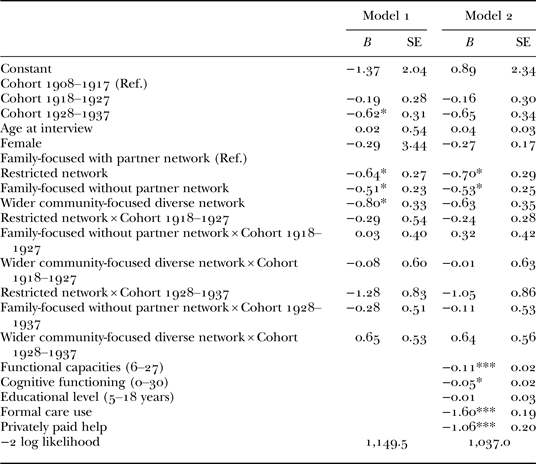
In the second stage, we investigate cohort differences in network types and informal care use among the sample with functional limitations. First, we determined whether network types of older adults differ between the three birth cohorts by using chi-square tests. Second, we also investigated cohort differences in informal care use and the other independent variables by chi-square tests and analysis of variance. Finally, we investigate cohort differences in informal care use by network type by employing logistic regression analyses. The birth cohorts and network types are entered in the model as dummies, with 1992 (birth cohort 1908–1917) and the family-focused network with a partner being the respective categories of reference. The middle birth cohort is included to see whether trends are linear. We include interactions between network type and birth cohort to test for cohort differences. In Model 1, we include the dummies for birth cohort, network type and interactions between network type and birth cohort, controlled for age and gender. In Model 2, we add the other explanatory variables to determine whether they can explain cohort differences in the impact of network type on informal care use.
Results
Network types
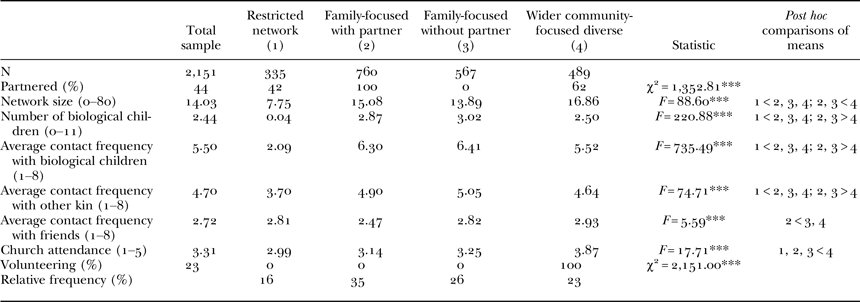
The characteristics of the four network types and their frequencies are in Table 1 (N = 2,151). Individuals in the restricted network (16% of the respondents) have the most limited social ties compared to individuals in other networks. They have the smallest network size, almost exclusively do not have children, have below average contact with other kin, slightly above average contact with friends and do not volunteer. This is the only cluster for which almost all network variables are below the sample mean. Individuals in the family-focused network with a partner (35% of the sample) have a relatively large network with a partner and a relatively large number of children with whom they have frequent contact, but they tend to have a relatively low frequency of contact with friends and other non-kin, low frequency of church attendance and they do not volunteer. Individuals in the family-focused network without a partner (26%) have a relatively large network, the highest frequency of contact with children and other kin, intermediate contact frequency with friends and other non-kin and church attendance, but do not volunteer and by definition have no partner. Finally, the wider community-focused diverse network that compromised 23 per cent of the sample has the largest network size, intermediate frequency of contact with children and other kin, and the highest frequency of contact with friends and other non-kin and always volunteers. This cluster scores above the average on all network variables, except for contact frequency with other kin.
Means and percentages of social relationship variables by network type

Note: N = 2,151.
Significance level: ***p < 0.001.
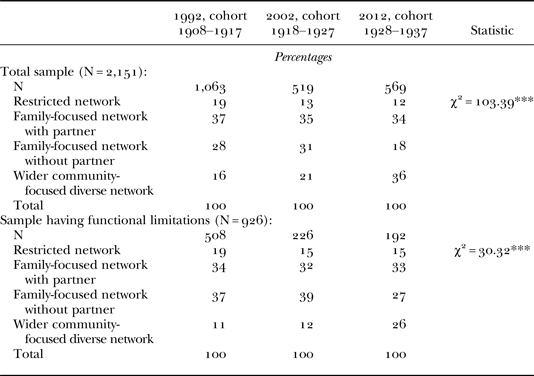
Table 2 shows cohort differences in network type, for the total sample and for those with functional limitations only (Research Question 1). In the total sample (N = 2,151), restricted networks and family-focused networks without a partner are less common in the late birth cohort and wider community-focused diverse networks are more common. Family-focused networks with a partner remain relatively stable in their prevalence across birth cohorts. In the sample that has functional limitations (N = 926), the pattern of cohort differences is roughly the same as the total sample. Family-focused networks without partners are more common in the sample with functional limitations than in the total sample, whereas wider community-focused diverse networks are less common. To sum up, we can conclude that family-focused networks without partners become less common and non-kin-based networks (i.e. wider community-focused diverse network) become more common. This supports Hypothesis 1. Family-focused networks with a partner also become slightly more common in the late birth cohort, but only in the sample with functional limitations.
Description of network types by birth cohort for the total sample and the analytical sample having functional limitations

Note: Percentages shown are within-cohort.
Significance level: ***p < 0.001.
Informal care use, independent variables and covariates by network types
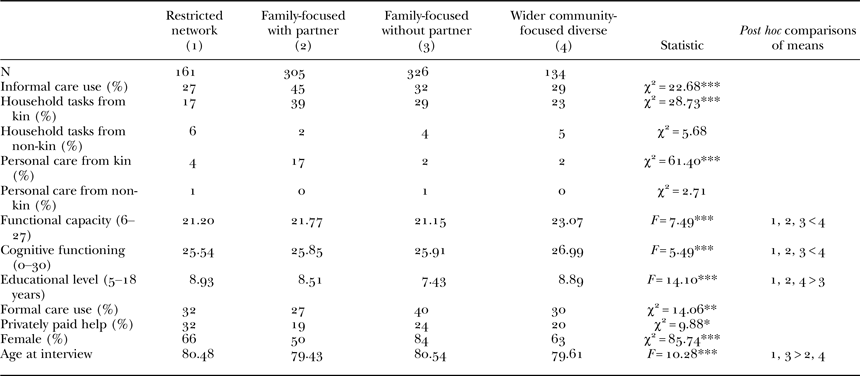
Table 3 shows how informal care use varies by network type. Those in family-focused networks with a partner receive informal care most often (45%), followed by those in family-focused networks without a partner (32%). Individuals in wider community-focused diverse and restricted networks receive informal care less often (29% and 27%, respectively). Only household tasks and personal care given by kin differ between the network types. Those in family-focused networks with a partner are most likely to receive care with household tasks and personal care from kin. Those in wider community-focused diverse networks also have better functional capacity and cognitive functioning. Those in the family-focused network without a partner are less educated. Those in the family-focused network without a partner and the restricted network use formal care most often. Those in a family-focused network with a partner are least likely to use formal care. Individuals in a restricted network are most likely to use privately paid help. Those in restricted and family-focused networks without a partner are older and more often female.
Description of dependent variables, independent variables and covariates by network type

Note: N = 926.
Significance levels: *p < 0.05, **p < 0.01, ***p < 0.001.
Informal care use, independent variables and covariates by birth cohorts
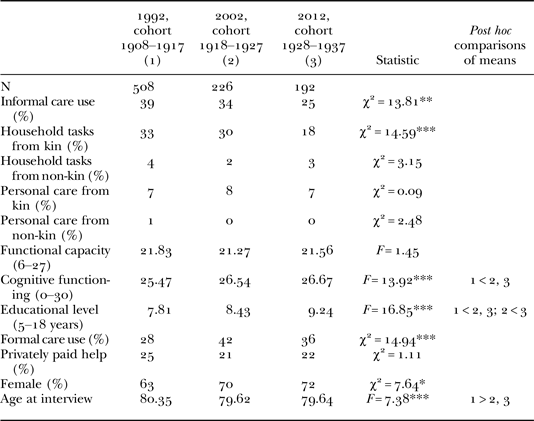
Table 4 shows how informal care use differs between the three birth cohorts that were interviewed in 1992, 2002 and 2012, respectively (1908–1917, 1918–1927, 1928–1937). Informal care use declines across the three birth cohorts. In the early birth cohort, 39 per cent of those aged 75–84 with functional limitations received informal care, this declined to 34 per cent in the middle cohort and 25 per cent in the late cohort. If we specify type of care and kin/non-kin, we observe that only household care from kin declines over the three birth cohorts, from 33 per cent in the early birth cohort to 18 per cent in the late birth cohort. No cohort differences in personal care from kin as well as household care and personal care from non-kin are observed. Cognitive functioning is higher in the middle and late birth cohort than in the early birth cohort, whereas functional capacity does not differ across the three birth cohorts. Attained educational level is highest in the late birth cohort, followed by the middle birth cohort and the early birth cohort. Formal care use is highest in the middle birth cohort, whereas privately paid help is highest in the early birth cohort. Those in the middle and late birth cohort are more often female and slightly younger.
Description of informal care use, independent variables and covariates by birth cohort

Note: N = 926.
Significance levels: *p < 0.05, **p < 0.01, ***p < 0.001.
Cohort differences in informal care use by network types: multivariate analyses
In Table 5, the three birth cohorts of older adults aged 75–84 years with functional limitations are compared (Research Question 2). In Model 1, those in the late birth cohort are less likely to receive informal care than those in the early cohort (B = −0.62), although the effect size is small. Those in the restricted network, family-focused network without a partner and wider community-focused diverse network less often receive informal care than the reference category, those in the family-focused network with a partner (B = −0.64, B = −0.51 and B = −0.80, respectively). There are no significant interactions between network type and birth cohorts, showing that the impact of network type on informal care use does not differ by birth cohort, which supports Hypothesis 2b.
Logistic regression analysis of informal care use: age 75–84

Notes: N = 926. SE: standard error. Ref.: reference category.
Significance levels: *p < 0.05, ***p < 0.001.
In Model 2, need, predisposing and enabling factors are included in the model. Those in the restricted network and the family-focused network without a partner still receive informal care less often than those in the family-focused network with a partner (B = −0.70 and B = −0.53, respectively). Those in wider community-focused diverse networks are now equally likely to use informal care, which can be explained by their lower functional limitations and better cognitive functioning (as established in Table 3). Furthermore, the negative effect of being in the late birth cohort becomes insignificant, showing no cohort differences in informal care use after controlling for need, predisposition and enabling factors. Those having a lower functional capacity, worse cognitive functioning, no formal care and no privately paid help are more likely to use informal care.
Discussion
The present study has two aims: (a) to determine cohort differences in network types among older adults aged 75–84 years and (b) to determine whether the impact of network type on informal care use differs across the three birth cohorts among those that have functional limitations. With regard to Research Question 1, we found that in the late birth cohort, wider community-focused diverse networks are more common. Restricted networks and family-focused without a partner networks were less common. Family-focused networks with a partner remained relatively stable in their frequency. This supports Hypothesis 1 that more non-kin-based networks become more common.
The four network types found in the current study are similar to those obtained in other studies in different national contexts (e.g. Fiori, Smith and Antonucci Reference Fiori, Smith and Antonucci2007; Litwin Reference Litwin2001; Wenger Reference Wenger1991). The restricted network is similar to the private restricted networks of, for example, Wenger (Reference Wenger1991) that has only minimal ties. For the family-focused network that has also been found repeatedly in the literature (e.g. Fiori, Smith and Antonucci Reference Fiori, Smith and Antonucci2007), we found a further distinction between those with a partner and without a partner. In both family-focused networks, the number of biological children in the network and contact with children is relatively high, but contact with friends and church attendance are higher in the sample without a partner than with a partner. Although this distinction between family-focused networks is rather distinctive, it is logical given the relatively high age of the sample under study; among the age group 75–84 years, widowhood is more common than among younger older adults. The wider community-focused diverse network in our sample that has above-average scores on contact with friends, high frequency of church attendance and volunteers is largely similar to the wider community-focused network, as put forward by Wenger (Reference Wenger1991), that has a great salience of non-kin and volunteers.
Concerning Research Question 2, we do not find any significant cohort differences in the effect of network types on informal care, supporting Hypothesis 2b. Those in family-focused networks with a partner still most often receive informal care than those in the other three network types, particularly when compared to the restricted network, but also to the family-focused without a partner network. Those in the wider community-focused networks are less likely to use informal care when no confounding variables were taken into account, but this was explained entirely by lower functional limitations and better cognitive functioning in this group. Furthermore, we do not find any indication that non-kin steps in as care-givers. The percentage of individuals that receive household and personal care from non-kin does not differ across the birth cohorts, whereas the percentage that receives household care from kin declines steeply. Across birth cohorts, personal care from non-kin is almost non-existent. These findings nuance recent studies showing a larger salience of non-kin, including for social support (e.g. Ajrouch, Akiyama and Antonucci Reference Ajrouch, Akiyama, Antonucci, Wahl, Tesch-Roemer and Hoff2007; Suanet and Antonucci Reference Suanet and Antonucci2016). Findings here lend support to the thesis of Allan (Reference Allan2008): for informal care, even in the face of large-scale societal change, kin and non-kin still have very distinct roles. Also, in the descriptive analysis, we found that informal care use declines in later cohorts, but we did not find a cohort effect in the explanatory analysis, when we also incorporated the network type. Combined with the insignificant interactions between network type and cohort, we can conclude that decline in informal care use in the middle and late cohort is due to more older adults having a network type that provides less informal care, the wider community-focused network and fewer older adults having a family-focused network without a partner, a network type that provides informal care relatively often.
Persistence of different motivations in (close) kin and non-kin ties could be one explanation (Allan Reference Allan2008). Non-kin might still be more dependent on reciprocity and family relationships on normative obligations and emotional closeness for support and care. But the decline in informal care (particularly with household tasks) from kin across birth cohorts suggests that the strength and/or relative importance of these mechanisms might be changing. Future studies should therefore investigate whether these different motivations for social support exchange and informal care have changed in different types of social relationships in recent times. Although our focus is on classifying networks as a whole rather than on impacts of individual social relationships or relationship types, findings in the current study suggest that Cantor's (Reference Cantor, Borgatta and McCluskey1980) hierarchical model is still very useful. Relationships with partners and children are on top in emotional closeness, followed by other kin and lastly non-kin (and formal carers), which can explain why those in family-focused networks with a partner receive informal care most often.
We can, however, also observe what Riley, Kahn and Foner (Reference Riley, Kahn and Foner1994) have called a ‘structural lag’, i.e. the structure of society has not yet adapted to changing characteristics and conditions. Structural lags are observed in institutional and organisational arrangements, but also in people's role expectations, mores and laws. Effects of societal changes take time to become manifest in people's outlook and behaviour. Individualisation influences all age groups in Western societies, but the younger perhaps even more so than the old. Those aged 15–25 years, in the so-called ‘formative period’ (Inglehart Reference Inglehart1990), are influenced most strongly in their worldview and attitudes by societal events and conditions taking place at a given time. Birth cohorts coming to age in the coming decades could therefore still see changes in who provides them with informal care. Despite large-scale societal changes that raised the importance of non-kin in networks, these have not (yet) blurred the boundaries between family and friends in providing informal care.
Several methodological notes should be made. First, the network delineation method in LASA that combines the social roles that people have, with contact frequency and importance of social ties results in relatively large networks containing more non-kin compared to some other methods, such as core discussion networks that generate smaller and mostly close kin networks (e.g. Cornwell, Laumann and Schumm Reference Cornwell, Laumann and Schumm2008). Because of its method of network delineation, the LASA study is particularly well suited to study ideas on a supposed shift towards increasing salience of non-kin in social network structure and function. Second, due to our ego-based network measurement, we are not able to include measures related to network density, multiplexity and/or closeness used in some other studies (e.g. Wellman Reference Wellman1992). It can be expected that in more close ties and in networks that are denser, informal care is used more often. Third, we compare three birth cohorts of 75–84 years having functional limitations cross-sectionally as our focus is on cohort differences in network types and informal care rather than on age-related change. Future research could take a longitudinal view when data become available. Fourth, we were not able to distinguish between informal care received from kin and non-kin in the regression analyses due to low numbers of respondents receiving informal care from non-kin (whether household tasks or personal care).
To sum up, this study showed that older adults in the late birth cohort are more likely to be in a wider community-focused diverse network and less likely to be in a restricted network and a family-focused network without a partner than in the early birth cohort. No cohort differences in informal care use by network type were identified: those in family-focused networks with a partner still use informal care most often.
Acknowledgements
The Longitudinal Aging Study Amsterdam is supported by a grant from the Netherlands Ministry of Health, Welfare and Sports, Directorate of Long-term Care. The data collection (in 2012–2013 and 2013–2014) was financially supported by the Netherlands Organisation for Scientific Research (NWO) in the framework of the project ‘New Cohorts of Young Old in the 21st Century’ (file number 480-10-014). Bianca Suanet's work was supported by a Veni grant from the NWO (file number 451-14-019).