Introduction
Depression is one of the most prevalent mental health problems in South Korea. The number of older adults with depression is projected to increase in Korea as the population ages at a faster rate than in other countries. Insufficient food intake or limited food availability exacerbates older adults’ mental health as well as physical health (Heflin and Iceland Reference Heflin and Iceland2009; Johnson, Sharkey and Dean Reference Johnson, Sharkey and Dean2011; Russell et al. Reference Russell, Flood, Yeatman, Wang and Mitchell2016). For example, low-income older adults experiencing food insufficiency showed high depression rates (German et al. Reference German, Kahana, Rosenfeld, Zabrowsky, Wiezer, Fraser and Shahar2011). In particular, older adults living alone are more likely to experience greater levels of depressive symptoms and food insecurity compared to older adults living with someone. To our knowledge, there is limited research knowledge on the relationship between food insecurity and depression in Korean older adults living alone. Understanding the link is crucial to develop interventions that protect access to food and lessen depressive symptoms associated with financial strain among older adults living alone. To address these gaps in the knowledge, this study examined whether food insecurity is associated with depressive symptoms among older adults living alone, using data collected from a nationally representative sample.
Background
Depression and older adults living alone in South Korea
A national survey on older adults reported that 33.1 per cent of older adults aged 65 or older had depressive symptoms (Chung et al. Reference Chung, Oh, Kang, Kim, Sun, Oh, Lee, Hwang, Kim, Oh, Park, Shin and Lee2014). The number of older adults with depression doubled between 2004 and 2009 (Korea Centers for Disease Control and Prevention 2013). Older adults aged 65 or more will comprise approximately 40 per cent of the entire population by 2060 in Korea (Ministry of Health and Welfare 2012). Older adults with depression are more likely to experience difficulties in their daily functioning and have higher risks of suicidal ideation and suicide attempt (Cho Reference Cho2013; Rim, Jang and Jeong Reference Rim, Jang and Jeong2013). The suicide rate of older adults in Korea is the highest among Organisation for Economic Co-operation and Development (OECD) countries (Ro et al. Reference Ro, Park, Lee and Jung2015). One of the main reasons for suicide is known as economic stress (Sim Reference Sim2013): 40.4 per cent of older adults who had suicidal ideations reported that financial strain was the most important reason (Chung et al. Reference Chung, Oh, Kang, Kim, Sun, Oh, Lee, Hwang, Kim, Oh, Park, Shin and Lee2014).
Korean older adults are the poorest among OECD countries. About 49.6 per cent of older adults live below 50 per cent of the median household income, much higher compared to 9.6 per cent of the general population below age 65 in 2013; average annual income is low at 9,593,000 Korean Republic Won (Statistics Korea 2017). While the type of income sources of older adults varies, one in five older adults work, largely in agriculture or non-skilled work (e.g. cleaning), to supplement their living expenses (Chung et al. Reference Chung, Oh, Kang, Kim, Sun, Oh, Lee, Hwang, Kim, Oh, Park, Shin and Lee2014).
Older adults living alone comprised 23 per cent of the elderly Korean population in 2014 (Chung et al. Reference Chung, Oh, Kang, Kim, Sun, Oh, Lee, Hwang, Kim, Oh, Park, Shin and Lee2014). Older adults living alone are at high risk of poor health, financial strain, social isolation, self-neglect and psychological distress (Chung et al. Reference Chung, Oh, Kang, Kim, Sun, Oh, Lee, Hwang, Kim, Oh, Park, Shin and Lee2014; Lee, Kang and Lee Reference Lee, Kang and Lee2013; M. Lee and K. Kim Reference Lee and Kim2014). They are less likely to receive emotional and financial support from family members compared to those living with others (Han, Oh and Joung Reference Han, Oh and Joung2014). Recent studies in Korea report older adults living alone have low levels of life satisfaction (Shin and Sok Reference Shin and Sok2012), and over two-thirds report mild depressive symptoms (Kim and Lee Reference Kim and Lee2015).
Food insecurity and depression
A large body of research has also found variations in depression of older adults by socio-economic status (e.g. Djernes Reference Djernes2006; Park et al. Reference Park, Kim, Kim, Kim, Kim, Kim, Kim, Moon, Bae, Woo, Ryu, Yoon, Lee, Lee, Lee, Lee, Lee, Lee, Chang, Jhoo and Cho2012). Emerging research has identified several conceptual mechanisms on how food insecurity contributes to older adults’ health outcomes (Heflin and Iceland Reference Heflin and Iceland2009; Johnson, Sharkey and Dean Reference Johnson, Sharkey and Dean2011; Tucker-Seeley et al. Reference Tucker-Seeley, Li, Subramanian and Sorensen2009), as food insecurity represents a different aspect of poverty than the traditional income-based poverty measure. First, insufficient food intake or limited food availability is hypothesised to have direct effects on physical health outcomes due to nutritional deficiency. Also, food insecurity is hypothesised to have negative consequences for daily functioning and behaviour, including detrimental effects on stress levels or mental health. Consistent with these theoretical hypotheses, previous studies have found that older adults with food insecurity reported higher levels of functional impairment and poorer self-rated health (Alley et al. Reference Alley, Soldo, Pagan, McCabe, DeBlois, Field, Asch and Cannuscio2009; Hampton Reference Hampton2007). In addition to physical health, several studies have suggested significant associations between food hardship and depression among low-income adults (Heflin and Iceland Reference Heflin and Iceland2009; Heflin, Siefert and Williams Reference Heflin, Siefert and Williams2005; Leung et al. Reference Leung, Epel, Willett, Rimm and Laraia2015). Similarly, older adults experiencing food insecurity reported significantly lower levels of mental health (Russell et al. Reference Russell, Flood, Yeatman, Wang and Mitchell2016), and low-income older adults experiencing food insufficiency and nutritional deficiencies showed much higher depression rates than those with sufficient food (German et al. Reference German, Kahana, Rosenfeld, Zabrowsky, Wiezer, Fraser and Shahar2011). Johnson, Sharkey and Dean (Reference Johnson, Sharkey and Dean2011) argued that food insecurity was the most influential risk factor of various economic hardships for depression among older adults.
Prior research in other countries finds lower rates of food insecurity for older adults compared to younger adults because of their eligibility for public benefits/subsidies and likelihood of having lower household expenses (Russell et al. Reference Russell, Flood, Yeatman and Mitchell2014; Strickhouser, Wright and Donley Reference Strickhouser, Wright and Donley2014). On the contrary, in South Korea, older adults are known as one of the most vulnerable populations experiencing food insecurity. National data show that one in ten older adults experiences hunger or food insecurity, which is almost twice the national average for all age groups (Kim, Kim and Shin Reference Kim, Kim and Shin2009). Cross-national comparisons show that older adults in Korea (8.3%) appear to experience food insecurity more than their peers in the United States of America (USA) (6.5%); in addition, food insecurity is much more prevalent among older adults living alone in Korea (17.1%) than their counterparts in the USA (7.3%) (Kim, Kim and Shin Reference Kim, Kim and Shin2009). Studies have found that about a quarter of older adults living alone in Korea did not maintain proper food consumption (M. Lee and K. Kim Reference Lee and Kim2014); over half of those living alone in rural areas skipped at least one meal a day (S. S. Lee and S. H. Kim Reference Lee and Kim2011).
Food assistance programmes for older adults in Korea are mostly administrated by local governments, and community-based organisations provide congregate meals or home-delivered meals for low-income older adults (Lee Reference Lee2012). Among the government budget for food assistance programmes, only 1 per cent is used for older adults, and over two-thirds of older adults who received food assistance programmes are dissatisfied with the programmes (Lee Reference Lee2012). Food access and consumption also vary by geographic area; those living in rural areas (74.5%) have more difficulties in accessing a grocery store than those in metropolitan (37.8%) or middle-sized cities (33.6%); also, older adults in rural areas spend less money on food and go grocery shopping less often than those in metropolitan areas (Lee Reference Lee2012).
In spite of high levels of food insecurity and risks for depression and other associated health issues, there is a lack of research knowledge to date on the link between food insecurity and depression in Korean older adults. Furthermore, limited empirical evidence is available on older adults living alone despite the fact that they generally have a high risk of food insecurity and tend to seek food assistance (Meals on Wheels America 2017). Thus, this study aims to examine whether food insecurity leads to depression in Korean older adults living alone. Also, with particular attention to low-income status, this study tests whether the relationship between food insecurity and depressive symptoms varies by low-income status.
Methods
Data and sample
We employed data from Waves 3 and 4 of the Korea Welfare Panel Study (KOWEPS) collected by the Seoul National University and the Korea Institute for Health and Social Affairs in South Korea. The study collected panel data beginning in 2006 with 7,000 households and continuing on an annual basis since. The data collected include information on socio-economic characteristics, health and participation in social welfare programmes and services. The KOWEPS used a nationally representative sample drawn using stratified sampling and over-sampling low-income households (for more information, see Korean Institute of Social and Health Affairs 2009). Our study used KOWEPS Wave 3 and Wave 4 data, which were collected in 2008 and 2009, respectively. The Wave 3 measures included a standardised food insecurity scale and represented the first national effort to collect data on multiple aspects of food insecurity in South Korea. We drew on data on economic predictors of depression, including food insecurity, from Wave 3 and data on the dependent variable, depressive symptoms, from Wave 4. This method was used for the purpose of establishing a temporal order and estimating whether depressive symptoms are a significant consequence of food insecurity, controlling for other factors. Our study sample consisted of a sub-set of data from the KOWEPS. Inclusion criteria included community-dwelling older adults living alone, and aged 65 or older at the time of Wave 3, and who had participated in both Wave 3 and Wave 4 data collection. The resulting sample included 815 older adults living alone.
Measures
The dependent variable was depressive symptoms measured in Wave 4. The KOWEPS measured depressive symptoms using the Center for Epidemiologic Studies Depression Scale (CES-D) as adapted for use with Korean adults (Hoe, Park and Bae Reference Hoe, Park and Bae2015; Radloff Reference Radloff1977). The CES-D uses 11 four-point Likert scale questions (1 = not at all to 4 = all the time) about cognitive, affective, behavioural and somatic symptoms of depression experienced during the past week (Cronbach's α = 0.86). Summed scores range from 1 to 44, where higher scores indicate greater levels of depressive symptoms.
The independent variable was food insecurity measured in Wave 3. The KOWEPS measured food insecurity using six questions (Korean Household Food Security Survey Module) adapted from the United States Department of Agriculture's (USDA) Food Security Scale (Bickel et al. Reference Bickel, Nord, Price, Hamilton and Cook2000) which investigate whether a household experienced food hardships in the past year as a result of economic difficulties (Kim and Kim Reference Kim and Kim2009). Food insecurity represents conditions with limited availability of nutritionally adequate foods and uncertain ability to obtain them; the measure captures whether one experienced and perceived food shortage or adjustment due to financial constraints (Bickel et al. Reference Bickel, Nord, Price, Hamilton and Cook2000; Kim and Kim Reference Kim and Kim2009). The questions are: (a) ‘The food that (I/we) bought just did not last, and (I/we) did not have money to get more’; (b) ‘(I/We) could not afford to eat balanced meals’; (c) ‘In the last 12 months, did (you/other adults in your household) ever cut the size of your meals or skip meals because there was not enough money for food?’; (d) (If yes in the previous question) ‘how often did this happen?’; (e) ‘In the last 12 months, did you ever eat less than you felt you should because there was not enough money to buy food?’; (f) ‘In the last 12 months, were you ever hungry but did not eat because you could not afford enough food?’ In each item, an affirmative response was coded as 1, or 0 otherwise. For the fourth item, the two responses of ‘almost every month’ and ‘some months but not every month’ were counted as affirmative (= 1); the response of ‘only one or two months’ or those who responded ‘no’ or ‘don't’ know’ in the third item (previous question) were coded as not affirmative (= 0). The total score, a sum of the six responses, indicated a level of food insecurity ranging from 0 to 6 (Cronbach's α = 0.75). We created a dichotomous indicator of food insecurity by which we classified those with two or more affirmative responses as food insecure older adults (= 1) and those with less than two affirmative responses as food secure older adults (= 0), following previous research guidelines (Bickel et al. Reference Bickel, Nord, Price, Hamilton and Cook2000).
We chose control variables that may be associated with depressive symptoms, based on the previous research. We employed control variables measured in Wave 3 to account for socio-economic and health characteristics of the study respondents. Age was a continuous variable measured in years, and sex was a dichotomous variable with male coded as 1 and female coded as 0. Education was divided into two groups: less than high school graduation (= 0) and high school graduation or above (= 1). We coded employment status as ‘currently employed’ (= 1) for those who were employed or self-employed and were paid for their work or ‘not employed’ (= 0) for those who were unemployed or acting as unpaid family care-givers and were not looking for a job. Health status was measured with one question: ‘what is your general health status?’ To make higher scores represent better health status, we reverse-coded the five-point Likert scale (1 = poor to 5 = excellent). Chronic disease was a dichotomous variable that indicated whether the respondent had a history of chronic disease in their life (= 1) or not (= 0). Smoking was a binary variable that indicated whether the respondent smoked (= 1) or not (= 0). Residence location was sorted into four categories based on population density: Seoul area (capital city; reference group in regression), major metropolitan cities (Gwangyeok-si; generally population size of over one million), middle-sized cities and other small cities including rural areas. We used a dichotomous measure of low income to represent households with annual income below 60 per cent of the household median income (= 1), otherwise it was coded as 0. The cut-off point of 60 per cent of the household median income is a poverty threshold commonly used in the European Union and many OECD countries (Gordon Reference Gordon, Pantazis, Gordon and Levitas2006; Kim and Shin Reference Kim and Shin2012). This is a more comprehensive indicator of poverty that takes into account relative economic deprivation and social exclusion. The working poor and many low-income households tend to repeat living below and above the absolute poverty line for a variety of reasons (e.g. employment characteristics, economic conditions). Given that our study attempts to capture subtle nuances in the relationship of how food insecurity and economic deprivation explain depressive symptoms, we chose to use this measure instead of an absolute poverty line. Home-ownership was a dichotomous variable indicating whether the respondent owned the home in which the family lived (= 1) or not (= 0). Cash public assistance receipt was a dichotomous variable that indicated whether the respondent had received cash assistance in the past calendar year (= 1) or not (= 0). Food service was a dichotomous variable indicating whether the respondent had received home-delivered meals for older adults provided by government programmes or private-sector social services (= 1) or not (= 0). Social relationship satisfaction measured the level of satisfaction with social relationships overall, ranging from very dissatisfied (= 1) to very satisfied (= 6). We included depressive symptoms measured in Wave 3 to control for earlier depressive symptoms and unobserved confounding factors.
Analysis strategy
First, we used descriptive statistics to summarise the sample characteristics. To understand our sample better, we also compared food-secure older adults living alone with their food-insecure counterparts on socioeconomic and health characteristics, using chi-square and independent samples t-tests.
Second, we tested whether the experience of food insecurity significantly accounted for depressive symptoms, using ordinary least square (OLS) regression analysis (Model 1). Next, we tested the interaction effect between food insecurity and low income (Model 2) on depressive symptoms. Previous studies suggest that food insecurity and depression were associated in socio-economically marginalised populations, such as low-income populations or Supplemental Nutrition Assistance Program participants (Leung et al. Reference Leung, Epel, Willett, Rimm and Laraia2015; Russell et al. Reference Russell, Flood, Yeatman and Mitchell2014). Thus, our test examined whether the association between food insecurity and depressive symptoms may differ by low-income status.
We also ran two separate tests for older adults living alone with low income (Model 3a) and those with middle or high income (Model 3b), respectively. Accordingly, Models 3a and 3b did not include the variable low income in the analysis. Our data meet statistical assumptions for the tests (e.g. normal distribution) and do not have multicollinearity issues.
Results
Descriptive results
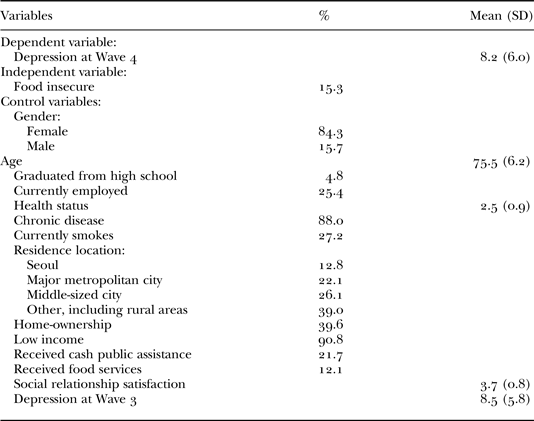
Table 1 shows the sample characteristics. The mean of the depressive symptoms was 8.2 (standard deviation = 6.0) in 2009 (Wave 4). About 15 per cent of the sample reported experiencing food insecurity in 2008 (Wave 3). More than 84 per cent of the sample was male, and the average age was about 75.5 years old. The majority did not graduate from high school (95.2%), and about 75 per cent were not currently employed. The mean self-rated health score was 2.5, indicating that the majority considered their health condition to be less than ‘good’ on this scale. Almost 88 per cent of the sample had a history of chronic disease, and more than a quarter of the sample currently smoked. About 13 per cent reported living in Seoul, 22 per cent in major metropolitan cities, about 26 per cent in middle-sized cities and about 39 per cent in rural areas. About 91 per cent of the sample had an income below 60 per cent of the median household income. Approximately 40 per cent of the sample reported owning their home, 22 per cent reported receiving cash public assistance from the government and about 12 per cent reported receiving food-related services provided by either the public or private sector.
Descriptive results of the study sample characteristics

Notes: N = 815. SD: standard deviation. Total may not sum to 100 per cent due to rounding.
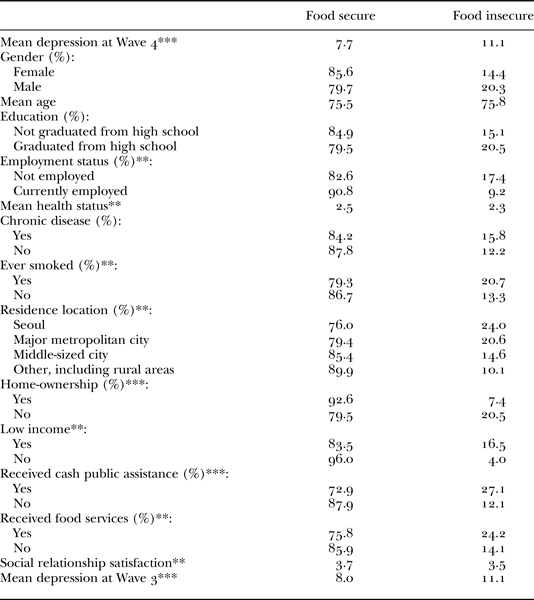
Table 2 compares food-secure older adults with those who were food-insecure for the observed characteristics. Most bivariate tests were statistically significant at the 0.05 alpha level. Food-insecure older adults showed higher levels of depressive symptoms by more than three points at both waves (t = −5.83, p < 0.001 at Wave 4; t = −5.68, p < 0.001 at Wave 3). Food insecurity was much more prevalent in some sub-groups of older adults living alone: those who were not employed (17.4%), lived in Seoul (24%) or major metropolitan cities (20.6%), did not own a home (20.5%), had low income (16.5%), received public assistance (27.1%) or received food services (24.2%).
Food insecurity by depression and other characteristics
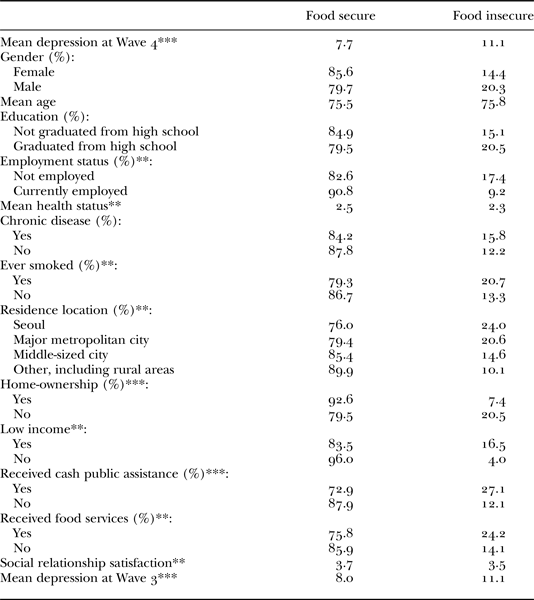
Notes: N = 815. Independent samples t-tests and chi-square tests were used to compare food secure older adults living alone and food insecure counterparts by depression and other characteristics.
Significance levels: ** p ⩽ 0.01, *** p ⩽ 0.001.
Regression results
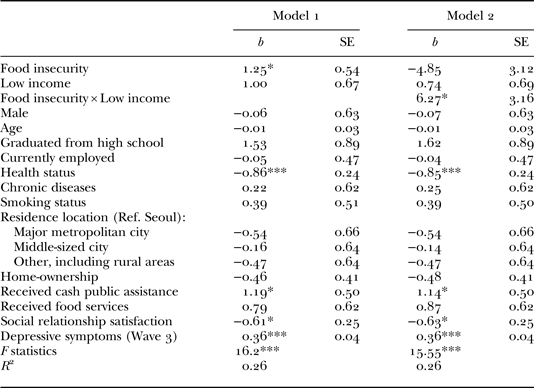
Table 3 presents the results from the two OLS regression analyses. In Model 1 without the interaction term, food insecurity was significantly associated with depressive symptoms for all older adults living alone (b = 1.25, p = 0.02). Model 2 tested the interaction effect between food insecurity and low income in predicting depressive symptoms. The interaction term was statistically significant (b = 6.27, p = 0.04), which indicated that the association between food insecurity and depressive symptoms differed by low-income status. Depressive symptoms significantly differed by health status, as expected (b = −0.85, p < 0.001). Those with better self-rated health had lower levels of depressive symptoms. Depression scores increased by about 0.85 for every level increase in health status. Those who received cash public assistance reported depressive symptom scores that were significantly higher, by 1.14 points, than those who did not receive public assistance (b = 1.14, p = 0.02). The level of depressive symptoms significantly decreased as older adults living alone were more satisfied with their social relationships (b = −0.63, p = 0.02). Earlier depressive symptoms were significantly associated with later depressive symptoms (b = 0.36, p < 0.001). However, other socio-demographic and health characteristics were not statistically significant in predicting depressive symptoms of older adults living alone.
Regression analysis: associations between food insecurity and depressive symptoms in the full sample

Notes: N = 815. SE: standard error. Ref.: reference group.
Significance levels: * p ⩽ 0.05, *** p ⩽ 0.001.
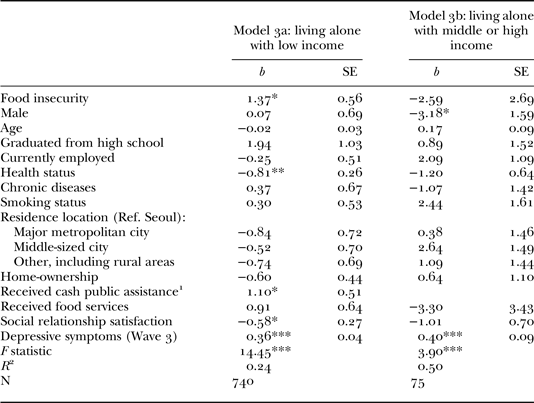
After finding the significant interaction effect, two separate analyses were run to examine the main effect of food insecurity in each sub-group: older adults living alone with low income (Model 3a) and their counterparts with middle or high income (Model 3b) (see Table 4). In the low-income sub-group, food-insecure older adults reported significantly higher depressive symptom scores than their food-secure peers (b = 1.37, p = 0.014). In the middle- or high-income sub-group, food insecurity was not a significant predictor of depressive symptoms (b = −2.59, p = 0.34). In Model 3a, the results of other covariates were largely comparable to those of Models 1 and 2 in that health status, cash public assistance, social relationship satisfaction and earlier depressive symptoms were significantly associated with later depressive symptoms. In Model 3b, male older adults living alone reported significantly lower levels of depressive symptoms (b = −3.18, p = 0.05), and earlier depressive symptoms had a positive association with later depressive symptoms (b = 0.40, p < 0.001); the other covariates were not significantly associated with depressive symptoms.
Regression analysis: associations between food insecurity and depressive symptoms by sub-group

Notes: Ref.: reference group. SE: standard error. 1. In Model 3b, the variable cash assistance was not included because no one received it in those with middle or high income.
Significance levels: * p ⩽ 0.05, ** p ⩽ 0.01, *** p ⩽ 0.001.
Discussion and implications
Our study suggests that older adults living alone with food insecurity are more likely to report greater depressive symptoms (Model 1). However, the association between food insecurity and depressive symptoms varies by their income status (Model 2), and the relationship is significant only in the low-income group (Model 3a). These results agree with previous studies conducted in other countries that find that food insecurity is a risk factor for the depressive symptoms of older adults and that this association indicates that older adults with constrained economic resources are particularly vulnerable (e.g. Leung et al. Reference Leung, Epel, Willett, Rimm and Laraia2015; Russell et al. Reference Russell, Flood, Yeatman and Mitchell2014). In addition, in the full sample, neither home-ownership nor low income is significantly associated with depressive symptoms, whereas public assistance receipt is. Overall, these results support that research into multifaceted economic deprivation – not just traditional measures of income-based poverty – may better the understanding of the mental health of older adults. For example, it may be helpful to examine other measures of financial constraints, such as limited inability to meet basic needs in the areas of food, housing, medical care or payment of essential bills (Beverly Reference Beverly2001). Depressive symptoms may be explained by food insecurity, low income or public assistance in different ways, particularly for older adults with limited earned income. Managing economic resources can be stressful in later life, and many older adults may be worried about financial strains such as a fixed income and health-care costs resulting from a decline in physical health or the development of a chronic illness. Our study confirms that, among various risk factors, the failure to meet the basic needs of food consumption and access may be a significant cause of depressive symptoms in older adults living alone.
It is noteworthy that older adults living alone have reported a high rate of food insecurity in Korea (15.3%). In our sample, the rate of food insecurity is over 16 per cent among low-income older adults living alone, more than four times that of their counterparts with middle or high incomes. This finding is consistent with previous research (M. Lee and K. Kim Reference Lee and Kim2014; S. S. Lee and S. H. Kim Reference Lee and Kim2011; Park Reference Park2010). Financial hardship is likely to co-exist with food insecurity in many older adults living alone. Korean older adults living alone have a more limited pool of financial resources compared to those living with others who may be able to share additional income (Han, Oh and Joung Reference Han, Oh and Joung2014). Lacking earnings from private income transfer, older adults living alone have less than two-thirds the household income of those living with other family members (Ban Reference Ban2011).
Among covariates, our study confirms previous evidence that depressive symptoms increase as health status and social relationship satisfaction decrease. Our evidence supports that perceived health status is a key predictor of depression. We speculate that greater social isolation and fewer opportunities for social interaction and engagement explain the larger incidence of depressive symptoms. For similar reasons, we hypothesised that older adults living in urban areas would be more likely to experience depressive symptoms than those living in rural areas as a result of rapid urbanisation and industrialisation following the Korean War. However, our findings do not support regional differences in depressive symptoms for older adults living alone. Previous research has found mixed results regarding rural–urban differences in depressive symptoms among older adults, suggesting that smaller rural areas may be positive contexts for older adults to have a sense of belonging to the community and a sense of stability (John, Blandfor and Strain Reference John, Blandfor and Strain2006; Park et al. Reference Park, Kim, Kim, Kim, Kim, Kim, Kim, Moon, Bae, Woo, Ryu, Yoon, Lee, Lee, Lee, Lee, Lee, Lee, Chang, Jhoo and Cho2012). Using more data and samples from diverse contexts, future research should attend to environmental factors and variations between rural and urban areas for depressive symptoms in older adults living alone.
It is worth noting that, unlike previous research (Kim and Frongillo Reference Kim and Frongillo2009), we find that food services do not have a significant association with depressive symptoms in all models. Table 2 suggests that older adults who received any type of food service are apparently vulnerable to the risk of food insecurity; this finding may suggest that food-insecure older adults living alone are more likely to use food services available in communities. Nevertheless, it is difficult to make a firm conclusion about the role of food services in our study. Those who had a food service comprised only about 12 per cent of our sample, and the variable of food service receipt is a rather crude representation of structured food assistance interventions for older adults. We suggest that future studies use a more reliable and valid measure of food assistance to address the roles of food assistance interventions in mitigating the negative consequences of food insecurity for depression among older adults living alone.
This study is not free from limitations. For the purpose of investigating potential causal mechanisms, we used predictors and a dependent variable that were measured at different points in time and controlled for unobserved confounding factors. Nonetheless, our study design with observational data does not allow testing of causal effects of food insecurity on depressive symptoms. Because of data unavailability, the study may also have omitted some important variables that may explain depression among older adults, including detailed health conditions, nutritional status or food intake. In particular, our variable food insecurity does not account for every possible area of food-related problems, for instance, severity of food insecurity, short-term (e.g. time reference of one month or past week) or chronic condition of food insecurity, nutritional status, or sources of food available/consumed. The KOWEPS data used the short-form six-item scale for food insecurity, as the USDA scale recommends, in order to lessen the respondent's burden (Bickel et al. Reference Bickel, Nord, Price, Hamilton and Cook2000). We suggest future research takes into account both breadth and depth of food insecurity using comprehensive measures and methodology. Also, readers should note that the majority of the sample consists of those with low income (N = 740 in Model 3a) while those with middle or high income accounted for less than 10 per cent of the sample (N = 75 in Model 3b). Model 3b with the latter sub-group may not have the optimal sample size to detect the main effect of food insecurity on depressive symptoms. Future studies are called for to draw older adults living alone across various income groups.
Our study provides important implications for healthy ageing of older adults living alone. In South Korea, older adults living alone are more vulnerable to food insecurity compared to the entire population and to younger adults. Also, the food insecurity rate tends to be higher for older adults living alone in Korea than in other countries, which is different from the USA and other countries where younger adults report greater food insecurity. Recognising the significant link between food insecurity and depressive symptoms is important for many other countries, as well as Korea, to mitigate adverse consequences in a rapidly ageing society. Protecting access to food may be a promising strategy to lessen depressive symptoms associated with financial strain among older adults living alone. Many developed countries, including the USA, Canada and Australia, have made efforts to invent valid and reliable food insecurity scales relevant to their social contexts and to monitor food insecurity. These efforts have influenced significant developments in food assistance programmes and policy, which are likely to support healthy ageing of older adults (Temple Reference Temple2008). To promote healthy ageing, health policy makers and practitioners should consider the prevalence of food insecurity risk and its effects on depression in intervention policy targeting older adults living alone. In addition, older adults are diverse in socio-economic status, living arrangement, health status and access to food assistance. To suggest differential health-care policy and practice implications relevant to particular national contexts, more research is warranted to identify the pathways from food insecurity to depressive symptoms in older adults and the roles different environments may play.
Acknowledgement
This study used secondary data without identifiable information; thus, it is exempt from Institutional Review Board review.