1 Introduction
Japanese mimetics (or ideophones) occur with or without a quotative particle. This paper argues that mimetic–predicate sequences without an intervening quotative particle are loose complex predicates that instantiate what Booij (Reference Booij2010) calls a ‘quasi-incorporation’ construction. This argument leads us to identify three major types of mimetic quasi-incorporation, which are characterized by different degrees of morphosyntactic integration.
Mimetics are sound-symbolic words that are found in many languages, including some African, Southeast Asian, and Amazonian languages (Hinton, Nichols & Ohala Reference Hinton, Nichols and Ohala1994, Voeltz & Kilian-Hatz Reference Voeltz and Kilian-Hatz2001). Japanese is known as a language with a particularly rich mimetic vocabulary with various semantic and morphophonological subtypes. As illustrated in (1), Japanese mimetics can represent both auditory and non-auditory eventualities, including manners of action, textures, and internal experiences (Martin Reference Martin1975, Kakehi, Tamori & Schourup Reference Kakehi, Tamori and Schourup1996).
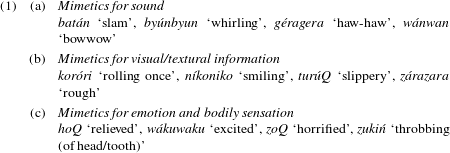
Hereafter, an accent nucleus, which is realized as a pitch fall in standard Japanese, is specified only for mimetics, as it systematically contributes to the occurrence of the quotative particle (see Section 3.1 below). Mimetics without an accent mark are meant to be unaccented.
As the above examples demonstrate, Japanese mimetics can be decomposed into monomoraic (e.g. hoQ → ho; wánwan → wa) and bimoraic roots (e.g. koróri → koro; níkoniko → niko), which essentially cannot stand alone in contemporary Japanese (Hamano Reference Hamano1998). Each type of mimetic root is realized in a restricted set of morphological and prosodic templates, such as reduplicative (e.g. níkoniko ‘smiling’, wánwan ‘bowwow’) and suffixal templates (e.g. hoQ ‘relieved’, koróri ‘rolling once’).
The syntactic categories of Japanese mimetics range over adverbs, verbs, and nouns. Manner-adverbial mimetics that modify verbs or adjectives are obligatorily or optionally followed by the quotative particle (or ‘complementizer’) to, which is the main focus of this paper.Footnote [2] As illustrated in (2), the presence or absence of to in adverbial mimetics does not clearly affect the sentential meaning.
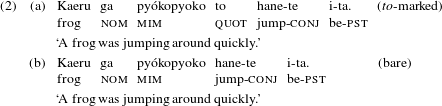
The primary category of Japanese mimetics is the adverb (Hamano Reference Hamano1998: Chapter 2). Therefore, the distribution and the function of the quotative particle have been regarded as nontrivial issues in the literature (Tamori Reference Tamori1980, Tamori & Schourup Reference Tamori and Schourup1999, Nasu Reference Nasu2002, Asano Reference Asano and McClure2003, Toratani Reference Toratani, Vance and Jones2006, Kageyama Reference Kageyama, Frellesvig, Shibatani and Smith2007). Moreover, the phenomenon is more than just morphological: it is also phonologically, semantically, syntactically, and pragmatically constrained. This complexity appears to be the reason why previous studies have repeatedly discussed and repeatedly failed to achieve a thorough elucidation of this particular phenomenon.
This study shows that Construction Grammar provides an appropriate framework for establishing a unified account of this complex phenomenon and proposes that mimetic–predicate sequences (e.g. pyókopyoko hane- ‘jump around quickly’ in (2b)) instantiate a quasi-incorporation construction. The present attempt is especially significant in light of the overall descriptivist orientation of the traditional study of mimetics (Tamori & Schourup Reference Tamori and Schourup1999, Voeltz & Kilian-Hatz Reference Voeltz and Kilian-Hatz2001), whose theoretical implications were not investigated until recently (Hamano Reference Hamano1998; Nasu Reference Nasu2002; Tsujimura Reference Tsujimura, Fried and Boas2005; Toratani Reference Toratani, Vance and Jones2006, Reference Toratani2007; Kageyama Reference Kageyama, Frellesvig, Shibatani and Smith2007).
The organization of this paper is as follows. Section 2 introduces quasi-incorporation as a case of constructional morphology. Section 3 summarizes the distributional facts of mimetic to-marking by reviewing three previously proposed conditions. Section 4 proposes and examines a constructional account of mimetic–predicate sequences as quasi-incorporation predicates. Section 5 compares this quasi-incorporation construction with two more types of mimetic predicates. The three types of mimetic predicates all instantiate quasi-incorporation but differ from each other in meaning and the degree of morphosyntactic integration. Section 6 concludes this paper.
2 Quasi-incorporation constructions
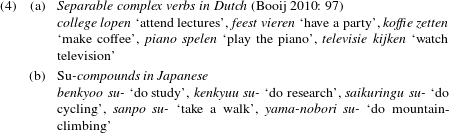
In his constructional approach to morphology, Booij (Reference Booij2010: Chapter 4) discusses a subclass of ‘separable complex verbs’ in Dutch and ‘su-compounds’ in Japanese as instances of quasi-incorporation. By ‘quasi-incorporation’, a term originally proposed by Dahl (Reference Dahl2004), Booij refers to ‘closely-knit’ units that are not as tight as compounds. Such structures are used for ‘conventional actions that require a specific competence and are therefore nameworthy’ (Booij Reference Booij2010: 107) and have been reported in many Germanic and non-Germanic languages, including Japanese. Example (3) schematically represents this type of linguistic unit as a ‘(grammatical) construction’, which is generally defined as a form–meaning pairing (see e.g. Fillmore & Kay Reference Fillmore and Kay1995):

The left side of the representation specifies the formal structure of the morphological construction, which is linked with the meaning/function on the right side. The coindices indicate the detailed correspondences between the two sides. Thus, (3) reads as ‘a construction in which a closely knit noun–verb sequence is paired with the verbal conventional action involving the nominal referent’. Some instances of quasi-incorporation predicates are cited from Booij in (4).
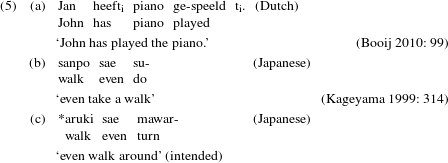
Both Dutch separable complex verbs and Japanese su-compounds are separated under limited circumstances. For example, in (5a), the noun piano ‘piano’ and the verb spelen ‘play’ are separated by the prefix ge-, which is attached to the verb constituent, rather than to the whole complex verb (*ge-piano-spelen). Similarly, in (5b), the focus particle sae ‘even’ separates the verbal noun (VN) sanpo ‘walk’ from the verb su- ‘do’.Footnote [3] This separation is not possible with compounds, as illustrated in (5c) (for other tests for wordhood, see Sells Reference Sells1995, Matsumoto Reference Matsumoto1996, Kageyama Reference Kageyama and Tsujimura1999, Iida & Sells Reference Iida and Sells2008).
The existence of the general construction in (3) accounts for both the productivity of these complex predicates and the special meaning shared by them (i.e. nameworthy and conventional actions). The semantic specification is not strictly predictable from the individual nouns and verbs that participate in the construction (e.g. college ‘lecture’ and lopen ‘go, walk’ in (4a) above), and this type of non-compositionality is often viewed as an important (but not a necessary) feature of a construction. It is generally argued that a derivational, input-oriented approach would not capture the systematically obtained meaning of the output because the meaning is not attributed to any particular morpheme in the input. This argument parallels the constructional analyses of sentences and idioms, which have been in the mainstream of Construction Grammar (Fillmore & Kay Reference Fillmore and Kay1995; Goldberg Reference Goldberg1995, Reference Goldberg2006). For example, the caused-motion use of sneeze in (6) is discussed as not predictable from the meaning of this otherwise intransitive verb or from that of the oblique PP following it; the caused-motion meaning is attributed to the whole syntactic structure [SUBJ [V OBJ OBL]] (Goldberg Reference Goldberg1995: 152).

Thus, quasi-incorporation demonstrates that the ideas of Construction Grammar, an output-oriented, non-modular, monostratal framework of language structure, are also applicable to word formation analysis (Riehemann Reference Riehemann2001, Gurevich Reference Gurevich2006). This is a natural direction of the extension of Construction Grammar, which generally assumes a continuum between lexicon and grammar (Croft Reference Croft2001, Fried & Östman Reference Fried, Östman, Fried and Östman2004).
In the present paper, we propose a quasi-incorporation account of mimetic–predicate sequences in Japanese and compare them with two more types of mimetic quasi-incorporation predicates. Theoretically, while corroborating the constructional approach to morphology, we refine two areas of Booij’s (Reference Booij2010) analysis of quasi-incorporation. First, we observe the semantic diversity of quasi-incorporation constructions, which is already suggested in the aforementioned examples. Unlike Dutch idiomatic complex verbs (e.g. college lopen ‘attend lectures’), it is not obvious whether the conventional actions denoted by Japanese su-compounds (e.g. benkyoo su- ‘do study’) ‘require a specific competence’ and are ‘nameworthy’. The two types of quasi-incorporation verbs also differ from each other in the semantic contribution of the component verbs. Dutch separable verbs involve verbs with full semantic content (e.g. lopen ‘go, walk’), whereas su- ‘do’ in Japanese su-compound verbs only has a skeletal meaning and is sometimes called a ‘dummy’ verb. Second, a close look at the separability of constituents reveals various degrees of structural unity in quasi-incorporation predicates. This issue provides additional evidence for the graded integration of mimetics in language structure, which is one of the mainstream topics in mimetic typology (Dingemanse Reference Dingemanse2011). Thus, we enrich the constructional account of quasi-incorporation by identifying the detailed formal and functional specifications of mimetic predicates in Japanese.
3 Mimetic TO-marking
This section summarizes the previous literature on mimetic to-marking with respect to its three conditions. The complex cooccurrence pattern between mimetics and the quotative particle has drawn considerable attention, and the basic facts of this phenomenon have been described since the early years of mimetic research (Tamori Reference Tamori1980, among others). However, these ‘basic facts’ have only recently been placed in their proper theoretical contexts (Mester & Itô Reference Mester and Itô1989; Nasu Reference Nasu1995, Reference Nasu2002; Toratani Reference Toratani, Vance and Jones2006; Kageyama Reference Kageyama, Frellesvig, Shibatani and Smith2007). Furthermore, as we will show below, these theoretical generalizations have been discussed in separate fields – one in phonology and the others in cognitive semantics. Therefore, in this section, we bring these separate pieces together. With the addition of some new insights, we refine the previous findings to provide a basic outline of this phenomenon.
The present study makes a fundamental shift from the previous literature. The previous studies of mimetic to-marking appear to accept the assumption that to is added to mimetics, rather than deleted from them. Our analysis is more similar to the latter position, but it is essentially distinct from both. At least synchronically, we do not posit a morphological operation (i.e. addition or deletion). Instead, we consider the phenomenon as the selection of a construction that has a distinctive function. As an anonymous JL referee noted, this construction selection view is similar to the output-based analysis of allomorphy, in which allomorphs are ‘selected’ according to the prosodic environment in which they occur (Drachman, Kager & Malikouti-Drachman Reference Drachman, Kager and Malikouti-Drachman1996, Yip Reference Yip2004). Each of the following subsections discusses one condition – phonological (Section 3.1), syntactic (Section 3.2), and semantic (Section 3.3) – and Section 3.4 recapitulates the three conditions, suggesting distinct functions for the two mimetic structures under consideration, which leads us to a constructional approach in Section 4.
3.1 Phonological condition
Phonology sets a twofold condition, which has been partially described since the early years of linguistic study on Japanese mimetics (Tamori Reference Tamori1980) and properly theorized by Nasu (Reference Nasu1995, Reference Nasu2002). This condition accounts for the obligatoryto-marking on certain types of mimetics (see also Asano Reference Asano and McClure2003). In this sense, phonology delineates the set of mimetics eligible for a bare realization.
First, Nasu (Reference Nasu1995, Reference Nasu2002: Chapter 3) posits a criterial schema called the ‘four-mora template’ (i.e.  $[{\it\mu}{\it\mu}{\it\mu}{\it\mu}]_{\text{PrWd}}$) to explain the obligatory to-marking on three-mora mimetics, such as poróri ‘dropping lightly’ in (7a). Hereafter, mimetics are presented with the predicates that they modify, as to does not occur when mimetics are used without their host predicates (see Section 4.1). (An asterisk outside the parentheses represents inomissibility.)
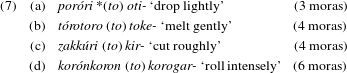
Nasu argues that to is necessary to allow the mimetics to satisfy the four-mora template. Meanwhile, to is not obligatory for mimetics with four or more moras, such as those in (7b–d), which successfully satisfy the template without an additional mora.
Second, to is not omissible from mimetics of any length that have an accent nucleus in their final syllables, as shown in (8). (Syllable boundaries are indicated with periods.)
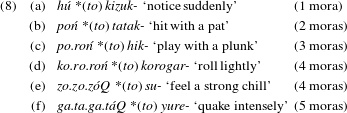
Nasu (Reference Nasu2002: Chapter 4) considers this condition to be an example of the well-known nonfinality constraint (Prince & Smolensky Reference Prince and Smolensky2004), which prohibits a word-final prosodic head (an accented syllable in the present case). Within this view, to saves these mimetics from violating this constraint by adding a syllable after the accented syllable (see also Hamano Reference Hamano1998: 30–32).Footnote [4] The first condition (i.e. the four-mora requirement) can also account for the ungrammaticality of the bare form in (8c) above. However, the four-mora template fails to account for (8a, b), which do not reach the required mora length even with the help of to. Furthermore, only the second condition accounts for the obligatory to-marking on the long forms in (8d–f). Note, however, that this nonfinal-accent condition cannot predict the ill-formedness of (7a), whose accent is on the penultimate syllable (po.ró.ri *(to) ‘dropping lightly’).Footnote [5]Footnote [6] This characteristic is why we need both the four-mora template and the nonfinal-accent condition.
It should be noted that the two phonological conditions have been discussed separately (i.e. for different sets of forms) because the current phenomenon has been assumed to be the addition of to, which is obligatory in the two sets of cases (i.e. (7a) and (8)). On the other hand, we would need only one condition if we consider the phenomenon to be the deletion of to, which applies iff a mimetic has at least four moras and a nonfinal accent (i.e. (7b–d)). This alternative generalization is reasonable in that the bare forms are restricted in terms of distribution: to-marked forms are available to virtually all mimetic manner adverbs. The generalization is also consistent with the historical fact that the mimetic to-marking used to be obligatory, and the particle started to ‘drop’ in the 17th century (Kawase Reference Kawase2006).
3.2 Syntactic condition
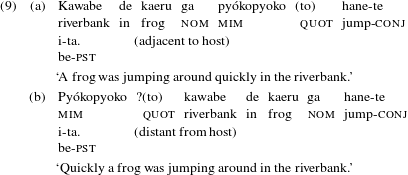
A syntactic condition was noted by Tamori (Reference Tamori1980: 164–166) and then investigated more extensively by Toratani (Reference Toratani, Vance and Jones2006: 416–417, 419). Toratani demonstrated that bare mimetics tend to occur adjacent to their host predicates in the literary corpus. Compare the pair of sentences in (9) below. The bare form of the mimetic adverb pyókopyoko ‘jumping around quickly’ may be slightly more acceptable when it appears adjacent to the host verb hane- ‘jump’, as in (9a), than when it appears at a distance from it, as in (9b).
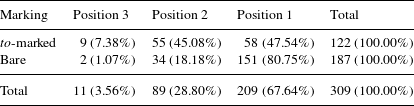
Because the well-formedness contrast here is not evident, Toratani (Reference Toratani, Vance and Jones2006) collected 309 reduplicative mimetic adverbs from eight novels and compared the distributions of to-marked and bare forms in three linear-order phrasal positions of simple sentences: Position 1 (the immediately preverbal position), Position 2 (the next position to the left), and Position 3 (the next). Table 1 (adapted from Toratani Reference Toratani, Vance and Jones2006: 417) presents the results.
The positional distribution of to-marked and bare mimetics in literary works.
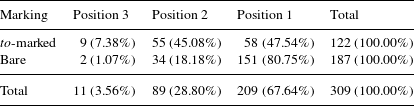
A chi-square test (performed by the present authors) yielded a significant group difference (χ 2(2) = 38.84,  $p<.001$). It was found that bare forms occur more frequently in Position 1 than to-marked forms (adjusted residual = 6.10,
 $p<.001$), which occur more frequently in Positions 2 and 3 (adjusted residuals = 5.10 & 2.93,
 $p$s < .01).Footnote [7] Therefore, we can conclude that the occurrence of bare mimetics is weakly restricted by the adjacency-to-host condition, which is neither a necessary nor sufficient condition.Footnote [8] Note that, again, it is the bare forms that are constrained in distribution. The to-marked forms have a wider distribution.
3.3 Semantic condition
Toratani (Reference Toratani, Vance and Jones2006: 417–419) also proposed the semantic condition. This weak condition states that bare mimetics are more likely to modify their typical (i.e. semantically readily predictable) host predicates than their atypical host predicates. Compare (10a), where the mimetic pyókopyoko ‘jumping around quickly’ modifies the verb hane- ‘jump’, with (10b), where the same mimetic modifies its atypical host, genki-soo-da ‘look lively’.
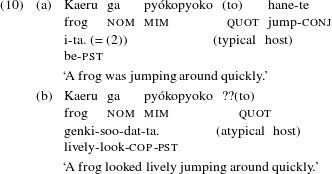
‘Typicality’ here appears to be based on both the semantic relatedness between a mimetic and a predicate (see Section 4.3 below) and their frequency of cooccurrence. In fact, the mimetic for jumping pyókopyoko ‘jumping around quickly’ would preferably be followed by to if it modified the Sino-Japanese verb tyooyaku su- ‘jump’, which is almost synonymous with hane- ‘jump’ but seldom occurs with this mimetic.
To corroborate Toratani’s proposal, Akita (Reference Akita, Shinohara and Uno2013b) conducted a corpus-based examination of the collocability of to-marked and bare mimetics with certain verbs. Akita examined 518 reduplicative mimetics with bimoraic roots (e.g. pyókopyoko ‘jumping around quickly’), which occupy the largest portion of the Japanese mimetic lexicon, from Kakehi et al. (Reference Kakehi, Tamori and Schourup1996). Two corpora – Aozora Bunko (an ‘online library’ that stores more than 10,000 copyright-free literary works, 703 of which (written in contemporary Japanese, 8,370,720 morphemes) were used in the study) and the Nagoya University Conversation Corpus (containing 2,318,134 morphemes from a 100-hour recording of two to four people’s informal conversations) – were used on the online concordancer Chakoshi. (Details of the corpora and concordancer are listed at the end of this paper.) As a result, the mean collocational strength scores (called  $t$-scores) for to-marked and bare mimetics were 2.86 and 3.36, respectively. An unpaired
 $t$-test for the scores revealed that bare mimetics form significantly stronger collocations with particular verbs than do to-marked ones (
 $t$(117) = 2.35,
 $p<.05$). These data support the existence of the semantic condition on the bare realization under discussion.
3.4 Summary
In this section, we have observed the three conditions that strictly or stochastically constrain the occurrence of bare-mimetic forms. As already mentioned, it is likely that the previous literature conceived mimetic to-marking as a phenomenon in which to is added to a mimetic. For example, in the discussion of the phonological condition, to was described as being obligatorily ‘added’ to three-mora mimetics (e.g. poróri ‘dropping lightly’) to satisfy the four-mora template and to mimetics with a stem-final accent (e.g. poń ‘hitting with a pat’) to avoid violating the nonfinality constraint.
In contrast, throughout the previous three subsections, the conditions have been discussed as being applied to the bare realizations of mimetics. This alternative perspective is compatible with the fact that bare mimetics are restricted in their distribution. To-marked mimetics can virtually occur wherever bare mimetics can. The only exceptions are certain ‘demimeticized’ adverbs for degree and frequency, which exhibit strong resistance to to-marking, e.g. dósidosi (??to) ‘unreservedly’, sukkári (??to) ‘completely’, tekkíri (*to) ‘undoubtedly’, tyókutyoku (*to) ‘from time to time’ (see Tamori Reference Tamori1980: 154).Footnote [9] These adverbs have acquired abstract meanings at the expense of a clear mimetic flavor, which results in regular adverbial morphosyntax.
It should be noted that we do not intend to argue that bare mimetics have exceptional (or ‘marked’) status and that to-marked mimetics have default status. On the contrary, as suggested by the total frequency of mimetics in Table 1 above (to-marked: 122 vs. bare: 187), bare mimetics are more common than to-marked ones. Moreover, the occurrence of bare mimetics inclines toward the typical environments of mimetics. First, four-mora mimetics with nonfinal accents, which meet the phonological condition, occupy a large part of the mimetic lexicon of Japanese (see e.g. Nasu Reference Nasu2002: 51). Second, the position adjacent to the verb, for which bare mimetics have a strong preference, is a typical locus for mimetics (Tamori Reference Tamori1980: 166; Toratani Reference Toratani2013; see also Tables 1 and 2 in this paper), or Japanese adverbs in general (Shibasaki Reference Shibasaki2009; Yokota Reference Yokota2011: 387). Third, according to the semantic condition, bare forms prefer the typical hosts of mimetics. These facts are quite iconic in the sense that unmarked morphology (i.e. the bare-mimetic form) tends to occur in unmarked conditions (see e.g. Haiman Reference Haiman1985; see also Fujita Reference Fujita2000: Chapter 2 for the iconicity of to-marked speech quotations).Footnote [10]
The present discussion allows us to argue that the bare form is a constrained but highly established type of realization for Japanese mimetics and that it has an iconic basis. These properties lend strong support for our constructional approach to the ‘optional’ to-marking on mimetics, in which to-marked and bare forms participate in two distinct morphological constructions. This reformulated view is compatible with Toratani’s (Reference Toratani, Vance and Jones2006) interpretation of the syntactic and semantic conditions. As cited below, she posits no operation between bare and to-marked forms, and she attributes a cognitive function to each of them:

Toratani argues that to-marked mimetics introduce conceptually separate events to sentences, whereas bare mimetics further specify the events that are denoted by the host predicates. In the next section, we delve into this direction of analysis from the perspective of Construction Grammar and identify the detailed specifications of the two constructions that are involved in optional to-marking.
4 A constructional account
4.1 Two mimetic constructions
This section presents a constructional account of the mimetic to-marking phenomenon. The morphological constructions that we propose here account for the distributional characteristics of to-marked and bare mimetics in an integrated manner.
First, as we have observed, the bare realization of mimetics is constrained by phonological, syntactic, and semantic conditions, whereas to-marked forms are widely distributed. In the constructional paradigm, the complex conditions of the bare realization can be described with a set of formal and functional specifications, as shown in (11). We propose this morphological construction as another case of quasi-incorporation, which is not limited to noun incorporation in this paper (see Shibatani Reference Shibatani1990: 71 and Rivero Reference Rivero1992 for examples of ‘adverb incorporation’).
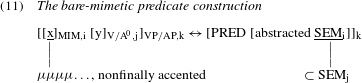
The construction shows that the sequence of a mimetic and a predicate (typically a verb) is linked with the predicative meaning, which is an abstracted version of the eventuality that the mimetic represents. (The syntactic category of mimetics is assumed to be underspecified, as they are always marked morphologically and/or prosodically when they appear in sentences; see Toratani Reference Toratani2013, Usuki & Akita Reference Usuki and Akita2015). The mimetic–predicate sequence is considered a syntactic phrase (XP), rather than a syntactic word (X0), which reflects the weakness of the syntactic condition. In this regard, the present complex predicate construction may be considered an instance of ‘semantic incorporation’, which is arguably not strictly accompanied by syntactic incorporation (van Geenhoven Reference van Geenhoven1998, Takayuki Tohno, personal communication). As indicated in the second line of the constructional description, both formal and functional sides of the construction have further specifications. (The underlines in the first line indicate which parts of the construction have such specifications. This convention is also used in Figure 1 below.) First, the mimetic has a phonological restriction; it must be four or more moras long and initially or medially accented (i.e. the phonological condition). Second, the meaning of the mimetic inherits that of its host predicate; in other words, the former is a kind of the latter (see Akita Reference Akita2012; see also Toratani Reference Toratani2007: 325). This lexical-semantic relationship embodies the semantic condition. For example, in our frog example (e.g. (2)), the mimetic pyókopyoko ‘jumping around quickly’ evokes the specific situation of a small animal hopping around quickly, which is an elaboration of the general jumping event that is denoted by the verb hane- ‘jump’. Note that there is an iconic relationship between the form and meaning of the proposed construction, in which a mimetic and a predicate that are semantically close to one another are realized in a tight structure without an intervening element (see Section 3.4).
Second, the unrestricted distribution of to-marked mimetics is captured by the low specificity of the construction that they instantiate:

As the coindices indicate, this adverbial construction presents the meaning of the mimetic as it is, and the meaning is pragmatically foregrounded. This function appears to be an inheritance from the speech quotation use of to, which is illustrated in (13).

Assuming that onomatopoeia is the basis of mimetics as primarily iconic lexical items, it is not surprising that language treats mimetics as speech, as both onomatopoeia and reported discourse are copies of actual sounds that are distinct from the main utterance (see Kita Reference Kita1997, Fujita Reference Fujita2000, Dingemanse Reference Dingemanse2011; see also Kageyama Reference Kageyama, Frellesvig, Shibatani and Smith2007: 76–78). In fact, the ‘quotation’ of mimetics is a crosslinguistically reported phenomenon. Güldemann (Reference Güldemann2008: Chapter 4) views mimetics as instances of ‘mimesis’, which also covers reported discourse and iconic gestures. Furthermore, the quotative nature of to-marked mimetics is supported by the fact that they are unlikely to occur without their host predicates, as shown in (14) (for related but less conventional cases, see Hamano Reference Hamano1998: 14–15). These examples do not involve quoting and quoted events, which need to be distinguished from one another by quotation markers.
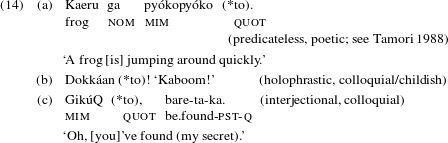
Thus, the quotative construction is fundamental to mimetics, which is consistent with the broad availability of this construction.
We now provide evidence for the constructional specifications of the two types of mimetic realizations. Section 4.2 focuses on the formal specifications of the two constructions and presents additional support for the sequence of a bare mimetic and a predicate as a word-like unit. Section 4.3 identifies the functional specifications of the two constructions. Section 4.4 summarizes the advantages of the present constructional account of mimetic to-marking vis-à-vis a possible derivational account.
4.2 Formal specifications
In Section 3.2, we observed the loose adjacency constraint on bare mimetics and their host predicates. Here, we present four types of data to substantiate the claim that the syntactic condition comes from the morphosyntactic unity of mimetic–predicate sequences: scopal ambiguity, ‘do so’ substitution, word order in transitive clauses, and compounding.
First, some manner adverbs show scopal ambiguity in the preverbal position, but others do not. This can be tested with causativized verbs. Yokota (Reference Yokota2011) observes that the adverbial damat-te ‘silently’ can modify both the verb and the causative suffix -(s)ase, as in (15a), whereas oomata de ‘with vigorous strides’ can only modify the verb, as in (15b).

Mimetic manner adverbs exhibit a similar contrast between their two realizational types. As illustrated by the partially reduplicated mimetic tékipaki ‘working efficiently’ in (16), to-marked mimetics are scopally ambiguous, whereas bare mimetics only modify their host predicates.

This contrast may lead one to conclude that to-marked mimetics are VP adjuncts, but bare mimetics are not (see Koizumi Reference Koizumi and Clancy1993; see also Cinque Reference Cinque1999, Tenny Reference Tenny, Tenny and Pustejovsky2000, Ernst Reference Ernst, Carnie, Siddiqi and Sato2014 for related generative approaches to adverbials). ‘Then what?’ is the question we ask next.
Second, the ‘do so’ test suggests that bare mimetics form a tighter unit with their predicates than do to-marked mimetics. The anaphoric verb complex soo su- ‘do so’ can corefer slightly more easily with the verb part of a to-marked-mimetic predicate than with that of a bare-mimetic predicate, as in (17) (see Toratani Reference Toratani2007: 328 for related data).

This weak contrast can be interpreted in favor of our mimetic construction. The verb hane- ‘jump’ is part of a complex verb in (17b), but not in (17a). As the verbal anaphor cannot target part of a verb, (17b) results in ill-formedness.
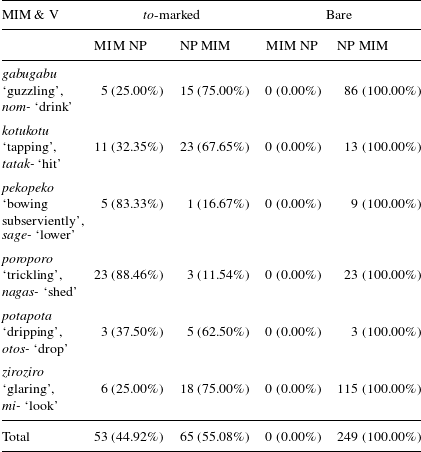
Third, the morphological unity of bare-mimetic predicates receives further support from the fact that they retain their adjacency, even in transitive clauses (see Matsuda Reference Matsuda2000: 67–68 for a related observation). Bare mimetics tend to occur even closer than direct object NPs to their host predicates, as illustrated in (18a), whereas to-marked mimetics precede a direct object more frequently, as illustrated in (18b).
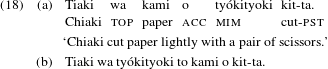
Because it is not self-evident, we confirmed this contrast in Tsukuba Web Corpus via NINJAL-LWP for TWC. Drawing on the collocation data in Akita (Reference Akita2012, Reference Akita, Shinohara and Uno2013b), we searched for six particularly frequent pairs of a reduplicative mimetic and a transitive verb (causative or reflexive). We obtained 367 instances that contain object NPs, which were classified in terms of the form of the mimetic (i.e. to-marked vs. bare) and word order (i.e. MIM NP vs. NP MIM). Table 2 presents the results. (Note that we cannot deny the inclusion of instances of colloquial particle drop in the present Internet data. See fn. 7 above.) We found no single bare-mimetic token followed by an object NP. A chi-square test for the column totals revealed that the bare form has a significant preference for the NP–MIM order (χ 2(1) = 130.72,  $p<.001$).
Fourth, the existence of a few compound nouns that consist of bare mimetics and their typical host verbs (e.g. yotiyoti-aruki ‘toddling (mim-walk)’, zaazaa-buri ‘heavy rain (mim-fall)’) may be considered additional evidence for the bare-mimetic predicate construction (Seizi Iwata, personal communication). Moreover, transitive verbs are slightly more likely than their direct objects to form compounds with mimetics (e.g. ?doa o kotukotu-tataki su- ‘do tap-knocking on the door (door accmim-hit do)’ vs. ??kotukotu doa-tataki su- ‘do door-knocking tappingly’). According to the First Sister Principle (Roeper & Siegel Reference Roeper and Siegel1978), these phenomena confirm the syntactic adjacency of a bare mimetic and its host predicate. Furthermore, compounding appears less likely for atypical mimetic–verb pairs that violate the semantic condition (e.g. ??nikoniko-aruki ‘walking with a smile’), which may reject the possible counterargument that these compounds are derived from to-marked mimetics, rather than bare ones, through the general operation of particle drop in compounding (e.g. booru (*-o)-nage ‘ball throwing (ball-acc-throw)’, Tookyoo (*-ni)-iki ‘Tokyo-bound (Tokyo-dat-go)’).Footnote [11]
All four sets of data reinforce the view that bare mimetics form loose complex predicates with their host verbs, which is the origin of the syntactic condition. The same is not true for to-marked mimetics and their host predicates. The difference between the two types of mimetic structures is expressed by the distinct sets of constructional specifications, as defined above. The bare-mimetic predicate construction, but not the quotative-adverbial construction, involves information about the host predicate.
Word order in transitive clauses.

4.3 Functional specifications
The proposed constructions also have functional specifications. The meaning of the bare-mimetic predicate construction in (11) above corresponds to an abstracted version of the meaning of the mimetic, and the quotative-adverbial construction in (12) above ‘quotes’ the mimetic as a focal element. This subsection clarifies these functional specifications by examining the subtle semantic and information-structural contrasts between to-marked and bare mimetics.
First, to-marked and bare mimetics differ from each other in terms of iconicity (see Hamano Reference Hamano1998: Chapter 2). More specifically, to-marked (reduplicative) mimetics are more likely to represent auditory and iterative events than their bare counterparts, which are more likely to allow non-auditory and continuative meanings. The following pair of sentences illustrates the audibility contrast:
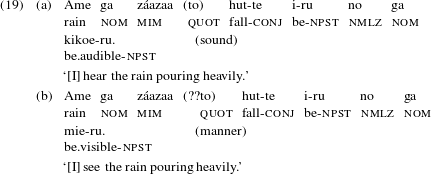
As shown in (19a), the mimetic záazaa ‘pouring heavily’, whose meaning involves both the sound and the manner of a heavy rain, can be followed by the quotative when it clearly refers to the sound. On the other hand, as shown in (19b), to is less likely to occur when the same mimetic is intended to refer to the manner (e.g. when the speaker is watching a silent film or looking at a real scene from a soundproof chamber).
A few mimetics even have distinct meanings in their to-marked and bare forms.Footnote [12] For example, the mimetic battánbattan displays an ambiguity between its sound emission meaning and its more abstract meaning (‘dying or collapsing one after another’), which is considered an ‘extended’ meaning in the cognitive-semantic literature (Lakoff & Johnson Reference Lakoff and Johnson1980, among others). As exemplified in (20b), the latter meaning is not available in the to-marked form (see Akita Reference Akita2013a for a crosslinguistic perspective on this phenomenon).

A similar but less obvious contrast can be observed for aspectuality. To-marked forms favor an iterative (semelfactive) reading, which is highly iconically associated with reduplicative morphology. For example, the mimetic píkapika ‘shining’ is ambiguously iterative and continuative (stative), but the latter reading is less likely when it is followed by to, as in (21b).Footnote [13]

All three contrasts indicate that to-marked mimetics are compatible with higher iconicity when compared with bare mimetics. The latter are more suitable for non-auditory, extended, and continuative semantics. In our framework, these semantic characteristics of the two mimetic structures are represented as their constructional specifications. On the one hand, the quotative-adverbial construction introduces the meanings of mimetics as they are, which results in high iconicity. On the other hand, the meanings of bare-mimetic predicates are more or less abstracted, which is a common semantic feature of incorporation. For example, the incorporated nouns in piano spelen ‘play the piano’ in Dutch and sanpo su- ‘take a walk’ in Japanese (see Section 2 above) do not refer to a specific piano or walk. The meanings of these incorporated elements are abstracted to a general, indefinite level. A similar type of abstraction is achieved in bare-mimetic predicates, which result in less iconic significations, as illustrated above. This abstraction is the semantic basis for our view that bare-mimetic predicates are a (loose) case of quasi-incorporation.Footnote [14]
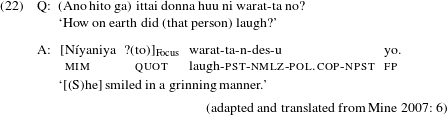
Next, the quotative-adverbial construction has an information-structural specification as a focal element (Toratani Reference Toratani, Vance and Jones2006: 419–420). For example, as Mine (Reference Mine2007) notes, a to-marked mimetic is preferable in an answer to a question about the specific manner of an action.
The notion of focus may also account for the following example, in which only a to-marked mimetic can successfully occur in the focus position (see Toratani Reference Toratani2007: 320).Footnote [15] Note that the violation of the syntactic condition alone (i.e. its occurrence away from the verb hane- ‘jump’) would not cause complete infelicity.

Indeed, to-marked mimetics can also occur outside the focus (e.g. the subordinate clause example in (17a) above). Moreover, this pragmatic feature is also not a sufficient condition of to-marked mimetics. As Toratani (Reference Toratani, Vance and Jones2006: 420) notes, bare mimetics may obtain focus from emphatic prosody. However, the feature constitutes the crucial part of to-marked mimetics or mimetics in general. In fact, the pragmatic foregrounding of mimetics is likely to be a crosslinguistically common phenomenon, as suggested by the previous general characterization of mimetics as ‘dramaturgic’, ‘expressive’, and ‘presentive’ (Kunene Reference Kunene1965, Diffloth Reference Diffloth1972, Hinton et al. Reference Hinton, Nichols and Ohala1994, Voeltz & Kilian-Hatz Reference Voeltz and Kilian-Hatz2001). The fundamental nature of the pragmatic feature is also suggested by the fact that to-marked mimetics have a wide distribution in Japanese. Note that the focus-related data here also serve as additional evidence for the structural unity of bare-mimetic predicates. The low acceptability of the answer with a bare mimetic in (22) above parallels that of a partial coreference with the verb part of a bare-mimetic predicate in Section 4.2. One cannot separately focalize a componential part of a word-like unit.
Thus, the two mimetic structures have their own functional specifications, which are paired with their formal specifications, as confirmed in Section 4.2. These specifications together define the two morphological constructions proposed in Section 4.1. In this constructional view, the ‘optionality’ of mimetic to-marking can be accounted for as a consequence of the availability of both constructions to mimetics that satisfy the phonological requirements.
4.4 Summary
In this section, we have discussed the constructional specifications of the two mimetic structures that are involved in the optional mimetic to-marking. We conclude the section by summarizing the two major advantages of the present constructional view over a derivational view in general.
First, the bare-mimetic predicate construction captures its semantic non-compositionality. Two instances of non-compositional semantics are worth noting. One is the inheritance relation between a bare mimetic and its predicate, which is realized as the semantic condition. The relation is predictable neither from the to-marked counterpart of the mimetic nor from its wide range of host predicates. The other instance of non-compositionality is the weakened iconicity (i.e. non-auditory, extended, and continuative semantics) of bare-mimetic predicates, as discussed in Section 4.3. If we took a derivational approach, we would posit a semantic abstraction effect for the deletion of to, which changes the aspectuality of a mimetic in one case (e.g. píkapika ‘shining in a blinking manner’ → ‘shining bright’ in (21) above) but metaphorically extends its meaning in another (e.g. battánbattan ‘falling down with a bang’ → ‘dying or collapsing one after another’ in (20)). The specific type of semantic abstraction is not predictable. In contrast, our constructional approach does not attribute the meaning of a bare mimetic to its to-marked counterpart. The speaker selects the bare-mimetic predicate construction when s/he intends to use the mimetic (and its host predicate) for an abstract meaning – non-auditory, extended, or continuative. The construction itself does not determine the specific type of abstract meaning.
Second, the two constructions have high productivity, which even allows the speaker to create innovative instances. For example, the non-existing mimetic for laughing/smiling pórapora would depict different aspects of a laughing/smiling event with these two structures. The bare-mimetic predicate pórapora waraw- is understood to represent the manner of laughing or smiling, whereas the quotative instance pórapora to waraw- is understood to mimic the laughter. (The verb waraw- is vague between ‘laugh’ and ‘smile’.) Likewise, the innovative mimetic myúromyuro would more likely mean a continuative shine in myúromyuro hikar-, but an iterative shine in myúromyuro to hikar-. These semantic contrasts between to-marked and bare mimetics can be attributed to the two constructions themselves. Furthermore, the mimetic núrunuru ‘slimy’ has recently acquired the meaning ‘moving as smoothly as computer graphics (of an animation character)’, primarily in webspeak. From its outset (circa 2007), this new use has been predominantly found in the bare form of the mimetic, immediately followed by the verb ugok- ‘move’. A Google search with the date filter (1 January 2007 through 31 December 2007; accessed 21 September 2014) yielded a sharp contrast between núrunuru ugok-u (178 hits [91.75%]) and núrunuru to ugok-u (16 hits [8.25%]). This phenomenon is attributable to the fact that the denoted movement is continuative, rather than iterative, which fits the constructional meaning of the bare-mimetic predicate construction. A derivational approach that posits the deletion of to would face a difficulty in capturing the semantic systematicity of these expressions in the absence of these mimetics in the input (see Tsujimura Reference Tsujimura, Rainer, Gardani, Luschützky and Dressler2014 for a constructional account of innovative mimetic su-verb uses).
Thus, incorporating all three conditions found in the literature, the two constructions give a specific content to Toratani’s (Reference Toratani, Vance and Jones2006) view of the two mimetic structures cited in Section 3.4 above. Contrary to the modular view of morphology, the two structures have distinct functions, and their non-compositional and productive nature fits the constructional view. In the next section, we provide further characterization of the bare-mimetic predicate construction by comparing it with two more mimetic quasi-incorporation constructions in Japanese from the viewpoint of mimetic typology.
5 Discussion: Three types of mimetic quasi-incorporation
The previous section argued for the constructional status of bare-mimetic predicates as loose cases of quasi-incorporation. In this section, we discuss two more quasi-incorporation constructions that involve Japanese mimetics – the ‘say’-construction and the ‘do’-construction – and place the bare-mimetic predicate construction in the general context of mimetic morphosyntax.
The two morphological constructions are ‘constructional idioms’, which have both lexically fixed and lexically open positions (Jackendoff Reference Jackendoff1997). First, as Toratani (Reference Toratani2015) discusses, the verb iw- ‘say’ productively forms complex intransitive verbs with bare sound-mimicking mimetics. Mimetic iw-verbs have stronger cohesion than bare-mimetic predicates, as illustrated by the low acceptability of the preposed bare mimetics in (24b) and (25b).

Because mimetic iw-verbs basically denote sound emission, they are not available to mimetics for non-auditory events (e.g. *pyókopyoko iw- intended: ‘jump around quickly’). However, as Toratani (Reference Toratani2015) observes, iw-verbs can express both animate and inanimate beings’ sounds, as illustrated, respectively, by (24a) and (25a) above. This animacy-neutrality is not predictable from the meaning of the base verb iw- ‘say’, which is limited to verbal sound. Thus, the structural tightness and the semantic non-compositionality of iw-verbs allow us to posit a quasi-incorporation construction for them that is tighter than the bare-mimetic predicate construction.
Second, su- ‘do’ can follow various types of mimetics to form complex verbs with low transitivity (Tsujimura Reference Tsujimura, Fried and Boas2005, Kageyama Reference Kageyama, Frellesvig, Shibatani and Smith2007). Mimetic su-verbs are even more tightly knit than iw-verbs, as illustrated in (26) and (27).
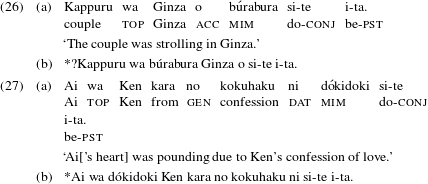
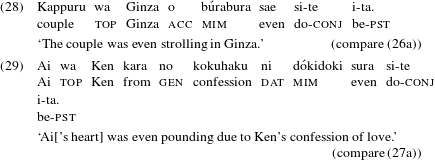
However, similarly to the VN su-compounds illustrated in Section 2 above, focus particles may split the strings, as in the following counterparts of (26a) and (27a), respectively (Kageyama Reference Kageyama, Frellesvig, Shibatani and Smith2007: 79).
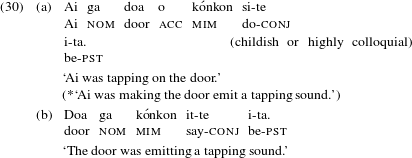
Mimetic su-verbs are essentially formed by mimetics with more or less abstract meanings, and they are not possible for sound-mimicking mimetics (e.g. *píyopiyo su- ‘tweet’) and some other ‘highly iconic’ mimetics (e.g. *tóbotobo su- intended: ‘plod’) (Akita Reference Akita2009). Sound-mimicking mimetics that clearly evoke physical contact events may indeed form su-verbs, especially in babytalk, although they do not depict sound emission itself but represent the contact events, as illustrated in (30a). In contrast, the iw-verb in (30b) purely depicts the sound emission.
These features characterize mimetic su-verbs as even tighter instances of quasi-incorporation (for a syntactic comparison between mimetic su-verbs and VN su-verbs, see Kageyama Reference Kageyama2005). The relatively low iconicity of the mimetics involved defines the semantic side of this third construction.
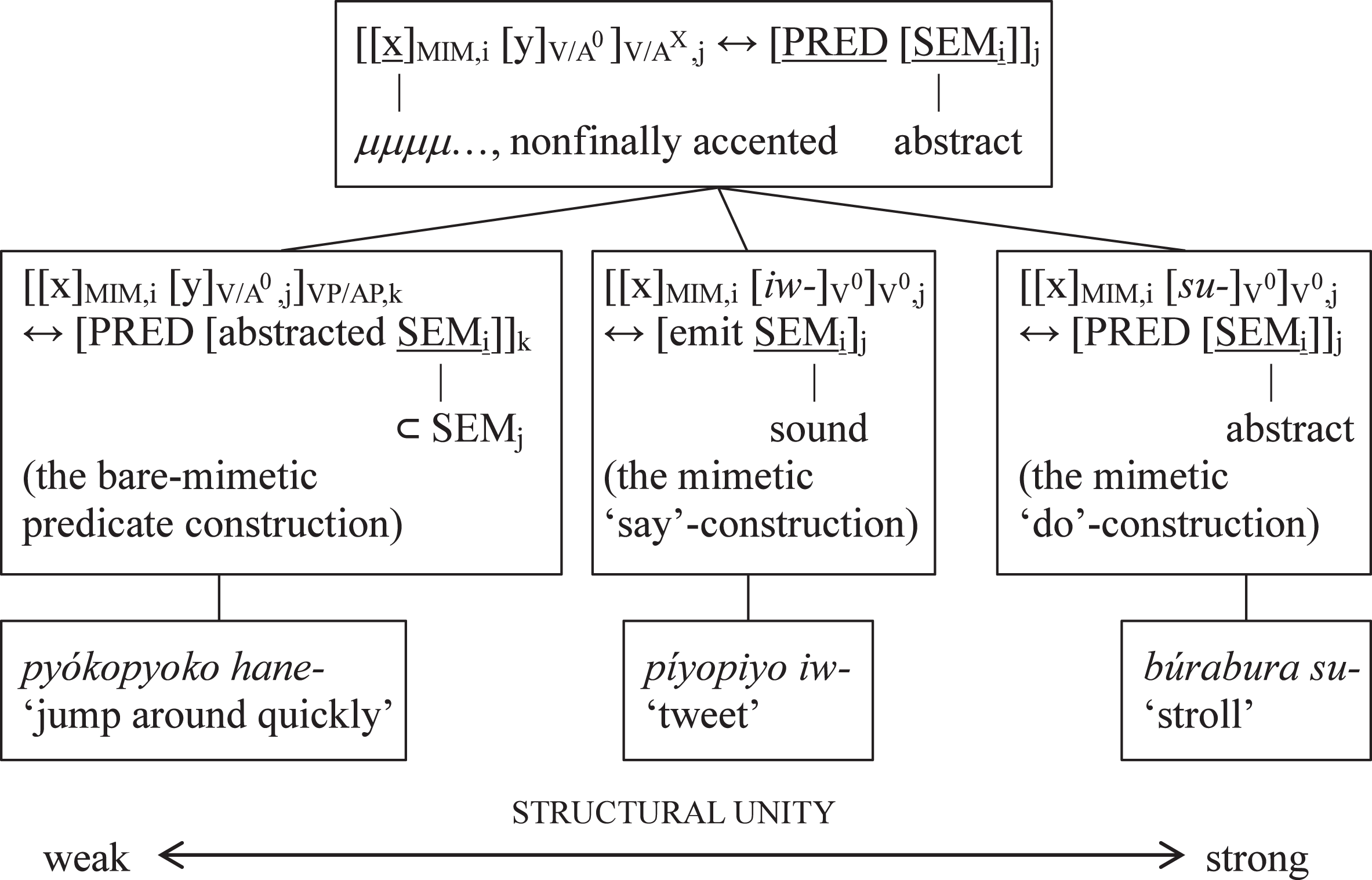
The present discussion has shown the existence of three quasi-incorporation constructions in Japanese mimetics. The three constructions can all be viewed as productive strategies for enabling mimetics to predicate sentences with a more or less abstract meaning (see Goldberg Reference Goldberg, Francis and Michaelis2003 for a related constructional account of Persian complex predicates). Bare-mimetic predicates involve a type of semantic abstraction (see Section 4.3 above). Mimetic iw-verbs are also abstracted in that they are free from the animacy restriction. Mimetic su-verbs are only available to mimetics with an abstract meaning. As in Figure 1, a superschema that subsumes the three constructions represents this generalization. (Each construct(ion) is boxed for the sake of clarification.) The syntactic unit of the superschema is either X0 or XP (labeled ‘V/AX’).
Mimetic quasi-incorporation constructions in Japanese.
As shown in the figure, the three constructions differ from each other in function and form. First, only the iw-construction produces sound-emission predicates by foregrounding the sound information involved in the meanings of mimetics (e.g. píyopiyo ‘tweeting’ → píyopiyo iw- ‘tweet’; kónkon ‘tapping’ → kónkon iw- ‘emit a tapping sound’). Accordingly, iw-verbs are all intransitive, and only mimetics with an auditory component can participate in the construction. On the other hand, the event types of bare-mimetic predicates and su-verbs crucially depend on those of mimetics. The two constructions foreground the ‘predicative’ meaning that is already prominent in the semantics of mimetics (e.g. pyókopyoko ‘jumping around quickly’ → pyókopyoko hane- ‘jump around quickly’; búrabura ‘strolling’ → búrabura su- ‘stroll’). The su-construction is more constrained in that it does not allow high transitivity (e.g. *bókiboki su- intended: ‘break (something) with a cracking sound’; compare bókiboki or- ‘break (something) with a cracking sound (mim make.break)’). Moreover, the fact that the su-construction is not available for highly iconic mimetics, including most sound-mimicking mimetics, suggests that the iw- and su-constructions are in near-complementary distribution (see Amha Reference Amha2001: 53 for a somewhat similar situation in Wolaitta).
Second, the three constructions have different degrees of structural unity, which is an important fact that is related to the typology of mimetic morphosyntax. Recent studies have found that mimetics are integrated into the language structure to various degrees within and across languages (Kita Reference Kita1997, Hamano Reference Hamano1998, Tamori & Schourup Reference Tamori and Schourup1999, Akita Reference Akita2009, Dingemanse Reference Dingemanse2011). For example, Dingemanse (Reference Dingemanse2011: Chapter 6) argues that Siwu mimetics can occur both as morphosyntactically ‘free’ elements (e.g. holophrases, adverbs) and as ‘bound’ elements (e.g. predicates), and ‘free’ mimetics are more subject to expressive features, such as emphatic morphology and intonational foregrounding. Dingemanse discusses this phenomenon in light of the degree of ‘system integration’ in mimetics. In his ‘depiction’ theory, mimetics lose their special semiotic mode as a function of their morphosyntactic integration into the sentence, which makes the mimetics less mimetic and less furnished with special formal features. The present discussion of the three types of mimetic complex predicates gives this model a more detailed image based on a well-defined set of constructional specifications. Structural unity in our terms corresponds to system integration in the depiction theory. Therefore, the three quasi-incorporation constructions can be regarded as strategies for system integration, and – referring to Figure 1 above – the degree of integration increases from left to right.
This view leads us to an important revision of the traditional categorization of Japanese mimetics. As we mentioned in Section 1, Japanese mimetics are primarily realized as adverbs. In the traditional view, to-marking has been assumed to be an optional phenomenon in adverbial mimetics, as in (31a) below. ([MIM iw-] is not included in (31a) because it had not received serious attention before Toratani Reference Toratani2015.) In contrast, the present study has revealed that a crucial distinction should be made between to-marked mimetics and the rest, as in (31b), as the quotative-adverbial construction is a special device that connects mimetics with the rest of a sentence with a minimum loss of their imitative semiotics. As discussed above, this alternative categorization is also more consistent with the system integration typology.

6 Conclusion
In this paper, we have reformulated the conditions that pertain to the quotative marking on Japanese mimetic manner adverbs and have proposed that they can be straightforwardly accounted for with two morphological constructions: the bare-mimetic predicate construction and the quotative-adverbial construction. In this constructional account, we ascribed the ‘optionality’ of the quotative particle to the fact that a set of mimetics can participate in both constructions. Moreover, the bare-mimetic predicate construction is characterized as a quasi-incorporation construction that is looser than the other two productive mimetic quasi-incorporation constructions (the iw- and su-constructions). All three constructions illustrate strategies for the morphosyntactic integration of mimetics into sentence structure, which is common across languages. These constructions are contrasted with the quotative-adverbial construction, which ‘quotes’ mimetics as mimetics (Section 4.3).
We conclude this paper by noting two possible extensions of the present study. First, the semantic condition on bare-mimetic predicates is reminiscent of the cooccurrence restriction on mimetics and verbs in many other ‘mimetic-rich’ languages, including those in Africa (Childs Reference Childs1994: 188–189; Johnson Reference Johnson1967: 243; Schaefer Reference Schaefer2001: 343), Australia (Alpher Reference Alpher1994: 167–168), and Southeast Asia (Watson Reference Watson2001: 392). A similar restriction is found for obligatorily to-marked mimetics in Japanese (i.e. those with three moras or a stem-final accent). For example, the to-marked mimetic koróQ to ‘rolling once’ forms a strong collocation with the verb korogar- ‘roll’. In this sense, the optional to-marking discussed in this paper can be regarded as a morphological signal of the general typical–atypical distinction of mimetic predicates. Thus, similar investigations in those languages may shed more light back on this language-specific issue.
Second, the present constructional account suggests the applicability of Construction Grammar to other cases of optional morphology, such as the case marker drop (Kuno Reference Kuno1973), verbal suffix omission (Nesset & Makarova Reference Nesset and Makarova2012), cliticization (Stateva Reference Stateva2002), and reduplication (Rackowski Reference Rackowski1999) in certain languages. We hope that the current focus on a tiny particle on ‘peculiar’ lexical items has successfully presented potentially far-reaching suggestions about morphology, grammatical constructions, and, of course, mimetics.