The self is always predicted on difference, on the positioning of an ‘other’ who serves to render the uniqueness and superiority of the self. (Jones Reference Jones2012, p. 20)
Friday, 22 July 2011 will always be remembered as one of the darkest days in Norwegian history. In the course of one afternoon an ethnic Norwegian maleFootnote 1 singlehandedly carried out the worst attacks on Norwegian soil since WWII. The bomb that went off outside the government building in downtown Oslo and the shootings at AUF's (the Labour Youth Party's) summer camp on the island Utøya killed 77 persons in total. Through his manifest and during the trial the following year the terrorist claimed defence of self, believing that Norway was at the brink of an Islamic takeover. Moreover, in his view, any idea supporting notions of cultural diversity would threaten to overthrow a ‘pure’ Norwegian culture and should therefore be fought against using any means possible (Indregard Reference Indregard2012).Footnote 2 The public response to the horrifying attacks and his extremist stance gave way to manifold reactions, joined together by a shared belief in community across ethnic, religious and sociocultural differences. Prime Minister Jens Stoltenberg's repeated call to face terror with ‘more openness, democracy and tolerance’Footnote 3 and a young girl'sFootnote 4 famous tweet ‘If one man can show so much hate – imagine all the love we can show together’ (Aagedal et al. Reference Aagedal, Botvar and Høeg2013) are two examples of many illustrating this. In the days and weeks that followed 22 July, a wide range of public gatherings, memorial services, secular and religious mourning ceremonies and concerts were guided by the necessity to rebuild notions of community through inclusion (Aagedal et al. Reference Aagedal, Botvar and Høeg2013). However, the aftermath of 22 July also sparked off debates on the mechanisms of exclusion operating through underlying homogeneous notions of Norwegian culture and ‘Norwegianness’, and the need to re-examine contemporary conceptions of community both in relation to recent societal changes and as a historical and political construction (Indregard Reference Indregard2012; Aagedal et al. Reference Aagedal, Botvar and Høeg2013).
Norway, compared with many other Western countries, is a relatively young nation-state that achieved independence as late as 1905. However, distinct ideas of a national identity started taking shape nearly 100 years earlier, when 400 years of political union under Danish authorityFootnote 5 were replaced by Sweden as the new ruling power between 1814 and 1905. During the 1800s, notions of ‘Norwegianness’ became strongly intertwined with matters of family descent and the idea of a shared ‘Norwegian’ culture, which was clearly driven by the nationalist resistance movement in order to mark a difference towards governing authorities (Hylland Eriksen Reference Eriksen1994; Gullestad Reference Gullestad2002; Opsahl Reference Opsahl2012).
Thomas Hylland Eriksen and Torunn Arntsen Sajjad offer critical discussions on ‘Norwegianness’ (Eriksen and Sajjad Reference Eriksen and Sajjad2006) by investigating how the ‘invention of Norway’ (Eriksen and Sajjad Reference Eriksen and Sajjad2006, p. 91) was centred upon images of nature and traditional peasant life. Hylland Eriksen and Sajjad argue how the Romantic Movement's heightened attention to nationalism in poetry and folk tales, visual arts, traditional folk music and the construction of a new national language – termed ‘New Norwegian’Footnote 6 – gained huge significance in the negotiation of ‘a national symbolic sphere’ (Eriksen and Sajjad Reference Eriksen and Sajjad2006).Footnote 7 Paradoxically, the authors observe, while notions of national identity were rooted in rural traditions, these ideas were largely fronted by urban citizens, residents of Bergen (West Norway) and Oslo (East Norway). This illustrates the political dimension of the nation-building project, in which continental urban lifestyles were played down while the particularities of Norwegian rural and folklore traditions were marked as the ‘authentic’ culture (Eriksen and Sajjad Reference Eriksen and Sajjad2006).
Bergen-born composer Edvard Grieg epitomises this dualism through his musical identification with the Germanic style,Footnote 8 which was channelled into National-Romantic compositions inspired by Norwegian folk music. Susan McClary (Reference McClary and Solomon2011) depicts the cosmopolitan dimension of Grieg's work, arguing that ‘he sought to bridge the divide between the international style and community on the one hand, and the Norwegian national identity-formation on the other’ (McClary Reference McClary and Solomon2011, p. 90). In this way, Grieg's role in the nation-building project illuminates Martin Stokes’ argument that ‘[it] takes a musical cosmopolitan … to develop a musical nationalism, to successfully assert its authenticity in the sea of competing nationalisms and authenticities’ (Stokes Reference Stokes2007, p. 6). Thus, it might be concluded that, while grounded in concrete political and cultural struggles, constructed notions of ‘authentic culture’ over time become articulated as traditions or shared identities and values through unmarked notions of the dominant culture.
In her critique of more recent public conceptions of ‘Norwegianness’, Marianne Gullestad (Reference Gullestad2002) points out how traditional notions of national identity were re-actualised in terms of responses to and resistance against the mass immigration from the mid-1960s and beyond. It was at this point in time that Norway would experience, for the first time, significant immigration from non-Western countries. Once again, descent and cultural heritage became crucial elements in the negotiation of national identity, which on many accounts would be used in order to reaffirm the cultural hegemony of the dominant ‘ethnic Norwegian’ population. Gullestad's employment of ‘ethnic Norwegian’ – a term not without its problems although widely used in the Norwegian general public and media debates (Gullestad Reference Gullestad2002, p. 286) – underlines her considerations of Norway as a nation state ‘still in the making’ (Gullestad Reference Gullestad2002, p. 21).
Drawing on Gullestad, I activate the term ‘ethnic Norwegian’ to refer to the dominant, white majority population in Norway. This is based on a complex set of arguments. First, the discourse on ethnicity in the Norwegian general public reveals an ongoing need to affirm notions of national belonging within the dominant population. Secondly, it discloses how ethnic dividing lines are strategically drawn through the division of ‘ethnic Norwegians’ and ‘non-ethnic Norwegians’. Thirdly, it shows how issues of nationhood go beyond questions of citizenship, when considering how ‘ethnic Norwegian’ is established as the key marker of what Hylland Eriksen terms ‘metaphoric kinship’ (Eriksen Reference Eriksen1994). According to Hylland Eriksen, a metaphoric kinship is based on notions of a social identity that is ‘essentially distinctive from members of other groups of whom they are aware of and with whom they enter into relationships’ (Eriksen Reference Eriksen1994, pp. 16–17).
Ethnicity, then, from a nation-building perspective, has had a significant role in the establishment and development of a sovereign nation-state and in the mediation of an imagined community. As argued by Benedict Anderson, a nation is imagined as limited (Anderson Reference Anderson1983, p. 7), which constitutes a central premise for the construction of a nation-state that inevitably implies mechanisms of exclusion. The history of Norway is no exception. The assimilation politics directed towards the indigenous Sami people up until the mid-20th century are one example of how notions of national homogeneity have been forced upon various peoples and citizens on the basis of ethnicity, culture and/or religion.Footnote 9
Adding to issues of ethnicity, the religious underpinnings of ‘Norwegianness’ should not go unnoticed. The historically close relationship between the state and the Evangelic-Lutheran Church of Norway is an important aspect related to questions of ‘a national symbolic sphere’. Dating back to 1537 during the Danish-Norwegian union, and constituted as the state religion up until 2012,Footnote 10 the Church of Norway has strongly informed notions of ‘common values’ within Norwegian society. In this way, Christian thought has laid significant premises for the constitution, the educational system and also informed the public debate on other religious communities (Gullestad Reference Gullestad2002; Leirvik and Røthing Reference Leirvik and Røthing2008). An example of this is found in the heated debate on integration in Norway, where to a large extent Muslims have been marked out as the group most reluctant to accept ‘Norwegian values’ (Gullestad Reference Gullestad2002, p. 95). Gullestad argues that this debate is dominated by a rhetoric grounded in a ‘secularized Christian-Protestant language’ (Gullestad Reference Gullestad2002, p. 99), implying that Muslims are ‘a matter out of place’Footnote 11 (Gullestad Reference Gullestad2002, p. 102) in a Norwegian context. Hence, by positioning Muslims as the ‘other’, the ‘uniqueness and superiority of the [Norwegian] self’ (Jones Reference Jones2012, p. 20) is reaffirmed despite destabilising demographic changes in society. From this it becomes evident that the negotiation of ‘common values’ operates both on an individual and a collective level, informing questions of human agency and the larger structures of society. Thus, one might suggest that being or becoming Norwegian is highly dependent on how individuals or groups ‘fit into’ the limited space of ‘Norwegianness’. In the wake of post-1960s demographic changes and increasing cultural and religious diversity, notions of a ‘national symbolic sphere’ need to be readdressed and re-examined, particularly when it comes to notions of community and shared values.
In tackling such arguments, Norwegian sociologist Lars Laird Eriksen (Reference Eriksen, Leirvik and Røthing2008) notes that notions of a homogeneous society need to be contested when acknowledging ethnic, cultural and religious diversity in a contemporary setting. His suggestion is to shift the focus from a community of shared values to a community of disagreement. Eriksen states that ‘the idea of Norway as a community of values is a rhetorical myth’Footnote 12 (Eriksen Reference Eriksen, Leirvik and Røthing2008, p. 136). This has parity with Gullestad's critique of ‘Norwegianness’ based on ‘common values’. Eriksen's position involves questioning the rhetorical use of ‘value’ in the curriculum of the Norwegian educational system, which is attached to identity constructions, and thereby functions as a tool for setting up boundaries between ‘us’ and ‘them’ within society. By introducing the concept of a ‘community of disagreement’, Eriksen argues for a shift from ‘value’ understood as a marker of ‘substantial values’ through shared identity constructions towards a concept of value that acknowledges ‘disagreement’ as a basic condition for a shared community based on interaction (Eriksen Reference Eriksen, Leirvik and Røthing2008, p. 134). Eriksen's argument prompts a rethinking of static notions of national identity, which harks back to Gullestad's claim to ‘listening to those who resist the identities offered to them’Footnote 13 (Gullestad Reference Gullestad2002, p. 308). Following Gullestad, then, what is needed is a ‘mutual active listening’ that enables us to develop a larger sense of ‘social musicality’Footnote 14 (Gullestad Reference Gullestad2002, p. 308). A critical perspective on ‘Norwegianness’ is therefore relevant in order to reveal how identity politics are negotiated sociohistorically and how notions of ethnicity, cultural heritage and belongingness might be brought into question through musical performance.
Forging national identity through music
In their reading of musical and televised constructions of Canadian nationhood, Susan Fast and Karen Pegley (Reference Fast, Pegley and Hawkins2011) deploy Ian Angus’ three steps of ‘forging national identity’, which they refer to as: ‘distinguishing a nation's inside from its outside’ (sameness/difference); ‘the rhetoric of the nation’ (symbolic markers such as national flags, national costumes, language, etc.); and ‘a national actor acting out national identity’ (Fast and Pegley Reference Fast, Pegley and Hawkins2011, p. 368). This three-part perspective serves as a starting point for the authors’ analysis of the post-9/11 benefit concert Music Without Borders: Live, which centres around debates concerning the ways in which musical performance became intertwined with the ‘rhetoric of the nation’ – both in the United States and in Canada – in the aftermath of the terrorist attacks in 2001. To this end, Fast and Pegley scrutinise how the benefit concert held in Toronto, Canada reveals crucial aspects of the politics of representation, by showing how choices of musical genres and artists reflect some general ideas of what is considered to be ‘national music’ (Fast and Pegley Reference Fast, Pegley and Hawkins2011). The categorisation of ‘national music’ helps define music and musicians who are on the ‘inside’, thereby implying what music constitutes the ‘outside’. Hence, the authors demonstrate that the mechanisms of inclusion and exclusion are staged through ‘acting out national identity’ in musical performance. This position concurs with Stan Hawkins' (Reference Hawkins2002, p. 13) observation that ‘only by identifying what someone is, is it possible to say what they are not’. Critical of the binarism that shapes sameness and otherness, Hawkins’ approach to identity politics in popular music wrestles with the discursive possibilities implicit in categories and stereotypes, where ‘identity might be considered as flexible and free-floating and not divided into clear-cut groups’ (Hawkins Reference Hawkins2002, p. 13). This position shares much in common with Stuart Hall's views on identity as ‘meeting points’, which he considers ‘point of temporary attachment to the subject positions which discursive practices construct for us’ (Hall Reference Hall, Hall and Gay1996, pp. 5–6).
Hawkins’ more recent notions on articulations of subjectivity in pop performance are informed by considerations of how ‘social identities are spectacularized musically’ (Hawkins Reference Hawkins2009, p. 39) through the ‘audiovisual display of the performers’ (Hawkins Reference Hawkins2009, p. 41). Theorising the central positioning of individual agency, he underlines how collective perspectives are crucial for pointing out the inextricable links between popular music and sociocultural contexts. With a focus on the audiovisual framing of popular music, Hawkins argues for readings of popular music based on analyses that take into account a wide range of aesthetic representations. Representational politics form the basis for understanding audiovisual display whereby the performer becomes a focal point for the conceptualisation of ‘pop identification’ (Hawkins Reference Hawkins2009, p. 41). According to Hawkins, the ‘audiovisual display of performers’ involves a threefold perspective; this includes the ‘profiling of biography’, the ‘audiovisual text’ and the ‘recording’. Paying attention to these ‘aspects of representation’ (Hawkins Reference Hawkins2009, p. 41) would possibly disclose the way in which representational politics gets entangled with discourse, which in turn opens up the interpretation of meaning(s). Emanating from this is the challenge of ‘reading the pop score’, a process involving attention to individual subject positioning, agency and collective framings. Hence, the production and consumption of popular music is constructed dialogically, through the juxtapositions of compounded subject positioning, texts and contexts. In a Bakhtinian sense this displays the polyphonic aspects of the processes through which meaning is constructed, negotiated and mediated on a broad scale. Positioned at centre stage, the display of the performers becomes a main site for identification, which relates to the ways in which self-fashioning is mediated through both public discourse and musical performance (Hawkins Reference Hawkins2009, p. 34). Self-fashioning, then, according to Hawkins, operates through aestheticisation and involves the ways in which ‘subjectivity is shaped by musical codes that draw on the spectacle of the body’ (Hawkins Reference Hawkins2009, p. 34).
Drawing on Hawkins’ dialogic and hermeneutically informed approach to audiovisual texts, I provide two readings of Karpe Diem's ‘Byduer i dur’ in order to achieve two central objectives. First, to uncover how, through audiovisual display, the spectacle of ‘otherness’ might be considered alongside aspects of ethnicity, cultural belonging and national identity within a Norwegian context. Secondly, to argue that identity is constructed as flexible and free-floating, whereby interpretations lead to reflection on negotiations of ‘difference’ in popular music, and how this provides an opportunity to reconsider notions of ‘Norwegianness’. In proposing a ‘decentred approach’ (Hawkins Reference Hawkins, Biddle and Knights2007, p. 179), the following discussions take up Hawkins’ challenge to expose asymmetrical dualisms attached to identity formations in order to understand how notions of nationhood might be negotiated through musical expression (Hawkins Reference Hawkins, Biddle and Knights2007, p. 179). This involves considerations of how ‘difference’ is represented, negotiated and displayed within a national context.
Karpe Diem and the spectacle of otherness
With Indian, half Arabic and half Norwegian descent, no wonder their [Chirag and Magdi's] worldview is somewhat different from the rest of the Norwegian music scene. A Hindu and a Muslim coming from Oslo's west side, raised by immigrant/refugee parents, and grown up in apartment blocks; this is not what one would expect.Footnote 15
Highly successful and critically acclaimed, Karpe Diem is an Oslo-based rap groupFootnote 16 founded in 2000 by two young rappers, Magdi Omar Ytreeide Abdelmaguid and Chirag Rashmikant Patel (Magdi and Chirag from now on)Footnote 17 . The former is the son of a Norwegian mother and Egyptian father, while the latter has Indian parentage. Both artists are Norwegian citizens, yet of non-Western descent. As the quote above illustrates, the group's artistic identity is partly constructed by juxtaposing Chirag and Magdi's ethnic ‘otherness’ with their personal backgrounds: both grew up on the west side of Oslo, the affluent, prosperous part of the city that has statistically the least number of non-Western immigrants.Footnote 18 Throughout their career Chirag and Magdi have repeatedly addressed issues of ethnocultural complexity through notions of doubleness,Footnote 19 which is particularly evident in the opening line from the 2010 hit ‘Tusen tegninger’ (Thousands of Drawings): Er både svart og hvit, er både glad og trist / Han så på passet mitt og kasta blikket og traff meg (Both black and white, both happy and sad / He checked my passport and threw a glance and it hit me).Footnote 20 Here, a sense of ordinariness attached to the song character's mixed ‘racial’ identity is motivated by the everyday experience of emotional ups and downs, but becomes ‘a matter out of place’ when juxtaposed with the character's passport. By implying a discrepancy between physical appearance (skin colour) and citizenship (Norwegian), these lines disclose how many Norwegians are actually ‘not Norwegian enough’. In other words, the character's mixed identity becomes a ‘problem’ when attached to notions of nationhood. On being awarded the prize ‘Musicians of the Year 2010’ at the annual Norwegian music award Spellemannsprisen,Footnote 21 Karpe Diem was praised in editorial comments by the commercial Norwegian television station TV2, which purported that ‘their multi-cultural background and openness on aspects of “differences” have turned Karpe Diem into important role models’.Footnote 22 Hence, this would serve as yet another example of how ethnocultural complexity is closely intertwined with constructions of artistic identity through self-fashioning in Karpe Diem.
It would be less than half a year later that the terrorist attacks on 22 July would leave the nation stunned. Again, Karpe Diem's compounded identity came to the fore as they were selected to perform at the first Memorial Concert, held in Oslo Cathedral on 30 July. Notably, the group performed two songs from the 2010 album Aldri solgt en løgn (Never Sold a Lie) at the event: starting off with ‘Byduer i dur’ (City Pigeons in Major Key),Footnote 23 their much acclaimed and highly successful homage to the city of Oslo, and then closing their act with ‘Tusen tegninger’ (Thousands of Drawings), a song Magdi introduced as ‘a song about tolerance. [It's] about being young and religious and young and Muslim’.Footnote 24 Whereas the live version of the latter remained quite close to the recorded song (it had been rearranged for the Norwegian Radio Orchestra, but was played in approximately the same tempo and performed with the same musical expression), ‘Byduer i dur’ had undergone quite dramatic changes, compared to the musical style, lyrics and the performers’ vocal and physical gestures in the music video performance, released only one year earlier.
Byduer i dur
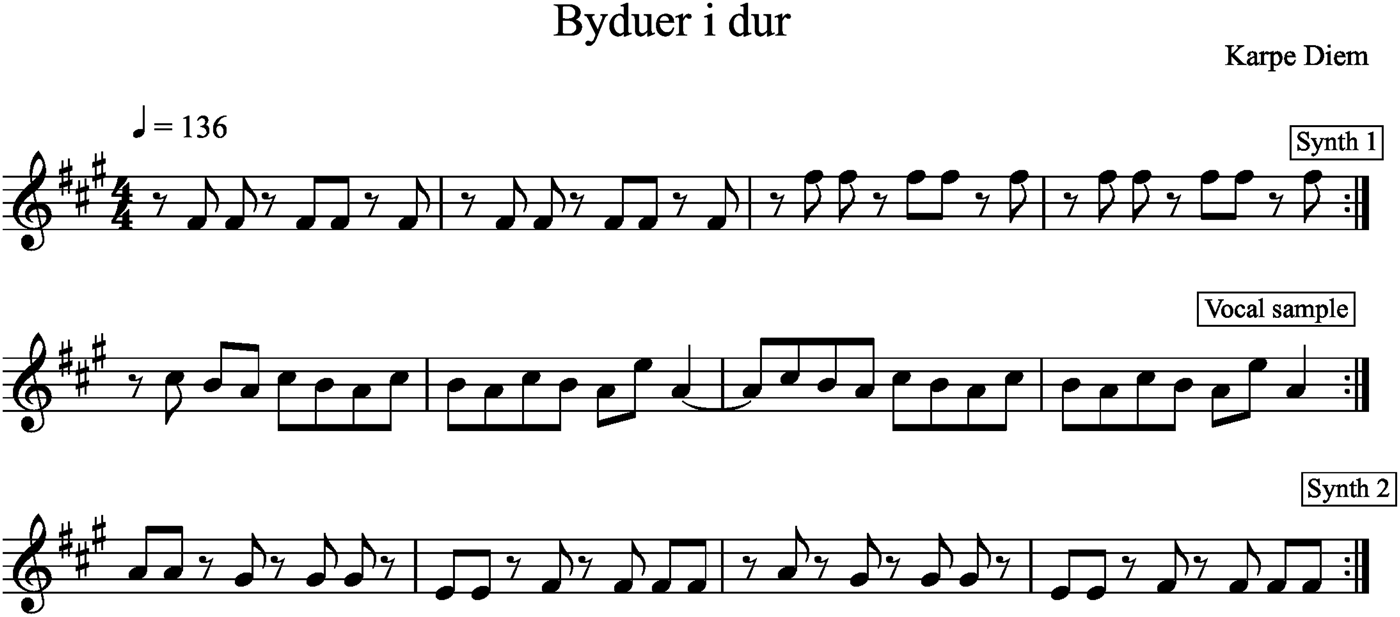
In the recording featured on the music video Byduer i dur,Footnote 25 the combination of up-tempo breakbeat grooves, densely layered and digitally produced sounds and catchy melodic refrains define the genres of rap, pop and EDM. Stylistic musical innuendos are paralleled in the lyrics, with the juxtaposition of boastful statements, such as Jeg kaller meg hovedmann i hovedstaden (I'm the main man of the capital). Poetic personifications of urbanity occur in the lines Hun [byen] sang for meg / Klokkene fra bysykkelen og kirka (She [the city] sang to me / The bells from the city bikes and the church), while the repeated invitation to Syng Oslo [Sing Oslo]Footnote 26 arises in the refrain. In the intro part of the song, the syncopated effect of three juxtaposed melodic motives (‘synth1’, ‘synth2’ and ‘vocal sample’ are introduced in bar 1, 5 and 9, respectively; see Figure 1) together with the absence of an underlying bass groove displace the feeling of a fixed downbeat. The effect of this is to create a high level of musical suspension.
Partial and schematic representation of melodic motifs in ‘Byduer i dur’.

Such techniques of destabilising and suspending material continue in the alternation between dense and transparent sound layering, including the use of build-ups in the transfer between verse and refrain, the drop-out of bass and other sound layers in the bridge and shifts between hard-edged rapped verses and sung, pop-style refrains. A wealth of shifting textural densities, musical styles and vocal gestures in the recording is complemented by the transfer between visual spaces in the music video: the first part of the video cuts between crane shotsFootnote 27 of a desolate quarry, situating the performance of Chirag and Magdi next to and on top of a Pakistani desi bus;Footnote 28 medium and close-up shots of bus passengers with mixed ethnicities are displayed in the interior of the same vehicleFootnote 29; and medium close-ups to close-ups of the two performers locate the artists in emptied spaces in the bridge section of the song. In addition, panorama shots present a night vision of downtown Oslo that helps with underscoring the desolate surroundings in the bridge. Entering into the second half of the video (1’56), an outdoor playground is introduced, yet another visual location which expands the representation of urban space in three different ways:
1. In synchronisation with the musical entering into the second refrain, depicting a large crowd walking determinedly – and in a somewhat hostile manner – across the playground in full daylight, fronted by Karpe Diem;
2. Conflating Chirag's delivery in the last eight bars of verse 2, depicting three expensive BMWs surrounded by a gang of tough-looking youths – posing in a stereotypical macho mannerFootnote 30 – set at night; and
3. Entering the instrumental end part of the song, depicting the same crowd as earlier, but now performing a joyous outdoor dance party together with both Chirag and Magdi, returning back to daytime.
The audiovisual synchronisation of these sections is established visually by Chirag and Magdi's lip-synced delivery of the lyrics, with their physical gestures responding to the rhythmic flow of the verses, and by other cast members’ active engagement with the song. Some of the bus passengers lip-sync lines from the first verse and refrain, whereas only a handful of the playground cast lip-synch the second refrain. The selected use of lip-syncing in these scenes might indicate a limited audibility of the music, accessible to some only. So, how is this rendered possible? It is as if the spatiality of these settings contradicts this suggestion, by staging both human interaction and collective physical gestures, hence constructing a sense of shared space. The implications here are that these points of audiovisual synchronisations (lip-sync, bodily gestures) suggest a sonic source present in the visualised space, albeit in the shape of a bus radio (desi bus), a boom blaster (playground, refrain), or a car stereo (playground, verse 2).Footnote 31
The final part of Byduer i dur (3’23–4’11) is marked out by several transitions, occurring both visually and through sonic alternations. First, there is a turn from depictions of distance and/or hostility between cast members featured in the bus and playground scenes, respectively, to the conciliatory looks and gestures between bus passengers and the smiling and dancing playground crowd at the end. Secondly, these emotional transitions are underlined visually by the shifting lighting of the playground, the conjunction of the video's different locations by the use of quick editing techniques and, above all, by focusing this final section on the dancing crowd. Employing lip-syncing and editing techniques, this dance routine draws attention to the audio context of the video: ‘figures dancing as one unit grants more autonomy to the music: it raises the question of whether the music or the characters have volition, and when the figures begin to look automatons, the music can seem to take over’ (Vernallis Reference Vernallis2004, p. 71). Carol Vernallis’ observation of the ‘dancing figures’ might be rephrased to describe what happens towards the end of Byduer i dur: here, I argue, the visual representation of dancing bodies focuses our attention towards the music by appearing as ‘one unit’ whose movements are steered by musical impulses. This demonstrates how the construction of sonic space structures the ways in which we experience what is played out visually. Three musical elements are crucial for creating this effect:
1. The instrumental drop-out occurring in the interlude (eight bars prior to the dance scene), drawing attention to one single repeated syncopated melodic motive;
2. Magdi and Chirag counting off the ‘dance scene’, followed by a riff-based electric guitar and an acoustic drum set to the fore of the mix, providing the song with a conventional rock aestheticFootnote 32; and finally
3. The slow build-up throughout the last 24 bars, where musical density and register work in tandem to create suspension and a sense of excess right up until the final note of the song.
What is evident from this is the recycling of similar musical elements and effects and their connection to altered visual settings, which open up the audiovisual space: the instrumental drop-out references the bridge, but exchanges the attention on Magdi's vocal performance with that of ‘Byduer i dur’ producer Nasty Kutt performing on an Akai mpk25 keyboard controller. The emptied visual setting and the camera zoom in this shot draw attention to the keyboard-playing producer, which is further intensified by the effect of the instrumental drop-out followed by a slow musical build-up. The audiovisual conjunction between bridge and interlude functions in two ways. First, it helps create an overall continuity, bridging the first and the second part of the video through audiovisual resemblance. Secondly, it shifts the focus from the main performers, Chirag and Magdi, to the performing producer Nasty Kutt. Hence, the explicit display of musicianship in the camera shots of the latter, playing the ‘synth 2’ motive on the mpk25, heightens our attention towards sound production and musical arrangements. It is also worth noting that in the absence of vocally produced lyrics – the mural ‘Byduer i dur’ on the back wall makes us fully aware of the song's lyrical fixation – the gradual crescendo of the syncopated ‘synth 2’ motive fills the visual space with sonic tension and unresolved expectations. With Magdi's count-off and the groove re-emerging (3’36), audiovisual suspension is released through bodies moving rhythmically to the music. In addition to the continued ‘synth 2’ motive, the ‘synth 1’ motive is re-established, but this time in the shape of an electric guitar riff. Conflated with the inclusion of an acoustic drum set in the recording, these musical elements establish a sense of live music experience by implying the presence of musicians into the visual setting. In contrast, the scene featuring Nasty Kutt implements conventional hip hop elements and ‘tools’Footnote 33 – the display of graffiti, casual street fashion and the mpk25 – into musical build-ups typically employed as intensifiers of the energy level in EDM music (Butler Reference Butler2006, p. 221). Hence, the incentive for the outdoor dance party seems to be the ‘on-stage’, off-screen representation of a ‘live rock band’.
Recontextualising ‘Byduer i dur’
The performance of ‘Byduer i dur’Footnote 34 at the Memorial Concert stands in stark contrast to the audiovisually compounded space constructed through the music video. In this instance, the musical performance is characterised by a subdued vocal delivery accompanied solely by acoustic instruments, with an extended use of pausing. Together, these musical elements create a sense of transparency in a clearly defined space. Similar to the recorded version, syncopated melodic motivesFootnote 35 are maintained throughout the song, although firmly placed within the confinements of a steady brush-swept drumbeat. There is also a significant difference in how musical suspension works musically in the video, in contrast to the live performance: the sudden musical effect created by drop-outs of sound layers in the transition to the bridge in the former is marked by a change of guitar register in the latter, but this musical alternation is toned down by the sustained musical flow in the steady drumbeat and the bass line. Here, the most significant suspension occurs in the transition between the bridge and second refrain through an extended musical pause (1:55–1:58). Hence, the musical effect first intended for the bridge is actually postponed to the following refrain. This results in an altered attention to the lyrics of the song, which Hawkins has argued arises from ‘the technique of sudden instrumental dropout, leading to dramatic textural thickening, serves to focus the listener's attention on specific lyrics’ (Hawkins Reference Hawkins2009, p. 64). Thus, attention is directed from Magdi's poetic and feminised personification of Oslo in the phrase Hun sang for meg (She sang to me), to the choir's collective experience of Våkna opp av at byen min sang (Woken up by the song of my city), followed by Chirag's invitation to Syng Oslo (Sing Oslo). The transition from the individual to collective experience is of importance here, where a sense of ‘gospel-like’ praise of the city is mapped unto the personal confessions of Magdi and Chirag. Additionally, then, the male backing voices’ ‘natural’, unfiltered-sounding vocals in the refrain might be thought of as somewhat reminiscent of hymn-singing congregations. This ‘spiritual’ layering of the performance is further strengthened by Magdi and Chirag's total erasure of swear words, which occur in both verses of the original recorded verses: obviously, this comes as a result of the restraints of performing in a religious setting, but it still remains significant in that it contributes to alterate meaning through musical recontextualisation.
The Memorial Concert was produced by the Norwegian Broadcasting Corporation (NRKFootnote 36) and featured some of the most publicly cherished Norwegian contemporary artists, all of whom performed within the broad scope of popular music forms. Another central actor at the performance was the Norwegian Radio Orchestra (KORKFootnote 37), which, apart from being one of the country's most critically acclaimed symphonic orchestras, over the last decade has built up a significant reputation for its collaboration with artists across a wide range of musical genres. During the concert KORK performed three musical pieces from the standard Classical repertoireFootnote 38 and accompanied several of the artists performing, including Karpe Diem's performance of ‘Tusen Tegninger’.
The concert was titled Mitt lille land (My Little Country), named after a song by Norwegian singer-songwriter Ole Paus,Footnote 39 a song that after the attacks quickly became part of what has been referred to as the ‘soundtrack to public grief’ (Aagedal Reference Aagedal, Aagedal, Botvar and Høeg2013, pp. 18, 101). With its lyrical display of a small country, where the overwhelming nature is depicted as the intimate space for individual reflection, ‘Mitt lille land’ would capture the scope of individual and public mourning and grief. As Jan Sverre Knudsen (Reference Knudsen, Knudsen, Skånland and Trondalen2014) has pointed out, the recontexualisation of ‘Mitt lille land’ also resulted in a significant alteration of the song's thematic connotations, originally written as a satire on Norway's ambivalent and somewhat anxious relationship to the rest of Europe (Knudsen Reference Knudsen, Knudsen, Skånland and Trondalen2014, p. 62). By including the song into the musical articulation of national grief, the ironic layering lost its hold, and in naming the Memorial Concert Mitt lille land NRK drew upon the closeness constructed in the depiction of Norway as ‘my little country’. NRK's choice, then, would illuminate that ‘television's essential properties as a medium are immediacy and intimacy’, as argued by Austlander in his discussion of ‘liveness’ and mediation (Auslander Reference Auslander2008, p. 14).Footnote 40
Importantly, in the TV production made for Karpe Diem's performance of ‘Byduer i dur’, notions of immediacy and intimacy are constructed in a multifaceted manner: to begin with, the ‘natural’ daylight lighting inside the cathedral – blending seamlessly with the outdoor camera shots showing a city bathed in sunlight – constructs a sense of an immediacy in which the ‘naturalistic’ appearance of the concert venue is highlighted. Further, details of on-stage musicians and acoustic instruments underline the experience of ‘real’ space with ‘authentic’ performers. Arguably, the ‘authenticity’ of Karpe Diem's performance is closely connected to their vocal and physical gestures. Both Magdi and Chirag's vocals are delivered in a reserved, ‘unmediatised’ manner. To explain, there is very little use of reverberation and other sound effects in the amplification of the vocals and some of the lines are slightly out of tune. There is also a sense of airiness in the vocal timbre, particularly during the sung refrains. Together with the toned-down physical gestures of the two performers, any sense of artifice is removed and replaced by an audiovisually constructed intimacy, supported by the emotional outpourings throughout the concert. The impact of such aesthetics can be understood through Nicola Dibben's (Reference Dibben and Scott2009, p. 330) theorisation of ‘emotional leakage’ – evident through Magdi's flickering eye movements (verse 1) and Chirag's palm dragged across his face (end, verse 2). On close inspection, Karpe Diem's ‘adaptor movements’ (Dibben Reference Dibben and Scott2009, p. 323) work to ‘reveal states which appear to be more intimate, personal and communicative of the “ordinary” person’ (Dibben Reference Dibben and Scott2009, p. 322). This, however, stands in direct opposition to the performers’ ‘display movements’ (Dibben Reference Dibben and Scott2009, p. 322) in the music video, where the physical gestures not only function as means for audiovisual synchronisation but also as inscriptions of Foucaultian ‘technologies of the self’.Footnote 41
Just consider how the visual representation of the last eight bars of verse 2 in the music video (2:36–2:54) – where Chirag's in-your-face attitude fronts the tough pose of the surrounding cast – bring on ‘attributes of toughness, hardness and being in control’ which is closely connected to conventional notions of masculinity (Hall Reference Hall1997, pp. 319–20). This has parity with Imani Perry's consideration of rap music as ‘a masculinist form with masculinist aesthetics’ (Perry Reference Perry2004, p. 156). While it is beyond the scope of this article to go into a deep analysis of representations of gender in these two performances, it is nevertheless worth emphasising the gendered implications of the transition from the video to the live performance, which arguably disrupt representations of a stereotypical macho image found at certain points in the music video. On this basis, the fragility and vulnerability on display in the live performance construct ‘emotional authenticity’ (Dibben Reference Dibben and Scott2009), which could possibly come at the cost of masculine ‘hiphop authenticity’ (Perry Reference Perry2004).
At the same time, I would argue, the recording conveys a potential for pulling out a ‘more emotional’ performance of the musical text, indicated both by the poetic lines in the bridge and the ‘love song’ pop sensibility to the refrain. What Karpe Diem achieves through the live performance, then, is a rearticulation of the song in a way that opens up a whole new spectrum of meaning constructions and possible interpretations. The audiovisual transitions between the music video and the live performance of ‘Byduer i dur’ thereby become significant in that they provide important clues to how we understand the negotiation of representational politics through musical performance. Thus, I would argue, the audiovisual performance of music connotes agency in the context of societal transformation.
Urban space and the politics of difference
The transfer between the two texts in question signifies a shift in how narratives of urban space are constructed through audiovisual display. In the video, Oslo is re-territorialisedFootnote 42 through the insertion of cultural codes interfering with ethnocultural markers constructed around notions of the Norwegian capital as ‘Western’ and ‘white’: both through the visible ‘otherness’ represented by the Pakistani desi bus and its multi-ethnic group of passengers, and Chirag's construction of a multilingual song character in verse 2 (Norwegian/Gujarati/Punjabi). By positioning themselves at the centre of attention and on top of an urban hierarchy (as ‘main man’ and ‘asphalt prince’), Karpe Diem confirms Tricia Rose's important point that the politics of rap involves claiming ‘access to public space’ (Rose Reference Rose1994, p. 124). Music stylistically, the transnational style of hip hop, alongside global EDM, pop and rock elements, add up to these cultural markers in a rearticulation of Oslo through a discourse on difference. In his discussion of multi-ethnic youth communities in an eastside urban area of Oslo, Viggo Vestel (Reference Vestel2004) points out how cultural expressions can serve as ways of positioning one's own community in relation to the rest of society:
The composition of their cultural expressions, results from the blurring and blending of a variety of impulses stemming from their origins, from transnational impulses as conveyed by the media, and from more local sources of varying distance to Rudenga. These are selected creatively on the basis of their pertinence to their shared conditions of living, and make the social life among the youths at Rudenga a true community of differences. (Vestel Reference Vestel2004, p. 223)
Vestel argues that the youth community's ‘blurring and blending’ of impulses illustrates how notions of identity are negotiated strategically: both in order to construct a sense of shared community grounded in cultural and ethnic diversity, and as a way of marking a difference in relation to the majority population (Vestel Reference Vestel2004, p. 223). Further, he observes that many of these young people identify strongly with the local area they live in, whereas notions of national identity are negotiated in more fluid and inconsistent ways. Hence, the construction of strong local identity becomes a strategy both for negotiating marginal positions and as an explicitly marked distance towards hegemonic notions of a homogeneous national identity. Vestel insists that African American hip hop culture represents an important site of identification for the multi-ethnic youth community he researches, arguing how these youths relate directly to the negotiation of marginalised identities mediated through the display of urban black American performers. This fits into Rose's take on hip hop culture's ‘contestation over public space’ (Rose Reference Rose1994, p. 124), something she argues represents a significant way in which power relations within hip hop culture and rap music are negotiated:
[…] the politics of rap music involves the contestation over public space, the meanings, interpretations, and value of the lyrics and the music, and the investment of cultural capital. In short, it is not just what you say, it is where you can say it, how others react to it, and whether you have the power to command access to public space. (Rose Reference Rose1994, p. 124)
Alternatively, though, in the live performance, the mediation of marginalised identities and the contestation of urban space are played down, and here the display of a ‘unified’ city lies at the centre of the construction of the urban narrative. In this version, Chirag's boasting claim to be hovedmannen (the main man) is humbly being rephrased to Vi er alle hovedmenn i hovedstaden (we are all main men of the capital), and this inclusive attitude is further expressed through the delivered lines, landet mitt er lite, men modig / og statsministeren snakker til meg som broren sin (My country is small, but brave / and the Prime Minister talks to me like to a brother). Chirag's rewriting of the entire second verse of the song is in line with the musical rearrangements and the TV production, mediating connectedness in the conflation of attentive audiences both inside and outside the cathedral. Thus, it might be argued that the performance invokes what Anderson (Reference Anderson1983, p. 145) termed ‘unisonality’, in which music and image echoed ‘physical realization of the imagined community’.
Adding up to notions of the unification of a community, the way in which the song is recontextualised within the concert also reveals negotiations of identity politics through musical performance. ‘Byduer i dur’ was performed together with ‘Tusen Tegninger’, a song addressing the right to express one's religious faith freely, which of course, when uttered in a church, underlines the way in which freedom of religion constitutes a basic right in Norwegian society. Hence, one might argue for a construction of an ecumenical space through musical performance, which opens up a possibility for a ‘community of disagreement’. As a consequence, by including marginal religious voices as part of a highly significant national event, the Church of Norway's religious hegemony may be considered as slightly destabilised. Thus, this concert could be seen as mediating a stance in line with a critical multiculturalism.Footnote 43 Gullestad deploys this term in her critique of how the vision of parallel cultures in society stands in danger of creating borders between individuals and groups of different cultures within the same national context, thereby resulting in a ‘cultural absolutism covering up social marginalization and exclusion from society’.Footnote 44 Critical multiculturalism, then, would enable more free-floating identity constructions and the recognition of ‘unbiased disagreement’. Likewise, the impression of an ecumenical concert space enables a transgression of ethnocultural dividing lines in Norwegian society, thus to a certain extent acknowledging the ‘failure’ of multiculturalism in a conventional understanding of the term. As pointed out by Amelia Jones:
[…] multiculturalism has functioned as a code word for a society's position relative to the embrace or repudiation of racial, ethnic, and cultural differences, and, since 9/11, has become the rubric for addressing anxieties on the part of the West about immigration, Islam, and faith-based community or individual identification. (Jones Reference Jones2012, p. 118)
Fast and Pegley share this critical stance on ‘multiculturalism’. In their critique of multiculturalism as governmental policy they argue that the multicultural ‘other’ has come to represent the site in society onto which a dominant and unmarked ‘core’ culture is reaffirmed, which in a Canadian context affirms to a distinct English-Canadian cultural identity (Fast and Pegley Reference Fast, Pegley and Hawkins2011, p. 361). Arguably, within a Norwegian context, a similar construction of the ‘core’ culture would be based upon the cultural identity of ‘ethnic Norwegians’. In critical responses to Mitt lille land it has been argued that NRK's decision to produce the first memorial concert in a church underscored the dominant position of the Church of Norway, which would arguably contribute to further marginalising other religious communities in the mediation of national public grief (Aagedal Reference Aagedal, Aagedal, Botvar and Høeg2013, pp. 102–3).Footnote 45 Taking into account the way in which Magdi introduces himself and Chirag as Muslim and Hindu, while none of the other artists fronted their personal religious beliefs, certainly underscores how the concert is framed within notions of an unmarked dominant majority culture.
By elevating religious faith through performance, Karpe Diem might be seen as positioned on the ‘outside’ of underlying, normative conceptions of a white and Christian sense of national identity. Here, we arrive at the complex ways in which music might be linked to negotiations of power relations in society. Judith Butler's (Reference Butler1993) theorisation of performativity captures the ways in which societal power structures are revealed through performance:
Importantly, however, that prior hegemony also works through and as its ‘resistance’ so that the relation between the marginalized community and the dominative is not, strictly speaking, oppositional. The citing of the dominant norm does not, in this instance, displace that norm; rather it becomes the means by which that dominant norm is most painfully reiterated as the very desire and the performance of those it subjects. (Butler Reference Butler1993, p. 133)
Butler's argument discloses the complexities involved in acting out ‘resistance’ from a marginal position within the constraints of dominant culture. Fast and Pegley exemplify this in their critical take on the construction of heteronormative notions of Canadian nationhood, post 9/11. Through the analyses of the TV production of Music Without Borders: Live, they argue that the dominance of white (male)Footnote 46 rock-style performers and the privileged position given to the English language through the choice of both artists and concert hosts strongly contributed to disregard the multicultural and bilingual aspects of Canadian society, also represented at this particular event. Noticing that the concert was highly profiled as featuring ‘the finest Canadian musicians’ (Fast and Pegley Reference Fast, Pegley and Hawkins2011, p. 363), Fast and Pegley raise critical questions as to how hegemonic constructions of Canadian nationhood are being mediated through this event:
In an event during which the notion of ‘Canada’ and Canadian identity was invoked and celebrated over and over again, this marginalization of French-Canadian culture – not to mention other ethnic minorities – is deeply problematic. The white, Anglo-Canadian culture seemed to stand in for Canadian-ness in general […] Clearly, there was no self-consciousness about how ‘the finest Canadian musicians’ happen to be predominantly white, rock-oriented, from Central Canada, and English-speaking. (Fast and Pegley Reference Fast, Pegley and Hawkins2011, p. 363)
While the performance of African-Canadian rapper Choclair (Fast and Pegley Reference Fast, Pegley and Hawkins2011, p. 361) and some short passages in French by TV host Anne-Marie gave the impression of an event embracing the ‘multicultural’ and French-Canadian parts of Canadian society, the marginalisation of these cultural expressions, as mediated through the TV production, placed the English-speaking majority population at the centre of attention, which thereby resulted in affirming the Anglo-Canadian culture at the ‘core’ of Canadian nationhood (Fast and Pegley Reference Fast, Pegley and Hawkins2011, p. 363). This televised display of the ‘rhetoric of a nation’ would, according to the authors, endorse heteronormative constraints forced upon multicultural and bilingual ‘others’ in the construction of a homogenous notion of Canadian national identity.
On the basis of Fast and Pegley's key argument, Karpe Diem's live performance could be interpreted as a spectacle of ‘otherness’, which enables reaffirmation of homogeneous and normative notions of ‘Norwegianness’. It seems, though, that Karpe Diem's presence signals a somewhat different attention to ethnic, cultural and religious diversity in the programming of the concert, not in line with the marginalisation of Choclair, as pointed out by Fast and Pegley. In NRK's production, however, the same on-stage time allocation is offered to Karpe Diem as to far more established mainstream artists such as the ‘ethnic Norwegian’ singer-songwriter (and former clergyman) Bjørn Eidsvåg, both performing two songs each. Additionally, Karpe Diem's song ‘Tusen Tegninger’ is accompanied by the Norwegian Radio Orchestra in a musical rearrangement made exclusively for this symphonic orchestra. Arguably, this would endorse a central positioning at the concert and, unlike the case of Choclair in the Canadian context, one could argue that Karpe Diem's staging of ‘difference’ strongly contributed to a televised notion of nationhood ‘still in the making’.
‘Still in the making’
As I have attempted to illustrate through the analyses and readings in this article, Karpe Diem relies on open-ended texts, which in many ways resist clear-cut interpretations of meaning. If taken to be ‘national actor(s) acting out national identity’, Karpe Diem's live performance could be considered as negotiating a national identity that forges ethnocultural diversity and urban cultural representations through a sense of transgressive positioning. Drawing on Hawkins’ theorisation on ‘transgression’, I employ the term to argue that Karpe Diem's ‘staged difference’ involves both a reversal of status quo and, simultaneously, a reiteration of dominant discourses (Hawkins Reference Hawkins2009, p. 108). In other words, transgression through musical performance opens up possibilities for exposing power structures between majority and minority positions in society, rather than suggesting the overthrow of these asymmetrical power relations. Thus, one could argue that Karpe Diem operates at the dividing line between the dominant majority population and the multicultural, marginalised communities.
Research conducted within the broad, interdisciplinary field of hip hop studies (Rose Reference Rose1994; Potter Reference Potter1995; Mitchell Reference Mitchell, Whiteley, Bennett and Hawkins2004; Vestel Reference Vestel2004; Danielsen Reference Danielsen, Krogh and Pedersen2008) has paid attention to how marginalisation is negotiated through the performance of rap music: whether by focusing on the use of language as means of re-territorialisation through ‘resistance vernaculars’ (Potter Reference Potter1995; Mitchell Reference Mitchell, Whiteley, Bennett and Hawkins2004); the ‘contestation over public space’ and ‘re-construction of place’ (Rose Reference Rose1994; Vestel Reference Vestel2004); or in the negotiation of ‘marginal identities’ (Rose Reference Rose1994; Danielsen Reference Danielsen, Krogh and Pedersen2008). A common denominator of all the studies mentioned above concerns how rap music is situated within marginalised, local communities in relation to larger sociocultural contexts – be it dominant majority populations, nation-states, diasporas, or framed within the global hip hop community. To a large extent these studies contextualise rap music within a theoretical framework dealing mainly with issues concerning identification processes operating on a local or global level, where notions of national identity are considered less important due to the transnational movement of styles, cultures, people (migration) and the global spread of (Western) popular culture (Vestel Reference Vestel2004, p. 331). Importantly, though, as pointed out by Ian Biddle and Vanessa Knights (Reference Biddle and Knights2007a, p. 1), ‘the nation [we suggest] remains a crucial but ambivalent Footnote 47 category for understanding how cultural texts and practices function in the construction of personal and collective identities’. The importance placed, by several scholars on issues of nationality in relation to music (Biddle and Knights Reference Biddle and Knights2007b) is carried further in Hawkins and Johansson's (Reference Hawkins and Johansson2014)Footnote 48 recent study of popular music in transcultural spaces. Drawing on Stokes’ conceptualisation of musical cosmopolitanism, these authors argue that ‘music helps us envision the world through the cultural affiliations that develop across national borders’ (Hawkins and Johansson, Reference Hawkins and Johansson2014, p. 5). Transcultural positions, then, the authors argue, enable interference ‘with a dominant culture's alignment to the nation-state’ while simultaneously expressing ‘powerful feelings of belonging and national identity’ (Hawkins and Johansson, Reference Hawkins and Johansson2014, p. 2). However, as argued by Gilroy (Reference Gilroy1993, p. 4), one also needs to be aware of how ‘the fractal structure of the transcultural’ is constrained by hegemonic underpinnings of society.
This is exemplified both in the case of Music Without Borders: Live and in the post-22/7 Memorial Concert Mitt lille land. These televised musical events clearly illustrate how notions of nationhood become highly profiled in times of deep uncertainty and insecurity, and – as these ‘hastily put together’ (Fast and Pegley Reference Fast, Pegley and Hawkins2011, p. 363) TV productions show – how politics of representation operate through the mediation of cultural expressions (Fast and Pegley Reference Fast, Pegley and Hawkins2011, p. 363). In the former, the conflation of public television and popular music maps ideas concerning ethnicity, gender and sociocultural power relations onto notions of national identity. Hence, in the case of Music Without Borders: Live the authors argue that the musical choices made for the concert ‘replicate hegemonic ideas’ that position English-Canadian heteronormative identity at the core of Canadian nationhood (Fast and Pegley Reference Fast, Pegley and Hawkins2011). Likewise, one might argue for a similar critical reading of the TV production Mitt lille land, where distinctions between ‘us’ and ‘them’ are reaffirmed through ethnic and religious visibility framed by the unmarked, dominant culture.
Still, there are other possible ways to understand this. As noted earlier, Karpe Diem is a hugely successful group in Norway, regardless of musical genres. Throughout the group's career Chirag and Magdi have been performing in Norwegian, thereby clearly targeting the Norwegian music market. NRK's decision to include Karpe Diem should thereby also be seen in the light of appealing to a mainstream audience. Thus, the group might seem to have filled several functions at the concert: first, Karpe Diem would act as unifying due to huge popularity; secondly, the ways in which the group's songs and videos expressed ideas of tolerance and community in culturally complex and compounded contexts would underline the official response to the attacks; and thirdly, the two rappers’ artistic identities would push forward a renegotiation of nationhood in the wake of growing cultural complexities in the ‘New Norway’.
Concluding thoughts
Critically informed discussions on national identity in contemporary Norwegian society have paid attention to how increased cultural complexity could and should open up revised notions of ‘Norwegianness’, reflecting what has recently been termed the ‘New Norway’ (Eriksen and Breivik Reference Eriksen and Breivik2006). As shown in this article, several Norwegian scholars have dealt with how the historical and political construction of ‘Norwegianness’ implied conflations of cultural heritage, ethnicity and descent, territorial positioning, secularised but religiously grounded ‘common values’, and heightened attention to (constructed) national artefacts and symbols. In light of this, recent societal transformations necessitate a critical take on how dominant norms are shaped and reaffirmed. Faced with increasing cultural and social diversity, conventionally conceived ideas of identity and aspects of belonging thereby need to be re-examined (Eriksen and Breivik Reference Eriksen and Breivik2006).
In many ways, Karpe Diem's performance at the Memorial Concert contributed to the construction of an ecumenical community by enabling a ‘community of disagreement’ through musical performance. Moreover, Chirag's depiction of a ‘small, but brave country’ where ‘the Prime Minister talks to me like to a brother’ captured the shared experience of collectiveness in the outpouring of public grief. At the same time, the group's ‘discourse on difference’ reveals the complexity involved in shaping notions of nationhood and cultural belonging through musical performance. On the one hand, Karpe Diem's spectacle of ‘otherness’ through verbal and lyrical statements and the artists’ ‘visual identities’ (Jones Reference Jones2012) might be said to reaffirm notions of ‘us’ and ‘them’ in Norwegian society. Hence, in a Butlerian sense, the way in which national identity is disclosed as performative simultaneously ‘conceals or dissimulates the conventions of which it is a repetition’ (Butler Reference Butler1993, p. 12). On the other hand, Chirag and Magdi's articulation of fluid subject positions epitomises how repetitions ‘which fail to repeat loyally … open up possibilities for resignifying the terms of violation against their violating aims’ (Butler Reference Butler1993, p. 124). Aagedal argues that public responses in the aftermath of 22 July could be considered both as symbolic actions and acts of defence, by showing how these responses contained both elements of mourning and messages directed against the attacks (Aagedal Reference Aagedal, Aagedal, Botvar and Høeg2013, pp. 88–9). To illustrate this, Karpe Diem's appearance in Oslo Cathedral could be understood as a twofold response: on the one hand the performance takes part in the national outpouring of grief and, on the other hand, the artists’ attitudes and physical presence become engaged in the battle against extremist notions of cultural ‘purity’ waged by the terrorist. This battle also involved reclaiming the space that had been devastated by the attack, which I argue Karpe Diem strongly contributed to by paying a musical homage to the city.
Finally, Karpe Diem's representation of urban space opens up a broader reconsideration of ‘Norwegianness’ through musical performance. Framed by the rural nostalgia implied in the concert title Mitt lille land, ‘Byduer i dur’ articulates notions of a transcultural, urban space. Thus, the conflation of ‘nature-loving’ imagery with the poetics of urban space repositions traditional notions of a ‘national symbolic sphere’ within a contemporary setting. Chirag and Magdi articulate strong feelings of cultural belonging and nationhood underpinned by a musical cosmopolitanism that somehow harks back to Grieg's intention to bridge cultural divides through music. In this sense, the audiovisual display of Karpe Diem represents a site upon which reflections on national identity might be negotiated and hinged, and the group's performance, I would argue, thereby opens up to considerations of how collective identities are shaped through music. Still, as both Music Without Borders: Live and Mitt lille land illustrate, the constraints that frame musical performance need always to be kept in mind when dealing critically with how power struggles and underlying politics shape notions of sameness and difference, particularly when cultural expressions engage in the forging of national identity.
Acknowledgements
An early draft of this article was presented at the IASPM Norden Conference in 2012; the author would like to thank Jan Sverre Knudsen for his fruitful responses to the paper presented at this occasion. Thanks are also due to the author's supervisor and research leader Stan Hawkins for reading through various drafts of this text and for his sharp reflections and critical remarks during the writing process. Finally the author would like to thank Mats Johansson for his responses to the final draft of this article, and the rest of the research group for the continuous discussions that informs the topics of this article. An extended version of this article appears as Chapter 5 in the author's PhD thesis ‘Staging the real: identity politics and urban space in mainstream Norwegian rap music’, submitted to the Department of Musicology, University of Oslo (2014, under review).