INTRODUCTION
This article compares stories told in a sociolinguistic interview and in a spontaneous conversation. This comparison is methodologically significant, as scholars typically collect and analyze narratives either exclusively from interviews or spontaneous conversation, and are often critical of other methods.
In particular, conversation analytically and ethnographically oriented scholars often claim that interview-based research ignores the complexity of interaction in both the elicitation and the analysis (Mandelbaum Reference Mandelbaum1987, Reference Mandelbaum1989, Reference Mandelbaum1998, Goodwin Reference Goodwin1990, Reference Goodwin1997, Edwards Reference Edwards1997, Schegloff Reference Schegloff1997). Schegloff argued that Labovian methodology “play[s] havoc with the motive force of the telling” (1997:99), and that the analysis treats the interview as a “null context” (1997:100). According to Wolfson (Reference Wolfson1976) narratives gleaned in sociolinguistic interviews do not resemble naturally occurring narratives and are likely told in summary fashion, rather than fully performed. These critics suspect that narratives told in interviews will be more interactionally impoverished than those told in “naturally occurring” interaction.
Although Wolfson (Reference Wolfson1976) advocated empirical comparison of narratives from interviews and other speech events, she did not compare the “same” narratives across these contexts. Rather than declare interview narratives artificial and conversational narratives authentic,Footnote 1 I compare them by examining how one participant, Margarida, told the “same” stories during a conversation with friends that she had previously told in an interview. I show that if interviews are one type of recognized speech event to participants from certain cultural backgrounds (Wolfson Reference Wolfson1976, Briggs Reference Briggs1986, Wortham Reference Wortham2001, Miller et al. Reference Miller, Wang, Sandel and Cho2002, Holstein & Gubrium Reference Holstein, Gubrium, Gubrium and Holstein2003, Van den Berg et al. Reference Van den Berg, Wetherell and Houtkoop-Steenstra2003, Quinn Reference Quinn and Quinn2005, Perrino Reference Perrino2007, De Fina Reference De Fina2009), they can provide an interaction in which participants “do” a variety of activities.
Following Briggs (Reference Briggs1986), in order to treat interviews as speech events, analysts should note how participants dynamically signal their understanding of an unfolding interview. One can then compare the communicative resources used in the interview to those in other locally recognized speech events. This article compares such signaling in interview and conversational narratives, qualitatively and quantitatively. Specifically, I compare how Margarida (M) moves among three speaker roles: interlocutor, when orienting toward the “here-and-now” of the telling; narrator, when describing “there-and-then” events; and character, when animating quoted figures from the narrated event. Although critics of interview methodology might expect interview narratives to contain less interlocutor and character speech, I show that M's interview stories are not clearly less “involved” (Tannen Reference Tannen1989), “performed” (Wolfson Reference Wolfson1976), or interlocutory (Koven Reference Koven2002, Reference Koven2007) than her conversational stories.
As M tells the “same” story in different contexts, this article indirectly addresses cross-contextual repetition of denotational and interactional (Silverstein Reference Silverstein and Urban1996) “meaning.” Interviews are one event type where cultural and personal experiences may be (re)told.Footnote 2 If we treat interviews as interactions in their own right (Speer Reference Speer2002, Van den Berg et al. Reference Van den Berg, Wetherell and Houtkoop-Steenstra2003), we can ask how much they “repeat” phenomena that transpire elsewhere.
OVERVIEW OF NARRATIVE DATA
Interview narratives
The interview narratives come from a project where I examined how French-Portuguese bilinguals present themselves in stories told in each language (Koven Reference Koven2007). Unlike traditional sociolinguistic interviews (Labov Reference Labov1972:Ch. 9), in my project interviewers were always from the same community as participants and had similar sociolinguistic profiles. The interviewer and participant were previously unacquainted, but knew that the other was of similar age and raised in France by Portuguese migrants. Margarida, this article's focal participant, told eleven narratives.Footnote 3
Conversational narratives
I also discuss narratives from a three-hour conversation among Margarida, two female friends (V and A), and myself. The three friends often socialized together and were also of Portuguese origin, raised in France. During this conversation, the women spontaneously told numerous stories about their vacations, parents, and friends. M told forty-two narratives in this setting. Unprompted, she retold two of the “same” stories she had told in the interview months before.
Comparison of two contexts
I compare one of those stories across the two contexts, qualitatively and quantitatively. I then quantitatively compare the entire interview and conversational corpora.
CODING NARRATIVES FOR SPEAKER ROLE
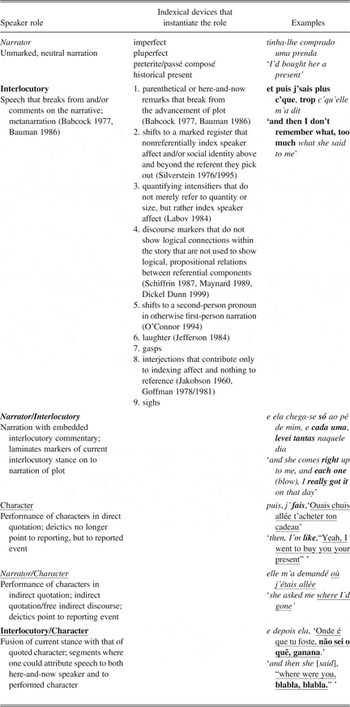
In previous work (Koven Reference Koven2002, Reference Koven2007), I have presented a coding scheme for narrative footing (Goffman Reference Goffman and Goffman1979/1981) or voicing (Bakhtin Reference Bakhtin1981, Hill Reference Hill and Tedlock1995, Wortham Reference Wortham2001). As storytellers speak through multiple roles of selves and others across here-and-now and there-and-then speech events, I code how people move between frames of the current interaction and the narrated events. I distinguish among three event frames and associated roles—interlocutor, narrator, and character— that storytellers can inhabit.Footnote 4
We see the interlocutor role, when the participant signals that she is speaking from the event frame of the ongoing conversation or interview in which the narrative is told; stories emerge from, respond to, and alter ongoing interaction. Here, speakers engage in metanarration (Babcock Reference Babcock and Bauman1977, Bauman Reference Bauman1986), the “overtly and explicitly social interactional elements of discourse … [that] have the effect of bridging the gap between the narrated event and the storytelling event by reaching out phatically to the audience” (Bauman Reference Bauman1986:99–100). This role is where participants negotiate pragmatic features of the speech event itself, and will be key for comparing the interview and conversation. We see the narrator role, when the speaker moves from the larger interaction to the role of storyteller, taking the floor for an extended turn, describing the plot of a narrated event. Finally, we see the character role, when the speaker quotes figures from the narrated event. Table 1 (from Koven Reference Koven2007:102–3) presents an overview of the coding.
Coding speaker role.

Italics = narrator; bold = interlocutory; underline = character
This model shows how narrative discourse is multifunctional, that is, how speakers interweave their current engagement with their audience, their narration of plot, and their performance of characters. These roles can be enacted separately or concurrently. Comparing how participants use roles between interview and conversation shows whether stories in either context are more interactionally involved (Tannen Reference Tannen1989).Footnote 5
COMPARING TWO VERSIONS OF THE SAME STORY
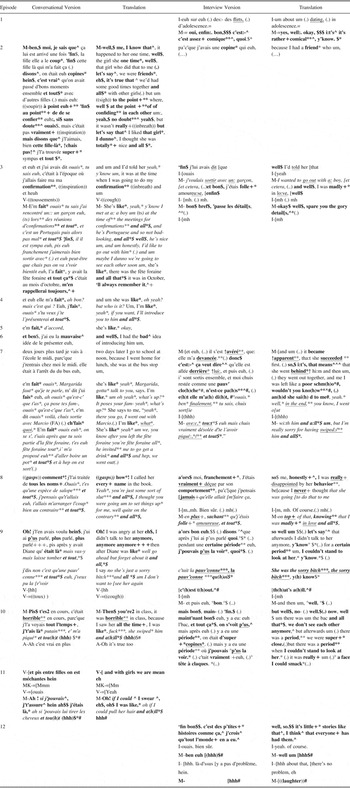
The episodes in Table 2 show how the same story emerges in the interview and conversation. I have parsed each version into segments that appear next to the same segment in the other version. Both versions are coded for narrator (unmarked), interlocutor (bold), and character (italics) speech.Footnote 6
Conversational and interview versions of story.

The plots and role inhabitances show consistent parallels and divergences. In both, Margarida (M) describes a friend with whom she had discussed her crush on a boy; the friend beats her to the punch and dates the boy before her; M reacts negatively, calling her friend a ‘sorry bitch’ (pauv' conne). Interactionally, M tries to get her audiences to align with her against a third-person character. She quotes herself talking back. Sometimes the quoted performances across tellings are almost identical. In these ways, there are consistencies in content, interaction, and performance.
In general, however, in the interview, M minimizes the seriousness of the narrated events and appeals to shared experience with the interviewer. In the conversation, the narrative is also interlocutory, but M does not minimize the story or insist on its genericness. Perhaps as the participants already know each other in the conversation, M does less interlocutory work to confirm that her audience “gets” the story. Instead, she displays her ongoing “here-and-now” rage. Given space limitations, I discuss only major trends displayed in particular paired episodes.
In episode 1 the story begins in different types of interactions. In the interview, M starts after the interviewer's prompt. The conversational version occurs in a series of stories (not shown) about people stealing each other's love interests. That is, in the interview she is offered the floor, in the conversation she seizes it.
In both events, she begins with interlocutory framing, briefer in the conversation. In the interview, sandwiched between a series of discourse markers, she parenthetically remarks that her story is “comical,” downplaying the seriousness of the story and her current reaction. Her use of the high register comique, rather than neutral drôle ‘funny’ or more familiar marrant, signals her remove.
In both versions of episode 3, she tells her friend about her love interest with narrator, interlocutor, and character speech. In both, she quotes herself saying that she wanted to date the boy, while using interlocutory devices to frame the significance of the narrated events to her at the moment of telling. However, her interlocutor and character performances work differently. In the interview, she uses indirect quotation, refraining from fully replaying this event, while using interlocutory devices that keep her in the present. Note the minimizing parenthetical “okay, in brief, I'll spare you the gory details.” These interlocutory strategies appear effective, as the interviewer provides two back channels. In the conversation, she gives her audience the “gory details.” There is less interlocutory framing, but more character performance.
In episode 7 she uses all three roles in both versions to present her friend's confession. She uses direct quotation to present how her friend reported that she beat her to the punch, opening the quoted confession with the discourse marker ouais and closing it with et tout. She quotes her friend using familiar and formal registers, presenting her as a ridiculous adolescent social type, while displaying her own current negative assessment. This seems successful, as the interviewer responds with laughter.
There are divergences, however. The conversational rendering is more elaborate, with more narrator and character speech. In the interview, her friend's infraction appears through interlocutor and narrator speech. Instead of fully performing the confession, M summarizes with high register avéré ‘it became apparent’ and devancé ‘succeeded first’ (formal). Her own response comes through interlocutory speech, alternating between familiar pauv' cloche ‘poor schmo’ and higher n'est-ce pas ‘wouldn't you know’ (formal), interspersed with laughter. She has made this a funny rather than an angry story.
Episode 9 involves performance of all three roles in both. There is almost verbatim repetition of certain elements—“I didn't talk to her anymore,” and “sorry bitch.” This supports scholarship on retellings, that critical quoted utterances are often remarkably stable across versions (Bauman Reference Bauman1986, Moore Reference Moore and Lucy1993, Norrick Reference Norrick1998, 2001, Koven Reference Koven2001, Reference Koven2007). This repetition of the quoted insult is notable for its register—conne ‘bitch’, displaying her affect at the time, replayed in the present. Both audiences respond to this quoted performance—with laughter in the conversation and a back channel in the interview.
Episode 11 demonstrates similar parallels and divergences. The conversational version contains all three roles, which M uses to highlight how angry she was and remains. Her friends respond, chiming in about the “meanness” of girls. The interview version ends on an almost exclusively interlocutory note. M again downplays the ongoing impact of this event, appealing to her interviewer that such stories are commonplace. She presents past hurt and current control, while seeking solidarity. This apparently works, as the interviewer chuckles that she recognizes such experiences.
In sum, it is remarkable that M offers such similar stories, embedding similar narrated events in different contexts.Footnote 7 In the conversation, M appears to be more “in” the story itself, what Labov calls internal evaluation (1972). In the interview, she is more oriented to the interviewer. Indeed, both versions are “involved” (Tannen Reference Tannen1989) or performed (Wolfson Reference Wolfson1976), but with different speaker-role orientations.
QUANTITATIVE ANALYSIS OF SPEAKER ROLE PROPORTION IN INTERVIEW VS. CONVERSATIONAL VERSION
We can quantify this role analysis. Although not a substitute for qualitative analysis, quantitative analysis summarizes data within and across narratives (see Tables 3 and 4). There are proportionally more clauses of character performance in the conversational narrative (47.9%) than in the interview narrative (21.9%), and more narrator performance in the interview (35.7% vs. 31.5%). However, Margarida is interlocutory in both, with 72.9% of interlocutory clauses in the conversational version, and 79.4% in the interview. Contrary to what critics of interview narratives might predict, she is proportionally more interlocutory in the interview.
Clauses in each role in conversation.

Clauses in each role in interview.

With quantitative analysis, beyond these two stories, we can also compare all narratives M told in the entire interview and conversation. If we compare the interview and conversational corpus, we find: greater character performance in the conversation (47.9% vs. 32%), but greater interlocutor performance in the interview (58.6% vs. 45.7%).Footnote 8 There is slightly more narrator performance in the interview (33.4% vs. 31.4%).
CONCLUSION
In both events, M negotiates roles across here-and-now and there-and then. Perhaps M was more interlocutory in the interview, because she and the interviewer created a relationship and established common ground from scratch. In the conversation, M and the others could assume this. Overall, these materials demonstrate that interview stories may be as interactionally complex and amenable to interactional analysis as conversational stories.Footnote 9 As such, if we investigate how participants construe interviews relative to other contexts and ask how interview data resemble what participants do elsewhere, interviews can remain a viable method for the study of narrative.
For Margarida, interviews are one event type where personal experience is repeatable. Investigating how people repeat the same story across contexts may reveal how they create interdiscursive links across encounters (Agha Reference Agha2006), so that the story appears to perdure beyond particular interactions.Footnote 10
Whether interviews are a valid method for sampling different social phenomena is not a question unique to interview methodology. Even researchers who intervene minimally in the interactions that they document must ask whether their recordings capture such interactions at other moments—that is, whether they “repeat” phenomena of interest (“content” and/or discourse strategy). Scholars are rarely interested in singular occurrences for their own sake, but for what such occurrences reveal about social regularities. By comparing interview and conversational narratives, this article addresses the relationship between the context of any particular instance of data collection and the other contexts where the phenomenon of interest occurs.
Appendix: Transcription conventions
Interlocutory devices (symbols appear after use of device):
- $
discourse marker
- ^
parenthetical remark
- *
shift to familiar register
- **
shift to formal register
- ***
shift to very familiar, or what participants call vulgar register
- #
laughter
- !
interjection
- 2
use of second-person pronoun
- +
intensifier