Introduction
Wild types of rice, also known as weedy rice, have characteristics similar to those of domesticated cultivars (Kovach et al. Reference Kovach, Sweeney and McCouch2007). However, infestations of weedy rice have been documented to be highly competitive with cultivated cultivars and to reduce rice quality. Because of its extensive similarities to cultivated rice, weedy rice is a threat to global rice production (Delouche et al. Reference Delouche, Burgos, Gealy, de San Martin, Labrada, Larinde and Rosell2007). Highly competitive and difficult to control in a cultivated rice system, weedy rice can in some cases lead to total crop failure and reduced milling quality (Burgos et al. Reference Burgos, Norman, Gealy and Black2006). Gealy et al. (Reference Gealy, Burgos, Yeater and Jackson2015) reported that US weedy rice populations can be divided phenotypically and evolutionarily into two distinct groups: straw hull (awnless) and black hull (awned).
Rice is a wild grass from Asia that was cultivated into a staple crop over thousands of years (Kovach et al. Reference Kovach, Sweeney and McCouch2007). Rice was gradually domesticated in ancient times to meet the needs of early farmers. Two known major subspecies of Asian rice are currently grown: japonica and indica. Japonica and indica rice represent the greatest genetic differentiation within weedy rice (Kovach et al. Reference Kovach, Sweeney and McCouch2007). These two groups are sometimes grown in the same geographic regions despite several morphological and physiological differences. Japonica and indica have been distinguished based on morphological characteristics such as grain shape, apiculus, hair length, leaf color, or sensitivity to potassium chlorate (Oka Reference Oka1988). However, many of the phenotypic traits are shared by both japonica and indica groups. Hull color, presence or absence of awn, and pericarp color are some of the phenotypic traits shared by both groups of rice (Burgos et al. Reference Burgos, Singh, Tend, Black, Young, Huang, Hyma, Gealy and Caicedo2014; Kovach et al. Reference Kovach, Sweeney and McCouch2007).
The genetically and phenotypically diverse populations of weedy rice are distributed throughout the rice-producing areas in the midsouthern United States (Burgos et al. Reference Burgos, Singh, Tend, Black, Young, Huang, Hyma, Gealy and Caicedo2014). Weedy rice grows taller, produces more biomass and tillers, and outcompetes cultivated rice for nutrients (Burgos et al. Reference Burgos, Norman, Gealy and Black2006; Estorninos et al. Reference Estorninos, Gealy, Gbur, Talbert and McClelland2005). Burgos et al. (Reference Burgos, Norsworthy, Scott and Smith2008) reported that weedy rice caused an average of $275 ha–1 in losses in Arkansas. Weedy rice reduces yield and can reduce grain quality because of seed contamination due to weedy rice seed color (Ottis et al. Reference Ottis, Smith, Scott and Talbert2005). These characteristics, in addition to herbicide-resistant biotypes, have distinguished it as one of the most problematic weeds in midsouthern US cultivated rice.
The first documented case of herbicide-resistant weedy rice located in Arkansas was in 2002 (Heap Reference Heap2018). The weedy rice was found to be resistant to acetolactate synthase (EC 2.2.1.6, ALS)–inhibiting (WSSA Group 2) imidazolinone herbicides. Imidazolinone-resistant weedy rice has become widespread over the southern US rice-producing area, because a high percentage of planted cultivars possess the imidazolinone-resistance trait (Burgos et al. 2008, Reference Burgos, Singh, Tend, Black, Young, Huang, Hyma, Gealy and Caicedo2014). Since development and commercialization in 2002, imidazolinone-resistant rice has made up the majority of the planted acreage in Arkansas until 2014 (Burgos et al. Reference Burgos, Norsworthy, Scott and Smith2008; Hardke 2013, Reference Hardke2015). Imidazolinone-resistant rice enabled growers to make applications of imazethapyr to control weedy rice infesting cultivated fields (Norsworthy et al. Reference Norsworthy, Bond and Scott2013). Despite this successful and effective technology, total control was not always achieved because of various environmental, biological, and herbicide application circumstances (Burgos et al. Reference Burgos, Norsworthy, Scott and Smith2008). The genetic and phenotypic similarities of cultivated rice and weedy rice led to outcrossing of the herbicide-resistant trait.
Strategies like crop rotation, use of certified seed, applications of selective grass herbicides, and other methods have been implemented by growers and recommended by consultants and extension professionals to control weedy rice infestations in fields (Burgos et al. Reference Burgos, Norsworthy, Scott and Smith2008). Weedy rice can be controlled through crop rotation, with the common rotation being soybean [Glycine max (L.) Merr.]. Rotation to soybean allows for the use of graminicides or glyphosate to control weedy rice outside of a rice crop. This reduces the amount of seed going back into the soil seedbank (Burgos et al. Reference Burgos, Norsworthy, Scott and Smith2008). Additionally, Arkansas law limits the number of weedy rice seeds that contaminate certified seed (AMS 2017). Other weed management practices include spot applications of glyphosate to rice or hand removal of plants; however, these practices are only feasible on infestations of low populations (Burgos et al. Reference Burgos, Norsworthy, Scott and Smith2008).
A need for new sites of action (SOAs) to control imidazolinone-resistant weedy rice exists in the midsouthern United States. The effective imidazolinone-resistant rice system that made up 51% of Arkansas rice hectares in 2013 has since declined to 46% in 2015 (Hardke 2013, Reference Hardke2015). This decline is partially attributed to the failure of imazethapyr to control weedy rice (Norsworthy et al. Reference Norsworthy, Bond and Scott2013). Producers that have fields infested with herbicide-resistant weedy rice now have no effective POST herbicide options for control.
Benzobicyclon, a 4-hydroxyphenylpyruvate dioxygenase (HPPD)–inhibiting herbicide, is used in Asian rice for control of ALS-resistant sedges (Cyperus spp.) and rushes (Scirpus spp.) (Komatsubara et al. Reference Komatsubara, Sekino, Yamada, Koyanagi and Nakahara2009; Sekino et al. Reference Sekino, Joyanagi, Ikuta and Yamada2008). It provides broad-spectrum control of many broadleaves, sedges, and some grasses (Sandoski et al. Reference Sandoski, Brazzle, Holmes and Takahashi2014). If commercialized in the United States, it will be the first herbicide targeting the HPPD-inhibiting SOA for use in rice.
There are known differences in sensitivity to HPPD herbicides among japonica, indica, and japonica×indica rice cultivars. Korean scientists evaluated 26 rice cultivars of varying backgrounds such as japonica, indica, and japonica×indica cultivars to the HPPD herbicides mesotrione, benzobicyclon, and tefuryltrione (Kwon et al. Reference Kwon, Shin, An, Lee, Min, Park, Shin, Jung and Kuk2012). These researchers documented that when applied over a range of timings and doses, the indica and japonica×indica crosses were more susceptible to benzobicyclon and showed greater injury than the japonica cultivars. Injury observed included phytotoxicity, necrosis, detached leaf, and bleaching. These symptoms may appear on new growth as chlorosis as early as 1 wk after POST applications, followed by necrosis and eventual death of sensitive species. Kwon et al. (Reference Kwon, Shin, An, Lee, Min, Park, Shin, Jung and Kuk2012) documented that the highest levels of phytotoxicity were exhibited on high-yielding japonica×indica–type cultivars. With benzobicyclon having herbicidal activity on cultivated indica and japonica×indica rice germplasm, it seems logical that its use may provide an option for controlling weedy rice in the southern United States. If benzobicyclon can be successfully implemented into US rice systems, it would provide a new SOA for potentially controlling weedy rice in conventional and imidazolinone-resistant rice systems.
Since the first documented case of ALS-resistant weedy rice in Arkansas, the number of resistant cases has increased across other rice-producing states in the midsouthern United States (Burgos et al Reference Burgos, Norsworthy, Scott and Smith2008; Heap Reference Heap2018). Weed surveys have been a successful tool for estimating weed flora within a geographic region (Johnson Reference Johnson2013). With resistance in weedy rice to the imidazolinone herbicides confirmed, and differences in genetic and phenotypic traits confirmed among weedy rice across the midsouthern United States, the potential may exist to control weedy rice with benzobicyclon.
Observations from field studies conducted in 2015 at the Rice Research and Extension Center near Stuttgart, AR, and at the Pine Tree Research Station near Colt, AR, indicated that bays treated post-flood with benzobicyclon at 247 or 494 g ha–1 had a high level of weedy rice control relative to bays containing no benzobicyclon. This prompted a weedy rice survey across the midsouthern United States to assess sensitivity to benzobicyclon. The objective of this research was to survey the weedy rice accessions in Arkansas, Missouri, and Mississippi for sensitivity to benzobicyclon and determine if any phenotypic characteristic would correlate with response to the herbicide.
Materials and Methods
Collection and Plant Materials
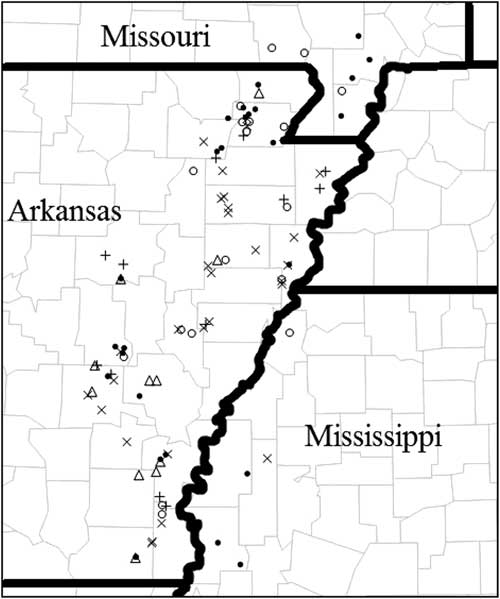
Benzobicyclon controlled weedy rice at 247 and 494 g ha–1 at the Pine Tree Research Station near Colt, AR, and the Rice Research and Extension Center near Stuttgart, AR (unpublished data), leading to a collection of weedy rice samples from rice fields across portions of the midsouthern United States. Weedy rice panicles were collected from 88 rice fields in Arkansas, 5 in Mississippi, and 7 in Missouri in the summer of 2015 (Table 1, Figure 1). If a field contained only one weedy rice plant, then approximately five panicles were collected. However, if a field contained multiple plants, 25 to 35 panicles were collected from different plants, and in all instances, panicles were combined to make a composite sample, even when differing phenotypes occurred within the field. A handheld global positioning system was used to record the coordinates for each sampling site. Accessions were designated as AR (Arkansas), MO (Missouri), or MS (Mississippi), and assigned a number ranging from 1 to 100 (Table 1, Figure 1).
A county map of Arkansas, Mississippi, and Missouri illustrating the percentage mortality of 100 weedy rice accessions to benzobicyclon at 371 g ai ha–1 applied post-flood. Markers indicate percentage mortality: ∙, 0% to 20%; o, 21% to 40%; Δ, 41% to 60%, +, 61% to 80%; X, 81% to 100%.

Weedy rice accessions collected from fields across the midsouthern US rice region listed by county, hull color, awn, and GPS coordinates from which they were collected.

a Accession state of origin indicated by ‘AR’ (Arkansas), ‘MO’ (Missouri), and ‘MS’ (Mississippi).
b Hull color: ‘Mixed’ indicates any accession that had multiple black, straw, gold, brown, or gray -colored samples within the accession.
c Presence or absence of an awn indicated by Yes or No.
Samples were collected in rice fields suggested by local crop consultants, county extension agents, and growers. For all samples collected, it was not known at the time of collection whether plants had escaped control of imazethapyr or imazamox. The AR accessions were collected during rice harvest from August 17 to 21, 2015. Each accession was evaluated for hull color (straw, black, or mixed) and presence or absence of an awn (Tables 1, 2). Any accession characterized as ‘mixed’ contained both straw and black hull accessions. The accessions were stored at room temperature for 5 mo prior to the greenhouse experiment.
Responses of 100 sensitive weedy rice accessions following a post-flood application of benzobicyclon at 371 g ai ha–1 in the greenhouse and field.Footnote a – Footnote c

a Accession state of origin indicated by ‘AR’ (Arkansas), ‘MO’ (Missouri), and ‘MS’ (Mississippi).
b Post-flood application made at two- to three-leaf stage with the addition of crop oil concentrate at 1% vol/vol.
c Accessions evaluated at 6 wk after post-flood applications in the greenhouse.
d The accessions of 100% or 0%, mortality or control, were not included in the analysis; therefore, ‘–‘ indicates a noncalculated standard error; ‘SE’ indicates standard error.
e Because of poor germination, some rows did not have 25 plants emerge per replication; therefore, the percentage mortality was calculated from the total number of plants that emerged.
f Mortality data collected from greenhouse.
g Control data collected from field study. It was not possible to quantify mortality in the field because of profuse tillering of surviving plants in plots that had both sensitive and tolerant plants within an accession.
Benzobicyclon Tolerance in the Greenhouse
The 100 accessions were screened for resistance to imazethapyr. For each accession, approximately seven to eight seeds were planted in 12-cm diam by 15-cm depth pots. Plants were thinned to five per pot after emergence. Each accession had a total of four pots and 20 plants. The screening had two replications in time. The results revealed that 63% of the weedy rice accessions were resistant to the ALS-inhibiting herbicide imazethapyr at 105 g ai ha–1 (data not shown).
Benzobicyclon tolerance was investigated at the Altheimer Laboratory in Fayetteville, AR, in 2016. This study was conducted twice in the greenhouse in a randomized complete block design with two replications per accession per treatment and 25 plants per replication, for a total of 50 plants treatment-1. The seed were sown into individual rows in a Pembroke silt loam (fine-silty, mixed, active, mesic Mollic Paleudalfs) soil that was 6 cm deep in stainless-steel containers measuring 123 cm in length and 51 cm in width. In each container were planted 25 accessions in rows 2.5 cm apart. After emergence, accessions were reduced to 25 plants row–1. Because of poor germination, some rows did not have 25 plants emerge; therefore, the percentage mortality was calculated from the total number of plants that emerged if less than 25. The containers were kept in a greenhouse under conditions of 32/22±3 C day/night temperatures with a 16-h photoperiod consisting of natural lighting supplemented by a metal halide lighting system. The flood was applied at the two- to three-leaf growth stage several days before the herbicide application. Soluble liquid fertilizer [N-P-K (24%-8%-16%) All Purpose Plant Food, Miracle-Gro] was applied immediately after flooding to ensure adequate plant growth. All containers were irrigated on a daily basis to ensure healthy plant growth.
The herbicide treatment was applied to two- to three-leaf weedy rice plants that were approximately 14 to 16 cm tall. Treatments were made after flooding the containers to a 5- to 7-cm depth. It is important to maintain a flood for the continued activity of benzobicyclon (McKnight et al. Reference McKnight, Webster, Fish, Bergeron and Sandoski2014). Benzobicyclon was applied post-flood at 371 g ha–1 plus 1% vol/vol crop oil concentrate (COC) (Agri-Dex, Helena Chemical Co., West Helena, AR) with a CO2-pressurized backpack sprayer consisting of a four-nozzle, handheld boom equipped with 110015 AIXR nozzles (Teejet Technologies, Springfield, IL) calibrated to deliver 143 L ha–1 at 276 kPa. Beginning 14 d after application, dead plants were recorded and removed from treated containers three times weekly for up to 6 wk after application.
Benzobicyclon Tolerance in the Field
To further confirm the greenhouse results, a field study was conducted in 2016 at the Pine Tree Research Station near Colt, AR, to evaluate tolerance of the same 100 weedy rice accessions to benzobicyclon. The study was conducted in a randomized complete block design with two replications per accession per treatment. Each replication was contained within an individual rice bay, 18 m by 24 m. A 10-row drill was used to create furrows within the test site, and each weedy rice accession was sown by hand on June 9, 2016, into a Calloway silt loam (fine-silty, mixed, active, thermic Aquic Fraglossudalfs). Approximately 60 to 80 seeds m–1 of row were sown in 4.5-m rows into the first, fifth, and tenth furrow with each pass of the drill, resulting in a 70- to 85-cm spacing between rows. Additionally, commercial japonica cultivars, ‘CL111’ and ‘Roy J’, were sown for comparison purposes. At the one- to two-leaf rice growth stage, flags were used to mark a portion of each row that contained 50 individual weedy rice or rice plants. The intent of marking 50 plants was to assess mortality similar to greenhouse evaluations after treatment.
The flood was established in both bays simultaneously by multiple-inlet irrigation 1 wk prior to the herbicide treatment at the two- to three-leaf growth stage. The flood was maintained at a 6- to 8-cm depth for the duration of the study, and nitrogen (168 kg ha–1) was applied immediately prior to flooding to simulate normal rice culture. Maintenance herbicide applications were applied to ensure that the study was maintained weed free. Clomazone was applied PRE at 360 g ai ha–1 immediately after planting, and a POST application of fenoxaprop at 122 g ai ha–1 plus halosulfuron 53 g ai ha–1 plus 1% vol/vol COC was applied prior to permanent flood establishment to help maintain the area weed-free. Benzobicyclon was applied 1 wk after flooding to each bay from levee to levee at 371 g ha–1 plus COC at 1% vol/vol with a CO2-pressurized backpack sprayer consisting of a four-nozzle, handheld boom equipped with 110015 AIXR nozzles (Teejet Technologies, Springfield, IL) calibrated to deliver 143 L ha–1 at 276 kPa. Most weedy rice accessions and the commercial rice cultivars had four leaves at application. By 3 wk after treatment it was impossible to access mortality, because carcasses had decayed or moved throughout the bay. Additionally, the profuse tillering of some tolerant accessions made it difficult to differentiate individual plants. Hence, the flagged portion of each plot was visibly evaluated for control on a 0% to 100% scale, with 0% being no control and 100% being complete plant death. The commercial cultivars were nonresponsive to benzobicyclon; hence, these served as controls during the evaluation.
Statistical Analysis
Mortality data from the greenhouse experiment and control data from the field were analyzed using PROC GLMMIX in SAS 9.4 (SAS Institute Inc. Cary, NC), where treatments having 100% or 0% mortality or control were excluded from the analysis. ‘CL111’ and ‘Roy J’ were not negatively affected by benzobicyclon; hence, they were not reported. A frequency distribution table was created in JMP 12.1 (SAS Institute Inc. Cary, NC) to describe the relationship of hull color and presence or absence of awn. A one-way ANOVA was performed in JMP 12.1 where the treatments were hull color and the response was percentage mortality. A separate one-way ANOVA was performed where the treatments were presence or absence of awns and the response was percentage mortality. A map was constructed to show the spatial distribution of the percentage mortality.
Results and Discussion
Benzobicyclon Tolerance in the Greenhouse
The mortality of weedy rice accessions collected from across the midsouthern United States varied in sensitivity to benzobicyclon at 371 g ha–1 (Table 2, Figure 1). Based on greenhouse data, 22 of 100 accessions exhibited mortality of 80% or greater. Ten accessions were completely controlled (100% mortality), and eight accessions exhibited tolerance to benzobicyclon with no mortality observed. ‘Roy J’ and ‘CL111’ showed excellent safety to benzobicyclon (i.e., 0% injury). These findings are similar to those of Kwon et al. (Reference Kwon, Shin, An, Lee, Min, Park, Shin, Jung and Kuk2012), where rice cultivars in Asia varied in sensitivity to benzobicyclon. Kwon et al. (Reference Kwon, Shin, An, Lee, Min, Park, Shin, Jung and Kuk2012) found increased tolerance of the japonica rice cultivars compared with indica cultivars. Previous research determined that the presence or absence of the HIS1 gene within rice germplasm is a major contributor to differences in sensitivity to triketone herbicides (Kwon et al. Reference Kwon, Shin, An, Lee, Min, Park, Shin, Jung and Kuk2012). Based on these results, there is variation in response of weedy rice accessions in the midsouthern United States to benzobicyclon; however, it is unknown whether expression of the HIS1 gene is the cause of this variation. Because of the differing response among accessions, it is likely that the weedy rice in the midsouthern United States arises from both indica and japonica origins, and there may be some accessions composed of indica×japonica crosses.
The phenotypic characteristics of weedy rice are shown in a frequency distribution table (Table 1). Of the 100 weedy rice accessions, 47% were awnless, and 81% of the awnless accessions were straw hull. Conversely, 96% of the black hull accessions had an awn. These findings are similar to those found by Burgos et al. (Reference Burgos, Singh, Tend, Black, Young, Huang, Hyma, Gealy and Caicedo2014) and Gealy et al. (Reference Gealy, Burgos, Yeater and Jackson2015) when assessing the phenotypic characteristics of weedy rice accessions across the mid-South. The majority of weedy rice in the midsouthern United States is straw hull in color and does not bear awns, whereas those that are black hull in color will most likely have an awn. The findings of Gealy et al. (Reference Gealy, Hesham and Eizenga2009) indicate that straw hull weedy rice accessions without awns are more closely associated with indica than japonica lines.
The one-way ANOVA between awn presence or absence and percentage mortality revealed a marginal statistical difference (P=0.0147) (data not shown). The same analysis conducted between hull color (straw, black, or mixed) and percentage mortality indicated a lack of relationship between these two variables (P value=0.1362, data not shown). Therefore, a grower will be unable to assess hull color during the fall and successfully determine whether the weedy rice in the subsequent rice crop will be sensitive to benzobicyclon. However, these findings suggest that weedy rice plants bearing awns are more likely to be tolerant to benzobicyclon. Nevertheless, the phenotypic characteristics of weedy rice, such as the presence or absence of awns and/or hull color, are not sufficiently reliable to determine sensitivity or tolerance to benzobicyclon.
Evidence suggests that the sensitivity or tolerance to benzobicyclon is based on the genetic background of the weedy rice (Kato et al. Reference Kato, Maeda, Sunohara, Ando, Oshima, Kawata, Yoshida, Hirose, Kawagishi, Taniguchi, Murata, Maeda, Yamada, Sekino and Yamakazi2015). Kato et al. (Reference Kato, Maeda, Sunohara, Ando, Oshima, Kawata, Yoshida, Hirose, Kawagishi, Taniguchi, Murata, Maeda, Yamada, Sekino and Yamakazi2015) reported that the HIS1 gene, located on the second chromosome of rice, has been identified as conferring tolerance to HPPD inhibitors. The HIS1 gene is expressed mainly in shoots of rice, where uptake of benzobicyclon is believed to be greatest in a flooded rice culture. Additionally, the homologous gene (HSL1) is located on the sixth chromosome of rice and is believed to be expressed at low levels and be partially responsible for tolerance to HPPD inhibitors. These two genes are the determining factors for the susceptibility to HPPD inhibitors such as benzobicyclon. Future research should examine if expression of HIS1 is correlated with the results obtained in this study. If so, it may be possible to develop an assay to screen for the likelihood of a benzobicyclon application successfully controlling weedy rice in the field.
Benzobicyclon Tolerance in the Field
Sensitivity to benzobicyclon was documented in the field in addition to the greenhouse. Benzobicyclon controlled 30 of the 100 accessions in the field 80% or more (Table 2). Of the 100 accessions evaluated, 7 were controlled 100% in the field. However, 34 of the accessions had minimal sensitivity (20% or less) to benzobicyclon based on control ratings. Benzobicyclon efficacy appeared slightly higher in the field than in greenhouse, but overall greenhouse and field results closely matched (Table 2). The increased benzobicyclon activity could be due to environmental conditions such as temperature, relative humidity, or pH of water. The parent molecule, benzobicyclon, is a pro-herbicide that must be hydrolyzed to benzobicyclon hydrolysate to exhibit herbicidal activity (Komatsubara et al. Reference Komatsubara, Sekino, Yamada, Koyanagi and Nakahara2009; Williams and Tjeerdema Reference Williams and Tjeerdema2016). Williams and Tjeerdema (Reference Williams and Tjeerdema2016) documented that the conversion of benzobicyclon to benzobicyclon hydrolysate increases as a function of temperature and pH of water. Johnson and Young (Reference Johnson and Young2002) confirmed that another triketone herbicide, mesotrione, has increased activity on certain weed species as temperature and relative humidity increases. Mesotrione efficacy increased seven-fold on large crabgrass [Digitaria sanguinalis (L.) Scop.] at 32 C compared to 18 C. Large crabgrass was also twice as susceptible to mesotrione at 85% relative humidity as at 30% relative humidity (Johnson and Young Reference Johnson and Young2002). The results of the percentage control data suggest similarities to the research conducted by Williams and Tjeerdema (Reference Williams and Tjeerdema2016).
Some of the weedy rice accessions varied in percentage mortality and control, because seeds were obtained from multiple plants at most collection sites, with occasional differences in phenological characteristics for a particular collection site. Therefore, weedy rice accessions within a field may vary in genetic background, with some being highly susceptible to benzobicyclon. Hence, benzobicyclon may offer some rice growers an option for controlling weedy rice in the absence of an herbicide trait. Sensitivity of the 100 weedy rice accessions to benzobicyclon is probably based on genetic origin. Regardless of the sensitivity to benzobicyclon possessed by some of the accessions, there is too much genetic diversity in the weedy rice populations in the midsouthern United States to deem benzobicyclon an effective post-flood herbicide option for control of weedy rice (Figure 1). However, benzobicyclon will offer a new SOA to producers and provide broad-spectrum control of many aquatics, grasses, broadleaves, and sedges (Norsworthy et al. Reference Norsworthy, Sandoski and Scott2014; Sandoski et al. Reference Sandoski, Brazzle, Holmes and Takahashi2014). For those producers who apply benzobicyclon, the opportunity for control of weedy rice is an added benefit.
A need for a rapid assay to determine the susceptibility of weedy rice to benzobicyclon is needed if this herbicide is to be used successfully for control of this weed. Such an assay would have to be simple and mobile to enable users to test and treat sensitive fields of weedy rice with benzobicyclon.
Acknowledgments
The authors thank Gowan Company and the Arkansas Rice Promotion Board for supporting this research.