Implications
With increasing pressure to abolish the farrowing crate, there is a need to develop a suitable farrowing and lactation system that optimises both animal welfare and commercial performance. This paper attempts to evaluate existing alternative systems, to determine their suitability for commercial adoption and to highlight their strengths and weaknesses to inform further system developments.
Introduction
Societal opinion, expressed through consumer demand and government legislation, is increasingly influencing practices in the pig industry (Barnett et al., Reference Barnett, Hemsworth, Cronin, Jongman and Hutson2001; Bornett et al., Reference Bornett, Guy and Cain2003; Edwards, Reference Edwards2005). Consumer attitudes towards farm animal welfare differ widely from country to country and are multidimensional, involving such issues as the way in which animals are treated in production and how animal welfare affects food safety and quality (Nocella et al., Reference Nocella, Hubbard and Scarpa2010). Reduction of freedom of movement for the animal, and therefore how much space it is afforded, is a significant point of concern for the consumer (Miele and Parisi, Reference Miele and Parisi2001). Within the pig industry, the main issues relating to space are the physically and behaviourally restrictive systems in which sows are kept during gestation, farrowing and lactation (gestation stalls and farrowing crates). In several countries, government legislation has addressed restriction during gestation by unilaterally implementing bans on sow stall use (e.g. Switzerland, Sweden, Norway and the United Kingdom). The European Union (EU)-wide ban (with an exception allowing restraint in stalls until 4 weeks after mating) comes into force in 2013 (Council of Europe, EU Directive 2001/88/EC), with New Zealand and Australia implementing bans in 2015 (NAWAC, 2010) and 2017 (PISC, 2008), respectively, and a number of US states also voting for this policy. One of the major concerns still to be addressed is housing for the farrowing and lactating sow, as the majority of sows continue to be kept in farrowing crates (70% in the United Kingdom – British Pig Executive (BPEX), 2004; 95% in the EU and 83% in the United States – Johnson and Marchant-Forde, Reference Johnson and Marchant-Forde2009) and there is growing societal pressure to abolish such systems. However, producers have valid concerns regarding such change; they need to achieve good animal performance (i.e. high piglet survival) in systems with acceptable capital, running and labour costs and that facilitate efficient labour routines and safeguard the operator. Invariably, such needs conflict with those of the farrowing sow, resulting currently in a predominant system where welfare of the sow is compromised. This compromise is evidenced by research demonstrating that sows kept in crated compared with loose accommodation show heart rate and stress hormone responses, and negative or abnormal behaviours, indicative of an impaired welfare state (Lawrence et al., Reference Lawrence, Petherick, Mclean, Deans, Chirnside, Vaughan, Clutton and Terlouw1994; Jarvis et al., Reference Jarvis, Calvert, Stevenson, van Leeuwen and Lawrence2002; Damm et al., Reference Damm, Lisborg, Vestergaard and and Vanicek2003).
The commercial outdoor farrowing environment, which often comprises individual farrowing paddocks with farrowing arks or specially designed A-frame huts (e.g. United Kingdom commercial system – Baxter et al., Reference Baxter, Jarvis, Sherwood, Robson, Ormandy, Farish, Smurthwaite, Roehe, Lawrence and Edwards2009; United States – McGlone and Hicks, Reference McGlone and Hicks2000), represents a system in which it would appear that the needs of all the main stakeholders (sow, piglets and producer) can be more balanced; national herd recording results for pre-weaning and total piglet mortality (stillborn +live-born mortality) in the United Kingdom over the last 9 years reveal that consistently competitive levels of piglet survival are being maintained (total mortality = 16.2% outdoor v. 19.1% indoor – Meat and Livestock Commission/BPEX 2000–2009). This is being achieved with relatively low capital and running costs (SAC, 2008), while allowing the sow freedom to satisfy behavioural needs, such as the ability to perform nest-building behaviour, an innate behavioural pattern whose restriction results in stress hormone responses and an increase in negative maternal behaviours (Lawrence et al., Reference Lawrence, Petherick, Mclean, Deans, Chirnside, Vaughan, Clutton and Terlouw1994; Jarvis et al., Reference Jarvis, Lawrence, Mclean, Deans, Chirnside and Calvert1997). Given that well-managed outdoor production has the potential to satisfy the biological needs of both mother and offspring, particularly by providing an appropriate environment in which to perform species-specific behavioural patterns, it could be labelled as the gold standard for facilitating high welfare, while being economically efficient. However, there are certain challenges that face both outdoor producer and animal (Edwards and Zanella, 1996) including environmental protection, biosecurity (Callaway et al., Reference Callaway, Morrow, Johnson, Dailey, Wallace, Wagstrom, McGlone, Lewis, Dowd, Poole, Edrington, Anderson, Genovese, Byrd, Harvey and Nisbet2005) and reduction in control over animals compared with indoor systems. Moreover, it can only operate effectively in regions with suitable climate and soil type, which will limit its widespread application in all countries. Therefore, more research is needed to investigate indoor alternatives that can achieve optimum animal welfare with greater managerial and environmental control than that available outdoors.
Various aspects of non-confined indoor farrowing systems have been reviewed previously (Arey, Reference Arey1997; Edwards and Fraser, Reference Edwards and Fraser1997; Johnson and Marchant-Forde, Reference Johnson and Marchant-Forde2009) and useful summaries of the performance of these systems show a common concern regarding the variability in pre-weaning survival; the total mortality has ranged from encouraging levels of 9% (e.g. Ottawa crate: Fraser et al., Reference Fraser, Phillips and Thompson1988) to high levels of 30% (e.g. Free crate and pen systems: Marchant et al., Reference Marchant, Rudd, Mendl, Broom, Meredith, Corning and Simmins2000). Inconsistent delivery of favourable production figures when moving from an experimental to a commercial evaluation is often cited as the reason for the limited uptake of alternative systems to the farrowing crate (for a review, see Edwards and Fraser, Reference Edwards and Fraser1997). However, more data are now available from countries where the use of the farrowing crate has been banned (e.g. Switzerland – Weber et al., Reference Weber, Keli, Fehr and Horat2007 and Reference Weber, Keil, Fehr and Horat2009; Norway – Andersen et al., Reference Andersen, Tajet, Haukvik, Kongsrud and Boe2007) for several years, with the exception that a crate can be used for one week post-partum for aggressive sows. In Norway, data from 39 herds with loose-housed sows in individual pens showed an average live-born mortality figure of 15.2%, ranging from 5% to 24% (Andersen et al., Reference Andersen, Tajet, Haukvik, Kongsrud and Boe2007). Data from 99 farms in Switzerland where sows were kept loose for farrowing showed an average live-born mortality rate of 11.8% (Weber et al., Reference Weber, Keil, Fehr and Horat2009). The ban in Switzerland has provided an opportunity to collect a large amount of comparative data from systems run at a commercial level in that country. In an earlier piece of work by Weber et al. (Reference Weber, Keli, Fehr and Horat2007), they demonstrated from an extensive data set (655 farms comprising 63 661 litters) that piglet losses in loose farrowing pens were no greater than in farrowing crates (total mortality (stillbirths + live-born deaths): loose = 17.2% from 18 824 litters and crates = 18.1% from 44 837 litters). Other studies with sufficient sample size to test for meaningful differences between systems have also demonstrated comparable piglet survival figures (e.g. total mortality: loose (Werribee Farrowing Pens) = 21.0% from 66 litters and crates = 24.3% from 80 litters – Cronin et al., Reference Cronin, Lefebure and McClintock2000; 19.1% live-born mortality with no significant difference between crates and pens across 87 litters – Pedersen et al., Reference Pedersen, Berg, Jorgensen and Andersen2011). Despite this evidence, universal acceptance and commercial adoption of non-crate systems has not occurred and it is important to evaluate these systems to determine how well they meet the needs not only of the animals but also of the producer. In particular, when developing new farrowing systems, it is important to maintain the advantages that led to the introduction of the contentious farrowing crate (i.e. decreased over-lying of piglets, ease of management and animal care – Edwards, Reference Edwards2002) and to address both sow and piglet requirements for optimal welfare.
Research into alternative farrowing accommodation over many years has resulted in the development of a number of different systems. The objectives of this paper are to evaluate how well these farrowing systems meet the biological needs of the sow and her piglets, by assessing how well they conform to the design criteria to meet the needs synthesised in a previous review (Baxter et al., Reference Baxter, Lawrence and Edwards2011a). Furthermore, the physical and financial performances of these systems are summarised to present a balanced evaluation of alternative farrowing accommodation.
Methodology
Defining farrowing and lactation systems for evaluation
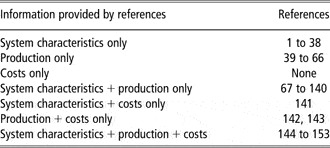
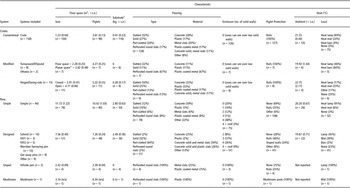
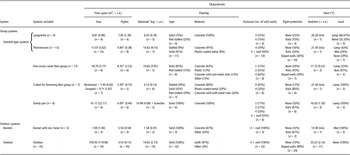
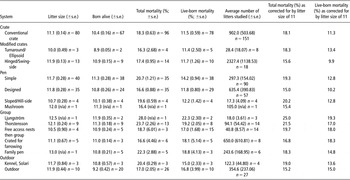
A database of literature was compiled to evaluate existing systems. Three hundred and forty-five items of literature were considered in the assembly of systems’ information. From this initial database, 153 items were screened as yielding sufficient detail to provide information on different aspects of a range of farrowing systems, including design characteristics and performance data (Table 1). The remaining literature, although not able to be used in the database, could be used to aid discussion of other aspects of interest regarding loose farrowing accommodation. The majority of information came from scientific papers (72%), with technical reports (13%), theses/dissertations (2%), conference proceedings and presentations (13%) also contributing to the database. Initially, 30 different farrowing systems were identified, which were then grouped based on common features and reduced to 14 categories. These systems were then defined based on the average data collated from the database and their physical characteristics described (Tables 2a and b). As with other work summarising farrowing systems and assessing welfare (Johnson and Marchant-Forde, Reference Johnson and Marchant-Forde2009), there are a number of caveats to address concerning the methodology: when summarising data, inevitably, details of particular studies are lost and such details may be contributing factors to certain production results in specific studies. For example breed differences, sow parity and previous experiences, and the similarity between dry sow accommodation and farrowing accommodation have all been shown to influence piglet survival (Damm et al., Reference Damm, Bildsoe, Gilbert, Ladewig and Vestergaard2002; Thodberg et al., Reference Thodberg, Jensen and Herskin2002; Canario et al., Reference Canario, Cantoni, Le Bihan, Caritez, Billon, Bidanel and Foulley2006). In addition, the data collected on each system are imbalanced, with some systems having only limited information from a small number of studies (e.g. Mushroom pens) and others being more abundant (e.g. conventional crates). However, summary data were required to sensibly define the systems in terms of their physical characteristics (Tables 2a and b), to determine how well they meet the design criteria to satisfy biological needs (Figure 1), to gather information on production performance (Table 3) and to estimate information on their investment costs. In addition, given that some data (particularly for the farrowing crates) were obtained from somewhat dated literature, expert opinion and current knowledge were sought to determine whether the definition of systems was sensible. To provide as much information as possible about the quality of the systems’ data, standard errors and sample sizes for each piece of information summarised are presented in the tables and it should be noted that the sample sizes are variable depending on how many items of literature provided a specific piece of information.

Physical characteristics of farrowing and lactation systems where sows are kept individually with their piglets in indoor accommodation, as determined by literature review

Data provided as average absolute values (i.e. space, substrate and ambient temperature) ± s.e. or percentage of studies where systems provided a specific characteristic (i.e. type of flooring, piglet protection mechanism or supplementary heat and amount of enclosure). Sample sizes (n) show number of studies providing information for each characteristic.
*Planar space refers to the space available at the sow's shoulder height and in these specific studies this space was enough for the sows to turn around in.
†Straw or chopped straw was the most common form of substrate used.
Physical characteristics of indoor group and outdoor farrowing and lactation systems, as determined by literature review

Data provided as average absolute values (i.e. space, substrate and ambient temperature) ± s.e. or percentage of studies where systems provided a specific characteristic (i.e. type of flooring, piglet protection mechanism or supplementary heat and amount of enclosure). Sample sizes (n) show number of studies providing information for each characteristic.
*Nest space available to the piglets, although some piglets maybe able to access sow space before official integration.
†Straw or chopped straw was the most common form of substrate used.
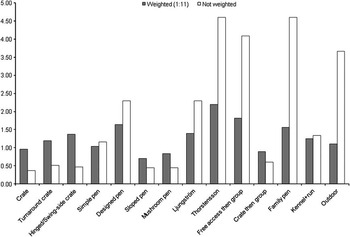
Welfare design scores for each defined system, as determined by assessing how well each system meets the biological needs of the animals during the three phases of farrowing: nest building, parturition and lactation. The differences between weighted scores (piglet criteria multiplied by 11 per litter) and non-weighted scores (sow given equal weighting to litter as a whole) are shown.

Average production results (±s.e.) and study sample size (n) for defined farrowing systems. Mortality data have also been corrected for a standardised litter size of 11 piglets

The 14 systems fall into five main categories of commercially available farrowing accommodation, which are briefly described below and further detailed in Tables 2a and b:
Conventional farrowing crates
The farrowing crate was first commercially introduced in the 1960s to provide more efficient management and control over sows and to reduce live-born piglet mortality (Robertson et al., Reference Robertson, Laird, Hall, Forsyth, Thompson and Walker Love1966). Typically, tubular metal bars run horizontally along the length of the crate, with additional bars positioned above the sow to prevent escape via climbing or jumping. The crate is designed to restrain the sow to limit her posture changes and movements. A water and food trough is situated at the front with a (often adjustable) gate at the back. This crate is situated in a larger pen accessible to the piglets (Table 2a). Flooring is usually fully or part-slatted, with pens usually having a solid floor or mat for the piglet resting area.
Modified crates
These systems essentially involve a widening of the existing farrowing crate to either allow the sow to be able to turn around throughout farrowing and lactation (e.g. ellipsoid – Lou and Hurnik, Reference Lou and Hurnik1994) or restrain the sow during farrowing before opening the crate up approximately 5 to 7 days post-farrowing (e.g. open crate – Weber, Reference Weber2000). Such systems were designed to allow the sow greater freedom of movement within the existing footprint of a conventional crate space and to retain the ability to restrain the sow if necessary.
Pens
These systems include a range of modified designs in which the crate is absent: the hillside or sloped pens (e.g. hillside pens – Collins et al., Reference Collins, Kornegay and Bonnette1987) attempt to occupy a footprint similar to that of the conventional farrowing crate with fully slatted floors that are profiled with the intention of directing piglets towards the creep area and away from the sow lying area; mushroom pens are designed to occupy a crate footprint, on fully slatted floors, but provide protection for the piglets from sow posture changes by replacing rails with mushroom-shaped protrusions placed throughout the pen (BPEX, 2004). Fairly simple pen designs include larger, solid-floored, straw-based systems (reviewed in Phillips and Fraser, Reference Phillips and Fraser1993). The most elaborate of these systems are the more designed pens with defined regions including separate dunging and lying areas and additional pen ‘furniture’ such as rails or sloped walls to assist sow posture changes and protect piglets (e.g. Schmid pen – Schmid, Reference Schmid1993; FATs (Swiss Federal Research Station for Agricultural Economics and Engineering, Tänikon, Switzerland) – Weber, Reference Weber2000; Werribee Farrowing Pen – Cronin et al., Reference Cronin, Lefebure and McClintock2000).
Group systems
These systems allow sows and litters to mix before weaning (Table 2b). The majority are based on multi-suckling accommodation; both sows and piglets are afforded a much greater amount of space and systems are often deep-straw bedded. For farrowing, sows are initially individually housed in either pens or crates, but are integrated with their litter into groups in larger multi-suckling pens between 10 and 21 days post-farrowing (e.g. Ljungström – Bäckström et al., Reference Bäckström, Algers, Nilsson and Ekesbo1994; Goetz and Troxler, Reference Goetz and Troxler1995; Marchant et al., Reference Marchant, Rudd, Mendl, Broom, Meredith, Corning and Simmins2000; McGlone, Reference McGlone2006). Alternatively, sows are already grouped before farrowing and have free access to individual nest boxes for farrowing, which may or may not be removed 7 to 10 days post-farrowing (Thorstensson – Mattsson, Reference Mattsson1996; Marchant et al., Reference Marchant, Broom and Corning2001; free access systems: e.g. get away pens – Bøe, Reference Bøe1993; freedom farrowing – Baxter, Reference Baxter1991; crated then grouped – Marchant et al., Reference Marchant, Rudd, Mendl, Broom, Meredith, Corning and Simmins2000). The Family Pen system was derived from observing sows and piglets under semi-natural conditions and attempting to fulfil the observed needs in a more complex group design (Stolba and Wood-Gush, Reference Stolba and Wood-Gush1984; Kerr et al., Reference Kerr, Wood-Gush, Moser and Whittemore1988).
Outdoor systems
These are systems with low capital investment and running costs, where sows and their piglets are housed individually, outdoors in farrowing arks or huts, with access to individual or group paddocks. Different ark and hut designs are available and have been described in detail elsewhere (e.g. Honeyman et al., Reference Honeyman, Roush and Penner1998; Baxter et al., Reference Baxter, Jarvis, Sherwood, Robson, Ormandy, Farish, Smurthwaite, Roehe, Lawrence and Edwards2009). Outdoor runs with kennels or Solari pens (e.g. Grissom et al., Reference Grissom, Friend, Dellmeier, Knabe and Dahm1990; BPEX, 2004) are systems that attempt to offer more managerial control than full outdoor systems by providing a separate heated creep area inaccessible to the sow, in addition to operating on a smaller footprint, with kennels often aligned next to each other.
Production information
As with data summarising physical characteristics, information regarding the production results of different systems was varied in the quantity and details for each system (Table 3). The most complete sets of production data available were the total litter size, number born alive, percentage total mortality (stillborn + live-born) and percentage live-born mortality. Further information of interest regarding both production and sow welfare (e.g. weaning to oestrus interval) was only available from a limited number of studies and too sparse to populate the database, but individual items could be used to aid discussion about such production parameters. As with other data in this review, there are certain caveats to be discussed – most importantly, the issue of litter size. With increasing litter size, the probability of survival decreases (e.g. Roehe and Kalm, Reference Roehe and Kalm2000) and therefore imbalances in this could influence the production figures reported for each system. For this evaluation, there is no attempt to correct mortality data to a standardised litter size for each piece of literature used, as this would require access to a more detailed level of individual data that many studies failed to provide. However, there is an attempt to correct the summarised mortality data for each system by standardising litter size and using a correction factor. Therefore, Table 3 not only reports the simple descriptive statistics for each system but also presents corrected data to provide an indication of the influence of litter size and the issues of litter size are discussed further in later sections.
Development of the welfare design index (WDI)
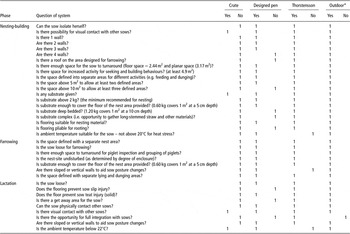
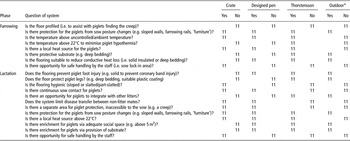
From a review of the biological needs of the sows and piglets during the three main phases of farrowing: nest-building, parturition and lactation (Baxter et al., Reference Baxter, Lawrence and Edwards2011a), design criteria for accommodation were proposed that were considered to best meet those needs. These criteria were further enhanced by accounting for the needs, particularly of piglets, of animals housed under indoor and more intensive conditions. For example, in the wild, piglets do not have or require a separate ‘creep’ area, inaccessible to the sow; however, protection is afforded somewhat by the properties of the nest-site (Baxter et al., Reference Baxter, Jarvis, Sherwood, Robson, Ormandy, Farish, Smurthwaite, Roehe, Lawrence and Edwards2009). Under indoor conditions, unless animals are housed on deep straw bedding, no flooring offers such properties. Therefore, provision of piglet protection must be added as a design criterion. Within the farrowing area, protective properties of floors, walls (e.g. sloped or rails added) and the provision of a separate heated area, inaccessible to the sow, were considered. In addition, the needs of the stockperson for the safe handling of livestock have been addressed, because this interacts with the needs of the piglets in terms of health and well-being. To document how well the 14 systems met these design criteria, a WDI was developed. To assign a single value (score) to each system, a set of over 50 questions (Tables 4a and b) was ‘asked’ based on the identified biological needs of both sows and piglets during the different phases described. The questions concerned different attributes of the system including both direct (e.g. quantity of space and substrate, ambient temperature, etc.) and indirect components (e.g. facilitation of hygiene and health care). The issue of piglet mortality (considered a welfare criterion because piglets may suffer rather than being killed instantaneously) was tackled in two ways: firstly, within the WDI, questions relating to design features that may prevent piglet death were asked. For example, crushing is the most common ultimate event preceding live-born death, although hypothermia and starvation are often underlying factors resulting in the neonate being more susceptible (Edwards, Reference Edwards2002), and thus questions relating to piglet microclimate and protection during sow posture changes are prominent. Secondly, production information documenting piglet mortality in each system was collated and summarised (Table 3).
Questions ‘asked’ of each system, based on the biological needs of the sow during the different phases of farrowing (nest-building, farrowing and lactation) as proposed by Baxter et al. (Reference Baxter, Lawrence and Edwards2011a). Answers for four different systems provided

*Outdoor system described as individual farrowing and lactation.
Questions ‘asked’ of each system, based on the biological needs of the piglets during farrowing and lactation, as proposed by Baxter et al. (Reference Baxter, Lawrence and Edwards2011a). Answers are multiplied by 11 to reflect an average litter size of 11 piglets as determined by national recording data (BPEX, 2010). Answers for four different systems provided as examples

*Outdoor system described as individual farrowing and lactation.
The review that formed the basis for the WDI documented the considerable amount of literature describing the biological needs of the sow and her piglets during the different phases of farrowing and lactation and identified and summarised suitable design criteria to accommodate biological needs (Baxter et al., Reference Baxter, Lawrence and Edwards2011a). However, this review also served to highlight that, despite the abundance of work in this area, there remain outstanding gaps in knowledge requiring additional and detailed research, for example the quantification of space and substrate needed at specific stages. Where data on these specifics were lacking, certain assumptions were made for the WDI, based on biological argument. An example of just such a dilemma occurred when asking questions about space; the welfare of the sow is increased when moving from a restricted space (i.e. a farrowing crate), where she is unable to turn around, to a more open space, where she can turn around. Scientific evidence looking at the stress physiology of sows housed in crates or loose shows elevated cortisol under restricted conditions (Lawrence et al., Reference Lawrence, Petherick, Mclean, Deans, Chirnside, Vaughan, Clutton and Terlouw1994; Jarvis et al., Reference Jarvis, Lawrence, Mclean, Deans, Chirnside and Calvert1997; Jarvis et al., Reference Jarvis, Calvert, Stevenson, van Leeuwen and Lawrence2002), supporting this statement. Furthermore, it can be stated that sow welfare is increased when she is given space, permitting increased ambulation (Jensen, Reference Jensen1986), particularly during the nest-building phase. From the first review (Baxter et al., Reference Baxter, Lawrence and Edwards2011a), it was determined that approximately 5 m2 would facilitate this increase in ambulation. Although no objective data exist to our knowledge that support the statement that the welfare of the sow is increased if, for example, she has 10 m2 space to use, observations of sows under natural or semi-natural conditions report that they cover large distances at this time (Jensen, Reference Jensen1986). We therefore conclude that, for the nest-building phase, a larger space would allow better expression of motivated behaviour and therefore extra points are awarded if the system facilitates this. This process is an example of the biological argument made to develop the WDI where quantifiable data were missing and, as with other work to quantify welfare (Bracke et al., Reference Bracke, Spruijt and Metz1999a and Reference Bracke, Spruijt and Metz1999b), it attempts to perform the best possible assessment based on the knowledge that is available.
To develop an overall score for each system, questions were phrased in such a way that a positive response was always considered positive for welfare and then the ratio of positive to negative responses was calculated. It was not intended that a positive response, and therefore a positive attribute of the system, would automatically cancel out any negative one or vice versa. Attributes are likely to lead to positive or negative outcomes with different intensities and therefore should not be considered equal. This point raises the issue of weighting attributes within the WDI.
Weighting the WDI
The WDI was weighted to account for the fact that the welfare of each individual animal should be considered of equal importance. Thus, questions relating directly to piglet welfare were multiplied by an average litter size of 11 (i.e. the reported industry average live-born litter size in the United Kingdom; BPEX, 2009). Tables 4a and b provide examples of how four different systems were scored and demonstrate which questions relate to sows (Table 4a) and which to piglets (Table 4b) and therefore which are weighted to account for each piglet in the litter. Weighting was only applied to attributes directly related to piglet welfare, and the issue of how to weight indirect needs (e.g. attributes that satisfy the sow and promote positive maternal behaviour that indirectly benefits piglets) is discussed later.
The second aspect of weighting relates to the number of questions asked about a given attribute of a system, and therefore, the extent to which its presence or absence influences the final score awarded. Scoring utilised multiple questions about an attribute to emphasise its importance to the animal at any particular phase, recognising the temporal nature of biological needs. For example provision of substrate is known to be of particular importance to the sow during nest-building and it can be considered an attribute with multiple benefits, given its properties to satisfy nest-building motivation (Damm et al., Reference Damm, Lisborg, Vestergaard and and Vanicek2003; Pedersen et al., Reference Pedersen, Damm, Marchant-Forde and Jensen2003) and provide thermal and physical protection for the piglets once born (Mount, Reference Mount1967; Baxter et al., Reference Baxter, Jarvis, Sherwood, Robson, Ormandy, Farish, Smurthwaite, Roehe, Lawrence and Edwards2009), and physical comfort for the sow (Baxter, Reference Baxter1983). Thus, this attribute is more heavily weighted during nest-building, by asking additional questions about substrate relating to needs during this phase that are not asked during the lactation phase, where there is no evidence to suggest that substrate is of equal importance. Tables 4a and b list the WDI questions, whose rationale is discussed in detail in Baxter et al. (Reference Baxter, Lawrence and Edwards2011a). Such a process is obviously a simplification, because it is based more on the number than the intensity of needs, but, while open to debate regarding weighting of individual attributes, has been made as transparent as possible.
Describing the financial performance of the systems
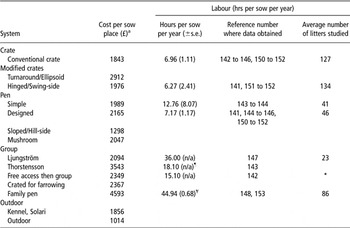
There is a dearth of data relating to the financial performance of systems (Table 1). As a result, to assign some standardised estimation of investment costs to each of the 14 systems, expert consultancy was utilised. Descriptions of each system (based on the scientific literature – Tables 2a and b) were given to a commercial farm buildings specialist (Mr Glyn Baker, Quality Equipment Ltd, personal communication) for economic evaluation. Investment costs per sow place for different farrowing and lactation housing systems included the costs of materials, design and labour for the manufacture of the basic internal structures (Table 5). The costs of accessories and furniture such as flooring materials, creep areas, bars, gates, walls, drinkers, feeders, etc. were also included in the total investment costs for every system. However, it was assumed that the shell of the building was in place, which includes plumbing, electricity and ventilation, and that differences in farrowing accommodation required no changes in any other parts of the farm. In addition to investment costs, economic evaluation of a system should include the cost of running the system in terms of labour input and, ideally, utility usage. A very limited number of studies provided information on labour input (Table 1) and data that were available were only for certain systems (Table 5). No information could be found on other running costs. The data for labour inputs are presented as hours per sow per year and information from available resources was modified to achieve consistent units.
Cost per sow place and reported labour costs ((±s.e.) and study number (n)) for defined system

aCosts calculated based on supplying average data for defined systems to a consultant for estimates. Assumes building ‘shell’ is in place with drainage, ventilation and plumbing, but not flooring.
¶Data given as farms no information on number of litters.
*Data from model so no actual figures given on litter number.
¥Piglets weaned at 85 days in this particular system.
n/a = s.e. not applicable as only one data set.
Results
Evaluating the welfare of systems
When the WDI is weighted for the number of piglets, the conventional farrowing crate scores 0.95 and the outdoor system scores 1.10. Modified crates only marginally increase their scores above 1.00 (Turnaround = 1.19; Swing-side =1.37). The designed pen scores highest in the pen category (1.64), with the simple pen only scoring marginally higher than the conventional crate (1.03) as a consequence of its negative characteristics regarding piglet protection. Among the group systems, the Thorstensson system scores the highest (2.20), with the crate for farrowing, followed by a group lactation system actually scoring lower than the conventional crate (0.90). This occurs because the sow is restrained during nesting and farrowing, as in the conventional crate, but unlike the conventional crate, the protective elements and managerial advantages are removed during lactation for the piglets and stockpersons. To show the influence of weighting, Figure 1 compares weighted and non-weighted scores (i.e. the sow is given equal importance to the litter as a whole rather than each individual piglet). This demonstrates that without weighting, all systems score much higher than the conventional farrowing crate.
Production performance of systems
Table 3 summarises the production data available for all systems. Total mortality (stillbirths + live-born mortality) was the most complete set of data relating to production efficiency and ranged from 16.3% in the Turnaround crates to 28.0% in the Ljungström system. The modified crates offered better overall survival rates than the conventional crate (Table 3), with the difference appearing to be in the percentage of stillbirths, as live-born mortality was very similar in crates (11.5%), Turnaround crates (11.4%) and Swing-side crates (11.7%). The Mushroom pen had the lowest mortality of the pen systems (16.4%); however, these data stem from one single study. From the more populated data sets in this pen category, the designed pens averaged the lowest total mortality (16.6%). Despite favourable WDI scores, the group systems had relatively high mortality levels, except for the system that restrained the sow in a crate for nest-building and farrowing phases (16.6%). The outdoor system offered a competitive level of survival (total mortality = 17.0%) compared with the conventional crated system (18.3%). In all these comparisons, however, it must be borne in mind that initial litter size was not always comparable and is a potential confounding factor that is discussed later.
Financial aspects of systems
Table 5 summarises the calculated investment costs of the defined systems and provides limited information on labour costs for selected systems. The additional floor space and ‘furniture’ required for the designed pens is reflected in the higher investment cost per sow place compared with simple pens (8.8% higher), crates (17.5% higher) and some modified crates (9.6% higher). Despite the relatively basic requirements of the Swedish-style group housing accommodation (e.g. large barn and simple wooden nest-boxes), the additional space afforded to each sow and its litter inflates the investment costs, via the costs of additional concrete flooring and penning/gating for the larger area, with the Thorstensson system twice as expensive as a conventional crated system. The Family Pen is the most expensive system, with the structural complexity of the design making it 2.5 times more expensive than a conventional farrowing crate. The Family Pen also has the highest labour requirements, with all group systems (with available data) averaging almost an extra 21.58 h per sow per year compared with conventional crates. Available data on modified crates suggest that there is relatively little difference regarding labour inputs compared with the conventional crates (6.27 v. 6.96 h respectively). Simple pens take twice as long to operate (12.76 h); however, designed pens are only marginally more time consuming (7.17 h) than conventional crates (6.96 h).
Discussion
A successful housing system should attempt to reconcile the ‘triangle of needs’ between sow, farmer and piglets, to maximise both productivity and welfare. From the data presented in this paper, no one system completely satisfies the needs of these three stakeholders and each system has different merits and drawbacks regarding their overall performance. The outdoor system, where it can be operated under suitable climate and soil conditions, has low capital and running costs, total pre-weaning piglet mortality at the lower end of reported national averages (15% to 20% – Leenhouwers et al., Reference Leenhouwers, Knol and van der Lende2002; BPEX, 2009; Fowler, Reference Fowler2009) and has higher welfare design scores (whether weighted or not) than the conventional crate. However, challenges exist for animals kept outdoors, and efficiency will be at risk to climatic extremes (Algers and Jensen, Reference Algers and Jensen1990; Edwards and Zanella, Reference Edwards and Zanella1996). For these reasons, indoor alternatives need to be considered and the merits and limitations of indoor systems with respect to welfare, production and economic performance will be discussed here. Alternative indoor accommodation needs to combine the managerial advantages of the conventional crates with the higher welfare standards afforded by the outdoor environments via the ability to fulfil certain biological needs. Such bridging systems need to emulate or surpass production levels in conventional systems and perform consistently across a range of farm conditions for widespread commercial implementation to be considered. From the data presented here, the designed pens appear to be the best option for an indoor alternative, with piglet mortality lower than conventional crates in the data sets reported, acceptable capital costs and scores from the WDI indicating that the system can better meet the biological needs of animals than other individually housed indoor systems. The descriptive data on these systems presented here and their subsequent assessment using the WDI illustrate where animals’ needs are met.
Satisfying biological needs – the welfare attributes of farrowing systems
Designing a suitable housing system based on the biological specifications of the animals concerned involves asking questions about their needs, both physiological and behavioural. The former include very obvious requirements including the provision of appropriate nutrition and climate to ensure maximum growth, development, health and productivity. The latter concept of ‘behavioural needs’ has been the subject of much debate and detailed scientific analysis (e.g. Dawkins, Reference Dawkins1977; Baxter, Reference Baxter1983; Hughes and Duncan, Reference Hughes and Duncan1988; Jensen and Toates, Reference Jensen and Toates1993). To develop questions for the WDI in the present review, the previous review (Baxter et al., Reference Baxter, Lawrence and Edwards2011a) first defined the term behavioural need and used the reasoning put forward by Baxter (Reference Baxter1983) and Jensen and Toates (Reference Jensen and Toates1993): ‘behavioural need’ describes the need to perform a specific behaviour pattern whatever the environment and even if the physiological needs that the behaviour serves are fulfilled in other ways. Possible behavioural needs can be catalogued by identifying species behaviours with important survival value that occur spontaneously in all environments and by measuring the preferences of animals (Hughes and Black, Reference Hughes and Black1973; Dawkins, Reference Dawkins1977). However, to demonstrate a true need, it should be shown that failure to meet this need results in a compromise in welfare by demonstrating negative consequences when motivated behaviours cannot be performed satisfactorily (e.g. performance of abnormal behaviour, physiological stress response or increased incidence of pathology; Baxter et al., Reference Baxter, Lawrence and Edwards2011a).
Apart from the two-stage system, involving initially crating the sow and then grouping during lactation, the group systems tend to score the highest on the WDI. This is true whether or not the scores are weighted for piglet number and reflects managerial and physical characteristics that allow the animals freedom to fulfil biological needs. When the WDI is weighted, the conventional farrowing crate scores higher than some of the individual pen designs, with most of the benefits being related to the piglet. When not weighted, as expected, the crate scores the worst because of the negative effects on sow welfare, predominantly as a result of close confinement. Although the modified crates attempt to improve the situation for sows by allowing greater freedom during lactation, this only equates to a marginal increase in the WDI score. The major issue with any confinement system is that it precludes certain behaviours that the animal has a strong motivation to perform and, in the case of all crated systems reviewed, the sows are confined during their most active phase of nest-building. This behavioural pattern is partially reliant on feedback from the farrowing environment and thus is strongly influenced by stimuli within that environment (Jensen, Reference Jensen1986; Wischner et al., Reference Wischner, Kemper and Krieter2009; Baxter et al., Reference Baxter, Lawrence and Edwards2011a). However, even when the sow is not restrained at all, the system can still score poorly when attempting to meet biological needs. This is the case with some of the individual pen systems (i.e. sloped pens and Mushroom pens); such systems aimed to develop an alternative within the footprint of a farrowing crate place and to add certain design criteria that might reduce the risk to piglets from crushing (i.e. ‘mushroom’ protrusions to support sow posture changes – BPEX, 2004; sloped floors to encourage piglets into the creep – Collins et al., Reference Collins, Kornegay and Bonnette1987). However, these systems were built on fully slatted floors, with no reported provision of substrate – thus lacking a design criterion that confers many positive welfare points to both sows and piglets. Ultimately, these pens and the modified crates fail from a welfare perspective because they have been too economical with certain design criteria that are considered critical to fulfil biological needs.
As with any work attempting to assess the overall welfare attributes of a system, development of the WDI involved making certain decisions that ultimately influence the judgement of that system and therefore should be discussed. It is important to discuss why this method was developed rather than utilising some of the existing techniques, such as Risk Assessment Analysis (EFSA, 2007), semantic modelling (e.g. Bracke et al., Reference Bracke, Metz, Spruijt and Schouten2002a and Reference Bracke, Spruijt, Metz and Schouten2002b), the Animal Needs Index (e.g. Bartussek, Reference Bartussek1999) or Fraser's Behavioural Deprivation Index (Fraser, Reference Fraser1983). The method used in the current study assigns many of its points to identifiable attributes of the farrowing and lactation systems described, similar to the Animal Needs Index or Tiergerechtheitsindex (Bartussek, Reference Bartussek1999). However, these models have been criticised for not having a transparent scientific basis (Bracke et al., Reference Bracke, Metz, Spruijt and Schouten2002a). Our index, however, has utilised scientific evidence to define the needs, describe the systems and assess their performance. There could be concern with the method of tallying the number of positive and negative responses and calculating a ratio to derive one score per system, because it might imply that a serious welfare disadvantage can be compensated for by a series of minor welfare advantages (cf. Spoolder et al., Reference Spoolder, De Rosa, Horning, Waiblinger and Wemelsfelder2003). Thus, an important element of welfare assessment is how best to weight certain attributes, or in the case of risk analysis, assess the intensity of the potential hazard, and this is a complex topic. In our evaluation, the list of questions in the WDI is derived by first identifying the minimum design criteria to satisfy biological needs and, as with the methods adopted by Keeling and Svedberg (Reference Keeling and Svedberg1999) when assessing battery cages for hens, extra questions regarding an attribute then weight that attribute to allow a system to score more highly if certain criteria are provided. Thus, the scoring utilised additional questions about an attribute to emphasise or weight its importance to the animal in the system and to address the temporal nature of biological needs. For example, substrate is a known need and is an attribute that can satisfy the requirements for more than one dimension of the animals’ needs. For example, substrate is particularly important for sows during the pre-farrowing phase to satisfy nest-building motivation (Damm et al., Reference Damm, Lisborg, Vestergaard and and Vanicek2003; Pedersen et al., Reference Pedersen, Damm, Marchant-Forde and Jensen2003), but it also has properties that provide thermal and physical protection for the piglets (Mount, Reference Mount1967; Baxter et al., Reference Baxter, Jarvis, Sherwood, Robson, Ormandy, Farish, Smurthwaite, Roehe, Lawrence and Edwards2009), physical comfort for the sow (Baxter, Reference Baxter1983) and behavioural enrichment for developmental functions of piglets (de Jong et al., Reference de Jong, Prelle, van de Burgwal, Lambooij, Korte, Blokhuis and Koolhaas2000). Therefore, questions about substrate were asked throughout the different phases of farrowing for both sow and piglets, giving it a high overall weighting in the WDI. Unwarranted double counting could also be a concern (Botreau et al., Reference Botreau, Bonde, Butterworth, Perny, Bracke, Capdeville and Veissier2007); however, this is overcome by distinguishing that the outcome of each measure is different from one dimension to another, by fulfilling different needs.
The potential trade-offs between sow welfare and piglet welfare represent another important issue and is at the very centre of the debate regarding the farrowing environment. For the WDI, it was important to decide whether the sow's welfare was of equal importance to her litter as a whole or equivalent to each individual offspring's welfare. Such a question involves both biological and ethical debate, which is beyond the scope of this review, but these weighting issues are discussed by other authors regarding welfare assessment (Bracke et al., Reference Bracke, Spruijt and Metz1999a). For the purposes of this paper, it was decided to give the benefit of the doubt and argue that each piglet is equal to the sow; thus, ‘all to count for one, and nobody for more than one’ (Bentham, Reference Bentham1789; Bracke et al., Reference Bracke, Spruijt and Metz1999a). Further prudence was demonstrated because weighting was only applied to attributes directly related to the piglet. Therefore, although maternal behaviour is paramount to piglet survival and maternal behaviour is known to be improved when the sow is provided with the correct stimuli to satisfy behavioural needs (Andersen et al., Reference Andersen, Berg and Bøe2005; Pedersen et al., Reference Pedersen, Jorgensen, Heiskanen and Damm2006), attributes relating directly to sow behavioural needs and indirectly to piglet needs were not weighted. The question of how to weight indirect needs is a relevant one, but again thorough discussion is not within the scope of this paper and the most parsimonious scoring system was adopted for this exercise to limit bias. However, one possibility would be to use expert opinion to determine the importance of these indirect needs. The use of expert opinion when scientific data are not available or inconclusive is another important issue regarding welfare assessment and one that raises concerns, as discussed by other authors (Bracke et al., Reference Bracke, Spruijt and Metz1999b). For the current study, as far as possible, scientific evidence informed the process of identifying design criteria (Baxter et al., Reference Baxter, Lawrence and Edwards2011a) and ideally unequivocal science would be utilised throughout the welfare assessment of housing systems. However, it is clear from reviewing the scientific literature to determine biological needs and propose design criteria (Baxter et al., Reference Baxter, Lawrence and Edwards2011a) that there are many gaps in the research, and there remains a surprising lack of quantifiable data and frustration with the lack of detail presented in the material that has been published. This makes an evaluation of certain husbandry systems based solely on scientific evidence difficult. Thus, where these data are absent, pragmatic approaches using stakeholder knowledge (in the case of this review: scientists regarded as experts in integrated pig science; pig industry representatives; and construction engineers) with consideration of practicalities (Barnett, Reference Barnett2007) were adopted here to attempt a thorough evaluation of systems.
Design detail
Attention to detail may be the key condition under which alternative housing systems will operate effectively. The design detail and then the management of a housing system may be more important for animal welfare than the system itself (Barnett, Reference Barnett2007). In addition, the design criteria, on which the welfare design score in this review were based, are considered as separate entities in the scoring system and recommendations are based on the properties of each criterion. However, inevitably, an animal will not consider each criterion separately and different criteria will interact. For example, based on reasoned opinion and scientific evidence, a peri-parturient sow requires a certain amount of space in which to perform ‘seeking’ behaviours for a nest site, but the complexity of space is likely to be just as important, if not more so. If the space is complex and dynamic, thus allowing greater opportunities for the animal to engage in different behaviours, it is likely to reduce the amount of space necessary to accommodate behavioural needs and hence the adverse consequences of confinement. The interaction between attributes of a system and how this influences overall welfare assessment is therefore another area that requires further investigation.
Production performance
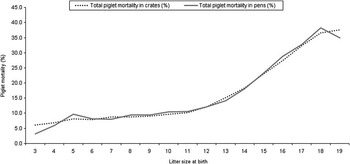
The multifactorial nature of piglet mortality means that the sow, her piglets and their environment represent a complex dynamic, all contributing to piglet survivability (Baxter et al., Reference Baxter, Jarvis, D'Eath, Ross, Robson, Farish, Nevison, Lawrence and Edwards2008). From the results presented here, the designed pens have one of the lowest total mortality percentages and it is most likely that designing the accommodation to recognise this dynamic is partly responsible for favourable production results. For example, maternal behaviour is a key survival factor, possibly the most important survival factor in loose-housed farrowing systems (Arey, Reference Arey1997), and designed pens provide an environment that incorporates stimuli that might improve the sow's interaction with her piglets (i.e. separate nesting sites, with solid flooring to accommodate nesting material). However, the group systems also provide these stimuli and such provision equates to high welfare design scores, but does not translate into acceptable production results, with piglet mortality still much higher than that reported in conventional crates. Potentially, there are other aspects of this system that might explain poor individual results and, when summarising data, there are issues regarding loss of information. By looking at the details of a study, it might be possible to pinpoint where a system has failed. For example factors known to influence mortality are breed (Canario et al., Reference Canario, Cantoni, Le Bihan, Caritez, Billon, Bidanel and Foulley2006), previous farrowing experience (i.e. parity; Jarvis et al., Reference Jarvis, Van der Vegt, Lawrence, Mclean, Deans, Chirnside and Calvert2001) and gestational environment (Marchant and Broom, Reference Marchant and Broom1993). In addition, a major factor known to contribute to production outcomes, such as survivability, is initial litter size; with increasing litter size, the probability of survival decreases (e.g. Roehe and Kalm, Reference Roehe and Kalm2000) and therefore imbalances in this parameter could influence the production figures reported for each system. To robustly assess the impact of a system on mortality, quality control data are needed, with systems being tested against each other under the same management conditions and with litter size being standardised. By extrapolating mortality to a standardised litter size for all systems, more information on performance could be attained, but again, this relies on good ‘real’ data initially to model the relationship between litter size and mortality in each system and such data are unavailable. At the very least, when trying to interpret the summarised data presented here, it is important to determine whether the relationship between mortality and litter size is the same across systems. Although to our knowledge such data have not been published, unpublished data from the comparative study by Weber et al. (Reference Weber, Keli, Fehr and Horat2007) have been made available (Figure 2 – Roland Weber, personal communication). Figure 2 demonstrates that the relationship between mortality and litter size is the same in both conventional crates and loose-housed farrowing pens, and by using this as a reference point, we might assume that this relationship exists in other alternative systems. Although the relationship is not linear, it suggests that over the most typical range of commercial litter sizes, total mortality increases by approximately 1.5 to 2 percentage points for each additional piglet born. It is, however, likely that this relationship will be considerably affected by the quality of management.
Effect of litter size on total mortality in conventional crated farrowing systems and loose-housed farrowing systems. Graph from unpublished data taken from a large-scale study by Weber et al. (Reference Weber, Keli, Fehr and Horat2007).

Where data on all variables that might influence mortality are provided in the studies, a thorough meta-analysis may help determine their relative influence within different systems. The exercise in this study was not intended to be a meta-analysis or a systematic review of the literature. Therefore, the quality of data provided for collation of information was not assessed (Cook et al., Reference Cook, Mulrow and Haynes1997) as it would have been, had a systematic review protocol been followed (Hirst et al., Reference Hirst, Le Fevre, Logue, Offer, Chaplin, Murray, Ward and French2002). A systematic review highlights areas that are well proven from the data provided and, in theory, could determine whether these summary data are truly representative of the ability of the systems reviewed. The collation of this material did not lend itself to a systematic review process because many sources of information were published in the ‘grey’ literature and, because information was being gathered on system characteristics not just production results, all papers were considered. As already indicated, the amount of information gathered to populate the database varied in quantity, detail and quality, making a traditional meta-analysis to examine the influence of other variates an untenable task.
Additional key factors influencing production performance that are not evaluated are the abilities of the stockperson and the behaviour of the individual animal. Indirectly, the WDI rewards systems that allow the stockpersons to carry out their job effectively. Such characteristics involve the ability to easily separate piglets from their mothers, which allows the performance of certain husbandry and health management procedures that will impact on productivity. However, good stockpersonship is more than this and should incorporate skills, experience, conscientiousness and empathy. In theory, a good stockperson could make any system productive and welfare-friendly within the physical constraints of that system. The group systems may fail to translate their high welfare design scores into good production performance because of the constraints these systems place on the ability of the stockperson to do their job. For example, because the highly complex nature of the Family Pen system (Stolba and Wood-Gush, Reference Stolba and Wood-Gush1984; Kerr et al., Reference Kerr, Wood-Gush, Moser and Whittemore1988) was based on the behaviour of animals under semi-natural environments, production performance should have been acceptable. In practice, piglet mortality and labour input and capital investment were unacceptably high (Kerr et al., Reference Kerr, Wood-Gush, Moser and Whittemore1988). The complexity and detail may serve to achieve improved maternal behaviour (e.g. correct farrowing location), but may be difficult for supervision by the stockperson and particularly difficult for cleaning and maintaining hygiene. The designed pens are built on a much smaller footprint than the group systems, with sows and litters kept separately, making control and management an easier task, potentially contributing to good production results. The other crucial factor contributing to production performance is maternal behaviour. The welfare design assessment assumes that if certain design criteria are met, such as cues related to farrowing location (e.g. enclosure) or substrate to satisfy nest-building behaviour, then maternal behaviour will be good. However, as referenced by other authors, the success of these cues is by no means absolute (Edwards, Reference Edwards1996) and maternal behaviour is subject to individual variation (Thodberg et al., Reference Thodberg, Jensen and Herskin2002) and is likely to have a genetic component (Grandinson et al., Reference Grandinson, Rydhmer, Strandberg and Thodberg2003). In small-scale studies, one problematic sow can easily negatively influence the production performance of a system that should, on paper, operate effectively. To a certain extent, confinement systems have the ability to minimise expression of this biological variability and poor stockpersonship and poor maternal behaviour may thus be less disastrous than in a loose-housed system. An alternative farrowing system needs to be robust to local circumstances and operate consistently for commercial uptake. This requires refinement of systems to ensure ease of management and operator safety and, unlike conventional systems, alternative systems lack a long history of trial and error to carry out these refinements and optimise working routines. In addition, further research into breeding for sows adapted to these conditions would most likely benefit performance. Genotype-by-environment interactions have been shown to influence piglet survival in loose farrowing systems (Baxter et al., Reference Baxter, Jarvis, Sherwood, Farish, Roehe, Lawrence and Edwards2011b) and further investigations are required to define strategies for successfully breeding for better mothering ability, including appropriate reactions to both piglets and stockpersons. In countries where farrowing crates have been banned for a number of years, production results are more favourable and consistent (Andersen et al., Reference Andersen, Tajet, Haukvik, Kongsrud and Boe2007; Weber et al., Reference Weber, Keil, Fehr and Horat2009) and it is likely that, because the sows have been farrowing in loose-housed accommodation for several years, they have been indirectly selected for maternal and behavioural traits that optimise performance in this system.
Financial performance
Only limited data were available to evaluate the economic viability of alternative systems, and yet, commercial uptake depends not only on welfare and production performance but also on financial feasibility. As a result of the scarcity of data, investment costs had to be calculated based on the physical characteristics of each system as determined by the summary data provided and by consultation. Calculations for the cost of running systems, in terms of labour (hours per sow per year), were even more scarce and could not be estimated for all systems. The designed pens offered some of the most comprehensive data sets (e.g. Schmid, FATs – Dun, Reference Dun1992; Weber, Reference Weber2000; Weber et al., Reference Weber, Keli, Fehr and Horat2007; Baumgartner, Reference Baumgartner2008; Werribee Farrowing Pen – Cronin et al., Reference Cronin, Lefebure and McClintock2000 and Reference Cronin2007) and demonstrated that well-thought-out engineering or ‘clever’ design could allow certain biological needs of the animals to be met without spiralling capital costs. For example, designed pens in this study cost approximately 17% more than conventional crates and, from the limited data available, had comparable labour requirements to conventional crates. These pens have costs for additional space and design complexity, but if this is offset by increased production performance in terms of piglet survival, weaning weight or sow rebreeding efficiency, then the capital investment should achieve an acceptable return rate. Certain systems could, in reality, require considerably less capital investment than a conventional crate and than the figures reported in this study. For example group systems such as the Swedish systems (Thorstensson and Ljungström) should be cheaper than installing a conventional crated system; crates themselves utilise more expensive components such as stainless steel, fully or partially slatted specialised flooring built above a slurry system, thus involving additional engineering and costs. In contrast, the Swedish systems could utilise an existing building, provide a microclimate with deep straw bedding, wooden nest-boxes and require solid manure removal only after each batch of farrowing. Although capital investment in group systems could be more economical than the present evaluation suggests, the cost of significant amounts of straw bedding and the high labour requirement suggest that these systems are likely to be financially untenable in many circumstances. Data on Thorstensson (Mattsson, Reference Mattsson1996), Ljungström (Goetz and Troxler, Reference Goetz and Troxler1995) and free access systems (Krieter, Reference Krieter2002) are limited to one study each and therefore require further investigation. Although not specified in all these studies, it is the additional manure handling that appears to incur the labour costs, a conclusion supported by researchers working in the Family Pen system (Kerr et al., Reference Kerr, Wood-Gush, Moser and Whittemore1988), where the labour requirements are the highest from all the reported data. However, it is worth noting that lactation length is longer in this system and therefore such labour data are non-comparable.
No attempt has been made in this review to actually weigh economics against welfare. The data are simply presented for the reader to make judgements about system performance, both biological and financial. There are techniques described in other fields, such as environmental management, that attempt to tackle complex problems requiring consideration of numerous factors to make a judgement, such as using Multiobjective Programming or Multiattribute decision-making techniques (Hung et al., Reference Hung, Yang, Ma and Yang2006). These methods attempt to combine both quantitative and qualitative factors to make decisions on optimal outcomes, such as site location or management strategies (Hung et al., Reference Hung, Yang, Ma and Yang2006). Such factors are evident regarding the present aim; the WDI data could be used in a multiattribute decision-making model if combined with accurate data regarding the economic performance of systems. Herein lies the crux of the problem: the availability of data. Accurate data on all economic aspects of systems are lacking and, as already described, the WDI required certain assumptions to be made. For a full economic evaluation, there needs to be more data on labour inputs, energy, bedding, veterinary and feed costs and maintenance requirements, and an effort to measure the capital depreciation of the system and thus predicted long-term costs. There may also be other, less apparent, costs that are unique to individual systems. For example, an outdoor system compared with an indoor system could require additional costs, such as predator control, that should be taken into account for complete evaluation. Even with these constraints, there have been recent attempts by colleagues to use optimisation modelling techniques in combination with animal welfare science to test possible trade-offs between profit and welfare within alternative farrowing systems (Vosough Ahmadi et al., Reference Vosough Ahmadi, Stott, Baxter, Lawrence and Edwards2011). Relationships or production functions between economic outputs (e.g. piglet survival) and welfare inputs (i.e. design criteria that could meet biological needs) were determined and these were used to model how increasing welfare inputs may influence economic outputs and vice versa. This study (Vosough Ahmadi et al., Reference Vosough Ahmadi, Stott, Baxter, Lawrence and Edwards2011) served to highlight the main issues arising at the biological–economic interface and possible steps that could be used to address them and provides a potential tool to use when and if more data become available.
Future-proofing systems
From the evaluation of the systems described in this review, assessments of welfare and economic performance can be performed. However, in addition, it is important that these systems are robust to potential ‘advances’ in the way pigs are produced and what the international market wants from their product. For example, consumer requirements include a product that is energy efficient, with low environmental impact, that considers animal welfare, but still at a low cost. The environmental implications of different systems therefore merit further detailed consideration. Genetic selection pressure on economically important traits, such as litter size, will increasingly challenge the sow, her offspring, the skills of the stockperson and the farrowing environment in the future. The current and most comprehensive report on loose-farrowing systems demonstrates success, particularly with respect to piglet survival (Weber et al., Reference Weber, Keli, Fehr and Horat2007). These authors report a respectable 13% live-born mortality rate in both crates and loose-housed systems from a sample size of 44 837 and 18 824 litters, respectively. However, the average number born alive in both systems was 11.0. Increasing genetic selection pressure on litter size has resulted in the average number born alive in some European countries reaching 14.00 (e.g. Denmark – Fowler, Reference Fowler2009), with the European average being 12.09 (range 11.12 in Italy to 14.00 in Denmark – Fowler, Reference Fowler2009). Litter size is a known risk factor in pre-weaning mortality (Baxter et al., Reference Baxter, Jarvis, D'Eath, Ross, Robson, Farish, Nevison, Lawrence and Edwards2008), with increased litter size increasing the heterogeneity of the litter and the number of low-viability animals born that require extra care and extra managerial input. Therefore, all farrowing systems must consider how best to facilitate ease of management, particularly the so far overlooked yet crucial issue of operator safety, while still respecting the biological needs of the animals.
Conclusion
From the evaluation of welfare and economic performance of systems described in this paper, the designed pen appears to offer the best indoor alternative to conventional farrowing crates. However, it is important to make efforts to refine these systems as there are still concerns, particularly regarding safety and ease of operation, and robustness to variability in maternal behaviour. Research into physical attributes of the systems that can facilitate the former and biological strategies (e.g. breeding for better maternal behaviour) to target the latter are important on-going objectives. In addition, to futureproof systems for a developing pig industry and uncertain market, additional research is needed to determine the environmental impact of certain systems and their economic feasibility in a national and international market place.
Acknowledgements
We wish to thank the Department for Environment, Food and Rural Affairs (Defra) of the United Kingdom for funding under project AW0143. We are grateful for the assistance of Mr Glyn Baker (Quality Equipment Ltd) for calculation of capital investment costs for alternative systems described in this review. We are grateful to Dr Roland Weber for providing data comparing the relationship between litter size and mortality in different systems.